





Treatment-resistant schizophrenia (TRS) affects approximately 20–30% of individuals with schizophrenia, and is associated with substantial impairment and healthcare utilisation. Reference Howes, McCutcheon, Agid, De Bartolomeis, Van Beveren and Birnbaum1 A recent meta-analysis of first-episode cohorts estimated the prevalence of TRS at 22.8%. Reference Siskind, Orr, Sinha, Yu, Brijball and Warren2 Clozapine remains the only antipsychotic with established superior efficacy for TRS. 3,Reference Taylor, Barnes and Young4 The landmark trial by Kane et al demonstrated that 30% of treatment-resistant patients responded to clozapine compared with only 4% on chlorpromazine, Reference Kane5 with subsequent meta-analyses confirming response rates of 30–60% and a number needed to treat of 9 compared with other antipsychotics. 3,Reference Siskind, McCartney, Goldschlager and Kisely6 International treatment guidelines consistently recommend clozapine initiation within 3 months of establishing treatment resistance, reflecting evidence that earlier initiation is associated with better clinical outcomes. Reference McCutcheon, Pillinger, Varvari, Halstead, Ayinde and Crossley7
Despite this evidence, clozapine remains substantially underutilised worldwide. Studies from high-income countries report that only 5–20% of patients with TRS receive clozapine, with marked international variation. A recent analysis of 75 countries estimated a 2024 global average of 0.46 defined daily doses per 1000 inhabitants per day, ranging from 2.99 in New Zealand and 2.61 in Finland to 0.0007 in Singapore; utilisation rose significantly in 60% of countries over the preceding decade, yet showed no association with the stringency of haematological monitoring. Reference Fitzgerald, O’Dwyer, Dhubhlaing, Gee, Sahm and Wheeler8 Among those who do initiate treatment, delays from TRS recognition to clozapine prescription frequently exceed guideline recommendations. A UK study by Howes et al found that only 24% of patients received guideline-concordant treatment before clozapine initiation, with mean delays of approximately 4 years from treatment resistance to clozapine prescription. Reference Howes, Vergunst, Gee, McGuire, Kapur and Taylor9 More recent evidence from Australia suggests some improvement, with Thien et al reporting median delays of approximately 12 months in an early intervention cohort, although substantial gaps persist. Reference Thien, Bowtell, Eaton, Bardell-Williams, Downey and Ratheesh10
The consequences of clozapine underutilisation and delayed initiation are significant. Patients with untreated TRS experience persistent symptoms, repeated hospital admissions and progressive functional decline. Tiihonen et al demonstrated that clozapine was associated with substantially lower psychiatric hospital admission rates. Reference Tiihonen, Taipale, Mehtälä, Vattulainen, Correll and Tanskanen11 Beyond symptom control, clozapine is associated with the lowest all-cause mortality of any antipsychotic in nationwide cohort data (adjusted hazard ratio 0.39), including substantially lower suicide-specific mortality (adjusted hazard ratio 0.21). Reference Taipale, Tanskanen, Mehtälä, Vattulainen, Correll and Tiihonen12 Delays in clozapine initiation are associated with poorer treatment response and outcomes, underscoring the importance of timely intervention. Reference Hatano, Kamei, Takeuchi, Gomi, Sakakibara and Hotta13
Multiple barriers to clozapine initiation have been identified in systematic reviews, including mandatory haematological monitoring requirements, concerns about adverse effects, prescriber unfamiliarity with clozapine management and healthcare system factors such as service fragmentation and limited access to specialist services. Reference Al-Huseini, Qutishat, Khan and Ahmed14 Prescriber attitudes, including overestimation of risks and inadequate training or experience, contribute substantially to underutilisation. Reference Farooq, Choudry, Cohen, Naeem and Ayub15 Patient-level factors, including comorbid substance use, medical comorbidities and sociodemographic characteristics, may further influence prescribing decisions. Reference Farooq, Choudry, Cohen, Naeem and Ayub15 However, the relative contribution of these factors varies across healthcare settings, and quantitative data from the Middle East and North Africa examining clozapine initiation rates by using operationalised TRS criteria remain limited. Reference Al-Huseini, Qutishat, Khan and Ahmed14
The United Arab Emirates (UAE) presents a unique context for examining clozapine prescribing patterns. The country has a diverse population comprising UAE nationals and expatriates, potentially introducing cultural and systemic factors influencing treatment decisions. Mental health services have undergone substantial expansion in recent years, yet data on clozapine utilisation and barriers to optimal prescribing in this setting are lacking. Although qualitative studies have explored clozapine prescribing practices across Arabian Gulf countries Reference Al-Huseini, Qutishat, Khan and Ahmed14 and surveys have examined psychiatrist attitudes in the Middle East and North Africa, no large-scale quantitative study has systematically examined clozapine initiation rates and predictors in the UAE, using operationalised TRS criteria.
This study aimed to characterise clozapine initiation patterns in a large cohort of patients with TRS in the UAE. Specifically, we sought to: (a) determine the proportion of patients with TRS who initiate clozapine, (b) examine the time from TRS eligibility to clozapine initiation and rates of guideline concordance, (c) identify patient-level factors associated with clozapine initiation and (d) examine clinical consequences of delayed initiation.
Method
Study design and setting
This retrospective cohort study used electronic health records from Al Amal Psychiatric Hospital, the principal tertiary psychiatric facility serving Dubai and the Northern Emirates. The study period ranged from 1 January 2018 to 22 December 2025. This study was approved by the Ministry of Health and Prevention Research Ethics Committee, UAE (reference: MOHAP/DXB-REC/M.J.J/No.91/2024), and the requirement for informed consent was waived because of the retrospective nature of the analysis.
Al Amal Psychiatric Hospital is the sole government tertiary psychiatric facility in the UAE; care is state-funded and medications are dispensed without direct patient cost. Out-patient psychiatric care is delivered by consultant and specialist psychiatrists and supervised psychiatry residents. Clinical psychologists and family medicine physicians contribute to multidisciplinary care, and the department is led by a consultant psychiatrist. The electronic health record captures encounters across all care settings, including in-patient, out-patient, emergency, day care, home care and telehealth contacts, and prescription and dispensing records were drawn from all of these. As a single tertiary psychiatric centre, the records do not capture antipsychotics dispensed by external or private providers.
Study population
Adult patients (aged ≥18 years) who received at least one antipsychotic prescription during the study period were identified from pharmacy dispensing records. Patients were required to have at least one encounter with a diagnosis of schizophrenia spectrum disorder (ICD-10 codes F20–F29) recorded in the electronic health record.
Definition of TRS
TRS was operationally defined as failure to respond to at least two adequate antipsychotic trials, consistent with international consensus criteria. Reference Howes, McCutcheon, Agid, De Bartolomeis, Van Beveren and Birnbaum1 An adequate trial was defined as continuous treatment with a distinct non-clozapine antipsychotic for at least 6 weeks, at a drug-specific therapeutic dose. Continuous treatment episodes were constructed from prescription records by merging consecutive prescriptions of the same agent separated by no more than 60 days, with a longer gap treated as the end of the episode. Drug-specific dose thresholds were derived from defined daily dose equivalents using the method of Leucht and colleagues, in which the dose equivalent to 100 mg chlorpromazine equals a third of each drug’s World Health Organization defined daily dose. Reference Leucht, Samara, Heres and Davis16 A trial was considered dose-adequate when the modal daily dose reached at least half of the drug’s defined daily dose, corresponding to 150 mg chlorpromazine-equivalents per day. This minimum-effective-dose threshold was adopted in preference to the higher 600 mg chlorpromazine-equivalent criterion proposed in some consensus definitions, because observed prescribing in this cohort clustered between 0.8 and 1.0 defined daily doses and a 600 mg threshold would have misclassified routinely and adequately dosed trials as inadequate. The per-drug thresholds and observed doses are reported in Supplementary Table 1 available at https://doi.org/10.1192/bjo.2026.12099. Long-acting injectable maintenance formulations were treated as dose-adequate by formulation. Daily dose was ascertained from prescription and administration records across all care settings.
This 6-week threshold is consistent with consensus criteria for an adequate antipsychotic trial. Reference Howes, McCutcheon, Agid, De Bartolomeis, Van Beveren and Birnbaum1,Reference Kane, Agid, Baldwin, Howes, Lindenmayer and Marder17 A shorter, 4-week threshold, reflecting real-world practice where medications are frequently changed earlier owing to clear non-response, intolerability or clinical deterioration, Reference Remington, Addington, Honer, Ismail, Raedler and Teehan18 was additionally examined in sensitivity analyses (Supplementary Table 2).
Importantly, sensitivity analyses applying a stricter definition (three or more adequate trials) yielded qualitatively consistent findings, supporting the robustness of the primary results. The treatment-resistance eligibility date, the point from which delay to clozapine was measured, was defined as the date a patient had completed two distinct sequential adequate trials, operationalised as the start date of the second adequate trial plus its minimum adequate duration. Trials were required to involve distinct antipsychotic agents; re-initiation of a previously used agent after a treatment gap was not counted as an additional trial. Sensitivity analyses applied alternative definitions, including a 4-week minimum trial duration and a stricter requirement of three or more adequate trials, to assess the robustness of the treatment-resistance estimate (Supplementary Table 2).
Outcomes
The primary outcome was clozapine initiation, ascertained from pharmacy prescription records. Secondary outcomes included time from TRS eligibility to clozapine initiation (calculated in months) and guideline concordance, defined as clozapine initiation within 3 months of TRS eligibility; this threshold reflects recent international consensus recommendations for prompt clozapine initiation following establishment of treatment resistance. Reference McCutcheon, Pillinger, Varvari, Halstead, Ayinde and Crossley7 The ≤3-month threshold was retained as the primary guideline-concordance dichotomy, whereas the 3- to 12-, 12- to 24- and >24-month categories were used descriptively to distinguish moderate, late and very late initiation among patients exceeding the guideline window. Secondary outcomes also included psychiatric hospital admissions and emergency department visits during the observation period.
Covariates
Demographic variables included age, gender, marital status and nationality (UAE national versus expatriate). Clinical variables included recorded diagnostic codes for substance use disorders, depression, bipolar disorder and anxiety disorders. Treatment history variables included the number of adequate antipsychotic trials, number of distinct antipsychotics prescribed and prior use of long-acting injectable antipsychotics. Concomitant psychotropic medications, including antidepressants, benzodiazepines and mood stabilisers, were also recorded.
Statistical analysis
Descriptive statistics were presented as means with standard deviations for continuous variables, and frequencies with percentages for categorical variables. Normality was assessed visually using histograms; delay duration exhibited marked right skew and was summarised using median and interquartile range (IQR). Clozapine initiation rates were calculated with 95% confidence intervals, using the Wilson score method for proportions; exact binomial confidence intervals were used for subgroups with small sample sizes.
Group comparisons used chi-squared tests for categorical variables, with Fisher’s exact test substituted when expected cell counts were below 5. Cramér’s V was used to quantify effect sizes for categorical associations. Mann–Whitney U-tests were used to compare continuous variables between groups. Spearman rank correlations were used to assess monotonic relationships between ordinal variables. Analyses were structured around the four study objectives. The proportion of treatment-resistant patients initiating clozapine was estimated with 95% Wilson confidence intervals. Time from eligibility to initiation was analysed with Kaplan–Meier methods, with patients censored at their last recorded encounter or the data extraction date of 22 December 2025, whichever was earlier; guideline concordance was defined as initiation within 3 months of eligibility. Predictors of initiation were examined with logistic regression (adjusted odds ratios with 95% confidence intervals) and, as a time-to-event sensitivity, Cox proportional-hazards regression (hazard ratios); candidate predictors were age, gender, number of adequate trials and prior long-acting injectable exposure. The association between initiation delay and psychiatric hospital admission was examined among delayed initiators, using a Poisson regression model with a person-time offset and robust (Huber–White) standard errors to accommodate overdispersion, expressed as incidence rate ratios; a propensity-score-weighted analysis comparing guideline-concordant with delayed initiation, was conducted as an exploratory secondary analysis. Patients with missing data for specific variables were excluded from analyses involving those variables (complete-case analysis). Statistical significance was set at p < 0.05 (two-tailed). Given the exploratory nature of subgroup analyses, no adjustment for multiple comparisons was applied; these results should be interpreted cautiously. Analyses were performed with Python 3.13.5 on macOS (Python Software Foundation, Beaverton, Oregon, USA; https://www.python.org/), with pandas 2.2.3 (pandas development team; https://pandas.pydata.org/), lifelines version 0.30.0 (Cameron Davidson-Pilon and contributors; https://lifelines.readthedocs.io/), statsmodels version 0.14.4 (statsmodels development team; https://www.statsmodels.org/) and scikit-learn version 1.6.1 (scikit-learn development team; https://scikit-learn.org/).
Results
Patient selection and baseline characteristics
Between 1 January 2018 and 22 December 2025, 6256 adult patients with a schizophrenia spectrum diagnosis were prescribed at least 1 antipsychotic. Of these, 1738 (27.8%) met treatment-resistance criteria. Among treatment-resistant patients, 129 (7.4%; 95% CI 6.3–8.8%) received clozapine (Fig. 1).
Patient flow through the study. The treatment-resistant cohort comprises patients with two or more distinct sequential adequate antipsychotic trials. Early initiators (n = 53) received clozapine before completing the second adequate trial, reflecting clinical recognition of treatment resistance preceding the formal two-trial threshold; they are excluded from delay calculations, but retained in the initiation rate. Delayed initiators (n = 76) had a measurable interval from eligibility to initiation, on which the median delay and guideline-concordance figures are based. IQR, interquartile range.

Fig. 1 Long description
The flowchart begins with 6256 patients diagnosed with schizophrenia spectrum and treated with one or more antipsychotics between 2018 and 2025. These patients are assessed for treatment resistance, defined as two or more distinct sequential adequate trials. Of these, 4518 patients (72.2%) are not treatment-resistant. The remaining 1738 patients (27.8%) form the treatment-resistant cohort. Within this cohort, 129 patients (7.4%) initiate clozapine treatment, while 1609 patients (92.6%) do not. The clozapine initiators are further divided into early initiators (53 patients) who start before completing the second adequate trial, and delayed initiators (76 patients) who have a measurable delay from eligibility to initiation. The median delay for clozapine initiation among delayed initiators is 13.2 months (IQR 2.2–32.5). Among delayed initiators, 20 patients (26.3%) start clozapine within 3 months, concordant with guidelines, while 56 patients (73.7%) start later than 3 months.
Missing data were minimal for core clinical and diagnostic variables (<1%; 27 of 6256 patients, 0.4%). Sociodemographic variables not routinely captured in the electronic health record had higher missingness, including education level (43.6%), employment status (30.3%) and marital status (30.2%). Within the TRS subgroup (n = 1738), missingness was <2% for all clinical variables used in the analysis.
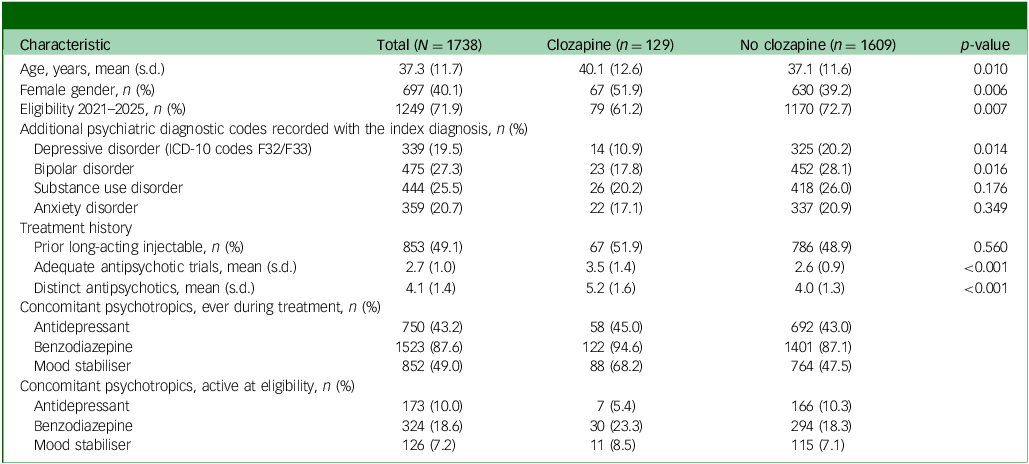
The TRS cohort had a mean age of 37.3 years (s.d. 11.7), was predominantly male (59.9%) and had high rates of prior long-acting injectable use (49.1%) and benzodiazepine prescription (87.6%). Clozapine initiators differed from non-initiators in several respects: they were more likely to be female (51.9 v. 39.2%; p = 0.006), older (mean 40.1 v. 37.1 years; p = 0.010), had more adequate antipsychotic trials (3.5 v. 2.6; p < 0.001) and were less likely to have a recorded depression or bipolar diagnostic code (Table 1). The antipsychotic agents prescribed across the cohort and the distribution of clozapine doses are shown in Supplementary Figs 1 and 2.
Baseline characteristics of the treatment-resistant cohort by clozapine status (N = 1738)

Table 1 Long description
A table comparing baseline characteristics of a treatment-resistant cohort by clozapine status. The table has 17 rows and 5 columns. Column headers are Characteristic, Total (N = 1738), Clozapine (n = 129), No clozapine (n = 1609), and p-value. Row 1: Age, years, mean (s.d.), 37.3 (11.7), 40.1 (12.6), 37.1 (11.6), 0.010. Row 2: Female gender, n (%), 697 (40.1), 67 (51.9), 630 (39.2), 0.006. Row 3: Eligibility 2021-2025, n (%), 1249 (71.9), 79 (61.2), 1170 (72.7), 0.007. Row 4: Depressive disorder (ICD-10 codes F32/F33), n (%), 339 (19.5), 14 (10.9), 325 (20.2), 0.014. Row 5: Bipolar disorder, n (%), 475 (27.3), 23 (17.8), 452 (28.1), 0.016. Row 6: Substance use disorder, n (%), 444 (25.5), 26 (20.2), 418 (26.0), 0.176. Row 7: Anxiety disorder, n (%), 359 (20.7), 22 (17.1), 337 (20.9), 0.349. Row 8: Prior long-acting injectable, n (%), 853 (49.1), 67 (51.9), 786 (48.9), 0.560. Row 9: Adequate antipsychotic trials, mean (s.d.), 2.7 (1.0), 3.5 (1.4), 2.6 (0.9), <0.001. Row 10: Distinct antipsychotics, mean (s.d.), 4.1 (1.4), 5.2 (1.6), 4.0 (1.3), <0.001. Row 11: Concomitant psychotropics, ever during treatment, n (%), 750 (43.2), 58 (45.0), 692 (43.0). Row 12: Antidepressant, n (%), 1523 (87.6), 122 (94.6), 1401 (87.1). Row 13: Benzodiazepine, n (%), 852 (49.0), 88 (68.2), 764 (47.5). Row 14: Concomitant psychotropics, active at eligibility, n (%), 173 (10.0), 7 (5.4), 166 (10.3). Row 15: Antidepressant, n (%), 324 (18.6), 30 (23.3), 294 (18.3). Row 16: Benzodiazepine, n (%), 126 (7.2), 11 (8.5), 115 (7.1).
Values are n (%) unless otherwise indicated. Additional diagnostic codes are affective or substance-related disorders recorded alongside the schizophrenia spectrum index diagnosis and are not mutually exclusive; these codes may reflect historical, differential or administrative diagnostic coding rather than concurrent syndromal comorbidity. Concomitant psychotropic exposure is shown both as any use during the observation period and as exposure active on the eligibility date. p-values are from the Mann–Whitney U-test (continuous variables) or the chi-squared or Fisher exact test (categorical variables).
Clozapine initiation rates
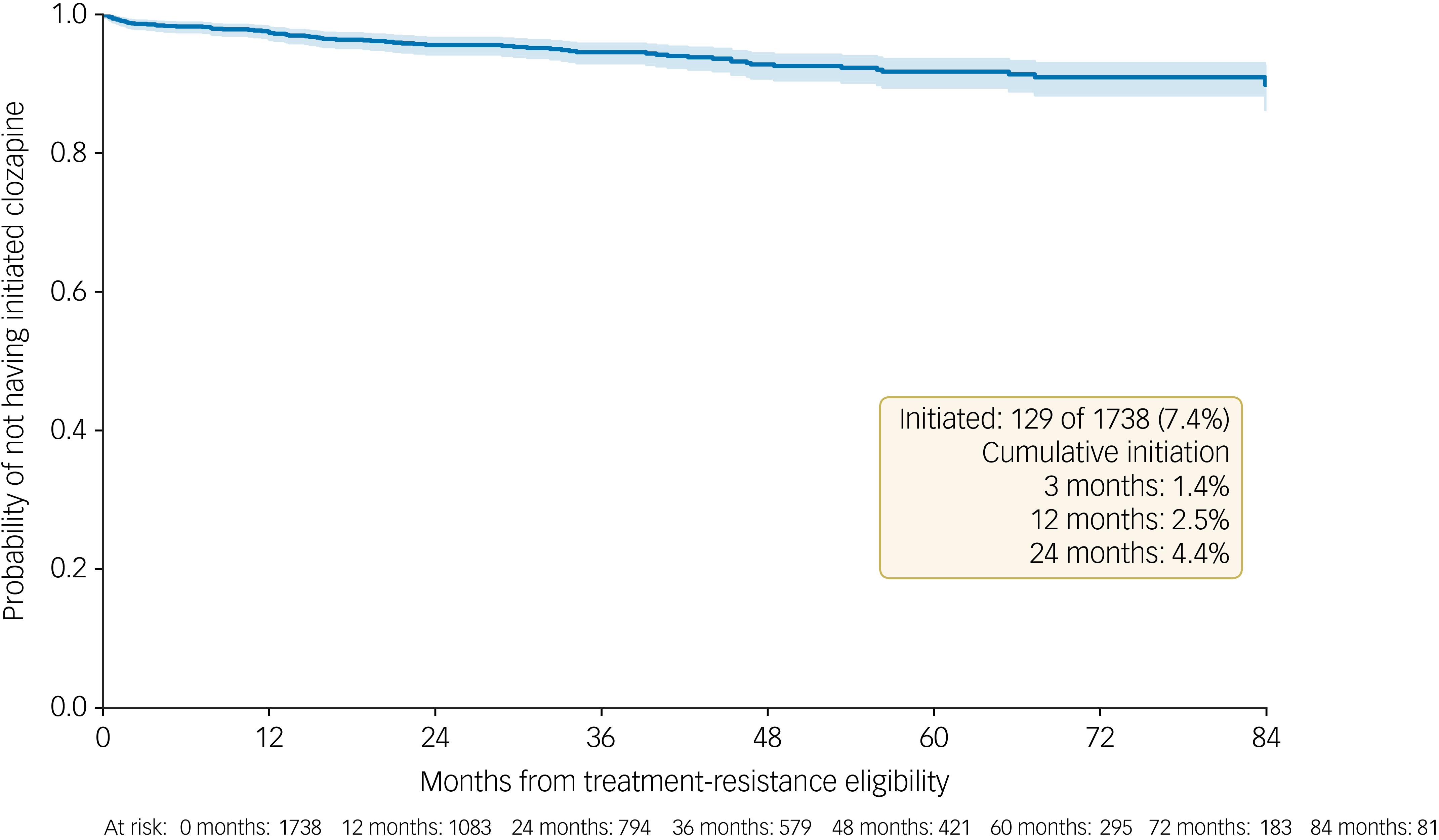
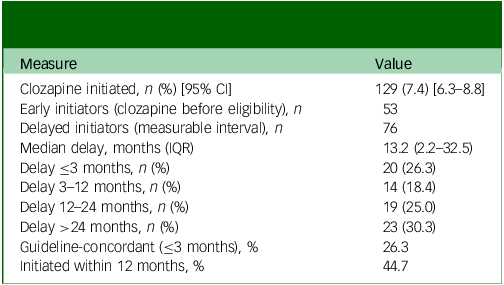
The overall clozapine initiation rate of 7.4% (95% CI 6.3–8.8%) indicates substantial underutilisation. Female patients had significantly higher initiation rates than males (9.6 v. 6.0%; χ 2 = 7.60; p = 0.006; Cramér’s V = 0.066). Patients with and without prior long-acting injectable use had similar rates (7.9 v. 7.0%; p = 0.56). Kaplan–Meier analysis showed cumulative initiation of approximately 10% at 7 years of follow-up, with most initiations occurring within the first 4 years (Table 2, Fig. 2).
Time to clozapine initiation among treatment-resistant patients. Kaplan–Meier estimate; time zero is the treatment-resistance eligibility date and the event is clozapine initiation. Patients were censored at the last recorded encounter or the data extraction date (22 December 2025), whichever was earlier. The 53 early initiators are retained and censored, so the curve reflects the 76 initiations occurring after eligibility, whereas the annotation reports the 129 patients ever initiated. The shaded band is the 95% confidence interval. The at-risk count is shown below the horizontal axis.

Clozapine initiation, time to initiation and guideline concordance among treatment-resistant patients

Table 2 Long description
A table summarizing clozapine initiation metrics and delays among treatment-resistant patients. The table has 10 rows and 2 columns. The columns are labeled Measure and Value. Row 1: Clozapine initiated, n (%) [95% CI], 129 (7.4) [6.3-8.8]. Row 2: Early initiators (clozapine before eligibility), n, 53. Row 3: Delayed initiators (measurable interval), n, 76. Row 4: Median delay, months (IQR), 13.2 (2.2-32.5). Row 5: Delay <=3 months, n (%), 20 (26.3). Row 6: Delay 3-12 months, n (%), 14 (18.4). Row 7: Delay 12-24 months, n (%), 19 (25.0). Row 8: Delay >24 months, n (%), 23 (30.3). Row 9: Guideline-concordant (<=3 months), %, 26.3. Row 10: Initiated within 12 months, %, 44.7.
The initiation-rate denominator is the full treatment-resistant cohort (N = 1738); the 95% confidence interval is the Wilson interval. Delay statistics are restricted to the 76 delayed initiators with a measurable interval from eligibility. The 53 early initiators, who received clozapine before completing the second adequate trial, are excluded from delay calculations but retained in the initiation rate. IQR, interquartile range.
Nationality data were available for all 1738 patients. Initiation rates were comparable among expatriates and UAE nationals (7.7 v. 7.1%; p = 0.72). Subgroup analysis showed modest heterogeneity, with rates ranging from 9.1% among South Asian patients and 8.4% among patients from the Middle East and North Africa, to 2.9% among Sub-Saharan African patients; the difference across groups was not significant (p = 0.30) (Supplementary Table 3, Supplementary Fig. 3).
Time to clozapine initiation
Of the 129 clozapine initiators, 53 (41.1%) initiated before their formal TRS eligibility date. This phenomenon has been described in other pharmacoepidemiological studies. Reference John, Ko and Dominic19 As these patients did not experience a measurable delay interval, they were excluded from delay analyses, but retained in overall initiation rate estimates.
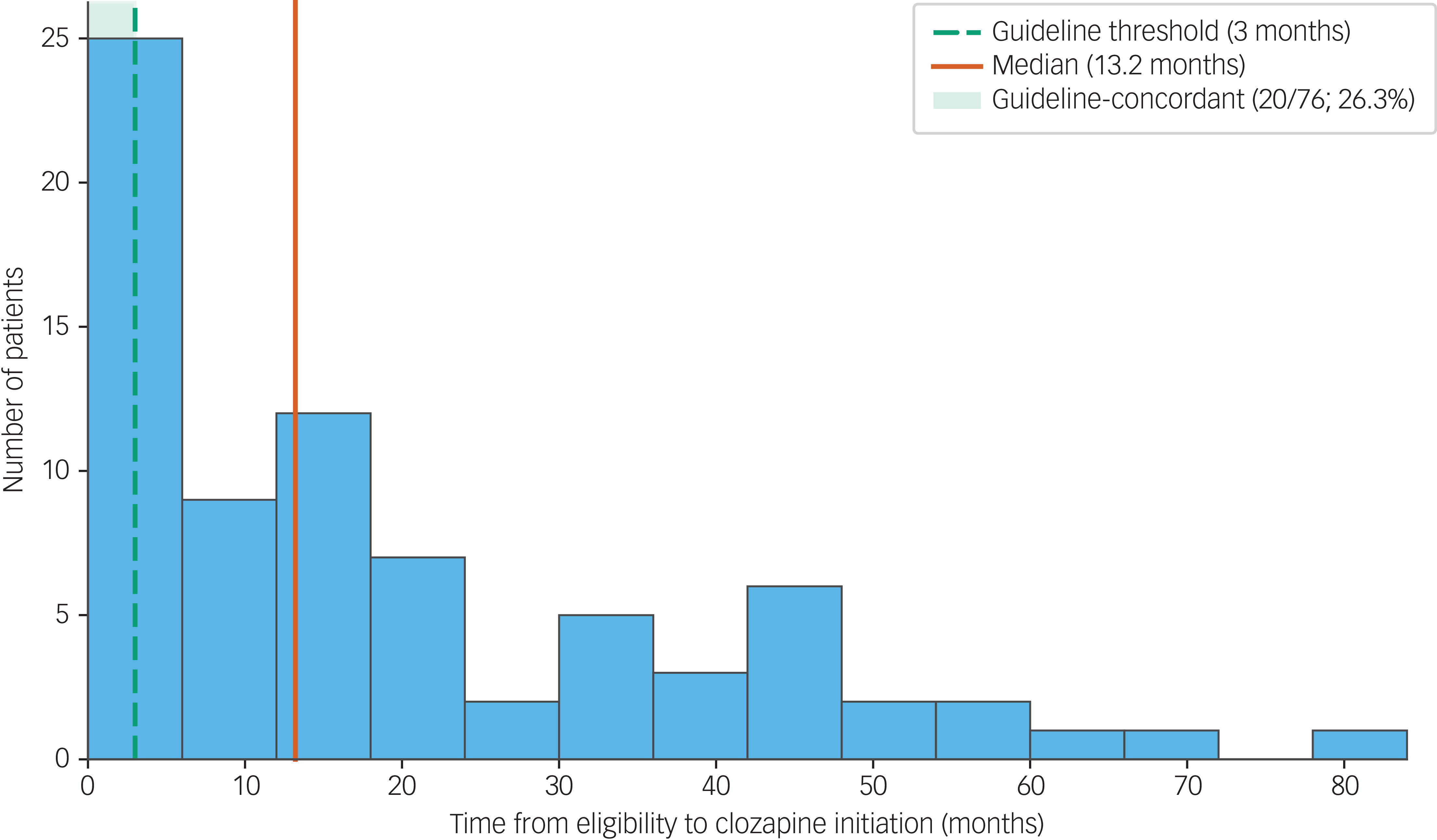
Among delayed initiators, median delay was 13.2 months (IQR 2.2–32.5). The distribution was markedly right-skewed, with nearly a third (30.3%) experiencing delays exceeding 24 months (Fig. 3). Only 20 patients (26.3%) achieved guideline-concordant initiation within 3 months of TRS eligibility; fewer than half (44.7%) initiated within 12 months (Table 2). Among these delayed initiators, each additional adequate antipsychotic trial was associated with a longer delay to clozapine initiation (log-linear regression: +63.7% per trial; 95% CI 28.5–108.4%; p < 0.001).
Distribution of time from eligibility to clozapine initiation. Restricted to the 76 delayed initiators with a measurable interval from eligibility. Bars are 6-month bins. The dashed line marks the 3-month guideline threshold and the shaded region the guideline-concordant interval; the solid line marks the median delay of 13.2 months. Twenty patients (26.3%) initiated clozapine within 3 months.

Predictors of clozapine initiation
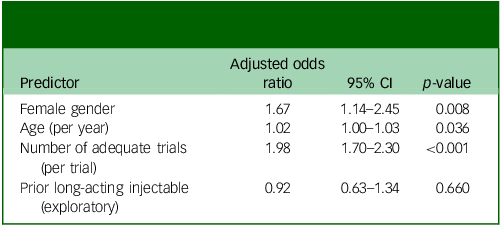
In the multivariable logistic model, three factors independently predicted clozapine initiation (Table 3): the number of adequate antipsychotic trials (adjusted odds ratio 1.98 per additional trial, 95% CI 1.70–2.30; p < 0.001), female gender (adjusted odds ratio 1.67, 95% CI 1.14–2.45; p = 0.008) and older age (adjusted odds ratio 1.02 per year, 95% CI 1.00–1.03; p = 0.036). Prior long-acting injectable exposure was not an independent predictor (adjusted odds ratio 0.92, 95% CI 0.63–1.34; p = 0.66) and is reported as exploratory. A Cox proportional-hazards model gave concordant results (Supplementary Table 4), and Kaplan–Meier curves stratified by these factors are shown in Fig. 4.
Time to clozapine initiation by subgroup. Kaplan–Meier estimates by (a) gender, (b) eligibility era, (c) age group and (d) number of adequate antipsychotic trials. Time zero, event and censoring are as defined for Fig. 2; p-values are from the log-rank test, which indicated associations for the number of adequate trials (d) and gender (a), but not for eligibility era (b) or age group (c); adjusted estimates are reported in Table 3.

Predictors of clozapine initiation: multivariable logistic regression (N = 1738)

Table 3 Long description
A table titled ‘Predictors of clozapine initiation: multivariable logistic regression (N = 1738)’ with five rows and four columns. The columns are labeled ‘Predictor’, ‘Adjusted OR’, ‘95% CI’, and ‘p’. The rows list the predictors and their corresponding values. Row 1: Female sex, Adjusted OR 1.67, 95% CI 1.14, 2.45, p 0.008. Row 2: Age (per year), Adjusted OR 1.02, 95% CI 1.00, 1.03, p 0.036. Row 3: Number of adequate trials (per trial), Adjusted OR 1.98, 95% CI 1.70, 2.30, p <0.001. Row 4: Prior long-acting injectable (exploratory), Adjusted OR 0.92, 95% CI 0.63, 1.34, p 0.660.
Adjusted odds ratios are from a single multivariable logistic regression with all four predictors entered simultaneously. Prior long-acting injectable exposure is reported as an exploratory predictor. A Cox proportional-hazards sensitivity analysis is provided in Supplementary Table 4.
A clear dose–response relationship was observed between the number of adequate trials and initiation probability (Supplementary Table 5). Initiation rates increased from 4.3% among patients with two adequate trials to 43.8% among those with six or more (Spearman’s ρ = 1.00). Among initiators, a third (32.6%) received clozapine after exactly two trials; the majority (67.4%) required three or more.
Clinical outcomes by initiation delay
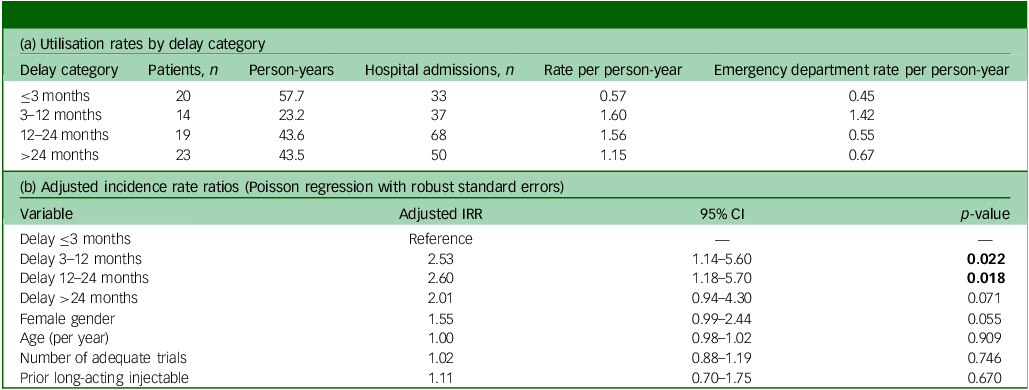
Among the 76 delayed initiators, clinical utilisation outcomes were examined with rate-based analysis (Table 4). Total post-initiation follow-up was 168.0 person-years. Hospital admission rates per person-year rose from 0.57 among those initiating within 3 months to a peak of 1.60 among those with 3- to 12-month delays, remained similarly elevated at 1.56 among those with 12- to 24-month delays and declined to 1.15 among those with delays exceeding 24 months.
Psychiatric hospital admission by clozapine initiation delay among delayed initiators (n = 76)

Table 4 Long description
The table is divided into two main sections: (A) Utilisation rates by delay category and (B) Adjusted incidence rate ratios. Section A includes columns for delay category, number of patients, person-years, hospital admissions, rate per person-year, and emergency department rate per person-year. It lists four delay categories: less than 3 months, 3-12 months, 12-24 months, and more than 24 months. Section B includes columns for variable, adjusted incidence rate ratios (IRR), 95% confidence interval (CI), and p-value. Notable trends include higher hospital admission rates for delays of 3-12 months and 12-24 months compared to delays of less than 3 months. The adjusted IRR for delays of 3-12 months and 12-24 months are significantly higher than the reference category of less than 3 months.
(a) Crude utilisation rates; hospital admission and emergency department counts and person-years are both measured over the post-initiation window, from the clozapine start date to the last recorded encounter or the data extraction date (22 December 2025), whichever was earlier. (b) Incidence rate ratios from a Poisson model with a log person-time offset and robust (Huber–White) standard errors, mutually adjusted for all listed terms. The delay–hospital admission association was robust to adjustment; prior long-acting injectable exposure was not associated with hospital admission. An exploratory propensity-score-weighted comparison of guideline-concordant with delayed initiation gave β = −2.57 (p = 0.12) and is underpowered. Bold indicates statistical significance (p < 0.05). IRR, incidence rate ratio.
In a Poisson model with robust standard errors, adjusted for gender, age, number of adequate trials and prior long-acting injectable exposure, patients with 12- to 24-month delays had significantly higher hospital admission rates than those initiating within 3 months (adjusted incidence rate ratio 2.60, 95% CI 1.18–5.70; p = 0.018) (Table 4). Prior long-acting injectable exposure was not associated with hospital admission (adjusted incidence rate ratio 1.11, 95% CI 0.70–1.75; p = 0.67). In an exploratory propensity-score-weighted analysis, guideline-concordant initiation was associated with a lower hospital admission burden, although this did not reach significance (β = −2.57; p = 0.12); covariate balance after weighting is shown in Supplementary Fig. 4. Haematological monitoring and clozapine-dose data were available for all clozapine-treated patients in the source records, a larger group than the 129 treatment-resistant initiators because clozapine was also prescribed to patients who did not meet the full treatment-resistance criteria. Among 168 monitored patients, a median of 11 full blood counts were recorded (median 18.4 per year); the median baseline absolute neutrophil count was 4.70 × 10⁹/L and the median nadir was 3.08 × 10⁹/L, with 5 patients (3.0%) recording a value below 1.5 × 10⁹/L (Supplementary Table 6, Supplementary Fig. 5). The median duration of clozapine treatment among all initiators was 10.8 months, and monitoring intensity was not associated with treatment duration, indicating that monitoring frequency reflects engagement rather than predicting maintenance (Supplementary Table S7 and Supplementary Fig. S6).
Sensitivity analyses
Several sensitivity analyses assessed the robustness of the findings (Supplementary Table 2). Requiring 3 or more adequate trials identified 760 treatment-resistant patients (12.1% of the cohort), of whom 87 (11.4%) initiated clozapine, reflecting higher clozapine use among patients with more documented treatment failures. Relaxing the trial-duration requirement to 4 weeks identified 2206 patients (35.3%), of whom 144 (6.5%) initiated. Varying the dose-adequacy threshold from 150 to 600 mg chlorpromazine-equivalents per day yielded initiation rates between 7.4 and 14.1%. Across every definition the initiation rate remained below 15% and the median delay between 12.0 and 14.6 months (Supplementary Table 2), confirming the robustness of the primary findings.
Discussion
Principal findings
This study provides the first large-scale quantitative data on clozapine initiation patterns using operationalised TRS criteria in the UAE. The 7.4% initiation rate is consistent with international reports of clozapine underutilisation, with around 10% in Danish national registers. Reference Nielsen, Røge, Schjerning, Sørensen and Taylor20 The median delay of 13.2 months exceeds guideline recommendations, but is substantially shorter than the 4-year delays historically reported in the UK Reference Howes, Vergunst, Gee, McGuire, Kapur and Taylor9 and comparable to 12-month delays in Australian early intervention cohorts. Reference Thien, Bowtell, Eaton, Bardell-Williams, Downey and Ratheesh10 Our concordance rate of 26.3% mirrors the 28% reported in New Zealand, Reference Wheeler21 suggesting UAE practice is comparable to other healthcare systems.
Interpretation in relation to guidelines
International guidance converges on prompt clozapine initiation once TRS is established. The International Guidelines for the Algorithmic Treatment of Schizophrenia guidelines recommend clozapine as early as 12 weeks after two unsuccessful trials, Reference McCutcheon, Pillinger, Varvari, Halstead, Ayinde and Crossley7 aligning with National Institute for Health and Care Excellence guidance and other major guideline standards. Reference Howes, McCutcheon, Agid, De Bartolomeis, Van Beveren and Birnbaum1,3,Reference McCutcheon, Pillinger, Varvari, Halstead, Ayinde and Crossley7,Reference Remington, Addington, Honer, Ismail, Raedler and Teehan18 Against this benchmark, most eligible patients in our cohort did not receive guideline-recommended treatment. It is important to acknowledge scientific nuance: a recent individual-participant data meta-analysis highlighted heterogeneity in randomised controlled trial evidence comparing clozapine with other second-generation antipsychotics. Reference Schneider-Thoma, Hamza, Chalkou, Siafis, Dong and Bighelli22 Nevertheless, long-term observational studies consistently demonstrate clozapine’s superior effectiveness for mortality, hospital admission and suicide prevention. Reference Taipale, Tanskanen, Mehtälä, Vattulainen, Correll and Tiihonen12,Reference Hatano, Kamei, Takeuchi, Gomi, Sakakibara and Hotta13
Predictors and consequences of delayed initiation
A key contribution is the clear demonstration that clozapine is systematically positioned late in care pathways. Reference Jakobsen, Schaug, Storebø, Austin, Nielsen and Simonsen23 Three converging findings support this conclusion. First, there was a strong dose–response relationship between number of prior antipsychotic trials and clozapine initiation probability (Spearman’s ρ = 1.00), with rates increasing from 4.3% among patients with two trials to 43.8% among those with six or more trials, and each additional adequate trial nearly doubling the odds of initiation (adjusted odds ratio 1.98, 95% CI 1.70–2.30; p < 0.001). Second, only a third of initiators received clozapine after exactly two failed trials as guidelines recommend; the majority (67.4%) required three or more, representing months of potentially avoidable ineffective treatment. Third, among delayed initiators, each additional adequate trial was associated with a longer delay to clozapine (+63.7% per trial; p < 0.001). This pattern of repeated switching, dose optimisation, augmentation and polypharmacy before clozapine consideration aligns with international literature describing ‘clozapine hesitation’. Reference Howes, Vergunst, Gee, McGuire, Kapur and Taylor9 Under this strict definition, a substantial minority of initiators (53 out of 129) received clozapine before formally completing two adequate trials, indicating that clinical recognition of treatment resistance frequently precedes the formal threshold.
Beyond treatment sequencing, diagnostic factors may also contribute to delayed initiation. The lower prevalence of comorbid depression and bipolar disorder among initiators (10.9 v. 20.2% and 17.8 v. 28.1%, respectively) may reflect diagnostic gatekeeping, with clinicians reserving clozapine for ‘pure’ schizophrenia presentations despite evidence supporting its efficacy across schizophrenia spectrum disorders, including schizoaffective disorder. Reference Wagner, Siafis, Fernando, Falkai, Honer and Röh24 Prior long-acting injectable exposure, by contrast, was not associated with clozapine initiation (adjusted odds ratio 0.92), subsequent hospital admission (adjusted incidence rate ratio 1.11) or the timing of initiation; we therefore do not interpret injectable use as a determinant of clozapine pathways in this cohort.
There are several possible explanations for the association between delay and hospital admission. The most straightforward explanation is that prolonged untreated TRS leads to ongoing symptomatic burden driving psychiatric crises, with delayed clozapine access allowing accumulation of relapse cycles, which may be associated with neurobiological changes, social disruption and progressive functional decline. Reference Shah, Iwata, Plitman, Brown, Caravaggio and Kim25 However, confounding by severity represents an important alternative: patients with more severe presentations may face greater barriers to initiation while simultaneously having higher baseline hospital admission risk. Reference Hatano, Kamei, Takeuchi, Gomi, Sakakibara and Hotta13 The non-monotonic pattern observed (highest incidence rate ratio at 12–24 months, lower at >24 months) may reflect selection effects, whereby patients experiencing very long delays represent a clinically distinct population from those with moderate delays. Our rate-adjusted approach addresses differential follow-up time, but cannot fully resolve confounding by indication. The association between delay and hospital admission persisted after adjustment for measured covariates; an exploratory propensity-score-weighted comparison was directionally consistent, but did not reach significance and was underpowered, so residual confounding cannot be excluded. Future studies with richer baseline data or instrumental variable approaches could further clarify causality.
UAE and Gulf context
The UAE population comprises both nationals (approximately 11.5%) and a large expatriate workforce from over 200 countries with employment-linked residency. Reference Albanna, Sultan, Nawaz, Derby, Zafar Ali, Khan and Al-Shamsi26 Population mobility creates uncertainty about long-term follow-up availability, potentially reducing clinician willingness to initiate a medication requiring regular haematological monitoring, whereas high healthcare workforce turnover and heterogeneous training backgrounds may contribute to variation in prescribing practices. Reference Paulo, Loney and Lapão27 Cultural factors add complexity: in Arab and Islamic cultures, collective community values are prioritised over individual autonomy, with family as the central unit influencing decision-making. Reference Alageel, Alsadhan, Alkhaldi, AlKasabi and Alomair28 Language and cultural barriers have been shown to interfere with timely mental health diagnosis and impede development of therapeutic relationships necessary for complex treatment decisions, Reference Alageel, Alsadhan, Alkhaldi, AlKasabi and Alomair28 and family involvement may prolong decision-making when multiple stakeholders require agreement. Reference Khatib, Alyafei and Shaikh29 Cultural and societal stigma surrounding mental illness remains a significant barrier to treatment engagement in Gulf populations. Reference Alageel, Alsadhan, Alkhaldi, AlKasabi and Alomair28
Our nationality-stratified analyses allowed empirical testing of several hypothesised barriers. Initiation rates were comparable among expatriates and UAE nationals (7.7 v. 7.1%; p = 0.72), with no significant difference across nationality groups (p = 0.30). The absence of systematically lower initiation among expatriates suggests that clinicians may not be withholding clozapine based on perceived residence instability, or that other factors compensate for any such effect. Reference Jakobsen, Schaug, Storebø, Austin, Nielsen and Simonsen23 Regional studies confirm structural and attitudinal barriers: a qualitative study across Arabian Gulf countries found monitoring burden among the most frequently cited deterrents, Reference Ismail, Tounsi, Zolezzi and Eltorki30 only 53% of psychiatrists in the Middle East and North Africa reported using clozapine as first-line treatment for TRS, Reference El Hayek, Noufi and Beayno31 and a systematic review of nine Arab countries confirmed consistently low prescribing rates. Reference Al-Huseini, Qutishat, Khan and Ahmed14 Our quantitative findings suggest barriers are predominantly system-level, with implications for intervention design favouring universal process improvements rather than population-targeted strategies.
Concomitant mood-stabiliser and antidepressant use, although common over the treatment course, was substantially lower when measured cross-sectionally at the point of eligibility (7 and 10%, respectively) and was approximately twice as frequent in treatment-resistant patients with schizophrenia as in non-resistant patients with schizophrenia, consistent with greater clinical complexity rather than routine polypharmacy (Supplementary Fig. 7). A systematic review of the Arab world similarly documents consistent clozapine underutilisation driven by systemic and training-related barriers. Reference Al-Huseini, Qutishat, Khan and Ahmed14 That international utilisation is unrelated to monitoring stringency Reference Fitzgerald, O’Dwyer, Dhubhlaing, Gee, Sahm and Wheeler8 reinforces our inference that barriers here are predominantly system-level.
Temporal patterns and the era effect
Initiation rates calculated by year of treatment-resistance eligibility are confounded by differential follow-up, because patients becoming eligible in recent years have had less time to initiate clozapine, and are therefore not interpreted as a secular trend. Reported temporal trends elsewhere are inconsistent: Taiwan showed increasing rates over 12 years, Reference Lin, Chan, Hsu and Chen32 whereas other studies found no improvement despite guideline revisions. A Danish registry study paradoxically found longer time-to-clozapine among patients diagnosed in 2003 compared with 1996, potentially reflecting the proliferation of alternative antipsychotics. Reference Nielsen, Røge, Schjerning, Sørensen and Taylor20
More encouraging was the finding that, among initiators, those becoming treatment-resistance-eligible in 2021–2025 had a shorter median delay than those eligible in 2018–2020 (11.5 v. 21.6 months, 46.9% shorter; p = 0.012) (Supplementary Fig. 8). This may reflect increased awareness through education and guideline dissemination, cumulative service learning or faster escalation for severe presentations. Similar reductions have been observed internationally, Reference John, Ko and Dominic19 although findings are inconsistent across settings.
Era was not associated with the cumulative incidence of clozapine initiation (Fig. 4(b); log-rank p = 0.85). In models additionally including era of eligibility, era predicted neither the odds of ever initiating clozapine (adjusted odds ratio 1.03; p = 0.88) nor, in a Cox model accounting for differential follow-up, the initiation hazard (hazard ratio 1.37; p = 0.23; Supplementary Table 8), confirming no true between-era difference in the rate of initiation. The shorter delays in the recent era therefore reflect faster initiation among those who did initiate rather than a higher overall rate (Supplementary Fig. 8). Reference John, Ko and Dominic19 The absence of secular improvement in initiation rates suggests passive guideline dissemination is insufficient. Active implementation through dedicated clozapine clinics and structured pathways has shown promise elsewhere, Reference Barnes, MacCabe, Kane, Delgado, Khan and Paton33,Reference O’Donoghue, Mora, Bismark, Thompson and McGorry34 and formalising such approaches could accelerate progress locally.
Clinical and health service implications
The findings point to several actionable interventions. First, embed automatic eligibility triggers and decision support. Once two adequate antipsychotic trials are documented in the electronic medical record, automated prompts should flag treatment resistance and prompt structured consideration of clozapine. Reference Correll, Agid, Crespo-Facorro, De Bartolomeis, Fagiolini and Seppälä35 This shifts the default from ‘clozapine as discretionary last resort’ to ‘clozapine as standard next step requiring documented opt-out’. Electronic clinical decision support has been successfully implemented for other high-stakes prescribing decisions and could be adapted for TRS identification. The prompt should trigger when the second adequate trial is documented as ineffective, consistent with the International Guidelines for the Algorithmic Treatment of Schizophrenia guidance recommending clozapine consideration as early as 12 weeks after two unsuccessful trials. Reference McCutcheon, Pillinger, Varvari, Halstead, Ayinde and Crossley7
Second, establish a dedicated clozapine pathway and clinic. International experience demonstrates that dedicated services with protected staffing and streamlined workflows can substantially improve access. Reference Kelly, Freudenreich, Sayer and Love36 A dedicated clinic should include standardised baseline work-up, pre-booked phlebotomy appointments, pharmacist-led titration protocols and clear communication pathways with referring clinicians. Reference Wagner, Siskind, Falkai, Howes, Correll and Lee37
Third, reduce monitoring friction through logistics optimisation. Practical interventions include coordinated appointment bundles, point-of-care testing for immediate results Reference Kamhi-Nesher, Taub, Halimi, Frenkel, Azam and Bormant38 and home phlebotomy services. Reference Heins39 A pharmacy-based monitoring programme in Minnesota demonstrated that mobile phlebotomy increased programme uptake from 23 to 69% and extended mean treatment duration. Reference Heins39 Recent consensus guidelines recommend reduced monitoring frequency after stable treatment, including 6-monthly monitoring after 2 years without neutropenia events. Reference Siskind, Northwood, Pillinger, Chan, Correll and Cotes40
Fourth, address workforce training heterogeneity. Given the multinational psychiatric workforce, mandatory competency-based training on clozapine initiation, titration and adverse effect management should be implemented. Practical evidence-based checklists for identifying and managing TRS can increase prescriber confidence and reduce delays. Reference Correll, Agid, Crespo-Facorro, De Bartolomeis, Fagiolini and Seppälä35 Training should include management of common adverse effects and recognition of rare complications.
Fifth, implement interpreter and family engagement protocols. Collaboration with patients and families is essential but often overlooked. Reference Alageel, Alsadhan, Alkhaldi, AlKasabi and Alomair28 For patients with limited English proficiency, standardised interpreter services and written information in Arabic, Hindi, Urdu, Tagalog and other commonly spoken languages should be available.
Strengths and limitations
This study has several methodological strengths. The large sample size (N = 1738 patients with TRS) represents the largest clozapine utilisation study from the Gulf region and provided adequate statistical power to examine multiple predictors simultaneously. Time-to-event methods appropriately handled censoring, and Poisson regression with robust standard errors and a person-time offset accounted for differential follow-up in outcome analyses. The operationalised TRS definition enhances international comparability, whereas objective prescription ascertainment from EMR data avoided recall bias. The dose–response relationship between treatment trials and initiation probability (Spearman’s ρ = 1.00) strengthens causal inference. Propensity-score adjustment partly explored potential confounding by indication in outcome analyses. Sensitivity analyses varying the required number of adequate trials, minimum trial duration and dose-adequacy threshold consistently demonstrated low initiation rates (between 6.5 and 14.1%), confirming robustness across definitional thresholds (Supplementary Table 2).
This study has several limitations. TRS was inferred from treatment exposure rather than prospectively confirmed non-response, potentially misclassifying patients whose medication changes reflected tolerability concerns. This would tend to overestimate TRS prevalence and underestimate the true clozapine initiation rate. We could not ascertain reasons for clozapine non-initiation, which may include contraindications, patient refusal or clinician preference. Associations between delay and outcomes may be confounded by unmeasured illness severity, which the exploratory, underpowered propensity-score analysis could not fully resolve. Our primary definition required a 6-week minimum trial duration, consistent with consensus guidelines; Reference Howes, McCutcheon, Agid, De Bartolomeis, Van Beveren and Birnbaum1 a 4-week threshold was additionally examined in sensitivity analyses and yielded consistent findings (Supplementary Table 2). The 3-month concordance threshold reflects recent recommendations, Reference McCutcheon, Pillinger, Varvari, Halstead, Ayinde and Crossley7 but is not universally specified. Because the data-set ended on 22 December 2025, patients who became treatment-resistant shortly before data extraction may not have had the full 3-month observation window to demonstrate guideline-concordant initiation; Kaplan–Meier censoring partly addresses this, but concordance estimates should be interpreted with this right-censoring limitation in mind. EMR availability from 2018 introduces potential left truncation bias, although restricting the cohort to patients whose first recorded contact occurred after 2018 yielded a similar initiation rate (7.2 v. 7.4%; Supplementary Table 2). Finally, this single-centre study from a specialised psychiatric hospital in Dubai may not generalise to other settings or regions with different prescribing cultures.
In conclusion, this study adds regional evidence from an underrepresented healthcare context to a literature dominated by European, North American and Australian data. In this large UAE cohort, clozapine was initiated in only 7.4% of TRS-eligible patients, with cumulative initiation of approximately 10% at 7 years. Median delay was 13.2 months; only a quarter achieved guideline-concordant initiation. Consistent with international studies, clozapine was systematically positioned late in treatment pathways, with a clear dose–response relationship between prior trials and initiation probability. Delayed initiation was associated with higher hospital admission rates, an association robust to adjustment for measured covariates, although an exploratory propensity-score analysis was underpowered. Importantly, barriers appeared system-wide: nationality did not significantly predict initiation, suggesting interventions should target universal process improvements rather than specific populations. These findings establish a UAE baseline for quality improvement and support systematic efforts to improve timely access to clozapine for patients meeting treatment-resistance criteria.
Supplementary material
The supplementary material is available online at https://doi.org/10.1192/bjo.2026.12099
Data availability
The electronic health record data-set analysed in this study is not publicly available because it contains sensitive patient information and is subject to institutional governance and legal restrictions. All variables used, outcome definitions and model parameters required to reproduce the analyses are provided in the manuscript and Supplementary Materials.
Author contributions
S.A.B. conceptualised the study, curated the data, developed the methodology, conducted the investigation and formal analysis, and drafted the original manuscript. S.F.J. and M.A.O.A. provided project administration and resources, supervised the work, and contributed to manuscript review and editing. M.E. conceptualised the study, curated the data, developed the methodology, and contributed to manuscript review and editing. All authors read and approved the final manuscript.
Funding
This research received no specific grant from any funding agency, commercial or not-for-profit sectors.
Declaration of interest
None.
Ethical standards
This retrospective study used routinely collected electronic health record data. Ethical approval was obtained from the UAE Ministry of Health and Prevention Research Ethics Committee (reference: MOHAP/DXB-REC/M.J.J/No.91/2024). The requirement for informed consent was waived by the ethics committee because the study involved secondary analysis of existing clinical data and posed minimal risk to participants. All data were de-identified before analysis.




 Open access


eLetters
No eLetters have been published for this article.