J.R.L. Allen and J.A. Todd write: The long-appreciated importance of the Iron Age–Roman agglomerated industries of the Poole-Purbeck area of Dorset has recently been enhanced by proof that, in the early Roman period, a range of decorative stone was produced from the coastal exposures of the Kimmeridge Clay Formation and widely marketed beyond the area.Footnote 9 Petrological and mineralogical evidence revealed that much opus sectile and huge numbers of tesserae were made from dolomitic cementstones present in the formation. Palaeontological evidence established that some of the mudstones were burnt to produce red tesserae and geometrical opus sectile for flooring. However, the source of one associated but much less common material — a very poorly fossiliferous yellow burnt mudstone — remained speculative, although a Kimmeridgian origin was thought likely. In this note we advance palaeontological proof of the Kimmeridgian age of this yellow material, which has been made possible by access to a substantial quantity of secondary raw (post-burning) and worked burnt mudstone recently relocated at Fishbourne Roman Palace, Chichester. The material had been excavated from the Neronian–early Flavian builders’ yard.Footnote 10 Combined with tesserae of hard white chalkFootnote 11 and dolomitic cementstone, the red and yellow burnt mudstones made an aesthetically significant contribution to essentially bichrome mosaics widely created in southern Britain during the early Roman period, as well as to opus sectile flooring of that time.
LITHOLOGY AND GEOCHEMISTRY
An examination by petrographic microscope was made of secondary raw material, opus sectile and tesserae of yellow burnt mudstone recovered from Fishbourne Roman Palace, Silchester Roman town, Caerleon Fortress Baths, and Eccles villa. Footnote 12
In hand-specimen the material is hard and tough and appears in shades of bright yellow (Munsell 2.5Y 8/6-8/8), unchanged when refired at 750° in an oxidizing atmosphere for three hours. Several lumps of raw material from Fishbourne Roman Palace were found to display a wave-polished face or strongly rounded edges and corners, as previously described from the red form,Footnote 13 a clear indication of procurement, prior to burning, from a coastal context subject to significant wave-activity. Signs of bioturbation, the disruption of the sediment by invertebrates living in it, are not uncommon. Shelly fossils, invariably in mouldic preservation, are ordinarily very rare, but occasionally occur in dense concentrations in layers a millimetre or so thick. The assemblages prove to be of Kimmeridgian (Upper Jurassic) age (see below). In thin-section under the microscope the burnt mudrock is very fine-grained, but displays some variation within this category. Some examples are made of a predominant, extremely fine-grained, uniform matrix of ceramic (originally clay-minerals) in which is evenly dispersed a little very fine- to fine-grained, detrital quartz silt and irregular granules of a faintly yellow, highly birefringent mineral suspected to be calcite (the burnt mudstone effervesces in dilute hydrochloric acid). Other specimens display a streaky to vaguely laminated appearance, the uneven, commonly wispy, coarser laminae consisting of very fine- to fine-grained quartz silt and irregular to almost rhomboid granules of a yellowish, highly birefringent mineral, also probably a carbonate.
The red burnt mudstone has a somewhat different but overlapping set of properties, as represented by raw material, opus sectile and tesserae from Fishbourne Roman Palace, Silchester, Caerleon Fortress Baths, Angmering villa, and Eccles villa.Footnote 14 This material is also hard and tough. Bioturbation has not been observed, but Kimmeridgian shelly fossils in mouldic preservation with a yellow selvage are common, the original shell-material having been burnt out. The colour of freshly broken samples, unchanged by refiring as above, is dark red (Munsell 7.5R 4/6), becoming paler on weathering in archaeological environments (Munsell 7.5R 5/3). One large broken lump of raw burnt material showed an unaffected core of dark grey mudstone, the primary rock that was burnt. The red mudstone is on the whole coarser textured than the yellow variety. Many thin-sections show plentiful fine- to medium-grained quartz silt set in an abundant matrix of very fine-grained ceramic. The fabric varies from streaky to faintly laminated. The short, irregular, parallel streaks consist of very fine- to fine-grained quartz silt. The better-defined laminae are of ceramic with little or no quartz silt. Fine- to medium-grained quartz silt dominates in the coarser laminae, which typically are impersistent.
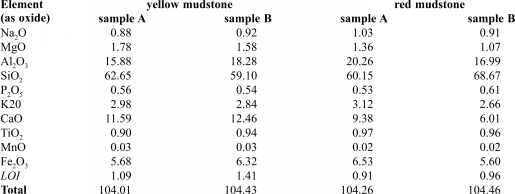
X-ray fluorescence analysis was thought likely to yield chemical clues as to the colour difference between the burnt mudstones. Two prepared samples of each kind were analysed using a Philips PW 1480 x-ray spectrometer with a dual anode Sc/Mo 100kV 3kW tube, loss on ignition (LOI) being determined using lithium tetraborate fusion beads. The major and minor element composition, expressed as oxides, appears in Table 1. The Al2O3/SiO2 ratios for the two kinds are similar (yellow: 0.253, 0.309; red: 0.337, 0.247), suggesting that these particular pairs of samples are about equally fine-grained, on the basis that alumina is a proxy for clay-minerals. Both are similarly ferruginous, for the Fe2O3/SiO2 ratios differ little (yellow: 0.0908, 0.107; red: 0.109, 0.0815). The MgO/CaO ratios are on the whole slightly higher for the red variety (0.145, 0.178), one indication that the carbonate mineral tentatively identified in the yellow mudstone (0.154, 0.127) is a calcite. The main difference, however, lies in the ratio of the total alkaline-earth metals to alumina, (MgO+CaO)/Al2O3, on the whole about 70 per cent greater for the yellow mudstone (0.842, 0.768) than for the red variety (0.530, 0.417). The corresponding value for ‘average shale’ is 0.36.Footnote 14 The yellow and red mudstones are similar in trace-element composition, and both yield high strontium values (yellow: 538, 436 ppm; red: 629, 473 ppm), pointing to lattice-substitution in calcite.
MAJOR- AND MINOR-ELEMENT COMPOSITION (WT. %) OF BURNT MUDSTONES FROM FISHBOURNE PALACE (ACC. NO. FB62/68.9)

The Kimmeridge Clay Formation, of shallow-marine origin, is 300–500 m thick and has been intensively studied, because of its importance as a hydrocarbon source. It has a complicated lithostratigraphy, for several intergrading lithologies combine to form repeated sedimentary rhythms on a vertical scale of a metre or so, as can be seen by walking the foreshore below the cliffs at Kimmeridge.Footnote 16 Macquaker and GawthorpeFootnote 17 recognised clay-rich mudstones, silt-rich mudstones, nannoplankton-rich mudstones, laminated calcareous mudstones/muddy limestones, and cementstones. The categories proposed by GalloisFootnote 18 included siltstones, muddy siltstones, bituminous mudstones, and oil shales, the latter of commercial importance in the past. The repeated sedimentary rhythm found in all but the lowermost part of the Kimmeridge Clay Formation ideally comprises bituminous mudstone grading upward to clay-rich then silt-rich mudstone, followed above by calcareous mudstone and cementstone.Footnote 19 One very calcareous mudstone has revealed a long sequence of laminae on a submillimetre scale, considered to be annual. Footnote 20
Because they are excavated in burnt form, the mudstones from Roman sites are difficult to compare directly with unaffected Kimmeridgian lithologies as seen in the field. Microscopically, the yellow variety has most in common with Macquaker and Gawthorpe'sFootnote 21 clay-rich mudstones and the less calcareous of their pale grey, nannoplankton-rich rocks. The red form is more like their silt-rich lithology and the dark grey mudstones of Cox and Gallois.Footnote 22 Geochemically, the yellow variety is the more calcareous, but would appear, at least in these analyses, to have a similar balance of detrital clay-minerals and quartz to the red mudstone. More examples of each were examined microscopically, however, than analysed chemically.
PALAEONTOLOGY
The considerable quantity of yellow burnt mudstone currently available from Fishbourne Roman Palace comprises lumps of secondary raw material, waste from the saw-bench, and tesserae. It has afforded a moderately varied, critical fossil assemblage, whereas in the past too little of this very poorly fossiliferous material was available to yield a stratigraphically significant fauna. Footnote 23
One hand-specimen is especially important (FB 62/96/11). It contains the internal mould of a small, limpet-like marine gastropod with a characteristic, concentrically-wrinkled shell surface. The shell is so thin in this species that external ornamental features are perfectly seen on the internal mould, the ornament consisting of major concentric growth pauses between which are a number of weaker and slightly irregular, raised concentric folds. The specimen matches exactly Pseudorhytidopilus latissimus (J. Sowerby, 1817), a species which ranges through the Kimmeridge Clay Formation of southern England in mudrocks deposited under conditions of restricted oxygen availability.Footnote 24 The same sample also contains many internal and external moulds of small bivalves that are morphologically consistent with Isocyprina, previously reported from the red burnt mudstone,Footnote 25 a genus typical of the Kimmeridge Clay Formation. Also, there is a small fragment of an ammonite with a style of strong ribbing consistent with a number of Kimmeridgian forms.
A large lump of secondary raw material, weighing 2.29 kg (FB 62/68/9), was broken down into numerous smaller pieces, yielding as internal and external moulds a sparse, essentially monospecific assemblage of small, inflated bivalve molluscs with a posterior carination. The shell surface is mostly smooth but develops weak concentric ribbing along its ventral margin that overrides faint radial elements. Overall shape, and the few internal structures that can be seen (e.g. muscle scars), are altogether consistent with an attribution to the Corbulidae, although diagnostic hinge features were not seen. The Kimmeridge Clay Formation contains a very common corbulid, Corbulomima suprajurensis (d’Orbigny, 1850), which ranges through its entire thickness. There is a close match with this species in all observable features. Footnote 26
DISCUSSION
Overall, the fauna recovered from the yellow burnt mudstone very strongly indicates procurement of the primary material from the Kimmeridge Clay Formation, the key form being the limpet-like gastropod. As with the red variety,Footnote 27 there is evidence from the character of the faces of some hand-specimens that mudstone for burning was recovered from a beach where vigorous wave-action could smooth and round outcropping or tumbled stone. The beaches below the cliffs at Kimmeridge on the Dorset coast fit this bill, but the fossil assemblage does not have the stratigraphic resolution to allow us to say precisely where on this long coastal section the material might have been obtained. We cannot say if the mudstone was burnt on the beaches from which it was quarried or collected, but it seems unlikely that it was fired under different conditions from the mudstones that gave the red variety. The chemical analyses presented show that the yellow variety is richer than the red in magnesia and lime and, at least in the case of clay bricks,Footnote 28 enrichment in these components is known to favour buff to yellow colours. The fact that the yellow burnt mudstone does not change colour when refired under oxidizing conditions points against a difference in burning conditions for the two varieties.
The new evidence which allows us to attribute to the Kimmeridge Clay Formation the yellow burnt mudstone widely seen as decorative floorings in southern Britain of the early Roman period again demonstrates the value of an eclectic geological approach to these cultural expressions as a complement to stylistic analysis, and further reinforces the importance of the Poole-Purbeck area as a major industrial zone of the time.
ACKNOWLEDGEMENTS
We are indebted to Robert Symmons of the Fishbourne Roman Palace, and to David Rudkin formerly of the Palace, for the opportunity to examine excavated material and for their enthusiastic support of this project.