Motivation
A section of Nattukottai Chettiars, a major banking caste from South India, switched from caste-based banking to joint stock banking in the first quarter of the twentieth century. This paper identifies such switching as an expression of severance of community ties and seeks to find factors that prompted this transition. A caste is a hierarchical subdivision under Hinduism, the religion of the majority people in India. The caste system characterizes a hierarchical structure of the society where one's occupation is typically determined by his caste. There are several caste-based banking groups in colonial India. Nattukottai Chettiar (in short, Chettiar), one of the banking castes from South India, emerged as one of the most successful banking communities during the late nineteenth century as it managed to ensure a remarkably high repayment rate on the loans it extended. British officials attributed this success to the higher community ties of the Chettiars (Ray Reference Ray1995).
Despite their success with caste banking, some of the Chettiar bankers decided to switch to joint stock banking during the first half of the twentieth century. There were three major joint stock banks that they established—Indian Bank (1907), Indian Overseas Bank (1937), and Bank of Chettinad (1929). Besides banks, Chettiars also entered into other forms of formal business such as the textile industry. This paper identifies this transition as a break in an age-old community tradition and seeks to find the reasons behind it. I found that a powerful minority of Chettiar business families who went through this transition, continued to hold a strong position in Indian business in post independence India. Reviewing the Nattukottai Chettiar control over business in South India, Shoji Ito (Reference Ito1966) found that four Nattukottai Chettiar groups control a large section of South Indian business—Somasundaram Group, the Rajah Sir group, the Karumuthu Group, and the A.M.M group. These four groups ventured into different lines of business with the Rajah Sir group holding two of the largest banks—Indian Bank and Indian Overseas Bank. According to Ito's estimate, made in the 1960s, the Chettiars families in the formal banking business controlled one-sixth of the total bank deposits of south India. The other groups were mostly in textile mills. The Karumuthu Group, for example, owns 16 textile companies in addition to one small bank and one insurance company. However, this organizational transition was limited to a handful of Chettiar families that managed to have a sustained presence in the Indian business scenario while the other Chettiars, who could not go through the transition, went into oblivion. This paper also explains the reasons behind the great divide within the Chettiar caste.
This paper is related to the body of theoretical and historical research that looks at the interaction between culture and economic decision making (Clark Reference Clark2007; Mccloskey Reference McCloskey2006; Tabellini Reference Tabellini2006; Weber Reference Weber2001). Particularly it provides a complementary position to Greif's seminal paper on the Maghribi traders (Greif Reference Greif1993) where he showed how culture plays an important role in determining economic outcomes. Unlike Greif who treats culture as an exogenous parameter that selects equilibrium, this paper shows how choice of culture is determined by factors such as technology and global trade. This paper is related to the economics literature that looks at the persistence of the caste system and the interaction between traditional community values and modern economic forces such as globalization (Freitas Reference Freitas2006; Munshi and Rosenzweig Reference Munshi and Rosenzweig2006). This paper also contributes to the body of research on business history of colonial India in general (Bagchi Reference Bagchi1972; Ray Reference Ray1992; Tripathi Reference Tripathi2004) and in particular, to the history of traditional Indian business communities operating during colonial period (Gupta Reference Gupta2012; Markovits Reference Markovits2000; Roy Reference Roy2010; Rudner Reference Rudner1994; Timberg Reference Timberg1977).
Borrowing Greif's terminology, I describe the organizational transition of Chettiars as a movement from a collectivist business practice to an individualistic business practice. I argue that the collectivist business organization (the caste-based banking in our case) had two edges over the individualist business practice, that is, joint stock banking. Caste-based business could do better agent monitoring at a lower cost than their joint stock counterpart and provide community-based insurance to its members against bad shocks. In the age of modern communication technology and expanding global trade both these edges were lost, prompting some of the caste bankers to start joint stock business. I provide a theoretical structure and archival as well as secondary evidence to support my argument.
The paper is organized as follows. Section 2 provides an overview of the history of banking in India. Section 3 discusses the possible reasons behind such a transition. Section 4 discussed evidence in support of the hypothesis put forward here. Section 5 discusses if the transition could have been caused by some other reasons and Section 6 concludes.
History of Banking in India
India had a long-standing tradition of banking characterized by banker communities before it came into contact with European banking. Before Europeans set their feet in India, banking communities were traditionally in two types of business: Hundi business and the business of managing government treasury. Hundis had different variants, but they can generally be described as indigenous versions of modern bank drafts providing an effective, safe mode of funds transfer for a significant span of time in history. The British, after coming to India, developed strong commercial relationships with indigenous bankers. During the time of colonial expansion British made a good use of the hundi network for remitting funds to different areas of conflict against local forces. This turned out to be a critical factor in their win against Marathas in the nineteenth century (Ray Reference Ray1995). Moreover, banker Jagat Seth collaborated with the British against the king of Bengal, Siraj-ud-daula, in the battle of Plassey in 1757, which created the first political foothold for the British in India.
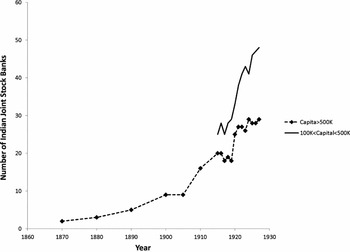
Under the colonial power, European and indigenous bankers would operate in complementary areas of the economy. The European bankers would, by and large, be involved in the trade with Europe while their Indian counterpart would mostly finance the inland trade. The Nattukottai Chettiars, however, were involved in international trade with South East Asia. The Indian banking sector during the first phase of the colonial rule was characterized by numerous caste bankers and a few European banks. This went through a makeover when in 1870 Indian joint stock banks started to emerge. Many of these banks were started by people from outside the traditional banking communities. In figure 1, I summarize the scenario by using data extracted from the Indian Central Banking Enquiry Committee (ICBEC) report (1931).
Indian joint stock banks.

The data shows that the number of Indian joint stock banks was continuously increasing throughout the period 1870–1930. The bank proliferation data reveals an interesting pattern. In the initial phase, only bigger Indian joint stock banks with paid-up capital of Rs. 5,00,000 or more started their businesses. In the period after 1915 there was a sudden rise in the smaller joint stock banks with paid-up capital between Rs. 1,00,00 and Rs. 5,00,000. It is important to note that the total capital of foreign banks, which were commonly referred to as exchange banks, exceeded the total capital of Indian joint stock banks by a large margin. According to the calculation made in the ICBEC report (1931), total paid-up capital of foreign banks in India was Rs. 762,43,333, which was way more than the total paid-up capital of Indian joint stock banks—Rs. 168,12,000. However, the number of joint stock banks with foreign connections was lower than purely Indian ones, implying that the average paid-up capital of a foreign bank was greater than that of an Indian one. The organizational transformation of Chettiar bankers has to be understood in the context of this period when a nation's banking sector was going through rapid changes and was gearing toward a high degree of formalization. Importantly, unlike some nouveau riche who entered the banking business in India at that time, Chettiars was a banking caste with a long-held tradition of banking using caste lines. Hence, its move from the caste-based banking to the joint stock banking was a change in the culture with a widespread implication for the general business environment of colonial India.
Why Did the Transition Take Place?
This paper looks at the question of organizational transition among Nattukottai Chettiars, namely their move from caste banking to joint stock banking. The underlying premise of this paper is that given a business environment a specific business culture has some economic benefit and, hence, changing the economic environment may lead to changes in the business culture and, subsequently, changes in business organization. To identify the reasons behind the changes Chettiars adopted, it is important to focus on the benefits of caste banking over joint stock banking. The two specific advantages of caste banking (or for that matter any other community-based business) are the use of caste-based social sanction for disciplining a cheater agent and financial help from other community members at the time of crisis.
Both these advantages of community-based business practice have been widely analyzed in the literature. The relation between a banker and his agent is characterized by the principal-agent problem in which the objective function of the agent is different than that of the principal (banker) and, hence, the agent has incentive to behave differently than what the principal wants. Besides formal contracting backed by third-party enforcement, the use of community-level social sanction is seen as one of the effective methods of solving the problem especially in the context of less-developed countries with weak formal courts. The use of peer monitoring and social sanction for solving the principal agent problem is well discussed in the context of premodern Europe and contemporary less-developed countries (Besley et al. Reference Besley, Coate and Loury1993; Ghatak Reference Ghatak1991; Greif Reference Greif1993; Greif et al. Reference Greif, Milgrom and Weingast1994). The second edge that caste banking had over joint stock banking was the safety net provided by the caste members—a Chettiar banker in crisis would get help from other Chettiar bankers. Such norm of bailing out community members can be interpreted as a mutual insurance mechanism based on reciprocity (Coate and Ravallion Reference Coate and Ravallion1993). The details of this insurance mechanism are explained in the following text. Joint stock banks established using more formal channels could not avail such insurance. They could avail formal insurance using formal contracting that was, however, difficult to obtain in a society characterized by weak enforcement.
In this paper, I will argue that in the first part of the twentieth century, the changes in technology and global business environment made both these channels less effective for caste-based banking prompting them to start a joint stock business.
The Agency Problem
A banker in colonial India would depend heavily on his agents for running his business. The bank agents in colonial India would work like a branch manager—deciding on which loan to approve. Banks would often suffer from dishonest agents. For example, in 1892, the Mercantile Bank of India, was the victim of a massive fraud that led to the loss in the region of £75,000, not to mention the loss of reputation (Green and Kinsey Reference Green and Kinsey1999: 12). Hence, it was critical for a banker to ensure his agents’ honesty. Effective agent monitoring would depend on a banker's ability of gathering information about agents’ activities in distant places. In colonial India, with weak communication systems such information could be obtained at a very high cost. The Chettiars could process agent-related information at a low cost by using three traditional institutions, namely, apprenticeship of agents, panchayat (community court), and the temple complex. I discuss all three and their centrality in Chettiar business practices.
The apprenticeship system had been a traditional tool for controlling the supply of skilled labor in the labor market and maintaining the quality of labor in different parts of the world. Its use for solving the principal agent problem is not rare either (Carlos and Nicholas Reference Carlos and Nicholas1993; Chwe Reference Chwe1990). Chettiars had the tradition of working as an apprentice agent before starting their own business. The Chettiar bankers had their headquarters in India while their branches were all over Burma (Myanmar) and Ceylone (Sri Lanka). A Chettiar banker would choose an apprentice from his family or from other Chettier families who would then be sent to an overseas branch office in Cylon or Burma. After working there for three years, he would hand over responsibilities to a new apprentice agent, and would return to his master in Tamilnadu, India (Rudner Reference Rudner1994: 116–18). For the first three-year term, a Chettiar agent at overseas locations would not get any money. However, the employer would arrange for his stay, food, and other expenses. Upon return to Chettinad after three years, he might get a share of profit as a bonus that would never exceed Rs. 1,000. But the usual payout would be Rs. 150–Rs. 300. After enjoying a holiday, the agent could get another three-year contract for Rs. 1,000–Rs. 2,000. In his second term, an agent would typically get a bonus of Rs. 500, the upper limit being Rs. 1,500. An apprentice with four to five years of experience would become an accountant or cashier, and after seven years of experience he might become an assistant. It usually took 13 to 15 years of experience to become an agent. By that time one could start his own business as well. An agent usually is engaged for a three-year term as well and his salary for three years was Rs. 6,000–15,000 (Burma Provincial Banking Enquiry Committee report (BPBEC) (1930: 208–10). Besides skill training and cheap labor, the other big advantage of the Chettiar apprenticeship system was to facilitate free flow of information between overseas sites such as Burma and Ceylon and the head offices at their home district, Chettinad. For each banker, his own apprentices would not come back before the stipulated three years. But with so many bankers around, there was a constant flow of apprentices between overseas sites and India bringing back information to India about situations in Burma and Ceylon. The information that was brought back by the apprentices would be disseminated by two other institutions: temple complex and panchayat.
Temples were central in the social and economic life of the Nattukottai Chettiars. It is well documented in government reports that a temple would always be established wherever there were a few Chettiars doing business. In Burma, the rate for temple contribution, known as magamai, was fixed at around 14 annas per Rs. 1,000 loans and Rs. 9 annas per Rs. 1,000 of property taken over for debt. Failure to pay such contribution would result into social sanction by other members of the Chettiar community (BPBEC 1930: 193).
The temple complex was also an indispensable ingredient of the Chettiar business practice. In Rangoon, the main temple was situated in the Mogul street where all the major Chettiar firms had their head offices. The ground floor of the temple had six business rooms that are described as the “Real Chettiar Exchange” where exchange of information would take place among the bankers (ibid.).
This is the place gossip is exchanged every morning before the main business of the day begins, and a general body of opinion [is formed] as to the financial situation and appropriate measures is developed.
The other institution complementing the temple network was the Nattukottai Chettiar panchayat—the traditional, informal civic body for dispute resolution. Together they formed the core of information dissemination mechanism for the Chettiars. The panchayat meetings for dispute resolution were usually held in temples (Rudner Reference Rudner1994: 118, 124, 127). However, it is important to note that the Nattukottai Chettiar panchayats started losing their importance from the first half of the twentieth century, lending further support to the central thesis of this paper (Mahadevan Reference Mahadevan1978). The use of a community-level information network for solving the principal agent problem was unique to caste banking and not available to joint stock banks, which would work under the structure of company law. Hence, the choice between joint stock banking and caste banking was, at least partially, a choice between the use of community-level monitoring of agents (say, collectivist monitoring) and monitoring of agents by the bank only (say, individualistic monitoring). In this paper, I argue that traditionally the collectivist monitoring had an edge over the individualistic monitoring, which was lost with the improvement in communication technology in the first half of twentieth century in India.
I provide an analytical model of agent monitoring in the appendix. In this section I would describe the basic intuition of the model. The profit of a banker is increasing in the quality of monitoring of the agents, which in turn depends on the quality of information a banker gets about his agent. Moreover, a banker chooses the organizational form (caste banking or joint stock) that gives him the maximum profit. This paper argues that Chettiar communities’ decisions to stick to caste banking for centuries was not an expression of their love for irrational, traditional values. Instead, there was a strong rationale for choosing caste banking as the most profitable business structure. In absence of modern communication technology, caste banking was indeed the most rational choice because individualist monitoring of agents was not feasible. However, in the first decade of the twentieth century there was a rapid development of communication technology increasing the effectiveness of individualistic monitoring. During the same period, the community ties among the Chettiars also weakened significantly reducing the effectiveness of collectivist monitoring and the profitability of caste-based banking.
However, one may wonder why the caste bankers did not use modern communication technology, making a hybrid of both collectivist and individualistic monitoring under the umbrella of caste banking. The answer lies in the costs involved in both types of monitoring technology. The cost of using modern communication such as telegraph or railways is easy to understand. But for collectivist monitoring there was no explicit cost. The cost a typical Chettiar member would bear to avail information for agent monitoring was the cost of interacting with the network—which could be pecuniary such as temple contribution or could be nonpecuniary such as time spent for social meetings. The individualistic monitoring using modern communication could not be assimilated in the traditional way of doing caste banking.
In the following section I provide evidence on both the development of communication technology and the worsening of community ties among the Chettiars.
Improvements in Communication Technology
The Indian economy in the late nineteenth century was characterized by a massive expansion of communication facilities through construction of railroads and telegraph lines. There was an extensive expansion of railway network during the period 1880–1914. Railway track increased from 15,764 km in 1880 to 59,585 km in 1915–16. Number of passengers also increased from 22 million in 1871–74 to 392.2 million in 1910–14 (Headrick Reference Headrick1988: 74). However, these are aggregate statistics covering all of India. The Chettiar bankers, however, ran their business from Chettinad in southern India while the centers of their operation were in Burma and Cylon. Hence, looking at the expansion of communication facilities in these regions is more important for this study.
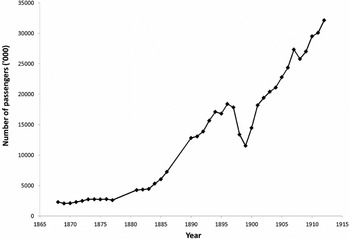
In figure 2 the number of passengers in South Indian railways has been presented.
Number of passengers in South Indian railways.

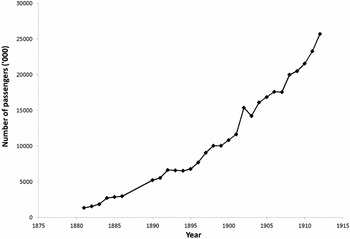
The data is mostly retrieved from Statistical Abstract Relating to British India, Her Majesty's Stationary Office and published in the web archive of Digital South Asian Library. I specifically look at the passenger carriage in the Madras Railway. A few clarifications about the data are needed. The passenger statistics for the period 1883–1912 has data for Madras Railways and Southern Mahratta coupled together. However, Southern Mahratta Railways did not start its operation before 1883. Hence, for time periods 1868–83, only Madras Railways data is used to represent the extent of railways operation in South India. Besides Madras, I also look at the railway expansion in Burma given the large-scale Chettiar banking network in Burma. This is presented in figure 3.
Number of passengers in Burma railways.

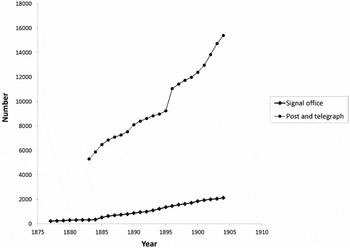
During this time, a telegraph network that started back in 1853 was expanding at a rapid pace as well. In figure 4 the expansion of the telegraph in India is presented. In 1883, the Department of Telegraph merged with the Postal Department (Headrick Reference Headrick1988: 121). This allowed numerous small post offices to handle telegrams increasing the coverage and effectiveness of the telegraph system. The telegrams were forwarded to them by mail from the nearest telegraph office. Hence, to get a complete picture of the telegraphic network in India, for years after 1883, the number of post offices are added to the number of signal offices leading to a discrete jump in the graph.
Expansion of post and telegraph system.

The Community Membership as Insurance
Besides providing a solution to the principal agent problem, the caste banking network would provide another important service—insurance. Whenever one caste member would get in trouble other members would bail him out. However, there was no formal contract between Chettiar firms for bailing each other out. I have already mentioned the theoretical literature that explains such norms as a reciprocity-based insurance arrangement. In this section I argue that one reason behind the transition to joint stock banking was the breakdown of such an insurance mechanism during the first half of the twentieth century. Before going into the evidence, I briefly explain the reciprocity-based insurance mechanism using the structure developed by Coate and Ravallion (Reference Coate and Ravallion1993). It is often seen that members of a community get involved in gift exchanging or helping each other out in crisis. While common perception sees this as an act of altruism, an important strand of literature in economics shows that such “altruism” can in fact be a self-seeking behavior. The papers pertaining to this strand of literature see the bailing out as part of a reciprocal insurance arrangement in which member A helps another member B when B is in trouble and, in exchange, B helps A when A is in trouble. The most critical problem in viewing neighborly help as insurance is that neither for gift exchange, nor for helping neighbors do we see any external agency enforcing reciprocity on the part of the neighbors. If in period t, person A helps person B, there is no guarantee that if in period t+k person A runs into trouble, B will help her. This problem is solved using the infinitely repeated game structure where people get into similar situations many times. If A does not help B in his need, B will deny her any help when he needs it. Hence, a rational agent would continue to help his neighbor if the amount of net transfer he can expect from his neighbor as a return help at the time of any future crisis is greater than the amount of money he can save by not helping his neighbor. This system can work fine as long as the people involved in this system draw their incomes from the same risk distribution. In that case, the reciprocity-based mechanism would save them from any idiosyncratic risk they may face. However, if they face different risk distributions then the system should not work.
Suppose that there is a farming community of a thousand people who have been participating in the reciprocity-based insurance mechanism for ages. Then a new technology arrives that can prevent pest infestation. For some exogenous reasons (e.g., lack of education or capital) 300 farmers can use this technology while the rest do not have access to it. In such a case, no insurance mechanism is viable between a member from the first group and one from second group. This is because the risk distribution of the first group of farmers is systematically different from that of the second group. This way the arrival of this new technology limits the scope of the reciprocity-based insurance arrangement. In the Chettiar case, I argue that during a few hundred years preceding the twentieth century, the risk distributions faced by the community members was the same, thus making the reciprocity-based mutual insurance system work.
The opening of Suez Canal in 1869 and the subsequent expansion in grain trade between Europe and Asia induced new kind of risk that affected Chettiar lenders in the business of agricultural finance. Judging a good borrower would now involve global information such as trends in grain speculation and price fluctuation in world market. The access of Chettiar members to the relevant information varies widely depending on their ability to access modern communication such as a telegraph network. A prominent Chettiar rice trader, M. M. Palaniappa, for example, conducted his whole business using telegrams, receiving information on price fluctuations from different centers. He employed delivery boys and clerks to bring, read, and translate the messages for him (Sridevi Reference Sridevi2005: 148).
The access to global information was costly but it became important for judging a risk. Consequently, the distribution of idiosyncratic risk faced by the Chettiars became different for different members. Chettiars who had better access to global information were systematically a different variety of businessmen than those who did not. Also, Chettiars started actively taking part in grain price speculation, which is not compatible with community-wide information sharing as the use of private information is the key to become successful in speculative trade. I argue that this made the mutual insurance mechanism unfeasible. This was because the Chettiar who were doing well in this new global trade scenario would deny to cover for the bad shocks for the members of the caste who could not access the global trade.
The reason is simple—the less able (or less fortunate) section of the Chettiar clan could not possibly cover the more able players when the latter group received bad shocks. The more able members in this scenario would be better off if they could get into partnership with people of their same ability who might even come from non-Chettiar communities. But that can only be done through formal contracting—joint stock banking was one such organization that would provide opportunity of sharing risk with non-Chettiars. In the next section, I present the evidence on worsening community tie among Chettiars.
Cultural Change and Organizational Transition
This paper claims that in the beginning of the twentieth century the community ties among the Nattukottai Chettiar bankers was severed resulting in a change in their banking organization style from community-based to joint stock banking. In support of the claim that community ties were severed in the first half of the twentieth century, I provide both direct and indirect evidence. Direct evidence on the worsening cultural ties among the Chettiars, besides other sources, comes from the minutes of the first All Burma Chettiar conference that was held in Rangoon in 1924. In the presidential address, T. S. Nagappa Chettiar, expressed his worries over declining cooperation among the Chettiars and criticized the trend of taking intracaste disputes to the formal courts. Some of the resolutions passed in that meeting are important for understanding the issue of weakening social ties (Mahadevan Reference Mahadevan1978).
-
1. It was decided that a modern joint stock Chettiar Bank should be established. The director and shareholders of the said bank must be Chettiars.
-
2. Chettiar bankers were urged not to charge excessive interest rates from their fellow Chettiars.
-
3. Consideration on the resolution as to whether disputes among the Chettiars be settled within the community, namely, through the medium of the Chettiar panchayats, or outside the community, was postponed to the next conference.
The document reveals that besides their aspiration to start a joint stock bank, the Chettiars were particularly concerned about the lack of intra-Chettiar cooperation that was captured in high intra-Chettiar rate of interest and use of formal courts for resolving disputes between Chettiars. Both incidents are expressions of weakening community ties among Chettiars.
A similar view was reflected in the correspondence of British officials during the early twentieth century. In one such letter written on June 6, 1903, Mr. L. G. Dunbar, the secretary general of Bank of Bengal, wrote to an agent of the same bank (Correspondence of Bank of Bengal to Rangoon).
Hitherto when a Chetty firm has fallen into difficulties other well to do chetties have always come forward and taken over the liabilities to the bank of the firm in default. This practice has been so well recognized that the Bank has felt confidence in advancing to Chetties large sums of money without security other than the usual promissory notes. Of late a disinclination has been manifest on the part of solvent Chetties to come to the assistance of embarrassed firms, and a modification of the Banks practice now appears to have become necessary. (Italics mine; CBBR 1903)
In the same letter, he also mentioned that only first-class firms would be given loans, while small firms must provide securities for availing loans from Bank of Bengal. BPBEC report (1929: 195) reiterated a similar view when it concluded “the general impression we have received is that there has in fact been some weakening [of ties].”
If the conjecture about weakening community ties is correct I would expect Chettiars to approach formal courts for dispute resolution in the first half of the twentieth century. For understanding the role of formal courts in resolving intra-Chettiar disputes, I take a look at the court data from Ceylone (Sri Lanka)—one of the major business centers for the Chettiars. In the existing literature, Weerasooria (Reference Weerasooria1973) analyzed a sample of 59 cases that were brought to the formal courts in Ceylon by the Chettiars. Of those, 10 cases were brought against another Chettiar.
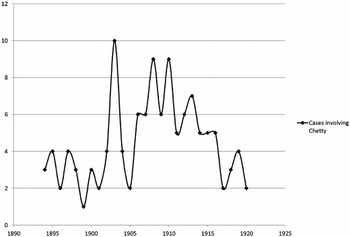
In this section, I extend his analysis by doing a detailed review of the court records over time that I collected from the online archive maintained by Sri Lankan government (see New Law Reports). I present a graphical analysis of the data and do a qualitative analysis of a few sample cases that involved Chettiars as both plaintiff and defendants. Cases with Chettiars as both plaintiff and defendant are important for the current paper because they were the most natural disputes for panchayat adjudication but ended up in British courts instead. Here, in figure 5, I present court records from district courts of Ceylone (Sri Lanka) for the period 1897–1917—a 20-year interval around 1907, the year of establishment of Indian Bank—the first joint stock bank established by the Chettiars. There are three sets of time series data presented here. I start by presenting the total number of cases involving Chetties either as plaintiff, defendant, or both. The graph shows an inverted U shape. However, the total number of cases involving Chettiars did not cross 10, minimum being 2.
The total number of cases involving at least one Chettiar member.

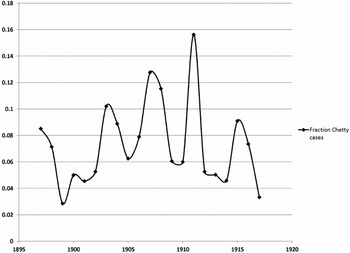
All the disputes involving Chettiar members were related to property or contract issues. Hence, the correct base for normalizing the data for a given year is the total number of contract- or property-related cases that were brought to the Ceylone district court by Chettiars and non-Chettiars alike in that particular year. This set of cases considered is a subset of all the civil cases that besides property- and contract-related cases also included ones involving illegal gambling, illegal alcohol selling, unauthorized deforestation, and so forth. The latter group of cases, however, is not included in the normalizing factor used here. My calculation shows that, on average, 7 percent of total property-related cases involved at least one Chetty member. The graphical representation of this time series is presented in figure 6.
Chettiar-related cases as a fraction total property-related cases.

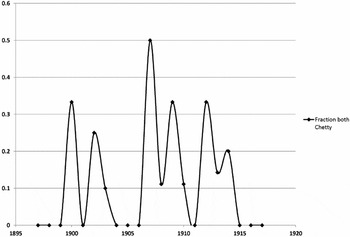
I also calculate the number of cases that involved Chetty members as both plaintiff and defendant and present the time series in figure 7. For this series—cases in which both plaintiff and defendant are Chettiars—I use the number of cases involving at least one Chettiar as the normalizing factor. My calculation shows a wide fluctuation in the time series as some years went without registering any case with Chettiars at both sides. Nevertheless, in some years the number was as high as 50 percent.
Cases when both plaintiff and defendants are Chettiars.

The graph is, however, showing an upward trend in the number of litigations during the first half of the twentieth century followed by a downward trend. This trend, in fact, makes our case even stronger as such a shape is typical to an institutional transition. Let us elaborate this point using the following example. When a dispute arises between a plaintiff and a defendant, it can be settled out of court or inside court. Suppose that if the defendant wins he does not have to pay anything and if she loses she has to pay K as fine. The plaintiff, by contrast, gets K if she wins and does not get anything if she loses. Suppose the plaintiff believes that his probability of winning is p and the defendant believes that the probability that the defendant wins (and the plaintiff loses) is q. For simplicity let us assume for a moment that the court cost is 0 for both and this is common knowledge (the main intuition of this argument will not change even if I assume positive court cost). Hence, the plaintiff believes that his expected payoff from going to court is pK. By contrast, the defendant perceives that she will lose –(1-q)K in the event of a court case. The plaintiff will file a court case as long as he is more optimistic than the defendant about winning the case. If p = (1-q), the parties will always settle out of court. Such difference in beliefs may arise if one side has more information about the case than the other. Such extra information may be some crucial evidence that only one party can observe or may simply be different beliefs that the parties hold regarding the efficacy of legal system. The Game Theoretic analysis of the effect of such differential information structure on litigation and pretrial negotiation is well discussed in literature (Bebchuk Reference Bebchuk1984; Reinganum and Wilde Reference Reinganum and Wilde1986; Schweizer Reference Schweizer1989).
I need not go into the detailed analysis of the previously mentioned game; our take away from the analysis is that litigation will occur in equilibrium if the defendant and the plaintiff have divergent beliefs about the merit of the case. Otherwise, they will settle out of court. I argue that in the beginning of the twentieth century the community ties among the Chettiar started to erode and they started moving to formal courts for resolving disputes. But the formal legal system was a new domain for the Chettiar members. This resulted in widely varying beliefs regarding the effectiveness of litigation (and merit of their cases) within the Chettiar caste. Hence, for two randomly matched litigants, it was more likely that they would have different beliefs regarding their probabilities of winning. This would make them go for legal battle rather than settle out of court. This theory outlined in the preceding text yields the prediction that such divergent beliefs among the Chettiars would lead to a rise in litigation involving Chettiars. However, as time progressed, Chettiars were exposed to more litigation and their beliefs regarding the court system converged resulting in a decline in the number of litigation. Hence, transition from an informal to a formal dispute-resolution mechanism should lead to an inverted U-shaped litigation curve that I observe from the data.
More important than the number, was the nature of intra-Chettiar disputes that were being brought to the formal courts. I elaborate my position further by qualitatively analyzing some cases fought between Chettiars. I pick a few sample cases between Chettiar members that were brought to the courts. The intra-Chettiar disputes were largely property and debt related. Chettiars would move to court for disputes related to debt or property in general. The first case I analyze here, like other Chettiar cases, involved property issues. But the fact that it centered on temple property made it interesting to study. Temples were at the core of the Chettiar community life and regular dispute-resolution meetings were often held in the temples. Hence, temple-related issues being brought to British courts was indeed a sign of cultural transformation.
The previously mentioned case, brought to the Colombo district court in 1901, was fought between two members of the Nattukottai Chettiar Association—Sitambaram Chetty and Palaniappa Chetty (New Law Report, Vol. 5, 353). The dispute was “related to refusal of one faction to permit the other to join in worship and administration of the property.” The court document further reveals that the dispute involved the members of Puducovil Nagaram—the association of the Nattukottai Chettiars in the Wellawatta area. The main issue of contention was a temple known as Pudu Kadirasen Kovil and the property attached to it. One faction of the Chettiar association was stopping the other from participating in the management of the facility and thus the latter group moved to go to court. This case provides a strong support for the main thesis of the paper that community ties among the Chettiars deteriorated in the first half of the twentieth century. This case shows that disputes involving worship right and temple property management could no longer be resolved by using community norms anymore—they were being brought to the formal courts.
Next, I look at a case between Kanappa Chetty and Walathappa Chetty in 1902. The content of this case is also indicative of cultural transition of Chettiars. This case (case number 1560, New Law Reports, Vol. 7, 339) was brought to the district court of Kurunegala. The plaintiff alleged that the defendants and plaintiffs were partners in trade and traded under the name and style of Su. Pa. A. Vee. The plaintiffs alleged that the fifth defendant, Sekappa Chetty, fraudulently sold land to the fourth defendant. This land was bought in the name of the partnership. So the plaintiffs prayed for the dissolution of partnership. The district judge dismissed the case because when the partnership was established in 1860 there was no written agreement. Hence, this partnership did not have legal authorization according to Ordinance No. 7 of 1840, section 21. This case reflects the transition the Chettiar business community was going through. It is clear from the proceedings that, when the partnership started its journey in 1860, none of the parties felt any need to formalize the business following the colonial legal procedures. It will be safe to infer that they thought that community norms would be good enough to resolve any possible dispute. However, in 1902 the plaintiffs could not resolve disputes using community mechanisms and were forced to move to formal court. Unfortunately, they could not foresee such transition when they started their business 40 years back and therefore did not bother to sign a formal contract.
The next case I discuss involved a debt contract between Chettiars. This type of case was more common among the cases involving Chettiars. This case (New Law Report, Vol. 10, 330) was brought to the district court of Jaffna in 1906. In this case the plaintiff, Kumarappa Chetty, alleged that the defendant, Kristnaswamy Chetty, did not honor a promissory note for Rs. 1,100 issued by him. The defendant admitted that he gave the promissory note “as security for any balance that might be found due from him upon an account which the plaintiff agreed to open in the plaintiff's name.” The defendant argued that because after the granting of the note the plaintiff went to India without opening any account, there was no money due on the note. The judges (The Hon. Sir Joseph T. Hutchinson, Chief Justice, and Mr. Justice Middleton), however, gave the verdict in favor of the plaintiff saying that the defendant owed the plaintiff money and the defendant's appeal was dismissed. This type of business dispute was the most common among the Chettiars who would specialize in the money-lending business.
I also look at a case from 1909 that was fought between Krishnappa Chetty and Carpen Chetty (New Law Reports, Vol. 15, 243). In this case, the defendant issued a postdated check of value Rs. 4,000 in the name of the plaintiff. But the check was dishonored by the bank on the ground that the hand writing of the defendant is illegible. The defendant also denied the endorsement and “further pleaded that the action was not maintainable, inasmuch as the cheque in question was post-dated.”
The last two cases are representative of cases involving financial instruments. In the first one, the instrument that was not honored was a Chettiar-issued promissory note while in the second, the instrument is a check drawn on a formal bank. Both of them deal with two instruments of deferred payment with different degree of formality. But in essence, they deal with promises that were not honored. One can imagine that, in a perfect community setting, verbal promises would have worked and any breach could be dealt with in community courts. The fact that the Chettiars started using written promises and went to formal courts to find remedies for their breach of contracts provides further support to my hypothesis—weakening community ties among the Chettiars. One implication of worsening community ties among Chettiar, I argue, is the establishment of joint stock banks by Chettiars in the first half of the twentieth century. However, there were only a handful of joint stock financial institutions established by Chettiars. Three of the most notable of them were Indian Bank (1907), Bank of Chettinad (1929), and Indian Overseas Bank (1937). One may wonder whether these three joint stock banks were just exceptions to the general norm reflecting the business attitudes of a few forward-looking Chettiar businessmen rather than a general cultural change among the Chettiars.
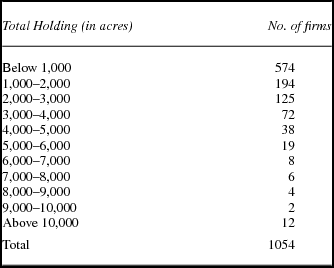
I argue that the Chettiar community indeed went through a cultural change in the first half of the twentieth century. However, such transition could not be translated to the establishment of more Chettiar-run joint stock banks because of the high setup cost of joint stock banks, which only the top bracket of the Chettiar community could afford. The Chettiar caste in the first half of the twentieth century was characterized by an unequal distribution of wealth. The land holding distribution shown in table 1 reveals the pattern of intracaste inequality of Chettiars in 1945. This shows that there were only a few firms at the top percentile making a high number of joint stock banks by Chettiars an unlikely event. The data presented in table 1 comes from a Nattukottai Chettiar Association document from 1945 (Mahadevan Reference Mahadevan1978).
Land holding distribution

It is important to characterize the costs of establishing joint stock banks that worked as a barrier to entry in the formal banking business. Such costs included but were not limited to different fees that a banker needed to pay to get a license, costs of building bank branches, or hiring a large pool of employees. The most critical component of these costs, I argue, consisted of costs of acquiring information regarding the modern institutional framework that was an unfamiliar domain for a typical Chettiar banker. Successful banking business requires effective risk pooling that Chettiar community was doing successfully for ages using their community network and norms rather than strict legal codes. But in the new environment, this needed to be done through a different mechanism, which would be costly for the Chettiars to learn. As a result, only the powerful and rich families could take a plunge in the new business environment.
The Chettiars who went on to establish joint stock banks came from the richest and most influential section of the Chettiar community. I discuss the family groups behind this initiative in the introductory section. To establish this point, I show that Indian Bank was much bigger than a typical Chettiar firm, but among the joint stock banks it was one of the smallest banks. Burma Banking Committee Report carried out a census in Burma in 1930 and found that there were 1,655 Nattukottai Chettiar bankers in Burma whose total working capital was Rs. 75,000,0000 (75 crore or 750 million) (BPBEC 1929: 210–11). The committee estimated that around five-sixth of this total capital would come from the proprietors and the rest from European banks. Hence the total Chettiar capital in Burma around 1930 was Rs. 65,000,0000 (65 crore or 650 million). This makes an average Chettiar worth only Rs. 3,92,749. This figure can give us the best measure available on Chettiar worth around 1925. Given the inequality within the Chettiar caste, I can safely infer that a typical Chettiar would be worth much less than that. In comparison to this figure, Indian Bank had a paid up capital of Rs. 12,59,000 in 1921 which went up to Rs. 12,79,000 in 1925 (STBI: 1925, 13).
But among the formal banks, Indian Bank was not a joint stock bank of exceptionally big size. In fact, it was one of the smallest among the class A and class B banks. The average resources of 41 class A and class B banks operating in 1913 was around Rs. 7 million, which was way less than the average capital of three presidency banks (Rs. 160 million) and that of exchange banks (Rs. 26 million) putting Indian Bank at the lower tail of the wealth distribution of banks (Goldsmith Reference Goldsmith1983: 30). The situation became worse during World War I as India was hit by a series of bank failures in 1914. However, things improved later and large and medium-sized banks increased from 58 to 78 during the 1920s which further increased to 170 during the 1930s and 340 in 1940s. However, official statistics did not involve small banks (class C and D and unscheduled) until 1939. But these small banks—most of which started with the swadeshi movement—were the first victims of an economic crisis and did not survive for long. An economic crisis eliminated 130 such small banks in 1923 and even more during World War II (ibid.: 91). The previously mentioned analysis suggests that entering the joint stock banking business with a prospect of long-term success was costly and the capital position required is way more than that of an average Chettiar banker. Hence, it is not unreasonable to infer that Chettiars, who are enjoying a respectable position among the indigenous banking class, would not venture into joint stock business unless they had enough capital to survive in the long run. Hence, the smaller number of Chettiar joint banks are a result of a self-selection mechanism.
However, one can expect that such information cost would go down with more Chettiar groups joining the bandwagon of modern business. This process of a transition toward individualistic business culture is a slow one. Nevertheless, I show from the evidence provided in the preceding text that such a process was in place among the Chettiars. But the unexpected turn of events in South Asian political history stopped such process for Chettiars to reach its fruition.
Burma was the main center of business for the Chettiars. Even though they hailed from India, only a small fraction of their working capital was operative in India. Chettiars who mainly took land as mortgage emerged as a big landholding class in Burma making the locals antagonistic against Chettairs. So, when Burma fell in the hands of Japan, Chettiars fled Burma during the 1940s but because the nontransferable nature of their asset—land—most of them could not bring their fortune along with them to India. For example, the Bank of Chettinad, which owned nearly 85,000 acres of land were recompensed a mere Rs. 150,000 (Kudiasya Reference Kudiasya, Kudaisya and Ng2009). The Chettiar business in general suffered a heavy loss that smaller firms could not survive. Following this dramatic turn in history I find a great divide in the Chettiar community—on one hand, there were a few big Chettiar families who flourished and continued to enjoy a respectable position in postindependence India while, on the other hand, there were thousands of small Chettiar bankers who went into oblivion ending the progress of a community called Chettiar.
Testing the Model of Agent Monitoring
Do data support my hypothesis? My model predicts that with improvement in monitoring technology and weakening of community ties the honesty-inducing wage should go down. This prediction is also consistent with the efficiency wage theory (Shapiro and Stiglitz Reference Shapiro and Stiglitz1984). If my hypothesis about agent monitoring is true, I should see Chettiar caste bankers paying more to their agents than the Chettiar-turned-joint-stock banks. Here I do a salary comparison of the Indian Bank and other caste-based Chettiar banks. The comparison is not perfect as the number of categories of employees in Indian Bank was higher than that for a typical Chettiar firm. However, I compare the salary of the position of agent under two organizations. For Chettiars in 1930, an agent would get Rs. 6,000–15,000 for a three-year period (BPBEC 1929: 206). The monthly salary of an agent in Indian Bank in 1912 was Rs. 100 making it Rs. 3,600 for a three-year period (Seshadri Reference Seshadri1982: 49). The salary edge of Chettiar agents over the agents of Indian Bank does not go away even if I deflate the salaries by rice prices. The price of rice was Rs. 160 per 100 baskets (46 pounds) in 1912 and Rs. 75 in 1931. The year 1931 being the year when the price of rice started to drop, I take an average of the price in 1931 and that price in 1930 as a deflator to avoid taking a year with extreme value for prices. The price of rice was Rs. 130 per hundred baskets, which makes the average approximately Rs. 100. The calculation shows that an Indian Bank agent's annual salary was 750 baskets of rice, while the salary of a caste banker's agent was worth 2,000 to 5,000 baskets of rice. This result is consistent with the prediction of the model.
Another implication of moving to joint stock business was to be able to hire competent employees outside the Chettiar caste. I do not have a full employee profile of Indian Bank. But importantly enough, the secretary for Indian Bank in 1916–17 was Mr. Vidya Sagar Pandya—a non-Chettiar hailing from North India. In the employee structure of Indian Bank, secretary was the highest position (ibid.). In his testimonial given to the Industrial Commission, Mr. Pandya revealed that he received his first training in 1903 when he joined People's bank in Karachi (Indian Industrial Commission [IIC] 1916–18b: 260). A non-Chettiar representing a Chettiar indigenous organization was an exceptional phenomenon in that period when a Chettiars firm would always be represented by a member of the Chettiar caste in all the government commissions. This piece of evidence goes on to show that Indian Bank was not a typical Chettiar firm registered with the Company Act—it embraced an essentially different business practice. The transformation of Chettiar firms to become joint stock banks involved real changes in the organizational aspect of the bank.
Alternative Hypotheses
In this paper, I argue that the movement by the Chettiars from caste banking to joint stock banking was due to changes in communication technology and global business environment, which led to change in the community fabric of Nattukottai Chettiars. In this section, I examine whether other factors could have prompted such changes. There are three such candidates for examination. First, if a different portfolio of investment was available to the joint stock bankers that could not be accessed by caste bankers as they were not registered under the Company Act; second, whether Chettiars as a caste banker was more discriminated by the British than as a joint stock banker; and third, if the establishment of an Indian joint stock bank was simply an expression of swadeshi tradition of the ongoing freedom struggle. If any of these hypotheses were true, that would form a logical basis for the transition.
In absence of any detailed account book of either Indian Bank in early twentieth century or its contemporary Chettiar bankers, I depend on the reports filed by different commissions. The Chettiar bankers mostly give loans for traders and farmers. In Burma in 1931, it was estimated and reported in Burma Provincial Enquiry Committee report (BPBEC 1930: 196) that out of 350 Chettiar firms in Rangoon, 150 lent to agriculturists. Outside Rangoon, in lower Burma, Chettiars mostly lent to agriculturists and in upper Burma their clients were mostly traders (ibid.: 200). It is estimated in 1931 that in Upper Burma, Rs. 10 million went for agriculture and Rs. 30 million to trade. While in lower Burma, Rs. 450–500 million went to agriculture and Rs. 210–60 million to trade (ibid.: 211).
The total estimate of the working capital of Chettiars in Burma was around Rs. 750 million (ibid.). The Report of the Madras Provincial Banking Enquiry Committee (MPBEC, Vol. 1) also mentions that Chettiars mostly lent to traders and agriculturists without giving any explicit estimate (1931: 144–146). In Ceylon, also, Chettiar mostly financed plantations. The questions is whether, after converting to joint stock banks, the Chettiars were lending money to any different type of clients. Two such possible candidates were the newly emerging jute and textile industries. First, I'll check the capital position of the Bank of Chettinad and Indian Bank and then try to see if I can find their possible places for investment. The paid-up capital of the Bank of Chettinad was Rs. 30 million (BPBEC 1929: 205) while that of Indian Bank was Rs. 6 million (MPBEC 1931: Vol. 2, 22). The lending activity of these Chettiar-run joint stock banks, or for that matter any other joint stock banks in South India, was not very different from that of the indigenous bankers. For example, Andhra Bank would lend money to support inland trade; the Calicut Bank mainly started to serve the Thiya community and lend money against land, gold, and similar assets such as acceptable hundis; and the Jayalakshmi Bank Limited would lend against jewelry and would invest in post office cash certificate and government securities. Indian Bank was no different.
For Indian Bank, Rs. 31 million of their assets were government securities and Rs. 1.4 million were short-term deposits in other banks. Indian Bank would also lend against land, jewelry, and government papers (MPBEC 1931: Vol. 1, 26). It was further revealed by Indian Bank's secretary, Mr. Vidya Sagar Pandya, in his testimony to the Indian Industrial Commission, 1916, that Indian Bank, following the footsteps of other Indian joint stock banks and the Bank of Madras, would finance only trade and not industries (IIC 1916–18b: 269). This evidence rules out the hypothesis that Chettiar did switch to joint stock banking for receiving access to a different portfolio.
The last alternative hypothesis is of British discrimination. If this hypothesis is true the caste bankers are discriminated against and Indian joint stock bankers are favored. The issue of discrimination would be relevant in face of a credit crunch in the market. The credit crunch and subsequent credit rationing were a regular feature of the Indian money market in the colonial period because of seasonality of agriculture, which was the most important sector of the economy. In the event of credit rationing, the presidency banks almost always favored the European banks (Bagchi Reference Bagchi1997: 43). This shows that while Indian banks were generally discriminated against, Indian joint stock banks and caste bankers were not treated differently.
Moreover, Indian caste bankers dealt directly with agriculturists while Europeans mostly controlled the overseas trade with Europe. Hence, if there is any discrimination, Indian joint stock banks are more likely to suffer from it. Hence, the movement from caste banking to joint stock banking cannot be reasoned in terms of the discrimination story. Another important view of Indian economic history sees the emergence of Indian joint stock banks in South India in the first half of the twentieth century as part of the swadeshi movement phase of freedom struggle following the partition of Bengal in 1905. The swadeshi movement called for the boycott of foreign products leading to the emergence of several Indian firms that included banking firms as well (Tripathi Reference Tripathi2004). However, Tripathi admits that some of these banks, namely Bank of Tanjore (1901), South Indian Bank, Tirunelveli (1903), and Kombakonam City Union Bank (1904), were established before the swadeshi movement started in 1905 while some others including Indian Bank were established after. Moreover, Indian Bank had some European shareholders (IIC 1916–18a: 260), which contradicts the argument that the nationalist ideology was solely responsible for its establishment. The swadeshi movement might work as a trigger, but it cannot be held as the cause behind the trend of establishing Indian joint stock banks. In fact, one may interpret the swadeshi movement as the expression for political power by the rising bourgeoisie class in India.
Conclusion
Some members of the Nattukottai Chettiar caste moved from their traditional caste-based banking business to establish joint stock banks. This paper seeks to explain the transition in terms of changes in technology, business environment, and social fabric. The paper argues that caste-based banking had two advantages over joint stock banking—caste-based monitoring of agents and reciprocity-based informal insurance within the caste. In the early twentieth century with the improvement of communication technology and expanding global trade, the caste banking lost both the edges. This prompted some of the caste bankers to move to joint stock banking. In this paper, I provide a theoretical structure explaining the transition and provide evidence from archival and secondary sources in support of my theory. This paper shows how culture as captured by business practices changes in response to variations in technology and business opportunities.
Appendix
A Model of Agent Monitoring
Suppose there are n bankers. Bankers may vary in terms of their wealth and business abilities. The bankers recruit agents who mediate between a banker and a borrower. A borrower can be of two types—good or bad. The borrower takes the money and invests in a project. The outcome of the project is uncertain. If it fails the borrower does not return the money. If it succeeds then only the good borrower returns the money, but the bad borrower does not. This means that the bad borrower always defaults on loan, whereas the good borrower defaults only when the project fails due to some natural reason. Suppose, the probability of failure for natural cause is 1− p. The good borrower returns the money with probability 1 if there is no natural disaster. The bad borrower returns the money with probability 0. Hence, the probability of repayment by borrower type k(k = g,b) is given by (1) and (2):
 $$\begin{equation}
{q_g} = p
\end{equation}$$
 $$\begin{equation}
{q_b} = {\rm{ }}0
\end{equation}$$
If the borrower defaults, the banker cannot decide whether the borrower was bad, or whether there was a natural shock. The probability of a natural shock is exogenously given. Hence, the only thing that a bank can do is to monitor his agent's effort for selecting a borrower. An agent can put high or low effort. High effort is costly for the agent, but the probability that a good borrower is selected is high if the agent puts high effort. Hence, bankers want the agents to put high effort while the agents find it costly to put effort. Hence, the banker deploys a monitoring mechanism. If the agent is caught putting low effort, he will be punished. The probability of getting caught depends on the quality of the monitoring technology, which in turn depends on the transmission of information about the agent's behavior. Bankers compare payoffs between two organizations: caste based and joint stock, and then choose the form of organizations that yields the highest payoff.
If the agent exerts high effort, then he gets wage w, but also bears a utility cost x. If he chooses low effort, then there is a probability η of detection that he is shirking. If detected, he pays a penalty of κ. If not detected, he enjoys the wage w. The cost of punishment is assumed to be constant. The implication of this assumption is discussed later. Hence, high effort is chosen if,
 $$\begin{equation}
w - x > \eta \left( { - \kappa } \right) + \ \left( {1 - \eta } \right)w
\end{equation}$$
Hence in equilibrium the high effort inducing wage is given by:
 $$\begin{equation}
w = \frac{x}{\eta } - \kappa
\end{equation}$$
Equation (4) shows that an improvement in monitoring technology leads to a fall in the honesty-inducing wage. The bankers then choose agents. The quality of monitoring is not the same at all locations. Monitoring quality depends on the flow of information between the branch and the headquarter. The flow of information depends on various things such as communication technology, social network, and so forth. If communication technology improves, then both the caste bankers and joint stock bankers can benefit from that. However, any changes in the social network only affects the information flow for the caste bankers. Hence, I define,
 $$\begin{equation}
\eta = f\left( {\delta ,\tau ,{\rm{\nu }}} \right)
\end{equation}$$
where δ represents geographical distance, τ is the coefficient for communication technology, and ν is the indicator of social network. Because, η represents the probability of detection, it must be the case that 0 < f(.) < 1. Moreover, f 1 < 0, f 2, f 3 > 0. There are two modes of monitoring possible: caste and joint stock. A caste banker can monitor using the caste network and modern communication, while a joint stock banker can only use modern communication. Equation (4) shows that the wage rises as η falls, and equation (5) shows that η is a function of geographical distance, communication technology, and social network. Now I focus on a caste member's decision about the organizational structure of his business: joint stock or caste banking. A joint stock company in the colonial period was a limited liability company that was registered under the British Company Act. When a banker chooses one form of organization over the other, he compares the payoffs under those two forms. The main difference lies in the quality of monitoring. The monitoring technology is assumed to be such that if a banker can monitor one agent better under joint stock banking (than under the caste banking), then this is true for all agents. Then, a member from the banking caste opts for joint stock banking if,
 $$\begin{equation}
^wJ^{ < w}C
\end{equation}$$
Two things can be different between a caste banker and joint stock banks—monitoring technology (η) and punishment for a shirking agent (κ). Hence, the condition can be rewritten as,
 $$\begin{equation}
\frac{x}{{{\eta _J}}} - {\kappa _J} < \ \frac{x}{{{\eta _C}}} - {\kappa _C}
\end{equation}$$
This can be further simplified as
 $$\begin{equation}
\frac{1}{{{\eta _J}}} - \ \frac{1}{{{\eta _C}}} < \ \frac{{{\kappa _J} - {\kappa _C}}}{x}
\end{equation}$$
The improvement in communication technology would affect the decision to adopt joint stock banking by affecting more than one parameter of equation (8). It affects the values of η J and η C , as the quality of monitoring technology would improve for both the types. Moreover, improvements in the transportation facilities allow an agent to find employment outside his community, and that makes the community sanctions less effective. Hence, κ C decreases with the improvement in transportation facilities, and the adoption of joint stock banking becomes more likely. Now, consider the banker's decision to spend resources on communication technology. I assume that each banker has a fixed amount of resources available for spending on monitoring, which is increasing in his wealth and size of business. Hence, big bankers spend more money on monitoring each of the agents. Also suppose that κ C does not change with improvements in communication technology.
The fundamental difference between a joint stock banker and a caste banker is that the joint stock banker cannot use social network for monitoring. Hence, he spends all his available money for communication technology. However, using a community network for monitoring was not a free lunch either. It has already been illustrated that the temple contribution can be interpreted as the cost of accessing caste network. The taxation policy followed within the caste was close to the ability to pay principle—rich members paying more. Suppose the bankers are indexed by their wealth. A banker l is wealthier than the banker l−1. The temple contribution is fixed by the caste panchayat. Suppose, for the banker l, the amount of endowment for spending on monitoring is γ l and the amount of temple contribution is fixed at cl . He can spend the rest of the money (γ l − cl ) on monitoring using conventional communication technology such as railway and telegraph. A specific functional form for the monitoring technology is assumed to further elaborate on the decision process. It is already been specified that η is increasing in τ and ν, and decreasing in δ. Define,
 $$\begin{equation}
{\eta _m} = \frac{{\tau {y_m} + {I_m}v\ }}{{{\rm{\Delta }} + \delta }}
\end{equation}$$
where the subscript m = C,J denotes whether it is a joint stock or caste-based organization. Im is an indicator function such that IC = 1 and IJ = 0. This indicator makes sure that monitoring under caste-based banking uses both modern technology and the caste network, while that under the joint stock banking only gets to use modern communication. The variable ym represents the amount of money spent on modern communication by organization type m. ∆ is just a big number that makes sure that η never gets bigger than 1, even if δ is close to 0. Given this functional form, equation (8) can be rewritten as
 $$\begin{equation}
\frac{1}{{\tau {y_J}}} - \frac{1}{{\tau {y_C} + \ v}} < \frac{{\rm{\Gamma }}}{{{\rm{\Delta }} + \ \delta }}
\end{equation}$$
Where
 ${\rm{\Gamma }} = \ \frac{{{\kappa _{J\ }} - {\kappa _{C\ }}}}{x}\ $
For a banker l, this condition can be rewritten as
 $$\begin{equation}
\frac{1}{{\tau y_J^l}} - \frac{1}{{\tau y_C^l + \ v}} < \frac{{\rm{\Gamma }}}{{{\rm{\Delta }} + \ \delta }}
\end{equation}$$
I already know that yl J = γ l and yl C = γ l − cl . Substituting this relation in (11) I receive
 $$\begin{equation}
\frac{{v - \tau {c_l}}}{{\tau y_J^l\left( {\tau y_C^l + \ v} \right)}} < \frac{{\rm{\Gamma }}}{{{\rm{\Delta }} + \ \delta }}
\end{equation}$$
This condition implies that a caste member opts for joint stock banking if τcl is sufficiently larger than ν. This condition is true when spending cl on communication technology yields much higher information content than that from the caste network. This can be true under these conditions: if τ is high, cl is high, and/or ν is less effective. Caste members are more likely to opt for joint stock banking if communication technology improves and/or social network gets weakened. If a transportation facility reduces the effective cost of social sanction (κ C ), then this condition is more likely to be met. This analysis leads to the following proposition that improvement in communication technology made the transition to joint stock banking more likely.