


Introduction
Anxiety disorders in children are highly prevalent, with lifetime prevalence estimates ranging from 8.3% to 27.0% (Costello et al., Reference Costello, Egger and Angold2005), and can be treated effectively with cognitive behavioural therapy (CBT) (Crowe and McKay, Reference Crowe and McKay2017; Higa-McMillan et al., Reference Higa-McMillan, Francis, Rith-Najarian and Chorpita2016). Nonetheless, around one-third of the children are not free from their primary anxiety disorder after treatment as has been shown by (reviews of) meta-analyses including trials both in university clinics and in routine clinical care (Crowe and McKay, Reference Crowe and McKay2017; Wergeland et al., Reference Wergeland, Riise and Öst2021). Therefore, it is important to explore therapy factors that may contribute to treatment gains for all children, including those who benefit less from CBT. Recently, personalised interventions such as modularised therapy have been suggested as promising in optimising treatment outcomes, highlighting the need for evidence-based solutions to adjust therapy to the individual (Ng and Weisz, Reference Ng and Weisz2016). One example of a personalised intervention is asking feedback from the client to monitor therapy progress with the possibility to adjust the structure of the therapy when needed.
Feedback informed treatment (FIT) provides the therapist with information on the specific treatment target as well as general functioning of the client during the process of therapy through systematic and frequent measurement occasions (de Jong et al., Reference de Jong, Conijn, Gallagher, Reshetnikova, Heij and Lutz2021). A large range of studies in adults have shown that feedback from clients to their therapists regarding their symptoms and their experience of the therapeutic alliance, positively influenced treatment outcome (e.g. Delgadillo et al., Reference Delgadillo, de Jong, Lucock, Lutz, Rubel, Gilbody and McMillan2018; Knaup et al., Reference Knaup, Koesters, Schoefer, Becker and Puschner2009; Whipple et al., Reference Whipple, Lambert, Vermeersch, Smart, Nielsen and Hawkins2003). These studies included a diverse population, of which the majority had affective disorders and a smaller part anxiety disorders or other mental health disorders. Most studies used CBT (Delgadillo et al., Reference Delgadillo, de Jong, Lucock, Lutz, Rubel, Gilbody and McMillan2018; Knaup et al., Reference Knaup, Koesters, Schoefer, Becker and Puschner2009) or other forms of psychotherapy (Knaup et al., Reference Knaup, Koesters, Schoefer, Becker and Puschner2009; Whipple et al., Reference Whipple, Lambert, Vermeersch, Smart, Nielsen and Hawkins2003). Moreover, several studies among adults demonstrated that FIT led to more clinically significant improvements and to the same results in less sessions compared with no FIT (Janse et al., Reference Janse, De Jong, Van Dijk, Hutschemaekers and Verbraak2017; Shimokawa et al., Reference Shimokawa, Lambert and Smart2010). Thus, FIT provides the therapist with a tool to monitor and adjust treatment, when necessary, which in turn could lead to better outcomes, in particular when clients are not on track (Delgadillo et al., Reference Delgadillo, de Jong, Lucock, Lutz, Rubel, Gilbody and McMillan2018; Kendrick et al., Reference Kendrick, El-Gohary, Stuart, Gilbody, Churchill, Aiken and Moore2016).
In contrast to adult studies, research regarding the use of FIT in youth psychotherapy is limited. A meta-analysis including 12 studies with children aged 10–19 years old showed an effect of FIT on treatment outcome of 0.20 (Hedges’g; Tam and Ronan, Reference Tam and Ronan2017). However, most of the included studies in this meta-analysis did not investigate children with a clinical diagnosis and studies examining the use of FIT in children with anxiety disorders were absent. In addition, a Cochrane review concerning the same topic that included six studies among children with mental health problems aged 11–18 years could not provide any conclusions due to uncertainty of evidence (Bergman et al., Reference Bergman, Kornør, Nikolakopoulou, Hanssen-Bauer, Soares-Weiser, Tollefsen and Bjørndal2018). Moreover, there seems to be inconsistency in the results with regard to different outcome measures. For example, a recent study in the Netherlands among children with substance use disorders, anxiety, depression and/or behavioural disorders did not find an effect of FIT on treatment outcome status (i.e. favourable outcome based on a reduction in mental health problems or less than 5 days substance abuse) (Van Benthem et al., Reference Van Benthem, Spijkerman, Blanken, Boon, Vermeiren and Hendriks2023), whereas FIT did seem to have a positive effect on quality of life in children with autism spectrum disorder (de Jong et al., Reference de Jong, Snoek, Staal and Knip2019). In sum, empirical findings regarding the role of FIT in youth psychotherapy and its possible effects on treatment outcome seem inconsistent, and more research on the use of FIT, in particular in samples with anxiety disorders, is needed.
While the effect of FIT on treatment outcome in youth is largely unknown, therapeutic alliance seems a robust – but modest – predictor of therapy outcome in child and adolescent therapy. Previous studies found moderate effects of alliance for different treatment modalities, including both behavioural and non-behavioural therapy, and individual or family therapy (Karver et al., Reference Karver, De Nadai, Monahan and Shirk2018; McLeod, Reference McLeod2011; Shirk et al., Reference Shirk, Karver and Brown2011). Several studies have examined the therapeutic alliance in youth with anxiety disorders as a predictor of treatment effectiveness. However, these studies showed inconsistent results: some studies did not find indications that alliance predicted treatment outcome (Chiu et al., Reference Chiu, McLeod, Har and Wood2009; Kendall, Reference Kendall1994; Kendall et al., Reference Kendall, Flannery-Schroeder, Panichelli-Mindel, Southam-Gerow, Henin and Warman1997; Liber et al., Reference Liber, McLeod, Van Widenfelt, Goedhart, van der Leeden, Utens and Treffers2010), whereas others did find that a stronger therapeutic alliance was related to better treatment outcome (Cummings et al., Reference Cummings, Caporino, Settipani, Read, Compton, March and Ginsburg2013; Hudson et al., Reference Hudson, Kendall, Chu, Gosch, Martin, Taylor and Knight2014; Hughes and Kendall, Reference Hughes and Kendall2007; Marker et al., Reference Marker, Comer, Abramova and Kendall2013). Finally, we found one study examining FIT and alliance in youth with substance use disorders, anxiety disorders, mood disorders, behavioural disorders, ADHD and other disorders, in which FIT did not improve treatment outcome, nor did it improve therapeutic alliance (Van Benthem et al., Reference Van Benthem, Spijkerman, Blanken, Boon, Vermeiren and Hendriks2023).
Although client feedback and therapeutic alliance may contribute to the effectiveness of modular child CBT, there is a lack of research regarding (1) the effects of client–therapist feedback in modular CBT for childhood anxiety disorders; and (2) the role of therapeutic alliance in modular CBT for childhood anxiety disorders. Therefore, the current study aims to examine whether FIT predicts treatment outcome and, more exploratory, whether therapeutic alliance predicts treatment outcome of modular CBT for childhood anxiety disorders. Based on previous literature, we tentatively hypothesised that providing feedback to the therapist would be a significant predictor of anxiety symptom reduction (Tam and Ronan, Reference Tam and Ronan2017). Therapeutic alliance was examined more exploratory, as research is inconclusive regarding alliance as a predictor of anxiety symptom reduction (McLeod, Reference McLeod2011; Shirk et al., Reference Shirk, Karver and Brown2011).
Method
Participants
This study included 106 children with anxiety disorders (52 boys; 49.5%) aged 7–17 years (mean age = 11.09, SD = 2.46), who were referred to mental health care centres because of anxiety problems. Inclusion criteria were that children had sufficient knowledge of the Dutch language in order to fill out the questionnaires. The Structured Clinical Interview for DSM-5 Disorders for Children (SCID-5 Junior; Wante et al., Reference Wante, Braet, Bögels and Roelofs2021) was used to assess anxiety disorders. All children had at least one anxiety disorder; the most common being generalised anxiety disorder, social anxiety disorder and specific phobia. Most children had two anxiety disorders (mean number of anxiety disorders = 2.03, SD = 0.95, range 1–4); 58 children (63.7%) had at least one co-morbid anxiety disorder. In addition, 53 children (58.2%) had a co-morbid disorder other than an anxiety disorder [most often ADHD (31.9%) and/or insomnia (24.2%)]. Almost half of the children (47%) had received some form of psychological treatment in the past. A more detailed description of the sample and procedure can be found in van Steensel et al. (Reference van Steensel, Telman, Maric and Bögels2024).
Measures
Anxiety symptoms
The 71-items Screen for Child Anxiety Related Emotional Disorders (SCARED-71; Bodden et al., Reference Bodden, Bögels and Muris2009), child and parent report, was used to assess child anxiety symptoms, rated on a 3-point scale [0 = (almost) never; 1 = sometimes; 2 = often]. The SCARED-71 is a widely used measure in the Netherlands and has shown good psychometric properties and discriminant validity for both child and parent report (Bodden et al., Reference Bodden, Bögels and Muris2009). The total scale was used and internal consistency in this sample was high for all measurements (α > .89 for mothers; α > .92 for fathers; α > .92 for children). Correlations between reporters were significant and ranged from medium to high (pre-test r = .46–.61; post-test r = .39–.60; follow-up r = .49–.64).
Therapeutic alliance – child and therapist report
The Working Alliance Inventory-Short Form (WAI) was used to measure therapeutic alliance at post-test, using child and therapist report. The WAI was chosen for this study because the instrument has an observer, child, and therapist report, and internal consistency is high. The WAI was developed by Horvath and Greenberg (Reference Horvath and Greenberg1989) and is based on the theory of Bordin (Reference Bordin1979). This study used the Dutch version of the WAI short form (WAI-S; Stinckens et al., Reference Stinckens, Ulburghs and Claes2009), with adaptations made for children and adolescents. Items were shortened or simplified to have a better fit with youth language. An example item is: ‘My therapist and I work together in deciding the goals of my therapy’. The WAI-S consists of 12 items, rated on a 5-point scale ranging from ‘never’ to ‘always’. Items are summed to a total score, and internal consistency in the current sample is high (Cronbach’s α ranging from .86 to .94).
Therapeutic alliance – observer report
The Working Alliance Inventory Observer Version-Short Form (WAI-O-S) was used to observe therapeutic alliance. The WAI-O-S consists of 12 items assessing the working alliance between the child and the therapist (Andrusyna et al., Reference Andrusyna, Tang, DeRubeis and Luborsky2001; Horvath and Greenberg, Reference Horvath and Greenberg1989). Coders rated the working alliance on a 7-point scale ranging from 1 (strong evidence against) to 7 (strong evidence), based on audio tapes of the therapy sessions. Every rating (1 to 7) has its own specification and/or example to make sure coders have a clear understanding which rating is most appropriate. An example item is: ‘There is agreement about the steps taken to help improve the client’s situation’. The total score ranged from 12 to 84, with higher scores indicating a stronger working alliance. Observed therapeutic alliance consisted of a mean score of the observed alliance of the first five sessions (mid-test) and of the second half of the therapy (post-test). Only the post-test measures of alliance were used, to align with child and therapist reports. The WAI-O-S has good reliability (r = 0.80; Gelfand & DeRubeis, cited in Andrusyna et al., Reference Andrusyna, Tang, DeRubeis and Luborsky2001), and internal consistency in the current study was high (α = .95).
Coders (bachelor and master students in child development) of the WAI-O-S received five weekly training sessions in which they were trained in the WAI-O-S instrument and in the modular CBT manual of Discussing+Doing=Daring (Bögels et al., Reference Bögels, Klein, Simon and van Steensel2025). Coders rated the same tapes during training, and differences in coding were discussed to reach consensus. Coders were trained until inter-rater reliability was satisfactory (intraclass correlation; ICC > .70). All available tapes of therapy sessions were coded, leading to a total of 684 tapes. Sessions with only parents present (n = 24) were excluded because the aim of this study was to measure therapist–child alliance. Inter-rater agreement was calculated for 17% randomly selected tapes. Coders in this study reached good agreement, and ICCs ranged between .69 and .76 (Cicchetti, Reference Cicchetti1994).
Treatment
Participants in this study received a modularised treatment for anxiety problems (Bögels et al., Reference Bögels, Klein, Simon and van Steensel2025), adapted from the CBT protocol Discussing+Doing=Daring (Bögels, Reference Bögels2008). Therapists could decide on the number of sessions and adjust the amount of treatment content in a session (see van Steensel et al., Reference van Steensel, Telman, Maric and Bögels2024) for a more thorough explanation of treatment). Therapists were instructed to start with the module ‘Psycho-education’ and end therapy with ‘Relapse prevention’ and were able to choose one of the following modules in between: Coping, Think (cognitive restructuring), Feel (relaxation + mindfulness), Do (experiments + exposure), and/or Parental guidance. In general, sessions were once a week, but therapists could decide on the frequency of sessions in line with their usual practice. The mean number of sessions was 9.74 (SD = 4.40; range 3–27 sessions).
Procedure
Children were referred to mental health care centres for anxiety treatment by their general practitioner. Therapists within the mental health care centres asked the families whether they wanted to participate in a study evaluating the effects of feedback informed treatment for anxiety disorders. When they agreed, their names and contact information were transferred to the researcher.
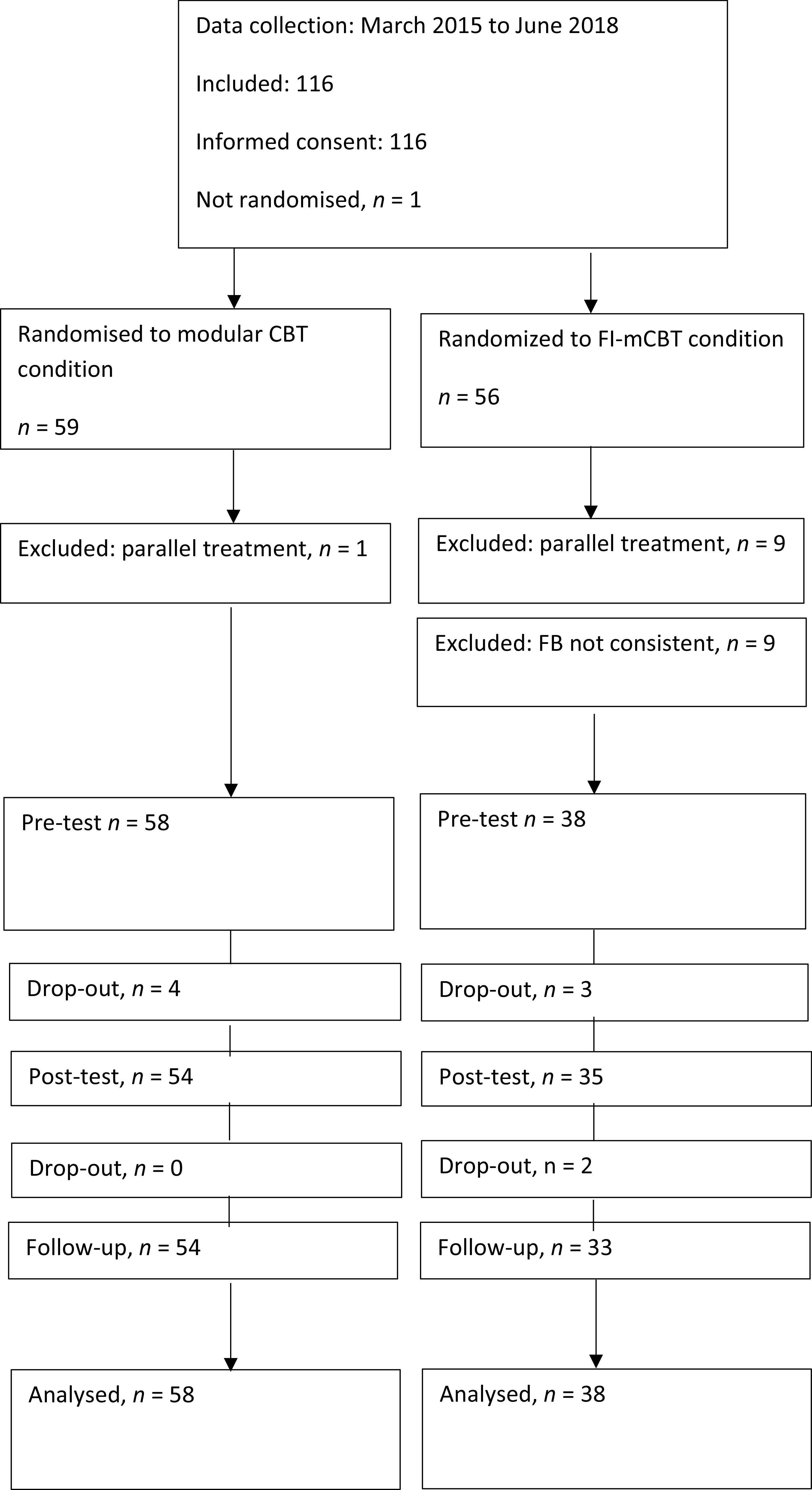
Children were randomly allocated to either the feedback informed modular CBT (FI-mCBT) condition or modular treatment without feedback (mCBT) condition; see Fig. 1 for the flow chart. Randomisation was performed individually at baseline assessment through an online tool. After a participant was entered in the system, randomisation was performed automatically, and group allocation became visible to the researcher. In both conditions, children and parents filled out questionnaires at multiple time points: baseline (T1), mid-test (after 5 weeks, T2), post-test (T3), and at 3-month follow-up (T4). Children and parents filled out a short questionnaire after each therapy session. Questionnaires were distributed by email and administered by the research coordinator (first author), who was independent of the therapist. The families received a 20 euro gift card after completing the follow-up assessment.
Flow chart of participants.

Children who did not consistently complete the feedback measures were excluded from this study (n = 9), which resulted in an uneven group sample size; see Fig. 1 for the flow chart. Included children in the feedback group did not differ from excluded children of the feedback group with respect to mean age, gender, or anxiety symptoms at pre-test. Therapists in the FI-mCBT group and mCBT group used the same modular treatment protocol and therapy was delivered individual and in person (face to face). In total, 58 therapists participated in this study. In the mCBT group (n = 58 children), 42 therapists participated. Mean age of the therapists was 34.06 (SD = 8.18, range 24–59) and years of experience as a therapist 9.46 years (SD = 8.19, range 1–40 years). In the FI-mCBT group, 29 therapists participated who treated 38 children. Mean age of the therapists in the FI-mCBT group was 36.39 years (SD = 8.76, range 24–63) and their years of experience 11.79 years (SD = 9.21 range 1–40 years).
It is important to mention that 13 therapists participated in both the FI-mCBT and the mCBT group. This was due to the randomisation at participant level upon giving consent to participate in the study; we did not randomise at therapist or treatment centre level. Mean age of these 13 therapists was 35.27 years (SD = 7.64, range 24–49 years), years of experience 9.62 years (SD = 8.01 range 1–25 years).
After each therapy session, children and their parents received a questionnaire by email and were instructed to complete the questionnaire at least one day before the next session (usually a week later). The questionnaire consisted of the Outcome Rating Scale (Child ORS; Miller and Duncan, Reference Miller and Duncan2004; Hafkenscheid et al., Reference Hafkenscheid, Been, Boer, Boon, Breukers, Crouzen, Teune and Wolff2006a), Session Rating Scale (Child SRS; Miller and Duncan, Reference Miller and Duncan2004; Hafkenscheid et al., Reference Hafkenscheid, Been, Boer, Boon, Breukers, Crouzen, Teune and Wolff2006b), and four questions regarding the child’s anxiety symptoms (avoidance, negative cognitions, anxious feelings, general anxiety). Therapists of children in the FI-mCBT condition received the child’s answers to these session questionnaires; therapists of children in the mCBT condition did not. Therapists of children in the FI-mCBT condition were instructed to start the session by discussing the feedback with the child. Therapists in the mCBT condition – who did not receive feedback – were instructed to start the session as they would usually do. Treatment fidelity was monitored using therapist report and observer report of the audio tapes of the sessions that were also used for the WAI-O-S. Therapists reported after each session which modules were used during that session and whether they used other material/content that was not included in the manual. In addition, observers coded from the audio tapes how much time was spent on each part of the module. We calculated that only 3% of the treatment time was spent on ‘other material/content’ (van Steensel et al., Reference van Steensel, Telman, Maric and Bögels2024).
Data analyses
This study used a mixed between-within design in which participants were randomly allocated to the FI-mCBT or mCBT condition, and anxiety symptoms were measured repeatedly (at pre-test, mid-test (after 5 weeks of treatment), post-test, and at 10-week follow-up).
First, preliminary analyses were performed using chi-squared tests (dichotomous variables, e.g. free of diagnosis) and t-tests (continuous variables; e.g. baseline SCARED-71 total scores) for group comparisons. A hierarchical linear model was used to examine whether the decrease in anxiety symptoms (SCARED-71) differed between conditions (FI-mCBT versus mCBT). Measurement occasions (pre-, mid-, post-, and follow-up assessment; level 1) were nested in respondents, and respondents (child, mother, father-report of child anxiety; level 2) were nested in families. Mid-, post- and follow-up assessments were contrasted against pre-assessment and entered as fixed effects. In addition, condition (FI-mCBT contrasted against mCBT) and its interaction with mid-, post- and follow-up assessments were included. Next, a hierarchical linear model was run to examine the possible effect of therapeutic alliance. Anxiety (measured by the SCARED-71 total score) was the dependent variable and therapeutic alliance, and its interaction with measurement occasions, was included as predictor. Variables were standardised and therefore the parameter estimate of the predictors can be interpreted as a measure of effect (Cohen’s d: .30 = small, .50 = medium, .80 = large; Cohen, Reference Cohen1992).
Results
Preliminary analyses
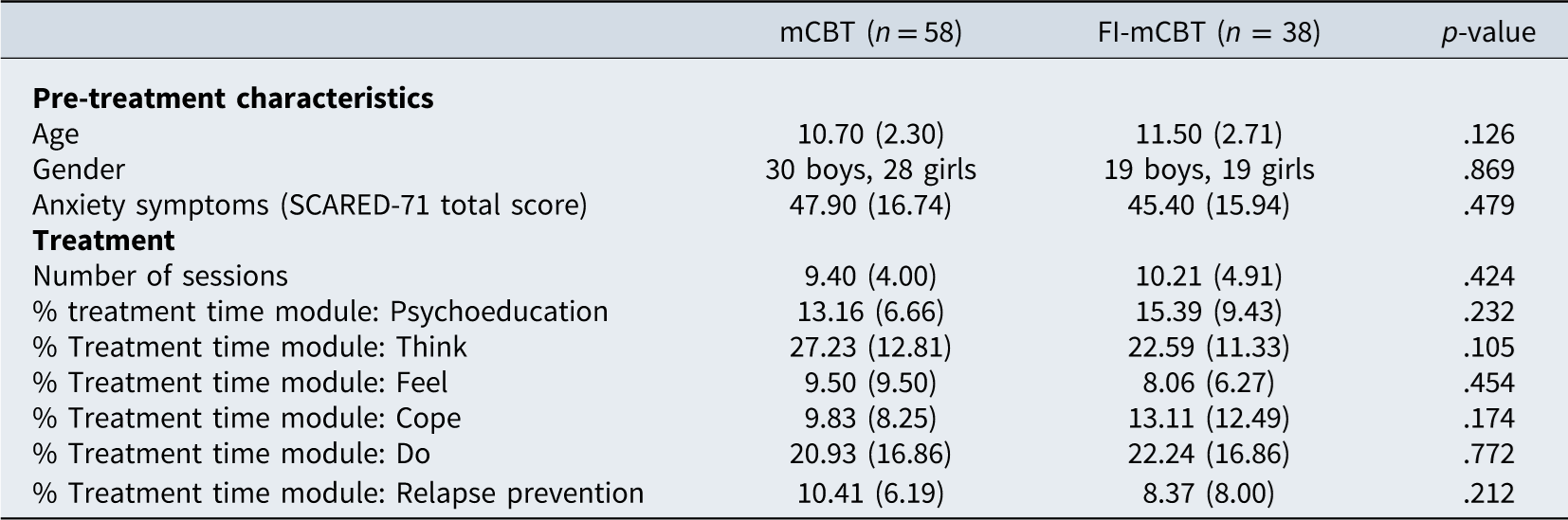
Children in the FI-mCBT condition did not differ from children in the mCBT condition with respect to mean age, gender, anxiety symptoms at pre-test, the mean number of sessions or treatment content; see Table 1. In both conditions, most of the treatment time was spent on the module ‘think’ (cognitive restructuring) and ‘do’ (i.e. exposure and/or experiments).
(Pre-)treatment characteristics of FI-mCBT and mCBT conditions

Table 1. Long description
A table comparing pre-treatment characteristics of FI-mCBT and mCBT conditions. The table has 12 rows and 4 columns. The columns are labeled as mCBT (n = 58), FI-mCBT (n = 38), and p-value. The rows are labeled as Pre-treatment characteristics, Age, Gender, Anxiety symptoms (SCARED-71 total score), Treatment, Number of sessions, % treatment time module: Psychoeducation, % Treatment time module: Think, % Treatment time module: Feel, % Treatment time module: Cope, % Treatment time module: Do, and % Treatment time module: Relapse prevention. Row 1: Pre-treatment characteristics, Did, 9; N 1, 28.221196; Bucket, bucket underscore 2. Row 2: Age, 10.70 (2.30), 11.50 (2.71), .126. Row 3: Gender, 30 boys, 28 girls, 19 boys, 19 girls, .869. Row 4: Anxiety symptoms (SCARED-71 total score), 47.90 (16.74), 45.40 (15.94), .479. Row 5: Treatment, Did, 9; N 1, 28.221196; Bucket, bucket underscore 2. Row 6: Number of sessions, 9.40 (4.00), 10.21 (4.91), .424. Row 7: % treatment time module Psychoeducation, 13.16 (6.66), 15.39 (9.43), .232. Row 8: % Treatment time module: Think, 27.23 (12.81), 22.59 (11.33), .105. Row 9: % Treatment time module: Feel, 9.50 (9.50), 8.06 (6.27), .454. Row 10: % Treatment time module: Cope, 9.83 (8.25), 13.11 (12.49), .174. Row 11: % Treatment time module: Do, 20.93 (16.86), 22.24 (16.86), .772. Row 12: % Treatment time module: Relapse prevention, 10.41 (6.19), 8.37 (8.00), .212.
mCBT, modular CBT; FI-mCBT, feedback informed modular CBT.
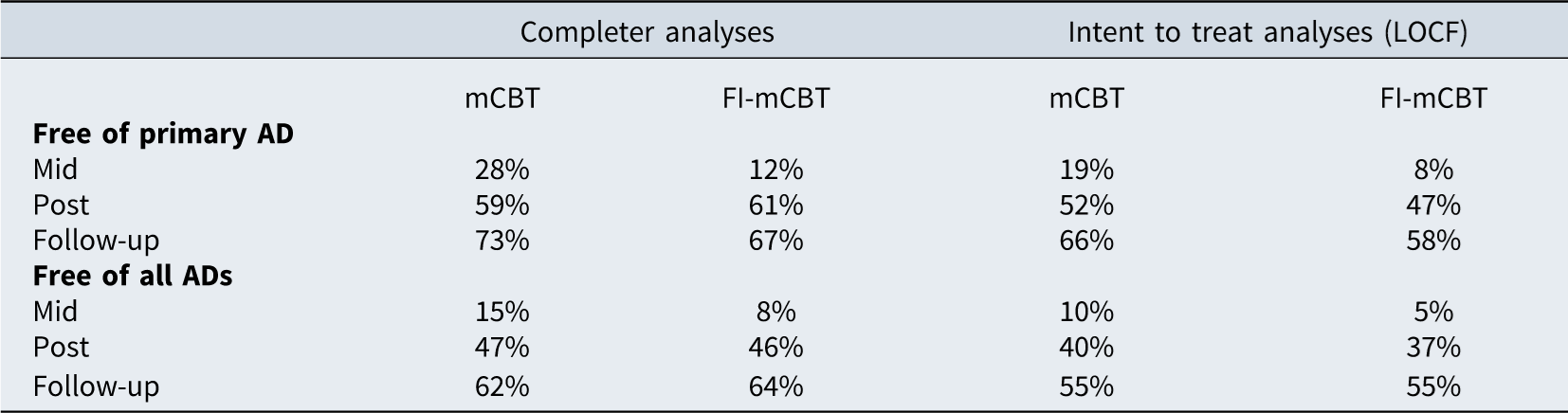
Next, children in the FI-mCBT condition did not differ from children in the mCBT condition in the percentage of children being free from their primary anxiety disorder, or in the percentage of children being free from all anxiety disorders (ranging from 55 to 64% at follow-up); see Table 2.
Percentage of children free of primary and all anxiety disorders over time

Table 2. Long description
A table comparing percentages of children free of primary and all anxiety disorders over time. The table has two main sections: Completer analyses and Intent to treat analyses (LOCF), each with two columns: mCBT and FI-mCBT. Each section contains data for three time points: Mid, Post, and Follow-up. The table has four rows and three columns. Row 1: Free of primary AD. Row 2: Free of all ADs. Column 1: mCBT. Column 2: FI-mCBT. Column 3: mCBT. Column 4: FI-mCBT. Row 1: Free of primary AD. Mid: mCBT 28 percent, FI-mCBT 12 percent. Post: mCBT 59 percent, FI-mCBT 61 percent. Follow-up: mCBT 73 percent, FI-mCBT 67 percent. Row 2: Free of all ADs. Mid: mCBT 15 percent, FI-mCBT 8 percent. Post: mCBT 47 percent, FI-mCBT 46 percent. Follow-up: mCBT 62 percent, FI-mCBT 64 percent. Row 3: Free of primary AD. Mid: mCBT 19 percent, FI-mCBT 8 percent. Post: mCBT 52 percent, FI-mCBT 47 percent. Follow-up: mCBT 66 percent, FI-mCBT 58 percent. Row 4: Free of all ADs. Mid: mCBT 10 percent, FI-mCBT 5 percent. Post: mCBT 40 percent, FI-mCBT 37 percent. Follow-up: mCBT 55 percent, FI-mCBT 55 percent.
AD, anxiety disorder; LOCF, last observation carried forward; mCBT, modular CBT; FI-mCBT, feedback informed modular CBT.
Main analyses
Does FIT predict treatment outcome?
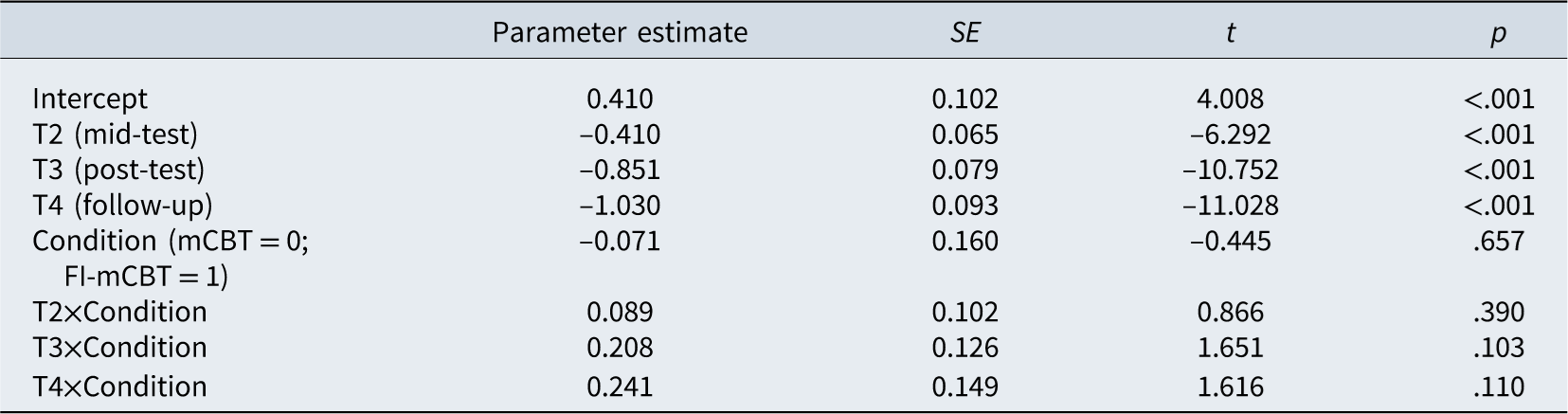
Results of the hierarchical linear model, displayed in Table 3, demonstrated a significant effect of time, but no significant condition or interaction (time×condition) effects, demonstrating similar decreases in anxiety symptoms over time for the FI-mCBT and mCBT condition.
Results of multi-level analyses examining effect of feedback on anxiety symptoms over time

Table 3. Long description
A table with 11 rows and 5 columns showing the results of a multi-level analysis examining the effect of feedback on anxiety symptoms over time. The columns are labeled Parameter estimate, SE, t, and p. The rows are labeled with different parameters and conditions. Row 1: Intercept, 0.410, 0.102, 4.008, <.001. Row 2: T2 (mid-test), -0.410, 0.065, -6.292, <.001. Row 3: T3 (post-test), -0.851, 0.079, -10.752, <.001. Row 4: T4 (follow-up), -1.030, 0.093, -11.028, <.001. Row 5: Condition (mCBT = 0; FI-mCBT = 1), -0.071, 0.160, -0.445, .657. Row 6: T2 x Condition, 0.089, 0.102, 0.866, .390. Row 7: T3 x Condition, 0.208, 0.126, 1.651, .103. Row 8: T4 x Condition, 0.241, 0.149, 1.616, .110. The table provides detailed parameter estimates, standard errors, t-values, and p-values for each condition and interaction effect.
mCBT, modular CBT; FI-mCBT, feedback informed modular CBT.
Does therapeutic alliance predict treatment outcome?
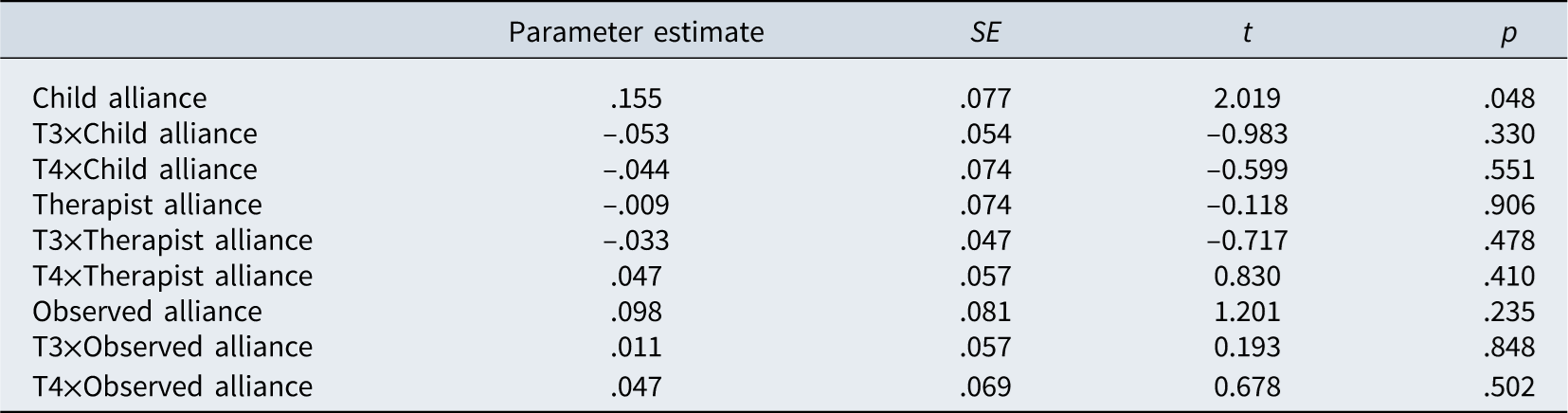
Post-treatment child, therapist, and observer reports of alliance were used to predict anxiety symptom reductions over time. Results of the hierarchical linear model are displayed in Table 4. A significant main effect of child reported alliance was found, indicating that stronger child-reported therapeutic alliance was related to higher anxiety symptoms. No significant interaction effects were found, indicating that child-reported alliance was not associated with a decrease in anxiety symptoms over time. For therapist-reported and observed alliance, no significant main or interaction effects were found.
Results of multi-level analyses examining effect of alliance on anxiety symptoms

Table 4. Long description
A table with 10 rows and 5 columns displaying results of multi-level analyses examining the effect of alliance on anxiety symptoms. The columns are labeled Parameter estimate, SE, t, and p. The rows are labeled with different variables related to child alliance, therapist alliance, and observed alliance. Row 1: Child alliance, Parameter estimate: 0.155, SE: 0.077, t: 2.019, p: 0.048. Row 2: T3xChild alliance, Parameter estimate: -0.053, SE: 0.054, t: -0.983, p: 0.330. Row 3: T4xChild alliance, Parameter estimate: -0.044, SE: 0.074, t: -0.599, p: 0.551. Row 4: Therapist alliance, Parameter estimate: -0.009, SE: 0.074, t: -0.118, p: 0.906. Row 5: T3xTherapist alliance, Parameter estimate: -0.033, SE: 0.047, t: -0.717, p: 0.478. Row 6: T4xTherapist alliance, Parameter estimate: 0.047, SE: 0.057, t: 0.830, p: 0.410. Row 7: Observed alliance, Parameter estimate: 0.098, SE: 0.081, t: 1.201, p: 0.235. Row 8: T3xObserved alliance, Parameter estimate: 0.011, SE: 0.057, t: 0.193, p: 0.848. Row 9: T4xObserved alliance, Parameter estimate: 0.047, SE: 0.069, t: 0.678, p: 0.502.
Only main effects of alliance and interaction with time are reported. Intercept and main effects of time are available upon request.
Discussion
The current study aimed to examine the effect of providing therapists with client feedback on modularised treatment outcomes for children with anxiety disorders and whether therapeutic alliance predicted treatment outcome. Main findings showed that (1) child feedback to the therapist did not predict better treatment outcomes in terms of decreases in anxiety symptoms and (2) therapeutic alliance – child, therapist, and observer report – did not predict a decrease in anxiety symptoms, but higher child reported therapeutic alliance was related to higher levels of reported anxiety symptoms.
That the FI-mCBT condition did not predict anxiety symptom decrease was contrary to our expectations. Previous studies indeed showed significant effects of FIT for adults, and tentatively for youth (Tam and Ronan, Reference Tam and Ronan2017), but this was not yet investigated in youth with anxiety disorders nor in modular therapy. We expected that providing feedback would predict treatment outcome, as therapists were able to adjust the content of the sessions based on the feedback that they received from the child. However, anxiety symptoms in our sample decreased regardless of whether feedback was provided or not. Several considerations may be important to understand this finding. First, the treatment content and number of sessions in both groups were comparable, and in both groups a decrease in anxiety symptoms and comparable percentages absence of diagnoses were found post-treatment. The extent to which the treatment was adjusted based on feedback in the FI-mCBT condition is unknown, but it seems that the treatments in both conditions were still largely alike. Modular CBT naturally incorporates feedback, as the therapist is expected to use client progress and client feedback to choose a module, based on shared decision (Venturo-Conerly et al., Reference Venturo-Conerly, Reynolds, Clark, Fitzpatrick and Weisz2023). Although the mCBT children did not provide direct feedback, therapists were still able to personalise treatment by changing treatment content and duration. This could explain the lack of differences in both groups, as it is not feedback that predicted the anxiety symptom decrease, but perhaps more so the personalisation of therapy.
It is further questionable whether therapists should adjust their treatment according to the feedback of the children. For example, exposure to the anxious stimulus plays a large role in anxiety treatment, and it is questionable whether therapists should stick to feedback when a child is showing resistance in participating in exposure exercises. Finally, clinical experience shows that a feedback approach – especially – for children could be useful, but it has also been questioned whether children are capable of providing feedback. This might especially hold for children with anxiety disorders. In this study children provided weekly feedback; however, around 16% of the children did not complete the feedback measures consistently and were therefore excluded from the study. Some children found it difficult to provide feedback regularly, possibly because the frequency in which we asked the children for feedback was too high, or because of their inhibited and shy temperament. In line with this, we observed trends in reporting high ratings of satisfaction with therapy, pointing to tendencies of socially desirable answers.
We found that therapeutic alliance did not predict treatment outcome. On the one hand, this is surprising as previous research and theory emphasised the positive role and effects on treatment outcome of alliance in child therapy (Karver et al., Reference Karver, De Nadai, Monahan and Shirk2018). On the other hand, the results from different earlier studies are less consistent and effect sizes are smaller than expected herein. Effects of multiple reporters are not always consistent across studies, and lack of agreement between reporters complicate interpretations (Zandberg et al., Reference Zandberg, Skriner and Chu2015). In our study, interestingly, child reported – but not therapist or observer reported – alliance was positively associated with child anxiety symptoms. This finding might reflect that for children with more (severe) anxiety problems, the therapeutic alliance is (rated) better because there is more agreement between child and therapists due to a higher need for help and/or a higher (child) motivation to change and/or more time (children with more anxiety problems might need more sessions) spent together.
Additionally, differences in alliance measures might explain the different outcomes in previous research. The alliance measure used in this study focused on agreement on goals, task, and the affective bond, based on the theoretical framework of Bordin (Reference Bordin1979). It could be that only parts of the alliance are relevant for children, and that the affective bond is more important than agreement on goals and tasks as children often are not as much involved as adults in determining goals and tasks (Karver et al., Reference Karver, De Nadai, Monahan and Shirk2018; Shirk et al., Reference Shirk, Karver and Brown2011). Moreover, previous studies showed that children tend to report stronger alliance compared with therapist and observer reports, and these reports do show moderate to strong associations (Roest et al., Reference Roest, Welmers-Van de Poll, Van der Helm, Stams and Hoeve2023; Zandberg et al., Reference Zandberg, Skriner and Chu2015). In our study, overall mean scores of therapist and child report did not significantly differ from each other, but child ratings were not significantly correlated with therapist and observer ratings (results available upon request); indicating that children and therapists might have a different perspective of the relationship. Future research should consider these differences, for example by using these differences as a source of information (Fjermestad et al., Reference Fjermestad, Lerner, McLeod, Wergeland, Heiervang, Silverman and Haugland2016) or add a qualitative component to get a better understanding of the aspects of the relationship that shape the alliance.
Strengths of this study include the innovative design of the study in which clinically referred children were randomly allocated to either the FI-mCBT condition or the mCBT condition and were given individual modular CBT to overcome their anxiety disorders. Moreover, this study was conducted in usual clinical practice, and community clinics participated in this study. This reflects high ecological validity. Nevertheless, implementation of this study in regular clinical practice, naturally brought challenges, such as practical restraints in relation to systematic monitoring of the implementation of client feedback in therapy. For example, children filled out feedback measures at home instead of immediately after the sessions. We are also not able to confidently state that all the therapists in the FI-mCBT condition indeed adjusted treatment content based on feedback. Reliably measuring the effects of feedback remains a point for further discussion. Furthermore, the children that did not complete the feedback measures were excluded from this study, leading to a smaller sample size for the FI-mCBT condition than originally planned. Although the hierarchical models included several time points and multiple reporters, the smaller sample size might have affected the power to find a small group difference. Indeed, post-hoc power calculations indicated that the study’s sample size is adequate to detect large to medium group differences; however, it is questionable whether it was possible to detect the small(er) group differences that are typically expected in FIT research. Finally, some therapists treated clients in both groups. These therapists could have been more inclined to check-in on symptom-level in the mCBT group; however, we did explicitly instruct them not to.
Directions for future research are to focus on smaller sample sizes with time series designs. In this way, strict monitoring of feedback seems more feasible. The use of single case studies as an alternative for large scale randomised controlled trials is receiving more attention and displays a shift to person-driven analyses instead of group level differences (Maric and Kok, Reference Maric and Kok2023). Single case designs can provide a more in-depth understanding of treatment effects, for example regarding the effect of treatment personalisation. In addition, from a clinical perspective, it seems evident that the therapist–child alliance plays a role in symptom reduction. However, the finding that the alliance did not predict anxiety symptom reduction could also indicate that other therapy factors are more important in (modular) CBT for anxiety disorders. Factors contributing to the therapist–child alliance are, for example, child involvement, motivation and therapist flexibility (Fjermestad et al., Reference Fjermestad, Lerner, McLeod, Wergeland, Haugland, Havik and Silverman2018; Hudson et al., Reference Hudson, Kendall, Chu, Gosch, Martin, Taylor and Knight2014). Moreover, the alliance between parents and therapists could also play a role, especially in younger children (de Greef et al., Reference de Greef, Pijnenburg, van Hattum, McLeod and Scholte2017; Karver et al., Reference Karver, De Nadai, Monahan and Shirk2018; Lebowitz et al., Reference Lebowitz, Omer, Hermes and Scahill2014).
To conclude, our study does not provide support for client feedback being predictive of outcomes in therapy for children and adolescents with anxiety disorders. We did not find therapeutic alliance to be predictive of anxiety symptom reduction in modular CBT for child anxiety disorders. Smaller in depth-studies are necessary to systematically disentangle the role of client feedback and shared decision making in therapy outcomes for child anxiety disorders. Given the variety of results of studies regarding the role of therapeutic alliance in therapy for children with anxiety disorders and the importance of this topic in theory for interventions, efforts should be made to understand the meaning of alliance in the context of childhood anxiety disorders treatment.
Data availability statement
The anonymous datasets are available from the corresponding author, upon reasonable request.
Acknowledgements
The authors thank all clinicians of the participating treatment centres for their contribution to the data collection of this study: UvA minds, Max Ernst GGZ (Buro van Roosmalen), Psychologenpraktijk Kuin Haarlem, Praktijk voor Leer- en gedragsadviezen Hilversum, de Kinderkliniek Almere, Ouder- en kindteams Amsterdam, Dokter Bosman, Jenneke Koster, Praktijk Eefde, Praktijk Appelboom, Altra Amsterdam, Psychologenpraktijk Waalre, TOP Psy&So Borne, AMC Psychosociale Zorg, GGZ Noord-Holland-Noord, Mediant Enschede, Indigo Den Haag, Karakter Ede, Reinilda Dernison, and Stichting Jeugdformaat.
Author contributions
Liesbeth G. E. de Paauw-Telman: Conceptualization-Equal, Formal analysis-Lead, Investigation-Lead, Methodology-Equal, Project administration-Lead, Writing - original draft-Lead, Writing - review & editing-Lead; Marija Maric: Conceptualization-Lead, Funding acquisition-Lead, Methodology-Lead, Supervision-Equal, Writing - original draft-Equal, Writing - review & editing-Equal; Susan M. Bögels: Conceptualization-Lead, Funding acquisition-Lead, Methodology-Lead, Supervision-Equal, Writing - review & editing-Equal; Francisca J. A. van Steensel: Conceptualization-Lead, Formal analysis-Lead, Funding acquisition-Lead, Methodology-Lead, Supervision-Equal, Writing - original draft-Equal, Writing - review & editing-Equal.
Financial support
This study was funded by a grant from ZonMw, the Netherlands Organization for Health Research and Development, project number 729101010. Open access funding provided by Utrecht University.
Competing interests
The authors declare none.
Ethical standards
This study was conducted conforming to the ethical principles of the Declaration of Helsinki. Participants were informed by the researcher, and informed consent was obtained from all individual participants (aged 12 years and older) and from their parents. Ethical approval for the study was given by the ethical committee of the University of Amsterdam (no. 2014-CDE-3916).

 Open access


Comments
No Comments have been published for this article.