At its core, the welfare state takes responsibility for promoting social and economic well-being by advancing public policies that Ann Orloff terms “care work.”Footnote 1 From a comparative perspective, the “dominant conception of the welfare state” among contemporary scholars is that “it represents a transfer of … goods and services from market determination to political determination.”Footnote 2 What is more, they explicitly or implicitly analyze the welfare state as if it were an institution based all but solely on market processes, such as how conflict, competition, and cooperation among economic interests achieve social policy outcomes, which most scholars view as requiring the state to redistribute economic resources by means of taxation.Footnote 3
While market processes may deliver care work, few if any, would claim that the market is responsible for care work in the normative sense of the word. Rather, the institution that is the most primary site not only for the delivery of care, but also for normative responsibility for care work is the family.Footnote 4 There are many ways to define a family, of course, but a common denominator is the designation of parents as responsible for the delivery of care work to dependent family members, at the very least, to children. The Oxford English Dictionary, for example, defines the word “parenting” as the job of “rearing a child or children” “to maturity,” a job that necessitates assuming responsibility for the provision of food, shelter, clothing, health care, and education if children are to survive, let alone thrive.Footnote 5
In Western European democracies, when parents do not fulfill this responsibility sufficiently, the responsibility for care work is transferred from the institution of the family to the institution of the state. The term for this transfer is parens patriae. In this research, I analyze the welfare state as parens patria writ large, that is, as a form of familial government in which the responsibility for care work is transferred not only from one particular family to the state for selected individuals, but rather for all in society who are in need of social provision, such that the public provision of goods and services becomes analogous to care work provided in the family. By so doing, I argue that market processes are necessary but not sufficient for explaining the development of the welfare state. What is also required is the analysis of the familial foundations of the welfare state.
A great deal of scholarship, of course, examines the relationship between the family and the welfare state, but in terms of the degree to which social provision includes family benefits for working parents, particularly mothers, or the impact such benefits have on other outcomes, such as the political participation of women.Footnote 6 Ann Orloff, for example, in her classic work points out that for women the key question is not how to become independent of the market (decommodified), but rather how to get into the market in the first place. And, once in the market, how to secure family-leave policies that support their dual roles in the home and on the job.Footnote 7 Similarly, in the work of Iversen and Rosenbluth, the key to understanding women’s placement in society is to understand their placement in the workforce, including the variables that promote or inhibit entry into the market.Footnote 8 What is more, scholarship on the relationship between gender and the origins and consequences of the welfare state is rich and diverse.Footnote 9
Analyzing the way the state provides benefits to family members and the way those benefits affect economic and political behavior, however, is not the same thing as analyzing the way the welfare state is an institution analogous to the family. It is this analogy that is missing from welfare-state scholarship. My research corrects that omission by analyzing the familial foundations of the welfare state in terms of its developmental connections to its familial antecedent, the monarchical state.
Prior to becoming democracies, most Western European countries were hereditary monarchies. Although contemporary welfare-state scholars have analyzed how historical legacies in general and monarchical legacies in particular have promoted welfare-state development, they have missed analyzing the single most relevant characteristic of monarchies for that development, namely, the familial foundations of the monarchical state. As this research establishes, it not merely that a dynastic family defines the pool of eligible monarchical rulers that makes the monarchical state a form of familial government. More importantly, it is that the office of kingship itself is defined to be a parental role that designates monarchs as responsible for the welfare of the people. As King James I put it, as a father ought to procure “his children’s welfare … so ought a good prince think of his people … for a King is trewly Parens Patria, the politique father of his people.”Footnote 10
The fact that monarchies are a form of familial government was recognized decades ago by Max Weber. As he noted, the monarchical state is one in which the “good king” rules as the “father of his people.”Footnote 11 Especially important, Weber argued that there was a developmental connection between the first form of familial government, hereditary monarchies, and what I term the second form of familial government, the contemporary welfare state. As he stated, a hereditary monarchy “must legitimate itself as guardian of the subjects’ welfare in its own and in their eyes. The [contemporary] ‘welfare state’ is the legend of patrimonialism, deriving … from the … relationship of father and children.”Footnote 12
Most theorists of the welfare state, however, see its development as grounded in economic imperatives and distributive political conflicts rather than as shaped, determined, or at least grounded in patrimonial histories based on monarchical legacies. This research expands current welfare state scholarship, therefore, by adding in the familial model. I first review explanations of the development of a welfare state as based on economic processes, and then I introduce the familial model. I establish that an attribute of the heritage of Western European monarchies is that they are care work regimes that designate monarchs to be responsible for the people’s welfare. I then use quantitative analysis to show that retaining the legitimacy of the first form of familial government, monarchies, in the course of Western European first-wave democratization makes it more credible to the public and to political elites to support the welfare state as the second form of familial government. That, in turn, promotes a more robust public sector supportive of social provision. In conclusion, I discuss how the results of the familial model of the welfare state prompt reconceptions of democracy in general and the welfare state in particular.
The Welfare State as Based on Market Processes
Contemporary Western European countries are democracies operating on the economic foundation of industrial capitalism. Economic processes, therefore, figure prominently in welfare-state scholarship. As Evelyne Huber and John Stephens note, scholars have developed three dominant models to explain welfare state formation—the logic of industrialism, a state-centric emphasis, and political class struggleFootnote 13—all of which rest upon market processes as based on economic goals. Wilensky’s early work on the welfare state, for example, emphasized that its development rested upon changing forces of production, specifically industrialization, which produced both a reliance upon wage labor and a demographic change based on a greater life expectancy. As the proportion of older people in society increased, so, too, did the proportion of those who were vulnerable, such as the old, as well as the sick and the young. These groups could not depend upon the market to provide for their economic needs, and so the state expanded to take on the responsibility for providing care work.Footnote 14
What is more, still today economic processes remain the major focus for scholars analyzing the welfare state. Definitions of the market as an institution categorize it as a site of economic activity based on processes of exchange, competition, and cooperation among its membership, and measurements of economic success and failure.Footnote 15 Hence, a great deal of welfare-state scholarship analyzes the way competing economic interest groups vie for control of public policy agendas. Korpi’s power resource theory, for example, contends that the rise of capitalism in conjunction with democracy gave to the masses a means to demand social provision from the elite.Footnote 16 The key to understanding the welfare state, therefore, is to understand the way left-leaning parties align with trade unions to secure legislation supporting labor.
In addition, some connect market processes to institutional structures more generally as well as to voter turnout.Footnote 17 In the case of the latter, for example, Iversen argues that partisan competition produces higher voter turnout, which includes previously under-represented lower class groups. The result of their participation shifts political power to the left.Footnote 18 Others point to how the structures of the government promote or hinder the success of class-based economic welfare policies.Footnote 19 Specifically, systems that are decentralized with multiple veto points, such as the United States, limit the ability of political parties to pass welfare oriented legislation.Footnote 20 Similarly, as Iversen and Soskice argue, a key political structure affecting development of the welfare state is whether a country has a proportional representation (PR) representative structure, because it is this type of party system that facilitates left-oriented redistribution policies in contrast to majority “take-all” systems that do not.Footnote 21
When we turn to one of the most important typologies of welfare regimes, that of Esping-Andersen, once again we find that the market and labor are the key. He defines welfare provision, for example, as the degree to which the government provides policies that “decommodify” workers, by which he means policies that make the worker less dependent upon the market for the provision of economic needs.Footnote 22 Furthermore, he thinks the “history of political class coalitions” is the most decisive cause of welfare-state variations.Footnote 23 More recently, although prominent welfare state scholars introduce the principle of cooperation, the players remain defined by economic interests. Duane Swank and Cathie Martin, for example, show that welfare state development is more robust when employers and workers cooperate to achieve legislative goals.Footnote 24
The Welfare State as a Family
The family as Market Processes
In much contemporary scholarship, so too does the family become a sort of mini-market operating on the basis of exchanges, competition, and cooperation among member entities, where economic measures define its success or failure. Thus, Becker in his initial classic work on the family stresses the division of labor among family members, particularly the parents, and employs common preference efficiency models to evaluate outcomes for the family as a unit.Footnote 25 In this model, the family is best understood as a one unit decision-making entity in which family resources are pooled in order to make the most of their utility. Individual decisions within the family generalize to reflect the utility of other family members as constrained by joint budget limitations.Footnote 26
Others, however, contend that individual family members do not always pool their resources and that there can be conflicting preferences among family members that subvert the convergence of utilities.Footnote 27 Consequently, members of a family can come into conflict and competition with one another. The dominant political economy model for the family is better represented by bargaining rather than consensus principles. Bargaining outcomes are best analyzed in terms of three aspects of family dynamics: who in the family has the most control over income; threats points defined in terms of utilities that are available outside compromise positions or outside the family itself; and shift factors defined by changes in outside opportunities that influence the bargaining power of family members.Footnote 28 Even more recently, Iversen and Rosenbluth build upon Becker’s view of the family as a welfare maximizing unit by developing a political economy model of the family. In so doing, they integrate micro-level economic decisions based on bargaining within the family with macro-level economic processes of production.Footnote 29
The Family Is More Than a Market
The family, however, is more than a set of market processes. This is because a market is not responsible for care work, but the institution of the family is. Scholars note, of course, that the family is an institution characterized by diversity in structure and composition, both historically and still today. What is more, utilitarian analyses based on market calculations and processes reveal important dynamics inherent in all institutions, including the family. However, despite these heterogeneous and utilitarian dimensions, scholars also identify a fundamental definition common to all forms and processes characterizing the family, namely, that it is an institution that has “two or more persons related by birth, marriage, adoption, or choice … with socio-emotional ties and enduring responsibilities, particularly in terms of one or more members’ dependence on others for support and nurturance.” Footnote 30
Parens Patria Is More Than a Market
Of course, defining families as institutions that deliver care work has normative implications. Clearly, this is what parents in a family should do if they are to fulfill the norms defining parental roles much like fire fighters should put out fires if they are to fulfill the norms defining their employment roles. However, as is well documented, the family as an institution can, and often is, the site of oppression, neglect, and physical (if not sexual) and emotional abuse. When parental dysfunction reaches threshold levels that put children at risk, not only the delivery of care work, but the responsibility for the delivery of care work is transferred to the state. The term for this transfer is parens patria, which literally means “parent of the nation.” It refers to the legal doctrine that the government intervenes in family situations and other contexts when it is necessary to protect the “‘health, comfort, and welfare’ of the people.”Footnote 31 It was a legal component of a monarchical regime as codified by Blackstone. He noted that even in early English common law, the Lord Chancellor, as derived from the English sovereign, was the “general guardian of all infants.”Footnote 32
The Welfare State As Parens Patria
So, too, does the modern welfare state entail more than economic processes defined by competition or cooperation between economic groups, fiscal organization or resources, and political structures that maximize or limit welfare benefits. As Esping-Andersen notes, the welfare state also constitutes a response to the failure of the market or the failure of the family to deliver adequate social provision.Footnote 33 What is missing from such observations, however, is that to the extent that the welfare state does constitute a transfer of care work from the family to the state, the welfare state becomes an institution that not only delivers care work, but also an institution that is responsible for care work.
Scholarship on the way the state intervenes or determines family relationships, of course, is vast. Political scientist Patricia Strach, for example, notes that too often scholars think about the family as a “private institution best left to sociologists and demographers,” rather than as a building-block upon which the development of the American state rests or any other state rests, I might add.Footnote 34 As she and others establish, however, the family is anything but private. One’s family status is often more salient than one’s status as an “individual” when it comes to civil and political rights. This is because governments use family status to regulate immigration, citizenship, the provision of public benefits, and tax policies, not to mention the institution of marriage.Footnote 35 What Strach does not consider, however, is the degree to which the family and the state are both premised upon the principle of being responsible for care work. That is, the degree to which the family and the state are analogous institutions.
Work by Carol Nackenoff also dramatically establishes that the boundaries between the family and the state are porous, and that it is often the so-called private sphere of the family that drives the political development of the so-called public sphere of the state.Footnote 36 Similarly, in a classic work, Frances Olsen insightfully analyzes three supposedly dichotomous relationships between the family and the market, civil society and the state, and men and women.Footnote 37 She shows how the interconnections between these institutions contradict assumptions about their separation. In particular, she discusses the way the state intervenes in the family.Footnote 38 She also claims that the family and the market are similar rather than distinct because both exhibit altruism and self interest. Furthermore, she traces relationships back to feudal times, which she analyzes as constituting a fusion between civil society and the state. Missing from her incisive perspectives, however, is attention to the analogy between the family and the state. Yet in feudal times it was exactly this analogy that served as a foundation for monarchical government in Western Europe. As Weber noted, kings ruled as the father of the people.
The argument here, therefore, is that transferring care work from the market to the state is distinctly different than transferring care work from the family to the state. This is because transferring care work from the market does not include transferring responsibility for care work because the market is not responsible for care work in the first place. By contrast, the family is. Hence, transferring care work from the family to the state entails more than just the delivery of care work. It also includes transferring the responsibility for care work, thereby constituting the family and the state as analogous institutions. The welfare state, therefore, can be thought of as the principle of parens patria writ large. When the family no longer can provide sufficient health benefits, educational services, or protections for working-class laborers, the delivery as well as the responsibility for providing health care, education, and working-class benefits is transferred from the family to the government.Footnote 39
Monarchical Legacies: The Antecedent of the Welfare State
The welfare state is not the first form of government in which the family is analogous to the state. Rather the first form is the monarchical state. Welfare-state scholars have considered monarchical legacies to be important for the development of the welfare state, but even a cursory review of their analyses shows that they have failed to examine the consequences for welfare-state development of the analogy between the family and the state that the monarchical state exemplifies. Instead, they customarily focus on monarchies as related to authoritarian and partisan legacies.Footnote 40
Monarchical Legacies As Authoritarianism
As Esping-Andersen argues, history matters a lot when explaining social provision, particularly the regime types from which welfare states develop. He contends that “the historical characteristics of states have played a determinant role in forging the emergence of their welfare-statism.”Footnote 41 Included in Esping-Andersen’s historical perspective is attention to monarchies as precursors to certain types of welfare states due to a history of what he terms the “monarchical welfare state,” or what historian Ralph Bowen refers to as “monarchical socialism.”Footnote 42 This regime type is a corporatist model characterized by class harmony rather than class competition due to the way rulers impose authoritarian discipline. In Germany and Austria, for example, such a regime type succeeded in fragmenting and dividing competing class interests, and, “tellingly … [these countries] were among the world’s leading welfare spenders both prior to, and after, Nazism.”Footnote 43
Similarly, Huber and Stephens define the historical variable of interest to be the degree of monarchical authoritarianism characterizing a country’s history.Footnote 44 However, along with Esping-Andersen, they ignore the familial foundations of the monarchical state. In another notable work, Julia Adams examines how familial networks in the seventeenth century in The Netherlands accounts for its unification and successful colonialization based on mercantile dominance.Footnote 45 However, although her analysis illuminates the market dynamics of kinship politics among members of the monarchy and economic elites, it does not address kingship as a care-work regime based on an analogy between the family and the state.
Monarchical Legacies As Partisanship
Other welfare-state scholars contend that monarchical legacies promote the development of left-leaning political parties as a crucial component of welfare state development.Footnote 46 Decades ago, for example, Louis Hartz is notable for arguing that left-wing parties promote the development of the welfare state, and that it is the right that inspires the left. As he put it, “socialism is largely an ideological phenomenon, arising out of the principles of class and the revolutionary liberal revolt … [against] the feudal ethos. The ancien regime inspires Rousseau; both inspire Marx.”Footnote 47
Seymour Martin Lipset also thought that monarchies affect the development of political parties, but in an opposite way. He thought conservative political parties promoted welfare-state development, and that monarchies promoted conservative parties because a monarchical society is premised upon a view of society as a collective, class-based hierarchy in which the privileged are obligated by a principle of noblesse oblige to assist those who are less advantaged. As he stated, in the case of Canada “the values inherent in monarchically rooted Tory conservatism give rise in the modern world to support for social democratic … welfare policies.”Footnote 48 Canadian historian Gad Horowitz agrees, noting that “socialism has more in common with Toryism than with [classic] liberalism, for liberalism is possessive individualism, while socialism and Toryism are variants of collectivism.”Footnote 49
Monarchical Legacies As Care Work Regimes
The problem with contemporary analyses of the way monarchical legacies promote welfare-state development, however, is twofold. First, scholars have not conducted cross-national empirical work to test the relationship between monarchical legacies and welfare-state development. Rather, they cite selected countries, such as Bismarck’s Prussia in the case of authoritarianism or Canada in the case of political parties, leaving open the question as to whether these examples of the impact of monarchical legacies represent a pattern that could be discerned in a more complete set of Western European democracies.
Second, contemporary scholars have completely missed the most salient characteristic of the monarchical state that maps onto welfare-state development, namely, its familial foundations.Yet it was the familial principle of the monarchical state that Weber viewed as most important. In his analysis, a major type of traditional authority is patrimonialism, which derives from the solidarity of the family.Footnote 50 Although he, too, neglected to do an empirical, cross-national analysis of the impact of monarchical legacies on welfare-state development, he nevertheless identified the key characteristic relevant for that development: the familial foundation of the monarchical state. As he noted, the authority of the patrimonial ruler in the political realm is modeled after the authority of the father in the family. In both cases, the father/ruler is limited by the way he “‘owes’ something to his dependents, namely, humane treatment and a limit upon exploitation.”Footnote 51 In this way, “patrimonial government is an extension of the rulers’ household in which the relation between the ruler and his officials remain the basis of paternal authority and filial dependence.”Footnote 52
Monarchies as Familial Government
The Job of Being a Monarch: Care Work
Most, of course, would agree that hereditary monarchies are founded on a familial principle in the sense that a dynastic family based on kinship and matrimonial ties defines the pool of those eligible to be chosen as kings or queens. In this way, the monarchical state fuses the public and the private. When women of the dynastic family give birth, for example, they are doing political work by contributing to the pool of eligible sovereigns.
What is less recognized, however, is that the definition of the office of kingship or queenship is as a job that is analogous to the job of a being a parent, meaning that the monarch is responsible for the care of people as if that monarch were the parent of the people.Footnote 53 The principle that the responsibility for care work is built into the very definition of what it means to have the job of being a king or queen dates back at least to Aristotle. He defined monarchy as government by a single person for the general good. By contrast, a tyrant is a ruler oriented toward his own private self-interest, and, by virtue of that orientation, is not a king at all.Footnote 54 Similarly, as early as the fifth century, Symmachus advanced a theory of monarchy in which the king’s power, as derived from God, was contingent upon the king’s use of that power for the public good. As such, the divine power possessed by kings is lost by their misuse of it.Footnote 55
In the early eleventh century, Manegold of Lautenbach, a priest seeking to defend the authority of the papacy against that of a king, asserted another early and fascinating social contract theory of kingship in which the king’s very legitimacy to rule is based on his orientation toward the well-being of the people. Manegold, using a provocative metaphor, explicitly compared the job of being a king to the job of a being a swine herder. He argued that if a man entrusts his swine for a suitable wage to a swine herder, who, instead of keeping them safe, steals, slays, or loses them, the man not only will refuse to pay the wage, but will dismiss the swine herder from service. By that analogy, “any king who tries to drive his people into error instead of governing them, [should] be deprived of all power.”Footnote 56
We see continued affirmation of a theory of kingship as care work even in times of political struggle. The Dutch Declaration of Independence of 1581, for example, depicts kingship as a parental, care taking role:
It is apparent to all that a prince is constituted by God to be ruler of a people, to defend them from oppression and violence as the shepherd his sheep; and whereas God did not create the people slaves to their prince … but rather the prince for the sake of the subjects … to love and support them as a father his children. Footnote 57
Similarly, it is clear that early modern political theorists, such as Erasmus, viewed monarchs as duty-bound to care for the people in a way that is analogous to the duty of parents to care for their children. As he stated,
The good prince must have the same attitude toward his subjects as a good paterfamilias has towards his household; for what else is a kingdom but a large family, and what is a king but the father of very many people … [thus, the prince] who undertakes to govern must … take account of the other people’s interests and disregard his own; he must keep watch so that others are allowed to sleep; he must work so that others may take their leisure … His mind must be drained of all personal feeling, and while he is engaged in public business he must think of nothing but the people.Footnote 58
John Locke also echoes the view that kingship is a regime type defined by familial precepts. As he stated in his Second Treatise, people originally sought the rule of one man who would rule “with Care and Skill, with Affection and Love to those under it … [who would be] nursing fathers tender and careful of the public weale.”Footnote 59
By contrast, Machiavelli is notable as an early modern theorist who contradicted the dictate that monarchs should be guided by a duty to care as if they were the parents of the people. In contrast to his contemporary, Erasmus, he makes no claim that the state is analogous to the family. Rather, Machiavelli acknowledges that he “may be thought presumptuous” because what he has to say “differs from the precepts offered by others.” As he states, “a ruler who wishes to maintain his power must be prepared to act immorally when this becomes necessary.”Footnote 60
In this way, Machiavelli is the exception that proves the rule that the dominant view of the monarchical state in early modern Europe was as an institution analogous to the family in which the monarch had a duty to care for the people as a parent has a duty to care for the family. Machiavelli considered himself to have diverged from the norms of the times. And he did. Even the most vehement critiques of monarchies by Republican theorists in this time period, for example, often agreed that monarchies as an institution are analogous to the family. The problem they saw, however, was that kings were not able to sustain their parental orientation toward the welfare of the people. Thus, by default, in practice monarchies became tyrannical institutions based on corruption, self-centered opulence, and self-interest in general. Monarchical critic, Algernon Sidney, for example, noted that “Kings by the law of nature are obliged to seek chiefly the good of the kingdom.”Footnote 61 The problem, however, is that this is not what kings do. Rather, as he argued, if one consults history, one finds “Herod, Tiberius, Caligula” and other kings that exhibit anything but “a tenderness of affection towards their people as towards their children.”Footnote 62
Similarly, as another monarchical critic, James Tyrell, stated, “For my own part I reverence Monarchy above all other forms of Government … the fault is not in the [monarchical] Government … but in humane Nature, which is not often found sufficient … to support and manage … the good and prosperity of that Empire which God had trusted them withal.”Footnote 63 America’s Thomas Paine also thought that kings could not act in the interest of the people, and, for that reason, monarchies were an untenable form of government. As he put it, “If there existed a man so transcendently wise above all others that his wisdom was necessary to instruct a nation, some reason might be offered for monarchy; but when we … look around the world, … [we] see that … kings are the most insignificant in [that] capacity.”Footnote 64 As Blair Worden notes, therefore, Republicans’ critiques of monarchy as a form of government were not theoretical, but historical because they believed that “virtuous kingship [in practice] was the remotest of possibilities.”Footnote 65
Liberal political theorist John Locke, however, did attack the theory of the monarchical state. In so doing, he did not dispute the view that a monarchy is a form of the state that is analogous to a family. Rather, he refuted the principle that the form of the state should be analogous to a family. This is because he considered the family and the state to be ruled by distinctly opposite principles. As Locke explained, the family is ruled according to a paternal principle based on the inequality of its members—children and their parents—with parents designated as the rulers of the family.Footnote 66 The state, on the other hand, is ruled according to a political principle based on the equality of its members, which requires their consent to be governed.Footnote 67 As result, the family and the state are in separate spheres, private and public respectively. Consequently, according to Locke, the monarchical state and the liberal state are based on orthogonal principles of rule.
First Wave Democratization: What Happens to Monarchies?
Most Western European countries were monarchies prior to becoming liberal democracies, a transition scholars term first wave democratization. In addition, most would concur that liberal theory in general and John Locke in particular were powerful influences in this transition leading to the development of the early modern state as exemplified by the founding of the United States in 1776/1789 (Declaration of Independence/adoption of the Constitution) and the French Revolution of 1789.Footnote 68 Given the liberal principle that the monarchical and liberal states are orthogonal, one might assume that when Western European countries democratized, they destroyed their monarchical heritages as being incompatible and dissonant with the liberal forms of government they were establishing, as did the United States and France.
Even a cursory look at Western European countries, however, belies the expectation that democracy was founded on the destruction of monarchical legacies. This is because the most usual form of first wave democratization was to retain the institution of familial government, that is, a monarchy, even though it is orthogonal to the principles of a liberal democracy. The countries that followed this path are Sweden, Denmark, Norway, the United Kingdom, Australia, New Zealand, Canada, The Netherlands, Spain, Belgium, Luxembourg, and Liechtenstein.
The second most usual way to democratize was simply to evolve peacefully from monarchies to democracies by retaining the legitimacy of familial government even if not retaining it institutionally. Some countries did so by means of referenda, in which people voted to let their monarchies go or not, such as in Greece, Italy, and Iceland, while in other countries, the monarch simply went into exile never to return, as in Germany and Austria. The least usual way to democratize was to destroy a country’s monarchical heritage by means of a violent revolution that institutionally and ideologically delegitimized familial government in the course of establishing a democracy. Only three countries did so, the United States, France, and Portugal.
Monarchies Matter
What Difference Does It Make?
Many, of course, might claim that what happens to monarchies in democratization processes is irrelevant because even if some Western European countries retained their monarchies, they have retained nothing more than antiquated symbols of a distant past. Furthermore, they might contend that it is unimportant whether countries differ on retaining, evolving away from, or destroying their monarchical legacies because monarchies in Western European countries have no real political power.Footnote 69 To do so, however, is a mistake because today’s Western European monarchies are a component of a contemporary political environment that infuses and affects the everyday lives and attitudes of people in many ways. In the case of countries that have retained their monarchies, for example, a dynastic family is not only a constitutional component of government, but one that is insulated from the partisan conflicts and negotiations defining electoral politics. Queen Elizabeth II, for example, has prevailed as the sovereign of the United Kingdom for over 60 years during which time a dozen Prime Ministers representing a wide range of partisan orientations have come and gone. Monarchs, therefore, are not aligned with particular political or economic interests, but rather with all of the people as a whole, as rituals and celebrations often signify, such as Queen’s Day in The Netherlands or the Maundy ritual in England.
What is more, the currency and coins of constitutional monarchies celebrate their patrimonial legacies with depictions of monarchical sovereigns, and in some constitutional monarchies, such as Norway and Sweden, coins are termed “crowns” (kroner, kronor). In addition, in constitutional monarchies it is common for universities, hospitals, streets, bridges, cities, and other such everyday entities to be named for a country’s monarchs, such as Queen’s University in Canada; Queen Victoria Hospital in Melbourne; Queen Louise’s Bridge (Dronning Louises Bro) in Denmark; and Leopoldsburg, a city in Belgium named after Leopold I of Belgium.
On the other hand, for those countries that severed the connection of the family to the state by a revolution that ideologically and institutionally destroyed their monarchical legacy, that heritage also remains in the psyche of people as rituals celebrating that revolutionary destruction. In the United States, for example, that destruction is celebrated to this very day by means of celebrations, such as on July 4, where fireworks remind everyone of the “war” for independence. In France, the comparable celebration is Bastille Day on July 14. In Portugal, the comparable holiday is Republic Day, October 5, which celebrates the end of the monarchy.Footnote 70 What is more, we know from historical institutionalists that history matters. This is because, as political scientists Paul Pierson and James Mahoney note, historical legacies “set development along a particular path” on the basis of critical junctures that make it progressively more difficult to return to initial historical contexts when multiple alternatives were still available.Footnote 71 Once a particular path is set and policies based on that path are in place, it becomes exceedingly difficult to reverse historical processes by dismantling those policies.Footnote 72
Assimilating a monarchical legacy to liberal democracy by retaining hereditary monarchies when democratizing in effect retains the principle of familial government, which is the very principle supportive of the modern welfare state. This sets up a path that reinforces the ideological and institutional legitimacy of familial government, that is, the assumption by government of parental roles—even if only in symbolic form.
The Symbolic Importance of Monarchical Legacies
As Pierre Bourdieu notes, symbolic power is crucial in political systems for establishing legitimacy.Footnote 73 When people use coins and currency depicting their monarchs, follow directions on streets named after their monarchs, attend schools and churches named in honor of their monarchs, they are encountering everyday reminders that the past is present in the form of their monarchical legacy. That is to say, their everyday lives are infused with symbols attesting to the legitimacy of the analogy between the family and the state in its first form, hereditary monarchies. In the case of coins and currency, that reminder is especially salient because, as Josh Lauer notes, scholars have overlooked the way money is a form of mass communication that links the government with the populous.Footnote 74 The intrinsic value of paper money, for example, is worthless. It is the iconography used on currency and what those visual images symbolize, therefore, that imparts to paper money its value, defined in terms of the government’s authority and legitimacy as well as the political and economic stability of the political system.Footnote 75 Money, therefore, is not only a medium of economic exchange, it is also a medium of political representation.Footnote 76 Or as Simmel argued, money is “a reification of the social whole.”Footnote 77
All Western European constitutional monarchies depict their past or current monarchical heritage on their coins or currency, thereby endorsing a political representation of the state in which there is an analogy between the family and the state. The question is: Does such symbolic infusion in every day life have an effect on public attitudes about the relationship between the family and the state? According to scholars who study the feedback effects of political institutions and policies, the answer should be “yes.”
Monarchical Legacies: A Policy Feedback Mechanism
The growing policy feedback literature argues that historical and institutional features of a political system as well as government policies influence public attitudes about welfare provision.Footnote 78 Of course, public attitudes affect the adoption of politics in the first place. However, once those policies are in place, there are feedback processes in which those policies then teach people who should be included in social provision and what are the legitimate roles of government, thereby affecting the public attitudes responsible for policies in the first place.Footnote 79 In addition, welfare state scholars have established that public attitudes affect the level of welfare provision. Clem Brooks and Jeff Manza find, for example, that measures of public opinion do explain levels of social expenditure in 14 Western countries and Japan.Footnote 80
Since public attitudes affect social provision, from a policy feedback perspective, the question becomes what types of institutions and policies affect public attitudes? The usual suspects, of course, are age, sex, religion, income, occupation, etc. According to Jeremy Mayer and Lee Sigelman, however, monarchies affect public attitudes, a perspective they fault political scientists for ignoring in the study of democracies.Footnote 81 As they noted, throughout history monarchies have been the dominant form of government and are retained in many Western European democracies to this very day.Footnote 82 Launching an effort to take monarchies seriously, they evaluated the relationship between monarchies and democracies.Footnote 83 They established that retaining a monarchy promoted a wide range of public attitudes supportive of democratic values, such as interpersonal trust, public support for the political system, and democratic performance.
Monarchies, however, are missing from current lists of policies that researchers study as affecting public attitudes. My research corrects this omission by testing the proposition that monarchical legacies teach people to view the state as responsible for the welfare needs of the disadvantaged, which in turn affects levels of social provision. As such, monarchical legacies affect public attitudes as a mechanism that in turn affects welfare-state development. The argument is that the degree to which a country retains the legitimacy of familial government in its first form, the monarchical state, will affect the degree to which the public supports familial government in its second form, the welfare state, which in turn will affect the degree to which a country develops a robust welfare state defined as transferring care work from the family to the state.
The Patrimonial Model
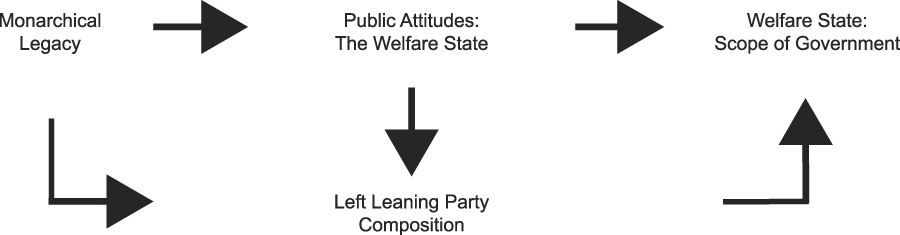
The vast scholarship on the welfare state is nothing if not remarkable for the array of variables found to be important. Adding in monarchical legacies—patrimonialism—as mechanism affecting public attitudes, therefore, is meant to be just that—an addition, not a substitution, for economic and political structure variables that researchers have found to be crucial, such as left-leaning party composition, union density, electoral systems, tax revenue, veto points, and federalism. Of these, left-leaning political parties have been found to be particularly important for welfare-state development.Footnote 84 In addition, as noted above, some scholars argue that monarchical legacies also affect development of left-leaning political parties. This research models and tests these perspectives, as diagramed in figure 1.Footnote 85 The three core hypotheses are:
H1: Patrimonialism affects public attitudes about the welfare state.
H2: Patrimonialism and public attitudes affect left-leaning party composition.
H3: Public attitudes and left-leaning party composition affect public spending on social provision and welfare benefits.
The Patrimonial Model: Monarchical Origins of the Welfare State

The four key variables of the patrimonial model, therefore, are patrimonialism, public attitudes, left party composition, and welfare spending/benefits. They are measured as follows.Footnote 86
Patrimonialism: Monarchical Legacies
Becoming a democracy is a long term and ongoing process with shifts in the way patrimonialism is retained, abandoned, destroyed, or restored. In England, for example, in 1649 Charles I was executed and the monarchy was abolished only to be later restored and retained to this day. Similarly, the history of France evinces annihilation, restoration, and eventual disengagement with its monarchical heritage. In the twentieth century, however, the last Western European country to resolve its patrimonial legacy was Spain. Here, the law had provided for the suspension—not the destruction—of the Spanish monarchy, to be restored after Franco’s death. Thus, in 1975, the monarchy was restored, and King Juan Carlos became head of state. The status of Western European monarchies has remained stable as of this date.
Consequently, I measure patrimonialism as based on a country’s monarchical legacy defined by the status of its monarchical heritage as of 1975. Countries are scored as an ordinal scale as “low” on the basis of using a revolution that destroyed the ideological and institutional legitimacy of their monarchical heritage without its restoration as of 1975 to the present; “medium” if the legitimacy of their monarchy was preserved even though it was replaced with a democracy by means of exiling their sovereign or referenda votes; “medium” if Commonwealth countries with a monarchical heritage retained on the basis of colonial and collective relationships; and “high” if their monarchies have been retained to this very day.
Public Attitudes: Is a Democratic State Responsible for Care Work?
I use the World Value Survey, 2005, to assess public attitudes about the responsibility of the state to provide care work to those in need. I use two questions as well as their additive combination. Both questions are measured on a ten point scale, where “1” is no and “10” is yes:
1 Do you think it is an essential characteristic of democracy for governments to tax the rich and subsidize the poor?
2 Do you think it is an essential characteristic of democracy for people to receive state aid for unemployment?
These questions explicitly address the principle that it is not only the responsibility of the state to provide care work for those in need, but that to do so is an essential characteristic of democracy. The first question does so in the context of society in general, and the second does so specifically for the working class. When assessing public attitudes about the welfare state, I control for the following variables included in the World Value Survey: Political orientation and demographic characteristics (sex, age, income, education, urban residence, occupational status, employment status, marital status, religious orientation, father’s immigration status).Footnote 87
Left Party Composition
I use the Comparative Manifesto Project data to measure the degree to which left-leaning parties are elected to office. I use an average of the elected left-leaning party representation as calculated over at least five years. When assessing the impact of public attitudes and left party composition on welfare state spending, among the variables I control are veto points as based on constitutional structure, union density, and tax revenue.Footnote 88 Veto points measure the “degree to which a constitution provides for entry points for minority interest groups to block social legislation.”Footnote 89
The Welfare State: The Scope of Government and Welfare Benefits
I define the basic principle of a welfare state to be the scope of government as defined by the degree to which the state takes on responsibility for the delivery of care work, that is, the degree to which care work is transferred from private sphere sources—such as the family, charities, and the market—to the public sphere of the state.Footnote 90 I measure the scope of government provision in three basic areas of care work: health, education, and social expenditures in general. Spending data is from OECD sources as supplemented by country-specific data. The percent contributed by the government to health, education, and social expenditures is the average percent over at least a five-year period from the most recent to the past.Footnote 91
In addition, I analyze three specific social policies often studied by welfare state scholars: working-class benefits, family allowances, and poverty reduction. For working-class benefits, I use Lyle Scruggs’ most recent overall benefit generosity index, which is a composite of pensions, sickness benefits, and unemployment benefits aggregated on the basis of their replacement rates, duration of benefits, extent of coverage, qualifying rules, and the number of waiting days.Footnote 92 For family allowances I use an index developed by Moller et alFootnote .93 that combines means-tested transfers, family, child, and maternity allowances as a percentage of total social transfers. For a measure of poverty reduction, I use the index developed by Moller et al., which is the proportional reduction in poverty resulting from taxes and transfers for households where the head is between 25–59 years of age.Footnote 94
Respondents and Countries
The data include over 12,000 respondents from the following countries with a Western European heritage: Australia, Austria, Belgium, Canada, Denmark, France, Germany, Greece, Iceland, Italy, Luxembourg, New Zealand, Norway, Portugal, Spain, Sweden, The Netherlands, United Kingdom, and the United States.
Testing the Patrimonial Model
The Assumption of Policy Feedback
Some may question, of course, a claim that posits public attitudes as responsible for welfare spending, arguing that it could be the case that welfare spending affects public attitudes. The policy feedback model that this project uses, however, begins with the observation that the monarchical heritage of a country predates the twentieth century expansion of the welfare state, which many scholars date to be a post World War II phenomenon. By the end of WWII, either a country had destroyed its monarchical legacy (United States and France in the eighteenth century, and Portugal in 1910); had evolved peacefully away from that legacy (1944 Iceland, 1946 Italy, 1918 Austria, 1919 Germany), or has to this date retained that legacy.Footnote 95 Thus, monarchical legacies are in place prior to the development of welfare expansion, and, therefore, monarchical legacies will affect public attitudes prior to the effect welfare policies might have on public attitudes.
Is a Monarchical Legacy Associated with the Family?
Another question, of course, is do monarchies really teach people that the state is like a family? It is difficult to find attitudinal surveys to answer that question in general, much less in decades prior to the expansion of the welfare state. However, one clue can be found in the Gabriel Almond and Sidney Verba’s civic culture data.Footnote 96 Respondents in the UK, Germany, and Italy were interviewed in 1959. Each has symbolic political leaders—the Queen in the UK and the President in Germany and Italy. Almond and Verba asked respondents in the UK, Germany, and Italy whether the Queen or President was “needed” or not.
Question (v 56) for UK, Germany, and Italy: Under our present system of government as you know, the Queen (England), or the President (Germany and Italy) has little to do with the actual running of the country. Government affairs are conducted by the Prime Minister, his cabinet and parliament. Some people say that there is really no need for the monarchy (UK) or the presidency (Germany and Italy). What do you think? Is the monarchy (presidency) needed or not?
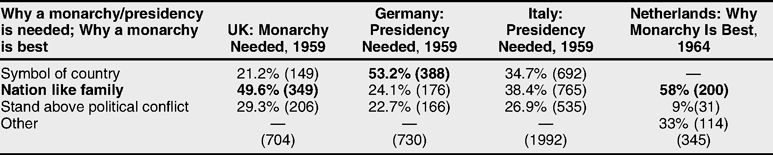
In all countries, the monarchy or the presidency was overwhelming viewed by respondents as needed, 84.1 percent in the UK, 90 percent in Germany, and 90 percent in Italy respectively. Looking at just those who answered that a monarchy or a presidency was “needed,” however, the important question is “why?” Does a monarchy or symbolic presidency mean to the public that the nation is like a family? The answer is “yes.” In the UK, 50 percent of those who believe a monarchy is needed do so because they believe a nation is like a family in contrast to Germany where only 24 percent believed a president is needed because the national is like a family and only 43 percent in Italy, as reported in table 1. There is evidence, therefore, that prior to the expansion of the welfare state in the 1970s that the public associates monarchies as a form of government with a view of the nation as a family.
Why a monarchy is needed

Notes: Data are from Almond and Verba 196) for United Kingdom, Germany, and Italy; interviews conducted in 1959.
Data are from “Attitudes towards the Monarchy,” 1965, for the Netherlands; interviews conducted in 1964.
ZA-No.0025, GESIS.
Similarly, a mid-1960s public opinion survey in The Netherlands asked respondents whether a “Kingdom was better” or a “Republic was better.” The overwhelming response, 86 percent, was that a “Kingdom was better.” For those who responded that a “Kingdom was better,” 58 percent said that the reason was some form of familial, connective, or affective tie, such as “more sense of a family,” “more unity,” “connection with the Orange,” “love for the Queen,” or “tradition, it’s always been this way,” as noted in table 1.Footnote 97
Is a Monarchical Legacy Associated with Partisan Orientations?
It is also important, to the degree that it is possible, to assess the relationship between support for a monarchy and support for left-leaning partisan orientations. It is the case that nearly two-thirds of those in the UK who believe that the monarchy is needed are also oriented toward conservative partisan orientations. However, of those who believe the monarchy is needed, it is those who believe that it is needed because the nation is like the family who register the highest support for left-leaning partisanship and the lowest percent for a conservative partisan orientation, as is reported in table 2.
Relationship between why a monarchy is needed and political party preference, 1959

Note: Data are from Almond and Verba (Reference Castles, Mitchell and Castles1963) for United Kingdom.
Patrimonialism Affects Public Attitudes about the Welfare State
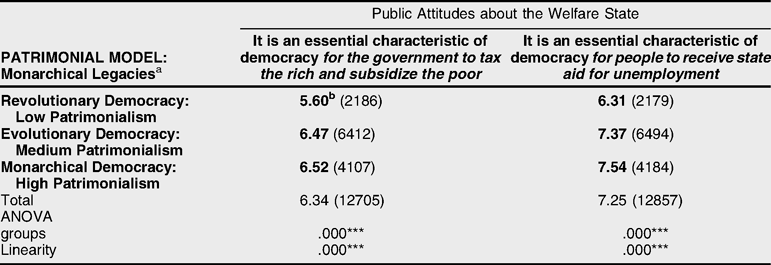
Let us now turn to a formal test of the model. The first hypothesis to test is that the degree to which Western European countries retain patrimonialism in the form of their monarchical legacy will affect the degree to which public attitudes support the welfare state. Let us first consider the key question about the public’s conception of the state, namely, whether it is an essential characteristic of a democracy for the government to tax the rich in order to subsidize the poor. Significantly, respondents living in a country that destroyed its patrimonial legacy by means of a violent revolution register the lowest support for this view of democracy, a score of 5.60 on a ten point scale in contrast to respondents living in a country that has retained its patrimonial legacy to this very day, who register the highest support with a score 6.52. Respondents living in countries that peacefully exited from this monarchical heritage without destroying it ideologically are in between at 6.47, as reported in table 3.
Patrimonialism and public attitudes about the welfare state, Western European democracies, 2005

a) Patrimonialism: Monarchical legacy 1=Low, revolution violently delegitimized monarchical legacy, 2=Medium, peaceful exit from monarchy or commonwealth monarchy, 3=High, monarchy retained to present day.
b) Mean, N in parentheses.
*** p=.000
We find the same pattern for respondents who are asked whether it is an essential characteristic of democracy for people to receive state aid for unemployment. Respondents in revolutionary democracies where their monarchial heritage was ideologically and institutionally destroyed register the lowest support of 6.31 on a ten-point scale, respondents in countries that have retained their monarchies to this very day register the highest support at 7.54, and respondents in countries that peacefully exited from their monarchies without ideologically destroying them are in the middle at 7.37, as reported in table 3.
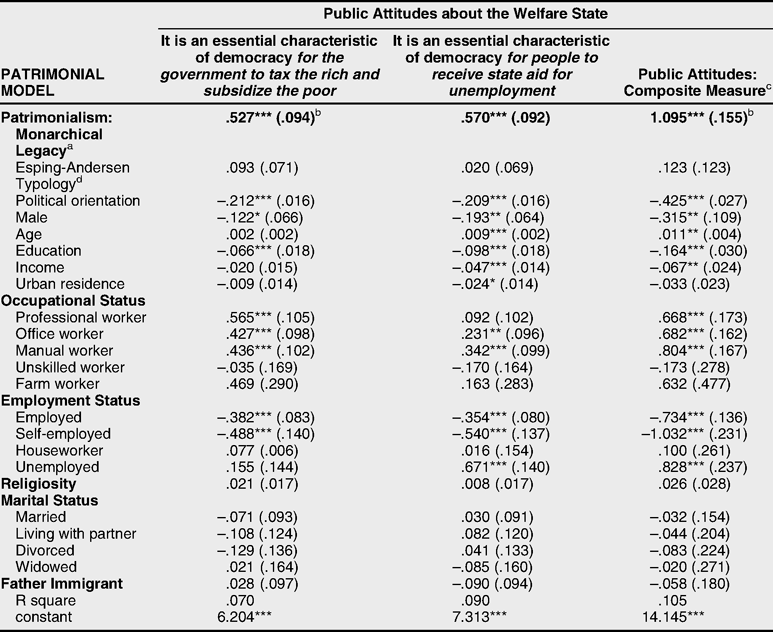
Many other characteristics, of course, affect public altitudes, such as respondents’ political orientation, demographic characteristics, religious orientation, and immigrant status. In addition, it might be the case that Esping-Andersen’s typology could have an affect on public altitudes, such that universal systems of social provision produce public attitudes more supportive of the welfare state than do liberal systems of distribution. When we control for these variables, we do, indeed, find that some do have an affect on public attitudes, such as political orientations, sex, education, and occupational status. However, what is equally important is that patrimonialism remains as a strong impact on public attitudes about government taxation for economic redistribution and government aid for unemployment, as indicated by the regression coefficients of .527 and .570 respectively, as reported in table 4. For the additive composite attitudinal measure combining the scores from both questions, the unstandardized regression coefficient is 1.095. Thus, we find support for the first hypothesis, namely, that patrimonialism promotes public attitudes supportive of a view of the state as an institution that is responsible for the well being of those in need of care.
OLS model: Impact of patrimonialism on public attitudes

***p=.000, **p=.05, *p=.100
a) Patrimonialism: Monarchical legacy 1=Low, revolution violently delegitimized monarchical legacy, 2=Medium, peaceful exit from monarchy or commonwealth monarchy, 3=High, monarchy retained to present day.
b) Unstandardized regression coefficient; standard error in parentheses.
c) Composite measure: Additive score from both questions.
d) See Appendix A for variable definitions and measurements.
Patrimonialism and Public Attitudes Affect Partisanship
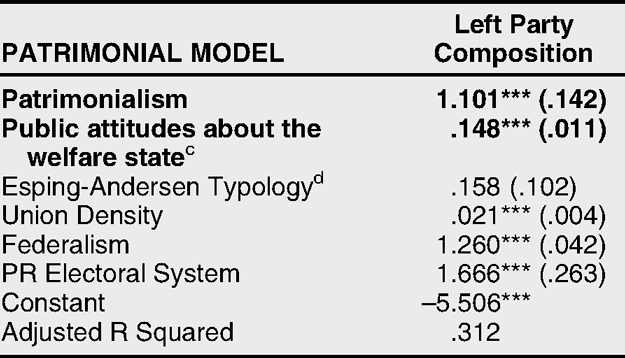
The second hypothesis to test is the degree to which monarchical legacies (patrimonialism) and public support for the welfare state affect the degree to which a country has a left-leaning party composition. Welfare-state scholars identify partisanship in general and left-leaning political parties in particular as one of most important variables affecting the formation of the welfare state.Footnote 98 In addition, as noted earlier, major scholars hypothesize that a country’s monarchical legacies affect the development of left-leaning parties. And, indeed, patrimonialism and public attitudes do affect left-leaning party composition. Controlling for key variables deemed important by welfare-state scholars, including the Esping-Andersen typology, union density, federalism, and the type of electoral system, patrimonialism and public attitudes remain statistically significant, with unstandardized regression coefficients of 1.101 and .148 respectively, as is reported in table 5.
OLS model: Impact of patrimonialism and public attitudes on left party composition

***p=.000, **p=.05, *p=.100
a) Patrimonialism: Monarchical legacy 1=Low, revolution violently delegitimized monarchical legacy, 2=Medium, peaceful exit from monarchy or commonwealth monarchy, 3=High, monarchy retained to present day.
b) Unstandardized regression coefficient; standard error in parentheses.
c) Composite measure: Additive score from both questions in table 3.
d) Refer to Appendix A for variable definitions and measurements.
Public Attitudes and Partisanship Affect Social Provision
The third hypothesis to test is whether public support for the welfare state and a left-leaning party composition affect the level of public spending on social provision and support for specific welfare benefits. In the welfare-state literature, attention to public attitudes as they affect welfare spending is an important focus. As Alesina and Giuliano found, people’s personal characteristics such as their age, sex, and socioeconomic status, affect their preferences for redistribution policies as a component of the welfare state.Footnote 99 It is also well established that partisanship affects public attitudes about the welfare state.Footnote 100
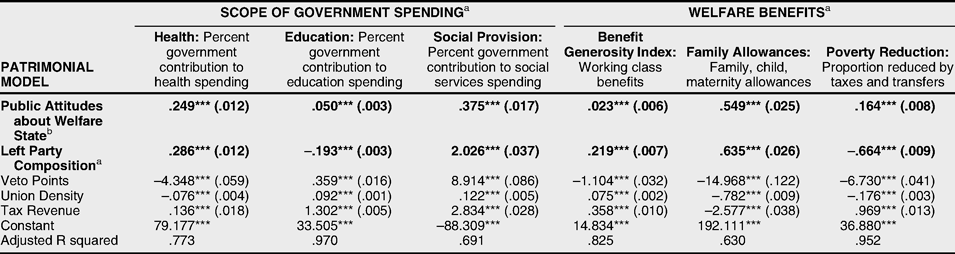
When we evaluate public attitudes about the welfare state and left-leaning party composition, we do, indeed, see that both variables have a positive impact on the scope of government spending as measured by percent the government contributes to health, education, and social provision, as is evident by the unstandardized regression coefficients for public attitudes, which are .249, .050, .375, as is reported in table 6. With the exception of education, left-leaning parties have a stronger impact than public attitudes on the scope of welfare spending, as we might expect. However, the point is that even when controlling for other variables, public attitudes about the welfare state do affect the scope of public spending. We find a similar pattern for specific welfare-state benefits. Public attitudes have a positive impact on the benefit generosity index, family allowances, and poverty reduction, as is evident by the unstandardized regression coefficients for public attitudes, which are .023, .549, and .164. Left party composition also is positive, and its impact is stronger compared to public attitudes.
OLS model: Impact of public attitudes and left party composition on scope of government spending and welfare benefits

**p=.000, **p=.05, *p=.100. (a) See Appendix A for variable definitions and measurements. (b) Composite measure: Additive score from both questions in Table 3. (c)Unstandardized regression coefficient; standard error in parentheses.
Summary
Even when controlling for market mechanisms, such as partisan orientation, union density, and political structures, therefore, patrimonialism is a statistically significant variable explaining the scope of government support for such basic welfare benefits as health, education, social provision, and the benefits generosity index as mediated by public attitudes and left-leaning parties. Of course, the market model of the welfare state is relevant to the explanation of its development. However, so, too, is the familial model of the welfare state. As this research demonstrates, retaining the legitimacy of the first form of familial government, hereditary monarchies, promotes left-leaning parties and public attitudes more supportive of the second form of familial government, the contemporary welfare state, key mechanisms for expanding the scope of government.Footnote 101
Conclusion: Familial Government, Then and Now
Patrimonialism and the Welfare State
T.H. Marshall asserted long ago that it is an imperative for the government to deliver care work because social welfare is a form of social justice.Footnote 102 As such, the welfare state is an essential component of democracy, if a country is to be considered a democracy at all.Footnote 103 The key question, therefore, is what promotes development of the welfare state in order to make development of a democracy complete? As this research establishes, one way the welfare state is promoted is by bringing the family back into the state—or by never getting rid of it in the first place by retaining the legitimacy of a country’s monarchical heritage. Yet in the contemporary state-building literature, generally, patrimonialism is either ignored altogether or associated with negative attributes, such as clientilism, if not corruption, that retard rather than advance democracy.
Francis Fukuyama’s monumental work, The Origins of Political Order, for example, refers to patrimonialism, but identifies this principle as the “human propensity to favor family and friends … unless there are strong countervailing incentives.” Thus, patrimonialism is treated as a form of absolutism that centralizes government on the basis of selling virtually all government offices “to the highest bidder.” The result is a “government . . . privatized down to its core functions, and public offices turned into heritable private property.” In his view, patrimonialism in some historical contexts such as China stands in the way of modern state development rather than promoting that development.Footnote 104
Michael Mann’s epic three-volume history of state development, The Sources of Social Power, contains references to patrimonialism in the first volume where he focuses on the way it “adapts an earlier, simpler form of patriarchal authority within the household to the conditions of larger empires.”Footnote 105Missing from his analysis of the household and consequently from his analysis of patrimonialism, however, is the way the rulers of the household, parents, are responsible for care work, which then transfers to the political rulers of a patrimonial state. Yet it is this element of patrimonialism that becomes the foundation of the welfare state as a developmental link. Missing from his discussion of welfare policies, therefore, is patrimonialism as their antecedent.
According to Thomas Ertman’s analysis of state-building, patrimonialism is defined as an administration that is constituted by a small staff of a ruler’s household. State-building occurs when a patrimonial administration competes with “various elite groups,” such as nobles, clerics, educated laymen, and financiers over who controls administering the state, including who controls the “choice of a successor in one’s office” so as to permit that office to be passed on to a family member or client” versus a non-familial person.Footnote 106 Patrimonialism, therefore, is primarily an administrative regime type to be distinguished from a bureaucracy on the basis of its infrastructure. Ertman does not define patrimonialism, however, as a regime in which the state is analogous to a family, and, by extension, the political ruler is analogous to parents who are responsible for care work. Rather, the long term “nagging” consequences of “patrimonial institutions” are the perpetuation of “patron-client” relations that produce corruption due to the “lack of clear boundaries between politics and administration,” such that the “redistribution of public funds towards political insiders remains a serious problem.”Footnote 107
Monarchies: More Useful Than You Think
Recently, however, political scientists Alfred Stepan, Juan Linz, and Juli Minoves avow that “students of democratization would do well to think about monarchies more.”Footnote 108 They point out that of Western Europe’s democracies with populations of at least a million, forty-four percent are monarchies. They note that “somewhat surprisingly, although historians and political scientists have produced many excellent country studies, comparative politics has contributed very little to the general analysis of how monarchies move toward democracy.”Footnote 109 Such a view endorses, of course, a major thesis of this research that first wave democratization processes belie the liberal principle that the transition from monarchies to democracies prescribes or requires the separation of the family and the state. Rather, as Stepan, Linz, and Minoves argue, it is important to recognize the way monarchies evolve into ruling monarchies, constitutional monarchies, and democratic parliamentary monarchies, which are distinguished by different types of government structures and the location of political authority.Footnote 110
Stepan, Linz, and Minoves however, do not analyze the relationship between monarchies and a democratic welfare state. They consider different types of monarchical families, such as “small hereditary monarchical families” and “large dynastic ruling families” as a crucial variable that affects monarchical boundary changes to different types of democratic monarchies.Footnote 111 However, they do not analyze monarchies as a form of government analogous to the family as an institution, regardless of whether a particular monarchical family is small and hereditary or large and dynastic. As a result, they do not analyze the way monarchial legacies are a mechanism that affects development of a welfare state responsible for care work.
Similarly, an editorial page of the New York Times included the proclamation that patrimonialism in the form of monarchies is “more useful than you think.” Not only were constitutional monarchies categorized as among the most liberal democracies in Europe, but also important for representing a nation’s history and continuity in a way that other political institutions do not. As the Editorial opined,
Belgium, Britain, Denmark, Luxembourg, the Netherlands, Norway, Spain and Sweden—are among the most liberal democracies of Europe … the royal heads of state represent a nation’s history and continuity. Republican heads of state … such as those in the United States or France … cannot rise above politics the way monarchs can.Footnote 112
This is correct, of course. Monarchical leaders do symbolize a nation’s continuity and history, and monarchies as an institution are insulated from the ups and downs of party politics. Yet as this research establishes, monarchies do much more. They are an institution that in principle connects the family to the state, and, in so doing, they promote public attitudes that view political rulers as responsible for care work. It is this principle that connects monarchical legacies to the development of welfare states because it is the principle that the government is responsible for those in need that is the bedrock for the conceptual foundation of the welfare state.
Bringing the Family “In” to A Study of the State
It is a flaw in liberal theory, therefore, to assume that a liberal democracy rests upon the destruction of the old regime based on the family in order to establish a new democratic one based on the autonomous individual. All Western European democracies guarantee civil and political rights as based on a liberal principle of individualism. However, they differ greatly when it comes to social rights as based on a principle of the familial state. Yet it is this combination that makes for a complete democracy. A complete democracy inclusive of welfare provision, therefore, requires a hybrid state based on both individualism and familial principles. To achieve the later requires that we bring the family “in” to a study of the state in general and the welfare state in particular.
Yet as historian Giovanna Benadusi argues, most research on “state formation has been concerned with explaining the successes and failures of central authority, the emergence of new institutions and the role of the more powerful bureaucratic provincial elites.”Footnote 113 Generally, what is missing from these perspectives is the institution of the family. What is more, even when political scientists include attention to the family, their analysis rarely, if ever, discusses the normative principles that define the family as institution much less the attitudinal and policy consequences of transferring those normative principles to the state. Rather, they examine the family as if it were solely a political entity that competes with other political units for political power.
Similarly, historians of the family have omitted the state in their analyses. As Benadusi notes, typical analyses focus on “family patterns in relation to socio-economic and demographic trends,” but not on the way the family as an institution plays into both the politics of state- building and the very definition of who is eligible to be a political ruler of a state.Footnote 114 Similarly, Ginsborg notes that the relationship between the family and the state has been neglected by empirical social scientists.Footnote 115 Generally, sociologists study the family, but not the state, and, with the exception of political theorists, political scientists study the state, but not the family.
It is time, therefore, to examine the past and present principles of familial government. It is true, of course, that governments use the family to regulate and to promote policy objectives. However, familial government does much more—it defines the state as an institution analogous to the family. As such, it becomes the job of the state to provide care work to those in need just as it is the job of a parent to do for family members. And, as this research establishes, it is these ripple effects of monarchical legacies as the first form of familial government that promote public attitudes supportive of the contemporary welfare state as the second form of familial government, which in turn results in a more robust welfare state.
Supplementary Materials
Appendix
∘ Patrimonialism
∘ Esping-Andersen Typology
∘ Welfare—Scope of Government Spending
∘ Note on Scope of Government Spending