1. Introduction
In this contribution, we address the introduction of private property rights and market trades in network industries and focus on trading in the rights to use the radio frequency spectrum. In order to avoid harmful interference between different radio users, centralized co-ordination (also referred to as ‘command and control’) is being applied, whereby the usage rights of the radio frequencies are allocated on the basis of specific uses and assigned to specific users. The degree to which command and control co-ordination may be replaced in favour of ‘market mechanisms’ lies at the heart of debates concerning liberalization of network industries (Hazlett, Reference Hazlett2001).
In section 2, we present the ideas of Ronald H. Coase in relation to this issue (Coase, Reference Coase1937, Reference Coase1959, Reference Coase1960, Reference Coase1988). Coase's perspective on radio spectrum governance is about the efficiency of coordinating transactions via markets compared to centralized, command and control types of governance. In section 3, we discuss how the policy makers in the UK were inspired by the ideas of Coase and review the developments following the policy of liberalization took effect.
In section 4, we present an alternative perspective on markets in relation to radio spectrum governance based on the ideas of John R. Commons. Following Commons, markets are to be regarded as one among a number of available policy options when allocating and assigning the rights to use the radio spectrum. The extent to which markets contribute to the realization of common values should determine whether private property rights and markets are appropriate governance structures. This is further illustrated in section 5 using the UK case of spectrum governance.
We show how Coase and Commons represent two different paradigms with respect to ideas on markets, institutions and government policies; Coase being primarily driven by efficiency considerations and Commons by realizing common value.Footnote 1 We show how the contributions of Coase and Commons can contribute to the understanding of the governance of the use of radio spectrum and the UK case of secondary trading in radio spectrum usage rights.
2. Coase and trading of radio spectrum usage rights
In March 1910, the department of the US Navy submitted a letter to a Senate commission complaining about ‘the etheric bedlam produced by numerous stations all trying to communicate at once’, hindering ‘calls of distress from vessels in peril on the sea’ (Coase, Reference Coase1959: 2). The Navy letter announced the beginning of a significant history of discussions and legislation regarding the regulation of the industry. Coase started his Federal Communication Commission-paper with this history, gathering ammunition for a theoretical offensive (Coase, Reference Coase1959).
Leitmotiv in the US history of regulating the use of the radio frequencies is the notion that the ether and the use thereof is ‘the inalienable possession of the people of the United States. . .’, as declared in a Senate resolution of 1925 (Coase, Reference Coase1959: 5). Therefore, in July 1926 the two houses of Congress passed a joint resolution providing that no license should be granted for more than ninety days for a broadcasting station or for more than two years for any other type of station. Furthermore, no one was to be granted a license unless he executed ‘a waiver of any right or of any claim to any right, as against the United States, to any wave length or to the use of the ether in radio transmission. . .’ (Coase, Reference Coase1959: 5).
Coase commented: ‘a stop-gap measure designed to prevent licensees establishing property rights in frequencies’ (Coase, Reference Coase1959: 5). The Congress opted for regulation of the radio industry by a commission. In 1927, an act established the Federal Radio Commission and in 1934 transformed into the Federal Communications Commission (FCC), regulating the telephone and telegraph industries (Coase, Reference Coase1959: 7).
Obviously, the cauldron of frequencies in the ether may be seen as a classic example of externalities, harmful effects, e.g. between users and receivers of radio frequencies. Since the publication of The Economics of Welfare by Pigou economists were used to seeing externalities as divergences between private and social net products (Reference Pigou1920). In this respect, the conventional thought is that if A inflicts harm on B, A should be restrained or taxed. The Pigovian approach is a consistent application of the marginal conditions of the Paretian optimum edifice, equating (social) costs to benefits. At the same time, it clearly is a government's tour de force. How is the FCC to determine the respective marginal benefits and how to avoid its policies become captured by interests groups?
Clearly, the FCC follows an impassable route, inevitably ending in arbitrariness, prone to bribery and censorship. In this respect, the arbitrariness is reflected in the rent the fortuitous applicant may afford. How to address this disorder?
Coase's view on (radio frequency) regulation
The FCC as a failing solution to the etheric bedlam offered Coase an excellent opportunity to expound his central message to the economists that would eventually laureate him with the Nobel Prize in 1991. Coase unfolded his seemingly ambiguous theoretical position for the first time in his 1937 paper. On the one hand, junior economist Coase held on to the tenet of his London-School-of-Economics professor Arnold Plant: ‘The normal economic system works itself’. (Coase, Reference Coase1937: 387). On the other, he specified that ‘the operation of the market costs something’, introducing the concept of transaction cost in economic theory (Coase, Reference Coase1937: 392). Transaction cost uncovers the need for institutions in economic life. Coase's 1959-paper actually was a reformulation of his 1937-paper, approaching the institutional dimension of economic life straightforwardly.
The question was this: why does etheric scarcity require government regulation, whereas, for other scarce means such as capital and land, the American economic system employed the price mechanism? Coase's analytical trouvaille was: ‘the real cause of the trouble was that no property rights were created in these scarce frequencies’ (Coase, Reference Coase1959: 14). The definition of frequency rights will render this hopelessly indiscriminate affair superfluous. Instead of the FCC, the highest bidder may decide on the use, enabled by the establishment of property rights.
The significance of the 1959-paper is broad. First of all, it is the focus on property rights as a central concept that deepened the insight in the actual working of the market. It floored the Pigovian approach to externalities, uncovering a fundamental omission in the mainstream microeconomic theory. Coase's property-rights solution of the frequency issue leads almost imperceptibly to restating the very theme of economics. A step by step recap may show this.
Generally, economic actors think of commodities in physical entities, acres of land, a bottle of wine, taking for granted the bundle of property rights these commodities entail in the economy (Coase, Reference Coase1988: 11). However, the nature of radio frequencies makes clear that transacting such a thing as the use of radio frequencies, and likewise any commodity or service, indispensably requires a well-specified definition of the bundle of rights concerned.
Consequently, the attention to property rights triggers attention to the notion of reciprocity. The establishment of a property right implies the assignment to someone and the exclusion of others. ‘All property rights interfere with the ability of people to use resources’ (Coase, Reference Coase1959: 27). It denotes a kind of reciprocity that becomes manifest in the economic transaction the assigned property right may invite to. It is this reciprocity that is obviously wanting in the Pigovian approach to externalities.
‘Economists who, following Pigou, approach the problem (of externality) in terms of a difference between private and social products but fail to make clear that the suppression of the harm which A inflicts on B inevitably inflicts harm on A’ (Coase, Reference Coase1959: 26).
The Pigovian remedy transfers property rights without knowing the relative value of them. However, ‘the problem is to avoid the more serious harm’ (Coase, Reference Coase1959: 26). For instance, the harm to B inflicted by A, might exceed the benefit of A's harmful activity. Pigou did not see this reciprocity, and was unable to see it as he reasoned in the quantities and the prices of the Paretian optimum, formulated in marginal variables. Moreover, Pigou did not worry about the laborious nature of his remedy. Pigou and the Pigovians are not concerned about transaction costs, as the whole affair did not concern transactions at all.
The concept of transaction cost enabled Coase in his 1937-paper to demonstrate the role of institutions, e.g. in economics, the hierarchy of a firm. The 1959-paper presented an immediate introduction to the institutional dimension. The frequency issue brought on the concept of property rights; nota bene the institution without which economics is unthinkable. Together, the concepts of transaction cost and property rights, floored where the Pigovian ‘blackboard economics’ stands for; i.e. a world of choices concerning scarce means and alternative uses aligned with marginal optimum conditions. Coase opened the invisible economic inner world of institutions. It is a turn in economics, in particular revealed in Coase's innovative approach to externalities.
The property-rights perspective showed that there is no analytical difference between the right to use a resource without direct harm to others and the right to conduct operations in such a way as to produce direct harm to others. In each case something is denied to others: in one case, the use of a resource; in the other, the use of a mode of operation (Coase, Reference Coase1959: 26). This is the inference of the FCC-paper. Coase repeated the proposition presenting the new perspective on externalities as follows:
‘With costless market transactions, the decision of the courts concerning liability for damage would be without effect on the allocation of resources’. (Coase, Reference Coase1960: 10).
Well-defined property rights enable an efficient allocation of the use of radio frequencies to the highest bidders. The procedure will require minimal transaction cost and arbitrariness seems to be banned. It will result in a commercial broadcasting industry; a consequence of individual's primacy. However, this does not mean being back to square one as the application of Coase's recommendations in the UK case suggests.
3. Coase and the UK case of trading in radio spectrum licenses
The issues with radio interference that Coase (Reference Coase1959) described refer to the very crude use of radio waves in the early days, spark-sets that blanket a large part of the radio spectrum. The next governance issue that emerged was the monopolistic use of the radio spectrum by Marconi and the safety of men at sea. The use of radio for broadcasting presented the next major challenge, when radio became recognized as a means to inform the public at large and linked to the ‘freedom of speech’ as embedded in the U.S. Constitution.Footnote 2
Today, radio spectrum management is still based on the same principals as agreed upon in 1927, when the first International Telecommunications Union (ITU) Radio Conference was held. The use of the radio frequency spectrum is globally governed by the ITU, of which the radio communication sector develops and adopts the radio regulations, a binding international treaty between member states. The regulations are based on avoidance of harmful interference through the division of spectrum in bands, which are allocated to one or more services out of approx. 40 different radio servicesFootnote 3. Based on these allocations the national spectrum management authority (SMA) assigns licenses to users. Usually, a license provides an exclusive right to operate apparatus on a specific frequency in a specific location or geographic area, under specific technical conditions (power, antenna height, etc.) and typically with service obligations and coverage requirements. If the demand for spectrum within a particular band is far less than supply, licenses are usually granted using a first come first served approach. When spectrum demand exceeds supply, the SMAs apply spectrum auctions; occasionally comparative hearings or ‘beauty contests’ are used. The introduction of (secondary) trading allows a market for access to the radio frequency spectrum to develop (Anker, Reference Anker2010).
The UK case
In this section, we provide information on the UK-case relevant for discussing how in the Coasean perspective the UK government should have acted in introducing private property rights and a market for these rights. Moreover, we provide information about the developments after the introduction of a market for radio spectrum licenses, notably with respect to the number of trades.
In 2001, the UK government commissioned Martin Cave to undertake a review of radio spectrum management in the UK. The ‘Cave Report’ as it became known (Cave, Reference Cave2002), recommended a policy of selective deregulation of spectrum use where possible and an increased reliance on the market rather than administrative systems. This was to be achieved by a two-pronged approach: the use of markets in the case of commercial use, and the continued reservation of spectrum for public service use, coupled with an administrative charge designed to ensure economy and efficiency of its use. Spectrum trading was expected to give incentives to firms to:
‘husband the nation's resources and direct it into the most profitable uses. Where demand grows for a service which utilizes spectrum, spectrum will increasingly be deployed for that purpose. Firms that do not utilize, or under-utilize, spectrum will have an incentive to lease or sell it’ (Cave, Reference Cave2002: iv).
The Cave Report also recommended licencing based on access to spectrum defined by the parameters of frequency, geography and time rather than by type of apparatus. This would enable division and amalgamation of licences.
Secondary trading would enable prospective spectrum users to enter the wireless market and develop a service by purchasing a license they needed when required. The report strongly advocated the earliest and widest application of trading possible and to be introduced in a way that would minimize transaction costs while maintaining the integrity of the spectrum management regime. The licensees would be given the freedom to divide and partition their licences by frequency and geography for subsequent sale. The report cautioned that although a market-based approach might lead certain operators to gain and abuse dominance in the spectrum market or a ‘downstream’ market which uses spectrum as an input, this could be dealt with using competition law rules.Footnote 4 The Cave Report described the role of Ofcom, the UK national regulatory authority, as follows:
‘The role of Ofcom in this regime will be to define the initial bundle of rights and interference co-ordination requirements attached to each licence, assign this licence via auction, and then ensure compliance with these requirements, and management of the system as a whole, as the licence trades through the market. In all cases Ofcom will need to monitor and register trades. Provided Ofcom publishes a comprehensive register of frequency assignments, enabling the market to identify changes in the licensee, further reporting requirements, such as publication of transaction prices, may be unnecessary. Evidence from spectrum trading elsewhere suggests that specialist brokers can rapidly fill any information gaps’. (Cave, Reference Cave2002: 19).
In the UK, the transfers of rights were regulated by the Wireless Telegraphy (Spectrum Trading) Regulations, 2004.Footnote 5 Trading in the rights is now permitted in six usage sectors: business radio, spectrum access, concurrent spectrum access, broadband fixed wireless access (scanning telemetry), fixed services and public wireless networks. Although Ofcom has stated publically that ‘a successful market needs information about whatever is being traded’, key details, such as price, are not made publicly available. Furthermore, a license trade is not distinguished from a license transfer between undertakings, as part of a firm acquisition or merger (Akalu and Arias, Reference Akalu and Arias2012, Akalu, Reference Akalu2014).
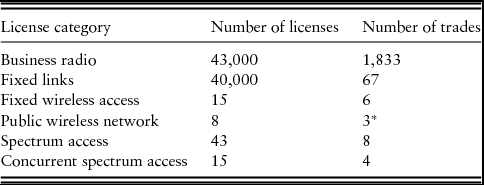
Although Ofcom has stated that there has been a clear upward trend in the number of transactions since trading began in 2004, the number of trades is still low relative to the number of potentially tradable licenses, as judged by Prof. Cave (see Sims, Reference Sims2008). The situation as of March 2013 is reflected in Table 1.
Number of licenses by category and number of trades between 2004 and 2013
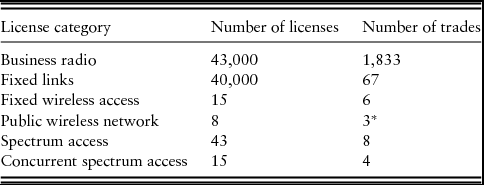
*These are transfers between undertakings.
Source: Authors (based on Akalu, Reference Akalu2014; ECC, 2011; Ofcom, 2014).
Coase and the UK Case
According to a Coasean perspective, policy recommendation to governments considering the introduction of a market for radio spectrum licenses is first of all: assign well-defined property rights. Second, take into account the transaction costs of a fine-tuned property-rights definition and the information issues these entail. Third, reflect on actors’ rent-seeking behaviour in the industry, e.g. how to prevent the concentration of significant market power and the hoarding of spectrum usage rights. The important message from Coase is that the assignment of rights brings the rewarded applicant profitable opportunities. Subsequently, the private owner faces the checks and balances of the market, which will force him to efficient behaviour. The situational logic of a private market in spectrum usage rights will leave the actors no other option then to use the resource in the most efficient way. To allow this to happen, the situation should be designed and implemented according to Coase's ‘institutional economics’.
Because Coase is first and foremost interested in the efficient allocation of the scarce spectrum resource, in his perspective, the first question is about the initial assignment of the property rights. The way the assignment is done has large implications for the number of potential owners of licenses in the spectrum market and for the number of trades that one can expect. Key questions are: Was the auction well-designed and did it result in an efficient assignment?
The next question in the Coasean perspective concerns the design of the secondary market for trading spectrum licenses: Were the basic rules of ‘pure and perfect competition’, in terms of access, availability of information, anonymous interaction among participants and the homogeneity of the product, implemented such that prices will reflect scarcities? In the Coasean perspective, the costs of market transactions are of great interest. Hence, are public and private institutions created that minimize transaction costs when searching for partners to trade, to negotiate, to establish and execute contracts, to monitor and sanction afterward? Following the Coasean perspective, one would like to know why in the UK the prices are not made public. What is the impact on the availability of information and consequently on the transaction costs involved? Did specialized brokers emerge as envisaged?
If the answers to all these questions do not indicate any failure in the design of the initial assignment and in the design of the secondary market then the observation of a few trades can only mean that the initial allocation was efficient. The number of trades is not a relevant issue, only the possibility to trade is important. This fits well with the general claim of mainstream economics: if markets are well designed they reveal the subjective values of the participants; many trades can take place, but also a few or none; prices can strongly fluctuate, show trends or remain stable. These indicators do not say anything about a good or bad functioning market; the crux of the matter is to design the property rights well and to design the market to trade them well. Then the best outcome possible will be realized and the market will reveal this outcome.
4. Commons and trading of radio spectrum licenses
To articulate the pros and cons of the Coasean perspective on trading in radio spectrum usage rights, we turn to the alternative perspective of Commons. Thereby, the focus shifts from the individual and her preferences and values to the collective and its common values.Footnote 6
The work of Commons revolves around the question how public purposes, common values, can best be realized through the collective control of individual actions. The subject matter of economics is the understanding of the rules, the institutions that create order, reduce uncertainty and therefore make transactions between individuals possible. The task of an economist is to investigate the causalities between the institutions and the individual actions and how these result in a specific performance of the economic system. Consequently, if we know and understand the ‘is’ situation, economists can reason what kind of behaviour of individual actors would result in the desired performance and what type of institutional change would be required to induce that kind of behaviour. In relation to trading of radio spectrum licenses, the core question is: What are the common values, the public goals the community wants to realize with respect to the use of the radio spectrum? How can these goals best be realized: through public property rights and government control, or through private property rights and a market? Or a mix? What is the impact of the physical characteristics of radio frequencies on the question of economic allocation? What is the specific nature of the radio spectrum as a public good and does that limit the use of markets?
According to Commons, actions of individuals are guided by institutions: the so-called ‘working rules’. Institutions do not fully determine individual actions, but ‘frame’ them in such a way that some space to manoeuvre remains. That means the domain of choice, freedom and volition can be larger or smaller. In that space, actors can impose their will upon others by means of persuasion (based on personality), coercion (economic power to withhold) and duress (the physical power of violence). In that space conflicts between (groups of) individuals and collectives about the right allocation of scarce resources have to be resolved. To do that orderly, individual action should be controlled by collective action. Institutions provide the desirable order, being the social rules resulting from ‘collective action in restraint, liberalization and expansion of individual action’ (Commons, Reference Commons1934: 73). In that sense institutions as ‘collective action in control of individual action’ are not ‘neutrally efficient’.
The first-level environment in which individuals operate is the so-called ‘going concern’, a theoretical concept encompassing every group within which individuals interact and coordinate their actions towards common future ends. Commons purposefully avoided the concept of ‘mechanism’ and ‘organism’, emphasizing that in the going concern a concerted action to attain goals is ‘volitional’ and the resulting institutions are an ‘artificial arrangement’. Going concerns are located at all layers of an economic system: firms, sectors, regions, nation states and at the supra-national level.
Through the working rules of going concerns – the ‘institutions’ – resources are allocated and benefits and burdens are distributed. Assessing existing working rules, or the proposal to change these should not be in terms of ‘freedom versus coercion’, but always be analysed as a matter of whose will is restrained and whose will is liberated.
Working rules do not represent frictions that hinder the ‘free’ market. Working rules are developed by the participants and decided upon by the ‘authoritative’Footnote 7 to control individual action and thereby to facilitate the realization of a common purpose. The working rules are embedded in the legal framework and subject to changing ethical norms. Broad grey areas of human discretion reveal the ethical component.
Commons makes a distinction between bargaining, managerial and rationing transactions. Here we focus first on the bargaining and later on the rationing one.Footnote 8 Bargaining transactions occur between market participants, which result in the transfer of legal control from one participant to another. Bargaining transactions are about voluntary exchange of property rights. In order for this to occur lawfully, the subject matter traded must be a legitimate object of exchange. The buyers and sellers in a bargaining transaction are considered legal equals, despite the fact that there may well be considerable inequality of bargaining power.
Rationing transactions take place between a collective legal superior (e.g. the national regulatory authority) and legal inferiors (e.g. mobile operators). Here, the transaction consists of rationing either wealth or purchasing power to subordinates without bargaining (Commons, Reference Commons1931: 654). Commons notes that this activity is often mistaken for bargaining, but the negotiations in this context involve arguments and pleadings. In the context of radio spectrum management this occurs in the case of regulatory consultations or handling of complaints concerning interference by the SMA.
In summary, in a Common's perspective the analysis should start with a well-articulated view on the common values that should be realized through the institutions being in place or through changing them. Hence, how will the introduction of trading in radio spectrum licenses serve the common purpose? Second, the social scientist should ask ‘why’. Why would the introduction of private property rights and a market for spectrum licenses lead to trades and realize common values? Commons explained how important it is to have a detailed understanding of the ‘institutional causation’ (the structure influencing and constraining individual behaviour) and ‘individual causation’ (the individual having autonomy and volition) in their combination.
First the common value, what are the societal objectives, with regard to the use of the radio spectrum?
Responding to this question requires unravelling the types of use of the radio spectrum. Based on the identified social objectives different institutions may be required that realize these objectives best. Society may wish to protect certain uses under all circumstances and hence a ‘command and control’ type governance may be desired. For commercial uses the market may be the appropriate governance mechanism, as it will reveal the commercial value of use and would allow trades in usage rights to be effectuated in an efficient manner. For other uses where transaction costs may become prohibitive, a license-exempt regime under certain limiting conditions may be considered.
While the radio spectrum is foremost used to enable two-way communication without wires and for radio and TV broadcasting, radio waves also play an important role in astronomy, in exploring the origins of our universe, and are used for heating, e.g. in medical treatments, in industrial processes and for cooking in micro-wave ovens. In terms of communication a distinction can be made between private use, such as cellular communications and public use, such as the police and emergency services, as well as the military. Today, broadcasting is at the crossroads between the private and the public space, with safeguards for pluriformity in broadcasting applied by many governments.
Hence, common values in the use of the radio spectrum differ by the type of use of the spectrum. Most people would agree that scientific research into the origins of the universe is important. The military and public safety services, such as police and fire brigade, are considered to be common values, and the assignment of spectrum to these services is not subject of debate. However, the amount of spectrum that has been assigned for their use has become a topic of discussion. In particular, the large amount of spectrum assigned to the military, which is rarely used. Proposals for sharing are being made, whereby the military would retain priority use under emergency conditions; representing different valuations under different circumstances. The success of mobile cellular communications, evolving to broadband with increasingly higher data rates, has resulted in demand for radio spectrum outstripping supply. It represents the highest valued use in economic terms.
As the roll-out of fixed broadband to rural areas is very costly, the use of mobile broadband is considered an important component in closing the digital divide and realizing broadband targets. This common value has led to coverage obligations becoming linked to usage rights.
In terms of economic valuation, according to Ofcom radio spectrum contributes some £24 billion to the UK economy each year, of which public mobile telecommunications contributed 40% and broadcasting 36%. Spectrum is considered ‘. . .a vital input to electronic communication services and networks and central to making the UK a dynamic and competitive communications market. It is essential to the operational effectiveness of the emergency and other essential safety-of-life services and is used for much cultural, social and scientific activity’.Footnote 9
In the tasks assigned to the regulator, the UK government reflects its societal objectives in very general terms:
‘It shall also be their duty, in carrying out their functions under those enactments to have regard, in particular, to the desirability of promoting
(a) the efficient management and use of the part of the electro-magnetic spectrum available for wireless telegraphy;
(b) the economic and other benefits that may arise from the use of wireless telegraphy;
(c) the development of innovative services; and
(d) competition in the provision of electronic communications services’.Footnote 10
In the perspective of Commons, to unravel the issues that today's use of the radio spectrum represent means to advocate an analysis into the appropriate (mix of) governance arrangements (including markets) to realize the common values associated with the uses of the radio spectrum on the basis of five interdependent elementary concepts which Commons considered a necessary part of economic theory: scarcity, futurity, custom, sovereignty and efficiency.
Scarcity
Scarcity is the entry point for the economic discourse and the justification for the establishment of property rights. A property right engenders access as well as exclusion.
There is a physical limit to the use of the radio spectrum in terms of the information a radio communication channel of a specific bandwidth can carry (Shannon–Hartley Theorem). In practice, the scarcity is a function of the technology applied and the way the spectrum is governed. Within this context scarcity becomes tangible through the occurrence of harmful interference that results from conflicting transmitted signals or energy emissions. As such it is determined by place, time, the frequency used, the power of the transmitter and the selectivity and sensitivity of the receivers. Scarcity becomes apparent in areas of high usage, typically in urban areas. The expectations are that in the case of calamities public safety services have guaranteed spectrum access, citizens are able to use their cellular phones and broadcasters should be able to inform the public at large. Scarcity in spectrum is related to the most attractive frequency range, from 300 MHz to 3 GHz, the so-called sweet spot. Resolving the scarcity issues brings us back to the issue of common value and how to resolve conflicts in the realization of a set of common values simultaneously.
Sovereignty
In a Commons type of analysis attention would have to be paid to the role of the ‘sovereign’. Commons took sovereignty as the ‘monopolization of violence’ (Commons, Reference Commons1950: 74). It is the ‘sovereign’ that will decide disputes between conflicting parties and in doing so will command obedience.
As the custodian of the radio frequency spectrum, the nation state holds the power to allocate and assign rights to the use of the radio spectrum within its jurisdiction. In the initial assignment of rights, the rationing transaction, the state reflects its objectives and valuation of uses and users of the radio spectrum, typically distinguishing between private use (commercial and competitive) and public use (reserved and non-competitive). In the assignment, the states follow the ITU recommendations at the global level. At the regional level – in Europe – they follow the CEPT in its role of coordination the radio frequency use and ETSI in providing the wireless standards.Footnote 11 Moreover, they follow the EC directives and guidelines for harmonization aimed at creating a European single market.
Since tradable licenses will essentially amount to a new form of property, the issue will become how control will be exercised over this property and over the new forms of governance that are being developed. Many of these will be private commercial initiatives aimed at responding to dynamic market conditions, including initiatives to create standards to realize economies of scale through interconnection of networks and interoperability of equipment. In the perspective of Commons, one should be very eager to explore what these expected developments would imply for the common value of spectrum.
Futurity
This element of economic theory forces the analysis into potential future developments: how do private actors that have to take decisions in the present perceive the future? How does an institutional change impact their valuation and how does it impact the barriers to entry and the introduction of new technologies? Economists ought to have theories about ‘futurity’.
In the Commons’ perspective, one would assume that the UK spectrum licenses have a value that is related to its expected scarcity, which is its economic futurity. This valuation will depend on the security of present expectations of future profits, investments and contracts. To illustrate: The UK 3G license award process occurred at the peak of the Internet/telecom bubble in 2000 and generated £22.5 billion or €650 per inhabitant. It was the highest level of proceeds in the 3G auction cycle in Europe, Germany followed with €613, the Netherlands with €171 and France €169 (Lennin and Paltridge, Reference Lennin and Paltridge2003; OECD, 2005).
In assessing the future value of spectrum rights, the frequency band is important in relation to the (new) type of use being considered, the amount of spectrum being assigned, the geographical coverage, the license period, as well as any potential restrictions in use. Moreover, the current and future level of competition are important in assessing future returns, as is any regulatory, political or economic uncertainty. This is all linked to the expected uptake and anticipated willingness to pay by end-users.
Custom
To understand the UK case and especially the developments after the introduction of trading, the economist should have a good understanding of formal and informal working rules, including custom. What are prevailing customs among the public and private actors, do the prevailing customs align with the common values and if not how to change them?
As an example of custom or industry practice, one should realize that any assignments of radio spectrum rights at the national level are typically preceded by many years of work within regulatory bodies, such as the ITU at global level and CEPT/ERCFootnote 12 at the regional level, to coordinate the allocation of uses to specific spectrum bands. Moreover, many years of technology coordination of radio spectrum use in standardization bodies precede the deployment.
The process is typically top-down. With the introduction of markets at the national level, the question to be answered is whether markets should be assigned within the boundaries of radio spectrum allocations (as is the case in the UK) or across allocation boundaries; the allocations to be relaxed or removed at regional and global level as part of bottom-up reform initiatives? And as the role of markets increases, will private actors be able to effectively and timely coordinate the use across an increasingly larger part of the radio spectrum and across national and regional boundaries?
Efficiency
In the context of efficiency, it is important to recognize that wireless communications require compatibility and interoperability of the transmitters and receivers. This is important for national markets to function properly, but is as important on the regional and global level. Static efficiency is closely linked to dynamic efficiency. Moreover, allocative efficiency across countries in terms of spectrum rights (in terms of number of players and timing) is closely linked to productive efficiency in terms of availability and cost of infrastructure and terminal equipment.Footnote 13 The development of mobile systems in Europe illustrates the point of achieving economies of scale within a command and control regime.
The first generation of mobile equipment based on an open standard developed by the Nordic telecommunications administrations NMT-450Footnote 14 was introduced in 1981. The specification was made available – free of charge – to the equipment vendors. The stage was set for the broad deployment of first generation – 1G – mobile telephone systems. In the Netherlands, Belgium and Luxemburg the incumbent operators adopted the NMT-450 standard. However, national cellular standards were applied in Germany, France, the UK and Italy. These national standards did not provide for interoperability, hence, travelling abroad required a different handset in almost every country in Europe.
The potential of pan-European mobile communications was observed by the French PTT who convened a meeting with other PTTs in 1981 to explore the use of the 900 MHz band. This led to a working party created within CEPT: the Groupe de travail Spécial pour les service Mobiles (in short: GSM) to develop a specification. In 1984, the European Commission endorsed the project and it issued a directive for the launch of GSM by 1991, with a minimum set of services. In the fall of 1992, GSM was launched in 7 countries by 13 operators. (GSM Association, 2004; Manninen, Reference Manninen2002; Meurling and Jeans, Reference Meurling and Jeans1994). By the end of 2011, GSM had captured 75% of the global cellular market, with 4.5 billion users.
In contrast, the historical record shows that very rarely a fundamentally new wireless technology is turned into broad deployment by a single firm, probably Qualcomm and CDMA is the best known example (Lemstra et al., Reference Lemstra, Anker and Hayes2010a; Mock, Reference Mock2005). Within a license-exempt regime for short range devices (essentially a property rights regime at the level of the individual user), private actors have collaborated in the establishment of the IEEE 802.11 standard and the allocation of frequency bands, leading to the global success of Wi-Fi (Lemstra et al., Reference Lemstra, Hayes and Groenewegen2010b).
Assessing the developments after trading was introduced
In assessing the degree to which trades have occurred, insights into the properties of the ‘good’ being traded is important as well as the context in which the ‘good’ is used. Two examples of a first order assessment follow.
As the access to spectrum is complementary to the use of a communications network and devices in order for a service to be provided, the question whether the rights to access the spectrum can be traded meaningfully without considering the related infrastructure and device assets becomes important. This linkage suggests that separating the license from the infrastructure and selling it separately may reduce the value of the infrastructure significantly (possibly to scrap value). This may explain why for PWN licenses no trades have occurred, only transfers between undertakings.
If the assignment of the license has been on the basis of first-come-first-served, as was the case for business radio, it implies there was no scarcity in the related frequency band. A license can thus be acquired through an application to the regulatory authority or through trade. The price in the market will unlikely exceed the price to be paid through the administrative process. A difference in transaction costs may point to the most likely course of events; the administrative process is well defined, while information on licenses in the market may be lacking. A trade may benefit the seller in terms of recuperating any residual value of the license. An increase in the trade of business radio licenses may point to an increase in scarcity.
Dual role of the market
As over time the use of the radio spectrum expanded it has become apparent that not all common values could be realized at the same time without conflict. In resolving conflicts in the realization of common values, the role of economic valuation of radio spectrum use becomes increasingly important.
In the radio governance regime, as it has evolved from 1927, the valuation of radio spectrum use has become a two-step process of rationing transactions. First in terms of the allocation of use at global and regional level and second in the assignment of users at the national level. The allocation and assignment processes are executed by government representatives and/or agencies and the influence of the (potential) users is limited to submitting arguments and pleadings. Moreover, the value of use remains implicit. The only way of valuation, which makes the value explicit in monetary terms, is through the application of markets and the price mechanism.
Conflicts in realizing common value typically relate to scarcity of the resources required. Scarcity being the entry point for the economic discourse, the market is considered the instrument to resolve scarcity issues through the price mechanism.
Hence, approaching the governance of radio spectrum from two perspectives, following Coase and Commons, respectively, leads to the market as a tool for two different purposes: to resolve interference issues and to achieve efficiency on one hand and to solve valuation and scarcity issues on the other.
The two perspectives point to the market as an alternative for the existing command and control governance regime. Markets can be introduced top-down and bottom-up, i.e. starting with allocation process or starting with the assignment process. The more feasible approach to realizing changes in a global and entrenched governance regime is bottom-up, within the national scope of assigning usage rights. This was the approach followed by the UK government.
5. Comparison of the two perspectives
Coase as a new institutional economist makes representations of markets and individual actors aiming at a rigorous analysis, while recognizing the more complex economic reality. In contrast to a number of other new institutional economists, Coase explicitly mentioned the indispensable role of the state with respect to a system of private property rights (Hodgson, Reference Hodgson2014a). However, he did not develop that notion further. In contrast, Commons placed the role of the state (‘sovereign’) central stage and included the state in his theoretical framework. Coase was well aware of the importance of the wider impact of institutional arrangements beyond costs and benefits in ‘all spheres of life’. However, he did not develop that impact in his work. Commons on the other hand addressed the interaction of institutions and individuals explicitly providing a deeper insight into the cognition and motivation of economic actors. While Coase was aware of the importance of common values, he did not develop that aspect further. Commons made the concept of common value the starting point of economic analysis. It appears that Coase and Commons can be considered complementary, whereby Coase focused on efficiency and stayed within the approach of calculative economic costs and benefits, while Commons identified the broader economic issue of common values and analysed how individual action could be best controlled by collective action. Coase showed in his writings that he was well aware of the limitations of his focus, but he choose for rigour over a broader – and others would say a more relevant – scope of analysis, as demonstrated by his qualification of the American institutionalistsFootnote 15. While the Commons’ perspective illuminates the limitations of a Coasean perspective it also shows the complexity of an analysis which includes institutional and individual causation. A Coasean perspective appears to be appropriate in situations when the ‘law of markets’ rules and the individual has little space to manoeuvre. This can be illustrated by representing the ‘free market’ as the core around which three circles of rules are located which make the market function properly and which constrain the actors in their behaviour: (1) the rules that prevent market imperfections; (2) the rules that make actors behave conform the market norms; and (3) the rules that forbid and prescribe such that societal values are realized. These rules are of a deontological nature: they prescribe what actors must, should, and should not do. The first category preserves the appropriate functioning of the free market: the rules guarantee equality among the actors, equal access to the relevant information, no possibility to abuse power, etc. These are the rules of fair competition embedded in competition policy. The second category concerns how actors should behave: owners of licenses behave ‘rightly’ when they sell their license when a price is offered which is higher than the net present value obtained from the current and perceived future use of the license. The third category relates to societal values that are materialized in formal or informal institutions and that constrain actor's behaviour. Rules about the equity in access to the radio spectrum belong to this category. This representation illustrates when the insights from a Coasean respectively a Commons perspective are relevant. The Coasean perspective applies foremost when time horizons are short, the circles are fixed and the options for actors are limited. When, in contrast, horizons are longer, the circles are subject to change due to interactions between different (groups) of actors, technologies and changing values, a Common's perspective becomes more relevant. This can be further illustrated when we consider policy recommendations for radio spectrum management.
6. Conclusion and policy recommendations
With radio spectrum being recognized as a common value, the state government has assumed the role of its custodian. In implementing this role, the question Commons raises about the public purposes provides the starting point for policy development. While much of the rhetoric on radio governance centres around efficient use and avoiding interference, the historical record shows how different values have been at stake and have become subject of policy intervention over time. First it was the monopolistic and exclusive use of the spectrum by Marconi. This was followed by concerns of safety of man at sea following the Titanic disaster. In the 1920s it was the proper reception of broadcasting stations and the issue of free speech. To this can be added the military use of radio and radar, radio astronomy and more recently the intervention to provide for mobile cellular communications and short range devices. Responding to the Commons-based question requires an understanding of society's evolving needs that may be satisfied through the use of radio waves. The outcome to the question is necessarily time dependent and largely determined by what technology can provide. The perceived needs are not necessarily compatible. As the radio frequency spectrum is not a homogeneous product, certain frequency bands are more suitable for particular uses than others. Moreover, depending on society's needs certain uses are more in demand than others. Furthermore, assuring the availability of certain uses may be important under certain circumstances and at certain times.
The diversity in use suggests that it is unlikely that one institutional solution is able to serve all purposes simultaneously and optimally. The assignment of private property rights, an initial allocation of these rights through an auction, followed by the possibility of secondary trading is an institutional solution that fits commercial and competitive use of the radio spectrum, with moderate transaction costs. However, this solution will not be suitable for uses which are not likely be safeguarded by a commercial regime, such as radio astronomy. In the case of public use of the radio spectrum, for instance in the military, for the police and for public broadcasting, the use of auctions will reveal the opportunity costs of radio spectrum use. However, private property rights in public hands may not provide the full solution as public users are not subject to profit-driven incentives. Hence, a secondary market may not develop, as retaining the rights may be more attractive than obtaining any proceeds of a sale which typically will be syphoned off through the state budget system. As the current regime, in which the state government assumes the central role, is not optimal anymore in responding to societies changing needs, the policy task includes responding to the question whether certain governance tasks can be devolved to actors in the market. In doing so the policy makers should recognize that governance tasks can be delegated, but not government's responsibility as custodian, which includes all initial assignments of usage rights. Hence, a continuous monitoring of the effectiveness of the institutional arrangements by the government is required, recognizing future changes in technology and society's needs. Once specific regimes have been selected and implemented, the Coasean perspective applies. This holds for the case of private property rights as well as for the case of common rights, such as in a license-exempt regime.
In the Commons’ perspective it is important to study the process of how institutions and actors shape the radio spectrum governance regime over time and how initial allocations of radio spectrum usage rights come into being. Transparency and neutrality of the process are important properties to be ensured. The uncertainty regarding the future suggests that society is best served by institutional arrangements that allow for adaptation in the long term, while providing the actors involved with sufficient certainty in the short term.
Acknowledgements
The authors like to acknowledge the very valuable feedback received from the anonymous reviewers on earlier versions of this contribution.