INTRODUCTION
Previous studies of the lipid-class composition of species of vestimentiferans have shown differences in the composition of anterior (obturaculum and vestimentum) and posterior (trunk and opisthosome) regions of Ridgeia piscesae. Higher concentrations of wax esters and triacylglycerols were found in the posterior region (Allen, Reference Allen1998), and wax-rich eggs have been reported in Lamellibrachia luymesi and Riftia pachyptila, suggesting that vestimentiferans store energy as lipids in the gonads (Young et al., Reference Young, Vásquez, Metaxas and Tyler1996; Gardiner et al., Reference Gardiner, McMullin and Fisher2001; Marsh et al., Reference Marsh, Mullineaux, Young and Manahan2001). However, because gonadal tissue has never been dissected and compared with the other tissues of the trunk it has not been possible to determine whether the gonad comprises the major lipid store in vestimentiferans, or if different lipid classes are stored in different trunk tissues. Here we show that both wax esters and triacylglycerols are found in the trunk of female Seepiophila jonesi, with substantial reserves of wax esters in the gonad, whilst triacylglycerols are concentrated in the body wall and trophosome.
Because of the close juxtaposition of the gonad tissue and trophosome, the only method to determine the reproductive condition in vestimentiferan tubeworms to date has been histological analysis of sections of the trunk from individual animals. We use histological methods to show that the amount of gonad in the first centimetre of the trunk is indicative of the rest of the body, and with lipid content analysis we establish a linear relationship between the amount of gonad (expressed as a percentage of total trunk tissue) and the proportion of wax ester (expressed as percentage of total lipid) in the trunk of female vestimentiferans. This relationship enables the amount of gonad tissue in the trunk to be compared to the amount of somatic tissues, and represents a new, and comparatively easy method for the determination of the reproductive condition in this taxon.
MATERIALS AND METHODS
Specimens of Seepiophila jonesi, first described by Gardiner et al. Reference Gardiner, McMullin and Fisher2001 were collected in the Gulf of Mexico (Bush Hill site, 27º46.96′N 91º30.46′W, 540 m depth) in March 2002 and February 2003 using the submersible ‘Johnson Sea Link II’. On reaching the surface the worms were removed from their tubes and males were distinguished from females: 12 females were collected in 2002 and 13 in 2003.
The specimens collected in 2002 were preserved in 5% seawater–formalin for 48 hours, and subsequently transferred to 70% ethanol. Subsamples of the reproductive system of each individual were obtained using a stratified random design. The trunk region of each individual was divided into 10 equal sections from which one segment of 1 mm was chosen by means of a random numbers table. The segments were slowly dehydrated by transfer to 90% propan-2-ol overnight followed by a period of 9 hours in 100% propan-2-ol with a change of solution every 3 hours to prevent dilution of the alcohol with tissue based-water. Before being impregnated in paraffin wax at 70°C for 12 to 24 hours, the segments were cleared with 100% xylene for 6 hours. The impregnated tissue was then embedded in wax, sectioned at 5 µm, and stained with Mayer's haematoxylin and eosin. Using an Olympus BH-2 binocular microscope, three sections from each of the ten segments of each individual were digitized with a Nikon 990 camera mounted on the microscope. The number of mature oocytes of each section containing gonad tissue was counted using SigmaScan-Pro software (Jandel Scientific, version 4.01).
To test for a statistically significant difference between the mean number of oocytes in the first section of the trunk and the rest of the gonad we ran an unpaired t-test with a significance level of 5%, assuming homoscedasticity, for each individual.
From the specimens collected in 2003 the first centimetre of the trunk was used for lipid composition analysis. The first centimetre of the trunk not underlying the vestimental wings was cut and stored at −80º C. In the laboratory, while the samples were still frozen, the gonad was carefully separated from the other tissues. After lyophilization for 24 hours samples were weighed and the amount of gonad was calculated as the percentage of gonad in total tissue. Both components were homogenized in chloroform–methanol (2:1, vol/vol) and filtered through a prewashed (chloroform–methanol (2:1, vol/vol)) Whatman No. 1 paper filter. Total lipid was extracted by the method of Folch et al. (Reference Folch, Lees and Sloane-Stanley1957) and dried under nitrogen. Total lipid was weighed and dissolved in 5 ml of chloroform. Aliquots of 600 µl of the total lipid solutions were dried under nitrogen in a pre-weight vial, reweighed and dissolved in chloroform to a concentration of 10 mg.ml−1. These solutions were applied as discrete spots 1 cm from the bottom of silica gel plates that were pre-washed with solvents to remove potential impurities. The plates were developed in hexane-diethyl ether-acetic acid (90:10:1 by vol.) until the solvent front was approximately 1.5 cm from the top, and then dried at room temperature in a vacuum desiccator. When dried, the plates were sprayed with a solution of 3% (w/v) copper acetate in 8% (v/v) orthophosphoric acid and dried in a vaccum desiccator (Olsen & Henderson, Reference Olsen and Henderson1989). The lipids were made visible as black deposits by heating the plates at 160ºC for 12 minutes. Lipid classes were quantified by scanning photodensitometry with a Shimadzu Dual-Wavelength Thin-Layer Chromato Scanner CS-930.
RESULTS
Histological analysis
The analysis of the histological sections of the specimens collected in 2002 showed that the female reproductive system of this species consists of a paired system of ducts surrounded by trophosome extending posteriorly from the anterior part of the trunk.
An ovisac is situated on the portion of the trunk underlying the vestimentum, and a spermatheca can be found at the far posterior end of the reproductive tract (Hilário et al., Reference Hilário, Young and Tyler2005). A strip of germinal epithelium arises from a continuous sheet of connective tissue that separates the two gonocoels. This strip grows into the gonocoels filling them with developing oocytes.
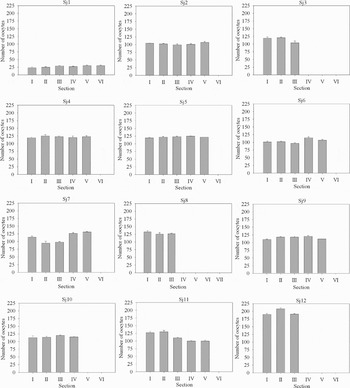
Figure 1 shows the number of oocytes in each section of trunk with gonad of each examined individual. Because of the anatomy of the reproductive system, the number of oocytes in the most anterior section is not statistically different from the number of oocytes in the rest of the gonad. Although in two of the individuals (Sj7 and Sj11, with P values of 0.047 and 0.043 respectively) the null hypothesis can be rejected, the overall P values allow us to assume that there are no differences between the first section of the trunk and the rest of the gonad (Sj2: P = 0.661; Sj3: P = 0.632; Sj4: P = 0.101; Sj5: P = 0.889; Sj6: P = 0.327; Sj7: P = 0.623; Sj8: P = 0.957; Sj9: P = 0.092; Sj10: P = 0231; Sj12: P = 0.327).
Mean and standard deviation of the number of oocytes per section of the trunk of each individual.

Chemical analysis
Charred thin layer chromatography plates and corresponding chromatograms show seven different lipid classes. Free fatty acids comprised less than 10% of total lipid in all tissues, suggesting that samples were in a good state of preservation (Jeckel et al., Reference Jeckel, de Moreno and Moreno1989).
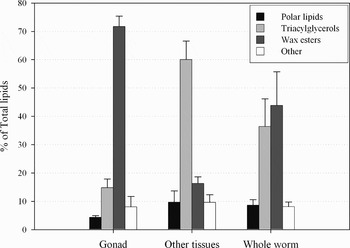
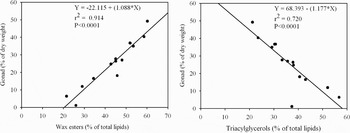
The results obtained (Table 1; Figure 2) demonstrate that the gonad has a higher concentration of total lipid (TL) and wax esters (WE), and lower concentration of triacylglycerols (TAG) than somatic tissues. These differences are statistically significant (TL: T = 301.000; P < 0.001, N = 13, α = 0.05; WE: T = 301.000; P < 0.001, N = 13, α = 0.05; TAG: T = 138.000, P = 0.003, N = 13, α = 0.05), and both the concentration (% of total lipids) of wax esters and the concentration (% of total lipids) of triacylglycerols are linearly related to the amount of ovary (WE: F = 127.27, P < 0.001, N =13, α = 0.05; TAG: F = 30.916, P < 0.001, N = 13, α = 0.05). From the two variables, the percentage of wax esters is the one that predicts more precisely the amount of gonad (Figure 3).
Mean and standard deviation of the different lipid classes in the ovary, somatic tissues and whole trunk of female Seepiophila jonesi (% of total lipid).

Relationship between the percentage of gonad in total tissue (normalized to dry weight) and the percentage of wax esters and triacylglycerols as a proportion of total lipid in female Seepiophila jonesi.

Mean and standard deviation of total lipid and lipid class concentration (mg.mg−1 of dry weight) in Seepiophila jonesi (N = 13).

DISCUSSION
The reproductive system of female vestimentiferans consists of a paired system of ducts extending posteriorly from the anterior part of the trunk. A longitudinal strip of germinal epithelium is present throughout the length of the gonocoels, which run parallel to the oviducts; some species have an ovisac situated on the portion of the trunk underlying the vestimentum. Although in 17% of the examined individuals the number of oocytes in the most anterior section of the gonad was different from the numbers in sections in the rest of the gonad, our results, together with the anatomical evidence suggest that, except at the ovisac, the composition of gonad tissue is constant throughout the gonad length. We propose that the amount of ovary found in the first centimetre of the trunk, not underlying the vestimental wings, can be used as representative of the reproductive condition of the individual.
To date there have been no studies on the reproductive condition of vestimentiferans, partly because of sampling constraints inherent to hydrothermal vents and cold seep environments (reviewed in Tyler & Young, Reference Tyler and Young1999) and also the lack of a simple methodology to quantify gonad development. The entire reproductive system is surrounded by trophosome, which makes the separation of the two, and consequently the determination of the proportion of gonad by mass extremely difficult. In comparison with the image analysis of histological sections of the trunk, the determination of the lipid-class composition is much less time consuming both in terms of the initial preparation of the samples on board ship and in the laboratory.
Recent studies have revealed spatial and temporal variation in the reproductive development of other invertebrate species at hydrothermal vents (Copley et al., Reference Copley, Tyler, Van Dover and Philp2003; Perovich et al., Reference Perovich, Epifanio, Dittel and Tyler2003) and cold seeps (Copley & Young, Reference Copley and Young2006). Characterizing such aspects of life history biology is a prerequisite for understanding the dynamics of these insular populations. The method outlined in this current work provides a realistic method to gain insights into the reproductive condition in a range of vestimentiferan species that inhabit the deep-sea, and to produce a ‘gonad maturation index’ based on the proportion of gonad as dry weight of trunk. Although the equation G = −22.115 + 1.088WE, where G is the amount of gonad (% of total dry weight) and WE the concentration of wax esters (% of total lipids) is specific to Seepiophila jonesi and may not hold for other species, the study of the lipid-class composition in general, and the determination of the proportion of wax esters in particular, can be considered as a new method to determine the reproductive condition in this taxon. This approach could be of great use in the study of the spatial and temporal variation of the reproductive biology of female vestimentiferans.
ACKNOWLEDGEMENTS
This work was supported by the FCT grant SFRH/BD/7084/2001. We thank C.M. Young (the chief scientist of the cruise) and the captain and crew of RV ‘Seaward Johnson II’ and DSV ‘Johnson-Sea-Link II’ for their support.