Transposition of the great arteries is a group of congenital cardiac defects involving aberrant connections of the aorta and pulmonary artery.Reference Warnes1 Transposition of the great arteries may be either simple, with isolated arterioventricular discordance – left ventricle associated with pulmonary artery and right ventricle with aorta – or more complex, with other associated cardiac defects such as ventricular septal defect among others. Physiologically, transposition of the great arteries disrupts the normal series arrangement of the circulation and forms two parallel circuits, systemic and pulmonary, causing presentation within the first hours of life with signs of cyanosis and respiratory distress.Reference Sommer, Hijazi and Rhodes2 Extrauterine viability is only maintained by communication between these circuits at the atrial, ventricular, and/or arterial levels.Reference Gutgesell, Garson and McNamara3–Reference Ellerbeck, Smith and Holden5 Modern therapy of transposition of the great arteries, in most cases, involves several days of medical stabilisation before definitive treatment with the arterial switch operation.Reference Ochsner, Cooley, Harris and McNamara6–Reference Sarris, Chatzis and Giannopoulos9
In some patients with inadequate mixing, pre-operative cyanosis is life threatening with severe hypoxaemia in the systemic circuit leading to tissue ischaemia. Balloon atrial septostomy, also known as Rashkind procedure, is a temporising means used within the first few days of life to increase atrial level shunting in these neonates.Reference Rashkind and Miller10 First described by Rashkind and Miller in 1968, this procedure provides a conduit for the passage of oxygenated blood into the systematic circulation in patients with these anomalies,Reference Rashkind and Miller10–Reference Waldhausen, Boruchow, Miller and Rashkind13 increasing effective pulmonary blood flow. At the time of its introduction, the Rashkind procedure afforded immediate relief to the neonate with severe hypoxia and provided adequate palliation for months until an atrial switch procedure could be accomplished later in infancy. In addition, among those patients undergoing Rashkind procedure, some undergo the procedure as an intermediary step before cardiopulmonary bypass and cannulation within the same hospitalisation.
Since its introduction 40 years ago, limited single-institution studies of Rashkind procedure have documented complications including arrhythmias, sub-clinical cerebral ischaemia, embolisation of ruptured balloon fragments, damage to valves or vasculature, and hypoxaemia.Reference Parsons, Astley, Burrows and Singh14–Reference Turley and Ebert25 Comprehensive data profiling the procedure are lacking. Furthermore, given the shorter delay before surgical therapy in the present atrial switch operation era, the question of routine balloon atrial septostomy versus selective application in neonates with limited intra-atrial shunting remains. This decision analysis may be informed by a more comprehensive knowledge of outcomes in those undergoing the procedure versus those who do not have the procedure.
This study begins to address the lack of multi-institutional data on transposition patients with a particular focus on those undergoing Rashkind procedure. This study is also the first to profile outcomes of Rashkind procedure at a national level using data from national databases.
Materials and methods
Databases
An analysis was performed using 15 years (1988–1996, 1998–1999, 2001–2002, and 2004–2005) of the Nationwide In-patient Sample Database and three complementary years (1997, 2000, and 2003) of the Kids’ Inpatient Database. These databases are maintained by the Agency for Healthcare Research and Quality, and funded by the Healthcare Cost and Utilization Project 26
The Nationwide In-patient Sample is an all-payer database containing annual information on up to 8 million in-patient discharges from approximately 1000 hospitals across the United States of America.27 Hospitals are sampled from 37 states to represent a 20% stratification of all hospitals nationwide. The Johns Hopkins Institutional Review Board considered this publicly available data set as exempt from review.
The Kids’ Inpatient Database provides annual information on up to 3 million in-patient discharges among patients 20 years old or younger.28 It provides a sample of paediatric discharges from all hospitals in up to 36 participating states. The Kids’ Inpatient Database sampling algorithm uses systematic random sampling to select 10% of all uncomplicated in-hospital births and 80% of all complicated in-hospital births, as well as other selected paediatric cases, for inclusion in the database. The Johns Hopkins Institutional Review Board considered this publicly available data set as exempt from review.
Both the Nationwide In-patient Sample and Kids’ Inpatient Databases were used to collect information regarding age at admission, gender, race, patient diagnoses, in-patient procedures, and descriptive hospital information.
Patient selection
We used the following inclusion criteria: an International Classification of Disease-9 diagnosis code of transposition of the great arteries and age of admission less than 60 days. One International Classification of Disease-9 diagnosis code was used to identify patients with complete transposition of the great arteries: 745.10. This study did not include patients who were transferred from hospital to hospital so as to exclude any patients who may have undergone a Rashkind procedure at one institution and further interventions at another institution.
Data management and analysis
We performed a descriptive analysis using the variables of gender, race, age, number of co-morbidities, geographic region, admission source, and hospital teaching status. A teaching hospital is defined by the Healthcare Cost and Utilization Project, as a hospital with an American Medical Association-approved residency that also is a member of the Council of Teaching Hospitals, or has a ratio of full-time equivalent interns/residents to beds of 0.25 or higher.27 We searched relevant International Classification of Disease-9 codes to determine the prevalence of certain co-existing diagnoses and in-patient procedures or complications. Major outcomes included in-patient mortality, length of stay, and total hospital charges. Total hospital charges were adjusted for medical inflation to reflect 2007 dollars.29
We made a comparison of descriptive data elements, outcomes, and clinical associations between transposition of the great artery patients undergoing Rashkind procedure and of those not undergoing the procedure. We did not include clinical factors such as patient’s gestational age and weight in this analysis because although these elements are present within the Nationwide In-patient Sample and Kid’s In-patient Database, the clinical factors are not systematically reported with high fidelity as are other data points that we have included in this observational analysis.
The International Classification of Disease-9 code used to identify patients undergoing Rashkind procedure was 35.41. We performed group comparisons using Pearson’s chi-square test for categorical outcomes and the Kruskal–Wallis test for non-normally distributed continuous variables. Comparisons were performed primarily to assess associations between Rashkind procedure and major clinical conditions, such as necrotising enterocolitis – the International Classification of Disease-9 code 777.5 – and stroke – the International Classification of Disease-9 codes 430–434. The codes used to define stroke included the following diagnoses: intracerebral haemorrhage; sub-arachnoid haemorrhage; non-traumatic intracranial haemorrhage; and thrombosis, embolism, stenosis, or obstruction of the precerebral or cerebral arteries. Other major outcomes included in-hospital mortality, length of stay, total hospital charges, which were all data points included within the Nationwide In-patient Sample and the Kids’ Inpatient Database. We performed multivariate analysis while only clinical associations from bivariate analysis are shown.
The analysis of national databases such as the Nationwide Inpatient Sample has several limitations, including potential errors in coding and an inability to capture repeat hospitalisations. A more complete discussion of the limitations of such data sources is included in the Discussion.
Results
Demographics and hospitalisation characteristics
We identified 8681 patients with transposition of the great arteries: 1742 (20%) underwent Rashkind procedure, whereas 6939 (80%) did not.
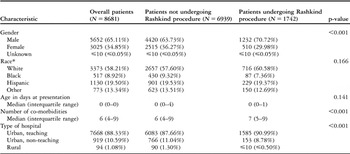
Overall, there was a nearly 2:1 ratio of male (65%) to female (35% ) transposition of the great artery patients (Table 1). A generally similar distribution was present in both the Rashkind and non-Rashkind groups, although patients undergoing the procedure were more likely to be male (71%) compared to those not undergoing the procedure (64%) with a p-value less than 0.001 (Table 1).
Demographics and hospitalisation characteristics.

*Not all states collected information on race (33.25% unknown in total)
Overall, a majority of transposition of the great artery patients averaged 58% of white ancestry, 20% Hispanic, or 9% black ancestry (Table 1). The racial distribution of patients did not differ significantly between transposition of the great artery patients undergoing the procedure versus those who did not (p = 0.166; Table 1). We were unable to obtain race data for 34% of participants because not all hospitals reported this information to the Healthcare Cost and Utilization Project.
Patients were admitted at a median age of 0 (mean: 0) days old (Table 1). Age at presentation did not vary significantly between transposition of the great artery patients undergoing Rashkind procedures and those not undergoing the procedure (p = 0.141; Table 1).
Overall, most transposition of the great artery patients were diagnosed at urban teaching hospitals (88%; Table 1). A higher proportion (91%) of transposition of the great artery patients undergoing Rashkind procedure were treated at urban teaching hospitals, compared to counterparts not undergoing the procedure (88%) with a p-value less than 0.001 (Table 1).
Co-existing diagnose
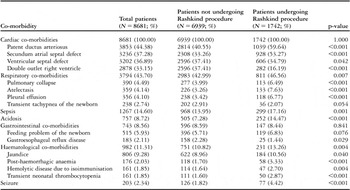
Transposition of the great artery patients undergoing Rashkind procedure had a significantly higher median number of co-morbidities compared to transposition of the great artery patients not undergoing the procedure (Table 1). The most common co-existing diagnoses among all transposition of the great artery patients were (44%) patent arterial duct, 37% secundum atrial septal defect, 37% ventricular septal defect, and 33% double outlet right ventricle (Table 2). Transposition of the great artery patients undergoing Rashkind procedures were significantly more likely to have a concomitant patent arterial duct or secundum atrial septal defect, and were significantly less likely to have a ventricular septal defect or double outlet right ventricle than their counterparts who did not undergo the procedure. All p-values were less than 0.05 (Table 2).
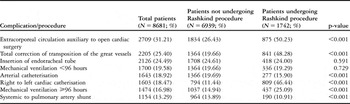
The prevalence of other specific co-existing conditions and in-hospital interventions are presented in Tables 2 and 3. Transposition of the great artery patients undergoing Rashkind procedures were more likely to have co-existing co-morbidities – 46% respiratory, 17% infectious, 13% haematological, or 4% neurological – relative to their counterparts not undergoing the procedure (Table 2). Both groups of transposition of the great artery patients had similar rates of gastrointestinal co-morbidities, with p-value of 0.841 (Table 2).
Co-existing diagnoses.

In-hospital interventions.

In-patient outcomes
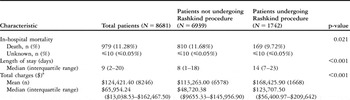
In-hospital mortality among all transposition of the great artery patients was 11% (Table 4). Morality was significantly higher (12%) in transposition of the great artery patients not undergoing Rashkind procedure, compared to 10% of those undergoing the procedure, with a p-value of 0.021 (Table 4). Median length of stay in all transposition of the great artery patients was 9 days (Table 4). Length of stay was significantly higher (14 days) in patients undergoing Rashkind procedure than in those not undergoing the procedure (8 days) with a p-value less than 0.001 (Table 4). The greater length of stay for Rashkind patients may reflect an increased need for observation of these patients who have undergone a procedure. Median total hospital charges for the initial hospitalisation were $124,421.40 in all transposition of the great artery patients (Table 4). Median total charges were significantly higher ($168,425.90) in those who underwent the procedure, compared to those who did not ($113,263.00) with a p-value less than 0.001 (Table 4).
Major outcomes.

aAdjusted to 2007 dollars
Clinical associations with the Rashkind procedure
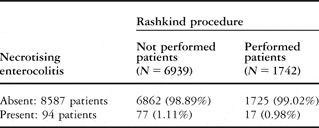
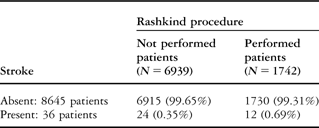
In bivariate analysis, patients undergoing Rashkind procedure were no more likely to have an associated diagnosis of necrotising enterocolitis than those who did not undergo the procedure, 1% versus 1%, respectively, with a p-value of 0.630 (Table 5). However, a bivariate analysis showed that stroke is almost twice as likely to occur in transposition of the great artery patients undergoing Rashkind procedure than in patients not undergoing the procedure, 1% versus 0%, respectively, with a p-value of 0.046 (Table 6).
Bivariate analysis of all transposition patients <60 days old (1998–2005): Rashkind procedure versus necrotizing enterocolitis.

p = 0.630
Bivariate analysis of all transposition patients <60 days old (1998–2005): Rashkind procedure versus stroke.

p = 0.046
Discussion
The scientific study of clinically significant complications arising from rare congenital anomalies, such as transposition of the great arteries, and of interventions aimed at palliating such anomalies, continues to be challenging given that the rarity of the condition often precludes the development of representative, clinically relevant, single-institutional studies. Several past studies and commentaries have alluded to a possible relationship between complex congenital heart conditions, such as transposition of the great arteries, and clinically relevant consequences, such as necrotising enterocolitis, through the mechanism of hypoxaemia.Reference McElhinney, Hedrick and Bush30–Reference Stapleton, Eble, Dickerson, Andropoulos and Chang35 Recent studies show an association between Rashkind procedure and the development of sub-clinical strokes in transposition of the great artery patients, although interventions to palliate cardiac anomalies, such as the Rashkind procedure, are traditionally thought to be relatively safe.Reference McQuillen, Hamrick and Perez22, Reference McQuillen, Barkovich and Hamrick23 However, a limitation of such single institution-based studies is their relatively small number of patients and sub-clinical outcomes.
The two primary goals of this study were to provide descriptive data on transposition of the great artery patients nationwide and to determine whether Rashkind procedure performed in transposition of the great artery patients was associated with clinically relevant consequences, such as the development of necrotising enterocolitis and stroke. We drew the data for this analysis from a national sample of 8681 discharges compiled from two national, de-identified databases spanning 18 years and 37 states. This approach minimised institutional or regional variation in practice patterns while allowing for the inclusion of a large number of transposition of the great artery patients.
Similar to previous studies, the ratio of male to female patients with transposition of the great arteries was approximately 2:1.Reference Gomelsky, Holden, Ellerbeck and Brenner4 Also, patients not undergoing Rashkind procedure were more likely to have emergent admission with co-existing diagnoses of ventricular septal defect or double outlet right ventricle, whereas transposition of the great artery patients undergoing Rashkind procedures were more likely to have non-emergent admission with co-existing diagnoses of patent arterial duct or secundum atrial septal defect. Physiologically, it is not surprising that the co-existing diagnoses of ventricular septal defect or double outlet right ventricle are negatively associated with Rashkind procedure, as ventricular-level shunting would be expected to ameliorate the severe hypoxaemia necessitating the procedure. The presence of a patent arterial duct would be expected to be only mildly protective, as it does not effectively alleviate cerebral hypoxaemia, as oxygenated blood is only delivered distal to the carotids. Unexpectedly, the co-existing diagnosis of secundum atrial septal defect was not associated with freedom from Rashkind procedure. It seems likely that the atrial septal defects coded are not haemodynamically significant, as large atrial septal defects would certainly alleviate the need for an atrial septostomy. One must also consider that the Rashkind procedure was routine practice at some centres during this time period without regard to clinical status. Practice patterns such as this quite likely confound simple associations. Patients undergoing Rashkind procedure had a lower mortality rate than their non-procedure counterparts, which was quite likely due to the more complex cardiac disease in the latter group. However, the Rashkind patients generally had more co-morbidities, stayed longer in the hospital, and were charged more on average than their non-procedure counterparts, potentially reflecting more profound hypoxaemia.
We conducted bivariate analyses to explore the association between Rashkind procedure and clinically relevant outcomes. A bivariate analysis showed that, among transposition of the great artery patients, Rashkind procedure was not significantly associated with a diagnosis of necrotising enterocolitis. In fact, the analysis seemingly shows either a slightly protective trend between Rashkind procedure and necrotising enterocolitis or reflects the more complex nature of congenital cardiac disease in the transposition of the great arteries in the non-Rashkind group. However, a separate bivariate analysis of transposition of the great artery patients showed a significant, positive association between Rashkind procedure and the diagnosis of stroke despite the higher anatomic complexity in the non-Rashkind group. In fact, the analysis showed that a diagnosis of stroke was almost twice as likely in patients undergoing Rashkind procedure (1%) compared to those not undergoing the procedure (0%) with a p-value of 0.046. The finding that Rashkind procedure is positively and significantly associated with stroke expands upon smaller, sub-clinical, radiographic studies conducted at single sites via the use of clinically significant outcomes at a national level.
This study is subject to the limitations inherent to all retrospective studies using national administrative databases. First, there are always some errors in administrative International Classification of Disease-9 coding. However, errors in coding across the more than 8000 neonates with transposition of the great arteries are likely to be randomly distributed. Second, some clinical details involved in diagnosis or treatment were not available in the data set. Given that our descriptive data elements parallel the population data reported in several past studies, we feel confident that our descriptive and bivariate analyses are valid. Third, although one may assume that stroke patients would not be candidates for Rashkind procedure, the databases analysed would not allow us to definitively declare that Rashkind procedures were consistently performed before the diagnosis of stroke. Also, for those neonates who may have undergone an arterial switch operation during hospitalisation, the limitations of this database would not allow us to definitely determine whether a possible peri-operative stroke occurred before or after arterial switch. Furthermore, we were also not able to strictly define a correlation between patients with restrictive atrial septum and stroke. We believe that our analysis validly reports an association between Rashkind procedure and stroke in this study using observational data, although lack of temporal data limited our ability to make statements of causation. Similarly, using this national database, it is difficult to clearly know which of these neonates were purposefully treated by clinicians with early arterial switch operation intervention versus later intervention. Fourth, given that this study used only in-patient databases, we were unable to capture repeat hospital visits or follow-up visits after discharge, thus potentially under-representing the total number of transposition of the great artery patients who went on to develop necrotising enterocolitis or stroke. Fifth, although we sought to provide the broadest possible profile of transposition of the great arteries patients either undergoing or not undergoing Rashkind procedure, the practice patterns of some providers may have changed over time leading to treatment bias, particularly given the tendency of surgeons to move towards earlier arterial switch operations over time.
Despite these limitations, we believe that our findings offer useful descriptive data and a novel insight into relevant clinical outcomes in transposition of the great artery patients undergoing Rashkind procedure. By combining two large national databases, we have produced what we believe is the broadest national profile to date detailing outcomes among transposition of the great artery patients. In addition, this is also the first study to associate Rashkind procedure with a clinically relevant diagnosis of stroke among transposition of the great artery patients at a national level.
Acknowledgements
The authors have no disclosures, including no relationships with pharmaceutical companies, biomedical device manufacturers, or other corporations whose products or services are related to the subject matter of this article.