The impact of performing cardiac operations during viral respiratory season on early post-operative outcome has been discussed for different kinds of operations and different diagnosis groups in paediatric cardiac surgery.Reference Fedderly, Whitstone, Frisbee, Tweddell and Litwin1–Reference Salam, Dominguez, Tsang and Giardini4 Patients with univentricular circulation suffer from long-lasting volume overload of the pulmonary and systemic circulation. The total cavopulmonary connection is a standard procedure for separating pulmonary and systemic circulation and, thus, reduction of volume overload of the single ventricle and improvement of cyanosis.Reference Fontan and Baudet5–Reference Pizarro, Mroczek, Gidding, Murphy and Norwood8 Mortality rates in the modern era are low, but post-operative morbidity still includes pulmonary, circulatory, and renal failure.Reference Rogers, Glatz and Ravishankar9–Reference Tweddell, Nersesian and Mussatto12 The missing subpulmonary ventricle and, as a consequence, only passive pulmonary perfusion make patients more susceptible to complications secondary to an even slight increase in pulmonary vascular resistance. Viral infections during the post-operative course may lead to increased pulmonary resistance with reduced pulmonary flow and consecutive circulatory failure.Reference Sreeram, Watson and Hunter13 Fontan operation performed in winter season has been described to be associated with higher mortality in a patient cohort operated until the year 2000.Reference Nicolas, Hills, Moller, Huddleston and Johnson2 More recent studies did not find higher mortality rates, but a correlation of post-operative pleural effusions and length of hospital stay with Fontan completion during winter respiratory viral season.Reference Fedderly, Whitstone, Frisbee, Tweddell and Litwin1,Reference Salam, Dominguez, Tsang and Giardini4 Thus, it was speculated that Fontan completion should be favourably performed during summer season for improving patient care.
The aim of our study was to compare post-operative outcome after total cavopulmonary connection between patients operated during winter and summer season in our institution in a cohort of 211 patients who were operated between 1995 and 2015.
Materials and methods
Study design and preoperative variables
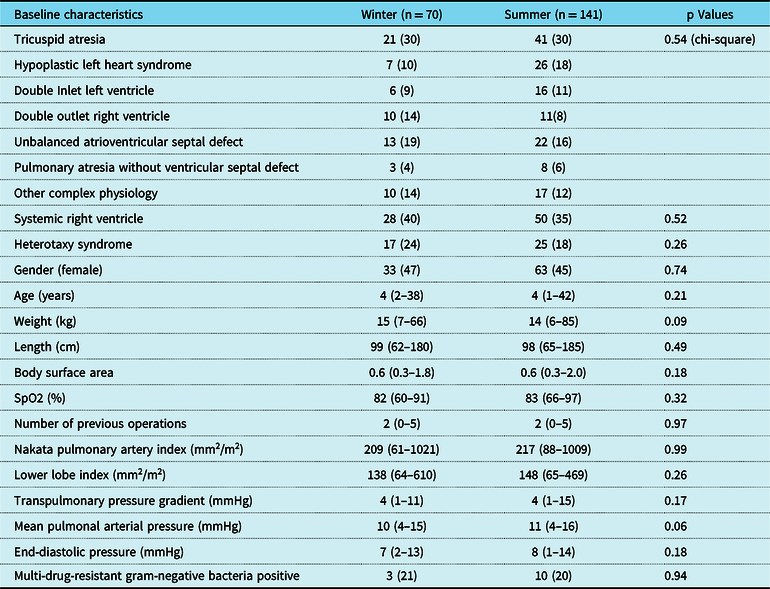
We retrospectively studied 211 patients who underwent an extracardiac total cavopulmonary connection procedure at the German Heart Center Berlin between January 1995 and December 2015. Patients were divided into two groups depending on the time of year operation was performed. One hundred forty-one (67%) patients were operated during summer season (April–October), and 70 (33%) were operated during winter season (November–March). We performed a retrospective analysis of hospital notes of pre-, intra-, and post-operative variables and compared these variables between the two groups. Baseline characteristics such as age, gender, and body measurements were reviewed, as were cardiac diagnoses and haemodynamic characteristics. In addition, we evaluated the colonisation with multi-drug-resistant gram-negative bacteria for all patients operated since 2012. All these variables are listed in Table 1.
Preoperative baseline characteristics according to season of operation.

Data are reported as n (%) or median (minimum-maximum) as appropriate.
n = number of patients.
Intraoperative variables
In all patients (n = 211), an extracardiac Fontan operation was performed. The surgical technique of extracardiac Fontan operation has been described elsewhere.Reference Marcelletti, Corno, Giannico and Marino14–Reference Alexi-Meskishvili, Ovroutski and Ewert16
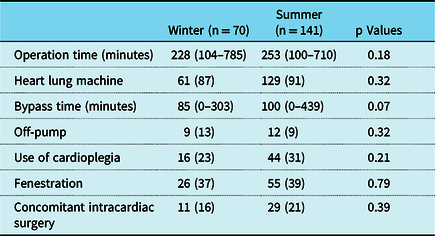
Intraoperative variables were compared between patients operated during winter and summer season and are listed in Table 2.
Intraoperative data according to season of operation.

Data are reported as n (%) or median (minimum-maximum) as appropriate.
n = number of patients.
Post-operative variables
During the post-operative course, the following variables were observed: early mortality, early Fontan takedown, need for mechanical circulatory support, prolonged inotropic support, incidence of supraventricular tachyarrhythmia, intubation time, incidence of fast-track extubation, nitric oxide ventilation, need for pulmonary vasodilation therapy, need for dialysis, incidence of relevant ascites, prolonged pleural effusions, incidence of chylothorax, specific antibiotic treatment, length of ICU stay, and length of hospital stay.
Early mortality was defined as death within 30 days post-operatively and early Fontan takedown as revision of the Fontan operation within 30 days after. Mechanical circulatory support means the implantation of an extracorporeal membrane or of a ventricular assist device. Prolonged inotropic support was defined as need for catecholamines for longer than 72 hours post-operatively. Intubation time (hours) was measured from end of surgery until final removal of chest tube. If extubation was carried out within 6 hours post-operatively, this was registered as “fast track extubation”. Need for pulmonary vasodilation therapy was indicated if patients demonstrated a mean pulmonary artery pressure of ≥15 mmHg. Pulmonary vasodilation therapy included the administration of nitric oxide ventilation and/or oral medication with Sildenafil and/or intravenous or inhalative medication with Ilomedin. Need for dialysis therapy was indicated in patients with acute renal failure post-operatively (i.e. anuria and volume retention). Dialysis therapy included peritoneal dialysis and haemodialysis. The presence of pleural effusion was diagnosed evaluating chest X-ray and sonography. Chylothorax was defined as the presence of triglycerides and chylomicrons in pleural drainage. It was defined that patients had prolonged pleural effusions if a pleural drainage was necessary for longer than 10 days post-operatively. If patients showed signs of infection, a calculated, specific antibiotic treatment was initiated. Length of stay in the ICU was defined as the time between the date of operation and the date of referral from the ICU to the stepdown unit (in days). Length of hospital stay was defined as the time between the date of admission and the date of discharge (in days).
Statistical analysis
For statistical evaluation, Mann–Whitney U-test and Fisherʼs exact test were used. Categorical variables were declared as numbers and percentages. Continuous variables were declared as a mean with standard deviation or median and range. Statistical significance was defined as p ≤ 0.05. IBM SPSS Statistics Version 18 was used for statistical univariate analysis.
For all 211 patients’ diagnoses, pre-, intra-, and post-operative variables were analysed.
Results
Patient population and baseline characteristics
Patients who were operated during winter and summer season showed comparable diagnoses, preoperative, and intraoperative variables (Tables 1–2). All patients who received a total cavopulmonary connection completion at the German Heart Center Berlin between January 1995 and December 2015 were included. There was no significant difference in known risk factors for adverse post-operative outcome like systemic right ventricle, heterotaxy syndrome, and preoperative oxygen saturation.
Post-operative outcome after total cavopulmonary connection was comparable between winter and summer season
Mortality and severe morbidity
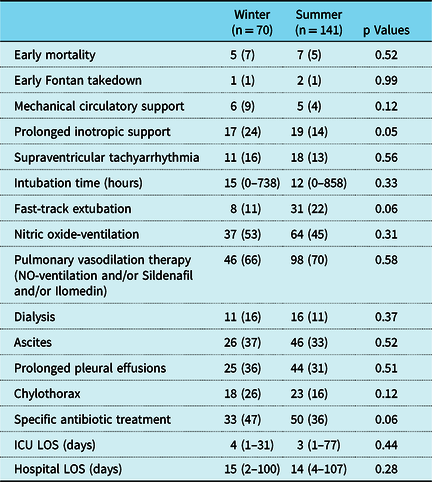
There were no statistically significant differences in early mortality (p = 0.52), early Fontan takedown (p = 0.99), and need for mechanical circulatory support (p = 0.12) between patients operated in winter or summer season (Table 3).
Comparison of post-operative outcome between winter and summer season.

Data are reported as n (%) or median (minimum-maximum) as appropriate.
LOS = length of stay; n = number of patients.
Post-operative morbidity
Patients operated during winter and summer season showed a comparable post-operative outcome (Table 3). There was no significant difference in length of hospital stay, pleural effusions, or post-operative intensified treatment strategies like prolonged intubation time, dialysis, or change in antibiotic treatment. However, there was a tendency towards a higher incidence of prolonged inotropic support during winter season with borderline statistical significance (p = 0.049).
Discussion
In the present study, we describe comparable post-operative outcomes after total cavopulmonary connection completion between patients operated during winter and summer season. Former studies have indicated a relationship between an increased risk for post-operative complications after total cavopulmonary connection completion and the date of surgery in winter season. Fedderly et al hypothesised that in the winter season, an increased burden of respiratory viral infections may lead to prolonged pleural effusion and to longer hospital stay after total cavopulmonary connection completionReference Fedderly, Whitstone, Frisbee, Tweddell and Litwin1 due to an increased pulmonary vascular resistance in case of respiratory viral infection. Similar results were reported in a study by Nicolas et al, which showed a higher mortality of patients after total cavopulmonary connection completion in the winter season.Reference Nicolas, Hills, Moller, Huddleston and Johnson2 In a study by Salam et al, a prolonged hospital stay was associated with total cavopulmonary connection completion during winter season, presence of a systemic right ventricle, and male gender.Reference Salam, Dominguez, Tsang and Giardini4 Furthermore, patients who were operated in the winter season suffered from more post-operative infections and acute renal failure.Reference Salam, Dominguez, Tsang and Giardini4
In our patient cohort, we found comparable post-operative outcomes between patients who underwent total cavopulmonary connection completion during winter and summer season. The main findings were that no differences were present related to pulmonary or renal failure, or the use of specific antibiotic therapy in case of post-operative infections. In case of prolonged inotropic support, patients operated in winter season showed a tendency towards a higher incidence with borderline statistical significance. However, as this remains the only parameter differing between patients operated in winter and summer season and no further difference is detected in severe morbidity and mortality, this finding does not seem not to have a relevant clinical impact.
Both groups, although limited by the retrospective study design, did not differ in known risk factors for unfavourable post-operative outcome (e.g. presence of systemic right ventricle, heterotaxy syndrome, or reduced preoperative oxygen saturation).Reference Ovroutski, Sohn and Barikbin10,Reference Nordmeyer, Rohder and Nordmeyer17 Importantly, there were also no differences in baseline characteristics like gender distribution, primary cardiac, or the number of previous operations. In our institution, all patients who are scheduled for Fontan operation are carefully checked for early infectious signs during the admission process, both in winter and in summer season; this includes assessment of medical history, physical examination, chest X-ray, and blood testing.
Thus, we feel that total cavopulmonary connection completion can be performed with a comparable safety in both winter and summer season.
Possible reasons for different findings between the present study and former studies could be differences in the cohorts studied. Fedderly et al reported results in Fontan patients operated between 1991 and 2000, and in 80% of cases, an intracardiac Fontan type was performed, and Nicolas et al reported results in Fontan patients operated between 1982 and 2000 with no information given in regard to intracardiac or extracardiac Fontan type studied.Reference Fedderly, Whitstone, Frisbee, Tweddell and Litwin1,Reference Nicolas, Hills, Moller, Huddleston and Johnson2 In the present study, only patients with extracardiac Fontan were included and Fontan completion was performed between 1995 and 2015.
Limitations
We included patients who underwent a Fontan operation between 1995 and 2015. Thus, the findings of our study may not be comparable to those which included patients from prior eras. Furthermore, our study patients received care at a single centre. Given that differences may exist among centres in management and infection control strategies, our findings may not be generalisable to other programmes.
Conclusion
In the present study, we did not find significant differences in mortality, severe morbidity, or longer hospital stay in the early post-operative period after total cavopulmonary connection between patients operated during summer or winter season. These results contrast with findings from prior studies and suggest that total cavopulmonary connection completion during winter season is as safe as during summer season. As prior studies also identified various other risk factors for post-operative complications, a thorough preoperative selection process to identify suitable patients seems to be more important than the season of operation.
Acknowledgements
None.
Financial Support
This research received no specific grant from any funding agency, commercial or not-for-profit sectors.
Conflicts of Interest
None.
Ethical Standards
The authors assert that all procedures contributing to this work comply with the ethical standards of the national relevant guidelines on human experimentation (Nuremberg Code) and with the Helsinki Declaration of 1975, as revised in 2008, and has been approved by the institutional committees (Ethikausschuss 2 der Ethikkommission am Campus Virchow-Klinikum der Charité, Berlin).