


1. INTRODUCTION
Complex predicates and reanalysis (or restructuring) have been important research topics for decades, see e.g. Butt (Reference Butt1995), Alsina (Reference Alsina1996), Wurmbrand (Reference Wurmbrand2001, Reference Wurmbrand2004, Reference Wurmbrand2013), Cinque (Reference Cinque2006), and references there. The terms have been used in somewhat different ways in the literature. I will use the term reanalysis for the process that combines two verbs into one predicate – a complex predicate which takes a single set of syntactic functions in a monoclausal structure.Footnote 1 Cases of reanalysis have been reported for many languages, but the Scandinavian languages have been largely absent from the international discussion. Exceptions are Wiklund (Reference Wiklund2001, Reference Wiklund2007) and Sells (Reference Sells2004), who give accounts of verbal feature agreement involving reanalysis in Swedish (see also Julien & Lødrup Reference Julien and Lødrup2013 on Norwegian). However, Wiklund (Reference Wiklund2007:87) claims that Swedish does not have the transparency phenomena that have been used to argue for reanalysis in other languages, such as long passives. The same claim is made in passing in Lundquist (Reference Lundquist2009:120, 127). (Both Wiklund and Lundquist have footnotes about possible exceptions.) This article shows that there are long passives in a closely related Scandinavian language, namely Norwegian, represented by Urban East Norwegian. Verbal feature agreement will also be shown to have a role to play.
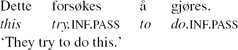
Section 2 discusses sentences with two passive verbs such as Dette forsøkes å gjøres ‘this try.pres.pass to do.inf.pass’, and argues that they must be considered long passives with voice agreement. Their properties are investigated, including the choice of first verbs and the choice of passive forms. Section 3 shows how long passives and verbal feature agreement can be accounted for within the framework of Lexical-Functional Grammar (LFG). Section 4 proposes that presentational focus sentences and pseudocoordinations also provide evidence for complex predicates in some cases.
2. LONG PASSIVES AND VOICE AGREEMENT
2.1 The long passive
A type of passive in Norwegian that has hardly been discussed in the literature is exemplified in (1)–(3). (Most example sentences in this article are from web texts.)
(1)

(2)
(3)



In these sentences, a passive verb is followed by a passive infinitive. The subject of the clause is typically the patient of the second verb. It is important that these sentences do not show subject-to-subject raising, as will be argued below. They will be referred to as voice agreeing long passives, to anticipate the analysis to be given.
The first argument of these sentences is a subject, and not a topicalized object in an impersonal construction. Norwegian requires realized subjects in finite clauses. In examples (1) and (2), it is clear that the first argument is in the canonical subject position (specifier of TP), and not in the topic position (specifier of CP). Example (1) has an adjunct PP in the specifier of CP. Example (2) is a subordinate clause, in which the specifier of CP is standardly assumed to be empty.
Voice agreeing long passives have the same options concerning subject choice as other passives. For example, pseudopassives are possible, shown in example (4).
(4)

Especially interesting are sentences with an expletive subject. Norwegian has a general option for impersonal passives with an expletive subject, which also applies to long passives. These sentences can have an object, as in example (5), or no object, as in example (6).
(5)
(6)


Voice agreeing long passives can be found with a number of verbs.Footnote 2 Searches were made in the Norwegian NoWaC corpus, which consists of 700 million words from web texts (NoWaC: Norwegian Web as Corpus, http://www.hf.uio.no/iln/om/organisasjon/tekstlab/prosjekter/nowac/index.html, accessed here via the Glossa page http://hf-tekstlab.uio.no/glossa2/front). To make the searches feasible, some shortcuts were taken, and I cannot claim that these searches were exhaustive. The search strings were as listed below, where å is the infinitival marker, and bli and være are the two passive auxiliaries, ‘become’ and ‘be’, respectively.
verb with -s-suffix + å + verb with -s-suffix
verb with -s-suffix + å + lemma bli/være + participle
lemma bli/være + participle + å + verb with -s-suffix
lemma bli/være + participle + å + lemma bli/være + participle
Some combinations gave no hits, see Section 2.4. Irrelevant hits were disregarded. Some verbs that gave very many ambiguous hits were put aside, see endnote 4 below. Needless to say, the analysis of a number of the sentences found could be disputed.
The number of voice agreeing long passives found was 102 (excluding the ones that were put aside). There were 21 different first verbs in these sentences, listed in (7).
(7) begynne ‘begin’, forsøke ‘try’, fortsette ‘continue’, fraråde ‘advise against’, klare ‘manage’, lære ‘learn’, makte ‘manage’, nekte ‘deny’, plikte ‘have a duty to’, prøve ‘try’, pålegge ‘instruct’, slutte ‘stop’, starte ‘start’, tillate ‘allow’, tørre ‘dare’, tåle ‘stand, tolerate’, unngå ‘avoid’, unnlate ‘neglect’, velge ‘choose’, ynde ‘like’, ønske ‘wish’
Exploratory web searches gave (reasonably) acceptable voice agreeing long passives with a number of other verbs as well, including those in (8).
(8) forby ‘forbid’, foretrekke ‘prefer’, fortjene ‘deserve’, gidde ‘bother’, glemme ‘forget’, greie ‘manage’, huske ‘remember’, klare ‘manage’, orke ‘be capable of’, overveie ‘consider’, prioritere ‘give priority’, tilråde ‘advice’, våge ‘dare’
Voice agreeing long passives can have an air of informal or even substandard language, and they are sometimes frowned upon by informants. However, examples abound in web texts, and they can be found in typical written genres, even in documents from the government. All example sentences in this article are (reasonably) acceptable to me as a native speaker of Norwegian, unless otherwise indicated. (This does not imply that I accept all the examples found in the NoWaC corpus; for example, I do not accept begynnes ‘begin.inf.pass’ as a first verb.)
2.2 The analysis of voice agreeing long passives
Voice agreeing long passives must be distinguished from other constructions in Norwegian that involve two passive verbs, such as ‘complex passives’ and (other) subject-to-subject raising sentences. It will first be shown that they are different from sentences such as (9), in which a subject-to-subject raising verb with passive morphology is followed by an ordinary passive verb (Sells Reference Sells2004, Julien & Lødrup Reference Julien and Lødrup2013).
(9)

The first verb in (9) is not a real passive. It can be replaced by an active form without any change in meaning, as in example (10), and it can only have passive morphology when the second verb is passive, shown in example (11). (There is more about these sentences in Sections 2.4 and 3.2 below.Footnote 3)
(10)
(11)


With voice agreeing long passives, on the other hand, the first verb is a real passive which cannot be replaced by an active form, as shown in example (12). It is the second passive form that is not real; it can to some extent be replaced by an active, as shown in example (13) (see also examples (24)–(26) below).
(12)
(13)


Voice agreeing long passives are also different from what is called ‘complex passives’ in Scandinavian grammar (see e.g. Christensen Reference Christensen1991, Ørsnes Reference Ørsnes, Butt and King2006). An example of a complex passive is (14).
(14)

The complex passive construction has a passive participle (with no auxiliary) as its second verb, while voice agreeing long passives have an infinitive – either an infinitive main verb with passive morphology, as in most examples above, or an infinitive passive auxiliary with a passive participle as in example (15).
(15)

The complex passive construction takes a very small group of first verbs, while voice agreeing long passives appear with a somewhat larger group (see (7) and (8) above). There is a certain overlap between the groups, e.g. the verb forsøke ‘try’. First verbs in the complex passive construction include akte ‘intend’, as in (14) above, but not e.g. huske ‘remember’, as shown in (16). Recall that this verb appears in an agreeing long passive in (2) above.
(16)

An interesting difference between these passive constructions concerns verbs that take a PP with an infinitival complement, such as advare ‘warn’. These verbs cannot be the first verb of a complex passive, see examples (17) and (18).
(17)
(18)


This restriction has been discussed thoroughly in the literature (Christensen Reference Christensen1986; Engh Reference Engh1994:111–113; Hellan Reference Hellan2001; Ørsnes Reference Ørsnes, Butt and King2006). Ørsnes (Reference Ørsnes, Butt and King2006) shows that it follows from a subject-to-subject raising analysis of the the complex passive – the extra structural layer created by the PP would make the raising path too ‘long’. With voice agreeing long passives, on the other hand, there is no such restriction, as shown in (19) and (20).
(19)
(20)


It is an important point that voice agreeing long passives are different from regular subject-to-subject raising sentences. What is here called voice agreeing long passives would be of no special interest if they could be derived in the following way:
(i) passivization of the second verb
(ii) passivization of the first verb
(iii) raising of the derived subject of the second verb to the subject position of the first verb
Example (21) is a subject-to-subject raising sentence with the passive raising verb hevdes ‘claim.inf.pass.
(21)
It is clear, however, that the voice agreeing long passive cannot be derived by subject-to-subject raising. Many of the verbs that allow the long passive do not allow subject-to-subject raising in the passive. For example, forsøkes ‘try.inf.pass’ differs from a typical passive subject-to-subject raising verb such as hevdes ‘claim.inf.pass’ in not allowing an expletive subject or an idiom chunk subject, as shown in (22) and (23).
(22)
(23)


Some of the verbs that allow the voice agreeing long passive, e.g. huskes ‘remember.inf.pass’, can be found with subject-to-subject raising in bookish style. This means that some sentences are ambiguous between voice agreeing long passives and subject-to-subject raising sentences.Footnote 4
Another argument against a subject-to-subject raising analysis of voice agreeing long passives is provided by sentences with a preposition preceding the infinitival complement, such as (19) and (20) above. These sentences would not be expected to be grammatical if the construction were a subject-to-subject raising construction.
An important argument that voice agreeing long passives are not subject-to-subject raising sentences is given by sentences such as (24)–(26). These examples have been selected to parallel the voice agreeing long passives (1)–(3) above. They have the same first verbs and the same main characteristics, but their second verb has the active form.
(24)
(25)
(26)



The acceptability of sentences such as (24)–(26) varies; they often sound better when the second verb is a passive. A search for the verbs in (7) and (8) above as passive first verbs in the NoWaC corpus resulted in 29 sentences with an active second verb, with 14 different first verbs.Footnote 5
Passives such as those in (24)–(26) cannot have a subject-to-subject raising analysis, because their subject is the patient of an embedded active verb. To my knowledge, they have not been discussed in the Norwegian or Scandinavian literature. However, they are well known from a number of languages under the name of long passives (see e.g. Wurmbrand Reference Wurmbrand2001, Cinque Reference Cinque2006, and references there). Examples (27) and (28) are long passives from German and Spanish (from Wurmbrand Reference Wurmbrand2001:19 and Cinque Reference Cinque2006:65, respectively).
(27)
(28)


The similarity with examples (24)–(26) above is striking. Both (24)–(26) and (27)–(28) have a passive first verb and an active second verb, and the surface subject of the first verb is the patient of the second verb.
Examples (24)–(26) can be safely assumed to be long passives. The question is, then, what the relation is between the long passives (24)–(26) and what I have called voice agreeing long passives such as (1)–(3). The answer is – as anticipated by my terminology – that the voice agreeing long passives are long passives in which the voice feature of the second verb agrees with the one of the first verb.Footnote 6 One argument for this analysis is the fact that a voice agreeing long passive can replace the second passive verb with an active verb form, while this is not possible with the first passive verb. (This was shown above, see examples (12) and (13).)
Verbal features are usually not in focus when agreement is discussed. However, verbal feature agreement has been established independently for Swedish in Wiklund (Reference Wiklund2001, Reference Wiklund2007), and voice agreement is discussed in Sells (Reference Sells2004) and Julien & Lødrup (Reference Julien and Lødrup2013). (There is more about feature agreement in Sections 2.7 and 3.1 below.)
In Sections 2.1 and 2.2 I have argued that Norwegian has long passives. It was shown that the sentences in question have grammatical properties that cannot be accounted for by a subject-to-subject raising analysis. Long passives are well known from other languages, but they have not been noted before in Norwegian. A difference between long passives in Norwegian and e.g. German and Spanish is that the second verb is often passive in Norwegian; this is considered a case of agreement.
2.3 Further arguments for the long passive analysis
A general argument for the long passive analysis concerns the time reference of the verbs involved. The long passive – or reanalysis in general – is assumed not to be possible when the second verb has independent tense, i.e. when it refers to a time that is independent of the time of the first verb (Wurmbrand Reference Wurmbrand2001:79–99). Several of the Norwegian verbs that take the long passive allow, more or less easily, an embedded verb to have independent tense; an example is foretrekke ‘prefer’ (see Wurmbrand Reference Wurmbrand2001:80–85 for similar German data). However, reanalysis is only possible when the second verb does not have independent tense. Thus, a sentence such as (29), with the second verb in the perfect, has no corresponding long passive, as can be seen in (30).Footnote 7
(29)
(30)


When complex predicates are assumed to be monoclausal, a prediction is that an adjunct modifies the whole complex predicate, and never just one of the verbs involved. Even if this prediction involves some delicate judgements, it seems to be basically correct, as indicated by the contrast in (31)–(32).
(31)
(32)


When there is no reanalysis, an embedded infinitive can easily take a sentence adverb following the infinitival marker, while this sounds very strange in a long passive. A parallel pair of examples with an ordinary adjunct is found in (33)–(34).
(33)
(34)


2.4 Passive forms in the long passive
Norwegian has two ways of realizing the passive, the suffix -s (the morphological passive) and auxiliary plus participle (the periphrastic passive). The morphological passive has no preterit form (with marginal exceptions) and no participle form. The passive auxiliaries are bli ‘become’ and være ‘be’. The periphrastic passive with være ‘be’ is usually understood as a perfect. It can be found with the first verb in long passives, but not with the second verb. The reason must be that with the second verb, it would give a time reference that is independent of the time of the first verb, which is not compatible with reanalysis (see Section 2.3 above). The periphrastic passive with bli ‘become’ competes with the morphological passive in the infinitive and the present. The relation between these passive realizations is generally not well understood (but see Engdahl Reference Engdahl, Lyngfelt and Solstad2006, Laanemets Reference Laanemets2013, Lundquist Reference Lundquist2013), and the long passives only add further challenges.
Both passive realizations are in principle possible with the first as well as the second verb. Examples with one or two periphrastic passives are (3) above, repeated here for convenience as (35), and (36)–(37).Footnote 8
(35)
(36)
(37)



Nevertheless, the frequencies of the morphological and periphrastic passives are different. For the 102 voice agreeing long passives in the NoWaC corpus, the distribution is the following:
morphological passive + morphological passive: 73
morphological passive + periphrastic passive: 9
periphrastic passive + periphrastic passive: 1
periphrastic passive + morphological passive: 19
We see that using the morphological passive with both verbs is the most frequent option. This is also the option that generally ‘sounds best’. Embedded periphrastic passives are only used with some 10% (10/102) of all voice agreeing long passives in the corpus.
The periphrastic passive can be found with the first verb, but primarily when there is no alternative. As mentioned above, the periphrastic passive competes with the morphological passive when the auxiliary bli ‘become’ is in the infinitive or the present tense. This turns out to be the case with only two of the 20 sentences with a first periphrastic passive in my dataset. The same holds for long passives with an active second verb: Of 29 such examples, 14 had a morphological passive and 15 a periphrastic passive. Again, only two of the periphrastic passives could have been replaced by a morphological passive.
This relative predominance of the morphological passive in long passives raises several questions. In simple passives, the periphrastic passive is the less formal form in Norwegian, in the sense that it is the predominant form in conversation. Written texts show a higher relative frequency of the morphological passive (Laanemets (Reference Laanemets2013:92) found 48.2% morphological passives in newspapers, and 20.4% in conversation). This general picture seems to conflict with the fact that the long passive can give the impression of being informal, and even substandard.
Especially striking is the use of the morphological passive in infinitival clauses. In general, the morphological passive is less frequent and to some extent marked when the infinitival marker is present (see Müller & Ørsnes Reference Müller and Ørsnes2013:298–299 on Danish).Footnote 9 However, the morphological passive is the preferred form when there is voice agreement in long passives. Julien & Lødrup (Reference Julien and Lødrup2013) observe that the morphological passive is also the preferred form when a subject-to-subject raising verb agrees in voice with an embedded passive verb, as in (9) above, repeated as (38).
(38)

Why should the morphological passive be the preferred form when there is voice agreement? Julien & Lødrup (Reference Julien and Lødrup2013) point out that the passive suffix – invariably -s – is a ‘small’ element, which might make voice agreement sound more natural. An idea from Lundquist (Reference Lundquist2013) gives the basis for a different explanation of the preference of the morphological passive with the second verb: In Norwegian, the morphological passive has a short paradigm. When some marginal preterits are put aside, it is traditionally said that the morphological passive only has infinitive and present forms. What is striking, however, is that these forms are always – without exception – identical. Drawing on this fact, Lundquist (Reference Lundquist2013) interprets the morphological passive as tenseless. This suggestion is strengthened by the fact that the morphological passive is used in ‘timeless’ sentences, such as rules and generic sentences. Lundquist uses this analysis to account for the fact that the periphrastic passive is the preferred form with epistemic modals (e.g. Brevet skal bli sendt ‘letter.def shall be sent’) – since complements of epistemic modals carry their own tense, the tenseless morphological passive is less optimal. If this kind of reasoning can be extended to agreeing passive forms, the preference for the morphological passive can be explained by the general constraint on reanalysis that was discussed above (Section 2.3): The second verb cannot have independent tense. The untensed morphological passive is therefore a natural choice with the second verb. This explanation could also be applied to sentences such as (38) above, which are also assumed to be reanalysis sentences (Sells Reference Sells2004, Julien & Lødrup Reference Julien and Lødrup2013).
2.5 Long passives and voice agreement in other languages
The present work is based on Norwegian data. However, a quick glance at other languages reveals that Norwegian is not the only language with a voice agreeing long passive. Unsystematic searches on the Swedish and Danish web indicate that (varieties of) Swedish and Danish have an option for long passives, comparable to the Norwegian one. Examples with voice agreement are (39) and (40), without voice agreement (41) and (42).
(39)
(40)
(41)
(42)



Swedish and Danish linguists have informally reported that they are aware of such sentences. Some of the Swedes have told me that they also accept some of these examples, but only with voice agreement. (The few Danes I have asked were more reluctant.)
English and French may also be argued to have voice agreeing long passives, even if they are seldom mentioned in the literature. Whitman (Reference Whitman2013) shows that this construction can be found in English from the 18th century to today, although it is disliked by normative grammarians. He gives several text examples such as (43).
(43) others were attempted to be killed
Some French examples of voice agreeing long passives are provided by Grevisse & Goosse (Reference Grevisse and Goosse2008:986). Other examples can easily be found on the French web, such as (44). I am not aware of any discussion of the French situation.
(44)

Long passives in Turkish are described by Kornfilt (Reference Kornfilt and Freidin1996, Reference Kornfilt, Johanson and Rehbein1999). Turkish allows long passives with passive second verbs, but only with a very small number of first verbs. An example is (45).
(45)
Especially interesting is the fact that Turkish, like Norwegian, allows impersonal long passives, such as (46).
(46)

Voice agreeing long passives can also be found in some Austronesian languages; see Wurmbrand (Reference Wurmbrand2013) for discussion and references.
3. A LEXICAL-FUNCTIONAL GRAMMAR ANALYSIS
3.1 Reanalysis
In the previous section we have established that Norwegian has long passives of the same kind that has been reported for a number of other languages, with an option of voice agreement. The question is now how to account for the long passives. Long passives are usually assumed to involve reanalysis (also called restructuring).Footnote 10 An argument that Norwegian long passives must be related to reanalysis concerns the types of verbs found in long passives. Using the same classification as Wurmbrand (Reference Wurmbrand2001), one may identify the following central types:
• aspectual verbs, e.g. fortsette ‘continue’
• irrealis verbs, e.g. forsøke ‘try’, tillate ‘allow’, tilråde ‘recommend’
• strong implicative verbs, e.g. unnlate ‘neglect’, glemme ‘forget’, våge ‘dare’
There is a clear parallel to the types of verbs that have been assumed to take reanalysis in other languages (see the overview in Wurmbrand Reference Wurmbrand2001:342–345).Footnote 11
Reanalysis has been understood in different ways in the literature. For analyses within Minimalism, see e.g. Wurmbrand (Reference Wurmbrand2001, Reference Wurmbrand2004, Reference Wurmbrand2013), Cinque (Reference Cinque2006) and Wiklund (Reference Wiklund2007). In this section, I give an analysis within the framework of Lexical-Functional Grammar (LFG), as in e.g. Butt (Reference Butt1995), Alsina (Reference Alsina1996), Andrews & Manning (Reference Andrews and Manning1999) and Sells (Reference Sells2004).
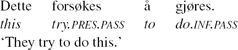
In LFG, the distinction between constituent structure and functional structure is important for an account of reanalysis. The constituent structure – the syntactic tree – does not reflect reanalysis directly. The crucial level of representation is functional structure, where syntactic functions and grammatical features are represented. At this level, the two verbs in a reanalysis construction together constitute one predicate which takes a single set of syntactic functions. A long passive such as (47) has the simplified functional structure in (48).
(47)
(48)

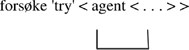
A verb such as forsøke ‘try’ has one lexical entry for its use as a reanalysis verb. It is then an incomplete verb with an argument structure in which the internal argument is not a thematic role, but an open position, as in (49) (Alsina Reference Alsina1996:201–203). When the functional structure is built, a process of predicate composition combines the reanalysis verb and the verb below it, creating a complex predicate. The argument structure of the complex predicate is the result of combining the argument structures of the two verbs, as in (50). The lines indicate that the external argument of the second verb is identified with the external argument of the first verb.Footnote 12 (Some technical questions involved are not in focus here, see e.g. Andrews & Manning Reference Andrews and Manning1999 and Sells Reference Sells2004 for discussion.)
(49)
(50)

This account predicts that reanalysis should in principle be possible with more than two verbs, when every (non-lowest) verb allows reanalysis. This prediction seems to be borne out, for example, by the grammaticality of the constructed (51).
(51)

A potential problem for a reanalysis approach is represented by long passives with a preposition in front of the infinitival complement (see Section 2.2 above). The preposition is selected by the verb, and its semantic content is insignificant. Examples (52)–(53) are repetitions of (19)–(20) above.
(52)
(53)


This preposition must be considered a part of the complex predicate. Independently of long passives, it is a common assumption in the literature that a verb and a preposition can be reanalyzed as one predicate. A central motivation is the pseudopassive (e.g. Bresnan Reference Bresnan and Bresnan1982, see Postal Reference Postal2004:258–264 for critical discussion). In Scandinavian grammar, this idea has not been popular, and there are arguments against reanalysis in pseudopassives (Lødrup Reference Lødrup1991). Even so, it seems to be necessary to assume that reanalysis in sentences such as (52)–(53) makes the preposition a part of the complex predicate.Footnote 13
It has been claimed that reanalysis verbs do not take an internal argument (the infinitive aside), see e.g. Cinque (Reference Cinque2006:22). Wurmbrand (Reference Wurmbrand2004:997–998) shows that an internal argument is possible with some reanalysis verbs in German, but this does not seem to be the case in Norwegian. Some of the verbs that allow reanalysis can take three semantic arguments, e.g. forby ‘forbid’ and tillate ‘allow’. In their regular use, they allow their benefactive argument to be realized as an object in front of an infinitival complement. This option does not exist when they are used as reanalysis verbs.Footnote 14 A web example such as (54) becomes completely unacceptable with an object inserted.
(54)

3.2 Feature agreement
The LFG theory of reanalysis makes a simple account of feature agreement possible. An important general insight, which can be found in Niño (Reference Niño, Corblin, Godard and Marandin1997), Wiklund (Reference Wiklund2001, Reference Wiklund2007) and Sells (Reference Sells2004), is that verbal feature agreement occurs in sentences with reanalysis. This follows without extra rules or stipulations within LFG, as shown in Niño (Reference Niño, Corblin, Godard and Marandin1997) and Sells (Reference Sells2004). Sells (Reference Sells2004) discusses sentences such as (9) above, repeated here as (55), in which a subject-to-subject raising verb agrees with its dependent verb in voice (see also Julien & Lødrup Reference Julien and Lødrup2013).
(55)

In a monoclausal functional structure, two instances of a grammatical feature will unify, e.g. PASSIVE. This means that there can be two of them with the same value, or just one. Example (47) above and its simplified functional structure (48) are reproduced as (56) and (57).
(56)
(57)
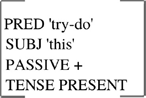
Both passive verbs contribute [PASSIVE +], and these features unify. An active infinitive is assumed to be an unmarked form without features. This means that it does not contribute [PASSIVE –], so a sentence similar to (56) without voice agreement would also get the functional structure (57).
Voice agreement in sentences with one or two periphrastic passives (such as (35)–(37) above) follows when the passive auxiliary is a functional head without a semantic predicate. With this analysis, the auxiliary does not define a separate level in functional structure, it only contributes grammatical features at the top level (see Butt, Niño & Segond Reference Butt, Niño, Segond and Gibbon1996, Frank & Zaenen Reference Frank and Zaenen2004). A morphological passive and a periphrastic passive then have the same functional structure (but it is of course possible to use a feature to distinguish them if necessary). Both the passive suffix and the passive auxiliary contribute a passive feature, which unifies with another passive feature when there is agreement. This means that a sentence with voice agreement similar to (56), but with one or two periphrastic passives, would also have the (simplified) functional structure (57).Footnote 15
This account of voice agreement works without any special rules or stipulations in LFG (see Lødrup forthcoming for more thorough discussion). Nevertheless, there are problems with overgeneration. The account given predicts that feature agreement should be possible with all verbal features in all reanalysis sentences. For some varieties of Norwegian, this could be a good approximation of the real situation (see Section 4.1 below). However, there is both linguistic and sociolinguistic variation, and the account given would overgenerate for most speakers. An even more unfortunate prediction of the account given is that a long passive can realize passivity with the second verb only. Overgeneration can be avoided with optimality restrictions (Sells Reference Sells2004:217), but this will not be discussed further here.
4. MORE EVIDENCE FOR COMPLEX PREDICATES
When the passives under discussion here show reanalysis, the expectation is that the first verbs in question also allow reanalysis in the active. There is evidence that this is the case.
4.1 Verbal feature agreement in the active
Many of the verbs that occur with voice agreement also show verbal feature agreement in the active. Wiklund (Reference Wiklund2007) shows that active reanalysis verbs allow verbal feature agreement in Swedish. This is also true of Norwegian, but neither the grammatical nor the dialectal and sociolinguistic facts are known in any detail.
Feature agreement in the active means that the second verb takes on the inflectional form of the first verb instead of the expected infinitival form. The forms that participate in this process are the imperative, the perfect participle, and the finite present and preterit forms.Footnote 16 Examples are (58)–(60).
(58)
(59)
(60)



There is an important reservation to be noted concerning participle agreement: Using a perfect participle instead of an expected infinitive is not a unitary phenomenon in Norwegian (or Swedish). There is also a different case (with a different distribution) related to counterfactuality (see Julien Reference Julien2003, Wiklund Reference Wiklund2007 and Eide Reference Eide2011 for discussion). This is not agreement and is therefore not relevant here.
Verbal feature agreement in active reanalysis sentences seems to be one and the same phenomenon from a grammatical point of view. However, the dialectal and sociolinguistic distribution of the different types of agreement is not the same. Wiklund (Reference Wiklund2007:64–65) writes that present and preterit agreement is more restricted in Swedish than imperative and participle agreement, concerning both which verbs and which speakers allow it. This also seems to be the case in Norwegian.Footnote 17
4.2 Presentational focus sentences
Presentational focus sentences might provide independent evidence for reanalysis. Norwegian has a general option for presentational focus sentences (see e.g. Lødrup Reference Lødrup1999). Many one-place verbs – including unergatives – can take an expletive subject and realize their thematic argument as an object, as in (61).
(61)

This option also applies to some complex predicates (mentioned in Holmberg Reference Holmberg2002:122). Web searches give examples such as (62) and (63), in which the thematic argument is in the object position of the second verb.
(62)
(63)
The first verbs in (62) and (63) do not allow subject-to-subject raising, as shown by the fact that they cannot take an idiom chunk subject.
(64)

Sentences such as (62) and (63) are not easy to find in texts, and it is not the case that all complex predicates take the presentational focus construction. This must be related to general semantic and pragmatic constraints on this construction, which are not well understood (see e.g. Sveen Reference Sveen1996:4.3). Even so, active presentational focus sentences seem to provide independent evidence for monoclausal reanalysis.
4.3 Pseudocoordinations
The syntax of pseudocoordinations might give further evidence for complex predicates. This construction looks like a coordination of two verb phrases, see (65) below, but its syntactic behavior is different. The first verb belongs to a small group of verbs that includes posture verbs (see e.g. Lødrup Reference Lødrup2002, Reference Lødrup, Helland and Salvesen2014).
(65)

The second verb in a pseudocoordination must have the same inflectional form as the first verb. In the literature, pseudocoordinations are usually considered to be reanalysis sentences (e.g. Wiklund Reference Wiklund2007). Lødrup (Reference Lødrup2002, Reference Lødrup, Helland and Salvesen2014) argues that most pseudocoordinations, including those with posture verbs, are usually biclausal subordination sentences in which the first verb takes a verbal complement. However, pseudocoordinations with posture verbs providing evidence for monoclausal reanalysis may occasionally be found. Two syntactic phenomena indicate reanalysis: the passive and the presentational focus construction.
In some pseudocoordinations both verbs may be passive. In the slightly edited web example (66), the passive subject is the patient of the second verb; it has no thematic relation to the first verb. Such sentences must be considered long passives.
(66)

Sentences such as (66) are not frequent, and they are marginal to many speakers, including myself. But there is also another indication that reanalysis is possible in pseudocoordinations, as a posture verb in a pseudocoordination may allow the presentational focus construction, as in (67).
(67)

These sentences usually have the characteristics of a biclausal construction (Lødrup Reference Lødrup2002, Reference Lødrup, Helland and Salvesen2014): The argument of the first verb is realized in its object position, controlling the subject position of the second verb. However, pseudocoordinations such as (68) below can be found in which the thematic argument is in the object position of the second verb. This is an indication of reanalysis; the parallel to the presentational focus sentences (62) and (63) above is clear.
(68)

Pseudocoordinations thus give further evidence for monoclausal reanalysis in Norwegian.
5. CONCLUSION
Reanalysis and complex predicates have traditionally played a marginal role in the literature on Norwegian and Scandinavian grammar. This article has argued that Norwegian has monoclausal complex predicate constructions, like many other languages. The central evidence is the option of long passives, which has not been noticed before. The grammatical properties of the relevant sentences have been discussed, and it has been argued that they cannot be accounted for by a subject-to-subject raising analysis. A difference between Norwegian and e.g. German and Spanish long passives is that Norwegian long passives often have a passive second verb. This has been analyzed as a case of voice agreement, which has a clear parallel in the option of verbal feature agreement in active sentences. I have also shown that the morphological passive is the most common passive realization in long passives. Furthermore, I have provided a discussion of the treatment of the long passive and voice agreement in LFG. According to Wurmbrand (Reference Wurmbrand2013:1), the long passive is ‘a showcase of complex predicate formation’. In this article, the evidence from the long passives has been corroborated by other phenomena, as presentational focus sentences and pseudocoordinations have also been argued to give evidence for complex predicates.
ACKNOWLEDGEMENTS
Versions of this work were presented at the 25th Scandinavian Conference of Linguistics (Reykjavík, 2013) and the 18th Lexical-Functional Grammar Conference (Debrecen, 2013). For input and discussion, I would like to thank Marit Julien, Jim Wood, Björn Lundquist, Ida Larsson, Elisabet Engdahl, Anders Holmberg, Marianne Hobæk Haff, Mary Dalrymple, Helge Dyvik, and Neal Whitman. Thanks are also due to the NJL reviewers and editor for their thorough work.













