At the very start of his leadership, Xi Jinping 习近平 announced that winning the “battle” for public opinion was to be one of the key objectives of the Party.Footnote 1 At the first meeting of the Leadership Group on Internet Security and Information in 2014, President Xi declared that “captivating online public opinion is a long-term task that requires bringing forth new ideas to improve online propaganda … stimulating the right energy, vigorously cultivating socialist values.”Footnote 2
The challenges posed by the internet to official persuasion efforts have long been recognized. The Hu–Wen administration was the first to attempt the rescue of the declining traditional media industry through state-driven media convergence (meiti ronghe 媒体融合) or the integration of traditional media with online platforms.Footnote 3 In more recent years, the crisis facing traditional media has intensified. The print industry has lost about three-quarters of its advertising revenue in the past three years,Footnote 4 and is facing increased competition from newly emerged “self-media” (zi meiti 自媒体),Footnote 5 and big-data news aggregators like Tencent, Sohu, and Today's Headline.Footnote 6 In response, the party-state has reasserted its commitment to the digitalization of traditional media and has called for fresh ideas in combining traditional journalism with new media platforms that are interactive, fast and competitive in the internet age.
These high-level endorsements inspired a new local-level digital journalism experiment, an initiative largely overlooked by Western scholarsFootnote 7 and observers.Footnote 8 Shanghai's flagship digital news outlet, Pengpai (also known as The Paper), has emerged from this experiment as a model, attracting attention from the central state and regional authorities across China. Launched in July 2014, Pengpai is China's first digital-only news outlet that features its own content.Footnote 9 Combining quality political and investigative reporting with innovative propaganda and a slick digital interface, Pengpai has become the face of digital journalism in the Xi era. Subsequently, a number of regional officials and media professionals have attempted to emulate Pengpai with their own versions of modern, influential digital-only news outlets that can help guide public opinion.
This study is the first in-depth investigation of this experiment, and as such, of the decentralized experimental approach towards upgrading digital journalism and persuasion in the Xi era. Our analysis examines the emergence of Pengpai as a model as well as its diffusion in other regions. We argue that the Pengpai model originates from a unique synergy between provincial-level officials and media entrepreneurs, a synergy which has turned out to be difficult to replicate and uphold in other regions.
Experimentation under Hierarchy: Meeting the Challenge of Digital Persuasion
Scholars and observers underscore the centralization of control in all governance domains, but especially in the media, as a defining feature of Xi Jinping's leadership. Recent studies show how regulation of the internet has been centralized through the creation of the Cyberspace Administration, the Central Leading Group of which is headed by Xi himself.Footnote 10 Other works focus attention on the media crackdown, as the regime targets public opinion leaders onlineFootnote 11 while tightening its control over the traditional media, resulting in a decline in investigative journalism.Footnote 12
While control presents one dimension of media policy, Xi, like his predecessors, faces the ongoing challenge of persuasion, or the effective shaping of public opinion, through media channels. Studies of media policy from Deng through to the Hu era highlight the state-directed commercialization and later conglomeration of the media, which was aimed at creating more appealing content within accepted political boundaries.Footnote 13 More recently, since the mid-2000s, even commercialized media have begun to experience a rapid decline.Footnote 14 Studies that examine the Party's adaptation to these changes analyse the creation of state-sanctioned digital spaces for public deliberation,Footnote 15 as well as the state's use of social media commentators to spread regime-friendly contentFootnote 16 and distract the public.Footnote 17
One area that has received less attention is the Party's response to the growing journalism crisis, itself a global phenomenon, that has hit China in recent years. Aside from upgrading direct propaganda, the Party has come under pressure to transform the ailing media industry. As noted earlier, initial steps were taken during the Hu–Wen era under the rubric of media convergence.Footnote 18 The few studies that examined these convergence efforts focused on the shift towards digital platforms within large media groups, finding journalistic reluctance to embrace these state-directed efforts. Multiple studies showed that journalists were ambivalent about convergence owing to concerns with journalistic professionalism, digital skills and collisions of departmental interests, among other factors.Footnote 19 A study of convergence efforts within the Shenzhen Press Group further highlighted journalists’ displays of non-cooperation and non-acceptance as their main reactions to these policies.Footnote 20 Our study builds on these works and examines an experiment with convergence that turned into a national success story – Pengpai – as a new digital journalistic media platform producing original content, and how this model has been emulated by other media groups across China. As such, we examine the importance of local-level journalistic experimentation in addressing the journalism crisis in China.
Previous analyses of local-level innovation with media policy have looked at the successful and at times controversial satellite programming of Hunan satellite TVFootnote 21 and the influential investigative journalism of Nanfang Media Group.Footnote 22 Whereas these works present local-level innovations as creative transgressions from central-level media policy, with local officials and producers taking advantage of fragmentation in media policy, we examine local-level experimentation under the auspices or tacit endorsement of the central state. As we highlight in the analysis, Shanghai officials were attuned to the signals from the centre in supporting innovative media efforts, and Pengpai was recognized as an important model by the Central Propaganda Department.
We explore how an “experimentation under hierarchy” approach, as articulated by Sebastian Heilmann in the realm of economic policy, has been applied in the area of digital persuasion innovation and in media policy more broadly.Footnote 23 Heilmann argues that decentralized experimentation allows for creative and adaptive policymaking, whereby successful innovations with central directives at the local level can be adopted at the national level. A number of scholars have further applied the experiment framework to examine diverse issues, ranging from political reformFootnote 24 to rural healthcare financing.Footnote 25 The literature on decentralized experiments and policy diffusion presents diverse and somewhat conflicting explanations for successful diffusion of policies. Whereas Heilmann and other scholars of economic policy reforms depict the diffusion process as being substantially guided by the central state, with central authorities determining which experiments are worthy of national dissemination, other scholars point to a less orderly picture with local officials and local-level concerns being the more decisive forces. Ann Florini and colleagues, for instance, emphasize the role of local officials in driving policy experimentation in transparency and public opinion surveying, among other areas.Footnote 26 Shaoguang Wang's study of healthcare experiments found locally driven experimentation to be more effective.Footnote 27 Sheng Ding's study found that obstruction at the local level prevented the diffusion of centrally endorsed transparency and accountability initiatives.Footnote 28 Referring to many of these works, Jessica Teets and Bill Hurst, in the introduction to their important edited volume on local-level experimentation, argue that diffusion should be studied as a political process of conflicting interests and not solely as a linear or what they call the “Darwinian” process orchestrated from the top.Footnote 29
Our study builds on and contributes to the debates on experimental governance and policy diffusion by highlighting not only the importance of initial central-level endorsement in inspiring local-level experimentation but also the overwhelming role that local officials play in successfully implementing and sustaining risky media ventures. Specifically, we find that, despite endorsements from the centre, most local officials only superficially adopted the Pengpai model, demonstrating inconsistency when it comes to supporting media innovation. In contrast to Heilmann's model, therefore, the national-level diffusion of the model was creatively forestalled by local-level officials. Moreover, similar to other scholars who point to the significance of policy entrepreneurs in facilitating diffusion outcomes, we show that it is the media practitioners themselves who drive the success of Pengpai as well as obstruct the implementation of the Pengpai model in other regions.Footnote 30 Finally, we argue that political sensitivity and the economic competitiveness of a sector matters when it comes to policy diffusion. The acute sensitivity of journalistic innovation that requires some official tolerance of critical and investigative reports explains local officials’ reluctance to emulate the Pengpai model in other regions; it explains also why the central state is happy to overlook these apparent “failures.” The competitive, geographically borderless nature of the online media sector makes it challenging for initiatives to successfully roll-out and compete cross-nationally, as the digital media sphere only allows for a handful of “winners.”
Sources and Data
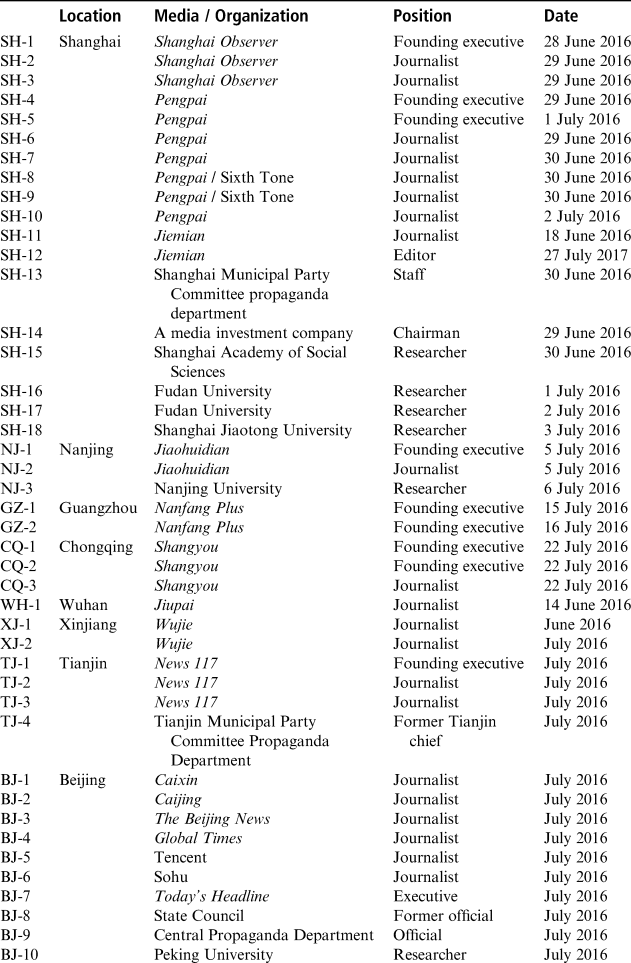
The analysis draws on fieldwork carried out in China in the summer of 2016, with some follow-up work completed in the summer of 2017. The two authors conducted in-depth interviews with 43 individuals, including members of the Pengpai founding team, former and current Pengpai journalists, Shanghai propaganda officials, executives and officials, as well as journalists from other digital media initiatives in eight provinces and municipalities, media investors, experienced journalists in traditional media, and media scholars (see Table 1 for more details).
Interviewees

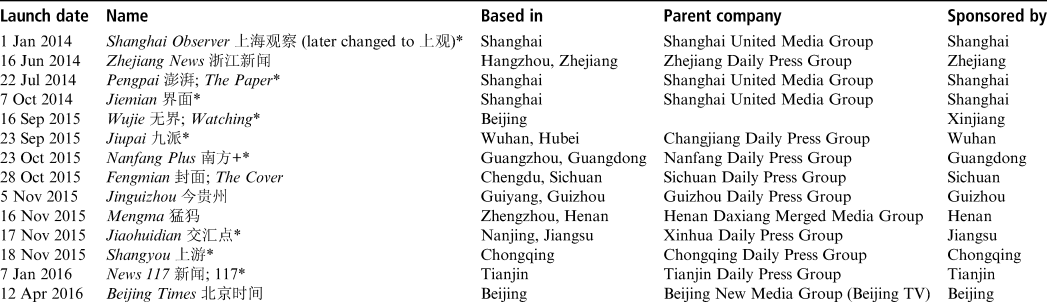
The eight provinces and municipalities were selected based on their geographic representativeness – Shanghai and Jiangsu in the east, Chongqing and Xinjiang in the west, Beijing and Tianjin in the north, Guangdong in the south, and Hubei in central China. As of June 2016, there were 14 major state-sponsored digital news media initiatives all over the country; we included nine of them in our analysis (Table 2). We chose to focus on geographic representativeness to capture all possible variations in policy diffusion outcomes.
State-sponsored Digital Media Initiatives (as of June 2016)

Notes:
* Covered in our study
The interviews were semi-structured. The major questions concerned the process of launching the projects, the ownership structure and business models, the challenges and opportunities that these new media initiatives present for journalism work, and perceived competitors. Additional questions were included selectively, based on the position and knowledge of individual interviewees. The interviews lasted on average between 1.5 to 2 hours, and were conducted in Chinese without a translator. Considering the sensitivity of the topic in China, the interviewees’ names have been anonymized.
In addition to interviews, the analysis draws on participant observation in the field. The authors visited newsrooms and also took part in dinners and informal gatherings which were attended by a diverse group of media professionals and scholars. At these meetings, we observed discussions on Pengpai’s success and the feasibility of competitive digital news outlets. These discussions complement the interview data and enrich the analysis.
The Emergence of a Model: Explaining Pengpai
Background and key features
As the first digital-only news outlet to produce original content, and as one of the most widely read news outlets, Pengpai symbolizes a new direction for media convergence in China.Footnote 31 While its content and layout mimic those of popular commercial news outlets, its business model most closely resembles that of a state-owned news outlet and features a mix of state funding and advertising. Launched and owned by Shanghai United Media Group, Pengpai is completely state-funded and has over 300 journalists covering news nationwide. The initial funding provided by the Shanghai government is estimated to have been 300 million yuan, or US$48 million.Footnote 32 In its second year, Pengpai’s advertising revenue covered about half of its total running costs, which were about 120 million yuan.Footnote 33 Advertising has since been growing, with some sources suggesting that it is now breaking even, but no reliable data are available.Footnote 34 In December 2016, six Shanghai-based state-owned enterprises invested 610 million yuan in Pengpai, adding stability to its financial situation and freeing it from profit concerns.Footnote 35
The recognition of Pengpai as a model is evident from the widespread references to the “Pengpai model” (pengpai moshi 澎湃模式) in practitioner, public and academic discussions. Interviews with leading and retired journalists in Beijing all touched upon the emergence of Pengpai, and it has been a popular topic of debate on social media and in academic communities.Footnote 36 Moreover, as we explain further, central government's tacit support of Pengpai and its diffusion symbolized its ascendance as a model for digital journalism.
Interviews with media scholars, Pengpai founders and propaganda officials reveal that the outlet's original content and creative aesthetic make for its unique attraction. Pengpai has managed to skilfully fuse fast and in-depth reporting on socio-political issues with soft coverage of President Xi and Shanghai officials. Its popularity soared following its reporting of major anti-corruption investigations such as the Zhou Yongkang 周永康,Footnote 37 and Ling Jihua 令计划 and Ling Zhengce 令政策 cases,Footnote 38 which other media failed to cover in much depth owing to censorship pressures. Pengpai's appeal further increased with its investigations of the Tianjin explosion,Footnote 39 the contaminated vaccine scandal,Footnote 40 and other controversial issues. “In a way, Pengpai has taken the space of Southern Media Group,” said one journalist, referring to an important shift in China's media eco-system.Footnote 41 As the famous Guangzhou-based critical news outlet has declined in recent years, it has left a vacuum in investigative journalism.Footnote 42
While it investigates regional authorities across the country, Pengpai has largely stuck to soft propaganda when it comes to coverage of President Xi and Shanghai authorities. One widely read piece was “Class monitor Xi Jinping,” in which the author compared China to a class, arguing that students need a strong, authoritative “class leader” like Xi.Footnote 43 Our interviews revealed that top leaders praised this piece and the author received a large bonus from Pengpai. Interviews with Pengpai journalists confirm that infusing the site with lively propaganda pieces is an intentional strategy to maintain space within the system. “We knew that both central and local governments wanted us to present something about Xi, but we couldn't publish a People's Daily-style article, so we chose a popular style to ‘cutify’ Xi. It helped us gain trust from the government,” a founding executive of Pengpai told us.Footnote 44 In combining some critical journalism with propaganda, Pengpai is engaged in the same, albeit a more dynamic, dance that traditional news outlets have had to perform in the past, fusing the roles of public opinion guidance with supervision.Footnote 45
Other than the appealing content, the aesthetic of Pengpai has also played its part. The name itself is simple, memorable and distinct from typical titles of traditional Chinese propaganda outlets, like People's Daily. “We decided to create a new brand to signal that Pengpai is a new initiative independent from any traditional media outlet that is considered obsolete in China,” one founding member of Pengpai shared in an interview.Footnote 46 “It's crucial that the name doesn't include any character that means ‘newspaper’ or the name of the province, and we believe the name itself is contributing to Pengpai’s success,” he added. Of course, the choice of The Paper as the English title for Pengpai also carries a degree of irony. The web design includes sophisticated modern features. For instance, a new section added in 2015 invites celebrities and those in the news to respond to questions from the readers.Footnote 47 The mixture of daring investigative reporting and skilful propaganda, as well as its unusual aesthetic and design functions, are the unique “selling” features of Pengpai. We now turn to the key forces behind the emergence of this innovative approach.
Experimentation under hierarchy: the making of a model
The heralding of Pengpai as a model in the media digitalization experiment is rooted in the opportunistic attitudes of local officials, riding a wave of high-level endorsements of media reform, and in a journalistic entrepreneurship aimed at the reinvention of the journalism profession. It was the recognition of these efforts by the central state, and other provincial propaganda leaders, that earmarked Pengpai as a model for digital media experiments.
Our interviews demonstrate that support for new media initiatives was present at the highest levels of the Shanghai government. “Shanghai leaders have enthusiastically studied Xi Jinping's speeches and seized on this opportunity,” noted an editor at Shanghai Observer.Footnote 48 According to interviewees who have worked with him, the Shanghai Party secretary, Han Zheng 韩正, had a special interest in media digitalization reform, as he genuinely believed that the time was ripe for change in the media industry: “Han Zheng himself doesn't really read newspapers, he spends a lot of time on new media. He also thinks that old models of journalism won't be able to attract Chinese youth, so he has endorsed a media transformation that would incorporate all media personnel.”Footnote 49 Our interviewees told us that from 2013 to 2017, Han Zheng made dozens of official visits to news outlets, and held a new media conference in February 2016. The Shanghai propaganda department has followed suit and has generally endorsed digitalization objectives, especially the successful initiatives such as Pengpai. “As a matter of fact, the department of propaganda has attached significant importance to Pengpai in many ways,” shared a Shanghai propaganda official.Footnote 50
This support translated into financial investment and visibility for the newly formed digital outlets. In 2016 alone, Shanghai invested 560 million yuan in the propaganda and culture sector, most of which went to digital media initiatives.Footnote 51 Interviewees from Pengpai and other digital news apps in Shanghai shared that profit was not their top priority, as state funding was generally sufficient for them to expand their operations and not worry about attracting significant advertisements or gaining a wide readership in the short term. “We have a very clear business model: some advertising plus government subsidies,” a journalist told us, “so we are not so anxious about making money.”Footnote 52 As for visibility, Shanghai authorities started to highlight successful initiatives like Pengpai at the national level from the very beginning. At the 2014 new media conference, for instance, Pengpai was allowed to bring three representatives, whereas other media were only granted one spot, indicating that preferential treatment was being given to Pengpai.Footnote 53
The Shanghai authorities were clearly opportunistic in their support as they took advantage of central-level endorsements to build Shanghai up as the centre for media innovation; they also used the new media outlets to promote their own image. “In the past, prior to the advancement of the internet age, Shanghai media were quite weak, weaker than those in Beijing … and weaker than those in Guangzhou. The internet transformations have definitely presented an opportunity for Shanghai to ‘cut the corner’,” shared a founding executive at Pengpai, referring to the opportunity for Shanghai to finally outcompete other national media capitals like Beijing and Guangzhou.Footnote 54 In addition, creating successful digital outlets also translates into propaganda opportunities for Shanghai. “Pengpai makes leaders shine,” shared a Shanghai-based editor.Footnote 55 “Pengpai has done well in positive propaganda reporting. For instance, when Han Zheng goes somewhere for an inspection, Pengpai comes along to do a video broadcast, a 360 degree angle report,” related a Shanghai propaganda official with enthusiasm.Footnote 56
In addition to the support from Shanghai officials, the rise of Pengpai is also rooted in bottom-up journalistic entrepreneurship. The former head of the Pengpai editorial team, Qiu Bing 邱兵, and the other co-founders are a uniquely ambitious group of media professionals who realized that media transformation is a matter of professional survival. The majority of Pengpai’s founding members came from Oriental Morning Post, the newspaper that first exposed the contaminated milk powder scandal in 2008.Footnote 57 Qiu himself was also the founding deputy editor of Oriental Morning Post, after spending 13 years at Shanghai's major daily newspaper Wenhui bao 文汇报. Based in China's financial capital and most international city, these journalists were the first to sense the changes in the media landscape. “We are polar bears on a melting iceberg. If we jump into the sea, we may have a chance to swim to the shore. If we don't do anything, we will starve to death,” shared one of the founding members of Pengpai.Footnote 58 Another admitted that he had “no nostalgia for the print media era” and fully embraced digital experiments.Footnote 59
Fuelled by this survival instinct, the Pengpai team attracted top talent from all over the country. The competitive salary and rare opportunity to practise professional journalism have lured in a diverse group of media professionals, including seasoned investigative journalists from the Southern Media Group, young start-up entrepreneurs in their 20s, and data journalists from top graduate programmes in the United States such as the Missouri School of Journalism. Feng Hongping 丰鸿平, a senior journalist who spent 12 years at the Southern Media Group, joined the founding team as an editor. Wang Zuozhongyou 王左中右 was hired as Pengpai’s founding chief operation officer after popularizing the Weibo account of the Japanese newspaper Asahi Shimbun in China by injecting it with some unique content and style. These journalists dared to experiment with critical reporting as well as with new journalistic formats such as satire, online documentaries and HTML5-based interactive mobile pages.
The success of the synergy and negotiation between Shanghai-level authorities and media entrepreneurs in the making of Pengpai was solidified in the implicit recognition by the centre of Shanghai as the model for digital media experiments. This recognition manifested itself in symbolic gestures like the Central Propaganda Department's hosting of a media digitalization conference in Shanghai in 2014, the promotion of Shanghai officials to central-level posts, and the rare high-level access granted to Pengpai journalists. First, selecting Shanghai as the conference venue was a clear indication of the central state's support, as hundreds of regional propaganda officials and heads of news outlets travelled to Shanghai to learn from its experience. During the conference, Pengpai was held up as a model of successful digital journalism. As for promotional rewards, in 2016 Xu Lin 徐麟, the head of Shanghai's propaganda department, was promoted to the head of the Cyberspace Administration of China, the most prestigious and influential party-state bureau in relation to internet management. While there is no official proof that his promotion was directly linked to Pengpai’s success, a number of interviewees in Shanghai suggested that the official was rewarded for launching the model for media digitalization.Footnote 60 One of the founding members went as far as to argue that “the only ones who have truly benefited from Pengpai success are local officials, especially Xu.”Footnote 61 Finally, Pengpai is the only digital news outlet that has been allowed to cover Xi Jinping's travels, speeches and other high-level events, including his visit to the United States – the first time a non-official news outlet has covered a high-level state visit.Footnote 62 Pengpai was also among the nine mainland media outlets that raised a question during Premier Li Keqiang's 李克强 2017 annual press conference.Footnote 63 Other journalists observed that many high-ranking officials accepted Pengpai interview requests, which is a sign of respect and trust,Footnote 64 especially when considering how difficult it is for the Chinese media in general to gain official access.Footnote 65
To conclude, the emergence of the Pengpai model sprang from the opportunistic attitudes and strategizing of local officials and media professionals who recognized the opportunities on offer in the internet age to create an innovative media platform that would rescue journalism from extinction as well as elevate Shanghai as a digital media capital. The recognition given to these efforts by the central state has signalled to other regions that Shanghai is an example to follow, stimulating widespread attempts at cross-national learning.Footnote 66 We turn to this learning process next as we examine the diffusion of the Pengpai model.
Horizontal Diffusion
Evidence of attempts at diffusion
At the peak of Pengpai’s popularity (late 2014 to 2015), a number of similar news outlets began to appear across China (Table 2). Specifically, by June 2016, 14 digital news outlets had been launched in 12 provinces. Our interviews illustrate both direct and indirect attempts at diffusion of the Pengpai model.
The direct diffusion attempts include cross-regional learning efforts via visits to Pengpai for officially sanctioned conferences and tours as well as informal networking events. The 2014 new media conference, mentioned above, is a prime example of state-sanctioned diffusion, but Shanghai propaganda officials have also arranged one-day tours of successful Shanghai news media organizations for regional officials and journalists. One of our interviewees jokingly remarked that the “Shanghai propaganda department started to resemble a regional tourism bureau.”Footnote 67 “I often see officials and editors wondering around the offices, asking questions, but generally just speaking to leaders,” shared a Pengpai reporter.Footnote 68 Many of these visits are of an unofficial nature, with individual editors coming to network with Pengpai. “The editor himself visited Pengpai several times,” noted a journalist from Tianjin-based outlet, News 117.Footnote 69 “At Pengpai, he studied content and technology, as well as business strategies,” he added. Similarly, a founding member of Nanfang Plus shared that when his team were developing their app, they “visited Pengpai and used it as a major example and reference.”Footnote 70 A Jiupai 九派 editor said that he often followed up with his colleagues from Pengpai informally after his visits, exchanging ideas about content creation and delivery.Footnote 71
Indirect learning is also evident in many of these outlets’ aspirations to be like Pengpai and even compete with it, as well as in their adoptions of similar key features. A number of regional editors referred to their news outlets as “mini Pengpai.”Footnote 72 Some, such as the Chongqing-based Shangyou 上游, deliberately promoted this association by publicizing a slogan: “Eastern Pengpai, Western Shangyou.” “We proposed this slogan because we learned a lot from Pengpai and we aspired to undertake similar original, quality reporting,” a founding member at Shangyou told us.Footnote 73 When asked about their competitors, the heads of these new platforms mentioned Pengpai, signalling their aspirations to rival its national influence. Even outlets which did not envision realistically competing with Shanghai, such as Jiaohuidian 交汇点 in Nanjing, still strove for national influence by choosing an app name that obscured regional location. “If the name includes Jiangsu, people in other provinces won't download it,” shared a senior editor at the outlet.Footnote 74
The key features of these news apps follow the Pengpai model, including the emphasis on content, the initial dependence on state funding and the creative design aesthetic. “The original model was pretty much that of Pengpai – start with high quality, original and innovative content, expand influence, attract investment,” reported a former editor at Jiupai.Footnote 75 Most of the editors and founding executives that we interviewed shared a similar initial prioritization of good quality journalism, including in-depth and investigative reports. Even executives at small outlets like the Tianjin-based News 117 specified “media supervision” (yulun jian du 舆论监督) as one of their specialties.Footnote 76 “If you want big influence, you have to compete with others, and this competition starts with content; if your content is a little better, then your chances are higher,” noted a former journalist at Wujie 无界, a Xinjiang-sponsored Beijing news outlet.Footnote 77
Like Pengpai, these outlets relied on state funding and had no apparent strategies for commercial success. According to our interviewees, local officials invested heavily in these news apps: Nanjing-based Jiaohuidian received 50 million yuan (US$7.5 million) from the government in 2015,Footnote 78 Nanfang Plus also received a comparable subsidy from the Guangdong government,Footnote 79 Shangyou received 60 million yuan (US$9 million) from Chongqing,Footnote 80 and Jiupai was promised 80 million yuan (US$12 million) in government funding.Footnote 81 One interviewee from Wujie compared official investment in new media with that in the soccer business: “It is all politically motivated, you are not pursuing profits … in the first two to three years the expectation is that you'll be losing money.”Footnote 82
Finally, the look and the functionality of these media platforms mimicked those of Pengpai, including the creative naming of the apps (something that our interviewees indicated they learned from Pengpai) and the introduction of similar web features. Following the Pengpai approach, for example, these news apps generally organized their content and their teams into dozens of small sections or columns (lanmu 栏目), for example “anti-corruption news,” rather than into bigger news categories such as “political news.” Initially, therefore, we found both direct and indirect attempts by regional officials and media practitioners to learn from Pengpai. However, there has been a backsliding in this learning, which has put into question the diffusion of the experiment, as we explain below.
Ambivalent aftermath: the dissolving of the Pengpai model
Although the Pengpai model at first spread in accordance with the “point to surface” logic of China's experimental policymaking, these efforts turned out to be limited and fleeting. The diffusion proceeded unevenly, with a selective number of regions and cities attempting to create “mini Pengpai.” None of these initiatives, moreover, managed to become national success stories, as they had initially hoped. Most of the outlets diverged from their model of producing quality journalism and shifted towards serving as local communication channels. As we explain, this outcome was the result of inconsistent support from local officials and a shortage of journalistic entrepreneurship.
First, it is important to note that these digital media initiatives were only launched in richer provinces: seven of the top ten provinces, according to GDP per capita ranking, implemented digital initiatives, and only two of the bottom ten provinces joined the experiment.Footnote 83 The two less developed provinces, moreover, have a strong media and technology presence. Sichuan is home to several reputable media outlets such as West China Metropolis Daily and Chengdu Business Daily, and Guizhou is now the leading province in big data and digital technology.Footnote 84 On the whole, the poorer provinces, and those lacking a pool of reputable traditional media and experienced journalists, were left out of the experiment.
Moreover, the initiatives we analysed have had mixed rates of success when it comes to competing nationally or even upholding the initial Pengpai model of digital journalism. As of summer 2017, none of these new outlets had attracted any national attention for their coverage. According to data analytics company analysys.cn, by the end of 2016, Pengpai ranked as 15th among all news apps in the Chinese market with daily active users of more than 3 million, while all other similar news apps ranked below 50.Footnote 85
More importantly, most of these outlets, including the promising Jiupai and Shangyou, have shifted away from the original objective of offering quality investigative reporting and towards focusing on big-data journalism and local news. Just prior to the launch of Jiupai in September 2015, its management structure was altered in favour of a semi-commercial, big-data model, abandoning the Pengpai experiment entirely. “The change happened so quickly that a number of previously planned stories got cancelled and the majority of journalists resigned in two months,” shared a founding member of Jiupai.Footnote 86 Months into its operation, Shangyou cancelled its entire politics section (zhengqing 政情) and switched to local news in which they were more experienced. “Our resources are concentrated in Chongqing, we should make better use of them,” a founding member of Shangyou told us, “plus, it's too expensive to send journalists to other provinces for an investigative story that might get censored.”Footnote 87 Interviewees in Jiangsu and Guangdong also noted that providing local news and information for local governments, rather than national investigative reporting, was now their key objective. “As a provincial newspaper group, we have strong connections with local governments and other institutions. That's our advantage and opportunity,” related an executive at Jiaohuidian.Footnote 88 Overall, most of these news apps have downscaled their ambitions to focus on either the more technical work of big-data aggregation or on local news provision.
Explaining the mixed results
The ambivalent results of the Pengpai diffusion stem from the non-committal attitudes of local officials and media professionals in regard to creating a sustainable model for digital media. In contrast to Shanghai authorities, the local officials in the regions we surveyed were driven less by the desire to reform their media industry than by the wish to superficially support central-level initiatives. When asked about the motivating forces behind these news apps, our interviewees in Nanjing, Chongqing and Guangzhou generally regarded “implementing the spirit of Xi Jinping's speech on new media” as the first and the most important factor. In explaining the failure of Pengpai’s imitators to live up to their ambitions, a Pengpai founding member highlighted the skewed motivations of local officials: “Other than the fact that Pengpai got there first, the key factor is that these initiatives lacked internal dynamism, and were mostly driven by political rationale, with local officials noticing Pengpai success and hoping to create something similar to showcase externally. So it was really a political tactic or a strategy, but it lacked an endogenous impetus,” he noted.Footnote 89
This weak impetus translated into wavering support among regional officials for the Pengpai model, as they expressed initial enthusiasm and then retracted to more conservative, less politically sensitive models of online journalism. Local officials were torn between the dual objectives of effective persuasion, which requires some quality political coverage, and upholding political stability, which can be potentially endangered by investigative reports. The switches towards big-data journalism at Jiupai and towards local news at Shangyou were largely owing to official pressures. “Local government changed their mind,” explained a founding member of Jiupai, “in getting rid of investigative journalism and changing to an aggregator based on big data, they wanted to reduce the cost and minimize the risk.”Footnote 90 “Pengpai would follow Jiupai’s path if Han Zheng withdrew his support,” commented a founding member of Nanfang Plus.Footnote 91
Since most Chinese media conduct extra-territorial investigative journalism (yidi jiandu 异地监督), local officials are less preoccupied with media revelations about their work than with pressures from other regional authorities that could, in turn, damage cross-provincial relations. The most dangerous scenario, however, is when these news outlets air criticism aimed at the centre. An extreme case of this was the Xinjiang-sponsored, Beijing-based Wujie. Funded by Xinjiang officials who wanted to improve their persuasion capabilities, Wujie was a promising news outlet staffed with top talent until it came under fire for publishing an anonymous letter calling for Xi's resignation. Our interviews with former Wujie journalists suggest that it was a technical error, but the editors were held in detention for a long time after this incident, and the Xinjiang authorities, of course, quickly withdrew their support and shut down the outlet.Footnote 92 This case has likely sent a signal to others about the potential, unanticipated political repercussions that can occur with digital media experiments.
In addition to the official ambivalence that translated into superficial and often short-lived support for the Pengpai model, the media entrepreneurs involved in these news outlets also lacked a clear competitive strategy and an adequate talent pool to move forward. These outlets positioned themselves in competition with all national media, ranging from data aggregators to quality journalism outlets like Caixin 财新. Wujie considered its major competitor to be Pengpai.Footnote 93 A founding member of Jiupai explained that “all national media, traditional or digital, are our competitors.”Footnote 94 Even after switching its focus to Chongqing, Shangyou still wanted to compete with other national news apps and be the first with breaking news.Footnote 95 By trying to do it all, these outlets lost their competitive advantage. In addition, the mission to be of national relevance was not matched by the talent pool. “It is hard to attract young talented people to join the media … It's especially hard to attract people with technical skills. People's Daily has managed to poach some talent from Baidu and other successful start-ups, but we don't have similar salaries and resources to offer,” shared an editor at News 117 in Tianjin.Footnote 96 With the exception of Wujie and Jiupai, regional news outlets faced an uphill battle when trying to recruit the best journalists, as there were higher paid opportunities for them in the tech sector. Even attracting journalists to join the Wuhan-based Jiupai was not an easy task, according to some interviewees. “If you are in Beijing and you are offered the same salary in Wuhan, would you stay in Beijing? I think most people would stay in Beijing. Beijing has more resources, and it is more familiar,” noted a former journalist at Wujie.Footnote 97 Unlike Pengpai, which attracted the boldest editors and reporters in the nation, these copy-cat outlets suffered from a shortage of enterprising talent that would push forward successful digitalization initiatives from the bottom up.
To conclude, neither the official entrepreneurship nor the journalistic agency matched that which spurred the success of Pengpai. Most local officials were only half-committed to this initiative, paying lip service to central-level directives, while at the same time obstructing the success of these nascent news outlets in order to cut costs and minimize the risks that come with political sensitivity. Media entrepreneurs, in turn, set ambitious untenable goals and lacked an adequate competitive edge to evolve into national players. As such, the popularity and influence of these projects remain questionable when it comes to fulfilling the national agenda of revitalizing persuasion online.
Discussion and Conclusions
In this article, we examine a unique experiment in digital journalism, the emergence of Pengpai and the cross-regional diffusion of its model. As we demonstrate, initially the experiment adhered to the point-to-surface approach introduced by Heilmann and examined by other scholars of Chinese governance. The subsequent failure of the diffusion, however, points to the importance of consistent local-level official support and journalistic entrepreneurship for ensuring the long-term success of media policy diffusion. The analysis, therefore, complicates the point-to-surface narrative and reasserts the relative significance of the local state and other policy entrepreneurs in policy diffusion processes.
We further argue that given the sensitivity and competitiveness of the digital media sector, the diffusion of digital media experiments can be an extremely volatile process. The tension between controlling information and enhancing media credibility dates back to the Mao period and has only intensified with media commercialization and digitalization. As argued in other works, the party-state is schizophrenically oscillating between tolerance and censorship to boost official responsiveness at minimal risk.Footnote 98 This balancing act is especially apparent at the local level, with most local officials, as we argue, settling for a conservative approach and mimicking innovation within a politically controlled environment. Even the authorities in Shanghai have allegedly started to impose more censorship on Pengpai after being pressured by other regional authorities to stop negative investigative coverage.Footnote 99 Some Beijing-based journalists referred to Pengpai as “old leaves in a new pot,”Footnote 100 and others said that it had passed its peak and was becoming more conformist in political coverage. Our latest analysis of Pengpai’s reporting finds it to be still relatively daring in its investigative coverage when compared to its competitors.Footnote 101 Its readership also continues to be high: latest estimates (August 2017) suggest that it draws more than 8.5 million daily active users, with page views of more than 20 million on some popular articles.Footnote 102 Nonetheless, its capacity to survive as a credible critical news outlet is not guaranteed.
Other than political sensitivity, the unusually high competition for readership is another obstacle for policy diffusion. According to a 2017 report by the Boston Consulting Group, a typical Chinese user would frequently use only six apps, including social media, maps and other essentials.Footnote 103 New local-level news platforms are an unlikely choice. In the past, provincial newspapers had their designated areas of circulation, allowing for each province to have a few successful newspapers; however, the internet is less tolerant of diverse regional voices. “The news app market is already small given the large shares taken by aggregators such as Tencent News and Today's Headline. It only has room for one Pengpai,” commented a media researcher in Shanghai.Footnote 104
Even maintaining a successful national digital outlet is a struggle over the long term owing to talent mobility in the fiercely competitive new media sector. In June 2016, Pengpai CEO Qiu Bing left the company, along with the core editorial team, to start up a new digital video platform, Pear Video. Interviews with some members of this team suggest that they were attracted by the better financial rewards offered by the new venture. The same opportunistic media professionals who launched Pengpai had moved on to become “real” entrepreneurs with financial stakes in their own businesses, something that was not possible with the state-owned Pengpai. One founding member expressed his dissatisfaction with the set up: “We put so much effort into Pengpai, but it 100 per cent belongs to the government, not to us. Even if it made a profit, we wouldn't have a share in it.”Footnote 105 If even the most successful initiatives experience such a rapid turnover in talent, then what hope is there for more localized state-owned media that struggle to attract top professionals in the first place?
The challenge of public persuasion in the digital age is not unique to China; rather it fits the broader pattern of the demise of the traditional news industry and, most recently, the rise of misinformation and fake news in the West. Enterprising digital journalism initiatives have also sprung up in other contexts, with journalists often driving these initiatives.Footnote 106 What is unique about China's experiments with digital journalism is that they remain state-driven, both in terms of their political agenda and, especially, their financial support. On the one hand, China seems to hold more promise for journalistic innovation given the seemingly infinite funding allocated for these initiatives. On the other hand, as this analysis of Pengpai demonstrates, state-driven innovation can also be an unpredictable and stifling force in the competitive and fast-evolving social media sphere. The initial official support may help to create a successful news outlet but it comes with political strings and may not be enough in itself to stem the flow of talented journalists from branching out on their own to pursue more lucrative independent initiatives.
Acknowledgements
The authors are grateful to the Center for the Study of Contemporary China at the University of Pennsylvania for the initial grant to carry out the field research for this study. They are also grateful to Junyan Jiang, Megan Metzger and the two anonymous reviewers for the feedback on the earlier drafts.
Biographical notes
Maria REPNIKOVA (DPhil Oxford) is an assistant professor of global communication at Georgia State University. She was previously a post-doctoral fellow at the Annenberg School for Communication, Center for Advanced Research in Global Communication (CARGC).
Kecheng FANG is a PhD candidate at the Annenberg School for Communication, University of Pennsylvania. His research interests include political communication, journalism and digital media.