Introduction
Radical radiotherapy for localised prostate cancer is reliant upon the delivery of a tumourcidal dose of radiation to the prostate.Reference McNair, Wedlake, McVey, Thomas, Andreyev and Dearnaley1 A conventional dose of 72 Gy is required,Reference Kupelian, Potters and Khuntia2 however higher doses are desirable.Reference Graf, Boehmer, Nadobny, Budach and Wust3 The introduction of conformal planning, image guided radiotherapy (IGRT) and intensity-modulated radiotherapy (IMRT) have enabled dose escalation to take place through increased accuracy and the ability to visualise prostate movement, while also reducing rectal and bladder toxicity.Reference Dearnaley, Khoo and Norman4 However, variable rectal filling still appears as a hindrance to further reducing treatment margins.Reference Graf, Boehmer, Nadobny, Budach and Wust3
The influence of rectal distension on prostate motion occurs due to their anatomical position. The prostate and seminal vesicles (SVs) are close to the mid rectum,Reference Smitsmans, Pos and de Bois5 therefore reducing faeces and gas within the bowel is necessary to achieve increased accuracy of radiotherapy treatment, dose escalation and increased local control.Reference Al-Mamgani, Heemsbergen, Peeters and Lebesque6 Recommendations to minimise the V70 and V75 rectal volumes, without compromising tumour coverage, has a significant impact on the predicted complication probability set out in the normal tissue complication probability model. A reduction in the V75 by just 5% should limit Grade ≥2 and Grade ≥3 late rectal toxicity to <15 and <10%, retrospectively.Reference Michalski, Gay, Jackson, Tucker and O’Deasy7 With the aim to reduce the incidence of late effects such as rectal bleeding and faecal incontinence.Reference Nijkamp, Pos and Nuver8
The advent of IGRT and fiducial markers has enabled movement of the prostate to be observed. IGRT allows direct visualisation of soft tissue using onboard cone beam computerised tomography (CBCT), while fiducial markers may be used in addition for treatment verification.Reference Lips, A N T J, van Gils, van Leerdam, van der Heide and van Vulpen9 StudiesReference Padhani, Khoo, Suckling, Husband, Leach and Dearnaley10, Reference Cheung, Sixel and Morton11 undertaken using these methods have found that movement is greatest in the anterior–posterior direction, which can be attributed to bowel filling. This causes changes to the size and shape of the rectum particularly in patients treated supine.Reference Hammoud, Patel and Pradhan12
Radiotherapy centres throughout Europe use varying forms of bowel preparation to reduce prostate motion including: dietary advice alone,Reference Lips, A N T J, van Gils, van Leerdam, van der Heide and van Vulpen9 or in conjunction with micro enemasReference Griffiths, Stanley and Sydes13 or mild laxativesReference Sripadam, Stratford, Henry, Jackson, Moore and Price14, Reference Rembielak, Jegannathen and McGovern15 to regulate the bowels, or fixed treatment times and rectal balloons.Reference Langen and Jones16 The measurement of fiducial marker movement, and therefore prostate position compared with pelvic boneReference Lips, A N T J, van Gils, van Leerdam, van der Heide and van Vulpen9 and the measurement of rectal distension at set levels of the prostate using IGRTReference Rembielak, Jegannathen and McGovern15 have been used to assess effectiveness.
Methods
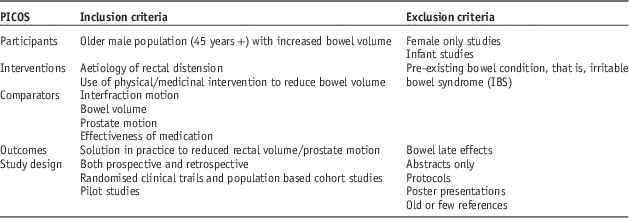
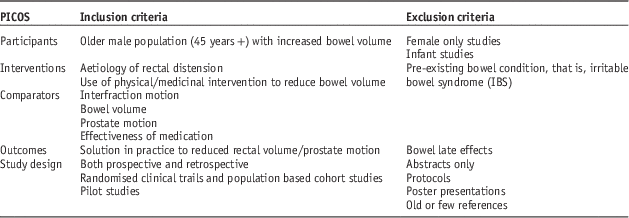
The systematic review was undertaken using PRISMAReference Liberati, Altman and Tetzlaff17 to investigate how aetiological factors of rectal distension can be managed to reduce interfraction prostate motion during radiotherapy. The literature was analysed using SIGN checklists18 relevant to study design. An outline of the search strategy is shown in Figure 1 with an overview of inclusion/exclusion criteria in Table 1.
PRISMA flow diagram of the search and selection strategy used in the systematic review undertaken between January 2008 and December 2013. Databases searched: CINAHL, Medline, PubMed, Science Direct, NHS Evidence and The Cochrane Library.

PICOS used to define inclusion and exclusion criteria
Results
Of the 2,339 citations obtained through database, grey literature and professional website searches, only 38 were selected for further evaluation following review of the title and abstract. For full results see PRISMA Flowchart (Figure 1).
The results of the review are presented by emerging themes seen throughout the included literature.
Aetiology of Changing Rectal Volume
Bowel gas
Radiotherapy related literatureReference McNair, Wedlake, McVey, Thomas, Andreyev and Dearnaley1, Reference Graf, Boehmer, Nadobny, Budach and Wust3, Reference Smitsmans, Pos and de Bois5, Reference Nijkamp, Pos and Nuver8, Reference Yahya, Zarkar, Southgate, Nightingale and Webster19–Reference Jhagra29 state that either gas and/or faeces are the cause of rectal distension and consequently prostate motion. Moving gas appears to be the main concern,Reference McNair, Wedlake, McVey, Thomas, Andreyev and Dearnaley1 but there is little literature to explain the causes of bowel gas, making solutions to reduce it problematic. Two non oncology related papersReference Azpiroz and Levitt Michael30, Reference Manichanh, Eck and Varela31 agree that both the physiology and pathophysiology of flatulence is poorly understood. However, all flatulence related literatureReference Azpiroz and Levitt Michael30–Reference Manichanh, Eck and Varela31 agreed that the volume of gas evacuated is determined by both diet and colonic microbiota,Reference Manichanh, Eck and Varela31 also suggestedReference Wind32 is that certain medications may impact on gastrointestinal motility and therefore intestinal gas.
The colonic microflora varies considerably among individuals with differences in activity, stability and compositionReference Manichanh, Eck and Varela31 and can be determined by environmental factors, both early and later in life; antibiotics and dietary exposure.Reference Azpiroz and Levitt Michael30 A difference has been observedReference Manichanh, Eck and Varela31 in microbial and bacterial taxa in patients with excessive passage of gas per anus compared with healthy subjects. One pertinent taxon documented in the literature, with regard to the issues seen in prostate radiotherapy is Bilophila wadsworthia. This was shown to positively correlate with the volume of gas evacuated.Reference Manichanh, Eck and Varela31
The literature suggests that the amount of fermentation and colonic microorganism consumption is affected by gut transit time,Reference Azpiroz and Levitt Michael30, Reference Wind32 which can be influenced by pelvic muscle activity.Reference Azpiroz and Levitt Michael30, Reference Wind32 Faecal impaction reduces gut transit time, prolongs fermentation and therefore may increase gas production.Reference Azpiroz and Levitt Michael30 Highlighting that constipation should be treated effectively. Lipids are also stated to delay transit time, with transit of gas being more effective when stood than when supine.Reference Azpiroz and Levitt Michael30
Constipation
It is documented33 that healthy active older people have normal bowel function but the risk of constipation still exists, although it should not be seen as a physiological consequence of normal aging.Reference Gallagher and O’Mahony34 This and other literature reviewed33–Reference Leung, Riutta, Kotecha and Rosser36 report that the medical definition of constipation is less than three bowel movements per week, although patient definition relates to stool consistency, feeling of incomplete emptying, straining and the urge to defecate, rather than frequency alone. Evidence33–Reference Leung, Riutta, Kotecha and Rosser36 also suggests that the prevalence of constipation increases with older age, with a larger increase seen after the age of 70 years.Reference Leung, Riutta, Kotecha and Rosser36 This is particularly relevant as a recently published UK paperReference Yahya, Zarkar, Southgate, Nightingale and Webster19 states that participants in three investigative groups had a median age at presentation for prostate cancer of 70·5, 62 and 71 years.
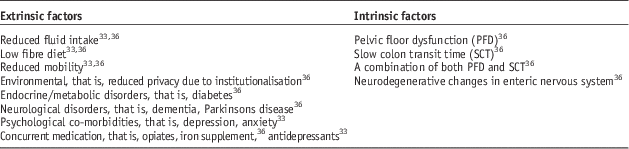
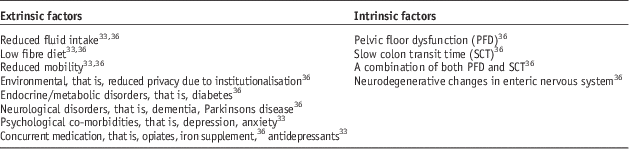
Two papers33, Reference Leung, Riutta, Kotecha and Rosser36 describe the aetiological factors of constipation in older people, which include both extrinsic and intrinsic factors (see Table 2). A reviewReference McCrea, Miaskowski, Stotts, Macera and Madhulika35 undertaken also describes the changes in the lower gastrointestinal tract that are associated with ageing. The existence of extrinsic and intrinsic factors,33, Reference McCrea, Miaskowski, Stotts, Macera and Madhulika35, Reference Leung, Riutta, Kotecha and Rosser36 can lead to slow colonic transit, low stool output and reduced bowel movement frequency33 and should be considered further when applying bowel preparation in radiotherapy of the prostate.
A summary of the aetiological factors of constipation discussed in the literature
Consequences of Changing Rectal Volume
The prostate and SVs lie between the bladder and rectum and have shown to be affected by physiological changes in both bladder and rectal volume.Reference McNair, Wedlake, McVey, Thomas, Andreyev and Dearnaley1, Reference Graf, Boehmer, Nadobny, Budach and Wust3, Reference Smitsmans, Pos and de Bois5, Reference Nijkamp, Pos and Nuver8, Reference Fiorino, Di Muzio and Broggi20–Reference Ki, Kim and Nam24, Reference Frank, Dong and Kudchadker26 It has been shown that anterior–posterior prostate motion is influenced by a change in rectal shape and volume.Reference Anderson, Yu, Peschel and Decker23, Reference Frank, Dong and Kudchadker26 These changes can noticeably alter the position of the anterior rectal wall and consequently the prostate tumour volume in relation to the preplanned radiotherapy target,Reference Anderson, Yu, Peschel and Decker23, Reference Frank, Dong and Kudchadker26 causing both intrafraction and interfraction prostate motion.Reference Smitsmans, Pos and de Bois5, Reference Smeenk, Louwe and Langen25, Reference Frank, Dong and Kudchadker26
Due to the expansion in the use of IMRT there is an increased emphasis on decreasing treatment margins to reduce dose to organs at riskReference McNair, Wedlake, McVey, Thomas, Andreyev and Dearnaley1, Reference Nijkamp, Pos and Nuver8, Reference Anderson, Yu, Peschel and Decker23, Reference Frank, Dong and Kudchadker26 without compromising dosimetric coverage of the clinical target volume.Reference Smeenk, Louwe and Langen25, Reference Frank, Dong and Kudchadker26 With rectal gas being a significant predictor of interfraction motion due to rectal distensionReference McNair, Wedlake, McVey, Thomas, Andreyev and Dearnaley1, Reference Frank, Dong and Kudchadker26 this appears a large hindrance to reducing these margins. However, there is insufficient information on how to control rectal volume.Reference Yahya, Zarkar, Southgate, Nightingale and Webster19, Reference Fuji, Murayama and Niwakawa21
Current solutions
A UK wide survey undertaken in 2009 has shown that 40% of responding centres use some form of bowel preparation,Reference Yahya, Zarkar, Southgate, Nightingale and Webster19 with the aim to achieve consistency in rectal volume.Reference Nijkamp, Pos and Nuver8, Reference Yahya, Zarkar, Southgate, Nightingale and Webster19–Reference Stillie, Kron and Fox22, Reference Ki, Kim and Nam24, Reference Smeenk, Louwe and Langen25, Reference Melchert, Gez and Bohlen27, Reference Ogino, Uemura, Inoue, Kubota, Nomura and Okamoto28, Reference Wind32
Within the literature, bowel preparation takes on three distinct forms from varying countries, summarised in Table 3, alongside lifestyle modifications.33, Reference Gallagher and O’Mahony34, Reference Leung, Riutta, Kotecha and Rosser36
A summary of methods discussed in the literature to manage rectal distension

Discussion
The literature reviewReference McNair, Wedlake, McVey, Thomas, Andreyev and Dearnaley1, Reference Graf, Boehmer, Nadobny, Budach and Wust3, Reference Smitsmans, Pos and de Bois5, Reference Nijkamp, Pos and Nuver8, Reference Yahya, Zarkar, Southgate, Nightingale and Webster19–Reference Jhagra29 highlights the importance of managing rectal volume, although the way in which this is undertaken is varied in both technique and levels of efficiency, in part, due to a lack of understanding of the aetiology of both bowel gas and constipation.Reference McNair, Wedlake, McVey, Thomas, Andreyev and Dearnaley1 Despite some limitations this review highlights areas to be investigated further.
Mechanical interventions
Non UK papers discuss the use of interstitial biodegradable balloons,Reference Melchert, Gez and Bohlen27 endorectal balloons (ERB),Reference Smeenk, Louwe and Langen25 rectum emptying tube (RET)Reference Fuji, Murayama and Niwakawa21 and manual removal of rectal gas.Reference Ogino, Uemura, Inoue, Kubota, Nomura and Okamoto28 There is no UK data within the review regarding mechanical interventions.
The aim of mechanical interventions is to manage rectal volume and ultimately reduce rectal dose and toxicity.Reference Fuji, Murayama and Niwakawa21, Reference Smeenk, Louwe and Langen25, Reference Melchert, Gez and Bohlen27, Reference Ogino, Uemura, Inoue, Kubota, Nomura and Okamoto28 Literature discussing this explain that the irradiated volume or cross-sectional area of the rectum is reduced. However, evidence in the literature regarding interstitial spacersReference Ogino, Uemura, Inoue, Kubota, Nomura and Okamoto28 and ERBsReference Smeenk, Louwe and Langen25 shows that neither completely pushes the rectal volume out of the field. ERBs have also been shownReference Smeenk, Louwe and Langen25 to push the anterior rectal wall into high dose areas despite reducing dose to the posterior rectal wall. This in turn could lead to increased toxicities.
All mechanical techniques of managing rectal volume included in the review are documented to be reproducible.Reference Fuji, Murayama and Niwakawa21, Reference Smeenk, Louwe and Langen25, Reference Melchert, Gez and Bohlen27, Reference Ogino, Uemura, Inoue, Kubota, Nomura and Okamoto28 Initial placement problems where highlighted.Reference Fuji, Murayama and Niwakawa21, Reference Smeenk, Louwe and Langen25 Insertion of the RETReference Fuji, Murayama and Niwakawa21 was incorrect on two occasions leading to a change in insertion technique. The use of an ERBReference Smeenk, Louwe and Langen25 may give rise to interfraction motion due to stools present getting trapped upon initial insertion at the planning scan. This could lead to reproducibility problems during radiotherapy treatment.
Generally patient acceptance was high for what appear to be invasive techniques. However, one patient in the RETReference Fuji, Murayama and Niwakawa21 study did not participate further due to lack of understanding of study purpose and repetitive examinations. Of all mechanical interventions the interstitial balloonReference Melchert, Gez and Bohlen27 is the only semi permanent device. All others would need to be applied at each treatment fraction, meaning repetitive insertion would be required, possibly leading to further patient compliance issues and increased irritation of the rectum,Reference Fuji, Murayama and Niwakawa21 alongside increased treatment times.
Literature relating to interstitial balloons,Reference Melchert, Gez and Bohlen27 RETsReference Fuji, Murayama and Niwakawa21 and manual evacuation of the rectumReference Ogino, Uemura, Inoue, Kubota, Nomura and Okamoto28 concludes that they are reproducible techniques; however, the use of ERBs has shown that interfraction set up deviations were not significant between patients with or without the device in place.Reference Smeenk, Louwe and Langen25 Considering this and the possible increase in rectal dose, mechanical interventions may help to manage rectal volume but with some disadvantages. Therefore, consideration should be given to evidence based solutions that can be implemented into radiotherapy practice
Medicinal interventions
Many papers discuss the use of laxatives.Reference Nijkamp, Pos and Nuver8, Reference Yahya, Zarkar, Southgate, Nightingale and Webster19, Reference Stillie, Kron and Fox22, 33, Reference Gallagher and O’Mahony34, Reference Leung, Riutta, Kotecha and Rosser36, Reference Lee-Robichaud, Thomas, Morgan and Nelson37 Laxatives take many forms including; bulk forming, stool softeners, osmotic agents, stimulants and chloride channel activators.33, Reference Gallagher and O’Mahony34, Reference Leung, Riutta, Kotecha and Rosser36, Reference Lee-Robichaud, Thomas, Morgan and Nelson37 Little evidence exists to support the use of many laxatives in patients with chronic constipation, with the exception of lactulose and polyethylene glycol, which can improve stool frequency.Reference Gallagher and O’Mahony34 Of the two, polyethylene glycol was shown to be most effective,Reference Lee-Robichaud, Thomas, Morgan and Nelson37 in stool frequency and formation. It is also documented to have a faster effectReference Gallagher and O’Mahony34 than many laxatives, other than stimulantsReference Gallagher and O’Mahony34 such as senna, which has a lack of placebo controlled evidence.33 Despite this, none of the radiotherapy literature in this review discussing the use of diet and laxativesReference Nijkamp, Pos and Nuver8, Reference Stillie, Kron and Fox22 specifies the use of this medication; no reasons are specified for the choice of laxatives used in the studies.
The use of enemas to manage rectal volume in prostate radiotherapy is commonReference Yahya, Zarkar, Southgate, Nightingale and Webster19, Reference Fiorino, Di Muzio and Broggi20, Reference Stillie, Kron and Fox22 and the suggestion has been made that in departments where access to CBCT is limited it may prove advantageous.Reference Fiorino, Di Muzio and Broggi20 In a recent studyReference Yahya, Zarkar, Southgate, Nightingale and Webster19 it was shown that the application of enemas reduced the number of geometric misses of >5 mm by half compared to no intervention, this was, however, not statistically significant due to a limited sample size of ten patients. In the context of prostate radiotherapy the use of daily enemas has been found to be easily implemented, highly efficient at reducing prostate motion, semi-invasive, inexpensive and well tolerated.Reference Yahya, Zarkar, Southgate, Nightingale and Webster19, Reference Fiorino, Di Muzio and Broggi20 Enemas can be used to clear the rectum and restore normal function before commencing further bowel management,33 although they are associated with greater risk of mechanical injury.33 It is also recommended that enemas should only be for short term use,Reference Gallagher and O’Mahony34 something to consider during a course of radiotherapy.
A reduction in rectal volume has been observed in studies undertaken using CBCT where interfraction motion was seen to be larger in patients who attended computed tomography (CT) planning with a full rectum.Reference Nijkamp, Pos and Nuver8, Reference Anderson, Yu, Peschel and Decker23 Although more recent informationReference Smitsmans, Pos and de Bois5, Reference Nijkamp, Pos and Nuver8 suggests that such time trends were not observed in patients following diet and laxative bowel preparation before they attended CT planning. Due to time constraints within radiotherapy the possibility of using enemas at the initial planning scan should be considered to reduce rectal distension, and therefore time trends, that have previously been observed.Reference Anderson, Yu, Peschel and Decker23
The presence of gas in the bowel has been shown in the literature to cause interfraction prostate motion.Reference McNair, Wedlake, McVey, Thomas, Andreyev and Dearnaley1, Reference Frank, Dong and Kudchadker26 Two papersReference Azpiroz and Levitt Michael30, Reference Wind32 discuss the use of Rifaximin, a non absorbable antibiotic. This has been shownReference Wind32 to be of value in patients who have small bowel bacterial overgrowth, to reduce intestinal gas production.Reference Azpiroz and Levitt Michael30 Despite this claim, decreased rectal excretion has not been demonstrated.Reference Azpiroz and Levitt Michael30 Considering this and the problems associated with long-term antibiotic therapy, no clear benefit is seen in the manipulation of flora in flatulent patientsReference Azpiroz and Levitt Michael30 and should be disregarded for use during a course of radiotherapy of the prostate.
A second medicinal approach to managing rectal volume are antiflatulents, namely β-galactosidase,Reference Azpiroz and Levitt Michael30 designed to enhance the digestion of oligosaccharides. SimethiconeReference Azpiroz and Levitt Michael30, which has defoaming properties, and peppermint oil,Reference McCrea, Miaskowski, Stotts, Macera and Madhulika35 which has an antispasmodic effect on the gastrointestinal tract. Each one of these is discussed with caution in regard to the evidence base surround their effectiveness.Reference Azpiroz and Levitt Michael30
The literature surrounding medicinal intervention for constipation is wide ranging and, in the most part, conclusive. However, evidence regarding bowel gas reduction was less so, despite different approaches,Reference Azpiroz and Levitt Michael30, Reference Wind32, Reference McCrea, Miaskowski, Stotts, Macera and Madhulika35 emphasising the difficulties in managing rectal volume.
Dietary interventions
Dietary intervention to manage rectal volume during prostate radiotherapy treatment has been investigated by a number of authors.Reference McNair, Wedlake, McVey, Thomas, Andreyev and Dearnaley1, Reference Graf, Boehmer, Nadobny, Budach and Wust3, Reference Smitsmans, Pos and de Bois5, Reference Nijkamp, Pos and Nuver8, Reference Ki, Kim and Nam24, Reference Jhagra29 Many discuss the use of high fibre diets, aloneReference McNair, Wedlake, McVey, Thomas, Andreyev and Dearnaley1, Reference Graf, Boehmer, Nadobny, Budach and Wust3 or in conjunction with a mild laxative.Reference Smitsmans, Pos and de Bois5, Reference Jhagra29 The use of such diets is also outlined in non radiotherapy literature with the aim to encourage stool propulsion.Reference Gallagher and O’Mahony34 EvidenceReference Smitsmans, Pos and de Bois5, Reference Nijkamp, Pos and Nuver8 exists that the implementation of a high fibre diet has shown to be effective in reducing rectal motion throughout a course of prostate radiotherapy, although one paperReference McNair, Wedlake, McVey, Thomas, Andreyev and Dearnaley1 did not prove this to be effective in achieving a reproducible rectal dimension. However, consensusReference McNair, Wedlake, McVey, Thomas, Andreyev and Dearnaley1, Reference Smitsmans, Pos and de Bois5, Reference Nijkamp, Pos and Nuver8 is that diet groups, when versus non diet groups, showed decreased feaces, moving gas and reduced rectal volume. Despite the reductions in gas and rectal volumes observed in these studies it has been suggested that a high fibre diet does not have an immediate effectReference Gallagher and O’Mahony34 and can worsen bloating and flatulence, although this usually resolves through time.Reference Wind32, Reference Gallagher and O’Mahony34 Patients with normal transit constipation typically respond well to a trail of dietary fibre, those with a poor response may have other disordersReference Gallagher and O’Mahony34 and may benefit from a suggestion made in one paperReference Wind32 of the FODMAP dietReference Wind32, which should be investigated further.
The literatureReference Azpiroz and Levitt Michael30 explains that dietary intake may cause an increase in colonic gas, for reason including; fermentation of sorbitol by colonic bacteria, malabsorption of lactose and the interference of nutrient absorption by components of everyday meals. Examples of such components include fibre, which increases starch malabsorption, and also a pancreatic amylases inhibitor, which is found in beans, and can slow starch digestion and absorption.Reference Azpiroz and Levitt Michael30 It may be that consideration needs to be given; not only to the exclusion of individual foods, but that some combinations of food in a single meal may lead to an increase of colonic gas production. It has also been suggested that further investigation into the role of gut microbiota may allow development of future treatment strategies rather than restrictive diets, which lack long-term patient compliance.Reference Manichanh, Eck and Varela31
The influence of diet on colonic gas is discussed in three papersReference Azpiroz and Levitt Michael30–Reference Wind32 and consensus is that a diet rich in fermentable residue encourages excessive flatulence; this includes resistant starch, oligosaccharides and plant fibres. It has beenReference Azpiroz and Levitt Michael30 suggested that most patients note a dramatic decrease in gas evacuations when they consume a diet without the above food groups. This has not shown to influence stool frequency or consistency.Reference Manichanh, Eck and Varela31
The aetiology of constipation may provide evidence to support the need for an adaptive approach to individual patients, taking into consideration both intrinsic and extrinsic factors.33, Reference Leung, Riutta, Kotecha and Rosser36 There is little that can be done regarding some extrinsic and intrinsic factors of constipation in the time frame for radiotherapy treatment, due to the specialist nature of potential problems such as diabetes, neurological disorders and anxiety.Reference Gallagher and O’Mahony34, Reference Leung, Riutta, Kotecha and Rosser36 One suggestion is that patients who have a predisposing factor for constipation may trigger the need to prescribe a form of bowel preparation automatically assigned to this ‘high risk’ group.
Solutions can be put in place to eliminate as many extrinsic factors as possible, through clear patient information, evidenced in a paperReference Graf, Boehmer, Nadobny, Budach and Wust3 that discusses the successful implementation of a fluid and fibre diet to manage rectal volume. This could help to manage rectal volume in the majority of patients undergoing prostate radiotherapy. Effectively treating constipation may also decrease rectal gas caused by prolonged colonic fermentation.Reference Azpiroz and Levitt Michael30 Further consideration to dietary information is required to establish a workable solution for all but the ‘high risk’ group.
The use of probiotics has been investigated in relation to radiotherapy of the prostate,Reference Ki, Kim and Nam24 and was found to have benefits including reduction of radiation toxicities and interfraction set up errors. Although probiotics vary greatly in formulation,Reference Wind32 and should be used with caution as excessive amounts can increase flatulenceReference Ki, Kim and Nam24 and therefore rectal distension, further investigation could be advantageous.
In a number of papers33, Reference Gallagher and O’Mahony34, Reference Leung, Riutta, Kotecha and Rosser36 it was found that lifestyle issues can be associated with constipation. Aspects such as fluid intake,33, Reference Leung, Riutta, Kotecha and Rosser36 dietary fibre,33, Reference Leung, Riutta, Kotecha and Rosser36 history of laxative usage,33 exercise33, Reference Leung, Riutta, Kotecha and Rosser36 and delaying the urge to defecate33 are thought to impact upon constipation. Although they are unsubstantiated in their contribution to constipation, it is common place for it to be discussed by both health professionals and consequently the public,Reference Leung, Riutta, Kotecha and Rosser36 without harm.
In studiesReference McNair, Wedlake, McVey, Thomas, Andreyev and Dearnaley1, Reference Graf, Boehmer, Nadobny, Budach and Wust3, Reference Ki, Kim and Nam24 evaluating the introduction of a dietary protocol, as with all interventions, patients were accepting of this with little deviation. It is presumedReference McNair, Wedlake, McVey, Thomas, Andreyev and Dearnaley1 that this acceptance illustrates the determination of patients to continue with interventions when they have perceived benefits.
Patient compliance is difficult to manage and assess to ensure instructions have been understood and followed correctly.Reference Lips, A N T J, van Gils, van Leerdam, van der Heide and van Vulpen9 There is no specific data in the review papers to quantify patient compliance and this may have a bearing on study outcome.
Limitations of this Review
(1) Traditional synthesis methods were not appropriate due to the range of articles acquired.
(2) Unable to make strong evidential recommendations to reduce bowel gas as only three included papers focused on this area.
(3) The definition of rectal volume was not consistent in all studies, some compared cross-sectional rectal area, others rectal diameter, which is evidenced to have a strong correlation with anterior–posterior prostate motion.Reference Mangar, Coffey and Mcnair38 In the analysis it was assumed that reduction in each was a positive result.
(4) Difficulty in comparison of the dietary literature, as few studies include specifics.
(5) Work was undertaken for a dissertation project therefore papers were screened and selected by one investigator only. This may introduce bias from the author.
Conclusion
The desire to dose escalate utilising new radiotherapy technologies requires consistent rectal filling to minimise toxicity from interfraction prostate motion.Reference Smeenk, Louwe and Langen25 It is evident from the literature that intervention before CT planning to manage rectal volume throughout the entire course of treatment is advantageous. Whether this is dietary advice, requiring pre CT contact and long-term patient compliance or enema based, also requiring compliance but more adaptable to the whole radiotherapy workflow.
What has also become apparent is that one bowel preparation regime will not benefit all patients, and that some individuals with complex extrinsic conditions should be identified and receive an approach appropriate to their needs. Investigation of how to highlight these patients in a timely manner should be undertaken on a departmental basis due to variation in workflow.
Importantly, further research is required into probiotic use, and investigation into the FODMAP diet, to assess if they may be of benefit to managing rectal volume in patients undergoing radiotherapy to the prostate.
Recommendations
∙ Individual centres would benefit from the introduction of bowel preparation in the form of enemas at CT planning.
∙ Patients would benefit from dietary information developed with consideration to the findings in this review.
∙ Identification of patients who are ‘high risk’ to enable effective bowel interventions to be established throughout the whole treatment process.
∙ The use of three-dimensional CBCT imaging is recommended to monitor rectal volume throughout treatment with or without the addition of daily enemas.
∙ Working collaboratively would allow UK centre to share practice and develop working guidelines to facilitate the formation of an effective bowel preparation regime. This would be adaptable to individual departmental practice, but established using a shared knowledge and evidence base. Allowing for comparability of effectiveness over a wider population.
Acknowledgements
The authors thank Mark Collins and Melanie Clarkson at Sheffield Hallam University for supporting them throughout this piece of work.
Financial Support
This research received no specific grant from any funding agency, commercial or not-for-profit sectors.
Conflicts of Interest
None.