




No CrossRef data available.
Article contents
Growth and predictive relations of vocabulary and inflectional morphology in children with and without familial risk for dyslexia
Published online by Cambridge University Press: 23 June 2004
Abstract
The growth and predictive relations of early vocabulary and inflectional morphology were examined in children with (N=107) and without (N=93) familial risk for dyslexia. Children's receptive and expressive vocabulary and inflectional morphological skills were assessed longitudinally at 2, 2.5, 3.5, and 5 years by using a parent report tool (the MacArthur Communicative Development Inventory), measures from a spontaneous speech sample, and standardized tests. Children with and without familial risk for dyslexia did not differ from each other, either in expressive vocabulary or in composite scores of inflectional morphology at the age of 2 years. However, language skills indicated increasing group differences with age. Inflectional morphology showed differing predictive patterns for the at-risk group and their controls. Proficiency of inflections at 2 years significantly predicted 5-year-olds' language skills in the at-risk group. In contrast, for their age-matched controls inflections were not a significant predictor until the age of 3.5 years. Our findings suggest that children from families with dyslexia risk status and low inflectional skills at an early age are at higher risk for impairments in subsequent language development than are their age-matched controls.
Information
- Type
- Articles
- Information
- Copyright
- © 2004 Cambridge University Press
It is well documented that the offspring of dyslexic parents are likely to face problems in learning to read (Scarborough, 1990). This is the underlying motivation for a number of prospective longitudinal studies that compare children born to dyslexic parents with their age-matched controls in an attempt to identify early precursors of later reading disability (e.g., Lyytinen, Ahonen, et al., 2001; Pennington & Lefly, 2001; Scarborough, 1990; Snowling, Gallagher, & Frith, 2003; van der Leij, Lyytinen, & Zwarts, 2001).
Retrospective analyses conducted by Scarborough (1990) and Snowling et al. (2003) showed that children at familial risk for dyslexia who manifested reading problems at 8 years showed a broad range of impairments in language development. Scarborough's results revealed a changing pattern of language difficulties over time for children who later became dyslexic. At age 2.5 years, the spoken language of children at risk, as compared with their controls, contained shorter sentence lengths, less syntactic complexity, and less accurate production of phonology. The receptive and expressive vocabulary skills of the children who later faced reading problems were less well developed at ages 3 and 3.5 years than those who did not have later reading disabilities. At the age of 5 years, children with later reading disabilities exhibited weaknesses in object naming, phoneme awareness, and letter–sound knowledge. At 8 years, 65% of the at-risk children were classified as reading disabled.
Similarly, Snowling et al. (2003) found that in their high-risk group, 66% had reading disabilities at age 8 years in comparison to 13% of a control group selected from similar, middle-class backgrounds. Data collected when the children were 3 years 9 months and then 6 years old revealed a broad and consistent pattern of language impairment in children who went on to be literacy impaired relative to controls. Snowling et al. (2003) suggest that, “contrary to the prevailing view that dyslexia is the consequence of a specific phonological deficit, the early precursors of reading disability in family studies appear to include slow vocabulary development and poor expressive language and grammatical skills” (p. 370). These findings confirm the suggestion presented by several researchers (e.g., Byrne, 1998; Catts 1996; Elbro, Borstrøm, & Petersen, 1998) that dyslexia is a language-based disorder and can be predicted from language development during the period that precedes reading acquisition.
The aspect of language development that supports the acquisition of phonemic awareness (see, e.g., Goswami & Bryant, 1990), shown to be essential for reading and spelling skills (e.g., Lundberg, Frost, & Petersen, 1988), is integral for the search of early predictors of reading. In contrast, the role played by morphological awareness as a preparatory precursor to reading acquisition has earned only a little attention, despite the interesting connections shown by these domains (Arnbak & Elbro, 2000). The highly inflected Finnish language offers a good context in which to assess the role of inflectional skills in language development from an early age. Inflectional morphology is an essential part of Finnish grammar acquisition. The basic principle of word formation is the addition of endings to stems, which means that Finnish words are relatively long (Karlsson, 1999). For example, the Finnish equivalent of the English expression “in our houses” would be talo/i/ssa/mme (house/plural marker/inessive case/possessive suffix). This example shows how single phoneme(s) can play a significant role in changing the meaning of a word. It obligates even the very young user of Finnish to be accurate at the phoneme level, both in listening to and producing words. Finnish uses 15 cases, which is more than is typical of many European languages. Case endings are added to nouns, adjectives, and other nominals. Verb forms are also constructed similarly to nominals through the addition of endings to stems and verbs are inflected for person. The acquisition of these inflections places heavy demands on the child as the addition of endings is often accompanied by sound changes (consonant gradation) in the stem.
Previous findings with Finnish-speaking children reveal that it takes time for the child to learn all of the conditions involving the use of morphemes. The clearest developmental changes are observed in the age range 2–4 years, when children actively discover ways in which to inflect words. Before the age of 2.5 years, Finnish children can produce the present tense, separate forms of the past, as well as some frequently used cases such as nominative, genitive, partitive, and both internal and external locative cases. By 5 years of age, most children use inflections in their speech in a way similar to adults (Lyytinen, 1982, 1987). Mastery of Finnish inflectional morphology has been found to be associated with reading and writing achievements in the early school years (Müller & Brady, 2001). Similarly, positive correlations between good reading and spelling skills and the use of morphology have been reported in English by Carlisle (1995), in Danish by Elbro and Arnbak (1996), and in Hebrew by Levin, Ravid, and Rapaport (1998). According to Rubin, Patterson, and Kantor (1991), poor readers have difficulty identifying base morphemes in spoken words and detecting morphological relationships in phonologically complex contexts (Fowler & Liberman, 1995).
Leonard, Miller, and Gerber (1999) have suggested that inflectional morphology plays an essential role in language acquisition from an early age, particularly among those children who are at familial risk for language impairment. Consequently, inflectional morphology is proposed to be a promising domain of language in which to assess the potential risks associated with language development (Rice, 2000). Verb-related morphemes (present third person singulars, regular pasted, copula be forms) have been shown to more accurately discriminate English-speaking children with specific language impairment (SLI) from normally developing groups than noun-related inflections consisting of articles, noun plurals, and genitives (Leonard, 1998, 2000; Leonard et al., 1999). In contrast, Spanish-speaking children with SLI have been found to exhibit more limitations in noun-related morphemes such as adjective-agreement inflection than in verb morphology (Bedore & Leonard, 2001). Leonard (2000) and Grigorenko (2001) emphasize that, when searching for grammatical markers, the type of language being acquired has to be taken into consideration.
Early predictive markers of children's language development are examined in this study. The data are from the Jyväskylä Longitudinal Study of Dyslexia (JLD), in which children at familial risk for dyslexia and their controls have been followed from birth (Lyytinen, Ahonen, et al., 2001). We assume that the offspring of dyslexic parents may have problems in speech perception, the cumulative influence of which manifests as impaired performance in children's later language skills. The inflection of Finnish words is frequently accompanied by a sound change in the stem. This means that, when searching for meaning in utterances, children must not only focus their attention on word endings, but they must also make fine discriminations at word boundaries (Lyytinen, Leinonen, Nikula, Aro, & Leiwo, 1995; Silvén, Ahtola, & Niemi, 2003). The manipulation and perception of such small phonemic units is a challenging task and may require more processing resources from individuals with dyslexia, especially if they have difficulties in speech perception (Richardson, Leppänen, Leiwo, & Lyytinen, 2003).
Of interest in this study is whether children in families with a positive history of dyslexia differ in their development of vocabulary and inflectional morphology in comparison to controls. Our hypothesis is that difficulties in speech perception are often present among the offspring of dyslexic parents because of inherited familial factors. The cumulative effects of this deficit may, in turn, be reflected in impaired patterns of vocabulary growth, phonological processing, and expressive language development, as shown by Scarborough (1990), Pennington and Lefly (2001), and Snowling et al. (2003). Our basic assumption follows from the JLD results based on behavioral (Richardson et al., 2003) and brain event-related potential observations. These reveal differences in the language-related cognitive processing between the groups with and without risk for dyslexia, both immediately after birth and at 6 months of age (Guttorm, Leppänen, Richardson, & Lyytinen, 2001; Leppänen et al., 2002). These differences were associated with poorer performance in children's later language and verbal memory skills and could not be explained either by perinatal factors or by the parents' educational status and IQ (Guttorm et al., in press).
In this study, children with and without familial risk for dyslexia were observed longitudinally at 2, 2.5, 3.5, and 5 years in order to obtain information with regard to the growth and predictive power of vocabulary and inflectional morphology. Because of the agglutinative nature of the Finnish language, inflections reflect a core domain of language skills. Thus, two main questions were addressed. First, does the development of vocabulary and inflectional morphology skills differ between children with and without familial risk for dyslexia, and second, does children's proficiency in lexical and inflectional morphology at 2–3.5 years predict their subsequent language development at age 5?
METHOD
Participants
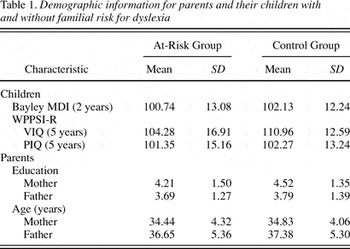
The participants were 200 children from the JLD. In this study children with familial risk for dyslexia (the dyslexic risk [DR] group; n=107) and children without familial risk for dyslexia (the no risk [NR] group; n=93) were followed from birth to school age (see Lyytinen, Ahonen, et al., 2001). Risk status was determined by the presence of dyslexia among parents (confirmed with extensive individual assessment) and at least one other close relative. None of the children had mental, physical, or sensory handicaps. In 49 families of the DR group, reading and spelling problems were identified in the father, in 55 families they were identified in the mother, and in 3 families both parents had reading and/or spelling problems. The assessment of the parents of the DR children comprised reading/spelling, phonological, and orthographic processing (Leinonen et al., 2001; for subgroups, see Lyytinen et al., 1995). Parental IQ levels were similar between the groups (Raven's Standard Progressive Matrices, subtests B, C, and D; Raven, Court, & Raven, 1992). Parents' education was classified into seven categories based on a composite score of basic level education and advanced educational training. There were no group differences in mothers' or fathers' education or age when their children were 5 years old. The means on the Bayley Mental Development Index (Bayley, 1993) were equivalent for children of both groups at the age of 2 years. There were also no group difference in the Wechsler Preschool and Primary Scale of Intelligence—Revised (Wechsler, 1989) Performance IQ at 5 years, but the NR group had significantly higher verbal IQ than the children in the at-risk group, F(1, 198)=9.66, p<.01. Demographic information concerning the children and their parents is presented in Table 1.

Language measures at 2 years
Parents reported on their children's language skills by using the Finnish toddler version (Lyytinen, 1999) of the MacArthur Communicative Development Inventory (CDI; Fenson et al., 1994), which was used to obtain scores for vocabulary and grammar skills. The vocabulary score was computed from a 595-item checklist containing words from 20 semantic categories. Two measures of grammar were employed. One section included Finnish noun (n=9) and verb inflections (n=6) shown via an example. Items of noun inflection consisted of the following: plural, genitive, partitive (some of), inessive (where, in what), elative (where from, from what), illative (where to, to what), adessive (where, at what) ablative (where from, from what), and allative (where to, to what). Verb inflections of the CDI cover first and third person singular of the present form, third person singular of the past and perfect forms, and imperative and passive indicative present forms. Parents were asked to report on the inflections used by their child, and only those records in which the parents had given one or more of their own examples were accepted. In the second section, parents were asked to write down three of the longest utterances expressed by their child. The scoring of maximum sentence length was based on the mean number of morphemes in the three longest utterances. Vocabulary and grammar items were used in this study.
The same inflections and maximum sentence length as assessed using the CDI were coded from an 8-min sample of a videotaped free play session. Analyses of the child's spontaneous speech were conducted to validate the parental report data. The play material consisted of toys familiar to children at this age. Videotaping took place through a one-way mirror using a standard VHS camera. A high quality microphone was placed centrally in the room. Coding was carried out by people who were without knowledge of the child's group membership (dyslexia risk vs. control). Interobserver reliability was assessed for 12% of the sample by having two coders independently code the same randomly selected cases. The mean correlation between the coders was .92 for inflections and .88 for maximum sentence length.
The composite mean score for inflectional morphology was based on four sources of data: inflections and maximum sentence length from the CDI and the same measures derived from the children's spontaneous language samples. In order to give equal weight to the test scores, they were standardized before the composite mean score was computed. The Cronbach alpha reliability for this composite score was .93.
The Bayley Scales of Infant Development—II (Bayley, 1993) were also administered to the children at 2 years. In addition to calculating the overall Mental Development Inventory score on the Bayley, the sum score of two expressive language items (naming pictures and objects) was calculated. This Bayley expressive score was carried out following the procedure documented by Siegel, Cooper, Fitzhardinge, and Ash (1995).
Language measures at 2.5 years
The Reynell Developmental Language Scales (RDLS; Reynell & Huntley, 1987) is a commonly used language test for which the validity and reliability have been demonstrated for toddlers. The RDLS were administered by a familiar experimenter in the children's homes. The test was used, both to gather information on the toddler's vocabulary comprehension, which is not covered in the Toddler CDI, and also to validate parental reports. The RDLS provides separate measures of verbal receptive and expressive language, both of which were used in this study.
Language measures at 3.5 years
Naming vocabulary was assessed using the Boston Naming Test (BNT; Kaplan, Goodglass, & Weintraub, 1983). A shortened version of the Peabody Picture Vocabulary Test—Revised (PPVT-R; Dunn & Dunn, 1981) of receptive vocabulary was also administered in the laboratory setting. These tests are used to assess children's comprehension and production of the meanings of words.
Mastery of Finnish inflectional morphology was measured with the 20-item Berko-type test (Lyytinen et al., 2001). This elicitation test measures a child's ability to inflect old Finnish words that are no longer in use and thus are not known by the child. The test covers items of adjective inflection (comparative, superlative), verb inflection (present), and noun inflection (elative, i.e., from something). After a practice session, five test trials are given concerning each type of inflection. In the actual test words with two to four syllables were orally presented in conjunction with a colorful drawing and the child was instructed to generate the inflection of the target word. The estimate of internal consistency for the test is .79.
Language measures at 5 and 5.5 years
The PPVT-R of receptive vocabulary and an expanded 30-item version of the Inflectional Morphology Test (IMT) were administered in a laboratory setting. Two inflectional forms (adverb and past inflections) were added to the IMT. During scoring, we considered at the age of 3.5 and 5 years whether the child used the target word, what suffix was used, and whether there were errors in the word stem. Each item was scored on a scale of 0–3, the maximum score for each inflection being 15.
In order to investigate the development of naming vocabulary, the BNT was administered to the children at 5.5 years. The mean score for the 5-year-olds' language skills was based on the three sources of data (the PPVT-R, the BNT, and the IMT). In order to give equal weight to the test scores, they were standardized before computing the composite mean score. The Cronbach alpha reliability for this composite score was .72.
RESULTS
Concurrent and predictive correlations between parental reports and language tests
The correlations between the CDI grammar scores (maximum sentence length and inflections) and corresponding behavioral measures derived from the children's spontaneous speech samples during the play session varied between .73 and .85, being highly significant at p<.001 in both groups.
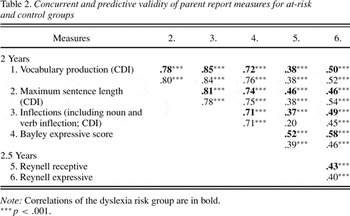
The validity of the Finnish CDI as an assessment tool was addressed by examining its correlations concurrently, with a standardized test such as the Bayley expressive score at 2 years, and predictively, with the RDLS at 2.5 years. As Table 2 shows, concurrent and predictive correlations varied between .37 and .85 in the DR group and were always highly significant (p<.001). For the NR group, corresponding associations were also found. Only the correlation between production of inflections and the Reynell receptive score failed to reach significance in the NR group.

Group differences in vocabulary and inflectional morphology measures
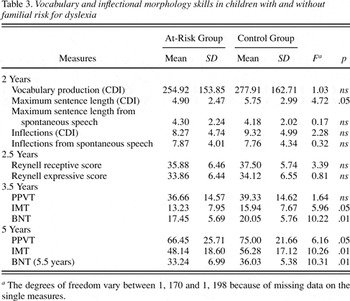
The measures of vocabulary production and inflections revealed no significant differences between the groups at the age of 2. No group difference was also found in early composite score for inflectional morphology. The CDI data for maximum sentence length were the only measure which differentiated children with and without familial risk for dyslexia, F(1, 195)=4.72, p<.05, at 2 years (see Table 3). The DR group produced shorter utterances as measured by the mean number of morphemes. A corresponding group difference was not found for maximum sentence length scores derived from the spontaneous language sample in the lab situation.

Children in the DR and NR groups did not differ on either the Reynell receptive or expressive scores at 2.5 years. The overall situation was different, however, at the ages of 3.5 and 5 years. Analyses of variance of the single measures showed that reliable differences between the groups were present at 3.5 years in the BNT, F(1, 197)=10.22, p<.01, and in the IMT, F(1, 170)=5.96, p<.05. The measure of receptive language (PPVT-R) revealed no significant group differences for the 3.5-year-old children. However, at the age of 5, the groups differed in the PPVT-R, F(1, 193)=6.16, p<.05, in the IMT, F(1, 198)=10.26, p<.01, and in the BNT, F(1, 197)=10.31, p<.01. On all of these measures, children in the DR group achieved lower scores than their age-matched controls.
Development of inflectional morphology skills
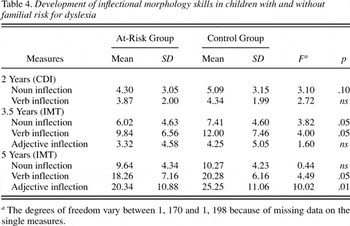
The data presented in Table 4 show that there was a trend for lower noun inflection levels among 2-year-old children in the at-risk group compared with the controls (p<.10). This trend was even clearer among the 3.5-year-olds. At this stage, children in the DR group achieved significantly lower scores for mastery of verb, F(1, 170)=4.00, p<.05, and noun inflections, F(1, 170)=3.82, p=.05.

Noun inflections no longer discriminated between the groups at age 5. Rather, children in the DR group mastered significantly fewer verb, F(1, 198)=4.49, p<.05, and adjective inflections, F(1, 198)=10.02, p<.01, than did their controls. A multiple analysis of variance for repeated measures was conducted for the 3.5- and 5-year scores of the IMT. Using Wilks' lambda-based F approximation as a criterion, a significant group by age interaction, F(1, 170)=5.64, p<.05, was found for the total score of the IMT. When examining inflectional forms separately, it was found that a significant interaction occurred only for the adjective inflection, F(1, 170)=5.27, p<.05. The acquisition pattern of adjective inflections was similar for both groups, although the growth was significantly slower in the DR group compared with their controls. In noun and verb inflections, the interaction failed to reach significance.
Predictive relations of early language measures
In order to investigate the extent to which early vocabulary and inflectional morphology contributed to the children's language skills at the age of 5 years, hierarchical multiple regression analyses were conducted separately for the at-risk and comparison groups. The order of entering predictive language measures was determined by developmental succession of the assessments for both outcome measures. Vocabulary production on the CDI and the composite score for inflections at 2 years were entered as the first step. The Reynell receptive and expressive scores were entered as step two, representing age 2.5 years. Finally, the scores of the PPVT-R, BNT, and IMT were entered to represent measures of age 3.5 years. The criterion for inclusion to the model was that F exceeded the p<.05 level.
The results are summarized in Table 5, which reports standardized betas at the last step and increments in R2 for those language measures that provided a significant contribution to the prediction of the outcome variable. Table 5 shows that the variance of 5-year-olds' language skills could be significantly accounted for by these predictors. The total R2 of this model accounted for 51% of the variance in the DR group, F(3, 76)=24.83, p<.001, and 51% in the NR group, F(3, 65)=21.38, p<.001. The earliest and most significant predictor for the dyslexia risk group was their composite score for inflectional morphology at age 2. Reynell receptive score at 2.5 years and naming skill at 3.5 years also provided significant incremental contributions to the prediction of 5-year-olds' language skills for the DR group. The earliest predictors for the control group were performances on Reynell receptive subtests at 2.5 years and on the Inflectional Morphology Test and PPVT-R at 3.5 years, which contributed significantly to language skills at 5 years.

DISCUSSION
The present study examined proficiency in early vocabulary and inflectional morphology and its predictive relations to subsequent language skills in children with and without familial risk for dyslexia. There are some previous findings concerning the different pathways assumed by vocabulary development, phonological ability, and orthographic skills between the ages of 2.5 and 6 years among at-risk children (Gallagher, Frith, & Snowling, 2000; Pennington & Lefly, 2001) and children who later become dyslexic (Scarborough, 1990; Snowling et al., 2003). However, very few studies have examined the role of morpheme recognition and morphological awareness in dyslexia (Elbro & Arnbak, 1996), and few (Levin et al., 1998) have looked for grammatical markers in richly inflected languages as distinct from the inflectionally sparse English (Leonard, 2000).
Our findings indicated, together with those reported earlier, the validity of parental report for measuring vocabulary and grammar in toddlers (Berglund, Eriksson, & Johansson, 2001; Fenson et al., 1994; Thal, Jackson–Maldonado, & Acosta, 2000). The high concurrent and predictive correlations for both groups between the CDI data and the standardized tests, such as the expressive scores of the Bayley Scales of Infant Development at 2 years and those of the Reynell Language Scale at 2.5 years, revealed that parents make reliable assessments of their children's early language skills.
The results of this study revealed impairments in vocabulary and inflectional morphology for the at-risk children from 3.5 years of age in comparison to their controls. No significant differences between groups were, however, found in receptive and expressive vocabularies assessed by the Finnish CDI at 2 years and by the structured tests at 2.5 years (RDLS). This result is consistent with the finding by Scarborough (1990) that children who later developed reading disabilities had age-appropriate lexical skills at 2.5 years. Oral language difficulties increased with age in the at-risk children who showed significantly lower expressive vocabulary at 3.5 years in comparison to controls. A similar difference was documented in the study by Gallagher et al. (2000) among children at familial risk for dyslexia between 3 and 4 years of age. Furthermore, in our study, receptive skills (PPVT-R) differentiated the groups at age 5. These results provide support for our assumption that the cumulative effects of subtle difficulties in speech perception are reflected among the at-risk children as a relatively consistent language impairment during the period that precedes reading acquisition. It is important to note that these language difficulties are present during the crucial period that prepares a child to attend more closely to phonemic patterns in order to begin acquisition of basic reading skills.
In examining the growth of inflectional morphology it is understandable that, because of the agglutinative nature of the Finnish language, maximum sentence length was the only single morphological measure to reliably differentiate the groups at age 2. Children in the at-risk group produced shorter utterances as measured by the mean number of morphemes than did their controls. Accordingly, it is not surprising that inflectional morphology, especially noun inflection, was observed to be the earliest grammatical marker that discriminated children with and without familial risk for dyslexia. However, corresponding inflectional measures assessed in a free play setting did not discriminate the groups. A general trend for both groups was that in the free play, children produced shorter utterances than reported by their parents. The reason may be that young children use more time in play situations to explore and handle toys rather than talk about them (Lyytinen, 1995; McCune–Nicolich & Fenson, 1984).
Early expressive vocabulary did not predict children's language skills in this study, either in the DR or in the NR group but receptive language, measured by the Reynell Scale at 2.5, contributed significantly to language skills in both groups at 5 years of age. In the control group, a good level of comprehension at 2.5 years was the best predictor of the children's subsequent language development. Previously, Bates and Goodman (2001) suggested that language comprehension is an essential prerequisite to expressive language, but it cannot be regarded as the sole explanatory factor. The nature of the remaining prerequisites depends partly on the outcome measures. The high predictive power of receptive language in this study might result from our measures that presuppose good comprehension and following of instructions as well as accurate auditory discrimination of linguistic forms.
Inflectional morphology showed differing predictive patterns for the at-risk group and the controls. The composite score for inflections provided a significant prediction for the subsequent language development of the DR group showing cross-age continuity from 2 up to 5 years. In contrast, the corresponding prediction was only found in the controls until the age of 3.5 years. This result is consistent with our previous findings (Lyytinen, Poikkeus, Laakso, Eklund, & Lyytinen, 2001) that revealed that those 2-year-old children who could be defined as late talkers and belonging to the at-risk group still had difficulties in receptive and expressive language skills at 3.5 years while children with a comparable late-talking history in the control group, almost without exception, reached the level of their age mates.
The results of this study support the suggestion presented by Rice (2000) that early identification of grammatical markers is important for children with SLI because these markers may persist and influence children's subsequent language development. In searching for grammatical markers, the type of language being acquired must be taken into consideration (Grigorenko, 2001; Leonard, 2000). Research has shown that English-speaking children who are slow to learn language or who have language-related difficulties have problems with verb inflection (Leonard, 1998, 2000; Rice, 2000; Rice, Wexler, & Hershberger, 1998). Our findings demonstrated that children in the at-risk group acquired inflections at a slower rate than did their controls. However, the acquisition pattern was similar for both groups. Different inflections were discriminative at different ages. Noun inflections differentiated the groups at 2 and 3.5 years. A similar discriminative trend between the groups was also found for verb inflections at 3.5 years and for verb and adjective inflections at 5 years. Difficulty with noun-related morphemes such as adjective-agreement inflection has also been observed to be more common than difficulty with verb morphology in Spanish children with SLI (Bedore & Leonard, 2001).
Our findings confirm that 2-year-old children at familial risk for dyslexia who have a low level of inflectional morphology are at higher risk for impairment in language development than children who have similar inflectional skills but are not at familial risk for dyslexia. Finnish children have to focus their attention on word endings and make fine discriminations at word boundaries when searching for meaning in utterances (Lyytinen, Ahonen, et al., 1995; Silvén et al., 2003). The ability to manipulate word endings and stems correctly is a more significant early marker than, for example, vocabulary, among the children who are at familial risk for dyslexia. It is important to note that poor skills in inflectional morphology or vocabulary at 2 years of age do not imply any serious concern for those children who do not have family-related reading problems. Thus, our data support the comparable contention of Paul (2000) that, for late talkers from supportive families with no other risk factors, parent training to optimize language input and careful monitoring of children's linguistic progress will be the intervention of choice.
An interesting issue is how the cumulative nonoptimal aspects of lexical and morphological development found among the DR group later exert their influence during the phase of reading acquisition. These issues are of particular interest to us as we follow these children into school age, when the retrospective identification of reliable predictors for the acquisition of fluent reading skills can be confirmed.
ACKNOWLEDGMENTS
This work is part of the Finnish Centre of Excellence Programme (2000–2005) and support has been provided by the Academy of Finland and the University of Jyväskylä. We thank the families in the study, the JLD group for their help in enrolling the families, Kenneth Eklund for assistance with statistics, and Jane Erskine and Jenny Thomson for polishing the English language.
References
Arnbak E. &
Elbro C.
2000
The effects of morphological awareness training on the reading and spelling skills of young dyslexics.
Scandinavian Journal of Educational Research,
44,
229–
251.Google Scholar
Bates E. &
Goodman J. C.
2001
On the inseparability of grammar and the lexicon: Evidence from acquisition.
In M. Tomasello &
E. Bates (Eds.),
Language development. The essential readings
(pp. 134–
162).
Oxford, UK:
Blackwell.
Bayley N.
1993
The Bayley Scales of Infant Development (2nd ed.).
San Antonio, TX:
Psychological Corporation.
Bedore L. M. &
Leonard L. B.
2001
Grammatical morphology deficits in Spanish-speaking children with specific language impairment.
Journal of Speech, Language, and Hearing Research,
44,
905–
923.Google Scholar
Berglund E.,
Eriksson M. &
Johansson I.
2001
Parental reports of spoken language skills in children with Down syndrome.
Journal of Speech, Language, and Hearing Research,
44,
179–
191.Google Scholar
Byrne B.
1998
The foundation of literacy: The child's acquisition of the alphabetic principle.
Hove, UK:
Psychology Press.
Carlisle J. F.
1995
Morphological awareness and early reading achievement.
In L. B. Feldman (Ed.),
Morphological aspects of language processing
(pp. 189–
209).
Hove, UK:
Erlbaum.
Catts H.
1996
Defining dyslexia as a developmental language disorder: An expanded view.
Topics in Language Disorders,
16,
14–
29.Google Scholar
Dunn L. M. &
Dunn L. M.
1981
Peabody Picture Vocabulary Test—Revised.
Circle Pines, MN:
American Guidance Service.
Elbro C. &
Arnbak E.
1996
The role of morpheme recognition and morphological awareness in dyslexia.
Annals of Dyslexia,
46,
209–
240.Google Scholar
Elbro C.,
Borstrøm I. &
Petersen D. K.
1998
Predicting dyslexia from kindergarten: The importance of distinctness of phonological representations of lexical items.
Reading Research Quarterly,
33,
36–
60.Google Scholar
Fenson L.,
Dale P. S.,
Reznick J. S.,
Bates E.,
Thal D. &
Pethick S. J.
1994
Variability in early communicative development.
Monographs of the Society for Research in Child Development,
59
(5, Serial No. 242).Google Scholar
Fowler A. &
Liberman I. Y.
1995
The role of phonology and orthography in morphological awareness.
In L. B. Feldman (Ed.),
Morphological aspects of language processing
(pp. 157–
188).
Hove, UK:
Erlbaum.
Gallagher A.,
Frith U. &
Snowling M. J.
2000
Precursors of literacy delay among children at genetic risk of dyslexia.
Journal of Child Psychology and Psychiatry and Allied Disciplines,
41,
202–
213.Google Scholar
Goswami U. &
Bryant P.
1990
Phonological skills and learning to read.
London:
Erlbaum.
Grigorenko E. L.
2001
Developmental dyslexia: An update on genes, brains, and environments.
Journal of Child Psychology and Psychiatry,
42,
91–
125.Google Scholar
Guttorm T. K.,
Leppänen P. H. T.,
Poikkeus A.-M.,
Eklund K. M.,
Lyytinen P., &
Lyytinen H. (in press).
Brain event-related potentials (ERPs) measured at birth predict later language development in children with and without familial risk for dyslexia.
Cortex.
Guttorm T. K.,
Leppänen,P. H. T.,
Richardson U. &
Lyytinen H.
2001
Event-related potentials and consonant differentiation in newborns with familial risk for dyslexia.
Journal of Learning Disabilities,
34,
534–
544.Google Scholar
Kaplan E.,
Goodglass H. &
Weintraub S.
1983
The Boston Naming Test (2nd ed.).
Philadelphia:
Lea & Febiger.
Karlsson F.
1999
Finnish. An essential grammar.
London:
Routledge.
Leinonen S.,
Müller,K.,
Leppänen P.,
Aro M.,
Ahonen T. &
Lyytinen H.
2001
Heterogeneity in adult dyslexic readers: Relating processing skills to the speed and accuracy of oral text reading.
Reading and Writing: An Interdisciplinary Journal,
14,
265–
296.Google Scholar
Leonard L. B.
1998
Children with specific language impairment.
Cambridge:
MIT Press.
Leonard L. B.
2000
Specific language impairment across languages.
In D. V. M. Bishop &
L. B. Leonard (Eds.),
Speech and language impairments in children. Causes, characteristics, intervention and outcome
(pp. 115–
129).
Hove, UK:
Psychology Press.
Leonard L. B.,
Miller C. &
Gerber E.
1999
Grammatical morphology and the lexicon in children with specific language impairment.
Journal of Speech, anguage, and Hearing Research,
42,
678–
689.Google Scholar
Leppänen P. H. T.,
Richardson U.
Pihko E.
Eklund K. M.,
Guttorm T. K.,
Aro M. &
Lyytinen H.
2002
Brain responses to changes in speech sound duration differ between infants with and without familial risk for dyslexia.
Developmental Neuropsychology,
22,
407–
422.Google Scholar
Levin I.,
Ravid D. &
Rapaport S.
1998
Developing morphological awareness and learning to write: A two-way street.
In T. Nunes (Ed.),
Integrating research and practice in literacy
(pp. 77–
104).
Amsterdam:
Kluwer.
Lundberg I.,
Frost J. &
Petersen O.
1988
Effects of an extensive programme for stimulating phonological awareness in preschool children.
Reading Research Quarterly,
23,
263–
284.Google Scholar
Lyytinen H.,
Ahonen T.,
Eklund K.,
Guttorm T. K.,
Laakso M.-L.,
Leinonen S.,
Leppänen P. H. T.,
Lyytinen P.,
Poikkeus A.-M.,
Puolakanaho A.,
Richardson U. &
Viholainen H.
2001
Developmental pathways of children with and without familial risk for dyslexia during the first years of life.
Developmental Neuropsychology,
20,
539–
558.Google Scholar
Lyytinen H.,
Leinonen S.,
Nikula M.,
Aro M. &
Leiwo M.
1995
In search of the core features of dyslexia: Observations concerning dyslexia in the highly orthographically regular Finnish language.
In V. W. Berninger (Ed.),
The varieties of orthographic knowledge 2: Relationship to phonology, reading and writing
(pp. 177–
204).
Dordrecht:
Kluwer.
Lyytinen P.
1982
The acquisition process of Finnish morphology in 2–7-year-old children.
Acta Psychologica Fennica,
9,
112–
125.Google Scholar
Lyytinen P.
1987
Cognitive skills and Finnish language inflection.
Scandinavian Journal of Psychology,
28,
304–
312.Google Scholar
Lyytinen P.
1995
Cross-situational variation on children's pretend play.
Early Child Development and Care,
105,
33–
41.Google Scholar
Lyytinen P.
1999
Varhaisen kommunikaation ja kielen kehityksen arviointimenetelmä
[Finnish manual for communicative development inventories] (University of Jyväskylä, Child Research Center and Niilo Mäki Institute).
Jyväskylä:
Yliopistopaino.
Lyytinen P.,
Poikkeus A.-M.,
Laakso M.-L.,
Eklund K. &
Lyytinen H.
2001
Language development and symbolic play in children with and without familial risk for dyslexia.
Journal of Speech, Language, and Hearing Research,
44,
873–
885.Google Scholar
McCune–Nicolich L. &
Fenson L.
1984
Methodological issues in studying early pretend play.
In T. Yawkey &
A. Pellegrini (Eds.),
Child's play: Developmental and applied.
Hillsdale, NJ:
Erlbaum.
Müller K. &
Brady S.
2001
Correlates of early reading performances in a transparent ortography.
Reading and Writing: An Interdisciplinary Journal,
14,
757–
799.Google Scholar
Paul R.
2000
Predicting outcomes of early expressive language delay: Ethical implications.
In D. V. M. Bishop &
L. B. Leonard (Eds.),
Speech and language impairments in children. Causes, characteristics, intervention and outcome
(pp. 195–
209).
Hove, UK:
Psychology Press.
Pennington B. F. &
Lefly D. L.
2001
Early reading development in children at family risk for dyslexia.
Child Development,
72,
816–
833.Google Scholar
Raven J. C.,
Court J. H. &
Raven J.
1992
Standard Progressive Matrices.
Oxford, UK:
Oxford Psychologists Press.
Reynell J. K. &
Huntley M.
1987
Reynell Developmental Language Scales Manual (2nd ed.).
Windsor, UK:
NFER-Nelson.
Rice M. L.
2000
Grammatical symptoms of specific language impairment.
In D. V. M. Bishop &
L. B. Leonard (Eds.),
Speech and language impairments in children. Causes, characteristics, intervention and outcome
(pp. 17–
34).
Hove, UK:
Psychology Press.
Rice M. L.,
Wexler K. &
Hershberger S.
1998
Tense over time: The longitudinal course of tense acquisition in children with specific language impairment.
Journal of Speech, Language, and Hearing Research,
41,
1412–
1431.Google Scholar
Richardson U.,
Leppänen P. H. T.,
Leiwo M. &
Lyytinen H.
2003
Speech perception of infants with high familial risk for dyslexia differ at the age of six months.
Developmental Neuropsychology
23,
387–
397.Google Scholar
Rubin H.,
Patterson,P. A. &
Kantor M.
1991
Morphological development and writing ability in children and adults.
Language, Speech, and Hearing Services in School,
22,
228–
235.Google Scholar
Scarborough H. S.
1990
Very early language deficits in dyslexic children.
Child Development,
61,
1728–
1743.Google Scholar
Siegel L. S.,
Cooper D. C.,
Fitzhardinge P. M. &
Ash A. J.
1995
The use of the mental development index of the Bayley Scale to diagnose language delay in 2-year-old high-risk infants.
Infant Behavior and Development,
18,
483–
486.Google Scholar
Silvén M.,
Ahtola A. &
Niemi P.
2003
Early words, multiword utterances and maternal reading strategies as predictors of mastering word inflections in Finnish.
Journal of Child Language,
30,
253–
279.Google Scholar
Snowling M. J.,
Gallagher A. &
Frith U.
2003
Family risk of dyslexia is continuous: Individual differences in the precursors of reading skill.
Child Development,
74,
358–
373.Google Scholar
Thal D.,
Jackson–Maldonado D. &
Acosta D.
2000
Validity of a parent-report measure of vocabulary and grammar for Spanish-speaking toddlers.
Journal of Speech, Language, and Hearing Research,
40,
1087–
1100.Google Scholar
van der Leij A.,
Lyytinen H. &
Zwarts F.
2001
The study of infant cognitive processes in dyslexia.
In A. Fawcett (Ed.),
Dyslexia. Theory and good practice
(pp. 160–
181).
London:
Whurr.
Wechsler D.
1989
Wechsler Preschool and Primary Scale of Intelligence—Revised.
San Antonio, TX:
Psychological Corporation.
Demographic information for parents and their children with and without familial risk for dyslexia
Concurrent and predictive validity of parent report measures for at-risk and control groups
Vocabulary and inflectional morphology skills in children with and without familial risk for dyslexia
Development of inflectional morphology skills in children with and without familial risk for dyslexia
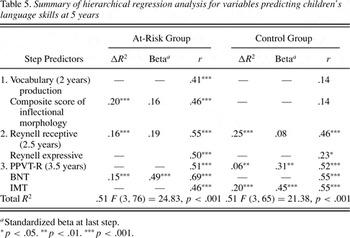
Summary of hierarchical regression analysis for variables predicting children's language skills at 5 years
 You have
Access
- 82
- Cited by