INTRODUCTION
Spider crabs Maja brachydactyla Balss, 1922 are important seafood items, with commercial fisheries occurring in all distribution areas—coastal shores of the North Sea to the north of Africa (Kergarion, Reference Kergarion1984; Neumann, Reference Neumann1998). Females mature and spawn from March to September (González-Gurriarán et al., Reference González-Gurriarán, Fernández, Freire and Muiño1998). Since M. brachydactyla has a high market price and is overexploited (Kergarion, Reference Kergarion1984; Ellis et al., Reference Ellis, Rogers and Freeman2000), it is important to develop a culture protocol to produce high quality animals that could compete with wild caught individuals, thus reducing exploitation of wild stocks. Larval culture is one of the most critical phases for aquaculture, particularly developing appropriate larval diets that can fulfil the requirements for a proper larval development. In aquaculture, the egg biochemical composition of many marine species has been used as a reference for the formulation of larval diets. A diet with a composition similar to the eggs should be adequate to the larvae after the onset of exogenous feeding (Rainuzzo et al., Reference Rainuzzo, Reitan and Olsen1997; Narciso & Morais, Reference Narciso and Morais2001).
The egg plays a central role in the life history of marine invertebrates and must contain all nutrients required for maintenance and development of the embryo (Anger, Reference Anger1998; Rosa et al., Reference Rosa, Calado, Narciso and Nunes2007). Lipids generally provide ~60% of the total energy expenditure of the developing crustacean embryo (Herring, Reference Herring1974; Holland, Reference Holland, Malins and Sargent1978; Amsler & George, Reference Amsler and George1984) and are utilized as structural components of cell membranes (Rosa & Nunes, Reference Rosa and Nunes2003). Previous studies revealed that the fatty-acid content and their dynamics during embryogenesis provide information on crustacean life history traits, feeding ecology and habitats (Rosa et al., Reference Rosa, Calado, Narciso and Nunes2007). Essential long-chain poly-unsaturated fatty acids (PUFA) cannot be synthesized de novo and are utilized as energy only when available in excess (Anger, Reference Anger1998). A low level of essential PUFA in the diet affects the reproductive performance of adult females by reducing embryo viability. The effect should likewise decrease the physiological condition of freshly hatched larvae and reduce development, survival and growth (Anger, Reference Anger1998).
We aim to study egg volume, energy content, and fatty-acid profile during the embryonic development of M. brachydactyla, and its potential implications for aquaculture.
MATERIALS AND METHODS
Sampling
Ovigerous females of Maja brachydactyla were purchased at local markets in Cascais, Portugal during April and May 2005. Live crabs were transported to the laboratory and female carapace length (CL) and carapace width (CW) were measured. The embryonic developmental stage of all female broods were classified according to the following criteria: stage I—eggs with uniformly distributed yolk (orange), absence of cleavage and eyes, no visible blastoderm; stage II—distinct blastoderm with half yolk, eyes visible; and stage III—embryos in an advanced stage of development (large eyes) with little or no yolk.
Egg volume
Six females were selected for each developmental stage to study egg size. Thirty eggs were taken from each female and their diameters (D) were measured in salt water immersion (30 eggs/female of six females for each developmental stage, N = 540) to the nearest 0.01 mm under a steromicroscope (Olympus®, model SZ6045TR) with a calibrated eyepiece. Egg volume was calculated using the formula V= (π D3)/6 for spheroid embryos.
Egg energy content
In order to assess egg energy content throughout embryonic development, three broods per embryonic stage were randomly sampled (N = 9). After freeze-drying the samples for 24 hours with a Savant Vapornet VN100 Freeze Dryer, the energy content (cal. g dw−1) of each sample was measured with a Parr-1425 Semimicro Oxygen Bomb calorimeter (previously calibrated with benzoic acid). Samples (62 to 143 mg) were burned in oxygen in the calorimeter.
Egg fatty-acid profile
To determine the fatty-acid profile of M. brachydactyla eggs at each developmental stage, nine egg masses per embryonic stage were sampled (N = 27). After freeze-drying, the samples were ground in a Potter homogenizer with chloroform–methanol–water (2:2:1.8) (Bligh & Dyer, Reference Bligh and Dyer1959). An internal standard fatty acid (C19:0) was added to the extracts. After saponification and esterification of the lipid extracts (Metcalfe & Schmitz, Reference Metcalfe and Schmitz1961), the fatty-acid methyl esters (FAME) were injected into capillary columns (30 m fused silica, 0.32 I.D.) installed in a Varian Star 3400CX gas–liquid chromatograph (GLC). Helium was used as carrier gas at a flow rate of 1 ml/minute; oven temperature was 180ºC for 7 minutes, then 200ºC (with a temperature gradient of 4ºC/minute) over a period of 71 minutes. Both the injector and the FID detector were set at 250ºC. GLC data acquisition and handling were performed using a Varian integrator 4290 connected to the GLC. Peak quantification was carried out with a Star Chromatography workstation installed in an IBM PS/1. Peak identification was performed using cod liver oil chromatograms as a reference.
Data analysis
One way ANOVAs were used to test if there were significant differences in egg volume, energy content, total fatty acid content and the fatty acid content between eggs in different developmental stages. Post-hoc Tukey's multiple comparisons tests were performed if a significant difference was found. The correlations between egg volume and energy content, and egg volume and total FA content were tested using non-parametric Spearman correlation-coefficients. All statistical analyses were performed in Statistica 7.0 with a significance level of 0.05.
RESULTS AND DISCUSSION
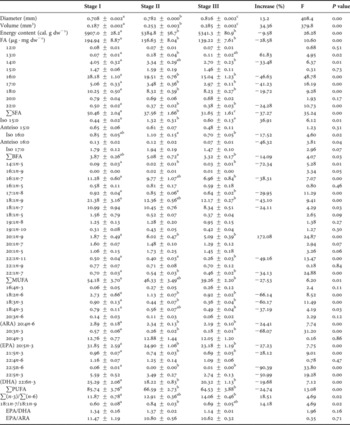
Ovigerous females collected ranged from 115.44 to 136.19 mm CW (130.68 to 152 mm CL). Average egg diameters were 0.707 mm (SE = 0.002, N = 180) for stage I, 0.782 mm (SE = 0.003, N = 180) for stage II, and 0.816 mm (SE = 0.002, N = 180) for stage III. Comparisons of egg volume, energy content, total fatty-acid content and per cent fatty-acid content among the developmental stages, are shown in Table 1. The egg diameter observed in the present study (0.71–0.82 mm, Table 1) was greater than what is usually reported for marine and brackish water species (0.25 and 0.45 mm) (Anger, Reference Anger1995). However, while in decapod crustaceans we commonly observe a 50–150% egg volume increase during development (Wear, Reference Wear1974; Petersen & Anger, Reference Petersen and Anger1997; Oh & Hartnoll, Reference Oh and Hartnoll1999), in Maja brachydactyla egg volume only increased 34%. Greater egg volume increase was recorded in the earlier development, similar to what was observed by De Vries & Forward (Reference De Vries and Forward1991) in other brachyurans. Like in other decapod species (e.g. Nauticaris magellanica, Wehrtmann & Kattner, Reference Wehrtmann and Kattner1998), both egg energy content and fatty acids were negatively correlated with egg volume increase (N = 9, r = −0.80, t = −3.54, P < 0.01 and N = 27, r = −0.46, t = −2.39, P < 0.03, respectively) showing that M. brachydactyla consumed significant amounts of energy (9.58%), particularly, fatty acids (28.58%) during embryonic development. This might be due to the fact that lipids are the major energy source for the development (Clarke et al., Reference Clarke, Brown and Holmes1990).
Egg diameter (mm), volume (mm3), energy content (cal. g dw−1), FA content (µg · mg dw−1) (average±SE), per cent increase from stage I to stage III (if significant) and F and P value results of the one-way-ANOVA comparing different embryonic stages of development (df = 2). Different superscript letters represent significant differences between embryonic stages (Tukey post-hoc tests) (FA, fatty acid; SFA, saturated fatty acid; MUFA, monounsaturated fatty acid; PUFA, polyunsaturated fatty acid).

However, the relatively high fatty-acid content of pre-hatching eggs indicates larvae might display a certain degree of independence from external food sources (planktontrophy) (Staton & Sulkin, Reference Staton and Sulkin1991; Leme, Reference Leme2006; Rosa et al., Reference Rosa, Calado, Narciso and Nunes2007); this is in agreement with the results obtained by Urcera et al. (Reference Urcera, Anaiz, Rua and Coo1993) who studied the effect of starvation during early larval development of M. brachydactyla: if not fed, newly hatched larvae survived for a maximum of 6 days but only 10% of the larvae metamorphosed to zoea II. The fatty-acid composition of M. brachydactyla eggs was similar to that of other decapod species (Wehrtmann & Kattner, Reference Wehrtmann and Kattner1998; Narciso & Morais, Reference Narciso and Morais2001; Rosa et al., Reference Rosa, Calado, Narciso and Nunes2007); with some variation expected, as fatty-acid content varies between and within species according to the adults' diet and habitat (Cahu et al., Reference Cahu, Fauvel and Aquacop1986; Wehrtmann & Kattner, Reference Wehrtmann and Kattner1998; Rosa et al., Reference Rosa, Calado, Narciso and Nunes2007).
The major saturated fatty acids (SFA) in M. brachydactyla eggs were palmitic (16:0), stearic (18:0) and 17:0 acids. The other SFA detected at lower levels were 12:0, 13:0, 14:0, 15:0, 20:0 and 22:0. SFA were significantly consumed through embryogenesis (37.3%), particularly14:0, 16:0, 17:0, 18:0 and 22:0 while, the other remained stable throughout embryogenesis, except 13:0 that was initially synthesized, but consumed at the posterior. Odd-numbered fatty acids (particularly 15:0 and 17:0) are known to be largely biosynthesized by marine heterotrophic bacteria, which are particularly abundant in sediment (Volkman et al., Reference Volkman, Barrett, Blackburn, Mansour, Sikes and Gelin1998). The high proportion of odd-numbered fatty acids (above 3%) in M. brachydactyla eggs reveals the detritivore scavenger nature common to crab species.
All branched fatty acids (BFA) (Iso 15:0, Anteiso 15:0, Iso 16:0, Anteiso 16:0 and Iso 17:0) were detected in low amounts. Fourteen per cent of the BFA were consumed through embryogenesis: Iso 16:0 and Anteiso 16:0 decreased significantly; Anteiso 15:0 and Iso 17:0 remained stable; and Iso 15:0 increased significantly (Table 1). The dominant monounsaturated fatty acids (MUFA) were 18:1n-9, palmitoleic (16:1n-7) and vaccenic (18:1n-7) acids. The other MUFA detected included 14:1n-5, 16:1n-9, 16:1n-5, 17:1n-8, 18:1n-5, 19:1n-8, 19:1n-10, 20:1n-9, 20:1n-7, 20:1n-5, 22:1n-11, 22:1n-9 and 22:1n-7. Twenty-seven per cent of the MUFA were consumed during embryonic development: 14:1n-5, 16:1n-7, 17:1n-8, 18:1n-7, 18:1n-9, 22:1n-11 and 22:1n-7 were significantly consumed through embryogenesis, while 20:1n-9 were synthesized (172% increase) and the others remained stable (Table 1). The fatty acid 18:1n-9 is the major fatty acid in marine animals and a general marker for carnivory (Dalsgaard et al., Reference Dalsgaard, St John, Kattner, Müller-Navarra and Hagen2003). The medium–high ratio of 18:1n-7/18:1n-9 and low percentage of 18:1n-9 (8.7–11%) shows that this species, at least in the area the animals were captured, is less carnivorous than what has been previously described (Bernárdez et al., Reference Bernárdez, Freire and González-Gurriarán2000); Kergarion (Reference Kergarion1974) previously described that the feeding regime of Maja changed depending on where the animals are caught, as it would be expected of an omnivorous species with a large distribution.
The most prevalent PUFA was eicosapentaenoic acid (EPA, 20:5n-3), followed by docosahexaenoic (DHA, 22:6n-3) and eicosatetraenoic (20:4n-3) acids. Additional PUFA detected were 16:4n-3, linoleic acid (18:2n-6), linolenic acid (18:3n-3), 18:4n-3, 20:3n-6, arachidonic acid (ARA, 20:4n-6), 20:3n-3, 20:4n-3, 21:5n-3, 22:4n-6, 22:5n-6 and docosapentaenoic acid (DPA, 22:5n-3). Twenty-four per cent of the PUFA were consumed during embryogenesis: all fatty acids decreased significantly, except 16:4n-3, 20:3n-6, 20:4n-3 and 22:4n-6 that remained stable (Table 1). The high proportion of essential PUFA of C18 and C20 (27–28.5%, particularly EPA), known trophic markers of primary producers (Rosa et al., Reference Rosa, Calado, Narciso and Nunes2007), reflects the adults' macroalgae-rich diet (namely laminar and coralline algae) (Kergarion, Reference Kergarion1984; Bernárdez et al., Reference Bernárdez, Freire and González-Gurriarán2000). The medium EPA/DHA ratio (1.14–1.37) indicates the species is in a medium level of the trophic chain (Auel et al., Reference Auel, Harjes, da Rocha, Stübing and Hagen2002; Scott et al., Reference Scott, Kwasniewski, Falk-Petersen and Sargent2002).
The Maja brachydactyla egg fatty-acid profile can provide clues to select the most adequate larval diet. The high content of PUFA, particularly EPA and DHA, indicates that larvae need a diet rich in these PUFA, as they are significantly consumed through embryogenesis (27.2% and 19.7%, respectively). The presently available preys for larval rearing in aquaculture, particularly Artemia, are great sources of EPA and therefore the supply of this fatty acid is usually not the major concern when rearing the larvae. DHA is considered one of the most important fatty acids in decapod eggs, generally accounting for 10–20% of the total fatty acids (Wehrtmann & Graeve, Reference Wehrtmann and Graeve1998; Rosa et al., Reference Rosa, Calado, Narciso and Nunes2007), however, rotifers and Artemia nauplii have naturally low PUFA content, particularly DHA (Narciso & Morais, Reference Narciso and Morais2001). Many studies have attempted to develop culture protocols for alternative prey items with improved fatty-acid profiles, such as copepods (Sørensen et al., Reference Sørensen, Drillet, Engell-Sørensen, Hansen and Ramløv2007). However, copepod culture remains unreliable as an alternative prey in the aquaculture industry, thus rotifers and Artemia nauplii are still the most commonly used live feed since they can be boosted with PUFA to fulfil larval requirements (Rainuzzo et al., Reference Rainuzzo, Reitan and Olsen1997; Sorgeloos et al., Reference Sorgeloos, Dhert and Candreva2001). This was observed in the two reported cultures of M. brachydactyla by Urcera et al. (Reference Urcera, Anaiz, Rua and Coo1993) and Andrés et al. (Reference Andrés, Estévez and Rotllant2007); newly hatched larvae fed Artemia nauplii, known to have low content of DHA (Narciso & Morais, Reference Narciso and Morais2001), yielded lower survival and growth (18% survival and 24 days of larval duration; Urcera et al., Reference Urcera, Anaiz, Rua and Coo1993) than enriched-Artemia nauplii (with PUFA, including DHA, through enrichment products and/or green water treatments) (46% in 22 days and 25.3% with faster development, respectively in Urcera et al., Reference Urcera, Anaiz, Rua and Coo1993 and Andrés et al., Reference Andrés, Estévez and Rotllant2007).
ACKNOWLEDGEMENTS
We thank Ana Pêgo, Filipa Faleiro, Junda Lin and Justin Anto for their technical support and valuable comments, and Fundação para a Ciência e Tecnologia for the PhD scholarship (SFRH/BD/17130/2004) to the first author.