1. Introduction
In the 1950s a concerted effort was made in some quarters to liberate the music score from the manacles of left–right/up–down orientation. The idea evolved both in music and across a range of art forms in the mid-twentieth century, all sharing a common impetus to generate the opportunity for multiple readings defined by the individual. Žižek claims that, as developments in ideology and formal innovation are interlocked, ideology and technology also evolve in parallel. He argues that ‘old artistic forms [push] against their own boundaries and [use] procedures which, at least from our retrospective view, seem to point towards a new technology’ (Žižek Reference Žižek2000: 39).
These ‘excessive experiments’ with traditional paper scores, such as multi-pathway ‘mobile scores’, and ‘graphic’ and ‘indeterminate’ notation, eventually found a more ‘natural and appropriate’ (Žižek Reference Žižek2000: 39) platform in graphical computing, which furnished the notated score with the capacity for the permutative, transformative and generative qualities of that medium. In addition, the computer provided a platform in which complex realtime manipulations of the score could be both shared and precisely coordinated through networks. The new medium for the presentation of notated materials to performers might most appropriately be termed the ‘screen score’. These developments possess the promise of novel compositional approaches to multiple varied instantiations of a work as well as the conception and realisation of hybrid and multiple formal structures.
This article traces the evolution of mobility in the score from its emergence in the work of postwar composers to the advent of the screen score.
2. The emergence of ‘mobility’ in the musical score
The mid-century saw a sudden abundance of ideas pushing against their own boundaries and pointing towards a new paradigm of openness and mobility in art works. In technology and the non-musical arts, these developments included Alexander Calder's first sculptural ‘mobile’ Feathers (1931) (Selz Reference Selz1966: 72); the invention of the Memex (1945) – a method of organising data ‘as we may think’ by Vannevar Bush (Bush Reference Bush1945: 101–108); the publication of Raymond Queneau's Cent mille milliards de poèmes (Hundred Thousand Billion Poems, 1961), a compendium (and ‘writing machine’) for generating 1014 possible ‘mobile’ sonnets (Dack Reference Dack2005: 2); Theodore Nelson's description of a system linking related texts together in the digital medium as ‘hypertext’ (Nelson Reference Nelson1967: 191–210); Alain Robbe-Grillet's Pour un nouveau roman (Towards a New Novel), espoused disjunctions in time, place and point of view as a method of breaking down the dominance of the omniscient narrator (Robbe-Grillet Reference Robbe-Grillet1963); and Umberto Eco published the first major theoretical text on the field Opera aperta (The Open Work) (Eco Reference Eco1989).
During the same period some of the basic concepts that underpinned notated music were also confronted by develpments such as graphic notation, indeterminate notation and the mobile score. These deviations from the conventions of traditional musical notational often introduced a greater ‘openness’ to performer's interpretation and realisation of the work. The avoidance of traditional notational conventions changed the performer's relationship to the score allowing great interpretive latitude and sometimes implying the freedom to move around the page in a more interrogative fashion. As Cornelius Cardew put it:
Notation and composition determine each other. Differentiate between creating a language in order to say something and evolving a language in which you can say anything. (Cardew Reference Cardew1961: 21)
Earle Brown's December 1952 is thought to be the earliest example of these challenges to notational convention: ‘filled with nontraditional notational signs and symbols, … with the resulting shape totally unfixed and different each time’ (Dubinets Reference Dubinets2007: 412). The score for his December 1952 is ‘open’ in a number of ways:
The ‘ambiguity’ of the notation exists with regard to the macroform (ordering of modules or units); to the microform (how to interpret one graphic symbol in relation to its neighbours); or to the time process (between groups of materials in minute, flexible detail, as in proportional notation). (Gresser Reference Gresser2007: 378)
The work employs asemic graphical notation – it does not privilege any manner of reading or interpretation. To most trained music readers it presents more like a painting of the neo-plasticism school than a musical score. The deviation from musical notational conventions points towards meaning that is more ‘open’ to interpretation and the avoidance also implies the freedom for the performer to move around the page in a more interrogative fashion.
Composers who work with such notation, where the distinction between symbol and drawing is blurred, hope that it may excite the performer's imagination. (Hanoch-Roe Reference Hanoch-Roe2003: 155)
John Cage, beginning with Winter Music (1957), amplified the existing ambiguities of musical notation to create scores in which semantic interpretation was more indeterminate. The 63 pages of his Concert for Piano (1958) are a virtually encyclopedic exploration of non-traditional notational. Such notation presumes that ‘the performer's mind is … inspired by the graphics through some sort of mental resonance’ (Hajdu Reference Hajdu2004: 5). Cage emphasised the indeterminate nature of this approach:
One cannot determine exactly what effect the notation causes. The observer-listener is able to stop saying I do not understand, since no point-to-point linear communication has been attempted. (Cage Reference Cage1970: 135)
A simultaneous development in notation was the mobile score: the idea that a music notation (graphic or otherwise) could be reordered or reorganised for, or even during, each performance. Mobile scores most commonly offered performer choice in the pathway(s) taken through the work. The ability for performers to read rhythm from left to right, or for composers to express harmony from top to bottom, was no longer required.
In the mobile score, the composer defers the final ordering and distribution of notated musical events until the performance. In such works
the instrumentalist's freedom is a function of the ‘narrative’ structure of the piece, which allows him to ‘mount’ the sequence of musical units in the order he chooses. (Brown Reference Brown1970: 378)
The musical developments towards mobility of the score pioneered by Brown and Feldman quickly spread to the European avant garde and elsewhere (Griffiths Reference Griffiths1975: 330). Mobile structure works by Stockhausen (Klavierstück XI (1956) and Zyklus (1959)) and Boulez (Third Sonata (1957–)) appeared almost immediately in the wake of visits to New York by Boulez in 1952 and to Darmstadt and Paris by David Tudor (1954), Earle Brown and Morton Feldman (1956) and Cage (1958) (Beal Reference Beal2007: 341–342).
During the same period, numerous projects in the visual arts, including Arseny Avraamov's hand-drawn motion picture soundtracks (1930) (Holzer Reference Holzer2010), Len Lye's A Colour Box (1935), camera-less animation, abstract films painted and scratched directly onto film (Manovich Reference Manovich2001: 258), and James and John Whitney's experiments (1943–44) in which sounds and images were synchronised optically by light shot through a stencil system (Brougher Reference Brougher2005: 125), sought to explore the visualisation of music. Interestingly there was little cross-over between the ‘visualised music’ and the ‘sonified image’ of the musical score.
It is strange to note that in the avant-garde scene of the 1950s and 60 s, the work of numerous abstract filmmakers such as the Whitneys, Fischinger, Harry Smith, Joseph Cornell, Maya Deren, Kenneth Anger, Stan Brakhage and Jordan Belson did not exert more influence on the experimental music works of the New York school and the Fluxus movement. As revolutionary as composers in the New York school were musically, the paper medium for presentation of notation to musicians remained relatively unchallenged.
3. Issues complicating the ‘real’ mobility of mobile scores
The ideological shifts that drove composers to explore new methods of notating music were varied. Roman Haubenstock-Ramati claims that:
During the compositional process a reciprocal relationship develops between the idea (thought) and the slowly evolving manner of writing it down. This relationship of continuous mutual influence lasts during the whole time of composition, and has the effect that, if the original idea of the work is musically pure and true, the resulting piece will be the best possible in terms of both music and notation. (Haubenstock-Ramati Reference Haubenstock-Ramati1976: 97–98)
According to Earle Brown graphical notation and mobility provided a greater level of ‘spontaneity, direct spontaneous action, and more spontaneity in the compositional process’ (Brown Reference Brown1970: 378), allowing ‘the performer to share directly with the composer in the construction of the music’ (Welsh Reference Welsh1994: 300). Stockhausen's earliest mobile-structure works reflected his interest in representing the aleatoric nature of the structure of sound itself. Later ‘moment’ works such as Kontakte (1958–60), Momente (1958–60) and Mixtur (1964) sought to explicitly avoid traditional musical narrative structure: ‘The piece tells no story. Every moment exists for itself’ (Pasler Reference Pasler2007: 38). Composers such as Xenakis used game structures to draw on mobile form's ‘field of possibilities’ to create tension. In Xenakis's Duel (1958), the composer employs game structure to outline 19 tactics of interaction between two orchestras performing notated music. Here the subject of the work is the inherent drama in the ‘playing out’ of the rules. As the dubious attribution to Sartre says, ‘everything is complicated by the presence of the opposing team’. Composers also extended the conventions of notation in search of a way to convey new compositional concerns such as extended techniques or aleatoric choices.
The reasons for the resilience of the paper medium in music until recent times are not entirely clear. In the past, practical issues such as the expense, convenience or even the operating noise of projections systems may have played a part. However, many of the compositional goals implied by the innovations were, in part, at odds with the capabilities of the paper score. Crucially, the space-inefficient paper score imposed upon composers an inverse relationship between the ease of mobility and the amount of information that could be provided for performer.
Some early mobile scores, such as Intermission 6 and Klavierstuck XI, solved this problem by employing a single performer and including all of the necessary information on a (sometimes very large) single page. Feldman's work comprises 15 fragments or musical objects, each a single note, chord or grace note. They fit comfortably on a standard sheet of paper and there is no great challenge to the performer in the realisation of the work, namely to freely order the fragments.
Stockhausen's Klavierstück XI provides somewhat greater challenges for the performer. The work comprises 19 musical passages or ‘groups’, each followed by a three indications detailing the tempo, dynamic and articulation that must be applied the group that is performed next:
At the end of the first group, the performer reads the tempo, dynamic and attacks indications that follow, and looks at random to any other group, which he then plays in accordance with the latter indications. (Stockhausen Reference Stockhausen1954: n.p.)
The implication of this formal arrangement, where both the order of groups and manner of performing them are variable, is a potentially momentous number of realisations of the score. (Read and Yen have calculated the number as greater than 1040 possible permutations (Read and Yen Reference Read and Yen1995: 5)). As a result, rather than ‘looking at random’ in order to determine the succession of events, many pianists ‘pre-order’ the score into a particular fixed sequence.
Stockhausen instructs the performer to ‘look at random to any other group’ in order to determine which group to perform next. It is hard to imagine how the composer, listener or even performer might verify whether this instruction is being followed. In the case of a paper score, however, involuntary choice is the most pragmatic solution for achieving an aleatoric order of groups. Stockhausen's stated motivation for this instruction is ‘that the performer will never link up expressly chosen groups or intentionally leave out others. Each group can be joined to any of the other eighteen’ (Stockhausen Reference Stockhausen1954: n.p.).
The coordination of multiple performers and scores in a live situation creates an even greater impediment to the goal of formal mobility in real time. Preparation of the order of the events in the score prior to the performance becomes a necessity rather than just a pragmatic convenience. The following account of an early performance of Stockhausen's Momente (1962–69) shows the imperative for pre-ordering of the orchestral parts.
Stockhausen expects the performer to vary the order of movements at will, and even provides for passages from one movement to be inserted into its neighbors. For each concert the score may be re-arranged, in accordance with certain instructions; the extracts or ‘inserts’ may be glued into certain slits in the score, and their duration and volume are varied depending on the context, as indicated by a long list of rules on each sheet. Then the parts are prepared in whatever order has been selected for the particular concert. (McElheran Reference McElheran1965: 37)
Clearly the pre-ordering of the performance materials prevents any formal reorganisation ‘at will’. Although the ability to assemble a unique sequence of musical events allows a form of ‘openness’ in the score, the pre-ordering essentially reduces the work to a closed form in performance.
Boulez's exploration of mobility in his third sonata draw on the emerging concept of the ‘open work’, a labyrinth to be explored through multiple, variable instantiations. ‘Because a development that is fixed in a final way has struck me as no longer coinciding exactly with the current state of musical thought, with the very evolution of musical technique, which it must be recognised is turning more and more toward the search for a relative universe, toward a permanent discovery-comparable to a “permanent revolution”’ (Boulez Reference Boulez1963: 32).
Xenakis's Duel employs a more radical (and awkward) means of coordination of its two orchestras. Non-notational visual cues, consisting of a complex arrangement of yellow, blue, red and violet coloured lights, are used to cue the different musical materials (Xenakis Reference Xenakis1959). Such a solution, in addition to being logistically complex, adds a further cognitive layer to the already taxing requirements for the performers, and arguably creates unnecessary non-musical distraction.
In regard to December 1952, Brown's original intention was that the performers should be left entirely to their own devices in the realisation of the work; however, as he later indicated, the creation of a new paradigm combining composition and performance required a level of creativity not always reached by performers accustomed to traditional notated music.
I had this idealistic, romantic feeling that I could (create improvisational composition), with a graphic score and classical musicians … I couldn't understand why classical musicians couldn't improvise, and why so many looked down on improvisation. (Yaffé Reference Yaffé2007: 300)
If the problem with scores such as Klavierstück XI is that the detailed notation lends itself to pre-ordering by performers into a linear form indistinguishable from a ‘closed’ work, the problem with the very openness of December 1952 is that it lends itself to improvisation with little regard for the score. The freedom created by allowing the unspecified interpretation of the range, duration and nature of the sound events as well as the orientation of the score and rate at which it should be read, leaves the performer with little necessity for precision in their interpretation.
Composers such as Brown, Stockhausen and Xenakis pushed the paper score medium to its limits in these works. The pursuit of true mobility would require the avoidance of pre-determined ordering of materials, the possibility of realtime re-ordering of materials based on aleatoric or other procedures, and the ability to coordinate longer and more complex materials with larger and more complex instrumental and/or electronic forces. Following the advances of the avant garde, the continued exploration of these ideas lay dormant, waiting for the advent of a more ‘natural’ medium for their expression. The computer generated ‘screen score’ provided the solution to many of these issues.
4. The screen score
The renewal of the goal of mobility of the musical score has been a product of developments in technology. The rapid improvements in graphics-processing capacity, smaller, lighter and cheaper screens, and data projection have all played an important part in promoting the exploration of these possibilities. Development of a range of software capable of robust realtime manipulation of notation began to emerge in 2007Footnote 1 and has also enhanced potential of this approach.
One general effect of the digital revolution is that avant-garde aesthetic strategies became embedded in the commands and interface metaphors of computer software. In short, the avant-garde became materialised in a computer. (Manovich Reference Manovich2001: 258)
There were a number of precursors to the presentation of musical notation on screen, such as Mauricio Kagel's work Prima vista (1962–63), which uses 25 slides randomly placed in the carousel of a slide projector, and is one of the earliest examples of score to be screened visible to both the musicians and audience. Academic discussion of this approach is, however, quite recent, gaining momentum as recently as 2004 with the publication of research by Didkovsky (Reference Didkovsky2004) and Winkler (Reference Winkler2004)Footnote 2 .
The range of approaches to the digital presentation of notation have resulted in a technology that is perhaps best referred to as the ‘screen score’.
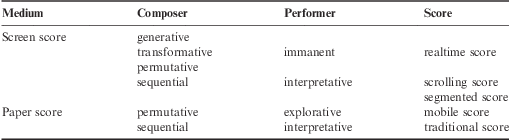
Clay and Freeman note that terms to describe the range of new approaches to presenting the score on a computer screen have not yet been standardised (Clay and Freeman Reference Clay and Freeman2010). There are four principal considerations governing the relationship between these new screen-based approaches and the traditional notated score (Table 1).
Paradigms for the presentation of notation to live performers

Note: The categorisations in this table are based on similar categories proposed by Reference AarsethAarseth 1997: 64.
-
1. Medium – the expanded range of approaches may give rise to either static or dynamic arrangement of materials analogous to traditional print text and computer-based hypertext.
-
2. Composer – the musical materials may be configured so that they are read sequentially, permutated, transformed or generated in real time. The computer-generated score provides a seamless medium for such approaches.
-
3. Performer – the relationship between the performer and the score may be characterised as interpretative (of a traditional score), explorative (of a ‘mobile score’), ‘immanent’ (in that reading may be expected to occur more ‘in the moment’) or interactive (in the case that the performer's actions result in changes in the score).
-
4. Score – traditional musical notation implies the abstraction of taking a continuous ‘scroll’ of music and splitting it into sections that can be arranged on successive pages. The scrolling score uses the computer to actualise the continuous paradigm of linear music on screen. In the mobile paper score, the notation remains fixed on paper, but ‘the order of musical sections is outlined either just before or during performance’ (Kim-Boyle Reference Kim-Boyle2010). The realtime score ‘refers to any notation, either traditional or graphic, which is created or transformed during an actual musical performance’ (Clay and Freeman Reference Clay and Freeman2010: 1).
4.1. The scrolling score
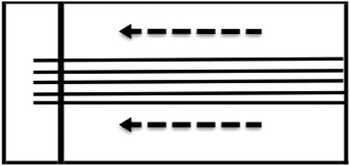
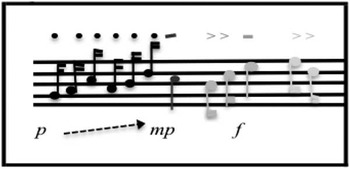
The scrolling score moves a continuous notational graphic from left to right, allowing performers to execute events as they strike a fixed ‘playhead’. This approach is best suited to scores that are notated proportionally; that is, the time durations of the musical events are proportional to the spatial lengths of their graphical representations (figure 1).
Scrolling score and fixed playhead

In traditional notation, note lengths are principally determined by their shape. To save space, traditional scores do not typically place musical events proportionally on the page: longer notes tend to take less space in comparison to short notes and spacing may be dependent upon the duration of events that are taking place across multiple staves.
For this reason the scrolling score is best suited to proportional graphical notation. It allows graphical scores that would normally need to be broken up over multiple pages, such as Penderecki's Threnody to the Victims of Hiroshima (1960), to be presented to performers as an unbroken continuum, revealing to the performer what they realise in each moment as well as what will be subsequently realised.
It is also possible to swipe the playhead across the score (figure 2). Such an arrangement limits the amount of graphical material that is visible to a single page or ‘screen’. It is therefore not suited to the presentation of continuous ‘multiple page’ scores; however, this limitation provides the opportunity for nonlinear presentation of the material, in the manner of a permutative score.
Fixed score with swiping playhead

4.2. Permutation
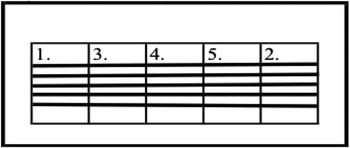
Computer coordination allows the permutation of musical materials that are presented to performers and the synchronisation of their performance. Permutation of scored materials may involve translocation, insertion, duplication and/or deletion of musical materials. The materials may vary in size from large structural blocks, to sub-structural cells or even individual parameters (figure 3).
The permutative score

The permutation of large structural blocks of music may be found in traditional paper scores such as Stockhausen's Momente (1962–69) and Mixtur (1964); however, synchronisation issues rule out realtime permutation in these works.
Although short fragments of a few seconds’ length are permutated in the performance of Feldman's Intermission 6 (1953), the fragments remain isolated ‘sound objects’ rather than functioning at any time as components of a continuous musical passage or discourse.
The independent manipulation of even smaller units, the parameters that are combined to form musical events, is also possible in digital media. This approach is exploited in Gerhard Winkler's Hybrid series (1991–) (Winkler Reference Winkler2004). In Hybrid II, for example the glissando, string position, bow pressure and dynamics are graphically conveyed to the performer in real time.
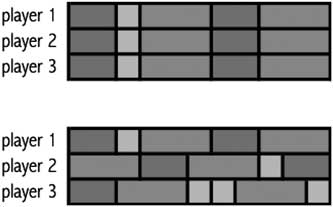
The structural implication of permutation of blocks, cells or parameters in ‘mobile’ forms are the same as those identified by Boulez in Stravinsky's The Rite of Spring (1913) (see Boulez Reference Boulez1991), namely that synchronous permutation of all parts simultaneously results in ‘vertical’ changes in the performed materials, and asynchronous permutation of the parts, given that they are sufficiently distinct, results in ‘horizontal’ or layered changes (figure 4).
Synchronous ‘vertical’ permutation (top), a-synchronous ‘horizontal’ permutation (bottom)

4.3. Transformative
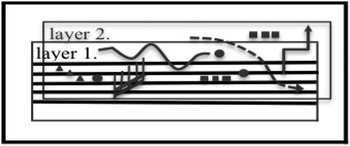
Transformation differs from permutation in that it acts upon an ‘original’ object to which alterations occur over time. In this sense transformation is related to the musical concept of development, as permutation is related to ‘concatenation’ or ‘block’ forms (Coenen Reference Coenen1994: 218). The notion of development is expanded by digital transformation in that the alterations need not be predetermined: they may act uniquely on the materials in each performance (figure 5).
The transformative score

Transformations may be applied graphically to a digital score, altering how it is to be performed. The transformative screen score is the digital descendant of Stockhausen's Refrain (1959), a work in which the paper score is overlaid by a mobile clear plastic strip that modifies whatever the material is below it – a structural approach he referred to as ‘variable form’ (Coenen Reference Coenen1994: 218).
In David Kim-Boyle's tunings (2006) for cello and computer, ‘real-time blurring and other distortion techniques’ are employed to reveal only portions of an underlying score. Boyle states that the work is modelled on ‘the idea of an old-fashioned radio tuning into different stations, sometimes pausing, often moving on’ (Kim-Boyle Reference Kim-Boyle2006). In this open work (Eco Reference Eco1989), Kim-Boyle refers to a range of musical materials, amongst them Bach's second cello suite. The reference to this work extends the ‘tuning’ metaphor, drawing on the performer's own memory and familiarity with this core repertoire work.
This configuration allows temporal independence to be established between parameters such as texture, pitch, dynamics and articulation. The graphical-score component of the score-player displays a continuum of transformations from silence to free improvisation to be followed by each performer.
Although transformation occurs over time and is therefore principally a ‘horizontal’ technique, it may contribute important structural differentiation according to how it is deployed, through the distinction between ‘vertical’ application to all scored components in the work, or ‘horizontal’ application to independent layers within the performance.
4.4. Generative
Algorithmic or interactive generative processes may be employed to construct components of a digital score in real time. This approach opens broad range of structural possibilities often linked to a narrative or dramatic concept (figure 6).
The generative score: traditional notation

In the broad sense permutation and transformation may both be viewed as having generative characteristics. The distinction here is the complete absence of any ‘object’ prior to the performance in generative works. Although algorithmic processes may be predetermined in a generative work, the outcome, in the form of a score or sonic product, is completely undefined prior to the performance. For this reason, this form of ‘dynamic scoring’ is sometimes euphemistically referred to as ‘extreme sight reading’ (Freeman Reference Freeman2008).
For example, in Polish composer Marek Chołoniewski's Passage (2001) a conductor directs a silent performance of hand gestures by the performers, which are observed via changes in luminosity measured by light-sensitive resistors mounted on their music stands. The recorded gestural data in turn generates a scrolling score that is subsequently performed by the ensemble (Chołoniewski Reference Chołoniewski2001).
Interaction with a generative model may also take place directly with the algorithmic processes themselves as is the case with ‘live coding’, an approach that ‘involves writing and modifying computer programs that generate music in real-time. Often this music making activity occurs in a live performance situation with the code source projected for the audience’ (Brown and Sorensen Reference Brown and Sorensen2009: 17).
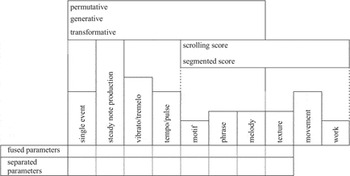
In general terms, scrolling and segmented presentation of a screen score is best suited to a pre-composed score that is both continuous and linear, while permutative, transformation and generative approaches suit nonlinear realtime instantiation of scores that are nonlinear in their conception (table 2).
Classification of score components that can be presented in a screen score

5. Formal Implications
A sense of structure is derived from changes in continuity and discontinuity in materials, processes and transformations evident in the sonic outcomes arising from a particular performance model. In the traditional classical model the sense of structure derives principally from the score, with a relatively minor contribution drawn from the performers’ interpretation and interaction.
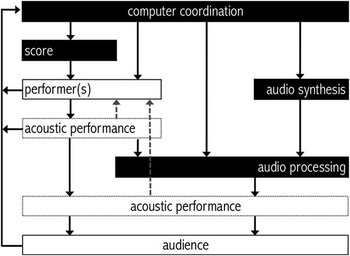
Computer coordination of live musical performance (figure 7) allows for the control and synchronisation of the score and the temporal framework, in addition to the generation of electronic sounds and electronic transformation of both the acoustically and electronically generated sounds.
A computer-controlled performance model

The computer-generated clicktrack creates the opportunity not only to independently control the tempi of multiple performers, but also to transmit formal (for example nonlinear selection of score materials) and performance (such as articulation, dynamics and so forth) parameters in real time.
Computer coordination can control many components in a performance in a manner analogous to the team of players necessary to bring symphony to life. Auditory and visual cues still play an important role in the coordination of the live performance; importantly, however, in a computer-controlled performance feedback into the system can also be achieved though other means:
-
• the performers may interact with the computer via hardware interface(s);
-
• the acoustic performance itself may be used as an interface through computer analysis; and
-
• the audience may interact with the computer, playing a role in defining the performance.
For centuries the relationship between the composer, the score and the performer has remained remarkably constant. The advent of random-access computing has created a range of new opportunities for revolutionising the interaction between the parties involved in musical performance.
Computer coordination allows a radical redistribution of the relationships between the performers, the score, the digital components and the audience. Structural decisions may arise from any level of the performance model and may be the result of interaction and improvisation as well as predetermination. In Jason Freeman's Glimmer (2004) for chamber orchestra and audience participation, for example, the audience influences the unfolding composition ‘by waving four-inch battery-operated LED light sticks back and forth’ in front of video cameras (Freeman Reference Freeman2008: 31).
Computer coordination allows for greater distinction between voices and layers in a musical work through expansion of timbral, dynamic, spatial and temporal qualities both ‘vertically’ and ‘horizontally’.
Sampling provides a pathway to unprecedented referentiality to sound objects outside the performance model. Networking and telepresence expand the potential of these possibilities beyond the specific environment of the performance model. Perhaps these possibilities will someday allow for the realisation of Anthony Braxton's ‘orchestral musics’ conceived ‘to be performed simultaneously in different cities’ (if perhaps not ‘on different planets and even in different galaxies’ (Adler Reference Adler2007).
In The Open Work, Umberto Eco theorised the possibility of the ‘work in movement’ permitting ‘numerous different personal interventions’ (Eco Reference Eco1989). The computer-coordinated performance provides just such a possibility, allowing for the existence of a precise, unique but variable, multi-versioned work, in which each performance renders a new outcome.
Computer coordination reduces the cognitive load on the performer. The manipulation of musical materials and the provision of coordination for their performance reduces non-musical decision-making, and potentially allows the performer give greater focus to their performance. It is also possible to apply structure to materials that are freely improvised, placing the performer(s) in an environment where the only consideration is the ‘performed moment’. George Lewis, the composer of the Voyager (1987), an ‘interactive musical environment that privileges improvisation’, states that ‘with no built-in hierarchy of human leader/computer follower – no ‘veto’ buttons, footpedals or physical cues – all communication between the system and the improvisor takes place sonically’ (Lewis Reference Lewis2000: 36). Other systems specifically designed for improvised performance include those of Lawrence Casserley and Evan Parker (Casserley Reference Casserley1998), and William Hsu and John Butcher (Hsu Reference Hsu2005).
In this environment the performer might be potentially capable of playing in an ‘immanent’ state, what Deleuze defines as ‘a pure stream of a-subjective consciousness, a pre-reflexive impersonal consciousness, a qualitative duration of consciousness without a self’ (Deleuze Reference Deleuze2001: 29).
Permutative, generative and transformative strategies can be independently employed in a single work through computer coordination. The combination of formal structures in a single work leads to structural polyphony – poly-structure. Poly-structures are additive in nature allowing the accretion of formally distinct material. The converse process – removing structural material – is also facilitated by computer coordination. Precise realtime excisions of material provide a novel structural approach.
6. Conclusion
The invention of the paper score provided composers with unprecedented control over the coordination of large musical forces and structures. In the postwar era many composers pushed the capabilities of the paper score to its logical and logistical limits. The goals of openness and mobility provided the impetus for a range of new models for the relationship between the composer, the score and the audience.
Although the exploitation of the screen score is in its early stages, the medium opens pathways for novel approaches to performance and structure that remained unrealisable to composers exploring the implications of openness and mobility in the avant-garde era.