Why are crosslinguistic generalizations like the noun phrase accessibility hierarchy (NPAH) relevant to our understanding of language acquisition? The answer to this question relies on our view of language universals. In generative linguistics, it is commonly assumed that language universals are based on innate linguistic knowledge. In this approach, languages share some of their basic grammatical properties because the core of human grammar is innate (Crain & Pietroski, 2001). However, this view of linguistic nativism is incompatible with what we know about the neurological foundations of the human mind: Although language has genetic prerequisites, it is biologically implausible that these prerequisites consist of prespecified categories and constraints (Quartz & Sejnowski, 1997).
A biologically more plausible account for the existence of language universals has been proposed in connectionism and the usage-based model (Bybee, 2006; Elman, Bates, Johnson, Karmiloff-Smith, Parisi, & Plunkett, 1996). In this approach, grammar is an emergent phenomenon that is shaped by the processing system grounded in the human brain (Hawkins, 2004). Because the processing system plays an important role in language acquisition, there is often a close match between grammatical development and language universals (Bates & MacWhinney, 1987).
The NPAH is one of the best known linguistic universals, used in numerous acquisition studies to characterize the development of relative clauses (RCs; e.g., Diessel & Tomasello, 2005; Doughty, 1991; Eckman, Bell, & Nelson, 1988; Gass, 1979). What all of these studies have shown is that the acquisition of RCs follows a developmental trajectory consistent with crosslinguistic constraints on the formation of RCs (Shirai & Ozeki, this issue). However, the bulk of the acquisition literature has been concerned with a few subtypes of RCs and has concentrated on European languages. The five articles in this issue are the first acquisition studies that systematically investigate the full range of RCs in several East Asian languages.
Whereas the RCs of these languages are in accordance with the NPAH, the data presented in this issue suggest that the acquisition of East Asian RCs does not follow the hierarchy. Specifically, the articles show that subject (SU) relatives (i.e., RCs in which the subject is relativized) are not generally acquired prior to direct object (DO) relatives (i.e., RCs in which the direct object is relativized), which suggests that East Asian RCs are learned and processed somewhat differently than RCs in European languages.
In what follows, I argue that the data presented in this issue are consistent with a usage-based approach to grammar and grammatical development. Specifically, I claim that RCs are grammatical constructions that language learners acquire based on their prior knowledge of simple sentences. Because East Asian languages have a different sentence structure than languages like English, the development of East Asian RCs takes a different pathway than the development of RCs in English and other European languages.
A CONSTRUCTION-BASED APPROACH TO GRAMMAR AND GRAMMATICAL DEVELOPMENT
The usage-based model is a new theoretical framework that draws on evidence from linguistics (Bybee, 2006; Hawkins, 2004), developmental psychology (Diessel, 2004; Tomasello, 2003), sentence processing (Tabor, Juliano, & Tanenhaus, 1997), and connectionism (Elman et al., 1996). In this approach, grammar consists of linguistic signs (i.e., constructions) that combine a specific form with a particular meaning; that is, constructions are conventionalized form-functions pairings in which syntactic patterns are associated with schematic meanings (Goldberg, 1995).
Relative clauses are grammatical constructions that children acquire based on their prior knowledge of simple sentences. The earliest RCs that English-speaking children learn are SU relatives that are attached to the predicate nominal of a copular clause, as in (1) and (2), or an isolated noun phrase (NP), as in (3) (Diessel, 2004; Diessel & Tomasello, 2005):

Although these sentences consist of two clauses, they are only slightly different than simple sentences. Specifically, Diessel and Tomasello (2005) argued that children's early relative constructions share the following features with simple (in)transitive clauses:
- Because the copular clause does not denote an independent situation, the whole sentence contains only a single proposition.
- Because the RC includes the only proposition, it tends to provide new information like a main clause.
- If we disregard the deictic pronoun and the copula, children's early RCs involve the same sequence of grammatical relations [i.e., SV(O)] as an ordinary (in)transitive clause.
Starting from such simple sentences, children gradually acquire more complex relative constructions that become increasingly different from simple sentences. Based on these data, Diessel (2004) and Diessel and Tomasello (2005) suggested that RCs constitute a network of interrelated constructions that children acquire in a piecemeal, bottom-up fashion by relating new RC construction to constructions they already know. The development begins with SU relatives in copular constructions, which are similar to simple (in)transitive clauses, and ends with genetive (GEN) relatives (e.g., the man whose dog is barking), which are structurally and conceptually distinct from all other RCs.
Interestingly, the same piecemeal development has been observed in studies on the acquisition of RCs in French (Hudelot, 1980), Spanish (Dasinger & Toupin, 1994), Hebrew (Dasinger & Toupin), Indonesian (Hermon, 2005), and German (Brandt, Diessel, & Tomasello, 2006). In all of these languages, children begin to use RCs in structures that are similar to simple (in)transitive clauses, which suggests that the acquisition of RCs follows a general crosslinguistic pattern. However, Ozeki and Shirai (2005) pointed out that this pattern does not occur in the acquisition of East Asian RCs; in particular, they noted that children's early RCs in Japanese and Korean are very different from children's early RCs in English—an observation that they attribute to the particular structure of East Asian RCs.
In the remainder of this article, I argue that although East Asian RCs are structurally very different than RCs in English, there are some striking parallels in the acquisition process. Specifically, I submit the following hypothesis:
Although the acquisition of East Asian RCs takes a different pathway than the acquisition of RCs in English, the developments are parallel in that they generally involve the language learner's prior knowledge of simple (in)transitive clauses.
The analysis concentrates on data from three languages: Japanese, Korean, and Chinese (both Mandarin and Cantonese). Three aspects of the acquisition of RCs in these languages will be discussed: (a) word order, (b) animacy, and (c) propositional structure.
Word Order
In the literature on English RCs, it has been argued repeatedly that word order is an important determinant of the acquisition and processing of RCs (Bever, 1970; de Villiers, Tager-Flusberg, Hakuta, & Cohen, 1979; Diessel & Tomasello, 2005; Hakuta, 1981). Specifically, it has been claimed that RCs are difficult to process and to learn if they deviate from the canonical word order pattern of simple (in)transitive clauses. This is part of the reason why DO relatives tend to cause greater difficulties in processing and acquisition than SU relatives in English (Diessel & Tomasello). As illustrated in (4), if we disregard the relative marker, English SU relatives have the same word order as simple (in)transitive clauses, whereas DO relatives exhibit a pattern that deviates from the canonical SVO order.

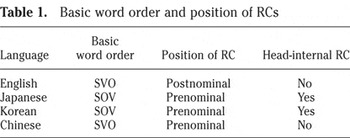
Because the word order hypothesis relies on language-specific properties, the analysis of the English data cannot be automatically transferred to other languages. However, the essence of the hypothesis that the acquisition and processing of RCs is influenced by the word order of simple sentences might also hold for the languages examined in this issue. Table 1 provides an overview of the relevant word order properties of English and the three East Asian languages considered in this article. Three aspects are important:
- Whereas English is SVO, Japanese and Korean are SOV; however, Chinese has the same basic word order as English (i.e., Chinese is also SVO).
- Whereas English has postnominal RCs, Japanese, Korean, and Chinese have prenominal RCs (i.e., RCs that precede the head noun).
- Whereas English and Chinese have only head-external RCs, in which the head is represented by a gap in the RC, Korean and Japanese also have head-internal relatives, in which the head is represented by a noun inside of the RC.
Basic word order and position of RCs

If we look at the word order of (externally headed) RCs in the two SOV languages (Japanese and Korean), we find that SU relatives do not have the canonical word order like SU relatives in English do. Both SU relatives and DO relatives in Japanese and Korean involve particular word orders that deviate from the basic word order in simple (in)transitive clauses, as illustrated in (5):

This might explain why the acquisition and processing of SU relatives does not appear to be easier than the acquisition and processing of DO relatives in Japanese and Korean. As Ozeki and Shirai (2005, this issue) have shown, there is no evidence that Japanese-speaking children acquire SU relatives prior to DO relatives (Hakuta, 1981) and there is also no evidence that second language (L2) learners of Japanese and Korean have fewer difficulties with SU relatives than with DO relatives (unless the interpretation is biased by semantic factors—a possibility I will discuss in the next section).
Interestingly, in Chinese, SU and DO relatives seem to differ in terms of both processing and acquisition, but, in this case, DO relatives cause fewer difficulties than SU relatives. Using a reading time experiment, Hsiao and Gibson (2003) found that adult speakers of Mandarin Chinese had fewer difficulties processing DO relatives than SU relatives. The results of this study are consistent with the results of Yip and Matthews' study (this issue). Using diary data from three bilingual Cantonese-English children, they found that two of the children produced DO relatives prior to SU relatives, whereas the third child began to use the two types of RCs simultaneously. In accordance with the word order hypothesis, Yip and Matthews explained the early appearance of DO relatives with the canonical word order of Cantonese. As seen in (6), DO relatives involve the same sequence of subject, verb, and object as basic (in)transitive clauses [i.e., SV(O)], whereas SU relatives involve a different word order pattern.

Note, however, that the early appearance of DO relatives could also be explained by the varying distances between filler and gap. As Hsiao and Gibson pointed out, whereas English DO relatives involve a longer distance between filler and gap than SU relatives, as illustrated in (4a) and (4b), in Chinese it is the other way around: Filler and gap occur adjacent to each other in DO relatives, but in SU relatives they are separated by the verb and object, as illustrated in (6a) and (6b). Both the word order hypothesis and the filler-gap hypothesis are in accordance with the Chinese data; however, there is a further finding that favors the word order hypothesis.
As pointed out previously, Japanese and Korean have two different types of RCs: head-external relatives, in which the head is represented by a gap, and head-internal relatives, in which the head occurs inside of the RC. Although the articles on Japanese included in this issue (Kanno; Ozeki & Shirai) do not consider the difference between the two constructions, Jeon and Kim's (this issue) article on Korean shows that although head-external relatives are more frequent than head-internal relatives, L2 learners of Korean begin to use head-internal relatives prior to head-external relatives. The same developmental order has been observed in first language studies on the acquisition of Korean relatives: Like adult learners of Korean, Korean children begin to use head-internal relatives before they produce head-external relatives, although the latter are much more frequent in the ambient language (Kim, 1987; O'Grady, Lee, & Choo, 2003). Moreover, Matthews and Yip (2002) and Yip and Matthews (this issue) argue that their bilingual Cantonese-English children began to produce English RCs that can be analyzed as head-internal relatives (although neither English nor Cantonese has internally headed relatives).
How do we account for the early appearance of head-internal relatives? Yip and Matthews (this issue) suggest that head-internal relatives appear early because they resemble simple sentences. Consider the Korean example in (7) from Jeon and Kim's article:

In this example, the relativized noun chayk “book” occurs inside of the RC, so that both the subject and object precede the verb as in an ordinary transitive sentence. In other words, the early appearance of head-internal relatives might be due to the fact that they involve the same word order as simple (in)transitive clauses (Matthews & Yip, 2002; Yip & Matthews, this issue).
Animacy
Closely related to word order is the animacy of the participants expressed in a RC. A number of studies have argued and presented evidence that animacy plays an important role in the acquisition and processing of RCs. Examining Dutch and German corpus data, Mak, Wietske, and Schriefers (2002) observed that whereas SU relatives are commonly used with both animate and inanimate head nouns, DO relatives are almost exclusively attached to inanimate NPs. Moreover, Mak et al. reported the results of an experiment in which DO relatives caused prolonged reading times when they were attached to an animate head noun. Similar results were obtained in an eye-tracking study by Traxler, Morris, and Seely (2002) and in various acquisition studies of RCs in English and other European languages (Bever, 1970; Correâ, 1995).
The articles of this thematic issue show that animacy is also an important factor in the acquisition of East Asian RCs. For instance, Ozeki and Shirai (this issue) observed that L2 learners of Japanese tended to associate SU relatives with animate head nouns, whereas DO relatives were mostly attached to inanimate nouns. Similarly, Jeon and Kim (this issue) reported that the Korean L2 learners in their experiment produced many errors if they were supposed to use a DO relative headed by an animate noun, and Kanno's (this issue) study showed that L2 learners of Japanese had great difficulties with RCs that include two animate referents.
Generalizing across all of these studies, we might conclude that a purely syntactic account is not sufficient to explain the acquisition and processing of RCs. However, why is animacy relevant? Animacy is an important semantic factor for the acquisition and processing of RCs because it correlates with grammatical relations. Across languages, subject and object are associated with particular semantic roles. In a prototypical transitive clause, the subject functions as actor or agent of an activity that affects the entity encoded in the direct object. Because the agent is an intentional being, the subject of a prototypical transitive clause tends to be animate, whereas the object is usually an inanimate entity. Note, however, that in intransitive clauses, the subject is not associated with a particular semantic role. With unergative verbs, the intransitive subject tends to be animate, but with unaccusative verbs, the subject is often an inanimate entity.
In the usage-based approach, (in)transitive clauses are grammatical constructions, or form-function pairings, in which the associations between grammatical relations and semantic roles are part of our linguistic knowledge. Because (in)transitive constructions are among the earliest constructions in language acquisition, they play an important role in grammatical development. The previous section showed that the word order of these constructions affects the acquisition of RCs; however, it is not only the sequential order of nouns and verbs that influences the acquisition process but also the semantic features that are associated with grammatical relations. Language learners know that the subject is more likely to be expressed by an animate referent than the direct object, which affects their expectations in online processing. An animate NP at the beginning of a clause is expected to function as subject, whereas an inanimate NP does not give rise to a particular expectation because an inanimate referent provides both a good object, if it occurs in a transitive clause, and a good subject, if it occurs in an (unaccusative) intransitive clause.
This explains why language learners have particular difficulties with DO relatives that are attached to an animate NP. As Mak et al. (2002) and Traxler et al. (2002) have shown, when a RC is attached to an inanimate head noun, SU and DO relatives are equally difficult to process, but when the head is an animate referent, DO relatives are much more difficult than SU relatives. In accordance with these studies, Ozeki and Shirai (this issue) observed that L2 learners of Japanese tended to convert DO relatives to SU relatives if they were headed by an animate noun, and Jeon and Kim (this issue) reported that the Korean L2 learners in their experiment often produced SU relatives instead of the target DO relative if they selected an animate referent as the head of the RC.
Propositional Structure
In addition to word order and animacy, there is third factor suggesting that the acquisition of RCs is based on the language learner's prior knowledge of simple sentences. As pointed out previously, the earliest RCs that English-speaking children produce are attached to the predicate nominal of a copular clause or to an isolated NP (Diessel, 2004; Diessel & Tomasello, 2000). Because a copular clause and an isolated NP do not express a full proposition, children's early relative constructions are semantically simple sentences.
However, Ozeki and Shirai (2007) have shown that Japanese-speaking children begin to use RCs in different grammatical patterns. Examining naturalistic data from five Japanese-speaking children, they found that not even half of the RCs in their data were attached to the predicate nominal of a copular clause or to an isolated NP. Together, these two types of RCs accounted for only about 40% of the relatives in their data; that is, the majority of children's early relatives in Japanese were embedded in structures that do not match the dominant pattern in early child English.
However, that does not mean that the acquisition of Japanese RCs starts with constructions that are semantically more complex than the relative constructions in early child English. In fact, there is evidence that early Japanese relatives resemble simple sentences, just like children's early RCs in English. However, the development takes a different path.
In Japanese (as well as in many other East Asian languages), there is a continuum of noun modification that ranges from adjectives to clauses (Ozeki & Shirai, 2005). A noun modifier can be a simple adjective, as in (8), a tense-inflected adjective, as in (9), an adjective with a complement, as in (10), or a clause, as in (11):

Although all of these constructions serve as noun modifiers, they differ in terms of meaning. Ozeki and Shirai (2005) pointed out that there were hardly any noun modifiers in their data that described an ongoing activity in the surrounding situation. Instead, the vast majority of children's early relatives functioned to define a nominal referent; they usually included a predicate that referred to attributes or states and were attached to a generic head noun. The same semantic bias has been observed in the production of RCs by L2 learners of Japanese (Ozeki & Shirai, this issue) and in the spontaneous use of RCs by Korean-speaking children (Kim, 1987). According to Ozeki and Shirai (2005), these relative constructions are only slightly different than attributive adjectives. Because adjectives express properties of nouns rather than full propositions, we might assume that children's early relative constructions in Japanese and Korean typically include only a single proposition. Thus, the development of Japanese and Korean relatives appears to be similar to the development of English relatives in that they originate from structures that are semantically similar to simple sentences (in that they denote only a single state of affairs). However, the source constructions are very different: In English, RCs originate from copular constructions that include a propositionally empty main clause, whereas in Japanese and Korean, RCs develop from attributive constructions that specify a semantic feature of the head noun. Thus, one might hypothesize that the incremental development of RCs from simple sentences is characteristic of the acquisition of RCs across different language types.
CONCLUSION
This article has argued that although East Asian relatives are structurally very different from RCs in English and other European languages, there are some striking crosslinguistic parallels in the acquisition of RCs. The earliest relative constructions that language learners produce share important properties with simple sentences. Across languages, early RCs tend to involve the same sequence of nouns and verbs as ordinary (in)transitive clauses, involve the prototypical link between grammatical relations and semantic roles, and be embedded in structures that describe only a single state of affairs even if the whole structure consists of two clauses.