A. MONUMENTAL
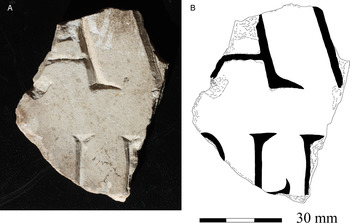
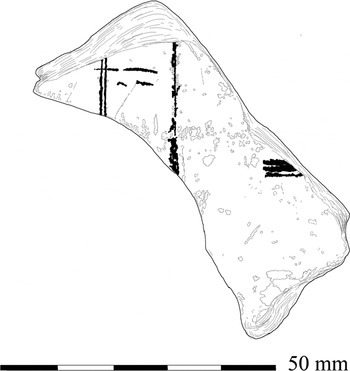
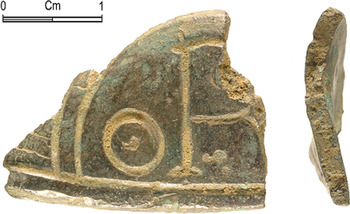
1. London (Londinium, TQ 3265 7965), Southwark, Tabard Street ( fig. 1). Small fragment of a white very fine crystalline marble slab, 50 by 68 mm, 10 mm thick, found in 2002 in a medieval robber cut adjacent to the pit between two Romano-Celtic temples that contained RIB III, 3014.Footnote 2 The surviving letters are incomplete, but they are very well drawn and inscribed; their height can be estimated as (line 1) 43 mm and (line 2) 22 mm. They read: [...] | [...]AV[...] | [...]OLL(or OLI)[...] | [...].Footnote 3
(a) and (b). London, Southwark, marble fragment (No. 1). (Photographed and drawn by R.S.O. Tomlin)

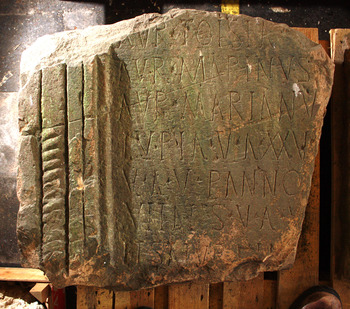
2. Old Carlisle (probably Maglona, NY 26 46), Cumbria ( fig. 2). Part of a red sandstone slab, 0.65 by 0.54 m, 0.11 m thick, foundFootnote 4 in 2012. Only the left-hand edge is original, and consists of a simple border with cable moulding which defines a recessed panel 0.09 m thick on which is inscribedFootnote 5 : [...] | ΛVR ♠ TOISIA [...] | AVR ♠ MΛRINVS[...] | AVR ♠ MΛRIΛNV[...] | LVPIΛ ♠ V ♠ Λ ♠ XXV[...] | V ♠ A ♠ V ♠ PΛNNO[...] | VITALIS ♠ V ♠ A ♠ V[...] | ET SΛTVRṆỊṆ[...] | [...], [...] | Aur(elia) Toisia [u(ixit) a(nnos) ...] | Aur(elius) Marinus [u(ixit) a(nnos) ... ] | Aur(elius) Marianu[s u(ixit) a(nnos) ... ] | Lupia u(ixit) a(nnos) XXV[... ...] | u(ixit) a(nnos) V[...] Panno[nius u(ixit) a(nnos) ...] | Vitalis u(ixit) a(nnos) V[...] | et Saturnin[us u(ixit) a(nnos) ... ] | [...]. ‘... Aurelia Toisia lived [..] years; Aurelius Marinus lived [..] years; Aurelius Marianus lived [..] years; Lupia lived 25(–29) years; [...] lived 5(–9) years; Pannonius lived [..] years; Vitalis lived 5(–9) years; and Saturninus lived [..] years. [...].’Footnote 6
Old Carlisle, tombstone (No. 2). (Photo: R.S.O. Tomlin)

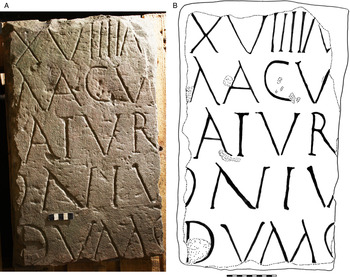
3. Ibid. (
fig. 3). Part of a red sandstone slab, 0.32 by 0.54 m, 0.06 m thick, foundFootnote
7
in 2012. None of the edges are original, but they have been roughly squared as if for re-use in paving or as a building stone. InscribedFootnote
8
: [...] | [...]XVIIII Ṃ[...] | [...]MACV.[...] | [...]ATVR[...] | [...]ONIV[...] | [...]DVM
 [...] | [...]Footnote
9
(a) and (b). Old Carlisle, tombstone (No. 3). (Photographed and drawn by R.S.O. Tomlin)

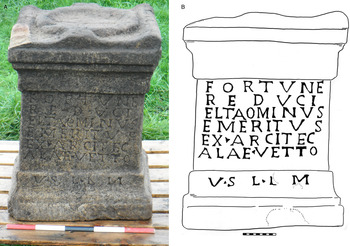
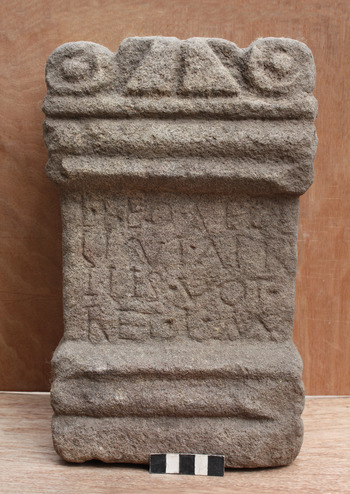
4. Binchester (Vinovia, NZ 210 313) Roman fort, County Durham; the external bath-house on Dere Street ( fig. 4). Buff sandstone altar, 0.50 by 0.65 m, 0.51 m deep, foundFootnote 10 in 2013. Except for damage to the left bolster, it is complete and well-preserved. Between the bolsters there is a shallow round focus above a recessed die, on the left side of which is carved a bull in high relief. The right side is plain. On the front (0.41 by 0.28 m) is inscribedFootnote 11 : FORTVNE | REDVCI | ELTAOMINVS | EMERITVS | EX Δ ARCITEC | ALAE Δ VETTO | V Δ S L Δ L M, Fortun(a)e | Reduci | Eltaominus | emeritus | ex arc(h)itec(to) | alae Vetto(num) | u(otum) s(oluit) l(aetus) l(ibens) m(erito). ‘To Fortune the Home-Bringer, Eltaominus, veteran and former engineer of the ala Vettonum, has paid his vow gladly, willingly, deservedly.’Footnote 12
(a) and (b). Binchester, altar (No. 4). (Photo: David Mason. Drawn by R.S.O. Tomlin)

5. Vindolanda (NY 768 663), Northumberland ( fig. 5). Buff sandstone altar, 0.18 by 0.265 m, 0.165 m deep, foundFootnote 13 in 2013 in a barrack-block south of the praetorium. Inscribed on the face of the die, 0.10 by 0.16 m, in letters c. 20 mm high: DEO Δ APOL|LINI Δ APR|ILIS Δ VOT Δ | RET Δ L Δ M, Deo Apol|lini Apr|ilis uot(um) | ret(tulit) l(ibens) m(erito). ‘To the god Apollo Aprilis has paid his vow, willingly, deservedly.’Footnote 14
Vindolanda, altar (No. 5). (Photo: R.S.O. Tomlin)

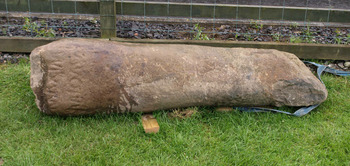
6. Ribchester (Bremetennacum, SD 65 35), Stonelands Farm ( fig. 6). Lower part of a red sandstone cylindrical milestone, 2.0 m high, 0.135 m in circumference, foundFootnote 15 in 2005. Only the bottom of the inscribed panel survives, inscribed in poor capitals now badly weathered: [...] | MAXIMI|ANO AV[G], [...]| Maximi|ano Au[g(usto)]. ‘... to Maximian Augustus.’Footnote 16
Ribchester, milestone (No. 6). (Photo: Patrick Tostevin)

B. INSTRUMENTUM DOMESTICUM
CHESHIRE
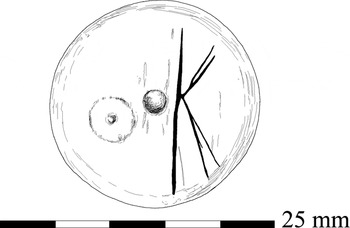
7. Chester (Deva, SJ 40 66), Roman amphitheatre (sf 8800) ( fig. 7). Flat bone roundel 5 mm thick, 19 mm in diameter, foundFootnote 17 in 2004–6. Scratched on one face: KFootnote 18
Chester, bone roundel (No. 7). (Drawn by R.S.O. Tomlin)

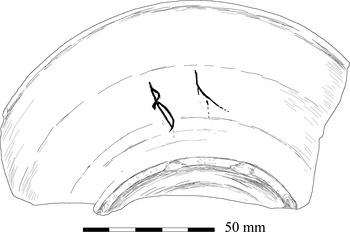
8. Ibid. (sf 7425) ( fig. 8). Sherd preserving the profile of a samian dish (Dr. 18, c. a.d. 80–110). Scratched after firing on the wall above the foot-ring: BLFootnote 19
Chester, samian graffito (No. 8). (Drawn by R.S.O. Tomlin)

9. Ibid. (sf 9959) ( fig. 9). Base sherd of a wide flat-bottomed samian dish (probably Walters 79, after c. a.d. 165). The upper surface is scored after firing by two parallel straight lines 13 mm apart, with short scratches at right-angles to them. The lines at least are deliberate, but they are not lettering. Since four unusually small counters were also found, only 13–15 mm in diameter, made from first-century South Gaulish samian, the dish may have been an improvised calculating table (abacus).Footnote 20
Chester, samian graffito (No. 9). (Drawn by R.S.O. Tomlin)

DURHAM
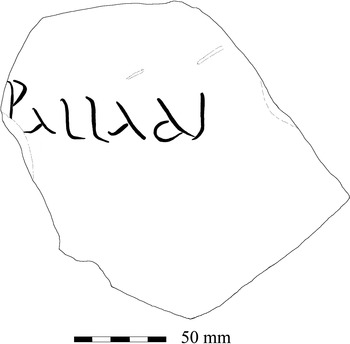
10. Bowes (Lauatris, NY 99415 13491), Holme Lea, in the vicus east of the Roman fort ( fig. 10). Wall sherd of a South Spanish oil amphora (Dressel 20), foundFootnote 21 in 2013. Neatly inscribed before firing in cursive letters: [...]PALLADI, Palladi. ‘(Work) of Palladius.’Footnote 22
Bowes, amphora graffito (No. 10). (Drawn by R.S.O. Tomlin)

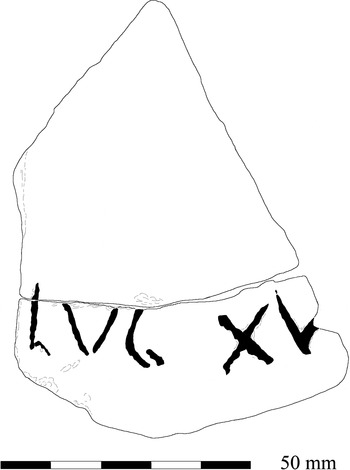
11. Ibid. ( fig. 11). Two conjoining wall sherds of a reduced ware (probably local) storage jar, incised after firing: […]LVG XV[…]Footnote 23
Bowes, coarseware graffito (No. 11). (Drawn by R.S.O. Tomlin)

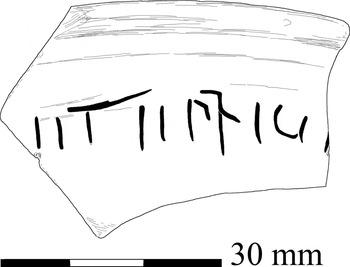
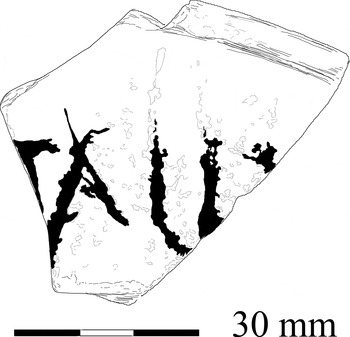
12. Binchester (Vinovia, NZ 210 313) ( fig. 12). Rim sherd of a thin-walled cooking pot in a buff fabric, second-century or earlier, foundFootnote 24 in 2013. Incised before firing in neat cursive letters: [...]IIT IIPRIV.[...], [...] et Epriu[m ...]. ‘... and Eprius ...’Footnote 25
Binchester, coarseware graffito (No. 12). (Drawn by R.S.O. Tomlin)

HEREFORDSHIRE
13. Kenchester (Magnis, SO 344 242) (
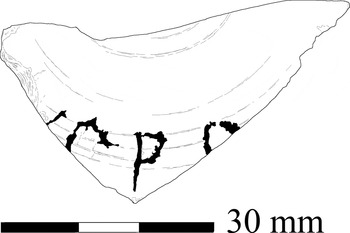
fig. 13). Base sherd of a black burnished (BB1) jar comprising about one-quarter of the base, foundFootnote
26
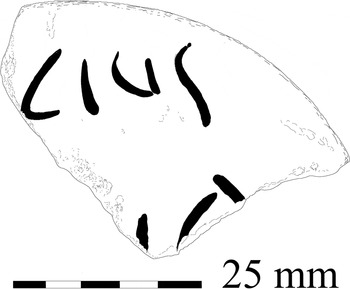
in 2011. Inscribed underneath before firing in cursive letters: [...]CIVS | [...]Ị
 Ạ[.], [...]cius | [...]ica[.]
Footnote
27
Kenchester, black burnished ware graffito (No. 13). (Drawn by R.S.O. Tomlin)

KENT
14. Snodland (TQ 570605 162072), in land off the old High Street ( fig. 14). Four conjoining sherds of a South Spanish oil amphora (Dressel 20), foundFootnote 28 in 2008. Inscribed before firing in cursive letters: IIDIVLES | [...]ḶṾCRIONIS, i Id(us) Iule(a)s | Lucrionis. ‘One (day before) the Ides of July [14 July], (work) of Lucrio.’Footnote 29
Snodland, amphora graffito (No. 14). (Drawn by R.S.O. Tomlin)

LEICESTERSHIREFootnote 30
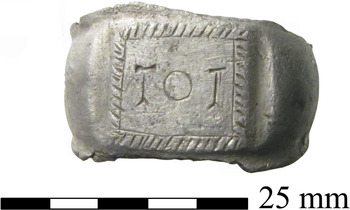
15. Hallaton (SP 79 99). Silver finger-ring (Henig type XI), 21 mm in diameter, 10 mm wide, recordedFootnote 31 in 2012. Inscribed on the bezel: TOTFootnote 32
LINCOLNSHIRE
16. Lincoln (Lindum, SK 98 74), in pasture north of the city ( fig. 15). Fragment of a moulded lead tank, 0.61 by 0.33 m, 20 mm thick at the rim, foundFootnote 33 casually in topsoil ‘some years ago’. Below the rim are two bands moulded in relief with cable-moulded margins, the lower a scroll ornament, the upper an inscription: MLLEDOFECITF ELIX [...], M(a)lledo fecit felix [...]. ‘Malledo made (this). [?Be] happy.’Footnote 34
Lincoln, lead tank (No. 16). (Photo: The Collection, Lincoln)

17. Marton (SK 83 81). Incomplete silver finger-ring (Henig type VIII), recordedFootnote 35 in 2011. Inscribed on the circular bezel: T o TFootnote 36
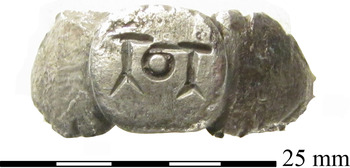
18. Horncastle (TF 26 69) ( fig. 16). Silver finger-ring (Henig type VIII), recordedFootnote 37 in 2011. Inscribed on the circular bezel: TOTFootnote 38
Horncastle, silver ring-bezel (No. 18). (Photo: PAS)

19. Ulceby (TA 10 14). Silver finger-ring (Henig type VIII), recordedFootnote 39 in 2011. Inscribed on the circular bezel 7 mm in diameter: TOT
20. Little Ponton and Stroxton (SK 92 32). Copper-alloy finger-ring (Henig type XI), recordedFootnote 40 in 2012. Inscribed on the oval bezel: TOT
21. Wellingore (SK 98 56). Copper-alloy finger-ring (Henig type VIII), recordedFootnote 41 in 2013. Inscribed on the circular bezel: T o TFootnote 42
22. Blyborough (SK 93 94). Silver finger-ring (Henig type XI), recordedFootnote 43 in 2012. Inscribed on the rectangular bezel: TOT
23. Roxby cum Risby (SE 92 17). Copper-alloy finger-ring (Henig type XI), recordedFootnote 44 in 2012. Inscribed within a rectangular panel formed by hatching between two lines of punched dots: TOT
LONDON
24. The City (Londinium, TQ 532549 181002), Bucklersbury/Walbrook, Bloomberg Place. Some 400 stilus writing-tablets were foundFootnote 45 in 2013, almost all of them fragments. They have lost their waxed coating, and at least four-fifths are uninscribed or illegible because they have been re-used, but more than 60 retain some legible trace of writing in the underlying scratches left by the stilus.
25. Ibid. (Londinium, TQ 32600 80830), Cannon Street Station (north). Oblong lead sealing, 15 by 6 mm, foundFootnote 46 in 1988. One face is impressed with a rectangular die, in capitals: LAF, L(ucius) A(...) F(...) Footnote 47
26. Ibid. (Londinium, TQ 32490 81120), 72–75 Cheapside/83–93 Queen Street. Incomplete lead sealing with remains of the hole for a cord, foundFootnote 48 in 1990. One face is impressed with a rectangular die, in capitals with an ‘arrow’ above and a ‘palm’ below: [...]VST, [E]ust(...) Footnote 49
NORFOLK
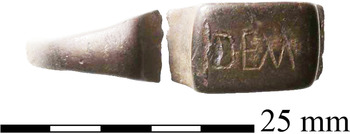
27. Narford (TF 77 13) ( fig. 17). Incomplete silver finger-ring (Henig type X1), external diameter 23 mm, with rectangular bezel 12 by 9 mm, recordedFootnote 50 in 2013. Inscribed on the bezel: DEM, de(o) M(...) or de(ae) M(...). ‘To the god (or goddess) M(...).’Footnote 51
Narford, silver ring-bezel (No. 27). (Photo: PAS)

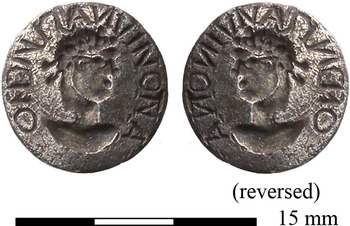
28. Near Swaffham ( fig. 18). Silver disc 11 mm in diameter, probably a finger-ring bezel, foundFootnote 52 in 2013. Engraved in intaglio with a diademed head facing right, surrounded by the retrograde legend: ANTONI VIVAS IN DEO, Antoni uiuas in deo. ‘Antonius, may you live in God.’Footnote 53
Near Swaffham, silver probable ring-bezel (No. 28). (Photo: PAS)

NORTHUMBERLAND
29. Vindolanda (NY 768 663). Cylindrical lead weight (sf 13868), 32–34 mm in diameter, 16 mm thick, weight 154 gm, foundFootnote 54 in 2013. Inlaid on one face in copper wire: S, s(emis). ‘Half (a pound).’Footnote 55
30. Ibid. Four conjoining fragments of a ridge tile (sf 16662), found in 2012. Impressed with a rectangular stamp almost complete: LEGVIV, leg(io) VI V(ictrix).Footnote 56
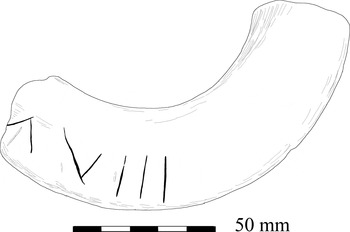
31. Ibid. ( fig. 19). Rim sherd of a South Spanish oil amphora (Dressel 20, sf 17876), found in 2013. Incised after firing in diagonal strokes: [...]Ṃ VIII, m(odii) VIII. ‘8 modii.’Footnote 57
Vindolanda, amphora graffito (No. 31). (Drawn by R.S.O. Tomlin)

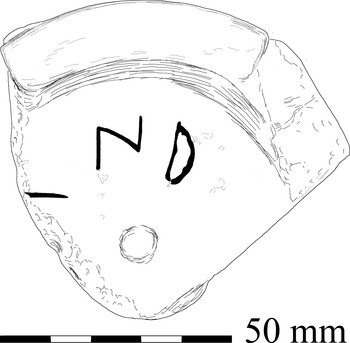
32. Ibid. ( fig. 20). Base sherd of a samian bowl (sf 17130), found in 2013. Scratched underneath after firing within the foot-ring: [...]ẠND, perhaps [C]and(idus).
Vindolanda, samian graffito (No. 32). (Drawn by R.S.O. Tomlin)

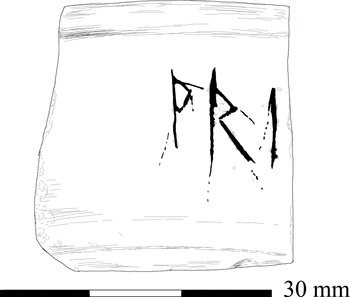
33. Ibid. ( fig. 21). Rim sherd of a samian platter (sf 16703), found in 2012. Scratched below the rim after firing: PRI[...], probably Pri[mus] or a cognate name.
Vindolanda, samian graffito (No. 33). (Drawn by R.S.O. Tomlin)

34. Ibid. ( fig. 22). Samian rim sherd (sf 17424), found in 2012. Coarsely incised after firing: [...]ṬALI.[...], perhaps [...]tali[us] Footnote 58
Vindolanda, samian graffito (No. 34). (Drawn by R.S.O. Tomlin)

35. Ibid. ( fig. 23). Samian (S.G.) base sherd (sf 16956), found in 2012. Scratched underneath after firing: [...]ṾṢPO[...], perhaps [...i]us Po[...].Footnote 59
Vindolanda, samian graffito (No. 35). (Drawn by R.S.O. Tomlin)

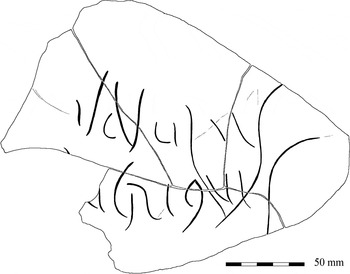
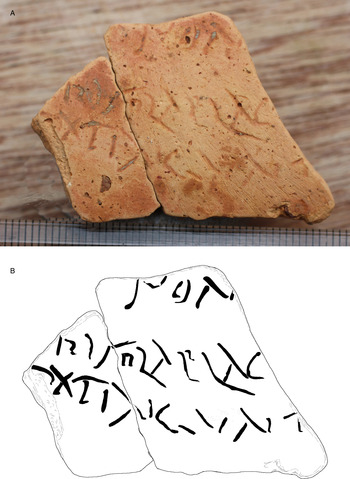
36. Ibid. ( fig. 24). Two conjoining wall sherds of a pink coarseware vessel, found in 2013. Inscribed before firing in fluent cursive letters: [...] | [...] non[...] | [...]ḥisolaplac[...] | [...]ẹxtingunt[...], apparently [...] non [...] | [... mi]hi sola plac[e...] | [...] exting(u)unt[...]. ‘... not (she or you or they) alone please(s) me ... (they) extinguish (or are extinguished) ...’Footnote 60
(a) and (b). Vindolanda, coarseware graffito (No. 36). (Photographed and drawn by R.S.O. Tomlin)

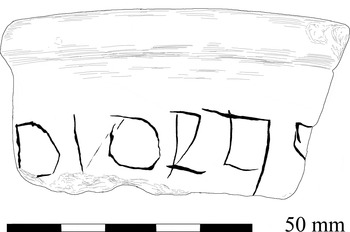
37. Ibid. ( fig. 25). Black burnished rim sherd (sf 16725), found in 2012. Scratched below the rim after firing: [...]DIORTIṢ[...]Footnote 61
Vindolanda, black burnished ware graffito (No. 37). (Drawn by R.S.O. Tomlin)

38. Ibid. Abraded pink coarseware sherd (sf 17931), found in 2013. Scratched after firing: [...]MAV[...], perhaps Mau[rus].
NOTTINGHAMSHIRE
39. Collingham (SK 83 61). Circular bezel and shoulders of a silver finger-ring (Henig type VIII), recordedFootnote 62 in 2011. Inscribed on the bezel: TOFootnote 63
40. Walkeringham (SK 76 92) ( fig. 26). Silver finger-ring (Henig type XI), recordedFootnote 64 in 2010. Incised within a rectangular panel formed by diagonal hatching: TOT
Walkeringham, silver ring-bezel (No. 40). (Photo: PAS)

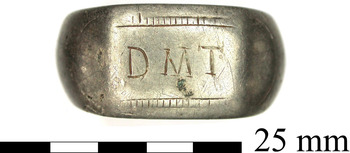
41. Carlton (SK 60 41) ( fig. 27). Silver finger-ring (Henig type XI), recordedFootnote 65 in 2011. Incised within a rectangular panel: DMT, D(eo) M(arti) T(outati). ‘To the god Mars Toutatis.’Footnote 66
Carlton, silver ring-bezel (No. 41). (Photo: PAS)

SOMERSET
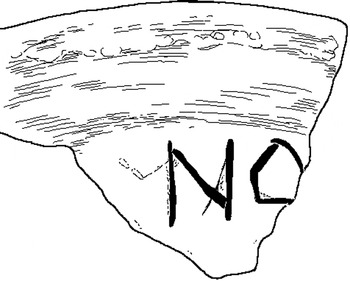
42. Banwell (ST 39 59), Roman cemetery ( fig. 28). Rim sherd of a fourth-century Oxfordshire mortarium (Young type C100), foundFootnote 67 in 2012. Scratched after firing on the outer wall: NO[...], No[...] Footnote 68
Banwell, mortarium graffito (No. 42). (Drawn by R.S.O. Tomlin from a photograph)

SURREY
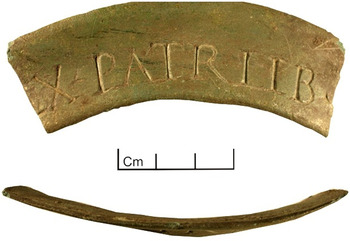
43. Flexford (SU 93734 50967), rural Roman settlement ( fig. 29). Fragment of a copper-alloy everted rim, 89 by 26 mm, 1.5 mm thick, foundFootnote 69 in 2013. Inscribed on the underside in good capitals: [...].X 7 PATR 7 LIB 7 [...], perhaps [... e]x patr(imonio) lib(ens) ...]. ‘... willingly, from his own property.’Footnote 70
Flexford, copper-alloy rim (No. 43). (Photo: David Calow)

WILTSHIRE
44. Leigh (SU 07 93) ( fig. 30). Copper-alloy rim fragment, 27.5 mm wide, 2.8 mm thick, apparently of a large round plate, foundFootnote 71 in 2007. The gently curving bottom edge is original, and is respected by the incised decoration which encloses one surviving letter: R[...]
Leigh, copper-alloy rim (No. 44). (Photo: PAS)

NORTH YORKSHIRE
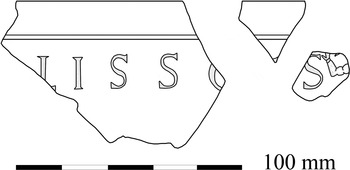
45. York (Eboracum, SE 6075 5185), Hungate ( fig. 31). Four sherds of a straight-sided colourless glass cup (late second/early third century), foundFootnote 72 in 2008–11. Inscribed below the rim in carefully-cut capitals, two rim sherds conjoin and read [...]LISSO[...].Footnote 73 A third rim sherd preserves the tip of an unidentifiable letter, and a wall sherd the letter [...]S followed by an engraved hand and arm.Footnote 74
York, inscribed glass (No. 45). (Drawn by Hilary Cool)

ADDENDA ET CORRIGENDA
(a) RIB 1054 (South Shields). This badly-weathered altar has been re-examinedFootnote 75 and a new reading proposed of line 9: N.LVG[...]ENSM, n(umerus) [.] Lug(u)[dun]ens(iu)m (‘the military unit at Lugudunum’). In support it can be argued that Lugudunum was the original name of South Shields.Footnote 76
(b) RIB 1749 (Great Chesters). The last line is better read as VIC Δ S[...], probably a reference to uicus or uicani.Footnote 77
(c) RIB II.2, 2416.7 (Bishop Norton). The moulded inscription on this lead tank is identical to that of item No. 16 (Lincoln), which allows the maker's name to be restored as [M(a)lle]do.
(d) RIB III, 3268 (South Shields), altar dedicated DEO | ANSV | VITIRI. A better explanation of the ‘dyslexic’ ANSV has been proposedFootnote 78 , that it is the Germanic equivalent of deo (‘to the god’).Footnote 79
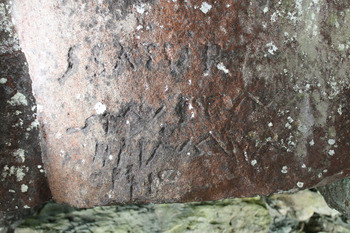
(e) RIB III, 3331 (Queen's Crags) ( fig. 32). Α better photograph is now available of this quarry-face inscription.Footnote 80
Queen's Crags (RIB III, 3331), quarry-face inscription. (Photo: R.S.O. Tomlin)

(f) RIB III, 3371 (Vindolanda). The miniature altar from Waltham cited in the commentary has now been published.Footnote 81
(g) RIB III, 3533* (alienum) is the tombstone of a Thracian woman called Demetrus whose alternative name was Eptesucu.Footnote 82
ALIENUM
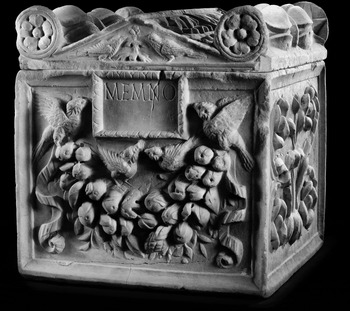
Cuckfield, Highbridge Hill near Ansty (TQ 291 233), West Sussex ( fig. 33). Richly carved marble ash-chest, 0.31 by 0.33 m, 0.29 m deep, thought to have been found there in 1703, but probably an eighteenth-century import. Inscribed: MEMNO, ‘Memno(n)’.Footnote 83
Cuckfield, marble ash-chest (alienum). (Photo: Bonhams 1793 Ltd)

CHANGES IN LOCATIONFootnote 84
(a) RIB 1068, ‘now lost’, is now in the Great North Museum, Newcastle upon Tyne (Hancock acc. no. 1956.128.9.A) ( fig. 34). It measures 0.28 by 0.24 m.
RIB 1068 in the Great North Museum. (Photo: Scott Vanderbilt)

(b) RIB 1313, ‘now lost’, is now in the Great North Museum (Hancock acc. no. 1813.4), but has not been located.
(c) RIB 1326, ‘now (1930) in the Black Gate. Sought in vain by R. P. W., 1947’, is now in the Great North Museum (Hancock acc. no. 1956.419.A) ( fig. 35).
RIB 1326 in the Great North Museum. (Photo: Scott Vanderbilt)

(d) RIB 1406, in private possession (1960), is now in the Great North Museum (Hancock acc. no. 1956.396).
(e) RIB 1407, in private possession (1960), is now in the Great North Museum (Hancock acc. no. 1956.129), but has not been located.Footnote 85
(f) RIB 1674, in private possession (1946), is now in the Great North Museum (Hancock acc. no. 1956.426), but has not been located.
FALSAFootnote 86
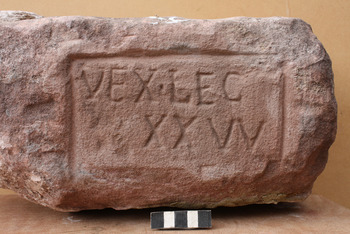
(a) Red sandstone building-stone, 0.46 by 0.16 m, 0.17 m deep, with adhering mortar (
fig. 36). Part of one long side has been neatly squared off as if to make a facing-stone where two walls met at right-angles. On the opposite side, and off-centre, a rectangular panel 0.175 m wide has been roughly levelled off and outlined.Footnote
87
Incised asymmetrically within this panel: VEX
o
LEG | XX VV | [ ]
 [ ], uex(illatio) leg(ionis) | XX V(aleriae) V(ictricis) | f(ecit). ‘A detachment of the Twentieth Legion Valeria Victrix made (this).’Footnote
88
Falsum (a), vexillation inscription. (Photo: R.S.O. Tomlin)

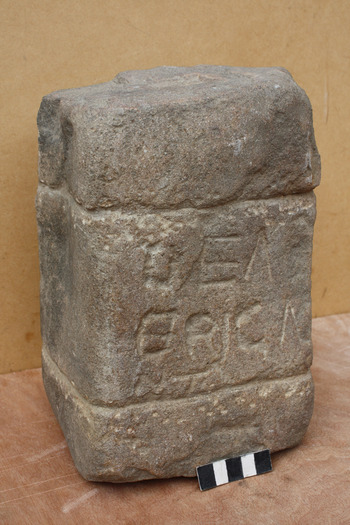
(b) Buff sandstone altar, 0.15 by 0.235 m, 0.12 m deep, improvised from a building-stone which was not squared to shape ( fig. 37). A rectangular focus, 0.04 by 0.03 m, has been outlined but not finished. Two pairs of horizontal lines extending round both sides mark the die, within which is roughly incised: DEΛ | BRIGΛ | NTΛ, dea | Briga|nt(i)a. ‘The goddess Brigantia.’Footnote 89
Falsum (b), altar to Brigantia. (Photo: R.S.O. Tomlin)

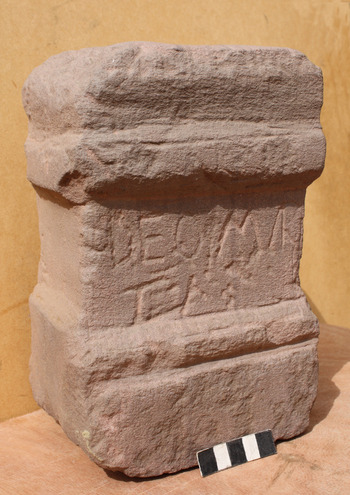
(c) Red sandstone altar, 0.15 by 0.23 m, 0.135 m deep, with a shallow round focus above ( fig. 38). The die is recessed between simple mouldings which mark capital and base, the base-mouldings not extending to either side. Crudely incised on the die: DEO MAR|TI, deo Mar|ti. ‘To the god Mars.’Footnote 90
Falsum (c), altar to Mars. (Photo: R.S.O. Tomlin)

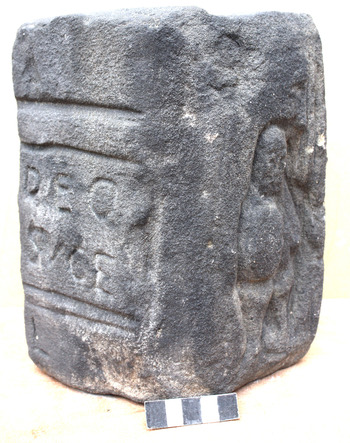
(d) Buff sandstone altar now blackened by fire, 0.145 by 0.215 m, 0.15 m deep, with an incomplete focus 0.06 m square ( fig. 39). The die is indicated by two pairs of scored horizontal lines. On its left side, a ‘façade’ formed by scored lines. On its right side, crudely carved in relief, a standing male figure with a shield unusually in his right hand and a lance in his left. Incised on the front: DEO | SVCE|L[.], deo | Suce|l[o]. ‘To the god Sucelus.’Footnote 91
Falsum (d), altar to Sucelus. (Photo: R.S.O. Tomlin)

(e) Grey sandstone altar, 0.135 by 0.177 m, 0.11 m deep, with a slightly-indicated focus 0.05 by 0.035 m ( fig. 40). Scored mouldings indicate capital and base, between which is a slightly recessed die; it is roughly incised: VETERI|BVS o POS o L | CΛTIV, Veteri|bus pos(uit) L | CATIV. ‘To the Veteres, ... erected (this).’Footnote 92
Falsum (e), altar to ‘Veteres’. (Photo: R.S.O. Tomlin)