INTRODUCTION
Eulimidae snails are characterized as minute parasites found specifically in association with echinoderms (Warén, Reference Warén1983a). These gastropods show different degrees of adaptation to a parasitic lifestyle. Some species have a typical mesogastropod ‘bauplan' (e.g. Eulima and Niso) (Warén, Reference Warén1983b), while others present an intermediate degree of adaptation to parasitism (e.g. Annulobalcis aurisflamma Simone & Martins, Reference Simone and Martins1995) up to species extremely modified and adapted to endoparasitism (e.g. Enteroxenos Bonnevie, 1902 and Entoconcha Müller, 1852) (Kincaid, Reference Kincaid1964; Lützen, Reference Lützen1968). The family includes about 4000 species (Warén & Gittenberger, Reference Warén and Gittenberger1993). Although species diversity is greater at the tropics if compared to the poles (Warén, Reference Warén1983a) only 27 species distributed over 13 genera have been recorded in Brazilian waters to date (Lima et al., Reference Lima, Barros, Silva, Santos and Cabrol2005; Simone & Birman, Reference Simone and Birman2006; Rios, Reference Rios2009).
Eulimids are associated with all major groups of Echinodermata (Ponder & Gooding, Reference Ponder and Gooding1978; Warén & Sibuet, Reference Warén and Sibuet1981; Hoskin & Warén, Reference Hoskin and Warén1983; Sasaki et al., Reference Sasaki, Muro and Komatsu2007; Schiaparelli et al., Reference Schiaparelli, Ghirardo, Bohn, Chiantore, Albertelli and Cattaneo-Vietti2007). Although this assumption is usually valid, there are only a few confirmed records of interactions between eulimids and their hosts. Moreover, a certain degree of specificity in these relations can be assumed (Warén, Reference Warén1983a). For instance, Annulobalcis is known to parasitize comatulid crinoids (Warén, Reference Warén1981, Reference Warén1983a; Simone & Martins, Reference Simone and Martins1995; Queiroz et al., 2011; Dgebuadze et al., Reference Dgebuadze, Fedosov and Kantor2012), while Sabinella parasitize cidaroid sea urchins (Pilsbry, Reference Pilsbry1956; Warén, Reference Warén1983a).
According to Warén (Reference Warén1983a) there are about 15 genera specialized in parasitizing holothurians. From these, nine are strictly endoparasitic forms, two are gall formers, three live as ectoparasites and one—Melanella Bowdich, 1822—is known to have a two-way lifestyle: endoparasites and ectoparasites of aspidochirote or dendrochirote sea cucumbers (Warén, Reference Warén1983a).
In Brazilian waters there are ten recorded species of Melanella (M. arcuata Adams, 1850; M. breviuscula (Dunker, 1875); M. conoidea (Kurtz & Stimpson, 1851); M. ephamilla (Watson, 1883); M. eulimoides (Adams, 1850); M. hypsella (Verril & Bush, Reference Verril and Bush1900); M. hebes (Watson, 1883); M. intermedia (Cantraine, Reference Cantraine1835); M. sarissa (Watson, 1883); and M. hians (Watson, 1883) (Lima et al., Reference Lima, Barros, Silva, Santos and Cabrol2005; Rios, Reference Rios2009), although association records are practically nonexistent. Information about interactions are limited to vague statements on Holothuroidea, such as ‘sea cucumber’ or ‘holothurians’ (Rios, Reference Rios2009), which are obviously lacking in taxonomic detail. Thus, the objective of this work is to bring up new host records for two eulimids: Melanella eburnea (Mühlfeld, Reference Mühlfeld1824) and M. hypsela (Verrill & Bush, 1900), as well as to report the first record of M. eburnea in Brazilian waters.
MATERIALS AND METHODS
The material studied was found in different locations along the Brazilian coast (Figure 1). The samplings consisted in capture, by free diving, of parasitized hosts infested by eulimids. All holothurians individuals were placed in different plastic bags to avoid loss or mix of symbionts. The sampling procedures were carried out in four places along the Brazilian coast: two beaches at Salvador, Bahia State—Pituba (13°00′21″S 38°27′12″W) and Barra (13°00′37″S 38°31′49″W); in the city of São Sebastião, São Paulo State (23°49′40″S 45°25′22″W) and at Flechas and Gordas Beach, located on Gipóia Island and Bonfim (23°37′63″S 44°21′23″W) and (23°12′27″S 44°19′56″W) respectively—Angra dos Reis, Rio de Janeiro State.
Geographical distribution of new hosts records for Melanella eburnea and M. hypsela in Brazil: (A) South America; (B) Brazil shown in detail. BA, Bahia State; RJ, Rio de Janeiro State; SP, São Paulo State; circle, M. eburnea; star, M. hypsela.

Except for the material from Rio de Janeiro which was fixed in the field, all hosts and their parasites were brought to the laboratory in plastic bags and some aspects on their biology were observed. The holothurians and the snails were maintained in aquaria, photographed and posteriorly fixed in 70% ethanol. The identification of the eulimids consisted in conchological and soft part features. For the host's identification, the form and combination of the calcareous ossicles were considered, as well as external features (Rowe, Reference Rowe1969; Hendler et al., Reference Hendler, Miller, Pawson and Kier1995; Cutress, Reference Cutress1996).
RESULTS
Altogether 20 specimens of Melanella were collected. Ten specimens of M. eburnea on three species of holothurians: 2 specimens of Parathyone suspecta (Ludwig, 1875) (Dendrochirotida: Cucumariidae), 1 specimen of Holothuria (Platyperona) sp. and 10 specimens of Holothuria (Halodeima) grisea Selenka, 1867 (Aspidochirotida: Holothuriidae); and 10 exemplars of M. hypsela on 4 specimens of Isostichopus badionotus (Selenka, 1867) (Aspirochirotida: Istichopodidae). Exemplars in free-living state were also collected.
SYSTEMATICS
Order CAENOGASTROPODA
Family EULIMIDAE
Genus Melanella Bowdich, Reference Bowdich1822
Melanella eburnea (Mühlfeld, Reference Mühlfeld1824)
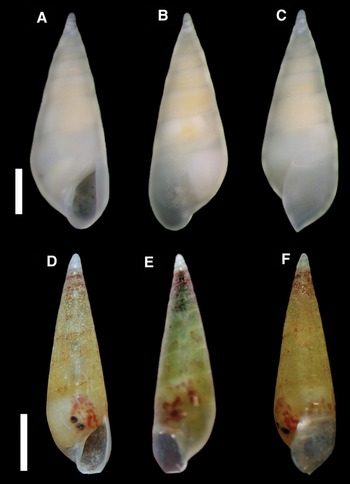
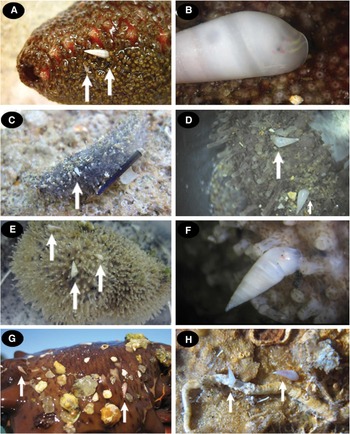
(Figures 2A–C; 3A–F & H)
Shells of Melanella eburnea (A–C) and M. hypsela (D–F): (A & D) ventral view; (B & E) dorsal view; (C & F) lateral view of the outer lip. Scale bar: 1 mm.

Melanella species and its hosts: (A–F & H) Melanella eburnea; (G) M. hypsella; (A & B) Holothuria (Halodeima) grisea; (C & D) Holothuria (Platyperona) sp.; (E & F) Parathyone suspecta; (G) Isostichopus badionotus; (H) M. eburnea in free-living state.

Melanella eburnea Mühlfeld, Reference Mühlfeld1824: 217, pl. 9, figure 7a, b; Redfern, Reference Redfern2001: 81, pl. 38, figure 342a–c, pl. 109, 342d, e.
Melanella intermedia Cantraine, Reference Cantraine1835: 390; Smith, Reference Smith1951: 86, pl. 33, figure 14; Abbott, Reference Abbott1974: 125; Rios, Reference Rios2009: 192.
Melanella jamaicencis Adams, Reference Adams1845: 6; Abbott, Reference Abbott1974: 125.
MATERIAL EXAMINED
Brazil: Bahia; Salvador, Pituba beach, 13°00′21″S 38°27′12″W, 1.5–2 m depth, UFBA 0034, 2 specimens, UFBA 0035, 2 specimens (23 March 2012, on Parathyone suspecta); Barra Beach, 13°00′37″S 38°31′49″W, 1–2 m depth, UFBA 0036, 3 specimens (5 April 2012, two in free-living state and one on Holothuria (Platyperona) sp.); São Paulo; São Sebastião Chanel, São Sebastião, 23°49′40″S 45°25′22″W, 1–2 m depth, UFBA 0037, 2 specimens, MZSP 108491, 1 specimen (11 October 2011, on Holothuria grisea).
DIAGNOSIS
Shell turreted, solid, white, glossy, slippery, straight-sided and commonly slightly tilted. Average shell length 3.8 ± 0.9 mm, ranging from 2.5 to 5 mm. Spire tall with acute apex (Figure 2A). Aperture drop-like with posterior portion rounded. Outer lip completely convex, forming a symmetrical curve (Figure 2B). Operculum yellowish. Big black eyes situated in a red band. Tentacles mostly fluorescent yellow (Figure 3B) (Redfern, Reference Redfern2001).
DISTRIBUTION
New Jersey, USA to São Paulo, Brazil (Smith, Reference Smith1951; Redfern, Reference Redfern2001; Leonora et al., Reference Leonora, Vargas and Cortés2003; Rios, Reference Rios2009).
TYPE LOCALITY
British Virgin Islands.
REMARKS
Regarding the taxonomy of Melanella eburnea, it has previously been referred to as M. intermedia or M. jamaicencis (Redfern, Reference Redfern2001). Rios (Reference Rios2009) signalled M. intermedia as occurring in Brazilian waters. However, his description does not fit the specimen we found and furthermore, M. intermedia is considered an objective junior synonym of the M. polita (Warén & Gittenberger, Reference Warén and Gittenberger1993). Actually, some databases consider M. jamaicencis invalid, as it is a junior synonym of M. eburnea (Bouchet, Reference Bouchet2012).
Melanella hypsela (Verrill & Bush, 1900)
(Figures 2D–F & 3G)
Melanella hypsela Verril & Bush, Reference Verril and Bush1900: 526, pl. 64, figure 9; Abbott, Reference Abbott1974: 126; Redfern, Reference Redfern2001: 81, pl. 38, figure 344a, b, pl. 109, 344c; Rios, Reference Rios2009: 192.
MATERIAL EXAMINED
Brazil: Rio de Janeiro; Angra dos Reis, Flechas and Gordas Beach, 23°37′63″S 44°21′23″W, 3–4 m depth, MNRJ 17219, 1 specimen (14 January 2012, on Isostichopus badionotus); Gipóia Island and Bonfim, 23°12′27″S 44°19′56″W, 3–4 m depth, MNRJ 17256, 10 specimens (14 January 2012, on I. badionotus).
DIAGNOSIS
Shell relatively small, slender, white, translucent with flat whorls. Average shell length 4.2 ± 0.56 mm, ranging from 3.4 to 4.9 mm. Spire tall, apex very acute; tip glass-like (Figure 2C, D). Aperture drop-like, posteriorly acute; lower half of the outer lip convex (Figure 2D). Live animal shows red or reddish-orange pigmentation consisting of discontinuous red lines starting behind the eyes and ending in mid-portion of tentacles. Melanella hypsela differs from M. eburnea because it has a more elongated aperture with a narrower base (Verril & Bush, Reference Verril and Bush1900; Redfern, Reference Redfern2001).
DISTRIBUTION
Bermuda, The Bahamas, West Indies and Brazil (Trindade Island, Rio de Janeiro and Rio Grande do Sul) (Verril & Bush, Reference Verril and Bush1900; Redfern Reference Redfern2001; Wiggers & Veitenheimer-Mendes, Reference Wiggers and Veitenheimer-Mendes2003; Rios, Reference Rios2009).
TYPE LOCALITY
Bermuda.
REMARKS
The exemplars were collected on four specimens of I. badionotus deposited at Equinoderm collection of Museu Nacional do Rio de Janeiro (EQMN 3848). There were no problems in identifying M. hypsela which fits completely with the original description (Verril & Bush, Reference Verril and Bush1900) and posterior works (Redfern Reference Redfern2001; Rios, Reference Rios2009).
DISCUSSION
The genus Melanella is known to parasitize sea cucumbers. These snails live as endoparasites or ectoparasites of their hosts (Warén, Reference Warén1983a). Usually, they are attached to the holothurian dermis, feeding on the host's fluids by introducing their proboscis (Will, Reference Will2009). Although this genus comprises several species (Bouchet, Reference Bouchet2012), records of interactions are scarce. There are 31 eulimid species recorded in association with sea cucumbers (Rehder, Reference Rehder1980; Warén, Reference Warén1983a; Sevilla et al., Reference Sevilla, Vargas and Cortés2003; Sonnenholzner & Molina, Reference Sonnenholzner and Molina2005; Lyskin & Britaev, Reference Lyskin and Britaev2005; Hoeksema & Gittenberger, Reference Hoeksema and Gittenberger2008; Tisselli & Giunchi, Reference Tisselli and Giunchi2008; Christiane & Roland, Reference Christiane and Roland2009; Will, Reference Will2009; Wirtz, Reference Wirtz2009a, Reference Wirtzb; Scuderi & Criscione, Reference Scuderi and Criscione2011). All hosts registered to date are either Aspidochirotida or Dendrochirotida holothuroids. There are no records of interactions with other classes of echinoderms.
To date, nothing is known about the Eulimidae–Holothuroidea interactions in specific level from Brazilian waters. The only information available mentions ‘sea cucumber', ‘holothurians' or ‘starfish' as hosts (Rios, Reference Rios2009) and nothing has been discussed at specific level so far. Therefore, the present paper is the first record of the species M. eburnea and of the interactions between Melanella and holothuroids in Brazilian waters. Furthermore, the two aspidochirotids (Holothuria (Platyperona) sp. and H. grisea) and one dendrochirotid (Parathyone suspecta) herein cited are reported as hosts for M. eburnea for the first time in the scientific literature.
Generally, the species of Melanella are reported as lacking high host specificity. Will (Reference Will2009) saw this same pattern in M. acicula. He conducted laboratory experiments and found that there was no specificity with respect to the analysed hosts. The only case of specificity was recorded from M. frielei, which lives on Mesothuria intestinalis (Warén, Reference Warén1983a). Melanella eburnea showed the same generic pattern, as it was found attached to three of the four holothurians surveyed. In vitro observations showed that individuals of M. eburnea survived for a few days when separated from its host and they were able to reattach to the hosts when reunited.
The present study provides new data on parasitic Melanella snails and their holothurian hosts along the Brazilian coast. In addition, we report the first occurrence of M. eburnea in Brazilian waters, increasing the number of representatives of the genus in this region to eleven species in total.
ACKNOWLEDGEMENTS
We are grateful to Dr Rodrigo Johnsson (LABIMAR–UFBA), to the biologists Licia Sales (IB-USP) and Marcela Rosa (EqMN), to the MSc Camila Queiroz and Patrícia Lacouth (IB-USP) for equipment and for helping with sampling procedures. We would like to thank Dr Polina Dgebuadze and the anonymous referees for helpful comments concerning our manuscript. V.Q. also thanks Daniel Caracanhas Cavalari (MZSP) for the English revision and Dr Luiz R.L. Simone for providing laboratory equipment and manuscript corrections.