This article treats one aspect of the burgeoning study of the cult of saints: the ubiquitous medieval phenomenon known as ‘translation’. In this saints’ relics were removed from their original context, typically the grave or execution site, and re-deposited in more elaborate shrines or buildings on-site, or shared across a wider area, often placed in churches newly dedicated to the saint.Footnote 1 Here I discuss where, when and (to some extent) how and why the relics of St Alban of Verulamium (St Albans, Hertfordshire) came to be translated and re-deposited in churches dedicated to him in the early medieval period. Aspects of Alban's cult – its antiquity, literary deposits and specific regional manifestations – have previously been examined, but this study represents the first attempt to treat the cult systematically as it spread across western Europe. Alongside this a second meaning of ‘translation’ emerges through examining how Alban's cult and story were reinterpreted as the relics of this British martyr were accommodated in fresh contexts.
Alban is in effect Britain's original patron, perhaps even the personification of Albion.Footnote 2 Believed to have been executed and buried on the site of the abbey of St Albans, to the east of Roman Verulamium across the river Ver, his dates are elusive, with suggestions ranging from the early third to the early fourth centuries.Footnote 3 Alban's earliest passio is of no help in settling the issue.Footnote 4 This narrates only his arrest, trial and (on the way to his hilltop execution) his Moses-like crossing of the Ver and the creation of a spring. The text concludes with an account of Germanus of Auxerre removing soil from the execution site, probably in 429.Footnote 5 Archaeological investigation at the abbey suggests that the cult began to flourish only in the 390s.Footnote 6 Thereafter graves of a ‘distinctively “late Roman” rather than “early or mid Saxon”’ nature continued to be cut.Footnote 7 These were interrupted by a four-century period of abandonment before resumption of building activity in the tenth century.
Victricius of Rouen's De laude sanctorum of 397 provides the first probable literary reference to Alban, referring to a martyr who, inter manus carnificum, nequa mora fieret properanti, iussit redire fluminibus (‘in the executioners’ hands, hurrying lest the journey be delayed, ordered the rivers to fall back’).Footnote 8 This replicates details in Alban's passio and has been taken by most modern historians to refer to Alban. Thereafter, references to Alban's cult recur consistently: in Constantius of Lyon's Vita sancti Germani (c.480s), Gildas and Venantius Fortunatus in the mid-sixth century, Bede in the eighth, and in charters through to the Norman period.Footnote 9 This rich textual history led Wilhelm Levison to compare St Albans favourably with Bonn and Xanten, two other Roman-era Christian sites that survived through the Germanic invasions into the medieval period.Footnote 10 Yet, as the archaeology of the abbey site suggests, the literary impression of uninterrupted continuity within the British Isles is deceptive. Paradoxically the cult seems to have found its most extensive and consistent welcome in Gaul and neighbouring regions, though even here Anglo-Saxon influence may have been detrimental, resulting in a ‘re-translation’ of the cult for reasons of cultural bias.
Alban's Insular Dedications
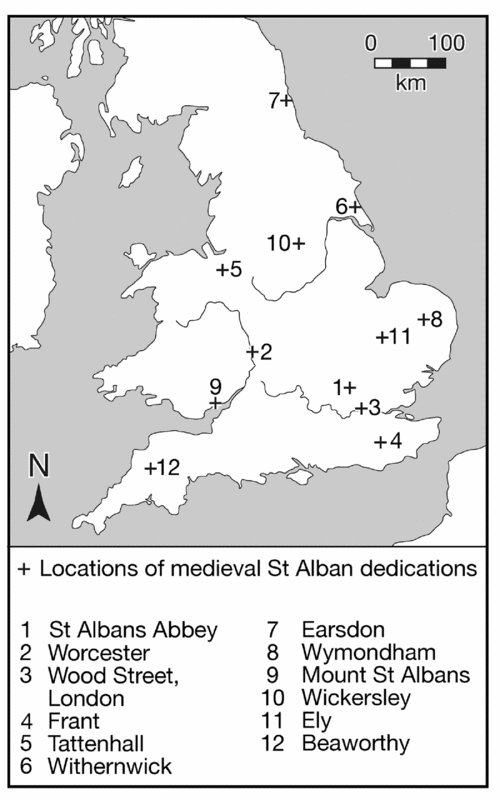
Surprisingly, there are records of only a dozen medieval churches dedicated to Alban within the British Isles (Fig. 1).Footnote 11 Admittedly dedications may have been lost and Alban's translated relics may also have been housed in side altars within other churches. For comparison, there are records of 27 churches dedicated to Augustine of Canterbury, 65 to Cuthbert, 151 to Martin of Tours, and 220 to Laurence.Footnote 12 Alban's cult never achieved such popularity.
Medieval Alban dedications in the British Isles.

Dating Alban's churches is not simple. After St Albans Abbey (fig. 1, no.1) the earliest are probably later Saxon, in Worcester (2) and London (3). The thirteenth-century chronicle of Evesham Abbey claimed Æthelbald had given Worcester's Alban church to it in 721, though no charter survives.Footnote 13 The building does survive and once occupied a prime riverfront location with an adjacent spring. It follows the line of, or possibly surmounts, the original Roman defensive rampart. Bassett has argued that, since the neighbouring parish of St Helen may have been a British (i.e. pre-680) episcopal see, the Alban church could have been an early dependent chapel.Footnote 14 Baker and Holt, however, favour an eighth-century date, suggesting an association with an as-yet-unlocated Mercian palace.Footnote 15 Evidence for this date, too, is sparse and archaeological study is inconclusive.Footnote 16 London's Alban church in Wood Street (3) was also once considered to be of eighth- or ninth-century date and related to a mid-Saxon palace at Cripplegate.Footnote 17 However, the existence of an early Mercian palace and the antiquity of the church are both now disputed. An early to mid-eleventh century date is currently thought more likely.Footnote 18 Worcester remains the only plausible mid-Saxon, or just possibly British, Alban church outside Hertfordshire.
Much hangs on Offa's contested involvement in the cult. Even what form his supposed interest took is unclear: Matthew Paris claimed that in 793 he discovered Alban's body, but a translation would seem more logical.Footnote 19 Although the earliest St Albans charters naming Offa are late tenth- or eleventh-century forgeries, Crick has argued that the abbey's endowments are difficult to associate with other early royal donors, leaving Offa the most promising candidate.Footnote 20 Offa's supposed interest in Alban is surprising, though, as Anglo-Saxon Christians rarely displayed reverence for the British Church.Footnote 21 Indeed, Hayward has shown that there is scant evidence of Alban's cult among Saxons before the tenth century, noting in particular Alban's absence from the earliest continental Anglo-Saxon calendars.Footnote 22 Willibrord's calendar includes Irish saints (Brigit, Patrick and Columba), but Alban is missing.Footnote 23 Might it be that Alban required cultural ‘translation’?
A subtle downplaying of Alban's British origins seems already present in Bede's Historia ecclesiastica. There, when the judge asks: cuius . . . familiae uel generis es? (‘what is your family and race?’), Alban replies: quid ad te pertinet, qua sim stirpe genitus? Sed si ueritatem religionis audire desideras, Christianum iam me esse (‘What does it matter to you what stock I come from? But if you desire to hear the truth of my religion: I am now a Christian’).Footnote 24 A further bar to Offa's interest may have been removed fifteen years before when the Welsh Britons adjusted their paschal system. It is conceivable that these changes enabled Offa to promote Alban as a specifically Mercian patron, perhaps (alongside the creation of a third archbishopric at Lichfield) as part of an attempt to relativize Canterbury and its saintly patron, Augustine.Footnote 25 Intriguingly, the traditional date of Offa's involvement also almost coincides with that of Charlemagne's burial of his wife Fastrada in the church of St Alban of Mainz.Footnote 26 Is it possible that Offa was inspired by Charlemagne?
Of the remaining insular dedications three others do not pre-date the late Saxon period: Frant (4), Tattenhall (5) and Withernwick (6).Footnote 27 These, and perhaps London's Alban church, were all presumably founded using relics sourced from St Albans Abbey after its refoundation in the 970s.Footnote 28 They date to a period in which, as Hayward has shown, Alban began to be promoted as an English saint, the ‘protomartyr Anglorum’.Footnote 29 The remaining six insular Alban dedications appear to be Norman.Footnote 30
Three observations can be made. First, aside from Verulamium, British (i.e. pre-Saxon) interest in the cult, at least in terms of relic translation and church dedication, seems extremely limited. Levison showed that the only Welsh dedication, Mount St Albans (9) near Caerleon, was probably the result of relics gleaned during the translation of the martyr's body into the new Norman abbey church in 1129.Footnote 31 Alban's relics do not appear to have been translated into Wales before this period and whether Alban's church in Worcester was British remains unclear. Gildas's lament that the Saxon advent rendered Verulamium, and consequently the cult itself, inaccessible does not therefore seem to be hyperbole.Footnote 32
Second, although Bede described miracles still occurring at the site of Alban's execution, he did not describe any functioning buildings or officiating clergy, observing only that a church ‘of wonderful workmanship had been built’ (mirandi operis . . . exstructa).Footnote 33 Bede's description of the miracles is similar to other accounts in which agents acting alone and on their own initiative remove dust from holy sites either without churches or from where a church has been ruined.Footnote 34 Verulamium may well have been part of a British enclave, possibly surviving until the late sixth century, but when and under what circumstances the town passed into Saxon control, and the fate of the cult site, is unknown.Footnote 35 Excavation at the Abbey has so far found little firm evidence of early and middle Saxon activity, most particularly an absence of burials.Footnote 36 Moreover, there is no evidence that Alban's cult was promoted elsewhere within England before the eighth century (again with the possible exception of Worcester). All this then might add credence to Matthew Paris's claim that Offa's involvement represented a significant new moment in the cult's history, perhaps indeed the creation of the first functioning Saxon church on the site.
Finally, it was ultimately late Saxon and thereafter Norman influence that was to have the greatest impact. Half of Alban's insular churches postdate the Conquest, and most can be directly related to promotion by the abbey's new Norman management. Ironically this was not a new departure for, aside from Gildas, all three pre-eighth-century versions of Alban's passion, including Bede's main source, were produced in Gaul.Footnote 37 It was Gaul that acted as a reservoir for the cult and perhaps primed the incoming Norman ecclesiastical elite to take an interest in St Alban.Footnote 38
Alban Church Dedications in France
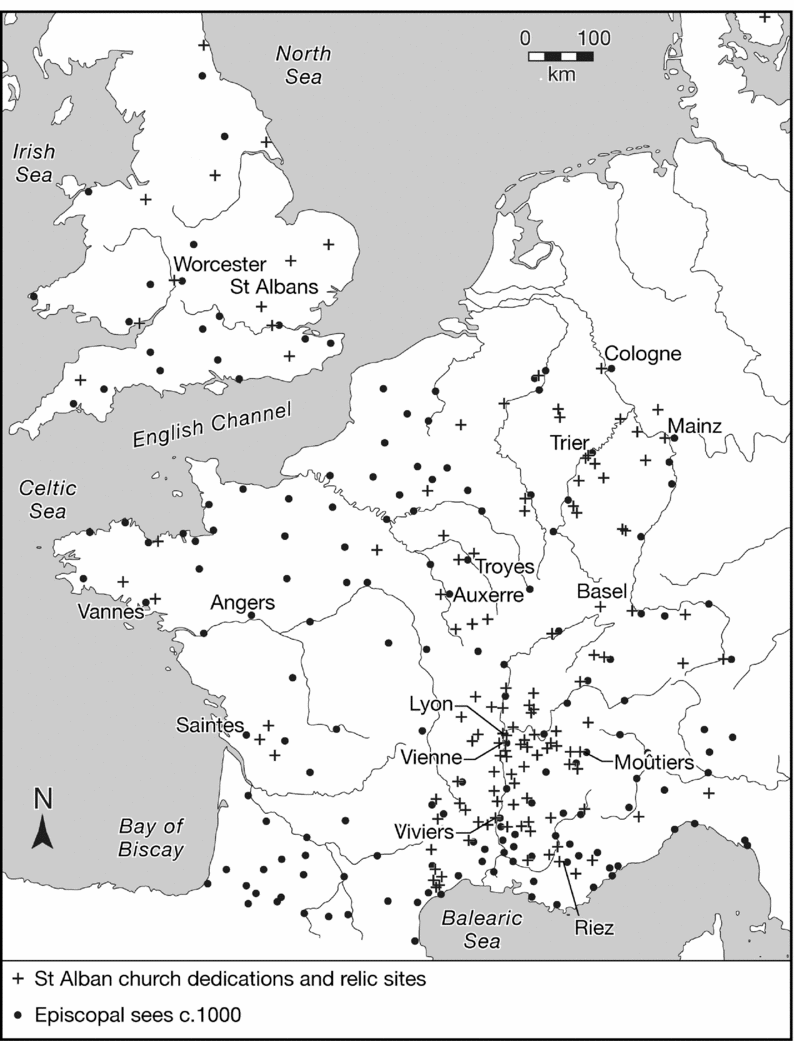
There have been previous studies of Alban's cult in France and neighbouring areas.Footnote 39 To date however there has not been a systematic examination of Alban dedications. By combining recent topographical surveys, online map-searching for Saint-Alban/Auban place-names, and searches in charters and other historical sources, it has become possible to construct the first map of western continental Europe showing the likely extent of Alban's cult in terms of church dedications.Footnote 40 Naturally caution is required, particularly in distinguishing churches dedicated to Alban of Verulamium, Alban of Mainz and the Merovingian bishop Albinus of Angers. Where they survive, festal dates help. Name slippage is also useful (Albinus typically produces ‘Aubin’ rather than ‘Auban’ place-names).Footnote 41 Moreover, the overall pattern can be confirmed from a previous study of medieval calendars by Martin Dolch. This demonstrated that, though overlapping, the three cults tended to concentrate in different regions.Footnote 42 Taking all this into account the resulting survey can claim that whilst there were a mere dozen or so insular medieval Alban churches, in France alone there were nearly a hundred (Fig. 2).
North-western European medieval Alban dedications.

Fewer than half of France's dioceses had Alban churches. Of these, most possessed only one or two. However there are significant concentrations in the dioceses of Lyon, Vienne, Viviers and Trier. Three-quarters of Alban dedications appear in Provence and Burgundy, and a further fifth are in north-eastern France. If the cult had been propagated by British clerics one might have expected more in Brittany. However, whilst there was an explosion of later Welsh saints in Brittany (over a hundred churches are dedicated to Gildas alone), only one of Brittany's three Alban churches (Elven, Morbihan), can be dated with certainty to the first millennium.Footnote 43
If British clerics were not responsible for translating Alban's cult to France, who was? The simplest answer is Germanus of Auxerre, whom Alban's passio describes as translating relics of blood-soaked earth from the site of Alban's execution. Ninth-century sources claim Germanus deposited these in Auxerre's former cathedral and rededicated it to Alban.Footnote 44 This would explain how Alban's cult reached central France, but why did it spread further south so spectacularly? Although Prosper of Aquitaine emphasized that Germanus's mission was papally instigated, Ralph Mathisen has argued that Germanus was acting under the more proximate orders of Hilary, metropolitan of Arles, and with the backing of the Provençal bishops.Footnote 45 This may explain why Provence and Burgundy provide the earliest and most extensive evidence for Alban churches.
The first of these to appear in the historical record is at Riez, where a sixth-century vita of Bishop Maximus of Riez claims that he dedicated a church to Alban.Footnote 46 If true, this foundation must have taken place before Maximus's death in 460, within thirty years of Germanus's return to France. Germanus's hagiographer claimed he travelled to Arles during this period.Footnote 47 Therefore Germanus himself could have been responsible for introducing Alban's relics to his Provençal episcopal colleagues (many of whom shared a Lérinian monastic heritage), who in turn deployed them in founding churches within their own dioceses.Footnote 48
Early Christian Riez is well studied and sheds light on some of the possible motives for the spread of Alban's cult. The first half of the fifth century saw the city's bishops undertake a major process of Christianization, including the conversion of its baths, a former site of Asclepian cult, into a grand baptistery.Footnote 49 It was during this period that Maximus founded the Alban church on a hilltop adjacent to Riez, separated from it by the river Colostre. This topography closely mirrors Verulamium, suggesting a knowledge of Alban's passio with its description of Alban's execution.Footnote 50 The dedication was also toponymically appropriate, since the church occupied Riez's former citadel, originally named ‘Alebaece’.Footnote 51 All this suggests that Maximus found Alban's cult helpful in reshaping his see. These three features – topographical mirroring, the crossing or channelling of water and pre-Christian ‘Alp-’ or ‘Alb-’ place-names – occur at numerous other Alban church sites in France, although rarely clustered so obviously.
Whether or not Germanus personally donated Alban's relics to Maximus, elsewhere there are suggestions of Germanus's direct involvement. A possibly eighth-century vita of the mid-fifth-century Severus of Vienne describes this missionary founding an Alban church at Vienne.Footnote 52 The narrative is highly fictionalized but includes an account of a visit by Germanus. We might conclude that it was Germanus, rather than Severus, who brought the cult to Vienne. The church survives at Saint-Alban-du-Rhône (Isère) beside a major late Roman cemetery, another feature replicated at other Alban sites.Footnote 53
An Alban church existed also at Lyon. This too could conceivably have been founded with relics given by Germanus to its bishop, Eucherius. The church was located beside the entrance to Lyon's episcopal complex. Destroyed in the eighteenth century, it has never been subject to archaeological study. Secondary literature has dated it to 1138 when it first appears in the historical record.Footnote 54 However this merely recounts its donation to the monastery of Saint-Claude (Condat, Ain), rather than its foundation. Devotion to Alban in Lyon certainly dates to the first millennium, as his passio features in a ninth-century passionale used in Lyon's cathedral.Footnote 55 There was a second Alban church, at a roadside Roman cemetery in Montchat, five kilometres east of Lyons. Now also demolished, its antiquity is suggested by its surviving, apparently eighth-century, font.Footnote 56 Similarly two Alban churches in the diocese of Troyes may have been founded using relics shared by Germanus. Troyes's bishop, Lupus, reputedly accompanied Germanus to Britain in 429.Footnote 57 Both buildings are situated at sources of rivers, perhaps indicating an attempt to Christianize pagan water cults, an activity most likely to have taken place early in the diocese's history, possibly at Lupus's instigation.Footnote 58 Lastly, the previously mentioned single early Alban church in Brittany at Elven could also witness Germanus's involvement. Constantius records that after he returned from Britain Germanus travelled to Armorica.Footnote 59 It is conceivable that while there Germanus deposited relics with the bishop of Vannes that were later translated to Elven.
Of course, Germanus's personal involvement cannot explain the majority of France's foundations. An Alban church near Viviers almost certainly post-dates Germanus's death, since the see was not established until 475. This building features in the episcopal res gesta among a group of six other extramural churches.Footnote 60 Modern studies have dated each of these to between the fifth and seventh centuries.Footnote 61 Alban's church has never received detailed study but may well date from the same period.Footnote 62 It may even reflect the continuing significance of the older regional capital's name, ‘Alba’ (civitas Albensium).Footnote 63 Another extramural Alban church existed in Moûtiers (formerly Tarentaise).Footnote 64 Its graveyard contained a Merovingian-period, possibly episcopal, sarcophagus.Footnote 65 Both of these (sixth-century?) churches were presumably built by local bishops, using relics sourced through an extended episcopal network or perhaps from the metropolitans of Vienne, to hallow existing extramural cemeteries.
In the diocese of Saintes, a cluster of three Alban churches makes an odd outlier. Here a more detailed interpretation of how Alban's relics arrived can be advanced. The first to be built was probably at Merpins (Charente), where the surviving tenth-century church lies adjacent to a Merovingian-period fortification and near a Roman settlement and necropolis.Footnote 66 When the church was founded is unknown. Early knowledge of Alban's passio in the diocese, however, seems to be demonstrated from an apparent verbal borrowing from it in the Vita Viviani, an account of Saintes's late fifth-century bishop.Footnote 67 The vita’s age is contested: it seems also to borrow from the Vita Germani and a date in the 520s has been advanced.Footnote 68 The vita describes Vivianus sending envoys to Rome in search of relics.Footnote 69 Since they would have journeyed through Provence, they could have encountered the cults of Alban and Germanus en route. It may thus be that Alban's relics and passio came to Saintes, somewhat fortuitously, as a result of an episcopal commission in the late fifth or very early sixth century. When these relics came to Merpins is unknown, though it need not have been long afterwards, but the evidence of the Vita Viviani suggests that the passiones of Alban and Germanus rapidly became influential in the diocese.
As the Vita Viviani hints, what may have assisted the spread of Alban's cult was a symbiosis between the martyr and his ‘host’, Germanus, who himself features as a saint in the early versions of Alban's passion. This conjoined veneration seems to have resulted in a number of adjacent Alban and Germanus churches. At Vienne a now lost and undated Germanus church lay at one end of the city's Circus Maximus, whilst two kilometres to the south, near a Roman-period necropolis, there is an Alban church.Footnote 70 Similarly, thirty-five kilometres south-east of Lyon, Alban and Germanus churches straddle the River Bourbre, two and a half kilometres apart. The Germanus church is certainly Merovingian and built on the site of an earlier temple, whilst the Alban church has been claimed to date from the fifth century.Footnote 71 In total there are at least four French examples of this combination.Footnote 72
Once shared by Germanus among the network of bishops closest to him in Provence and north-eastern France, Alban's relics were thence variously deployed within their dioceses. That there are relatively few dedications around Auxerre suggests that it was this secondary phase of translations that was most influential. Paradoxically, in Auxerre, once established by Germanus, Alban's cult seems to have received far less promotion. Why this should be is not clear, although there is an increasing awareness that many cults were regionally defined.Footnote 73 The southern Burgundian interest in Alban may be related to the fact that Germanus's own cult seems initially to have been promoted in Lyon rather than Auxerre. Constantius's Vita Germani was commissioned by Patiens, bishop of Lyon, and according to the author only later sent to bishop Censurius of Auxerre.Footnote 74 By contrast Gregory of Tours mentions neither Germanus nor Alban, and their cults seem not to have flourished within the diocese of Tours in this early period.
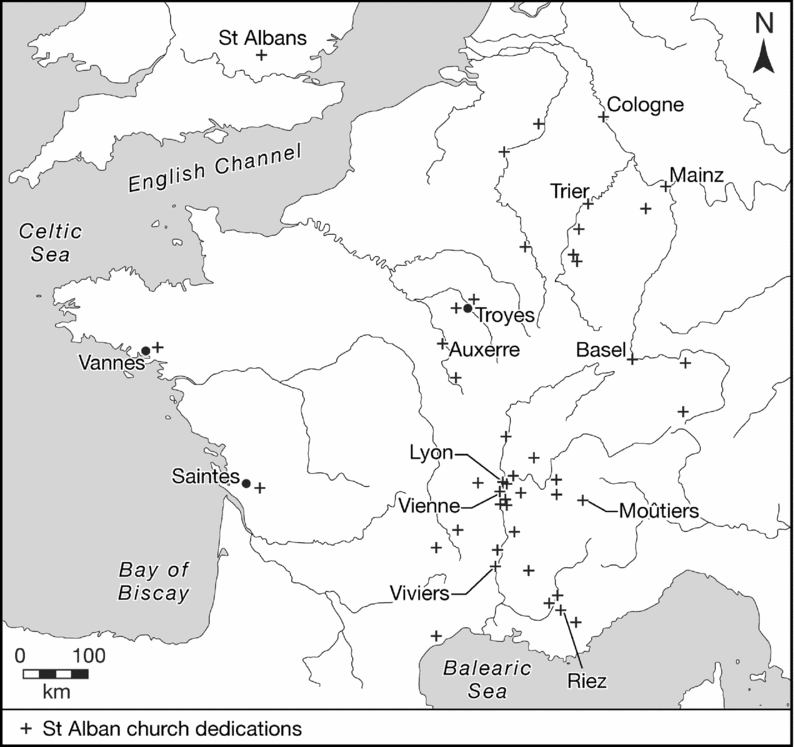
How quickly Alban's cult spread in France is hard to determine. Nevertheless, late antique Gallic bishops would most likely have sought first to Christianize those locations closest and easiest to reach, those that already possessed settlement infrastructure, and those that were of existing pagan religious importance.Footnote 75 A significant number of Alban's churches occur in precisely these locations: close to major cities, on or very close to France's major Roman roads, on the sites of former villas, at late antique Roman cemeteries or near the sources of rivers. Based on these factors and (as we have seen) in some cases more explicit evidence, it may be suggested that perhaps a third of France's nearly one hundred Alban churches may have been in existence by around 750 (Fig. 3), whilst in Britain there may have been only one. Nor should this necessarily surprise: by the end of the sixth century Venantius Fortunatus was already lauding Alban as one of Europe's most significant martyrs.Footnote 76 Moreover, there is no evidence that this success was due to British exiles or Columbanian mission; rather it was due to Gallic bishops, in particular Burgundian ones, using Alban's cult in the furtherance of their pastoral outreach.
Conjectured Alban dedications before c.750.

Alban Dedications in Germany
Alban churches have long been known of in Basel, Mainz and Cologne but a major problem has been disentangling the cults of Alban of Verulamium (22 June) and Alban of Mainz (21 June). Levison considered they were the same saint, although domestic German scholarship has tended to preserve Alban of Mainz's independence.Footnote 77 Mainz's Alban church was constructed outside the city on a hilltop. Archaeology has revealed fifth- and sixth-century Christian grave inscriptions and a church possibly from the same period.Footnote 78 The earliest biographical details of this martyr are given by Rabanus Maurus, whose ninth-century account is creatively extracted from a possibly eighth-century Passio Theonesti, a bricolage of Italian, Gallic and Mainz traditions in which Alban plays a minor role.Footnote 79 Rabanus depicts Alban of Mainz as a martyred foreign missionary, very much in the manner of an idealized Boniface.Footnote 80 From none of this can we deduce anything other than that one of Mainz's early churches was dedicated to a saint named Alban. Levison's explanation of duplication remains the most economical.
Alban of Mainz's distinctive feast day first appears in additions to martyrologies of the late eighth century.Footnote 81 It is tempting to suggest that he may have been the product of the reinterpretation – translation, as it were – of the original British martyr by the Anglo-Saxon missionaries Boniface and Lull. Here the Wessex background of these figures could be significant. Yorke, amongst others, has noted that Aldhelm seems to have treated older Irish and British dedications in Wessex differently. The survival of the name ‘Malmesbury’ and its retention as an ecclesiastical centre suggests a respect for its saintly Irish founder Maíldub. By contrast, the British church centre at Lanprobus, ‘the community of Probus’, was apparently bypassed in favour of a new episcopal centre nearby at Sherborne.Footnote 82 This difference may reflect Anglo-Saxon antipathy to the British Church. The next generation of Wessex clergy, encountering in Mainz the pre-existing cult of Alban (perhaps, indeed, with little surviving evidence as to the saint's identity), may have decided on the basis of a similar anti-British bias to forge a new identity for this ‘Alban’.
The Mainz cult ultimately came to dominate its hinterland, no doubt assisted by the patronage of Charlemagne, who in 794 buried his wife Fastrada in Mainz's new abbey. Indeed the rival cult seems to have caused a shift in the name of the British martyr to ‘Albinus’ throughout Austrasia. An eleventh-century tradition explained that Mainz and Cologne, which both possessed a church dedicated to the British martyr, had agreed to the name-change in order to avoid confusion. Cologne's ‘Albanus’ became ‘Albinus’.Footnote 83 However, this shift appears much earlier. The British martyr is consistently named ‘Alban’ in all the copies of his passion but one. This, probably created in Soissons in the late eighth or early ninth century, changed his name in the title to ‘Albinus’, while retaining the older name in the body of the text.Footnote 84 Something similar is found in the Namur edition of Bede's Historia ecclesiastica, copied in the monastery of St Hubert in the Ardennes also in the eighth or ninth century. There the scribe altered Alban's name to ‘Albinus’ at the start of the account of his passion and at the final notice of his obit, but retained the original name ‘Albanus’ throughout the rest of the chapter.Footnote 85 Alongside this one can add Martin Dolch's note that the martyr appears as ‘Albinus’ in the Wissembourg and Berne recensions of Martyrologium Hieronymianum that also date from the latter part of the eighth century.Footnote 86 Lapses in orthography cannot explain this phenomenon, since Alban of Mainz's name is never subject to such alteration. This suggests that in the second half of the eighth century in north-east France, Belgium and the Rhineland Alban of Verulamium underwent a name-change. The explanation might well be the Anglo-Saxon promotion of the new cult of Alban of Mainz and the desire to distinguish it from the older British cult.
It has long been thought that Mainz's Alban cult eclipsed other older (possibly British) Alban cults in the region, including Basel (Fig. 3).Footnote 87 However, an Alban church (now lost) in Trier has hither- to been considered a late eighth-century translation from Mainz, but several details suggest the church may be older and originally related to the British saint.Footnote 88 Trier's Alban church was extramural and located within a Roman-period cemetery suggesting some antiquity. It was situated in proximity to a pre-Christian ‘Alb-’ location name: the Roman ‘Porta Alba’. A kilometre to the south lies another church dedicated to Germanus, thought to be of early Merovingian date and situated also in a late antique cemetery.Footnote 89 Taken together, there is a case to be argued that Trier's Alban church may have been a fifth- or sixth-century dedication to the British martyr, later eclipsed by the Mainz traditions, and the fifth case of a conjoined Alban-Germanus veneration identified so far.Footnote 90 According to Bede one of Trier's bishops, Severus, accompanied Germanus on his second visit to Britain, and it could be that Alban's relics came to Trier through a connection with Auxerre's bishop.Footnote 91
Conclusion
Alban of Verulamium's cult underwent both physical and cultural translation in the early medieval period. British promotion appears to have been limited, perhaps by the Saxon adventus, and there is no evidence that relics were translated within Wales or Brittany. Anglo-Saxon interest at home appears initially to have been equivocal and probably dependent on a degree of cultural translation that began with Bede. The extent and nature of Offa's involvement remains unclear but, if it did exist, seems not to have reached further than the abbey site. Insular interest, on the whole, dates mainly from the late tenth century onwards. Abroad, a more drastic form of ‘translation’ may have occurred at Mainz, where Anglo-Saxon missionaries possibly created an entirely new identity for their local martyr. Gallic uptake of the cult, stemming from a translation undertaken by Germanus of Auxerre in 429, was by contrast highly energetic, particularly in south-eastern France. The subsequent translation of relics between and within dioceses seems to have provided Gallic bishops with a useful tool by means of which a further kind of ‘translation’ could occur, as pagan sites and extramural burial grounds were transformed by the construction of Alban churches into places of Christian worship. Paradoxical though it may appear, in the early Middle Ages it was France that saved Albion's foremost martyr.