1. Introduction
Performatives are defined as “illocutionary acts that can be performed by uttering a sentence containing an expression that names the type of speech act” (Searle, Reference Searle1989, p. 536). Thus, speakers of English can make a promise or cancel a meeting simply by uttering sentences like (1) and (2):
(1) I promise that I won’t do it again.
(2) I hereby cancel the meeting.
Yet only a restricted set of verbs allows such performative usage: as pointed out by Searle (1989, p. 535), it is not normally possible to fry an egg or fix the roof just by saying (3) or (4):
(3) I hereby fry an egg.
(4) I hereby fix the roof.
In other words, performatives are conceptually special in that they involve doings rather than sayings (Austin, Reference Austin1962). This distinctive status of performative utterances lies at the basis of a range of studies on performativity within linguistics and philosophy of language: besides Austin (Reference Austin1962) and Searle (Reference Searle1989), examples are, among many others, Bach (Reference Bach1975), Bach and Harnish (Reference Bach and Harnish1992), Condoravdi and Lauer (Reference Condoravdi, Lauer, Reich, Horch and Pauly2011), Harnish (Reference Harnish2007), Sweetser (Reference Sweetser2000), and Verschueren (Reference Verschueren, Shibatani and Thompson1995). Various theoretical issues have been addressed in these studies, such as why performatives allow speakers to do things with words, whether performatives can be true or false, the role of the speaker’s intention, and the distinction between performatives and other types of speech act. In this study, we adopt a more empirically driven approach by concentrating on the aspectual properties of performatives from a cross-linguistic perspective. As we will demonstrate, our survey of the aspectual constructions (perfective, imperfective, perfect, …) used in performative contexts in a variety of languages provides insight into the epistemic import of both performativity and aspect, i.e., the special knowledge status of the event types involved. We will argue, more specifically, that performatives are about ‘fully and instantly identifiable’ events and that they therefore select that aspectual construction that is dedicated in a given language to the expression of such events.
Most studies that address the formal properties of performative utterances concentrate exclusively on English. An oft-noted grammatical peculiarity of English performatives is that they favor the simple present (or what Searle, Reference Searle1989, calls the ‘dramatic present’) over the present progressive (compare (1) with (5)), and that they differ in this respect from merely descriptive present-time event reports (see (6)).
(5) ? I’m promising that I won’t do it again.
(6) I *talk / am talking to my mother right now.
The simple present in performative utterances has been analyzed as an aspectually perfective use by various authors, including Smith (Reference Smith1997), Langacker (Reference Langacker2001), Williams (Reference Williams2002), and De Wit (Reference De Wit2017).Footnote 1 As pointed out by Langacker (2001, pp. 263–264) and De Wit (Reference De Wit2017), there is a notional connection between perfective aspect, which is typically assumed to involve a global and bounded viewpoint (Chung & Timberlake, Reference Chung, Timberlake and Shopen1985; De Wit, Reference De Wit2017, Ch. 2), and performativity: since the speech act named by the performative verb (promise in (1), cancel in (2)) actually constitutes the corresponding event, the conceptualizer can readily conjure up a global conception of this event at the time of speech. Most other, non-performative present-time events, such as the one illustrated in (6), do not have this property, because they typically do not coincide exactly with the interval of the time of speaking (durational problem), and/or the conceptualizer cannot verify them as instances of an event type at the time of speaking (epistemic problem). According to Langacker (Reference Langacker2001), the durational and epistemic problems involved in the construal of descriptive present-time event reports prevent the use of the perfective simple present in English.
In view of the notional plausibility of the association between performatives and perfective aspect (and the lack of such an association with descriptive present-time event reports), we might suspect that these observations concerning English can be extended to other languages. That is, it might be expected that languages systematically favor perfective aspect in performative utterances, and that performative utterances are grammatically exceptional in this respect, since non-performative present-time events cannot normally be reported by means of perfective constructions (De Wit, Reference De Wit2017). Yet data from another group of languages in which performativity has been studied relatively extensively, viz. Slavic (see especially Dickey, Reference Dickey2000, Reference Dickey2015), already show that neither of these conclusions is justified: like any other sentence reporting present-time events, Slavic performative sentences almost exclusively involve imperfective aspect, as is illustrated for Polish in (7):
(7) Przyrzekam /*Przyrzeknę, że nigdy cię nie
say.prs.ipfv.1sg/prs.pfv.1sg that never 2sg neg
opuszczę.
let.prs.pfv.1sg
‘I promise that I will never leave you.’ (Kochańska, Reference Kochańska and Brisard2002, p. 355)
Similarly, in Modern Standard Arabic (MS Arabic) performative utterances canonically feature imperfective, rather than perfective, aspect:
(8) Naṭlubu min-kum ‘adama t-taǧammu‘ i
ask.prs.ipfv.1pl from-2sg lack def.sg-congregating
‘We ask you not to congregate.’ (Khalil & McCarus, Reference Khalil and McCarus1999)
These preliminary observations raise the question that lies at the heart of this study: what are the aspectual characteristics of performatives in a cross-linguistic sample of languages? To our knowledge, the relationship between aspect and performativity has received little attention in the extant typological literature, with the exception of Hewson and Bubenik (Reference Hewson and Bubenik1997). In their analysis of a variety of Indo-European languages and language groups they introduce the term ‘Performative’ for the type of aspect found in performative contexts (cf. also subsequent work by Hewson, such as Hewson, Reference Hewson and Binnick2012). Hewson and Bubenik (Reference Hewson and Bubenik1997) distinguish between a situation’s temporal (in)completion (i.e., its actual completion in time) and phasal (in)completion (the completion of all the phases that a situation consists of). With events, this distinction is blurred, since events are not temporally complete until all the phases that they consist of are complete. States, however, are monophasal, which means that phasally they are “necessarily complete from the first moment” (Hewson, Reference Hewson and Binnick2012, p. 516): they are instantly verifiable, even if they are not temporally complete at a given moment. Hewson and Bubenik (Reference Hewson and Bubenik1997) observe that the aspectual constructions used in performative utterances in Indo-European languages are not quite like traditional perfectives – which, in their view, cannot be used in performative or stative contexts as a consequence of the notion of temporal completion by definition associated with perfective aspect – and at the same time they are not quite like imperfectives either, because performatives “represent the complete performance of all phases of the event” (Hewson, Reference Hewson and Binnick2012, p. 516). Therefore, they distinguish a different type of aspect, the ‘Performative’, the most important properties of which are the following:
(i) it is used in performative contexts;
(ii) it indicates phasal completion;
(iii) if a language does not have a dedicated performative construction, this function is taken up by an imperfective (non-progressive) form (as is the case in, e.g., Slavic).
Hewson and Bubenik’s (1997) proposal is highly illuminating in many respects.Footnote 2 As we will demonstrate, we subscribe to the idea that the aspectual construction used in performative contexts must indicate some kind of phasal completion, in the sense that these contexts involve events that are instantly identifiable in their entirety. Yet our analysis also differs from Hewson and Bubenik’s in important ways. We will argue that there are no reasons to believe that, cross-linguistically, performatives constitute a class that is special aspecto-temporally (despite what is suggested by the marked status of simple-present uses with performatives in English). We hypothesize, moreover, that there is not one specific aspectual category, such as perfective, imperfective, or perfect, that is systematically favored worldwide in performative contexts, yet unlike Hewson and Bubenik we do not infer from this that it is necessary to posit the existence of a separate ‘Performative’ aspectual category. Instead, our central assumption is that, in general, aspectual constructions (also) have an epistemic meaning associated with the type of aspect they express, and that, in performative contexts, language users resort to the aspectual construction that they generally use to express situations that are fully identifiable as an instance of a given situation type at the time of speaking. Thus, we will argue that, on the basis of grammatical (i.e., aspectual) properties observed in a number of unrelated languages, performatives can be shown to be part of a larger group of contexts which share an important epistemic feature: full and instant identifiability at the time of speaking. More concretely, building on data from 16 languages collected by means of a questionnaire (provided in the ‘Appendix’ to this paper) and analyzed by means of Multidimensional Scaling, we will hypothesize that a language will make use of one dedicated aspectual construction (whether imperfective, perfective, or perfect) for the majority (if not all) of these contexts, a property we refer to as epistemic clustering. The contexts selected for this study’s questionnaire are exactly meant to elicit responses directly relevant to determining which aspectual construction a language favors for referring to fully and instantly identifiable situations, including performatives. A crucial implication of this assumed association between performativity and full and instant identifiability is that progressive constructions will not normally appear in performative contexts, because progressive aspect has been shown cross-linguistically to indicate lack of full and instant identifiability or, put differently, to express epistemic contingency (for a limited sample, see, e.g., De Wit, Patard, and Brisard, Reference De Wit, Patard and Brisard2013, on French and English; De Wit and Brisard, Reference De Wit and Brisard2014a, on English; Anthonissen, De Wit, and Mortelmans, Reference Anthonissen, De Wit and Mortelmans2016, on German). Epistemic contingency is a property of actual ongoing situations whose occurrence cannot be predicted on the basis of the speaker’s knowledge at the time of speaking (see also Goldsmith and Woisetschlaeger, Reference Goldsmith and Woisetschlaeger1982, who use the term ‘phenomenal’ for these kinds of situations). Thus, progressive aspect is used to refer to actually occurring situations that have a non-consolidated status within the speaker’s conception of reality (this is true for most events, which are typically non-structural, in the sense of not being perfectly predictable), and it therefore does not combine with states without coercing them into events. In this respect, progressives differ from general imperfectives, which do combine with states by definition, and therefore the latter do not imply any notion of contingency.
The remainder of this paper is organized as follows. We will begin in Section 2 by defining the notion of ‘full and instant identifiability’ and discussing the contexts for which it is relevant. In Section 3, we outline the methodological underpinnings of our cross-linguistic research: the difficulty of defining the concept of performativity in a cross-cultural study, the choice for native speaker questionnaires to gather our data, the design of these questionnaires, and our selection of languages. Section 4 discusses the results of our study: after demonstrating that languages use a variety of aspectual constructions in performative contexts, but not progressive aspect (Section 4.1), we will show by means of Croft and Poole’s (2008) method of Multidimensional Scaling that our predictions regarding the epistemic clustering of aspectual constructions are borne out (Section 4.2). Section 4.3 is devoted to detailed discussions of exceptional language-specific cases in English, Slavic, and MS Arabic, and how these exceptions tie in with our analysis. In Section 5 we submit our conclusions.
2. Full and instant identifiability
By ‘identifiability’ we refer to the identification of a situation token as an instance of given situation type. Although this addition is important for a proper understanding of the notion, as we will explain in detail in this section, we will use the shorter term for practical reasons throughout the rest of this paper. By ‘full and instant identifiability’ we mean that the identification can be completed on the basis of a sample phase coinciding with the time of speaking. It should also be noted that, even though we make ample use of English examples in this section, the claims we make about the epistemic properties of situations in certain contexts are taken to be universal.
The distinction between situations that are construed as fully identifiable and those that are not can be illustrated by contrasting state reports (as in (9)) with reports of ongoing events (as in (10)):
(9) a. I adore cats.
b. He understands the question.
(10) a. She is eating an apple.
b. I’m loving it.
All the situations referred to in these sentences are taken to be verifiable at the time of speaking on the basis of a sample interval coinciding with the time of speaking. Yet this kind of verifiability is not quite the same as the concept of identifiability which is central to our analysis. Full and instant identifiability refers to the conceptualizer’s ability to identify situations on the basis of a sample interval coinciding with the time of speaking. Any event (like those reported in (10)) can be identified after its full completion, yet this is not a case of instant identification, since typically the limited temporal overlap between an event and the time of speaking does not suffice to establish full identification of the event. States, in contrast, are conceptually unbounded and homogeneous, and hence they do not involve a change over time (as in (9)). An important epistemic consequence of these properties is that any random segment of a state is representative for that state in its entirety – a quality known as the ‘contractibility property’ (Langacker, Reference Langacker1987, pp. 258–262) or the ‘subinterval property’ in formal-semantic approaches. This property allows states, such as the ones reported in (9), to be fully identified on the basis of what the speaker witnesses or knows at the time of speaking. This is different for the events reported in (10), which represent the vast majority of the events witnessed in daily life. While we may assume that the description in (10a) is triggered by the observation of a singular event involving the eating of an apple, this instance cannot instantly be construed as a consolidated description of an apple-eating event type, because for all the speaker knows the subject might just be taking a bite (cf. Langacker’s epistemic problem, discussed in Section 1). This unconsolidated status is marked by the use of progressive aspect. Note that this analysis can equally be applied to first person singular occurrences of the progressive: while we may assume that in a sentence like I’m eating an apple, the speaker has a higher degree of control over (and thus a higher degree of certainty with regard to) the further development of the denoted process, he or she will not construe this event as fully and instantly identifiable at the time of speaking. In ‘normal’ contexts, this event of eating an apple does not follow from the structure of the speaker’s world, or at least the speaker chooses not to present it as such: it is not a habit nor is it in any way scripted (as opposed to, e.g., running commentaries accompanying demonstrations, as illustrated in (12)). In other words, the event is construed as contingent: real, but not particularly informative beyond its own occurrence. Similarly, the use of progressive marking in (10b) indicates that the canonically stative verb love is reinterpreted as a dynamic verb, used to describe an event that involves more agency than more normal instances of loving something and, especially, that is construed as less stable and less indicative of a structural state, which is what makes this a contingent event. The fact that progressive marking with stative verbs is marked in a language like English reflects the speaker’s intention to construe a state as atypical (i.e., having non-state-like properties). If the speaker uses the simple present in both (10a) and (10b), the result would be that the event referred to has a structural quality (i.e., is highly predictable, as in Every day she eats an apple) or that the situation is in fact construed as a state (10b).
In general, then, states are epistemically fully and instantly identifiable, while events are typically not. Yet there are exceptions to this generalization in special contexts of use, which have been extensively discussed in Vanden Wyngaerd (2005) (for English) and De Wit (Reference De Wit2017) (for English, French, Sranan, and Slavic). All of these special contexts involve the use of the simple present in English but, as stated above, we have reason to believe that (many of) these contexts also involve special aspectual marking in other languages. Performative utterances form one of these special contexts. Since such utterances involve acts that come about in their entirety as we describe them – e.g., as soon as a speaker says I promise, she has made a promise – performatives are by definition fully and instantly identifiable at the time of speaking. This is also the case for the events reported in live sports broadcasting, as in (11) (see also Hewson, Reference Hewson and Binnick2012, pp. 515–516):
(11) Smith passes to Devaney, Devaney to Barnes, Barnes to Lucas – and Harris intercepts – Harris to Simms, nice ball – and Simms shoots! (Vanden Wyngaerd, 2005, p. 191)
Such play-by-play reports normally involve fairly stereotypical, scripted events (Langacker, Reference Langacker2001, p. 265), which are therefore highly predictable, even if unlike (first person) performatives, they involve third person subjects whose intentions lie beyond the speaker’s (epistemic) control. They are also relatively short, which makes a full and instant conceptualization coinciding with the time of speaking more straightfoward (Vanden Wyngaerd, 2005). The same holds for running commentaries accompanying demonstrations, such as (12):
(12) Look, I take this card from the pack and place it under the handkerchief – like this. (Leech, Reference Leech2004, p. 7)
Examples such as (12) involve contexts in which the speaker, following a script characteristic of a magician’s demonstrations, fully controls the events she is referring to. Full and instant identifiability of her own actions is therefore unproblematic.
While with performatives, sports commentaries, and demonstrations of the type illustrated above it is highly likely that part of the reported event coincides with the present time of its report (in the case of performatives there is even full coincidence), there are also events that involve no actual coincidence with the time of speaking, but that are nevertheless construed as fully and instantly identifiable in the present. A case in point are structural statements (Langacker, 1991, p. 264), viz. habituals and generic sentences, which report situations that are construed as generally valid, such as (13) and (14):
(13) I play tennis as much as I can.
(14) Dogs bark.
The situations referred to in a generic or habitual sentence are very much like states, in that they are unbounded and homogeneous (not focusing on their internal development) and can hold at any random moment in time (i.e., they are always true when uttered). The difference with states is that, in order to utter (13) or (14), the subject need not be playing tennis and no dog needs to be barking – i.e., no event needs to be actually going on at the time of speaking.
Full present-time identifiability is also characteristic of historical events that are rendered as if they were occurring in the present for reasons of narrative vividness, as in (15):
(15) Yesterday, I’m talking to my husband, and he tells me he wants to move to Norway.
As with knowledge of generic or habitual situations, these narrated past events can be ‘replayed’ at any given moment by the conceptualizer, who has them available in her mental repertoire (since they have already occurred). In addition, De Wit (Reference De Wit2017) points out that the use of the simple present in instructions, such as recipes or stage directions, could be regarded as “another style of narration” (Langacker, Reference Langacker, Patard and Brisard2011, p. 64). In the case of instructions, the denoted situations (i.e., the actions the addressee/reader is to perform) are part of a kind of script – e.g., the recipe or the play – that is supposed to be mentally or physically re-enacted at the time of reading. In this case, the writer/conceptualizer is not strictly reporting events that actually happened; instead, her description is meant to create them, i.e., trigger their actual realization. Another instance of a description not reporting on events but predicting them involves scheduled activities, whose future occurrence is construed as highly certain in the present. A case in point are train and flight schedules:
(16) My train departs at midnight.
Again, there is no actual event going on in the present, yet the speaker has sufficient information to conceive of the entire future event at the time of the report in (16). In other words, as with the previous cases and unlike with canonical, non-predictable events, the speaker/conceptualizer does not have to witness its full actualization to treat the event at issue as part of her knowledge of the world, i.e., in a way she pretends that the denoted event is (already) a consolidated fact. A final example of a non-actual (i.e., virtual) construal can be found in the protasis of realis conditional constructions:
(17) If you go to England, you will eat many scones.
The if clause in (17) refers to a potentially real event of going to England. Yet at the time of speaking this event is entirely virtual – it is conjured up by the speaker herself in a hypothetical mental space (Fauconnier, Reference Fauconnier1997). By definition, an event framed to occur only in the speaker’s projection of current reality is epistemically controlled by the speaker and treated as given within the relevant space (as opposed to the event reported in the apodosis, which is construed as a prediction based on that ‘fact’).
Performatives thus share the epistemic property of full and instant identifiability with several other contexts, be it sometimes involving entirely different motivations for it: present-time states, play-by-play reports typical of sports broadcasting, demonstrations, habitual and generic statements, narrative uses and instructions, scheduled future events, and realis conditionals. Together, they constitute the ‘special contexts’ that we will refer to in the following sections: contexts that have been selected for a questionnaire designed to elicit sentences in a variety of languages that can be checked for their aspectual properties. In Section 4, we will demonstrate that these languages exhibit a kind of clustering of these contexts on the basis of aspectual marking similar to what can be observed in English, though not necessarily involving a contrast between simple versus progressive marking. First, however, we need to discuss a number of methodological issues involved in a cross-linguistic study of performativity.
3. Methodology
Our study involves relatively specific types of context, which are typically not given much attention in reference grammars. Therefore, we have chosen to consult native speakers or expert linguists with near-native knowledge of the languages under consideration with the help of a questionnaire (see ‘Appendix’). In what follows, we discuss the methodological considerations involved in the design of such a questionnaire and, more generally, in the study of aspect and performativity in a diverse sample of languages.
One factor that potentially plays an important role in cross-linguistic studies of performativity are felicity conditions: as Austin (1962, 1979, pp. 237–238) points out, in order for a performative utterance to be felicitous, certain conditions need to be fulfilled and these conditions hinge on culture-specific conventions. In addition, speakers of different languages often have different (grammatical) means to their avail for the expression of performativity – apart from constructions of the type ‘first person subject + finite performative verb (+ complement)’, speakers may for instance use modals, imperatives, or indirect speech acts – which have different degrees of entrenchment in these different languages. While we certainly do not want to deny the existence of cross-cultural variation in the expression of performatives (cf. for instance observations and analyses by Levinson, Reference Levinson1983, Rosaldo, Reference Rosaldo1982, and Traugott and Dasher, Reference Traugott and Dasher2002, Ch. 5), its influence on our study is minimal. The goal of our research is not to identify a range of means by which speakers of different languages can produce performatives, but to verify whether they can use constructions of the type ‘first person subject + performative verb (+ complement)’ and if so, which aspectual construction is involved. This entails that the construction type we are focusing on may be relatively scarce in colloquial speech in some languages (as has been pointed out to us for Hindi by one of our informants), though none of them turned out not to use it for the expression of performativity at all. Still, in order to gauge the idiomatic status of the responses we got, the questionnaire included the following instructions: “Provide both a literal and a less literal, more natural translation, if both are available, and explain the differences. If there is anything else that you think might be relevant, feel free to add comments.” For contexts where we thought this was relevant (notably recipes), we also instructed our participants not to use the imperative, unless there was no other option. In addition, we avoided culturally/institutionally specific references in our questionnaire items, with one exception: pronouncing someone President. Rituals such as this presumably involve a more formulaic expression, which might elicit different aspectual constructions (reflecting an older stage of the language) than more colloquial types of performative.
As for the general design of the questionnaire, there are three main parts: part 1 serves to identify the basic aspecto-temporal categories and their formal manifestation in a language; part 2 includes all the ‘special’ contexts discussed in Section 2, with the exception of performatives; and in part 3 we concentrate on performative sentences specifically. Participants were asked to translate the English questionnaire items into their own language, whereby each of the verbs in the questionnaire items was capitalized and appeared in the to infinitive so as to avoid any bias from English as much as possible (see Dahl, Reference Dahl1985).Footnote 3 For example, questionnaire item (11) is ‘Tigers [TO EAT] meat’. Part 1 of the questionnaire contains sentences featuring present ongoing events, both telic and atelic, present states, present copular states, past (perfective) events, and future events. Part 2 includes a recipe, stage directions (as a special kind of narrative), demonstrations, sports commentaries, a habitual, a generic statement, a habitual-chain context, and meta-comments accompanying an oral presentation.Footnote 4 Finally, part 3 of the questionnaire focuses on performatives and includes representatives of various types (based on Searle’s, Reference Searle1976, classification of illocutionary acts): directives, expressives, commissives, representatives, and declarations. It is of course vital to make sure that participants interpret the prompt as an actual performative, and not as a description of an ongoing present-time event. Since the performative adverb hereby is not always easy to translate (as has been pointed out by our participants), contrasting sentences were added that clearly involve descriptions, with third person subjects. For example, item (17) ‘[general to soldier:] I [TO ORDER] you to leave’, which is supposed to elicit a performative utterance, is followed by item (18) ‘Right now, the general [TO ORDER] the soldier to leave’, which is clearly descriptive. In addition, we included some variation in terms of degree of authority on the part of the speaker, since data from North Slavic (Israeli, Reference Israeli2001; Dickey, Reference Dickey2015) shows that this parameter can influence aspectual choice in performative utterances (see Section 4.3.2 for more discussion). Hence, in terms of implied authority, the performative sentence in (17) contrasts with item (19) ‘[soldier to general:] I [TO BEG] you to let me go’, even though both involve directive speech acts (order and beg). Adding up the items (i.e., sentences for translation) in parts 1 to 3 of the questionnaire yields a total of 29 items, some of which involving complex sentences or dialogues with multiple finite verb forms. Overall, we collected 50 finite verb uses, each instantiating a certain category, such as ‘present stative’, ‘habitual’, or ‘performative expressive’, with some overlap.Footnote 5 We will return to these different uses/categories in Section 4, when we discuss our results (see also Table 1, Section 4.2).
A final methodological question concerns the language sample needed to conduct this kind of investigation. The sample used in the present study consists of 16 languages for which we could find native speakers or expert linguists: MS Arabic, Mandarin Chinese, English, Hindi, Spanish, Turkish, Japanese, Icelandic, Kilivila, Catalan, Farsi, Lingala, Kirundi, Russian, Czech, Bosnian/Croatian/Serbian. Although this sample is quite varied, it deliberately comprises some closely related languages as well. Besides English, we have included Icelandic as a second Germanic language, in view of the high degree of grammaticalization of its progressive construction (Jóhannsdóttir, Reference Jóhannsdóttir2011), which might be an indication of the possible use of this construction in performative contexts. As we will see in Section 4.3.1., the use of the English progressive, though very restricted, is not entirely impossible in English; if this is a reflection of an advanced stage of grammaticalization, we might attest similar progressive performatives in Icelandic. Catalan and Spanish are both Romance languages, but only in the latter language has the progressive really grammaticalized. The relatively large representation of Slavic languages is motivated by the important aspectual differences that distinguish these languages along geographical lines (East/West; North/South), and the influence this has on aspectual choice in performative utterances (Dickey, Reference Dickey2000; Galton, Reference Galton1976). Furthermore, we deemed it worthwhile to include two Bantu languages rather than one (Kirundi and Lingala), because, despite the well-known relative homogeneity of this family as compared to others of the same size, its internal typological diversity in terms of tense and aspect encoding (see Nurse, Reference Nurse2008) suggested particular relevance for our object of study. Moreover, Kirundi is known to be one of the Bantu languages with the most complex systems of concatenative verbal morphology (de Samie, 2009), while Lingala, due to its history as a creole with origins in the pidginization of Bobangi, lost some of the typically Bantu synthetic encoding in favor of analytical constructions (Meeuwis, Reference Meeuwis, Michaelis, Maurer, Haspelmath and Huber2013).
For each of these languages, one or two participants were presented with our questionnaire, except for the Slavic languages, for which we could entirely rely on existing descriptions in Dickey (Reference Dickey2000) and De Wit (Reference De Wit2017), which are themselves based on data elicited from (near-)native speakers and which (among other things) look into the same categories as the ones relevant for our own study. For most of the languages, one of us would be present when the informant filled out the questionnaire, so that we could immediately reply to any questions that he or she might have, discuss alternative translations, and ask for glosses and further clarification (if necessary). If, for some reason, we could not administer the questionnaire in person, we contacted our participants via e-mail. In each case, the process of data collection typically consisted of relatively elaborate consultation sessions, which were significantly facilitated by the fact that each of our informants has a background in linguistics. The next step was to analyze these data by verifying which contexts systematically involve the same aspectual construction across our sample of languages. This analysis, for which we used the method of Multidimensional Scaling, is presented in the following section.
4. Results and discussion
4.1. aspectual constructions used in performative contexts
When trying to identify the various aspectual constructions used in performative contexts, we run into two important problems: first, the suitability of aspectual labels such as ‘perfective’ and ‘imperfective’ is crucially dependent on the definition we provide for these labels; and second, applying those labels may obscure differences in their language-specific manifestation (e.g., the Slavic perfective, which is strongly associated with a sense of boundedness, may differ in this respect from perfectives in other languages; cf. Dahl, Reference Dahl1985, on a prototype approach to linguistic categories). The list below should therefore be taken with a certain degree of caution, since other linguists – using different categorizations – might come up with different labels for the same constructions. Still, and most importantly, we believe that an equal degree of variation would be attested regardless of the labels used.
On the basis of the data in our sample, one cannot infer that there is one preferred aspectual construction in performative utterances across languages. Using the aspectual labels most commonly used in descriptions of the languages at hand and employed by our linguist informants, we attest the following constructions in performative contexts:
(i) Imperfective aspect (MS Arabic, Turkish, Slavic languages): those languages that have a dedicated imperfective construction, i.e., a construction used to report states and unbounded events, also make use of this construction in performative contexts (cf. the Polish example in (7)).
(ii) Non-progressive (simple) present tense (English, Farsi, Hindi, Icelandic, Catalan, Spanish): as observed by, among others, Hewson (2012, p. 515), the term ‘non-progressive’ is relatively useless from a cross-linguistic perspective, since many languages do not have a progressive construction.Footnote 6 Yet for the six languages listed here, which do have a progressive construction, the label is quite useful. Example (18) illustrates this use of the simple present (skipa) in a directive context in Icelandic. This use of the simple present contrasts with the use of the progressive ‘vera ‘to be’ + að ‘to’ + infinitive’ construction for regular present-time event reports, as is illustrated by means of tala ‘talk’ in (19).
(18) Ég skipa þér að fara.
1sg.nom order 2sg.dat to leave.inf
‘I order you to leave.’
(19) Hún er að tala, verið svo væn að þegja.
3sg.f.nom be.prs.3sg to talk.inf, be so kind to shut.up
‘She is talking, so please be quiet.’
We leave open the question whether the non-progressive in these six languages is perfective or aspectually ambiguous, since this depends on the degree of grammaticalization of the progressive with which it is in competition. Following De Wit (Reference De Wit2017), we believe that the simple present has a perfective value when it cannot be used to report (non-structural) present-time events, and the use of the progressive has become obligatory in those contexts. This is the case in, for instance, English, but not in Catalan. In Catalan, the simple present can take on both perfective and imperfective readings, depending on the context (see De Wit et al., Reference De Wit, Patard and Brisard2013, and De Wit, Reference De Wit2017, Ch. 5, for a more detailed analysis of the aspectual ambiguity of the French simple present, which is similar to its Catalan equivalent in this respect).
(iii) Perfective/perfect (Lingala, Kirundi): the two Bantu languages in our sample make use of a construction that is variously analyzed as a present perfect (see, e.g., Brisard & Meeuwis, Reference Brisard and Meeuwis2009) or a present perfective (De Wit, Reference De Wit2017, on Lingala; cf. also Brisard and Meeuwis, Reference Brisard and Meeuwis2009, pp. 23–27, for an elaborate overview of the various analyses proposed for the relevant suffix in Lingala and related languages). Cf. example (20) for an illustration of the use of the -í suffix in performatives in Lingala:
(20) Na-lak-í yó na-ko-yá-aâ lóbí.
1sg-promise-prs.pfv/prf 2sg 1sg-fut-come-fvFootnote 7 tomorrow
‘I promise you I’ll come tomorrow.’
(iv) Zero-marked verb (Japanese, Kilivila, Mandarin Chinese): consider (21) for an example of the use of a zero-marked verb in a performative utterance in Kilivila:
(21) A-nigada yokwa magi-gu b-a-la.
Ø-31sg-beg/request 2sg wish-1sg.poss fut-1sg-go
‘I beg you to let me go.’
As with the simple present, the exact interpretation of unmarked verb forms hinges entirely on the inventory of overt aspecto-temporal constructions within a given language: whatever is not expressed by those overt constructions is expressed by means of zero marking. Thus, in Kilivila, which has a relatively restricted set of tense and aspect markers (only four different markers were mentioned in our questionnaire, zero verb marking included), zero verb marking covers a broader range of meanings than in Mandarin Chinese or Japanese. We contend that zero offers a positive contribution to the aspectual interpretation of a sentence, i.e., zero verb forms have a specific aspectual value (see De Wit and Brisard, Reference De Wit and Brisard2014b, on zero-marked verb forms in Sranan). Yet which contribution this is needs to be determined for each language individually.
Again, our findings indicate that there is no single aspectual construction that is dedicated to the expression of performativity across languages. Which construction is chosen depends on language-individual properties; more particularly, on which construction is generally used for the expression of fully identifiable situations (see Section 4.2). Still, there are two overall tendencies that we can discern on the basis of a preliminary inspection of our data. The first is that if a language has a general imperfective construction, it will use this imperfective construction in performative utterances. This is not surprising, since imperfective aspect markers (unlike progressive ones) are by definition used to report present-time states: in view of our hypothesis on the association of performativity with the epistemic feature of full and instant identifiability, we predict that the construction used in performative contexts is also the one used for the expression of present-time states (see Section 2).Footnote 8 The second observation is that, in spite of the compatibility between performativity and general imperfective constructions, progressive constructions, a subtype of imperfectives not compatible with states, do not appear to be used in performative contexts (but see Section 4.3.1 for a discussion of English exceptions). This confirms our hypothesis that the progressive, which is dedicated to the expression of contingent non-predictable events, is generally considered infelicitous with performatives.
Zooming in on our data more closely, we also see that there are very few differences between types of performative: most languages use uniform marking for different performatives, yet some – i.e., English, Slavic, and MS Arabic – turn out to allow some variation in specific contexts, i.e., with specific acts. We will discuss these exceptions and how they fit in with our overall analysis in Section 4.3.
4.2. evidence for epistemic clustering from multidimensional scaling
The main objective of our study is to demonstrate that performative contexts and the other special contexts of use discussed in Section 2 trigger the same formal expression in a given language (in the form of an aspectual construction) as a token of their semantic, more specifically epistemic, similarity. Thus, if a language A uses an aspectual construction x in performative contexts, we contend that it will also be likely to use x for the expression of, e.g., present-time states or instructions (and vice versa). And if a language B makes use of an aspectual construction y in performative contexts, y will again also be used with, for example, present-time states or instructions (and vice versa). Demonstrating this requires a technique that allows us to measure the semantic similarity of various usage types (such as, e.g., performative expressive and habitual) on the basis of a large number of data. In our case, these data are the aspectual constructions chosen in 50 contexts of use (see Table 1 for a list of these usage types) for each of the 16 individual languages. The statistical tool of Multidimensional Scaling (MDS), frequently used in the social sciences and applied by, among others, Croft and Poole (Reference Croft and Poole2008) to analyze typological variation (cf. also Wälchli & Cysouw, Reference Wälchli and Cysouw2012), turns out to be well suited for this purpose.Footnote 9
MDS has been developed to visualize the relationships within a set of data that are similar to each other along many dimensions (such as the constructions used in 16 different languages in each of the questionnaire items in our study), and represent them in a low-dimensional map, typically featuring only one or two dimensions. These dimensions, which need to be identified by the analyst, are the parameters primarily responsible for the position of the data on the map – MDS thus allows us to find patterns in the range of variation between all the datapoints by pinning down those dimensions that are most relevant for the attested variation. In the case of linguistic typology studies, these parameters are dimensions like polarity or specificity that generate different formal markings within a particular grammatical paradigm (such as that of pronouns) across languages. MDS is similar to the semantic-map method (as used by, among many others, Haspelmath, Reference Haspelmath1997, and van der Auwera and Plungian, Reference van der Auwera and Plungian1998), in the sense that it starts from empirical data rather than presupposing the existence of universal categories such as ‘perfective’ or ‘progressive’. Both semantic mapping and MDS implement Haiman’s (1980) isomorphism principle, according to which formal similarity reflects functional similarity: if languages systematically use the same forms for the expression of certain categories, then we can infer that these categories are semantically related. The two methods thus allow linguists to “compare the linguistic categorization of meanings across a number of languages for a set of meanings or uses in a particular semantic domain, and examine the semantic coherence and consistency of the resulting classification of the meanings in a large number of languages” (Croft, Reference Croft2012, p. 129). Both methods also use spatial representations of the attested relations and clusters.
For the present purposes, MDS is more appropriate than semantic mapping (see Croft and Poole, Reference Croft and Poole2008, pp. 6–7, and Croft, Reference Croft2012, pp. 129–132, for a more elaborate comparison of MDS and semantic mapping). First of all, MDS allows us to incorporate many more data-points, i.e., functions or usage types (50 in our case), and is thus more fine-grained than semantic mapping (e.g., Haspelmath, Reference Haspelmath1997, only distinguishes nine functions of indefinite pronouns). Second, the distance between various categories on the spatial model that is produced by MDS is meaningful (which is not the case with semantic mapping): the more distant from each other, the more dissimilar categories are, and conversely, the closer two categories are to each other on the map, the more similar they are with respect to the relevant dimensions. A third advantage of MDS is its automatic computation and the fact that it includes statistical tests that measure the goodness of fit, i.e., how well the model fits the data.Footnote 10 To sum up, MDS allows us to compute a mathematically informed geometric map, representing for each form used in the questionnaire how similar it is to the other forms included. If the forms used in the contexts of, say, present-time states and performative expressives are often/always the same in the languages in our sample, then the usage types ‘present state’ and ‘performative expressive’ will appear very close to each other (or they will overlap) on the map. The spatial model thus represents the extent to which the usage types we investigate are semantically (dis)similar, and on the basis of this representation we can infer which universal (and thus cognitively motivated) linguistic dimensions could be responsible for the attested (dis)similarities.
In order to apply MDS to our data, we first drew up a matrix on the basis of our questionnaires, showing for each construction whether or not it can appear in a certain context of use. We then ran MDS in R (version 3.2.3), using the packages ‘pscl’, ‘oc’, and ‘gdata’, yielding one- and two-dimensional representations of the data we put in.Footnote 11 The fitness tests developed by Keith Poole as a part of his Optimal Classification algorithm for MDS (see footnote 10) show that, for our data matrix, a two-dimensional map is more accurate than a one-dimensional one (percentage of correct classification: one dimension: 93.19%, two dimensions 96,34%. APRE: one dimension: .47, two dimensions .72). This means that the relationships between all 50 usage types (habitual, present stative, present ongoing atelic, performative directive, etc.) distinguished in our questionnaires can be visualized on a two-dimensional scale; there are, in other words, two dimensions that determine the position of each usage type on that scale. In what follows, we will propose that these two dimensions are: (i) a temporal one, ‘present versus non-present’, and (ii) an epistemic one, ‘fully and instantly identifiable versus not fully and instantly identifiable’. Obviously, it is the latter one that concerns us most.
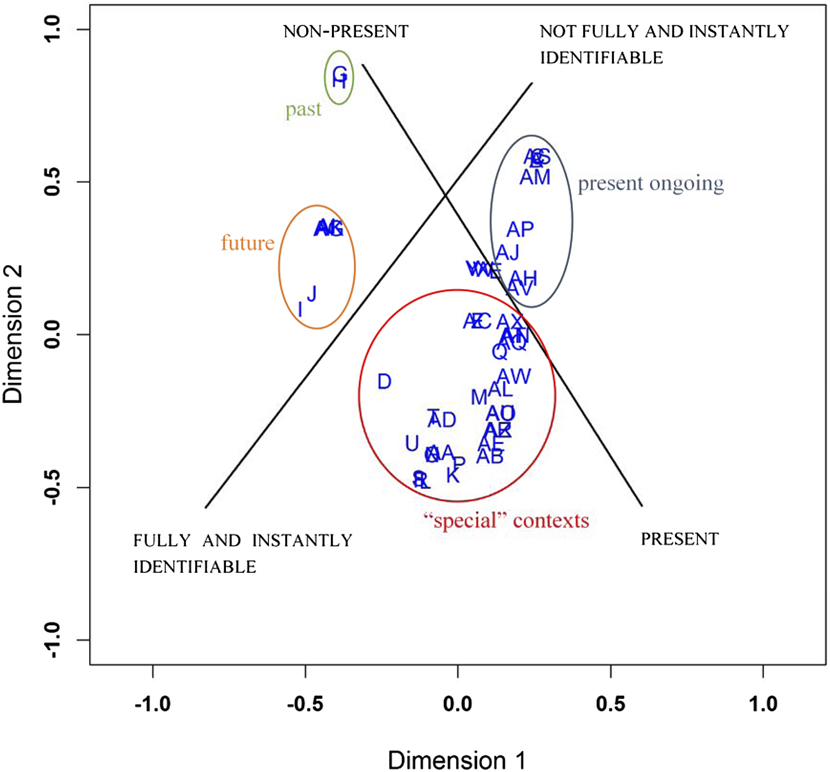
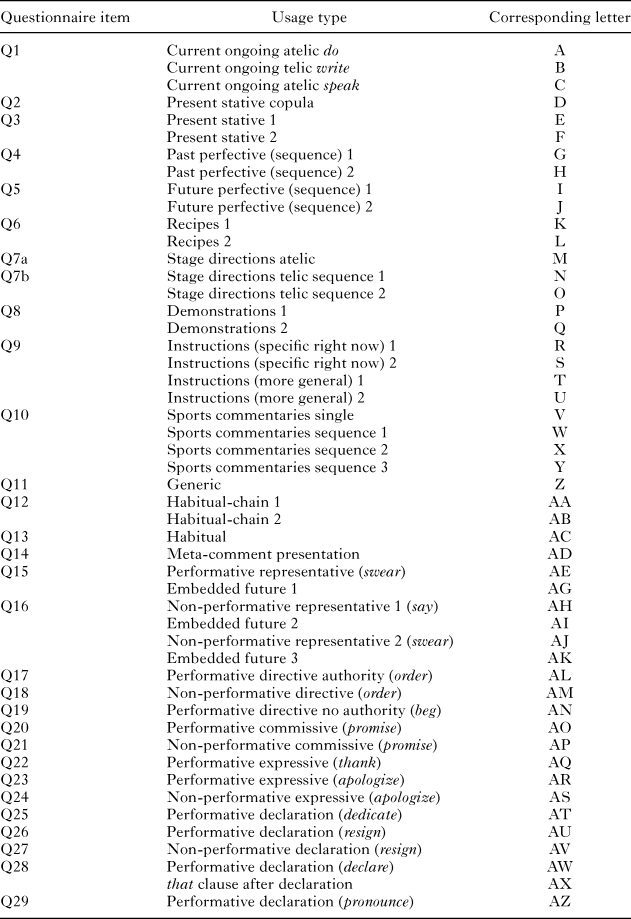
The two-dimensional representation that results from our analysis is shown in Figure 1. Each of the usage types we have distinguished is rendered by a letter or a combination of two letters for reasons of legibility. Still, given the high degree of overlap of some usage types, they are not always easy to distinguish from one another (a problem that appears to be common with MDS). In Table 1, we provide the accompanying legend. We also indicate, in Figure 1, the four clusters of usage types that we can discern (‘past’, ‘future’, ‘present ongoing’, and ‘“special” contexts’) and the two aforementioned dimensions (in small caps).
Two-dimensional model of usage types and the extent to which they are expressed identically in the individual languages of our sample.

Legend of usage types, their item number in the questionnaire, and their letter displayed in Figure 1

The role of the ‘present versus non-present’ dimension is relatively easy to infer from the position of the usage types in Figure 1: the cutting line running from the bottom left to the top right corner splits the non-present uses (left) from the present uses (right). Since our study mainly deals with present-time uses, there are obviously few non-present uses attested in our questionnaire. We can see that future events (I, J, AG, AI, AK) are closer to the cutting line than past events (G, H), which is not surprising given the cross-linguistically attested association between present and future (in the sense that they often receive the same formal expression) (cf., e.g., Comrie, Reference Comrie1985, p. 49, and Dahl, Reference Dahl and Dahl2000, on this phenomenon in European languages). On the ‘present side’ of the cutting line, we see that stative copular contexts (D) are closer (i.e., more similar) to non-present usage types than, say, performative declarations (AT, AU, AW, AZ), which is a consequence of the fact that the copular context in our questionnaire (‘[Standing in front of a house:] The house [TO BE] big’) contains a description that is taken not just to include the time of speaking (as opposed to, e.g., performative declarations). Moreover, copulas often do not get any overt formal expression (e.g., MS Arabic, Japanese, and Mandarin Chinese), as opposed to the other special contexts of use, which therefore cluster together more closely.
More important for the present purposes, the second dimension is ‘full and instant identifiability versus no full and instant identifiability’: the more one moves up to the upper-right corner, the less instantly identifiable the reported events become. In the upper-right corner we find the ‘present ongoing’ cluster, which comprises all the contexts that would get progressive marking in the languages that have it. This cluster includes canonical currently ongoing atelic (A, C) and telic events (B), and also verbs that can be used in performative contexts, such as resign, but that do not function as such in the given (descriptive) context (AS, AM, AP, AJ, AH, AV). Some of these (non-performatively used) performative verbs, such as order (AM) and apologize (translated as ‘say sorry’ in many languages; AS), pattern closer to canonical progressive contexts than others, such as promise (AP), swear (AJ), or resign (AV). This might indicate that the latter are more likely to pattern as achievements, which are normally incompatible with progressive aspect (e.g., ?? Rick was noticing she’d changed).
Moving further towards the lower-left corner, the first set of usage types are the examples of play-by-play reports accompanying sports commentaries included in the questionnaire (V, W, X, Y). These appear closer to non-fully-and-instantly-identifiable uses than to fully and instantly identifiable contexts in Figure 1. This means that, in spite of what is suggested by the fact that English features the simple present in such sports commentaries, play-by-play reports do not normally get the same aspectual construction as other contexts of use that we have identified as ‘special’ in Section 2. In fact, given their position on the map in Figure 1, sports commentaries cannot be considered part of the cluster of ‘special’ contexts of use, involving fully and instantly identifiable events. Although the results may be somewhat distorted by the high presence of Slavic languages, none of which allow perfective aspect in sports broadcasting, we have noted in Section 2 that there is an important difference between play-by-play reports and all of the other special contexts of use, in that the former do not involve events that are (objectively) controlled by the speaker. In the other contexts, the speaker either controls the events she is carrying out at the time of speaking, as in the case of performatives and demonstrations, or has epistemic control over fictive situations she conjures up at will herself, as with instructions or stage directions. With sports commentaries, however, the speaker does not epistemically control the events that are carried out by someone else (cf. also Dickey, Reference Dickey2000, p. 173). Hence, even if sports events are typically part of some sort of script, which makes their occurrence highly unsurprising, they have some features of canonical (non-first person) reports of ongoing events as well. It should therefore not be surprising that sports broadcasts fall in between the ‘present ongoing’ cluster (involving events that are not fully and instantly identifiable) and the ‘“special” contexts’ cluster (involving events that are fully and instantly identifiable), right on the dividing line between these clusters.
When moving further down on the ‘present side’ of the graph, we encounter more of the special contexts of use discussed in Section 2, as predicted. A number of more specific subclusters can be discerned: (i) the different performative contexts (AE, AL, AN, AO, AQ, AR, AT, AU, AW, AZ); (ii) the homogeneous and unbounded statements (‘generic’ [Z], ‘stative 2’ [F], and ‘habitual’ [AC]); and (iii) the virtual uses (various examples of instructions, recipes, and stage directions, e.g., R, S, L, U, O). These clusters are generalizations: there are some specific usage types that behave differently from their likes, seemingly for idiosyncratic reasons that we cannot discuss in detail here.Footnote 12
We have up to now only discussed the role of full and instant identifiability for the usage types on the ‘present’ side of the graph. Given the low number of non-present-time contexts in our sample, it is difficult to attach any meaningful interpretations to the positions of those usage types that are on the non-present side and to the influence in this respect of the epistemic dimension of full and instant identifiability. Our preliminary observations indicate that future-time contexts appear to be closer in terms of aspecto-temporal marking to (other) fully and instantly identifiable contexts than past-time contexts. This might be surprising given the fact that non-scheduled future-time events are typically events that cannot be fully and instantly identified on the basis of the conceptualizer’s current knowledge (as opposed to completed past events). Yet this unexpected distribution of future and past events in Figure 1 may be a consequence of the questionnaire items involved: whereas the future contexts in our questionnaire involve first person singular predications – i.e., situations that the speaker controls epistemically – the past contexts involve a third person subject (a goat), hence events that are not within the speaker’s control. Once again, these are tentative explanations for very preliminary observations about a set of uses that are not central to our study.
In sum, our MDS analysis provides evidence for our hypothesis that usage types are clustered on the basis of their epistemic similarity. From the relative vicinity of performative usage types and other ‘special’ fully and instantly identifiable usage types, it can be inferred that, cross-linguistically, the aspectual construction used for the expression of performativity is also often used to report states, structurally valid situations, demonstrations, and virtual events that are epistemically controlled by the speaker. The non-fully-and-instantly-identifiable contexts of use included in the questionnaire appear at a greater distance from the performative usage types in Figure 1, showing that languages typically select a different construction for the expression of these non-fully-and-instantly-identifiable events. This formal overlap of performative contexts with other contexts involving fully and instantly identifiable events, and the lack of overlap of both with non-fully-and-instantly-identifiable events, is evidence for our claim that there is a cross-linguistically attested semantic association between performativity and full and instant identifiability, and this association is typically marked in a language by means of aspectual selection.
4.3. non-canonical english, slavic, and ms arabic
Our data show that performatives generally display the same formal marking within individual languages, irrespective of parameters such as type of illocutionary act or degree of authority.Footnote 13 Still, a few divergences appear if we consider some of the data more closely. Studies carried out by De Wit and Michaelis (ms.) for English and Israeli (2001) and Dickey (Reference Dickey2015) for Slavic claim that there are some contexts in which a performative can be marked aspectually in an exceptional way (for that language): by progressive aspect (in English) and by perfective aspect (in Slavic). In what follows, we briefly summarize their findings, and show how they tie in with our own. In addition, we make a few final comments on the special use of perfective aspect in ritualized performative contexts in MS Arabic.
4.3.1. The progressive in English
Starting from the observation that it is not entirely impossible in English to use progressive aspect in certain performative contexts (cf., e.g., Searle, Reference Searle1989, p. 537), De Wit and Michaelis (ms.) carried out a corpus investigation of the aspectual properties of English performative verbs from different illocutionary classes. As expected, a large majority of English performatives is marked exclusively by the simple present, yet there appear to be systematic exceptions as well, as illustrated in (22) and (23):Footnote 14
(22) As she walks, she mutters to herself… Jo: “I’m requesting… I’m… Captain, I’d like to request that I be the attorney assigned to rep – I’d like to request that it be myself who is assigned to represent”– (she stops) – “That it be myself who is assigned to represent?”
(23) ALI (to reporters): I’m dedicating this fight to all the African people who are fighting for their freedom and independence!
These exceptions are particularly common with performatives from the directive subclass, such as warn, order, and request, whereas they are virtually absent with expressives, such as thank and apologize, and commissives, such as promise and swear.
One might hypothesize that examples such as (22) and (23), which appear to defy our claim that performative utterances never take progressive aspect (in view of the contingent quality of the latter), result from the wish of speakers to be noticed – cf. the notion of extravagance proposed in Petré (Reference Petré2017). Using a construction in a context in which it does not normally appear – in this case, the progressive in a performative context – allows a speaker to make an utterance ‘stand out’, because it is somehow divergent from what is normally the case. The notion of extravagance is proposed specifically in connection with emphatic uses (of the progressive, notably), but it is not necessarily to be interpreted merely as relating to expressions of intensity, insistence, or commitment. Thus, while example (23) is clearly meant to be a more intensive expression than its simple-present counterpart, example (22) is actually more downplayed: the speaker does not want to present her request as a direct challenge. A notion like extravagance appears, in the case of progressive performatives, to cover contradictory values (insistence versus mitigation), and in this sense remains semantically rather vague, given that it is a stylistic/rhetorical principle. It is, however, associated with the historical rise of the progressive in English (Petré, Reference Petré2017), which may currently be expanding to performative contexts following the same mechanism, possibly also leading to more or less idiomatic expressions like I’m dedicating (versus I dedicate) that do not always appear to be extravagant (anymore). Yet even if we assume that this is the motivation for the attested progressive performatives, we still need to explain why these attestations seem to be restricted to certain illocutionary classes. There is, after all, no reason why a speaker would not want to give more emphasis to a promise or an apology. Building on De Wit and Brisard (Reference De Wit and Brisard2014a), De Wit and Michaelis (ms.) offer a tentative explanation for this puzzle that neatly ties in with our own analysis: they argue that it is the intrinsically contingent quality of the progressive that prevents its occurrence with verbs expressing commissive or expressive speech acts. Promises or apologies are not the kinds of act that a speaker would want to present as not fully and instantly identifiable, and thus valid, at the time of speaking. It appears, then, that directives are more open to progressive (and thus contingent) construals for reasons of extravagance. This might have something to do with the fact that some directives are urgent, therefore requiring more emphasis, or, on the other hand, with the speaker’s wish to downplay the effect of directives that threaten the addressee’s negative face (Brown & Levinson, Reference Brown and Levinson1987). Yet the precise details of this relationship between contingency and illocutionary class is a topic we leave open for future analyses to address (such as De Wit & Michaelis, ms.).
4.3.2. Perfective aspect in Slavic
In Section 4.1, we claimed that those languages that have a marker of general imperfectivity, like Slavic languages, systematically use this imperfective marker in performative sentences. Yet, again, a close look at data from different North-Slavic languages (Russian, Polish, and Czech) reveals that it is not impossible to find instances of perfective aspect used in performative contexts. For instance, as pointed out by, among others, Barentsen (1985, pp. 272–273), Dickey (2000, pp. 178–183), Forsyth (1970, p. 150), and Israeli (2001, pp. 81–94), certain verbs of communication (or verba dicendi) in Russian do seem to take present-perfective marking in performative utterances. This is, for example, the case for the verb prosit’ ‘request’, as shown in (24):
(24) A teper’ po-prošu provodit’ menja k karete.
and now pfv-request.prs.1sg take 1sg.acc to coach
‘And now I ask you to see me to the coach.’ (Dickey, Reference Dickey2000, p. 179) (Ru)
According to Israeli (2001, pp. 84–88), performative contexts such as (24) trigger the use of perfective aspect to emphasize the authority of the speaker. This sense of authority is absent in more neutral, imperfective construals. Another motivation for using perfective aspect with some verba dicendi in performative expressions in Russian is to present the denoted performative event as new, whereas imperfective marking would imply reiteration (2001, pp. 88–94). Polish, too, allows the use of perfective aspect in a limited set of performative contexts featuring certain verbs of communication, primarily poproszyć ‘request’, przyznać (się) ‘admit’, and pozwolić sobie ‘allow for oneself’ (Dickey, Reference Dickey2015; Wiemer, Reference Wiemer, Dmitrenko and Zaika2014). Although Slavic perfective aspect and English progressive aspect are clearly distinct categories, the motivation for their exceptional appearance in performative utterances is probably the same: standing out. When speakers of Russian or Polish opt for perfective aspect in a performative context – the non-standard option – we may assume that they have a specific reason to do so, e.g., to draw explicit attention to features like authority and newness. Whatever they may suggest through this marked choice, the atypicality of the contexts themselves seems to be sufficient cause for using a marker that is not expected in that context.
It should be noted that the data on performatives in Czech, which appears to allow perfective aspect in more diverse contexts and with a broader range of verbs, is less easy to account for: there are no parameters such as authority or newness that govern aspectual choice, as is the case in Russian. According to Wiemer (Reference Wiemer, Dmitrenko and Zaika2014) and Dickey (Reference Dickey2015), it is not unlikely that register and bygone Austro-Hungarian speaking habits play an important role in this matter.
4.3.3. Perfective aspect in MS Arabic
As mentioned in Section 1, MS Arabic performatives typically feature imperfective aspect (also sometimes called imperfect aspect in descriptive grammars), which is marked by verbal prefixation. There is, however, one notable exception included in our questionnaire: the Arabic translation of the declaration ‘I PRONOUNCE you President’ (questionnaire item 29) features perfective aspect, marked by verbal suffixation. Additional evidence from Khalil and McCarus (Reference Khalil and McCarus1999) suggests that our questionnaire case is an illustration of a more general pattern: of all types of performative verb in MS Arabic, only declarations allow perfective (or ‘perfect’, as they call it) aspect (although an imperfective construal is always possible too), as illustrated in (25):
(25) Faṣalnā-ka (mina l-laǧnati).
fire.pfv.1pl-2sg from def.sg-committee
‘You are (hereby) fired from the committee.’ (Khalil & McCarus, Reference Khalil and McCarus1999, p. 13)
Declarations, which “bring about changes in the formal or official status of a person or a thing” (Khalil & McCarus, Reference Khalil and McCarus1999, p. 13), are the most institutionalized type of performative. Prototypical declarations, like pronouncing someone President, involve speakers who have the proper institutional authority, and they belong to a register of more formulaic, possibly stilted, language (see Section 3). It is not unlikely, therefore, that such declarative formulae are remnants from Classical Arabic. This analysis offers a straightforward explanation for the attestation of contemporary perfective performatives: in Classical Arabic, perfective aspect was the default form in performative contexts (Hewson, Reference Hewson and Binnick2012, p. 518; Procházka & Bsees, Reference Procházka and Bsees2011). Therefore, the more institutionalized – i.e., ritualized – the declaration, the more likely a perfective construal becomes: one can pledge allegiance to the king, appoint a committee, or pronounce a couple husband and wife using perfective aspect. On the other hand, it is no surprise either that the other, less formal declaration in our questionnaire, ‘I DECLARE that I withdraw’, does not normally feature perfective aspect in MS Arabic. It is not entirely clear why an aspectual shift occurred in the expression of performatives in the history of Arabic – Procházka and Bsees (2011, p. 2) vaguely mention “European influence”, yet we have no indication that European languages are overall more imperfective-prone in performative contexts. Perfective aspect was generally more broadly used in Classical Arabic, and so it is not unlikely that performatives are just part of a larger tendency in MS Arabic to restrict the use of the perfective.
The case of MS Arabic thus illustrates that it is important to include such features as degree of ritualization when analyzing the syntax, semantics, and pragmatics of performatives. What is the case for present-day varieties may have been different at older stages of a language, and it is not unlikely that ritualized performative uses reflect those older stages. Our study has shown that, apart from ritualization, other parameters that need to be taken into account when analyzing performatives in individual languages are: illocutionary type, information status (newness/repetition), language contact, and (institutionalized) authority.
5. Conclusion
In this paper we have concentrated on the epistemic motivation underlying aspect choice in performative sentences across languages. On the basis of questionnaire data elicited from native speakers, and by means of the statistical tool of Multidimensional Scaling, our study provides evidence for our hypothesis that performatives generally select that aspectual construction that is also used for the expression of other types of fully and instantly identifiable situations, namely present-time states, habituals, generic situations, recipes, demonstrations, instructions, predictable (scheduled) future events, and realis conditionals. Since progressive aspect cannot be used to report fully identifiable situations, there are no languages in which the progressive appears in the context of performatives (barring the few well-motivated English examples discussed in Section 4.3.1).
A larger typological study, still based on native-speaker elicitations, could provide additional corroboration for our claim that aspectual construal (in performative utterances and elsewhere) has an epistemic basis. The same is true for more in-depth analyses of (performativity and) aspect in individual languages. These could reveal more exceptions of the type discussed in Section 4.3. More generally, the fact that aspectual constructions (also) carry an epistemic meaning, as our analysis has unveiled, can shed a new light on how to unify the at times disparate array of uses that these constructions may have in individual languages.
APPENDIX: QUESTIONNAIRE
NAME (optional):
LANGUAGE:
Instructions
Please provide a translation/equivalent for the English sentences listed below. Provide both a literal and a less literal, more natural translation, if both are available, and explain the differences. If there is anything else that you think might be relevant, feel free to add comments.
In each of the sentences, the verb is presented in the infinitival form and in capitals. If your language makes use of a non-Latin script, then please add a transliterated version. Please also provide word-by-word glosses.
Part 1
(1) Q. What your brother [TO DO] right now?
A1. He [TO WRITE] a letter.
A2. He [TO SPEAK], so please be quiet.
(2) [Standing in front of a house:] The house [TO BE] big.
(3) My brother [TO KNOW] (present) that she [TO LOVE] him (present).
(4) Yesterday, the goat first [TO CROSS] the street and then [TO JUMP] over the trench.
(5) Tomorrow I first [TO WRITE] a letter and then I [TO WORK] for an hour.
Part 2 (Please do not use imperatives, unless there are no other options.)
(6) Recipes:
First you [TO ADD] sugar, then you [TO POUR] the milk.
(7) Stage directions (e.g. as part of a play script – translate the stage direction between square brackets):
a. “I’m tired” [Sam [TO YAWN]] (= first Sam speaks, then he yawns)
b. “I’m tired” [Sam [TO TAKE] the chair and [TO SIT DOWN]] (translate the stage direction between square brackets)
(8) Demonstrations:
Look, I [TO OPEN] the box and [TO TAKE OUT] the cards.
(9) Instructions/Explanations:
c. Now you [TO PRESS] “Enter” and then you [TO WAIT].
d. Whenever / Each time you [TO PRESS] “Enter”, you [TO WAIT] a few seconds.
(10) Sports commentaries, live broadcasting:
Pele [TO SCORE]!
Neymar [TO PASS], Messi [TO SHOOT] and … [TO SCORE]!
(11) Tigers [TO EAT] meat.
(12) Whenever / Each time I [TO SMOKE], I [TO FEEL SICK].
(13) Virginia [TO SMOKE] (as a habit).
(14) In a presentation:
Now I [TO RETURN] to the first slide.
Part 3
(15) I [TO SWEAR] that I [TO DO] it.
(16) She not just [TO SAY] that she [TO DO] it, she [TO SWEAR] that she [TO DO] it (right now).
(17) (general to soldier:) I [TO ORDER] you to leave.
(18) Right now, the general [TO ORDER] the soldier to leave.
(19) (soldier to general:) I [TO BEG] you to let me go.
(20) I [TO PROMISE] to come.
(21) He [TO PROMISE] to come (right now).
(22) I [TO THANK] you for coming.
(23) I [TO APOLOGIZE] for coming late.
(24) [What your brother [TO DO] right now?] He [TO APOLOGIZE] for coming late.
(25) I [TO DEDICATE] this book to my husband.
(26) I hereby [TO RESIGN].
(27) She not [TO RESIGN] (right now).
(28) I [TO DECLARE] that I [TO WITHDRAW].
(29) I [TO PRONOUNCE] you President.