



Depression is a chronic mental disorder, with lifetime prevalence rates of 14.6% in high-income countries and 11.1% in low- and middle-income countries. Reference Kessler and Bromet1 As the leading psychiatric contributor to global disability, depression affects over 34% of the worldwide population, with its disease burden demonstrating a marked upward trajectory. Reference Shorey, Ng and Wong2 Recent findings from the global burden of disease study reveal that depression exhibited one of the largest increases in age-standardised disability-adjusted life-year rates between 2010 and 2021 (16.4%), ranking as the second leading cause of mortality across all ages and genders (56.3 million deaths). 3 The detrimental effects of depression extend beyond social functional decline, elevated suicide risk and increased healthcare utilisation. Reference Yan, Li, Duan and Zhao4 Notably, individuals with depression demonstrate higher all-cause mortality than the general population, with only a minor proportion attributable to direct psychiatric causes, Reference Wicke, Ernst, Otten, Werner, Dreier and Brähler5 suggesting complex mechanistic roles of comorbidities.
The bidirectional relationship between depression and chronic physical conditions is well established. Individuals with chronic diseases exhibit a higher risk of depression. Reference Moussavi, Chatterji, Verdes, Tandon, Patel and Ustun6 In contrast, depression increases susceptibility to several non-communicable diseases, such as diabetes, obesity and dementia. Reference Cherbuin, Kim and Anstey7 However, current evidence predominantly focuses on individual comorbidities, lacking comprehensive temporal dynamics analysis. To date, emerging studies exploring depression-related comorbidity trajectories remain methodologically constrained. A disease trajectory network study identified three major comorbidity clusters (cardiometabolic, chronic inflammatory and tobacco-related diseases) post-depression diagnosis, but failed to capture pre-diagnostic accumulation patterns spanning decades. Reference Han, Hou, Yang, Chen, Ying and Hu8 Similarly, a symptom trajectory study of depression–anxiety comorbidity identified six treatment-response subtypes, but excluded physical comorbidities, limiting insights into long-term somatic impacts. Reference Cukor, Xu, Vekaria, Wang, Olfson and Banerjee9
Depression comorbidities may arise through several interconnected mechanistic pathways. First, direct relationships are supported by shared genetic susceptibility loci such as SLC6A4-mediated serotonergic dysregulation, which bridges nociceptive and affective circuitry dysfunction. Reference Aleknaviciute, Tulen, de Rijke, van der Kroeg, Kooiman and Kushner10 Second, overlapping environmental and genetic risk architectures derived concurrent conditions, exemplified by neuroinflammatory pathways jointly elevating risks for hypertension and metabolic disorders. Reference Kendler, Aggen, Knudsen, Røysamb, Neale and Reichborn-Kjennerud11 Third, the effects of antidepressant therapies, particularly selective serotonin reuptake inhibitors, may inadvertently alter metabolic homeostasis and immune responses, creating secondary comorbidity risks. Reference Kappelmann, Lewis, Dantzer, Jones and Khandaker12 However, systematic delineation of comorbidity trajectories remains limited, underscoring the critical need for longitudinal phenotyping to guide interventions.
In this study, we first quantified a 20-year silent accumulation phase preceding depression diagnosis, systematically analysing dynamic comorbidity trajectories. We then revealed specific progression patterns for genetics, gender, age and medication history, and identified characteristic prodromal conditions. These findings may shift clinical paradigms from post-diagnosis comorbidity management to trajectory-based precision prevention, informing time-sensitive, stratified intervention strategies.
Method
Study participants
The UK Biobank is a prospective cohort encompassing 502 462 UK residents aged 37–73 years, recruited between 2006 and 2010 through 22 assessment centres across England, Wales and Scotland. Reference Bycroft, Freeman, Petkova, Band, Elliott and Sharp13 As an open-access biomedical resource, it systematically integrates multidimensional health data, including ICD-10-coded medical histories, phenotypic measurements from baseline assessments and longitudinal healthcare records through national database linkages. Specifically, hospital admission timelines and diagnostic information are derived from Health Episode Statistics for participants in England and Wales. The study was approved by the North West Multi-Centre Research Ethics Committee (NHS identifier:11/NW/0382), with written informed consent obtained from all participants in accordance with the Declaration of Helsinki. The study design and operational protocols are detailed in institutional publications and its official portal (https://www.ukbiobank.ac.uk). Reference Drozd, Pujades-Rodriguez, Lillie, Straw, Morgan and Kearney14 For this specific analysis (application number: 46478), we included only those participants with a diagnosis of depression at any time in life until the study censorship date of 31 December 2024. This resulted in a cohort of 32 953 participants who had developed depression.
Definitions of depression and comorbidities
We focused on the comorbidities of depression and other conditions as outlined in Cui et al’s review of assumptions, mechanisms and treatments for depression. Reference Cui, Li, Wang, Wu, Liu and Yu15 We examined depression comorbidities according to the ICD-10, including Alzheimer’s disease, anxiety, bipolar disorder, coronary heart disease (CHD), diabetes, dorsopathies, hypertension, obesity, obsessive–compulsive disorder (OCD) and Parkinson’s disease. All UK Biobank ICD-10 codes for our definition of depression and comorbidities are presented in Supplementary Table 1. Diagnostic timelines were derived from multiple health records: (a) self-reported medical histories collected through baseline questionnaires and nurse-led interviews at assessment centres, (b) primary care documentation from general practitioners and (c) national hospital admission registries, including Health Episode Statistics (England/Wales) and Scottish Morbidity Records (Scotland). The earliest identifiable diagnosis date across these sources was adopted as the outcome timestamp. For each comorbidity, we calculated the difference between its date of first diagnosis and the date of first depression and recurrent depression diagnosis, to understand the sequence and relative timing of comorbidity occurrence. It is important to note that the diagnostic trajectories and time windows described in this study refer exclusively to the chronological order of diagnostic records in healthcare databases.
Polygenic risk score data-sets of depression
The genome-wide association study summary statistics of depression were obtained from Howard et al. Reference Howard, Adams, Clarke, Hafferty, Gibson and Shirali16 The study performed a genome-wide meta-analysis of depression based on a sample size of 807 553 individuals (246 363 cases and 561 190 controls) by combining summary statistics from 3 large independent studies. Reference Howard, Adams, Shirali, Clarke, Marioni and Davies17–Reference Wray, Ripke, Mattheisen, Trzaskowski, Byrne and Abdellaoui19 Quality control and association analyses were conducted separately for each contributing data-set. For UK Biobank, genetic data were imputed using the Haplotype Reference Consortium and UK10K reference panels, and association testing was performed using BGENIE with adjustment for gender, age, genotyping array and principal components. Results were transformed to the logistic scale. For 23andMe_307k and PGC_139k, summary statistics were obtained directly from the original studies, with variants filtered for imputation accuracy and minor allele frequency. The meta-analysis was performed using an inverse variance-weighted approach in Metal, Reference Willer, Li and Abecasis20 conditional on each variant being available in all 3 cohorts, resulting in 8 098 588 variants tested. Independent significant variants were identified through clumping and conditional analysis. Detailed information on genotyping, imputation, quality control and statistical analysis is available in the Online Methods by Howard et al. Reference Howard, Adams, Clarke, Hafferty, Gibson and Shirali16
Polygenic risk scores for depression
In PRSice-2 (version 2.3.5, Linux 64-bit, King’s College London, London, UK; https://choishingwan.github.io/PRSice/), the clumping procedure was implemented to select independent single nucleotide polymorphisms (SNPs) by retaining the most strongly associated index SNP within each linkage disequilibrium block. SNPs within a 250 kb window and with linkage disequilibrium r 2 > 0.1 relative to the index SNP were clumped together and excluded from further analysis. Polygenic risk scores (PRS) for depression were constructed using recently published large-scale genome-wide association study summary statistics for depression. Reference Howard, Adams, Clarke, Hafferty, Gibson and Shirali16 Effect estimates and significance levels derived from the UK Biobank cohort were applied to develop an optimised PRS model. Briefly, individual PRS was computed as the weighted sum of allele effects across all SNPs retained in the final model, with adjustment for the top ten principal components of genetic ancestry, age and gender as covariates. The analysis compared 24 616 cases with 352 086 controls. The optimal PRS model was identified by evaluating a series of P-value thresholds ranging from 5 × 10⁻⁸ to 1, incremented by 0.0005 (with parameter setting code as ‘‐‐interval 0.0005 ‐‐lower 5e−08’). The threshold yielding the highest Nagelkerke’s R 2 of 0.079 was selected. A total of 464 666 SNPs meeting this criterion were then used to generate the PRS for all individuals within the UK Biobank cohort.
Statistical analysis
Continuous variables were expressed as mean±s.d., whereas categorical variables were summarised as frequencies (percentages). For intergroup comparisons, we employed parametric unpaired t-tests or non-parametric Mann–Whitney U-tests for continuous variables, and chi-squared tests for categorical variables. All analyses were conducted with two-tailed tests and a corrected significance threshold at P < 0.005 (0.05/10). Genetic risk stratification was performed by dividing participants into high-and low-risk groups based on the median PRS. Gender stratification was performed utilising UK Biobank field identifier 31 for classification. Age stratification was implemented with participants categorised into three groups: those aged <50 years, those aged 50–60 years and those aged >60 years. We performed sensitivity analyses for depression and the comorbidities. Specifically, we excluded all individuals whose depression or comorbidity diagnoses were based on self-report. In addition, we constructed the comorbidity trajectory of recurrent depression and conducted the same stratified analysis.
Results
Characteristics of participants
Among the study population, 32 953 individuals were diagnosed with depression, presenting an average of 1.8 comorbidities per person (Table 1). The prevalence of the ten comorbidities varied substantially, from 0.8% for OCD to 53.4% for hypertension. Compared with females, males were diagnosed with depression at an older age (56.8 v. 56.3 years; P < 0.005) and had a higher comorbidity burden (2.0 v. 1.7 per person; P < 0.005). Specifically, CHD, hypertension, diabetes, Alzheimer’s disease and Parkinson’s disease were more prevalent in males, whereas anxiety, obesity and dorsopathies were more common in females (all P < 0.005). From the overall depression cohort, we identified 2402 individuals diagnosed with recurrent depression, who had an average of 2.0 comorbidities per person (Supplementary Table 2). In this subgroup, distinct comorbidity patterns were observed. Males and females were diagnosed at a comparable age (55.2 v. 54.8 years), but males carried a higher comorbidity burden (2.1 v. 1.9 per person; P < 0.005). Consistent with the full cohort, CHD, hypertension, diabetes, Alzheimer’s disease and Parkinson’s disease were more prevalent in males, whereas anxiety, obesity and dorsopathies were more frequent in females (all P < 0.005).
Participants characteristics for depression

Sequence and chronology of depression in the trajectory of multiple long-term condition accrual
In the majority of individuals, depression was the first diagnosed condition in the multimorbidity sequence (54.1%; Fig. 1(a)). This pattern was similar when stratified by genetic risk (54.9% in the high-PRS group and 54.1% in the low-PRS group). However, gender-specific differences emerged: females were significantly more likely than males to receive a depression diagnosis earlier in the sequence (56.9 v. 49.2%; P < 0.005). A pronounced age-related trend was also observed: depression preceded other conditions in 67.2% of younger individuals (≤50 years), compared with 44.4% of those aged ≥60 years. We next analysed the temporal dynamics of comorbidity accumulation relative to depression diagnosis (Fig. 1(b)). Comorbidity counts increased over time, showing accelerated accumulation starting approximately 5 years before depression diagnosis and persisting for about 5 years post-diagnosis, before plateauing. Post-diagnosis accrual rates were faster in low-PRS individuals than in high-PRS individuals. Overall, males demonstrated higher comorbidity burdens than females, particularly among older adults (≥60 years).
Position of depression in sequence of long-term condition diagnoses and chronology of comorbidity accrual related to depression. (a) Histograms illustrating the position of depression within the sequence of long-term condition diagnoses in the total cohort, stratified by PRS, gender, age, antihypertensive drug use and antidepressant use. (b) For strata at age at depression diagnosis, the mean number of non-depression comorbidities are plotted against time relative to depression diagnosis in the whole cohort, stratified by PRS, gender, age, antihypertensive drug use and antidepressant use. Negative time denotes before depression. PRS, polygenic risk score.

To assess robustness, a sensitivity analysis was performed excluding individuals with self-reported diagnoses. The temporal position of depression within the comorbidity sequence remained consistent overall and across subgroups (Supplementary Fig. 1A). Similarly, the trajectory of comorbidity accumulation was preserved, including the accelerated increase approximately 5 years before depression diagnosis. Although the mean number of comorbidities was slightly lower in this sample, the overall temporal pattern was unchanged (Supplementary Fig. 1B).
In the recurrent depression cohort, the condition most frequently appeared as the first diagnosis, preceding any comorbidity in over 80% of individuals (Supplementary Fig. 2A). Analysis of cumulative comorbidity burden relative to the recurrent depression diagnosis revealed a distinct temporal pattern: accelerated accumulation began approximately 2 years before diagnosis, a shorter pre-diagnostic window than in the general depression cohort. Additionally, the mean comorbidity count in this subgroup was lower overall compared with the general depression cohort (Supplementary Fig. 2B).
Timing of individual comorbidity diagnoses in relation to depression
Figure 2(a) shows the temporal relationship between depression and specific comorbidities. Hypertension was the earliest precursor (median: −2.6 years; interquartile range (IQR): −7.0 to 0.0), followed by CHD (−2.4 years; IQR: −8.0 to 2.0) and diabetes (−1.6 years; IQR: −6.0 to 2.0). In contrast, neurodegenerative and psychiatric conditions such as Alzheimer’s disease (2.5 years; IQR: 0.0–5.0) and bipolar disorder (1.7 years; IQR: −1.0 to 7.0) were predominantly diagnosed after depression. Anxiety exhibited a narrow diagnostic window around depression (1.4 years; IQR: 0.0–3.0) (Supplementary Table 3). For diagnoses occurring immediately before and after depression (Fig. 2(b)), hypertension was the most frequent antecedent (1.71%), followed by dorsopathies (0.88%) and anxiety (0.80%). Following depression diagnosis, anxiety was the most common subsequent condition (1.04%), with obesity (0.72%) and CHD (0.58%) also prevalent. Among synchronous diagnoses, anxiety was the most frequent (10.84%), followed by hypertension (8.87%) and obesity (3.61%) (Supplementary Table 4).
Chronology of comorbidity diagnoses in relation to depression diagnosis. (a) Ridgeline plot illustrating the chronological distribution of comorbidity diagnoses in relation to depression diagnosis. The amplitude of Ridgelines does not relate to comorbidity prevalence, the data for which are noted to the right of the plot for reference. (b) Sankey plot illustrating the comorbidity immediately before and after depression diagnosis. Comorbidities diagnoses simultaneously with depression are not illustrated.

These temporal relationships were further assessed in sensitivity analyses. In the cohort excluding self-reported diagnoses, the median diagnosis times for most comorbidities remained aligned with the primary analysis (Supplementary Fig. 3A). Specifically, hypertension (−1.3 years), CHD (−1.3 years) and diabetes (−1.4 years) preceded depression, whereas Alzheimer’s disease (2.0 years), anxiety (0.9 years) and bipolar disease (2.7 years) followed it. The relative temporal ordering was unchanged, confirming robustness. Analysis of diagnoses immediately proximate to depression revealed consistent profiles: in the sensitivity cohorts, hypertension and anxiety were the most frequent diagnoses, immediately before and synchronous with depression, respectively (Supplementary Fig. 3B).
In the recurrent depression cohort, diagnoses of specific comorbidities occurred much later after the index depression diagnosis (Supplementary Fig. 4A). For instance, hypertension was diagnosed a median of 9.3 years after diagnosis (IQR: 0.0–16.0), and CHD was diagnosed a median of 8.8 years after diagnosis (IQR: 0.0–16.0). Neurodegenerative and psychiatric conditions also showed longer delays, such as Alzheimer’s disease at 11.8 years (IQR: 4.0–20.3) and anxiety at 8.4 years (IQR: 0.0–15.0) post-diagnosis. The proportions of comorbidities diagnosed immediately before, synchronously with or after recurrent depression were markedly lower (Supplementary Fig. 4B). Over 98% of individuals had no comorbidity recorded immediately before or after their recurrent depression diagnosis.
Stratified analysis of comorbidity chronology relative to depression diagnosis
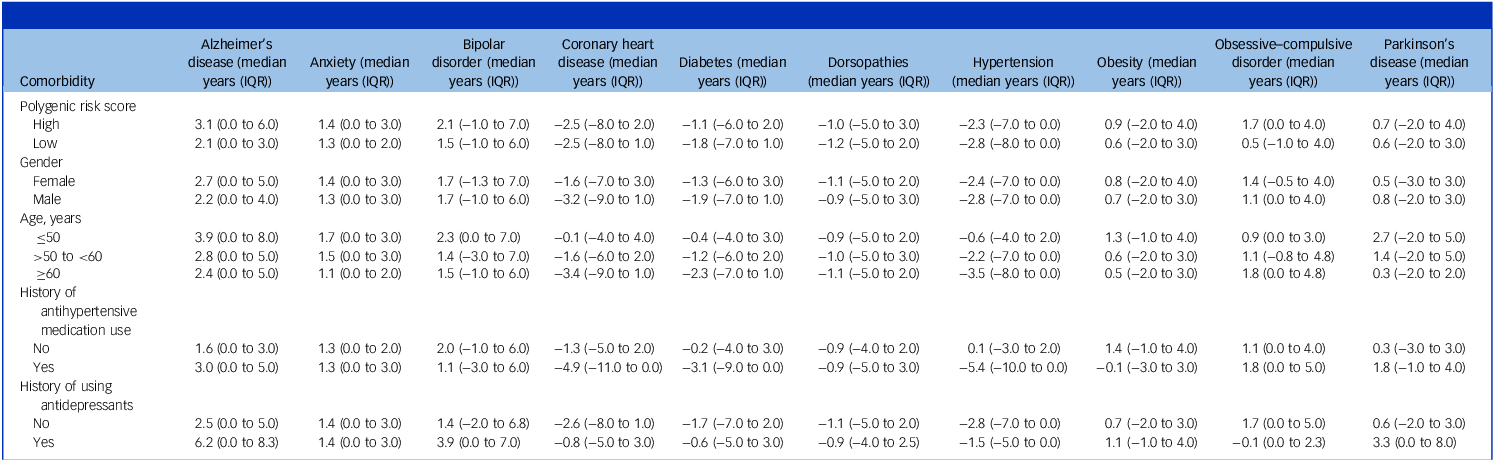
High-PRS groups exhibited later post-depression diagnoses for psychiatric comorbidities compared with low-PRS groups, such as Alzheimer’s disease (3.1 v. 2.1 years), bipolar disorder (2.1 v. 1.5 years) and OCD (1.7 v. 0.5 years) (Table 2). Conversely, metabolic disorders such as diabetes and hypertension were diagnosed earlier pre-depression diagnoses in the low-PRS group. Females had delayed post-depression diagnoses for neuropsychiatric conditions (e.g. Alzheimer’s disease: 2.7 v. 2.2 years), whereas males exhibited earlier pre-depression diagnoses for cardiovascular/metabolic conditions (e.g. CHD: −3.2 v. −1.6 years). Younger individuals (≤50 years) received diagnoses for Alzheimer’s disease (3.9 years), obesity (1.3 years) and bipolar disorder (2.3 years) after depression. In contrast, older adults (≥60 years) showed pronounced pre-depression diagnoses for CHD (−3.4 years), diabetes (−2.3 years) and hypertension (−3.5 years). Medication history further stratified the timelines. Antihypertensive medication use was associated with a substantially earlier pre-depression diagnosis of cardiometabolic conditions (e.g. CHD: −4.9 v. −1.3 years). Conversely, antidepressant use was linked to a delayed post-depression diagnosis of neurodegenerative conditions (e.g. Alzheimer’s disease: 6.2 v. 2.5 years). These overall stratification patterns were preserved in the sensitivity analysis (Supplementary Table 5).
Chronology of comorbidity diagnoses in relation to depression diagnosis for stratified population

In the recurrent depression cohort, the comorbidity chronology presented a distinct pattern. Unlike the broader cohort, cardiometabolic conditions typically emerged many years after, rather than before, the index diagnosis (e.g. hypertension: 9.3 years post-diagnosis; CHD: 8.8 years post-diagnosis). This pervasive post-depression delay was observed for nearly all comorbidities, including neurodegenerative diseases such as Alzheimer’s disease (11.8 years) and Parkinson’s disease (10.0 years). Stratification analyses confirmed that these prolonged delays were consistent across genetic risk, gender and age categories (Supplementary Table 6).
Discussion
This population-based study established temporal diagnostic sequences between depression and ten major comorbidities. Half of depression cases presented as the initial diagnosis, particularly among females and younger individuals. The accumulation of recorded comorbidities exhibited a 5-year bidirectional acceleration phase. Hypertension served as the earliest precursor of depression, whereas anxiety represented the most frequent secondary comorbidity. These findings provide critical temporal epidemiological evidence for depression within the diagnostic sequencing of multimorbidity.
Our findings corroborate and extend the recognised heterogeneity of depression, wherein the assumption of clinical homogeneity has been identified as a major barrier to addressing its multifactorial comorbidities. Reference Feczko and Fair21 Building on prior evidence regarding polygenic burden and recurrence risks, we further delineated distinct age-stratified pathophysiological trajectories: late-onset depression demonstrated accelerated dementia progression alongside a predominance of vascular comorbidities, Reference Jang, Kim, Moon, Lim and Kim22 contrasting with the severe recurrence patterns characteristic of early-onset cases. This enhanced temporal resolution reveals bidirectional metabolic interactions. For example, depressive symptom severity predicted a 25–80% increase in hypertension incidence across age groups, whereas elderly depressed cohorts exhibited an annualised increase in diabetes risk mediated by hypertension and dyslipidaemia. Reference Gao, Yang, Ma, Ma, Jing and Liu23 The identification of dorsopathies as sentinel pre-depression conditions, coupled with evidence of neuroinflammatory latency in Alzheimer’s disease, Reference Hirakawa and Terao24 suggests serotonergic/noradrenergic dysregulation within pain–mood circuits, rather than purely cytokine-mediated neurodegeneration.
Building on the observed temporal patterns of diagnostic records, we considered a stage-specific hypothesis for potential pathophysiological links between depression and its multisystem comorbidities. During the 5–10 years pre-diagnosis, subclinical inflammation is a central feature, with hypertension and chronic pain serving as sentinel manifestations. Reference King, Mothersill, Holleran, Patlola, McManus and Kenyon25 In the 5 years pre-to 5 years post-diagnosis, the depression-related autonomic imbalance accelerates metabolic dysfunction. Reference Schreiber, Wozniak, Scheller, Schmidt and Pelz26 This dysregulation promotes visceral adiposity and insulin resistance, which aligns with the rapid recording of obesity and diabetes diagnoses observed during this phase. Beyond 5 years post-diagnosis, chronic neuroplasticity impairment manifests as accelerated brain ageing, facilitating neuroinflammation. Reference Ng and Zetterberg27 This mechanism may contribute to the delayed recording of Alzheimer’s disease and Parkinson’s disease diagnoses in long-term depression individuals.
Our analysis of recurrent depression reveals a fundamentally distinct diagnostic trajectory compared with the broader depression cohort. In recurrent depression, nearly all comorbidities are recorded many years after the index diagnosis, with delays extending beyond a decade for neurodegenerative diseases. Several interconnected mechanisms may explain this protracted, post-diagnosis diagnostic accrual. First, chronic low-grade inflammation associated with recurrent depression may drive cumulative endothelial and neuronal injury. Elevated pro-inflammatory cytokines are consistently observed in recurrent depression and are implicated in the pathogenesis of both cardiometabolic and neurodegenerative diseases. Reference Miller and Raison28,Reference Köhler, Freitas, Maes, de Andrade, Liu and Fernandes29 Second, epigenetic modifications may accumulate with each depressive episode, altering long-term disease susceptibility. Reference Schiele, Gottschalk and Domschke30 Third, behavioural and lifestyle factors, such as sustained physical inactivity, poor diet and medication adherence issues, may be more entrenched in recurrent depression, further amplifying chronic disease risk over time. Reference Penninx, Milaneschi, Lamers and Vogelzangs31 These mechanisms align with the concept of allostatic overload, wherein recurrent episodes exert cumulative wear-and-tear on physiological systems, ultimately manifesting as late-emerging somatic comorbidities. Reference McEwen32
The observed temporal order between depression and its comorbidities was partially confounded by pharmacological treatments. The significantly earlier recorded diagnosis of cardiometabolic conditions, such as hypertension and CHD, in individuals with a history of antihypertensive use likely reflects enhanced clinical surveillance and earlier diagnostic ascertainment within a treated population. Substantial evidence indicates that certain antidepressant classes, particularly with long-term use, can adversely influence metabolic parameters like weight and glucose homeostasis, potentially influencing the risk and timing of metabolic comorbidity emergence. Reference Wang, Liu, Li, Liu and Wu33,Reference Shi, Atlantis, Taylor, Gill, Price and Appleton34 Simultaneously, antihypertensive agents may exert neuromodulatory effects that influence mood and cognitive outcomes. Reference Carnovale, Perrotta, Baldelli, Cattaneo, Montrasio and Barbieri35 These observations underscore that treatment itself constitutes a complex intervening variable.
Based on the identified temporal patterns of comorbidity diagnoses, we propose a stratified intervention strategy centred on three sequential stages that can be translated into clinical practice. First, in the pre-diagnosis phase, the clustering of metabolic/cardiovascular comorbidities such as hypertension, CHD and diabetes (with mean lead times of 2.6, 2.4 and 1.6 years, respectively) positions them as preclinical risk markers. Thus, for individuals with subclinical affective symptoms or psychosocial risk factors, integrating annual blood pressure screening and structured pain assessment into primary care is recommended. Reference Si, Moss, Sullivan, Newton and Stocks36 Second, at the time of diagnosis, the close temporal coupling between depression and anxiety (IQR: 0.0–3.0 years) necessitates systematic co-screening. For instance, routinely administering brief validated tools like the Generalised Anxiety Disorder-2 within depression management protocols can facilitate the initiation of integrated treatment. Reference Plummer, Manea, Trepel and McMillan37 Finally, in the post-diagnosis phase, the delayed recording of neurodegenerative diseases such as Alzheimer’s disease and Parkinson’s disease (with mean lags of 2.5 and 0.7 years, respectively) underscores the need for proactive cognitive monitoring in older adults or those with recurrent depression. Implementing a baseline cognitive assessment at diagnosis, followed by periodic reevaluation every 1–2 years using brief cognitive batteries, is recommended. Reference Rosenberg, Mangialasche, Ngandu, Solomon and Kivipelto38 These time window-specific interventions may support a shift in the clinical paradigm from reactive treatment toward proactive, stratified prevention.
This study benefits from the precise reconstruction of depression comorbidity diagnostic sequences, using standardised medical records within the UK Biobank, with a large sample size enabling robust subgroup stratification. However, there are also several limitations. First, the healthy volunteer bias inherent to the UK Biobank may lead to underestimation of comorbidity burdens. Second, misclassification of depression and other chronic conditions could introduce noise into temporal analyses. Third, our approach did not account for disease subtypes (e.g. melancholic versus atypical depression) or remission states, reflecting broader methodological challenges in trajectory-based comorbidity research that demand advanced data integration frameworks. Fourth, our analyses are based on the timing of diagnoses as recorded in health records, not on the actual onset or biological progression of diseases. As such, the reported trajectories reflect diagnostic sequencing rather than underlying pathophysiological processes. This distinction is critical to avoid overinterpretation of causality or disease natural history.
In summary, this study indicates that depression may emerge as a complex disease of multisystem dysregulation rather than an isolated psychiatric disorder. Our findings advocate for a shift from single disease management to precision medicine informed by diagnostic sequencing. Such strategies align with the Comprehensive Mental Health Action Plan 2013–2030 of the World Health Organization, Reference Singh39 offering a potential method to mitigate the growing burden of depression-associated multimorbidity.
Supplementary material
The supplementary material is available online at https://doi.org/10.1192/bjp.2026.10638
Data availability
Access to UK Biobank data can be requested through a standard data access procedure. Requests to access these data-sets should be directed to http://www.ukbiobank.ac.uk/register-apply. The analytic codes supporting the findings are available from the corresponding author, F.Z., upon reasonable request.
Author contributions
F.Z. and B.C. conceived and designed the study. B.C. conducted the data analyses and wrote the manuscript. W.W., S.C., X.Y., C.P., D.H. and J.F. contributed specific expert insights in psychiatric complications and clinical implications. All authors critically reviewed the report, proposed revisions and approved the final manuscript for publication.
Funding
F.Z. is funded by the Natural Science Basic Research Plan in Shaanxi Province of China (grant number 2021JCW-08). B.C. is funded by the Fundamental Research Funds for the Central Universities. This research has been conducted using the UK Biobank Resource under application number 46478.
Declaration of interest
None.






eLetters
No eLetters have been published for this article.