

1. INTRODUCTION
1.1 Outline of the paper
Section 1 will give a brief overview of the Esperanto speech community and standard norms. This will be followed by a short presentation of the test subject, who is a bilingual native speaker of Norwegian and Esperanto. The aims and theoretical framework will also be presented. Section 2 will present some general prosodic traits of the subject's native Esperanto with reference to the Norwegian adstrate. The main part of the discussion relates to the stress patterns in Esperanto compounds, which will be presented in Sections 3 (interview method and dataset), 4 (compound nouns) and 5 (compounds in other word classes). Some hypotheses for the observed patterns will be discussed. A glossed and translated list of compounds will be given in the appendix.
1.2 The Esperanto speech community
Esperanto is a ‘planned language’ (terminology: see e.g. Blanke Reference Blanke1985:51ff.), proposed in 1887 by the Warsaw physician Ludwik Lejzer Zamenhof as a second language for everyone. Its vocabulary is borrowed mainly from Romance and Germanic languages, while its grammar was designed by Zamenhof with the intention to make it easily accessible to its learners. As of today, the membership of the World Esperanto Association (Universala Esperanto-Asocio, UEA) fluctuates between 16,000 and 20,000. In addition, there is an unknown number of individual speakers who are not members of the UEA. As of 6 January 2015, the online course lernu.net had 186,823 registered users; 6500 of them had logged in during the previous 30 days.
The Esperanto speech community is geographically spread, but is bound together by an infrastructure that offers, among other things, social events, periodicals, blogs, music, and radio broadcasts including podcasts and Internet radio streams. At least two bookshops serve customers worldwide, and there is also a record company that is entirely devoted to different kinds of Esperanto music. Speakers of Esperanto meet at international and national conventions and at local club meetings, or online.
Most speakers of Esperanto have acquired their language skills either at traditional language courses or on the Internet. There is, however, a small group of individuals who have grown up with Esperanto as a home language, and who have learnt Esperanto as one of two or more native languages. The first documented case is from a family in Czechoslovakia in 1919 (Golden Reference Golden1991; see Corsetti Reference Corsetti1996:264, Fiedler Reference Fiedler2012:73). In Corsetti's (Reference Corsetti1996:268) opinion, the ‘present situation of Esperanto is most similar to that of Modern Hebrew (Ivrit) at the beginning of the revival’.
Corsetti (Reference Corsetti1996:266) is aware of 350 families worldwide in which Esperanto is spoken, and of those ‘at least two-thirds consist of partners of the same nationality living in their native country’. I am aware of between 10 and 15 native speakers of Esperanto in Norway, all of whom also speak Norwegian natively, and some of them speak a third language as well. Their primary language in daily use is Norwegian. The frequency and extent of their Esperanto usage varies.
Native speakers of Esperanto do not constitute a separate speech community, and there are very few native speakers that speak Esperanto regularly among themselves as a group. This paper will discuss the Esperanto of a single native speaker, and no assumptions will be made that other native speakers display the same patterns.
1.3 Basic facts about Esperanto, the Tekstaro corpus
This subsection will present a number of features of Standard Esperanto, and is primarily meant to provide the reader with basic facts about the language in order to facilitate interpretation of the examples used in the article.
Word stress in Standard Esperanto is assigned to the penultimate syllable. There is no explicit prescriptive rule for how stress should be realised phonetically.
Nouns, adjectives and adverbs carry suffixed word class markers: -o for nouns, -a for adjectives and -e for mostFootnote 1 adverbs: fingro ‘finger’ (noun), rapida ‘quick’ (adjective), rapide ‘quickly’ (adverb). Verbs end in an inflectional suffix, e.g. -i for infinitive and -as for present tense: montri ‘to point’, montras ‘points’. It is common to derive different word classes from the same stem. For instance, the adjective rapida and the adverb rapide above are related to the noun rapido ‘speed’, and there is also a verb rapidi ‘to hurry’. According to Piron (Reference Piron1989:130f.), derived verbs, and adverbs that correspond to prepositional phrases, are more common now than in the early days of Esperanto. He mentions the authentic example Kie paski? Italuje! ‘Where Easter.infinitive? Italy.adverb!’, meaning, in Piron's translation, ‘Where spend the Easter vacations? In Italy!’. Piron states that ‘[s]uch wording was not in use before the Second World War, except in poetry’.
In compounds, the word class marker of the first element is usually omitted, i.e. the compound consists of a sequence of roots (and derivational affixes if any) with a word-class specific suffix only at the end. The word class marker is still used in the first element of some individual compounds mainly for phonotactic or ‘euphonic’ reasons (see Schubert Reference Schubert1989a:261), e.g. letero ‘letter’ + kesto ‘box’ = leterkesto ‘mailbox’, but libro ‘book’ + vendejo ‘shop’ = librovendejo ‘bookshop’, not *librvendejo.
Compounds impose some restrictions on the word class of the first element depending on the word class of the compound as a whole. For instance, if the first element of a noun compound belongs to any other lexical word class, a noun form is usually derived: montri ‘to point’ + fingro ‘finger’ = montrofingro ‘index finger’, not *montrifingro. See Gledhill (Reference Gledhill1998:33f.) and Schubert (Reference Schubert1989a:261f.) for a brief discussion and further references. They also discuss unplanned patterns of Esperanto word formation in general.Footnote 2
In this paper, a few nouns and adjectives in Esperanto have been inflected for plural -j, accusative -n or accusative plural -jn. When compounds are inflected, this is seen only at the right edge, e.g. libro-vendejojn ‘bookshops, acc’.
Standard Esperanto orthography coincides with the International Phonetic Alphabet (IPA), with the following exceptions (graphemes are represented within angled brackets): <c> [ ], <ĉ> [
 ], <ĝ> [
 ], <ĥ> [x], <ĵ> [ʒ], <ŝ> [ʃ], <ŭ> [w]. Diphthongs are written with <j> or <ŭ> as the second element, e.g. morgaŭ [ˈmor.ɡau] ‘tomorrow’ and semajno [se.ˈmai.no] ‘week’. Two orthographical vowels in a row indicate two syllables, e.g. balau [ba.ˈla(ː).u] ‘sweep, imperative’. In the remainder of the paper, diphthongs will be transcribed with glide symbols, i.e. [ˈmorɡaw] and [seˈmajno]. This is done only to avoid confusion, and is not intended to suggest any specific analysis. It can be observed that while /j/ may occur in onsets (e.g. jes ‘yes’) and in the diphthongs /aj, ej, oj, uj/, /w/ only occurs as the second element of the diphthongs /aw, ew/ (with the exception of ŭato ‘Watt’ and a few other special cases; see Wennergren Reference Wennergren2005:26f. for a brief discussion).
In this paper, primary stress will be marked with an acute accent in orthographic transcriptions when relevant; this is not done in standard orthography. Strong secondary stress (see Section 1.5 below) is similarly marked with a grave accent. Compounds will generally be represented with a hyphen between the elements, which is rare in standard orthography. The term ‘L2’ will be used as equivalent with ‘non-native language’ and not with ‘secondary language’. The term ‘simplex word’ will be used for non-compounds. Assuming that the native language of the subject's parents, Norwegian, which is also the subject's primary native language, may have influenced the subject's native Esperanto, Norwegian is occasionally referred to as an ‘adstrate’ language.
A source of information about the Esperanto language which we will have occasion to refer to in the present study is the Tekstaro de Esperanto, a corpus of Esperanto texts, original and translated, spanning the period from 1891 to 2004. As of January 2015, the corpus contains 4,675,412 words in total. The Tekstaro (‘corpus’, literally: ‘text collection’) is funded by the Esperantic Studies Foundation and edited by Bertil Wennergren, and can be accessed online at http://tekstaro.com.
1.4 The bilingual Norwegian–Esperanto speaker
For the purpose of this paper, the subject will be called ‘Linda’. Linda is an adult female native speaker of Norwegian and Esperanto. Her Norwegian dialect is the same as the one spoken by her parents and others in her surroundings, see Section 2. One parent only spoke Norwegian to her, the other one only L2 Esperanto, and so Linda was brought up with both languages just as in any other bilingual family. In an Esperanto context, she would be characterised as a denaska esperantisto, ‘Esperanto speaker from birth’. The family was often visited by other L2 Esperanto speakers from Norway and abroad, and there was also a local Esperanto club. As mentioned above, Linda's primary language is Norwegian.
It is common knowledge among L2 speakers that there exists some kind of ‘international pronunciation’ (internacia prononco) of Esperanto (Wood Reference Wood and Goninaz1987, Wells Reference Wells1989:26). In Wood's (Reference Wood and Goninaz1987:71) words, the term ‘refers to the optimal style of orthoepy in current judgement. This is one which does not reveal the speaker's ethnolinguistic background’. The norm allows for some variation. Both Wood and Wells discuss several observations about the pronunciation norm, with references, but overall, very little systematic research has been performed on what may be aspects of this norm, or on Esperanto phonology and phonetics in general.Footnote 3 Impressionistically, Linda's pronunciation could be characterised as fluent and well within the boundaries of what is considered ‘international pronunciation’. She has also related that it has been important for her Esperanto-speaking parent that people should speak ‘proper’ Esperanto, without an accent from their ethnic languages.
1.5 Aims and prosodic model
The main object of the present paper is to investigate compound stress in Linda's Esperanto in relation to compound stress in Norwegian. Word stress in Standard Esperanto is realised on the penultimate syllable. Norwegian, like other Germanic languages, has primary stress on the first element of the compound, e.g. elefánt-hàle ‘elephant-tail’ (also see Section 4.2). Penultimate primary stress in Esperanto compounds, e.g. montro-fíngro ‘index finger’ (literally: ‘point-finger’), would not be surprising when considering the general, prescriptive word stress rule in Standard Esperanto, while first element primary stress, móntro-fingro, would agree with the compound stress pattern in the Norwegian adstrate. My own anecdotal experience from Norwegian L2 speakers of Esperanto is that some of them would indeed say montro-fíngro with penultimate primary stress, while others would say móntro-fingro with primary stress assigned to the compound's first element, as in Norwegian. Some may also use different stress patterns for different compounds. None of this has been explored systematically to my knowledge.
The question, then, is: Is there a specific pattern for compound stress assignment in the native Esperanto spoken by a Norwegian, and if there is a pattern, what is it?
In a hierarchical analysis of stress, the prosodically ‘strongest’ syllable of the word, the syllable that carries primary stress (word stress), may be understood as the head syllable of the head foot of the word. Both in Standard Esperanto and in Linda's Esperanto, stress in polysyllabic simplex words is always found on the penultimate syllable, regardless of syllable structure: ín.ter ‘between’, fa.mi.lí.o ‘family’, ne.ní.am ‘never’, kro.ko.dí.lojn ‘crocodiles, acc’. This type of stress assignment can then be stated as a system of syllabic, weight-insensitive trochees where the head foot is aligned with the right edge of the word. Theoretical approaches with other types of feet will not be explored, although monosyllabic feet without a non-head will be allowed for in the present account.
Following Myrberg & Riad's (Reference Myrberg, Riad, Asu and Lippus2013) and Riad's (Reference Riad2014:117ff.) implementation for Swedish of Itô & Mester's (Reference Itô, Mester, Borowsky, Kawahara, Shinya and Sugahara2012) prosodic hierarchy, it will be assumed that the prosodic word (ω) is recursive, such that a ‘maximal’ ω (ωmax) dominates two or more ‘minimal’ ωs (ωmin) if the word is a prosodic compound, while the two are coextensive if the word is prosodically simplex (ωmin/max). According to Itô & Mester (Reference Itô, Mester, Borowsky, Kawahara, Shinya and Sugahara2012:287), the ωmax can be defined as a ω which is not dominated by a ω, while the ωmin is a ω which does not dominate a ω. In the Swedish accounts mentioned above, ‘stress’ is a phenomenon reserved for the minimal ω, while the maximal ω is the domain for word accent (the tonal melody triggered by stress). Thus, a maximal ω may have more than one stress if it is a compound, but it only has one word accent. In a more traditional framework, this would correspond to the distinction between secondary stress (stress without word accent) and primary stress (stress with word accent).
In this paper, the use of the model will be somewhat simplified. It will be used as a practical, descriptive tool, the scope will be limited to simplex words vs. compounds, and there is no intention to delve into other theoretical aspects of the model. Deviations from the framework referred to above may therefore occur. Headedness in layered domains will be applied more explicitly than in the Swedish accounts, such that e.g. a ωmin will regularly be given attention as the head of the ωmax when they are not coextensive. An early account of the pilot data mentioned below relied on Frid's (Reference Frid2001) use of the Clitic Group as the top domain for compounds and simplex words alike, with one ω in simplex words and two or more ωs in compounds; that model would have served the purpose of this paper equally well.
Unless otherwise stated, explicitly or by context, what is generally referred to as ‘stress’, will be ‘word stress’ or ‘primary stress’, i.e. a metrically accumulative property that triggers a tonal melody. The syllable where this property is found would be the head syllable of the head foot of the ωmin/max in prosodically simplex words, or the head syllable of the head foot of the head ωmin of the ωmax in prosodic compounds. This is also the syllable focussed on in the present paper. The discussion in general will be based on Optimality Theory (Prince & Smolensky 1993/Reference Prince and Smolensky2002, Kager Reference Kager1999).
Simplex stress assignment in Esperanto can be seen as the combined effect of the constraints in (1).
(1) Simplex stress assignment in Standard Esperanto
Align (Ft, σh, Lt): For every foot there is a head syllable such that their left edges coincide. Feet are left-headed (trochees).
FtBin: A foot consists of two syllables.
Align (ωmin, HdFt, Rt): For every minimal prosodic word there is a head foot such that their right edges coincide. Minimal prosodic words are right-headed.
FtBin is violated in monosyllabic words and in compounds with first element stress where the first element has been truncated (see Section 4.2). The two alignment constraints in (1) will be taken for granted in the discussion below, and will be presumed to be undominated.
In (2), all heads have been indexed with a subscript h. The elefánto structure assumes that there is also a non-head foot (see Section 2 for the motivation for this assumption). We will return to the metrical structure of compounds in Section 4.
(2)


For comparison, (3) shows the assumed prosodic structure of the Norwegian word elefánt [ɛləˈfɑnt] ‘elephant’, with moraic trochees and also with a right-aligned head foot (cf. Kristoffersen Reference Kristoffersen2000, Rice Reference Rice2006). See Section 2 for the assumed footing. Although Norwegian also has right-aligned head feet (this is true for Linda's dialect of Norwegian as well), weight plays an active role in stress assignment there and has also been argued to interact with a default non-finality of feet (see especially Rice Reference Rice2006). This is not the case in Esperanto.
(3)

Textbooks of Standard Esperanto state that its words have penultimate stress. Common understanding of the term ‘word’ would include compounds, and this is also true for speakers of Esperanto, and for every prescriptive grammar or textbook that mentions compounds. Compounds are also generally pronounced with penultimate stress by the speakers. Nevertheless, compounds have at times been unsystematically observed, both in native and in L2 Esperanto, to not always follow that pattern.
General aspects of Esperanto stress assignment have received some attention in the literature. In his preliminary study of nativisation processes, which also included other phenomena, Bergen (Reference Bergen2001:589) mentions some instances of non-standard stress assignment in children's Esperanto. Bergen found examples like nómiĝas ‘is called’, málgrándaj ‘small, pl’, ámikoj ‘friends’ and móntro-fíngro ‘index finger’, where one would otherwise expect nomíĝas, malgrándaj, amíkoj and montro-fíngro. These examples are from a speaker of Swiss German. The first two of them are morphological derivations (nom- ‘name’, -iĝ- ‘inchoative’, mal- ‘un-’, grand- ‘big’), and only the last one is a compound. While there is some disagreement about the native or L2 status of Bergen's subjects (see Corsetti Reference Corsetti2003), it would nevertheless not be surprising if a native speaker uses non-standard patterns, given the unsystematic observations mentioned above concerning Norwegian L2 speakers doing this as well.
2. PROSODIC TRAITS OF THE BILINGUAL NORWEGIAN–ESPERANTO SPEAKER
The following details on Linda's prosody are intended to provide a brief background for understanding how data from interviews with her have been interpreted.
In most Norwegian dialects, each primary stress triggers one of two contrastive tonal melodies: accent 1 or accent 2. Linda's native Norwegian dialect is a ‘low-tone dialect’ (e.g. Christiansen Reference Christiansen1976:33); this traditional label refers to the tone found in the syllable with primary stress when accent 1 is applied. Although there is some variation, these dialects typically behave as follows: Primary stress triggers a sequence of a low tone and a high tone (LH) for accent 1, and a sequence of a high tone, a low tone and a high tone (HLH) for accent 2. The first tone of the sequence is found in the stressed syllable, the final H is most often realised right before the next primary stress. Low-tone dialects are mainly found in Eastern Norway, the Trøndelag area and in parts of Western Norway.
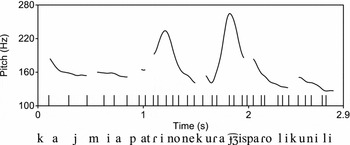
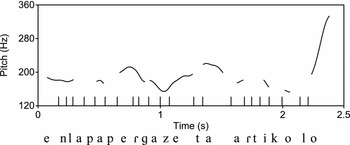
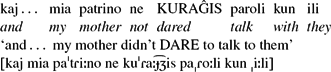
Linda's Esperanto generally exhibits H in syllables with primary stress, and L elsewhere. This is the case in example (4); the fundamental frequency (f0) contour is presented in Figure 1. With more targeted data it could be discussed if the syllables with primary stress in this specific example have a LH contour (which would not be similar to the Norwegian accent 1 LH sequence mentioned above) or only a phonetically late peak. Focal accentuation seems to be signalled through a higher f0 peak for the H. At times, L is observed in stressed syllables, especially before a H% utterance boundary tone, as in (22) below, see Figure 2 in Section 5.1. The preference for H in stressed syllables (here limited to primary stress) and L elsewhere is in agreement with typological universals (de Lacy Reference de Lacy2002). Impressionistically, her Esperanto intonation does not sound Norwegian.
f0 contour for the example in (4): kaj. . . mia patrino ne KURAĜIS paroli kun ili ‘and. . . my mother didn't DARE to talk to them’.

f0 contour for the example in (22): en la paper-gazeta artikolo ‘in the paper- newspaper article’.

(4)
Fundamental frequency (f0) contours in this paper have been extracted with Praat (Boersma & Weenink Reference Boersma and Weenink2014). Short vertical lines mark the segment boundaries.
Standard Esperanto has no quantity oppositions.Footnote 4 In spoken L2 Esperanto, stressed syllables may or may not display lengthening, presumably depending on the status of Stress-to-Weight in the native language. Linda's native Esperanto seems to agree with Norwegian, where stressed syllables (primary stress and strong secondary stress, see below) must be bimoraic: Linda's open stressed syllables tend to have a long vowel, while open unstressed syllables are characterised by a short vowel, as transcribed in (4).
In recent analyses of Norwegian (e.g. Rice Reference Rice2006), a single consonant at the right edge of a word-final syllable does not contribute to syllable weight, unless it is lexically specified as moraic (in which case it will surface as a moraic coda consonant). When stress is final, the vowel is then associated with both morae by default, as in Norwegian /pɑpir/ [pɑˈpiːr] ‘paper’.
This also appears to be the case in Linda's Esperanto in the few words where stress is final. In monosyllables, Linda's pronunciation is [ˈkvaːɾ] ‘four’, [ˈkviːn] ‘five’, [ˈseːs] ‘six’, [ˈnuːn] ‘now’, etc., but she has also been observed to say [ˈnunː]. In truncated compounds with first element stress, where stress as a result is final in the first element, the final consonant of the first element is also treated as word-final: papér-gazèto ‘paper-newspaper’ and vetúr-permèso ‘drive-permission’ are pronounced [pa.ˈpeːɾ.ɡa.ˌzeː.to] and [və.ˈtuːɾ.pəɾ.ˌmeː.so], respectively.
Norwegian has been understood to display word-initial feet (Kristoffersen Reference Kristoffersen2000:162f.). For instance, a word like elefant ‘elephant’ will reduce its second /e/ to schwa, [ɛləˈfɑnt], footed as (e.le)(fant) with moraic trochees (the [ɛ] in the first syllable is the normal short pronunciation of /e/), see (3) above. As such, the initial syllable of (e.le)(fant) may be said to carry secondary stress, although it is monomoraic. This is then what can be labelled a ‘weak’ secondary stress (Kristoffersen Reference Kristoffersen2000:141, 162).Footnote 5 In Norwegian, an obligatory bimoraicity is associated with primary stress, and with secondary stress that is the result of ‘main stress demotion’ (Kristoffersen Reference Kristoffersen2000:141, about compounds). In other words, it occurs only once for every minimal prosodic word. An example could be open syllable vowel lengthening in elefant-hale ‘elephant-tail’ [ɛ.lə.ˈfɑnt.ˌhɑː.lə]. Primary stress and strong secondary stress will be indicated in the present paper. In rhythmic terms, Norwegian has also been suggested to display exhaustive footing (Kristoffersen Reference Kristoffersen2000:293ff.).
In Linda's Esperanto, where syllabic trochees are assumed, /e/ has been observed to be reduced to [ə] in words like /elefanto/ ‘elephant’, pronounced [eləˈfanto]. This then seems to follow the same reduction pattern as in Norwegian, and it may indicate a foot structure (e.le)(fan.to) as in (2b) above, where the initial foot has weak secondary stress: No lengthening occurs there, but the /e/ of the foot head is not reduced while the /e/ of the non-head is. In comparison, when the syllable count does not readily invite such footing, a schwa is heard even in initial syllables, such as vetúr-permèso [vəˈtuːɾpəɾˌmeːso] ‘drive-permission’ above and in rekonas [ɾəˈkoːnas] ‘recognises’, where the prosodic structure can then be understood as <ve>(tur)+<per>(me.so) and <re>(ko.nas); parentheses indicate feet and angled brackets indicate non-footed (extrametrical) syllables, while the ‘plus’ sign indicates the internal prosodic word boundary. Linda's distribution of long vowels in compounds like papér-gazèto [pa.ˈpeːɾ.ɡa.ˌzeː.to] and vetúr-permèso [və.ˈtuːɾ.pəɾ.ˌmeː.so] also seems to agree with the Norwegian pattern of one Stress-to-Weight for each element of the compound. As in the Norwegian examples, only primary stress and strong secondary stress will be indicated in this paper.
3. COMPOUND STRESS DATA
The remainder of the paper will concentrate on stress assignment in compounds. Pilot interviews were performed in 2003 and 2005, and new interviews in 2014. The discussion in Sections 4 and 5 will rely on the 2014 data, but a summary of the pilot is presented in Section 3.2 for reference.
3.1 Interviews
A pilot interview, partially in Norwegian, took place in 2003 at a time when Linda had spoken Esperanto with L2 speakers for some days. A conversation in Esperanto about certain topics had been prepared to collect specific compounds from spontaneous speech. This approach soon proved to be less suitable than anticipated, since the compounds were not necessarily used in the conversation. Therefore, an improvised perception test was applied instead, where individual compounds were read aloud for the speaker, with pairs of alternative primary stresses, e.g. dórso-sako vs. dorso-sáko ‘backpack’ (literally: ‘back-bag’). Linda was then asked which pronunciation was the better one according to her intuitions, and she often confirmed her choice by pronouncing the compound herself.
This method obviously has some weaknesses, not least the risk of priming the test subject. Isolated words may also lead to contrastive use of stress, e.g. a dórso-sako as opposed to other kinds of bags, causing a bias towards first element stress.
The first interview focussed on nouns and derived adjectives, such as dorso-sako ‘backpack’ and dorso-saka ‘relating to backpacks’. Almost two years later, in 2005, a couple of follow-up interviews on the telephone added verbs and adverbs derived from the same nouns, e.g. dorso-sakis ‘backpacked’ and dorso-sake ‘backpackly, with/in a backpack’. This time, all compounds were placed in utterances to establish a context for them (see below). Afterwards, the speaker was given the isolatedwords.
It should be emphasised that neither the pilot interviews nor the later interviews had a quantitative scope. There are very few available speakers of native Esperanto. As noted above, they do not constitute a separate speech community, and we can assume that Linda may be the only person with exactly her combination of linguistic traits. This makes it difficult to perform quantitative studies with statistically reliable datasets without exhausting the test subject.
The pilot data had been collected in part through production and in part on the basis of how the native speaker perceived and assessed spoken words. The main insight from the pilot study was that spontaneous speech would not provide sufficient data. In addition, superimposed intonational patterns could easily obscure the tokens. Therefore an introspection-based approach was carried out in 2014. The interviews were performed on the telephone. In addition to an informal chat in advance, there were two interview sessions, one on each of two days. The conversations were held entirely in Esperanto.
A set of compound nouns and derived adjectives, verbs and adverbs was prepared. Although derivation between word classes is productive in Standard Esperanto, to the extent that it occurs spontaneously and is understood, a context may at times be needed. For instance, the adverb dorsosake ‘backpackly’ may be used both for ‘(travelling) with a backpack’ and ‘(being located) in a backpack’. Therefore, along with stylistic traditions, several of the tested derivations would possibly seem somewhat unmotivated when presented in isolation. For such reasons, all test words were placed in utterances to ease the processing. These utterances, written in standard orthography, were sent to the speaker in advance. Introspection and written stimuli would also serve to prevent priming effects, but may have added the risk of a penultimate stress bias both due to the implicit norm, and (given the discussion in Sections 4.3 and 4.4 below) because the compounds risked being treated as established lexemes. On the other hand, the method enables us to approach the test subject's intuitions even for words that would seldom be used in spontaneous speech.
Linda read all sentences in the set aloud; this was repeated once. This reading part was mostly there to make her accustomed to the words. The value of such data may also be discussed, as reading something aloud may produce artefacts and hesitation. Afterwards, Linda tried different pronunciations for the individual test words to judge which was better. Most of the time she decided with little or no hesitation. This part too was repeated once. The presentation of data in Section 3.3 relies on the introspection-based judgement task.
3.2 The pilot
The pilot data are presented only briefly as a background for the more carefully elicited 2014 data.
Twenty-one of 35 compounds nouns exhibited primary stress on the first element (e.g. dórso-sako ‘backpack’). Only five compounds displayed primary stress on the penultimate syllable (e.g. leter-késto ‘mailbox’). Seven compound nouns showed alternation between the two patterns.
Eleven of 14 compound adjectives received penultimate stress (e.g. dorso-sáka ‘relating to backpacks’), three had first element stress (e.g. papér-gazeta ‘relating to printed newspapers’) and one showed alternation (áŭto-ŝofora or aŭto-ŝofóra ‘relating to car drivers’). In other words, nouns tended to exhibit more first element stress than their derived adjective counterparts. Verbs and adverbs essentially displayed the same tendencies as adjectives: penultimate stress was more common, though more so when the test words were in a context than when in isolation.
3.3 Data from the 2014 interviews
The test words in 2014 were selected such that most of the nouns have a derived adjective, verb and adverb which can be compared with the noun (by an accidental oversight during the data elicitation, two of the nouns are not represented with corresponding verbs and adverbs in the dataset).
The results are summarised in (5), (6) and (7). These are based on introspection, as explained in Section 3.1 above.
(5)
(6)
(7)

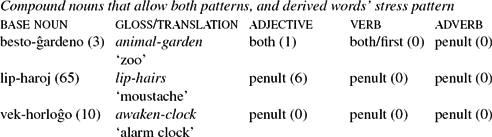

It has been indicated in (5)–(7) whether the adjectives, verbs and adverbs display first element stress (‘first’), penultimate stress (‘penult’), both patterns (‘both’), both patterns but with a preference for first element stress (‘both/first’), or both patterns but with a preference for penultimate stress (‘both/penult’). By stress we mean primary stress. The ‘both’ category is applied both when Linda gave different judgements in the two introspection turns, and when she herself pointed out that both stress patterns could be applied. The ‘both/first’ and ‘both/penult’ categories are used when Linda stated that both patterns are possible, but that she felt that one of them was better according to her intuitions.
The numbers in parentheses refer to the token count in the Tekstaro corpus. The relatively high token count for the adjective pomarba is misleading, as they were all found in one text, Zamenhof's 1916 translation of H. C. Andersen's fairy tales.
The full forms of the adjectives, verbs and adverbs have not been included in the summary, but are easily deducible: For adjectives, it involves replacing the noun suffix -o (or the plural -oj) with the adjective suffix -a, for verbs replacement of -o(j) with the past tense suffix -is, for adverbs replacement of -o(j) with the adverb suffix -e; for instance, the words derived from aŭtoŝoseo ‘highway’ are aŭtoŝosea, aŭtoŝoseis and aŭtoŝosee, respectively. There are three plural nouns (lipharoj, okulvitroj and supersignoj); all other nouns are singular, and all adjectives were also singular.
Four of the 22 compound nouns in the dataset received first element primary stress only, while three allowed both first element primary stress and penultimate primary stress. Among these three, though, one (besto-ĝardeno ‘zoo’) was consistently pronounced with first element primary stress (bésto-ĝardèno) in the reading part of the interview. Most compound nouns, 15 of the 22, had penultimate primary stress only.
Adjectives, verbs and adverbs had a weaker affinity for first element primary stress than nouns: Only two of 22 compound adjectives had first element stress only, two allowed both patterns and 18 had penultimate stress only. Only one of the 20 verbs had first element stress only, while five allowed both patterns. None of the 20 compound adverbs had first element stress only. Four allowed both patterns, and these four were all derived from nouns with first element stress.
The overall tendency in the dataset is that compound nouns that have first element stress correspond to compounds in other word classes that (also) allow penultimate stress, while nouns that allow both first element stress and penultimate stress correspond to compounds in other word classes that allow penultimate stress to a greater extent. In adjectives, verbs and adverbs, then, there is a tendency towards penultimate stress in comparison with the corresponding nouns.
Strong secondary stress (diagnosed by vowel lengthening) for the compound nouns in (5) has been transcribed. First element primary stress seems to imply strong secondary stress in the second element, and this is true also for other word classes.
In production, some of the words also seemed to be pronounced with two primary stresses, one in each element of the compound. We will return briefly to the double-stress forms in Section 4.4 for nouns and in Section 5.1 for other word classes.
A smaller set of non-derived compound adjectives were also included in the interviews (see Section 5.2).
In addition to what has been summarised in (5)–(7), some segmental variation was also observed in the compound montro-fingro ‘index finger’ (literally: ‘point-finger’) and derived words. These contain two consonant clusters with /r/. Occasionally either the first or the second /r/ was deleted, especially in verbs (eight of nine verb tokens were montro-fíngis, only one of eight noun tokens was monto-fíngro). For ‘thumb’ (dik-fíngro ‘thick-finger’ and derivations) or other words for fingers in general, this never happened. When asked explicitly at a later time, Linda emphasised (still occasionally deleting one /r/) that ‘index finger’ is montro-fíngro. The phenomenon was not within the aim of the study, and so the observations are too unsystematic to form a strong hypothesis about the mechanisms behind the alternations. It can however be guessed that the /r/ deletion is some kind of cluster simplification, perhaps due to the presence of two such clusters in the same word (compound). All seven adverb tokens were montro-fíngre. It can also be mentioned that when the first /r/ was deleted in the adjective, mont-fíngra (two of five tokens), the phonotactically motivated -o (see Section 1.3 above) was not produced either.
4. STRESS IN COMPOUND NOUNS
The discussion below relies on the 2014 data. As the nouns seem to behave differently from the derived adjectives, verbs and adverbs in allowing more first element stress, compound nouns will be discussed separately.
4.1 Default stress patterns in compound nouns
Most compound nouns in the dataset have penultimate stress as in Standard Esperanto, while a few have first element stress as in Norwegian, or alternate between the patterns. The Norwegian-like stress assignment may be assumed to be the result of adstrate influence from Norwegian. Since penultimate stress dominates in the compounds of the present dataset, and is also the default pattern for simplex words, one obvious approach would be to assume that the minority of the compounds, the ones with a Norwegian-like stress pattern, have been lexically marked as exceptions to the default penultimate stress. That would mean that some kind of stress-related information has been provided in the lexicon for each single lexeme that displays first element stress. However, while this approach would be tempting at first sight, it is also not entirely without problems.
First, this is not a ‘Linda corpus’, and the number of compound nouns that display different patterns may be an artefact of the dataset. The test words have been selected more or less at random from existing compounds in L2 Esperanto, some of them happen to be frequent words in Esperanto, others not. A mere pattern count in the dataset may therefore not be representative of the pattern of compound stress in the speaker's Esperanto.
Perhaps more importantly, although compounding is a productive process in Esperanto, some compounds will be more established in an individual's lexicon than other compounds, which are created more or less spontaneously. With reference to corpus token counts, it will be argued in Section 4.3 that the Esperanto compound nouns that display a Norwegian-like stress pattern may be less established as lexical entities than those with penultimate stress. At least two of the Norwegian-like compound nouns were also new words to Linda. Lexical marking would be more expected in compounds that are already established as lexemes than in compounds that are not.
Moreover, while lexical marking is usually applied in dealing with unpredictable patterns, the Norwegian-like pattern of first element stress seems to be at least somewhat predictable based on corpus token count (see Section 4.3), and the specific stressed syllable within the first element is entirely predictable (see Section 4.2).
For these reasons, regarding first element stress in Linda's Esperanto compounds as lexically marked is not straightforward. It could just as well represent the productive default pattern. At the same time, penultimate stress is consistent with the default pattern that we already know from simplex words in Esperanto, and which is also the prescriptive pattern for compounds in Standard Esperanto. Thus, the opposite approach, lexical marking of penultimate stress, would perhaps be even less expected. The subsequent discussion assumes that neither of the stress patterns needs to be prespecified for individual lexemes. In Section 4.3 it will be argued that penultimate stress in compound nouns may instead be a case of simplex prosodic surface structures.
4.2 First element stress in compound nouns
It will be argued in Section 4.3 that the distribution of first element stress and penultimate stress in compound nouns correlates with the degree of lexicalisation, with more penultimate stress in compounds that are already established with separate entries in the lexicon. The present subsection will concentrate on the prosodic structure of first element stress itself.
In Norwegian, first element stress is the default pattern for compounds, e.g. elefánt-hàle [ɛləˈfɑntˌhɑːlə] ‘elephant-tail’ (see Section 2 above). Assuming moraic trochees in Norwegian (Kristoffersen Reference Kristoffersen2000), the prosodic structure of elefanthale can be understood as in (8), with primary stress in the syllable that represents the head foot of the head minimal ω, and strong secondary stress in the non-head minimal ω.
(8)

A few of the Esperanto compound nouns in the dataset seem to follow the Norwegian pattern of first element stress. Esperanto compounds with first element stress have primary stress on the syllable of the first element that would have received stress if the first element had been a simplex word in isolation. This is, incidentally, true not only for words like bésto-ĝardèno ‘animal-garden, zoo’ (compare bésto) but also for compounds where the first element has been truncated, such as papér-gazèto ‘paper-newspaper’ and vetúr-permèso ‘drive-permission’, where the first element's base form (with word class marker) would be papéro and vetúro, respectively. For convenience, bésto-ĝardèno will be used here as an example of first element stress in a compound without truncation, although penultimate stress was also observed in the data.
In simplex Esperanto words, the head foot is found at the right edge. The fact that compounds with first element primary stress have primary stress on the same syllable as the corresponding simplex word, observing the right edge of the first element, indicates that the compound's internal word boundary has been preserved in the prosodic structure, and furthermore that the head minimal ω is found at the left edge of the maximal ω, as in Norwegian. If this, as proposed, represents some kind of default pattern in Linda's Esperanto as argued above, it can be captured in a constraint like the one in (9).
(9) Align (ωmax, ωminh, Lt) (abbreviated as Align-ω below)
For every maximal ω there exists a head minimal ω such that their left edges coincide. Compounds are left-headed.
In prosodically simplex words, the maximal ω and the minimal ω are coextensive, and Align-ω is automatically observed. In prosodic compounds, the maximal ω consists of at least two minimal words. Compounds like bésto-ĝardèno, then, receive primary stress on the head syllable of the head foot of the leftmost minimal word, as in (10).
(10)

Assuming adstrate influence from Norwegian, additional evidence for two minimal words can, as noted in Section 2 above, be found in vowel quantity phenomena, as in bésto-ĝardèno [ˈbestoaɾˌdeːno], papér-gazèto [paˈpeːɾɡaˌzeːto] ‘paper-newspaper’ and vetúr-permèso [vəˈtuːɾpəɾˌmeːso] ‘drive-permission’, where the non-head (i.e. rightmost) minimal ω has a strong secondary stress. This is found in the head syllable of the head foot of the non-head minimal ω.
As noted, compounds with first element primary stress assign stress to what would have been the stressed syllable if the first element had been an isolated word, and this also applies to first elements that have been truncated, such as in papér-gazèto ‘paper-newspaper’ in (11). The base form of the first element is papéro.
(11)

The same stress pattern has been observed in Norwegian L2 Esperanto whenever first element stress occurs with a truncated first element. In an Optimality Theory perspective, the pattern may be regarded as an opaque process, being an example of underapplication of penultimate stress in the relevant domain (first element), in derivational terms such that stress is assigned to the penultimate syllable of the first element before the final syllable is deleted. In this paper, the pattern will be treated as an output-to-output correspondence (see Benua Reference Benua, Beckman, Dickey and Urbanczyk1995, Reference Benua1997; Kager Reference Kager1999:259ff.) Ident-BT (FtHd) as in (12), which requires that the syllable that acts as a foot head (the stressed syllable) in the base is preserved as a foot head in the truncated form.
(12) Ident-BT (FtHd)
A syllable which is a foot head in a truncated minimal prosodic word, is identical to the corresponding foot head in the base form of the minimal prosodic word.
This dominates FtBin as in (14) below.Footnote 6 Just how the truncated form is obtained will not be discussed here. For simplicity, the -o of the first element will be included in the input for besto-ĝardeno in (13) but will be left out for paper-gazeto in (14).
(13)
(14)

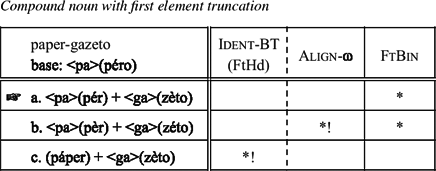
As previously, the ‘plus’ sign indicates the boundary between minimal prosodic words, parentheses indicate feet, and angled brackets indicate non-footed (extrametrical) syllables. Each output candidate constitutes one maximal prosodic word, and every minimal prosodic word corresponds to a morphological compound element.
4.3 Penultimate stress in compound nouns and lexicalisation
Most compound nouns in the data, those listed in (7) above, have stress on the penultimate syllable, as in Standard Esperanto. The hypothesis will be that penultimate stress in compound nouns is the result of a simplex prosodic word structure; and that the prosodic word structure is simplex due to lexicalisation, where ‘lexicalisation’ refers to a compound's having been established with a separate entry in the lexicon, as opposed to being created spontaneously. That is, these nouns are morphological compounds, but behave as prosodically simplex words (only one ω level), and not as compounds from a prosodic viewpoint. The synchronic status of this process will be addressed in Section 4.4.
Prosodic sensitivity to lexeme status has also been observed in what we could call Standard L2 Esperanto (spoken L2 Esperanto that obeys standard norms), where penultimate primary stress is obligatory (Wennergren Reference Wennergren2005:28): An optional secondary stress there has been described to behave differently in lexicalised compounds (màten-mánĝo ‘morning-meal, breakfast’) and non-lexicalised compounds (matèn-mánĝo). Only in the latter case does secondary stress seem to relate to internal word structure. The observation will be briefly discussed in the final paragraph of the current subsection with reference to the similar alternations in Linda's Esperanto, which will be discussed first.
Lexicalisation, in the sense that something has its own entry in the lexicon, is among other things a matter of how common or established a particular expression is as the notion for a particular object or phenomenon, and can be expected to correlate somehow with the frequency of use.Footnote 7 Token frequency in a corpus does not necessarily correspond to the lexicalisation status of a word for individual speakers, and one should also be especially careful with such data when dealing with a geographically spread speech community where the language is little used on an everyday basis. Corpus counts may still give some hints about the overall situation. If lexicalisation, or lexeme status, is a relevant factor, as suggested above, one would expect low token counts for nouns with first element stress and high token counts for nouns with penultimate stress. And in Linda's Esperanto, this also seems to be the case.
The Tekstaro corpus token count has been included in parenthesis for each individual compound in (5)–(7) above; these numbers also include inflected forms. Among the four nouns with first element stress in (5), two do not occur in the corpus, one occurs once, and only one word, póŝ-telefòno ‘mobile phone’, is relatively frequent, with as many as 37 tokens. That particular word, however, is a new word for Linda: If she ever uses an expression for ‘mobile phone’, she would say mobíl-telefòno, borrowed directly from Norwegian mobíl-telefòn. The word vetúr-permèso is similarly little used also in L2 Esperanto. It was used here for ‘driving licence’, and Linda has indicated that this word was new to her as well (see also the remark on this word in the appendix).
Apart from this, among the three nouns that allow both stress patterns in (6), one was consistently pronounced with first element stress in the reading part of the interview, bésto-ĝardèno ‘animal-garden, zoo’. That particular word does exist in the Tekstaro corpus but is infrequent (three tokens). Most of the remaining nouns, especially those with penultimate stress in (7), are relatively frequent in the Tekstaro corpus, with the noticeable exception of aŭto-ŝofóro ‘car driver’ (no tokens). The average count for the 15 compounds with only penultimate stress is 39 tokens.
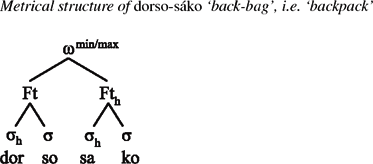
According to the lexicalisation hypothesis, a form like dorso-sáko ‘backpack’ (literally: ‘back-bag’) would consist of only one minimal ω, identical to the maximal ω. The morphological compound in (15) would behave prosodically just like a simplex word (e.g. elefánto ‘elephant’ in (2b) above).
(15)
It is known from other languages too that lexicalisation of compounds may lead to diachronic restructuring. In diachronic processes, the semantic transparency of the lexicalised compound may become so reduced that the entity is perceived as monomorphemic, which also has consequences for phonology. A well-known example from Norwegian is the monosyllabic and monomorphemic fjøs [fjøːs] ‘cowshed’, from Old Norse fjós [fjoːs], but with the etymological origin fé-hús [feːhuːs] ‘livestock-house’, compare Modern Norwegian fe [feː] ‘livestock’ and hus [hʉːs] ‘house’ (see e.g. Falk & Torp Reference Falk and Torp1991:164).
But even with somewhat better semantic and morphological transparency, lexicalisation may have prosodic consequences. Another example from Norwegian can be used to illustrate this: As mentioned in Section 2 above, stressed syllables in Norwegian must be bimoraic. Also, closed stressed syllables in word-medial position have a short vowel and a long (i.e. moraic) consonant, while a word-final consonant may be rendered non-moraic so that the vowel is associated with both morae (Rice Reference Rice2006:1184, also see Lorentz Reference Lorentz1996:123f.). This is also true for the minimal prosodic words of Norwegian compounds. For instance, the nouns gard [ˈɡɑːr] ‘fence’ or ‘farm’ and nes [ˈneːs] ‘headland’ may be combined to form the compound gard-nes [ˈɡɑːr.ˌneːs], with /r/ behaving like word-final in the first minimal ω. However, this particular compound also exists as a lexicalised proper noun, a place-name for several localities in Norway, and at least one of them (in Ulstein, Sunnmøre, not Linda's dialect area) is commonly pronounced by locals as [ˈɡɑrː.ˌneːs], where /r/ has been forced into a moraic coda just as it would be in the word-medial position of a simplex word. Interestingly, primary stress is still assigned to the first element as in a compound, and the remaining semantic and morphological transparency makes the name suitable only for a headland.Footnote 8
The examples above are presumed to be isolated cases of diachronic restructuring. A pattern with synchronic effects in German will be referred to in Section 4.4 below.
Lindaʼs native Esperanto does provide some evidence that compounds with penultimate primary stress are prosodically simplex: absence of vowel lengthening, and the presence of a reduction pattern. In the recordings, Linda pronounced the word leter-késto ‘mailbox’ (literally: ‘letter-box’) eight times, including two instances where she interrupted herself after leter-ke and leter, respectively. The first element of the compound leter-kesto is a truncated form of letéro. The eight tokens were recorded in the reading part of the interview, in her more spontaneous pronunciation during a short chat, and during the introspection part. In one of these eight tokens the vowels are difficult to classify, but in the seven remaining tokens the pronunciation was [letəɾˈkesto], including the two [letəɾ(ke)] tokens.
One reason to suspect that this compound constitutes one minimal ω (i.e. that it is prosodically simplex), is the observation that Stress-to-Weight does not apply to what would have been the non-head minimal ω, see Sections 2 and 4.2 above: Linda says [letəɾˈkesto], not *[ˌleːtəɾˈkesto] or *[ləˌteːɾˈkesto]. If a non-head minimal ω were present here, it would correspond to the first element leter-. Since there is no strong secondary stress, this would lead one to suspect that there is also no separate first element of the compound, prosodically speaking. The absence of vowel lengthening in itself is not conclusive evidence, though, as it has also been observed in Norwegian that first elements may lose their vowel length in some compounds where primary stress is found further to the right due to a stress-attracting derivational suffix (Kristoffersen Reference Kristoffersen2000:195).
For leter-késto there is also a familiar reduction pattern: If the morphological first element leter- corresponds to a separate minimal prosodic word, which would be a truncated form of the base minimal prosodic word letéro, we would not be surprised to find <le>(ter)+(kes.to), with a preserved foot head from the base. But we do not find this. Instead, the consistent reduction of the second vowel in leter-kesto [letəɾˈkesto] may, as in elefánto ‘elephant’ in Section 2, indicate that (le.ter) is a foot where [le] is the foot head and [təɾ] the non-head. This is what we would expect if leter-kesto is prosodically simplex, in Optimality Theory terms because the prosodic faithfulness constraint Ident-BT (FtHd) would be vacuously satisfied when the prosodic truncation counterpart to letéro does not exist. In sum, the prosodic structure seems to be (le.ter)(kés.to) within one minimal/maximal ω. Thus, prosodically, it behaves like a simplex word, just as elefánto ‘elephant’.
The evidence from vowel length and reduction is compatible with this interpretation (though see the discussion below about stress clash as a possible factor). In this interpretation, the prosodic surface of leter-késto in Linda's Esperanto is understood to be structured as in (16), just as it has already been proposed for dorso-sáko in (15). The leter-késto example is only a reiteration of this, but with data from vowel quantity and vowel reduction.
(16)

Independent evidence for a simplex prosodic structure in compounds comes from rhythmic intuitions in L2 Esperanto, and can be found in a compound like staci-dómo ‘railway station building’, literally: ‘station-house’. This is a very frequent compound in Standard Esperanto, so examples are easy to find. The first element is a truncated form of stacío, which would have the footing <sta>(ci.o). When the compound stacidomo is used in poems and song lyrics, however, the first syllable is treated as a foot head (none of the examples are from speakers of Norwegian, though).
One example is the song ‘Ĉuk’ (text and melody by Nanne Kalma, a native speaker of Dutch), where the text reads en la stacidomo alvenas mi (literally: ‘in the station-house arrive I’).Footnote 9 Although song lyrics may reflect factors unrelated to prosody in speech (nevertheless see Nichols et al. Reference Nichols, Morris, Basu, Raphael, Hirata, Tzanetakis and Yoshii2009), it is worth mentioning that Kalma sings the word stacidomo with the first and third syllables on the relatively strong metrical positions (beats) of the bar. This would parallel a foot structure (sta.ci)(do.mo) rather than <sta>(ci)+(do.mo).Footnote 10 Similar L2 tokens can be found in texts by other authors as well, such as the poem ‘Vesperoj en tendaro’ by the Moscow poet Valentin Melnikov, where stacidomo fits into the iambic pentameter with strong first and third syllables: De l’ stacidomo – tramo, poste buso (literally: ‘From the station-house – tram, afterwards bus’). A melody has been composed by the Moscow singer-songwriter Mikhail Povorin, and the same syllables as above are sung on the strong beats.Footnote 11 The rap ‘Por la rep’’ by the Polish hip-hop singer Eterne Rima (Igor Wasilewski) treats okul-vitroj ‘glasses’ (first element base: okúlo) similarly as (o.kul)(vi.troj), not <o>(kul)+(vi.troj).
However, the present evidence – from Linda and from rhythmic intuitions in L2 poetry and music – is found in constructions where stress clash may also play a role in accounting for the foot structure in the first element: If the first element of the compounds staci-dómo ‘station-house’, leter-késto ‘letter-box’ and okul-vítroj ‘eye-glasses’ does retain its prosodic status as a separate minimal ω, the head syllable there would be expected to be the rightmost one, and this would cause a clash when the following syllable hosts penultimate stress.
An L2 example that is inconsistent with the stress clash hypothesis is found in Kalma's song ‘Ĉuk’, where the text reads stari senmove en stacidomet’ (literally: ‘stand motionless in station-house-diminutive’), where, incidentally, a word-final truncation allowed in poetry can also be seen.Footnote 12 When read aloud, the derivational suffix -et ‘diminutive’ would carry the word stress in domét’ (dométo ‘small house’), and this syllable is not adjacent to the potential head syllable in <sta>(ci). Still, the compound stacidomet’ is sung with /sta/ and /met/ on the strong beats, indicating (sta.ci)<do>(met) rather than <sta>(ci)+<do>(met).
It has been proposed that a simplex prosodic structure is found in Linda's Esperanto when the compound is an established lexeme. As mentioned above, some kind of sensitivity to lexeme status seems to have been observed even in Standard L2 Esperanto, with a similar though not quite identical alternation pattern which will not be discussed in depth here (but see Section 5.4 below): In his otherwise mainly prescriptive grammar, Wennergren (Reference Wennergren2005:28) briefly mentions an observation of optional secondary stress in compounds like maten-manĝo ‘morning-meal, breakfast’. He describes that if secondary stress occurs (it is not specified what this means in phonetic terms), this compound may be rendered as màtenmánĝo if it is felt ‘as one whole’, understood as a lexeme, and otherwise as matènmánĝo, cf. the base maténo. Wennergren's account is written for a non-academic audience, but the interpretation that this is a case of established lexemes vs. compounds that are created more or less spontaneously, agrees with his intentions (Bertil Wennergren, p.c.). This, then, seems to be a parallel to Linda's pattern, also including the specific footing and the correspondence with the base form: Linda's leter-késto (leter)(késto) would correspond to the màten-mánĝo type, while her papér-gazèto would correspond to the matèn-mánĝo type. Only in the latter case do Linda's primary stress and Wennergren's secondary stress relate to internal word structure and rely on the stressed syllable of the first element's base form. Common to both varieties of Esperanto is also the fact that this prosodic correspondence with the base form is found specifically in non-lexicalised compounds.
4.4 Alternating and double stress
It has been proposed above that penultimate primary stress in compound nouns may be the result of lexicalisation (lexeme status) which leads to a simplex prosodic word structure. An issue that should be addressed more explicitly is whether this is a diachronic or a synchronic process: The prosodic structures for dorso-sáko in (15) and leter-késto in (16) above may very well be the prosodic output structures, but are such compounds also simplex words in the input, such as elefánto, or is the simplex prosodic structure the result of a synchronic phonological process in what is still a morphological compound?
The present hypothesis is that compound nouns with first element primary stress are not quite as established in the lexicon as those with penultimate primary stress, which are more readily accessible as precomposed entities. If this is so, then a reasonable guess would be that compounds with alternating stress patterns, e.g. vék-horlòĝo ~ vek-horlóĝo ‘awaken-clock, alarm clock’, have an ambiguous or ‘in between’ status in the lexicalisation process, in the sense that they are like other compounds that have not been firmly established, but may still be more readily accessible, perhaps even for random effects of exposure. There are only three nouns in the dataset that allow both stress patterns, and that hardly provides any strong empirical evidence for the guess. Still, two of them are relatively infrequent in the Tekstaro corpus.
The above may be a relevant way to understand the alternations. But an alternation such as vék-horlòĝo ~ vek-horlóĝo should not be possible if this is a simplex word already at the lexical level, since the individual compound elements would be needed for the vék-horlòĝo form. Hence, it could be proposed that the simplex prosodic structure of compound nouns with penultimate primary stress, such as leter-késto and the vek-horlóĝo form, is the result of a synchronic phonological process in Esperanto which is sensitive to lexeme status. See also the additional evidence from double stress in derived adjectives, verbs and adverbs in Section 5.1 below.
Similar seemingly synchronic effects are not quite unknown in other languages: Zonneveld et al. (Reference Zonneveld, Trommelen, Jessen, Rice, Bruce and Árnason1999:536f.) discuss different analyses of German nominal compounds with three stems, where the stress patterns, according to at least one of the cited lines of analysis (Stötzer Reference Stötzer1975, Giegerich Reference Giegerich1985), depend on the lexicalisation status of the internal compound: The three-constituent structure [A[BC]]N is interpreted both semantically and phonologically as a two-constituent structure [AB]N when the internal constituent [BC] is lexicalised and becomes semantically less transparent. Zonneveld et al. refer to Lehmann's (Reference Lehmann1989) suggestion that lexicalisation is enhanced by (structural) ‘reduction’ in the linguistic sign, and relate the phonological side of this in the German case to ‘the depth of [metrical] branching’. The situation suggested in the present paper is not very different: compounds behaving as prosodically simplex words due to lexicalisation. In Section 4.3 above, we also saw that lexicalisation of compounds may lead to diachronic restructuring. This should probably often be seen in relation to an accompanying morphological reinterpretation; the [ˈɡɑrː.ˌneːs] example shows that this is not necessarily always the case, however.Footnote 13
A tendency to interpret lexemes prosodically as simplex words may, at least for the sake of this paper, be captured ad hoc by a constraint like the one in (17), which specifically bans ω recursion for lexemes (for general non-recursion, see e.g. Itô & Mester Reference Itô and Mester2013).
(17) Lex=ωmin: A lexeme constitutes one minimal prosodic word. No ω recursion for lexemes.
(18) GrWd=PrWd: A grammatical (i.e. morphological) word is a prosodic word.
The constraint Lex=ωmin is concerned with prosodic structure alone, and the words discussed here are assumed to be morphological compounds. Assuming that prosodic word structure is related to morphological word structure due to GrWd=PrWd (Kager Reference Kager1999:152, 166) as in (18), and that both the morphological word at compound level and the individual compound elements count as grammatical (morphological) words in this regard, the ranking Lex=ωmin≫GrWd=PrWd would reflect prosodically simplex structures being more frequent in lexicalised compound nouns than in compound nouns with a weaker lexicalisation status.
The tableaux in (19)–(21) present two lexicalised compound nouns and one that is spontaneously formed.
(19)
(20)
(21)
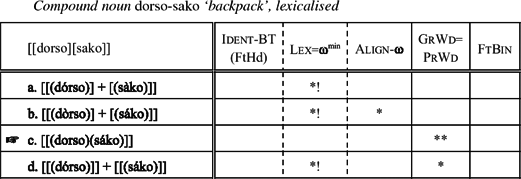


The ‘plus’ signs indicate the boundary between different (minimal or maximal) prosodic words, the parentheses indicate feet, and the angled brackets indicate non-footed syllables. For the input, square brackets indicate morphological words, including compound elements. For the output candidates, the outer square brackets indicate maximal prosodic words, while the inner square brackets indicate minimal prosodic words. Ident-BT (ωmin) is vacuously satisfied when the truncation correspondent of the base ωmin does not exist. Not all constraints interact, and Lex=ωmin has been ranked just high enough in the tableaux to select the optimal output form. As above, the -o of the first element has been included in the input for (19) but, for simplicity, not in (20) and (21). In a more thorough analysis the account may be different.
Of course, one cannot rule out the possibility that some compound nouns with penultimate stress may be simplex at the lexical level due to diachronic change. Such words would not display any variation in stress pattern. Both dorso-sáko ‘back-bag, backpack’ and leter-késto ‘letter-box, mailbox’ could potentially be such words. As they are morphologically (and semantically) fairly transparent, though, they have been treated as underlying compounds in the discussion above. There is also some additional evidence from derived adjectives, verbs and adverbs that at least some compound nouns with penultimate stress cannot be simplex words underlyingly (see the discussion of double stress in Section 5.1 below).
To summarise the proposed analysis: In Esperanto compound nouns, Linda allows first element stress as in Norwegian, contrary to the prescriptive rules of Standard Esperanto, but the pattern is overruled if the compound has a separate entry in the lexicon, in which case it is treated as prosodically simplex. Some compounds are ambiguous in this regard.
A few compound nouns were occasionally pronounced with two primary stresses. These were three of the four that have been classified as having first element stress (arést-ordóno ‘arrest-command’, papér-gazéto ‘paper-newspaper’, vetúr-perméso ‘drive-permission’) and one from the group of alternating stress (bésto-ĝardéno ‘animal-garden’). This pattern would have to be understood as two maximal prosodic words in the specific tokens, one for each compound element, e.g. [papér]ωmax+[gazéto]ωmax. Such prosodic structures can be reckoned as additional evidence for an internal morphological word boundary. We will return to this in Section 5.1. There are few tokens in the recordings, and the picture is probably incomplete, but it can be noted that in tableau (21) above, with a spontaneously formed compound noun, the structure with two maximal prosodic words is the second best output candidate. There are double-stress tokens for other word classes as well, and an f0 example, Figure 2, is presented in Section 5.1.
5. OTHER WORD CLASSES
5.1 Derived compounds
The compound adjectives, verbs and adverbs that were derived from compound nouns had an overall stronger affinity for penultimate primary stress than the nouns that they were derived from.
All adjectives, verbs and adverbs derived from compound nouns with penultimate primary stress in (7) above also had penultimate primary stress (with one exception: the verb aŭto-ŝoseis ‘highwayed’ allowed both patterns: áŭto-ŝosèis and aŭto-ŝoséis). One might suspect that none or few of these derived words have been lexicalised, but have rather been treated as though they have been formed spontaneously. All of them also have low token counts in the Tekstaro corpus (most have 0–2 tokens), with the exception of pom-arba ‘relating to the apple tree’, see the comment in Section 3.3 above. If the derived forms had behaved like nouns, we would have expected more first element stress. Still, when the base noun compounds are suspected to contain only one minimal ω, then derived adjectives, verbs and adverbs may also show this pattern, perhaps in an output-to-output correspondence which preserves prosodic structure. In other words, it comes as no surprise that adjectives, verbs and adverbs derived from nouns with penultimate primary stress also have penultimate primary stress.
A more interesting pattern emerges when the nine words derived from nouns with an alternating stress pattern in (6) mostly display penultimate stress only. Similarly, the 12 adjectives, verbs and adverbs derived from the four nouns with first element stress in (5) most often show both patterns, and only two display first element stress only.
Not disregarding the variation, it thus seems like derived compound adjectives, verbs and adverbs display a stronger affinity for penultimate primary stress than the base compound nouns do, and that this is fairly independent not only of the presumed low lexicalisation status of the derived compound but also in part, but not completely, of the stress pattern in the base noun.
Tokens such as vetur-permésa ‘drive-permission.adj’, with penultimate primary stress (cf. the corresponding noun vetúr-permèso, with first element primary stress) were pronounced without vowel lengthening, but with reduction and non-reduction, as in [vetuɾpəɾˈmeːsa]. This may suggest once again that there is only one minimal prosodic word. Thus, also derived compound adjectives, verbs and adverbs with penultimate primary stress can be understood as prosodically simplex words. The present example would be footed as (ve.tur)<per>(me.sa), with a left-edge non-head foot as in Norwegian (recall Section 2). Note that in this case, the footing (ve.tur) cannot be explained as a result of stress clash (which was a possible relevant factor for the noun leter-késto in Section 4.3 above).
Some compound adjectives, verbs and adverbs in the dataset were occasionally pronounced with double stress. An example is seen in the word papér-gazéta in (22), which is the last part of the utterance ‘I read about you in the paper-newspaper article’. The f0 curve is presented in Figure 2.
(22)
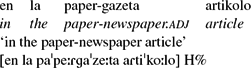
Parts of the curve are missing due to a creaky voice quality, but we can see a rising f0 for [ˈpeːɾ] and yet another rise that starts in [ˈzeː]. The utterance ends in an H% boundary tone, and the stressed syllable in artikólo is associated with a L tone, see Section 2.
As for the compound nouns mentioned in Section 4.4 (last paragraph), double primary stress serves as additional evidence that there exists an internal word boundary in the tokens where the pattern occurred. Such double stress was observed both in compounds derived from nouns with first element stress (adjectives: papér-gazéta, vetúr-permésa; verb: papér-gazétis; adverbs: arést-ordóne, papér-gazéte, póŝ-telefóne, vetúr-permése) and in compounds derived from alternating nouns (all three derivations from besto-ĝardeno). Interestingly, though, double stress was also observed in words derived from compound nouns with penultimate stress (adjectives: áŭto-ŝofóra, áŭto-ŝoséa; verbs: áŭto-ŝoséis, líbro-vendéjis; adverbs: dórso-sáke and perhaps flúg-havéne and móntro-fíngre).
It was argued above that lexicalised compound nouns with penultimate stress are still underlying compounds, but that they are rendered prosodically as simplex words. We have also found that derived compound adjectives, verbs and adverbs have a stress pattern that relies in part on the corresponding compound noun. The observation here is that some adjectives, verbs and adverbs derived from ‘penultimate stress nouns’ still exhibit occasional signs of being two words (double stress), which suggests that the internal morphological word boundary is intact in the particular tokens. If so, then the internal word boundary should be intact at lexical level also in the base nouns that these forms are derived from, otherwise the speaker would not have access to the structure that is needed to produce the derived double-stress surface forms. This may substantiate the assumption that compound nouns with penultimate stress are still underlying compounds. None of the base compound nouns with penultimate stress in the present dataset was ever pronounced with double stress.
5.2 Derived vs. underived compound adjectives
The adjectives, verbs and adverbs discussed above can all be assumed to be derived from a compound noun base. For instance, the underived compound noun paper-gazeto [[paper][gazeto]]N ‘paper-newspaper’ can be assumed to be the base for the adjective paper-gazeta ‘relating to paper-newspapers’, derived as [[[paper][gazet]]N a]A. On the basis of the data, it could be suspected that the prosodic difference between the underived papér-gazèto and the derived paper-gazéta is motivated by the derivational structure.Footnote 14
If this is the case in this speaker's Esperanto, then we should expect underived compound adjectives to behave in the same way as underived compound nouns, with a preference for first element stress in low-frequency compounds. Compared to compound nouns, however, there are not as many credible opportunities to create underived, meaningful compound adjectives, verbs or adverbs, especially if both elements should be of the same lexical category, see Gledhill (Reference Gledhill1998:33f.): In a compound where the last element is an adjective, the first element is normally ‘understood to be a nominal complement’, while ‘Adjective + Adjective compounds are rare’ and (their first elements) are usually ‘interpreted as adverbial modifiers’. Similar considerations are valid for verbs, while adverbs ending in -e are always derived.
A few underived compound adjectives were included in the interviews, following a similar set of test words in the pilot. They are presented in (23) and (24), with the token count in the Tekstaro corpus given in parentheses.
(23)
(24)


This limited sample is obviously not sufficient for a conclusive answer, but some discussion is presented below.
We consider the compound adjectives in (23) first. Here, two have a clearly different structure than just A+A: fajro-flava ‘fire-yellow’ has a noun first element, and jun-aspekta ‘young-appearing, with a young look’ has a second element derived either from the noun aspekto ‘appearance’ or from the verb aspekti ‘appear’, but the compound itself is not derived from a compound noun or compound verb.
None of these adjectives had first element stress only, and half of them only had penultimate stress. Note that the example nov-norvegan ‘new-Norwegian, acc’ (i.e. ‘Nynorsk’) was pronounced with penultimate stress during the first introspection judgement round and with first element stress in the second one. It is possible that the frame sentence caused the compound to be interpreted as a contrast to other kinds of Norwegian, causing a contrastive stress pattern with first element stress (‘in Western Norway the people use new-Norwegian’). The example fajro-flava seemed to have a preference for penultimate stress, with hesitation for first element stress and absolutely no hesitation for penultimate stress. Tokens with double stress were observed for jún-aspékta ‘young-appearing’, plén-konténta ‘full-satisfied’, hél-gríza ‘bright-grey’ and possibly hél-vérda ‘bright-green’.
In the present data, there seems to be a preference for penultimate stress, and even compounds with a very low Tekstaro corpus count do not exhibit first element stress exclusively. However, the dataset is too small for a thorough analysis, and there are no corresponding nouns to compare these adjectives with. A purely quantitative comparison of underived compound adjectives (or verbs) with underived and hence unrelated compound nouns would probably demand analysis of a much larger material.Footnote 15
Another observation in the present data is that all adjectives in (24) above have a potential stress clash situation at the internal word boundary, (σ)+(σσ), while all the adjectives in (23) have a structure that would not cause stress clash whatsoever. This may suggest that stress clash is an active factor in avoiding first element stress, but it may also be a coincidence of the dataset. For instance, fajro-flava ‘fire-yellow’ had such a clear preference for penultimate stress that it might have been appropriate to group it with the other words in (24). There are also several nouns with penultimate stress in (7) where stress clash would not be an issue.
5.3 Noun as a strong position
Morphological structure has here been proposed as a variable that influences stress. An alternative would be that the word classes themselves are a determining factor. Smith (Reference Smith, Kirchner, Pater and Wikely2001) examines cross-linguistic data and argues that the lexical category noun generally constitutes a strong position in positional faithfulness when compared to other word classes (she looks specifically at verbs), and in a markedness perspective, some languages also display augmentation effects for nouns in contrast to other categories. In Smith's survey, adjectives behave either as nouns or as verbs depending on the language.Footnote 16
This could be a relevant approach for interpreting the present data if, for instance, it can be shown that nouns are relatively immune to the cluster simplification observed in Section 3.3 above while verbs are not: It was observed that the noun montro-fingro ‘point-finger, index finger’ lost one /r/ in one of eight tokens (monto-fíngro), while the corresponding verb lost one /r/ in eight of nine tokens (montro-fíngis).
Within a positional faithfulness analysis of stress assignment, and assuming for simplicity a prosodic input representation, it would be possible to understand the seemingly special behaviour of nouns as a noun-specific faithfulness constraint for prosodic word structure, e.g. Faith-N (ω), outranking a constraint that bans recursive prosodic words, cf. NoRecursion in Itô & Mester (Reference Itô and Mester2013). This would in turn outrank a general Faith (ω). In sum, the analysis would suggest that compounds are rendered as prosodically simplex words either due to lexeme status (formalised in Section 4.4 as an undominated Lex=ωmin banning ω recursion for established lexemes) or by a lower-ranked constraint against ω recursion in general, while compound nouns not yet lexicalised are protected by a special faithfulness constraint for nouns.
None of this occurs in Norwegian and, as implied in Section 3.3 above, more data from the Esperanto speaker would also be required to investigate this option further.
5.4 Right-headedness
Yet another way to understand penultimate stress in derived compounds would be an approach where the head ωmin is generally right-aligned, but left-aligned in productive noun compounding for some reason (it has already been argued that lexicalised nouns behave prosodically like simplex words). This would be especially relevant if it can be shown that there is a prosodic correspondence between a noun like vetúr-permèso ‘drive-permission’ and e.g. a corresponding adjective vetùr-permésa ‘relating to drive-permissions’. This secondary stress would indicate that the speaker still recognises vetur in the adjective as a separate minimal prosodic word.
No such reliable tokens have been identified, however. In the specific case, Linda pronounces vetúr-permèso with two long vowels in [vəˈtuːɾpəɾˌmeːso], understood as cues for two minimal ωs (Sections 2 and 4.2), while vetur-permésa is pronounced as [vetuɾpəɾˈmeːsa] with only one long vowel, and with initial non-reduction, as discussed in Section 5.1.
A preserved non-head minimal ω and a right-aligned head minimal ω would, on the other hand, be a relevant way to understand the matèn-mánĝo observation from Standard L2 Esperanto (Wennergren Reference Wennergren2005:28) mentioned in Section 4.3. This structure for non-lexicalised compounds and a simplex prosodic structure for lexicalised compounds would explain why the secondary stress in Wennergren's account is found on the syllable /ten/ in the productively composed matèn-mánĝo ‘morning-meal’ (compare base maténo ‘morning’) but on the first syllable in the lexicalised màten-mánĝo. The difference from Linda's pattern is where the head minimal ω is found in non-lexicalised compounds.
6. CONCLUSION
Some of Linda's native Esperanto prosody can be attributed to influence from Norwegian, quite possibly via her L2 Esperanto-speaking parent. She seems to have a Stress-to-Weight mechanism as in Norwegian, she reduces /e/ to [ə] when unstressed, and she has weak secondary stress with non-reduction but without a weight requirement. She also allows non-moraic final consonants in word-final stressed syllables, again as in Norwegian.
Her Esperanto shows penultimate primary stress as in Standard Esperanto, both in simplex words and in compounds, but in compounds the data also exhibit examples of first element primary stress. First element primary stress is the main pattern in Norwegian and other Germanic languages, and it has been observed in Norwegian L2 Esperanto as well. With reference to corpus data and word-specific comments from the speaker herself, it has been proposed that first element primary stress is her default pattern for spontaneously formed compound nouns, while penultimate primary stress is associated with Esperanto compounds that have been established as entities in the lexicon. The alternation has been regarded as an effect of variation in prosodic structure at the word level: two minimal prosodic words for non-lexicalised compound nouns and one for lexicalised ones. For derived compounds in word classes other than nouns, the tendency for penultimate stress is stronger than in the compound nouns that they are derived from.
The alternation between first element primary stress and penultimate primary stress is different both from Norwegian and from prescriptive textbook Esperanto. Still, one parallel is relatively apparent: the effect that lexeme status has on secondary stress as observed by Wennergren (Reference Wennergren2005:28) in Standard L2 Esperanto. Both in Linda's compound nouns and in Wennergren's L2 observations, the head syllable of the first element's base form is preserved as a head syllable specifically in non-lexicalised compounds.
Linda's compounds with first element primary stress, along with secondary stress in Wennergren's example of a non-lexicalised compound, display an opaque pattern where binary foot formation is underapplied whenever the word class marker is omitted, e.g. papér-gazèto ‘printed newspaper’ in Linda's speech. Her stress assignment in those cases agrees with informal observations of Norwegian L2 Esperanto, and has been treated here as a prosodic output-to-output correspondence between the base form papéro ‘paper’ and the truncated first element papér-. Similar truncation of simplex words (or of final elements of compounds) in Standard Esperanto is found only in poetry, recall note 12, and primary stress also remains on the same syllable as in the base form in those cases.
L2 Esperanto, specifically Norwegian L2 Esperanto, is one source of influence for Linda's Esperanto that has not been explored systematically. Linda is a member of a Norwegian and international speech community defined by L2 speakers; the same would apply to her Esperanto-speaking parent. We know that certain norms or habits have evolved in the L2 community. If L2 speakers have unknowingly established non-standard prosodic structures in their common L2, then what are those structures like? Very little is known about this.Footnote 17 More specifically in our case, while we may know from informal observations how truncated first elements interact with the occasional pattern of first element stress, we do not know exactly how Norwegian L2 speakers of Esperanto process their Esperanto compounds more generally.
ACKNOWLEDGEMENTS
I would like to thank Jørgen G. Bosoni, Jonathan Allen Brindle, Violeta Martínez-Paricio, the editors and two anonymous reviewers for their comments. I also wish to thank Nanne Kalma for transcribing music notes for parts of his song ‘Ĉuk’ for me, and him and Mikhail Povorin for answering questions about their music, used as L2 data above. In addition, I would like to thank Marc van Oostendorp for his comments during the pilot study. Finally, I owe special thanks to the native speaker, who allowed me to interview her and write this paper.
APPENDIX
List of compounds
For convenience, we list below the Esperanto compounds mentioned in the article, with their English glosses and translations. Adjectives, verbs and adverbs that have been derived from nouns are not included in the list.

As noted in the main text (Section 4.3), vetur-permeso is a little-used word in L2 Esperanto. It seems to hold the status of a productively composed compound, and is not established with a fixed meaning. It may mean both ‘driving licence’ or more generally ‘permission to drive at a specific place or with a specific vehicle’. In the interview, it was used for ‘driving licence’. The common terms for ‘driving licence’ in daily L2 Esperanto are konduk-permesilo ‘drive/lead-licence’ or stir-permesilo ‘steer-licence’.