Take-Home Points
1. Blocking serotonergic 5HT2C receptors causes the enhanced release of both dopamine and norepinephrine in the prefrontal cortex.
2. Stimulating melatonergic MT1 and MT2 receptors causes synchronization of circadian rhythms.
3. When 5HT2C antagonism is combined with MT1 and MT2 agonism, this results in unexpected synergistic actions, including much greater dopamine and norepinephrine release in the prefrontal cortex than with 5HT2C antagonism alone, as well as several actions not seen at all with either action alone, including increases in brain derived neurotrophic factor (BDNF) in the prefrontal cortex, and reduction of stress-induced glutamate release in the amygdala.
4. In theory, this synergy accounts for the antidepressant actions of the monoaminergic/melatonergic agent agomelatine and may account for its unique clinical profile.
The new antidepressant agomelatine, marketed in many countries but not in the U.S., has a mechanism of action quite different from any other antidepressant.Reference Stahl1, Reference De Bodinat, Guardiola-Lemaitre and Mocaer2 It combines antagonist actions at serotonergic 5HT2C receptors with agonist actions at melatonergic MT1 and MT2 receptors (Figure 1). Neither mechanism alone has any evidence of efficacy in depression, but when combined in a single molecule, agomelatine has proven antidepressant actions.Reference Stahl1–Reference Stahl, Fava and Trivedi4
Agomelatine: a monoaminergic and melatonergic antidepressant. Agomelatine has antagonist actions at serotonin 5HT2C receptors and agonist actions at melatonin MT1 and MT2 receptors.Reference Stahl1, Reference De Bodinat, Guardiola-Lemaitre and Mocaer2

Pharmacologic Synergy of Agomelatine
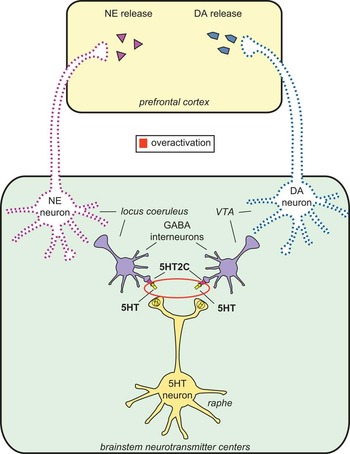
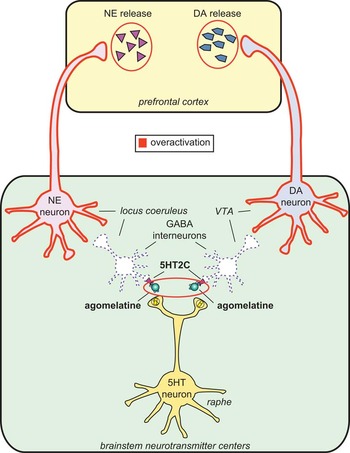
Normally, 5HT2C receptors inhibit downstream dopamine and norepinephrine release from the prefrontal cortex (Figure 2A).Reference Stahl1 When these 5HT2C receptors are blocked, dopamine and norepinephrine release is disinhibited in the prefrontal cortex, and the levels of dopamine and norepinephrine increase (Figure 2B). 5HT2C antagonist action is one of the multiple pharmacologic properties of many antidepressants, and may thus contribute to the antidepressant efficacy of quetiapine, olanzapine, mirtazapine, and possibly asenapine; some tricyclic antidepressants; and other known antidepressants.Reference Stahl1
Serotonin normally inhibits dopamine (DA) and norepinephrine (NE) release via agonist actions at 5HT2C receptors. Serotonergic 5HT2C receptors on GABA-ergic interneurons in the brainstem normally inhibit the release of both dopamine and norepinephrine.Reference Stahl1

5HT2C antagonists increase dopamine and norepinephrine release. When serotonergic 5HT2C receptors on GABA-ergic interneurons in the brainstem are blocked by a 5HT2C antagonist such as agomelatine, this disinhibits downstream dopamine and norepinephrine release in the prefrontal cortex.Reference Stahl1–Reference Zajecka, Schatzberg and Stahl3

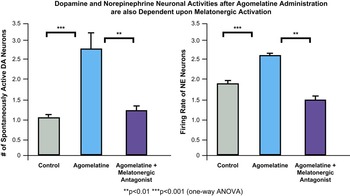
Dopamine and norepinephrine neuronal activities after agomelatine administration are also dependent upon melatonergic activation. When the 5HT2C antagonist action of agomelatine is combined with melatonergic action, there is greater activity of both dopamine and norepinephrine neurons than with 5HT2C antagonist actions alone, thus showing synergy of monoaminergic with melatonergic actions of agomelatine.Reference Chenu, El Mansari and Blier5

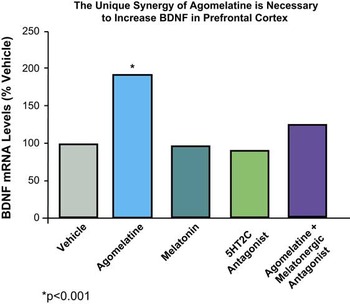
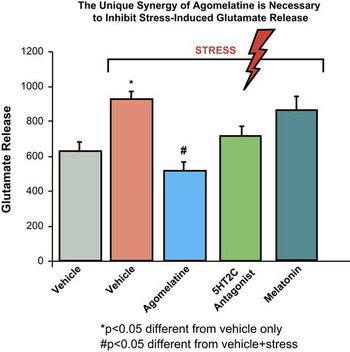
Normally, stimulating melatonergic receptors has the effect of “resynchronizing” circadian rhythmsReference Stahl1, Reference De Bodinat, Guardiola-Lemaitre and Mocaer2 without altering monoamines. However, when MT1/MT2 stimulation is combined with 5HT2C antagonism, a striking and unexpected potentiation of dopamine and norepinephrine release occurs in the prefrontal cortex (Figure 3).Reference Chenu, El Mansari and Blier5 This is not the only example of synergy between these 2 mechanisms. A serendipitous finding of synergy between 5HT2C antagonism and MT1/MT2 agonism has now been demonstrated as well for increases in brain derived neurotrophic factor (BDNF) (Figure 4)Reference Molteni, Calabrese and Pisoni6 and for blocking stress-induced release of glutamate (Figure 5).Reference Tardito, Milanese and Bonifacino7
The unique synergy of agomelatine is necessary to increase BDNF in prefrontal cortex. Agomelatine increases brain derived neurotrophic factor (BDNF) in the prefrontal cortex. This is a unique product of both of agomelatine's pharmacologic actions since BDNF is not increased either by a selective 5HT2C antagonist or by melatonin, and agomelatine's actions on BDNF are reversed by a melatonin antagonist. Thus, the 5HT2C antagonist plus MT1/MT2 agonist actions of agomelatine are synergistic for causing increases in prefrontal BDNF.

The unique synergy of agomelatine is necessary to inhibit stress-induced glutamate release. Glutamate is released by stress, an animal model of depression. This action is reversed by agomelatine but not by melatonin nor by a selective 5HT2C antagonist. Thus, the 5HT2C antagonist plus MT1/MT2 agonist actions of agomelatine are synergistic for inhibiting stress-induced glutamate release.

How does this synergy occur, and what are the functional consequences of combining 5HT2C antagonism with MT1/MT2 agonism in depressed patients? It is possible that the actions of agomelatine are especially targeted at the suprachiasmatic nucleus, the brain's pacemaker; this is where circadian rhythms are regulated and where both 5HT2C receptors and MT1/MT2 receptors are expressed in abundance.Reference Stahl1, Reference De Bodinat, Guardiola-Lemaitre and Mocaer2 It is also possible that separate actions in different brain areas may also account for some of the observed pharmacologic synergies. Where these various receptors exist in close physical contact, there is even the possibility of interaction of the receptors through heterodimerization.Reference De Bodinat, Guardiola-Lemaitre and Mocaer2 However, the exact mechanism of how simultaneous actions at 5HT2C and MT1/MT2 receptors is synergistic remains under active investigation.
Monoaminergic–Melatonergic Synergy and the Clinical Profile of Agomelatine
To the extent that restoring dopamine and norepinephrine neurotransmission results in antidepressant action, this may explain in part the antidepressant mechanism of agomelatine, which combines 5HT2C antagonism with MT1/MT2 agonism (Figure 1).Reference Stahl1, Reference Nutt, Demyttenaere and Janka8 Indeed, this could theoretically underlie the observation that agomelatine has robust actions in treating anhedonia,Reference Martinotti, Sepede and Gambi9 emotional blunting,Reference Corruble, de Bodinat, Belaidi and Goodwin10 daytime sleepiness,Reference Lemoine, Guilleminault and Alvarez11 cognition, attention, and psychomotor retardation,Reference Quera-Salva, Hajak and Philip12 without causing sexual dysfunction.Reference Kennedy, Rizvi, Fulton and Rasmussen13
These clinical actions of agomelatine in depression are consistent with its known pharmacologic effects on dopamine and norepinephrine—and not on serotonin—as dopamine and norepinephrine deficiencies have been theoretically linked to “reduced positive affect,”Reference Stahl1, Reference Nutt, Demyttenaere and Janka8 namely depressed mood, loss of happiness/joy, loss of interest/pleasure, loss of energy/enthusiasm, decreased alertness/cognitive functioning/attention/concentration, and decreased self-confidence.Reference Nutt, Demyttenaere and Janka8 Clinical studies of agomelatine's actions have the profile of improving reduced positive affect,Reference Martinotti, Sepede and Gambi9–Reference Kennedy, Rizvi, Fulton and Rasmussen13 and this differentiates agomelatine from serotonergic antidepressants such as selective serotonin reuptake inhibitors (SSRIs) and serotonin norepinephrine reuptake inhibitors (SNRIs) that do not have particularly robust actions on restoring reduced positive affect, but are more consistent in their therapeutic effects in reducing the increased negative affects that characterize some depressed patients,Reference Stahl1, Reference Nutt, Demyttenaere and Janka8 such as guilt/disgust, fear/anxiety, hostility, irritability, and loneliness.Reference Nutt, Demyttenaere and Janka8
Summary
Agomelatine is an antidepressant with a novel mechanism of action, namely the blockade of 5HT2C receptors with simultaneous stimulation of MT1/MT2 receptors. These actions are synergistic for various pharmacologic effects associated with antidepressant efficacy, and define a unique clinical profile of an antidepressant that not only reduces negative affects such as guilt and anxiety but has particularly robust clinical actions on improving positive affect, namely targeting the improvement of anhedonia, emotional blunting, daytime sleepiness, cognition, attention, and clinical retardation without causing sexual dysfunction.