I. INTRODUCTION
Aerogel is a kind of structure-controllable nanomaterial. It possesses large specific surface area, high porosity, fast optical transmission, low volume density, small refractive index, excellent thermal insulation, and slow conductive velocity of sound.Reference Zhang, He and He1–Reference Lei, Hu, Cao, Chen and Song3 On account of above-mentioned characteristics, people apply it in optical field, thermal subject, phonics, electronics, catalyst support, and capture of high speed particle.Reference Hrubesh, Keene and Latorre4–Reference Hotaling6 And in recent years, researchers have principally reported numerous papers about SiO2 aerogels, Al2O3 aerogels, and C aerogels. For example, Guanhua Jia et al. have successfully synthesized SiO2 aerogels with exaggerated specific surface area (921 m2/g).Reference Jia, Zhu, Liu and Jing7 Guoqing Zu et al. have developed Al2O3 aerogels with ultralow thermal conductivity [0.058 W/(m•K) at 400 °C].Reference Zu, Shen and Wei8 Surprisingly, SnO2 aerogels are basically in a state of few reports. Liu et al. have studied Sb–SnO2 aerogels through ambient-pressure drying.Reference Liu, Zhou, Han and Li9 So it is necessary for researchers to have a deeper study about SnO2 aerogels.
At the same time, there exists a crucial point that the relative atomic mass of Sn (118.71 g/mol) is much heavier than that of Si (28.09 g/mol). Inevitably, the volume density of SnO2 aerogels is heavier than that of SiO2 aerogels with the same pore structure. On the other hand, pore characteristics, such as specific surface area, etc, are also considered as foundation of aerogels. In theory, with the atomic mass increasing, the probabilities of collision can be improved among phonons, leading to decline of mean free paths and thermal conductivity.Reference Kittel10,Reference King and Maquarrie11 In terms of thermal conductivity, heat conduction and heat convection are still main mechanisms for aerogels at relatively low temperature. Phonon scattering and heat convection are hindered on account of vast surface and interface of aerogels.Reference Jia, Dai, Zhu, Wang, Qiao, Long and Ling12 As a result, SnO2 aerogel owns a nature of low thermal conductivity.
In this paper, SnO2 aerogel is synthesized via the sol–gel method and subsequent ambient pressure drying of sol–gel. Compared with super critical drying, ambient pressure drying exists some potentials in aspects of facility request and security. Besides, the effects of different ratios of propylene oxide (PO), SnCl4•5H2O and ammonium hydroxide (AH) on the properties of SnO2 aerogels are investigated in this report.
II. EXPERIMENT
A. Synthesis of SnO2 aerogels
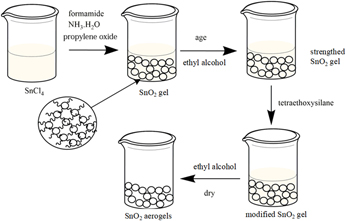
All chemical reagents (analytical grade) were purchased from Kelong chemical reagent factory in Chengdu, China. In the process of synthesis of SnO2 aerogels, SnCl4•5H2O was dissolved in 40 mL of deionized water and absolute ethyl alcohol. Next, AH was added into above-mentioned solution dropwise as reaction promoter. After the solution became clear, formamide was dripped into the mixed solution as drying control chemical additive (DCCA) with stirring for 0.5 h, then PO was added into mixed solution to form gel. The above gel was aged at room temperature for 1 day. We poured out all the liquid in the beaker, filled the beaker with absolute ethyl alcohol, and put it in the oven at 60 °C for 2 days to continue to strengthen the gel network (absolute ethyl alcohol evaporated over time, so we poured out all the absolute ethyl alcohol in the beaker and refilled it with anhydrous alcohol every 12 h). Subsequently, 40 mL mixed solution [tetraethoxysilane (TEOS) and absolute ethyl alcohol (volume ratio of 4 to 1)], as surface modifier, was added in and the beaker was kept at 40 °C for 2 days during which the solvent was changed once. The modified SnO2 gel was immersed in the absolute ethyl alcohol at 60 °C for two days (absolute ethyl alcohol evaporated over time, so we poured out all the anhydrous alcohol in the beaker and refilled it with anhydrous alcohol every 12 h). The modified gel was dried at 70 °C for 1 day to obtain SnO2 aerogel. Finally, SnO2 aerogel was calcined at 600 °C for 3 h. The detailed chemical constituents of raw materials can be found in Table SI.
The samples with different molar ratios of Sn4+:formamide:propylene oxide = 1:1:X and Sn4+:formamide:propylene oxide = X:1:12 were named as Sn-POX and Sn-SCX, respectively. When the samples with molarities of Sn4+:formamide:propylene oxide = 1:1:12 were constant, the samples with variational mole number of AH (X0mmol) were named AH-X. After Sn-PO12 and Sn-AH2 were calcined at 600 °C for 3 h, they were, respectively, defined as Sn-PO12-600 and Sn-AH2-600.
B. Characterization
The volume density of sample was measured using solid densimeter (ET-320, Etnaln, Beijing, China). The porosity was calculated from the following formula:
 $$P\% = \left( {1 - {{{\rho _{\rm{b}}}} / {{\rho _{\rm{s}}}}}} \right) \times 100\% \quad ,$$
where ρb is the volume density of the sample and ρs is the density of skeleton solid (the density of SnO2 crystal = 6.95 g/cm3). Functional groups of the samples were recorded using a Fourier transform infrared spectrometer (FTIR) (TENSOR27, Bruker, Karlsruhe, Germany). Thermogravimetric analysis and differential scanning calorimetry [TG/DSC(STA 449, Netzsch, Selb, Germany)] were performed with the varieties of samples with the rise of temperature. The SEM and FESEM (JSM-7500F, JEOL, Tokyo, Japan) were used to observe the microstructure of SnO2 aerogels. The pore characteristics of SnO2 aerogels were investigated utilizing a nitrogen adsorption–desorption analyzer (Tristar II 3020, Micromeritics, Atlanta, Georgia). A thermal resistance tester (DRL-III, Xiangtan instrument and meter factory, Xiangtan, China) was used to measure the thermal conductivity of SnO2 aerogels, which were constructed into the disk with the diameter of 30 mm. The contact measuring instrument (JC20001C1, Powereach, Shanghai, China) was utilized to measure the hydrophicity or hydrophobicity. The crystal constituent of SnO2 aerogels was examined by X-ray diffraction (XRD-6000, Shimadzu, Kyoto, Japan). The details can be seen in the Supplementary Material.
III. RESULTS AND DISCUSSION
SnCl4 is a kind of Lewis acid and Sn4+ ions are polymerized with PO under the joint action of water and alcohol [reactions (2) and (3)].Reference Worsfold and Eastham13,Reference Worsfold and Eastham25 The specific reaction mechanism is as follows: First, the Sn4+ ions form complex compound with water or ethyl alcohol. And then the complex compound converts to ion pair to provide the proton or cation. The proton initiates PO to open the ring and form the positively tertiary oxonium ion. The electron deficiency of the α-carbon atom near the tertiary oxonium ion is favorable to the nucleophilic attack of oxygen atom in the monomers and the continuous opening of the ring.
On the one hand, formamide (DCCA) has a positive effect on forming the uniform pore and reducing capillary pressure according to the report of Zhong et al.Reference Lu, Song, Zhang, Zhou, Sun and Hu14 On the other hand, the surface of H and N atoms absorbed by external gel through hydrogen bonding can weaken hydroxyl interaction between water and gel, which is beneficial to drying.Reference Lu, Song, Zhang and Zhou15 Afterwards, tetraethoxysilane plays an important role in surface modification. Hydroxyl is replaced by C2H5OSi- to enhance the hydrophobicity of SnO2 gel, thus volume collapsing can be hindered during drying. Therefore, SnO2 aerogel is fundamentally retained with favourable skeleton structure and numerous pores.
 $$$$
 $$$$
 $${\rm{S}}{{\rm{n}}^{4 + }} + 4{\rm{N}}{{\rm{H}}_3} \cdot {{\rm{H}}_2}{\rm{O}} = {\rm{Sn}}{\left( {{\rm{OH}}} \right)_4} + 4{\rm{NH}}_4^ + \quad ,$$
 $${\rm{S}}{{\rm{n}}^{4 + }} + 4{{\rm{H}}_2}{\rm{O}} = {\rm{Sn}}{\left( {{\rm{OH}}} \right)_4} + 4{{\rm{H}}^ + }\quad ,$$
 $${\rm{S}}{{\rm{n}}^{4 + }} + 4{{\rm{C}}_2}{{\rm{H}}_5}{\rm{OH}} = {\rm{Sn}}{\left( {{{\rm{C}}_2}{{\rm{H}}_5}{\rm{O}}} \right)_4} + 4{{\rm{H}}^ + }\quad .$$
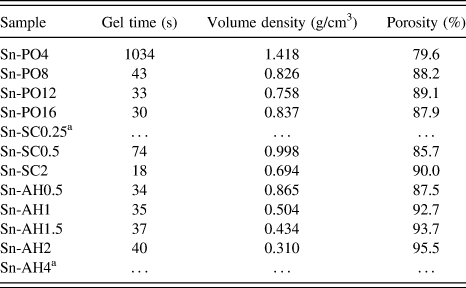
In contrast with variable experimental conditions in Table I, with the molarities of PO increasing, the gel time is shortened, the volume density and porosity are conformed to the tendency of first decreasing and then increasing. The optimal value is Sn-PO12. When the amount of PO is too little, the solution cannot form gel or incomplete gel skeleton structure is built undesirably. With more PO being added in, the gel structure is loose and the volume density is the lowest. But when the PO is overmuch, the system will be devoid of central atoms and influence gel skeleton. As a result, the structure of SnO2 aerogels is compact and the volume density is bulky. Simultaneously, when the concentration of Sn4+ is relatively low, the gel is unable to form on account of the lack of central atom. As Sn4+ ions increase, the solution can form gel with multi-hole structure. Predictably, when too many Sn4+ ions are added, similar circumstance like Sn-PO4 will appear because of the lack of PO. In addition, as the AH concentrations augment, the volume density of aerogels is reduced. However, when overmuch AH is added, there will generate the irreversible sediment. It is a reasonable explanation that reactions (5) and (6) can happen without the addition of AH, but after the addition of AH, reaction (4) can occur to promote the concentrations of Sn(OH)4 and Sn(C2H5O)4. Besides, ammonium can also form hydrogen bond with water, alcohol, hydroxyl, and alcoholic hydroxyl on the surface of gel. Consequently, hydrolysis and polycondensation are facilitated to form complete and large skeleton structure of aerogels. To sum up, the optimal mixture ratio is Sn-AH2 which possesses the lowest volume density (0.310 g/cm3) and maximal porosity (95.5%).
Gel time, volume density, and porosity of different SnO2 aerogels.

a Because Sn-SC0.25 and Sn-AH4 cannot form the gel, the data of the gel time, volume density, and porosity are nonsense.
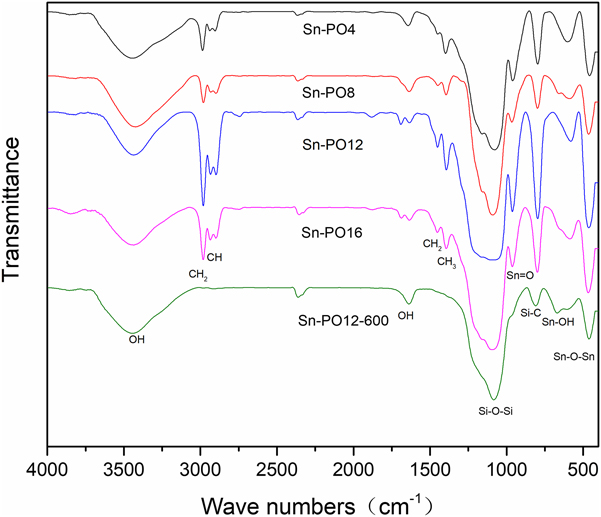
FTIR spectra of Sn-POX and Sn-PO12-600 aerogels are shown in Fig. 1. The peaks at 3438−1 cm correspond to O–H groups of physisorbed water molecules bond by weak hydrogen bonds.Reference Benrabah, Bouaza, Kadari and Maaref16 The peaks at 1079 cm−1 are deemed as stretching vibration of Si–O–Si bond.Reference Nazriati, Setyawan, Affandi and Yuwana17 The peaks at 459 cm−1 are overlapped by the stretching bond of O–Sn–O at 585 cm−1.Reference Sun, Shi, He and Li18 The appearance of Si–C bond at 796 cm−1 derives from the addition of TEOS and the other detailed analyses have been supplemented in the Supplementary Material.Reference Parale, Han and Jung19,Reference Gurav, Venkateswara Rao and Bangi20 Notably, 2977 cm−1 of CH2 bond of antisymmetric stretching vibration, 2932 cm−1 and 2893 cm−1 of CH bond of symmetric stretching vibration, 1692 cm−1 of OH bond of absorbed water, 1450 cm−1 and 1390 cm−1 of CH2, and CH3 of bending vibration, respectively, 754 cm−1 of Sn=O bond of bending vibration are observed clearly before calcination. However, a new peak of Sn–OH bond appears at 669 cm−1 after calcination,Reference Gaddari, Berger, Amjoud, Sanchez and Lahcini21 indicating that the SnO2 aerogels have been oxidized during the calcination. In general, SnO2 gel has been successfully modified by the addition of tetraethoxysilane and the CH3CH2OSi-bond has been transferred to SnO2 gel.
Diverse molarities of PO and temperature using FTIR.

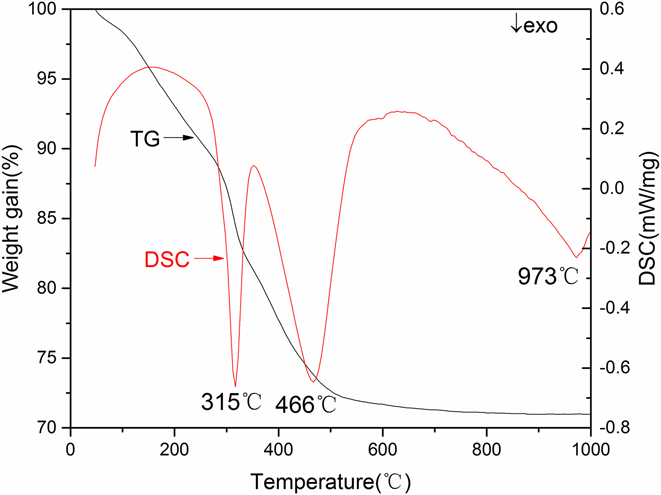
The TG-DSC curve in Fig. 2 shows the mass and heat of variation of SnO2 aerogels with elevation of temperature, from which a continuing mass loss and three visibly exothermic peaks can be observed. First, two sharp exothermic peaks, derived from evaporation and dissociation of organics and oxidation of methyl, are observed at 315 and 466 °C separately. Next, there exists a tiny exothermic peak at 973 °C which may be considered as the phase transition. The result of TG-DSC is consistent with FTIR, which verifies that SnO2 aerogels have been successfully oxidized at a relatively higher temperature. Through the analysis of TG-DSC result, the best calcination temperature is considered to be 600 °C.
TG-DSC curve of Sn-PO12 from indoor temperature to 1000 °C with 10 °C/min rate of temperature increase.

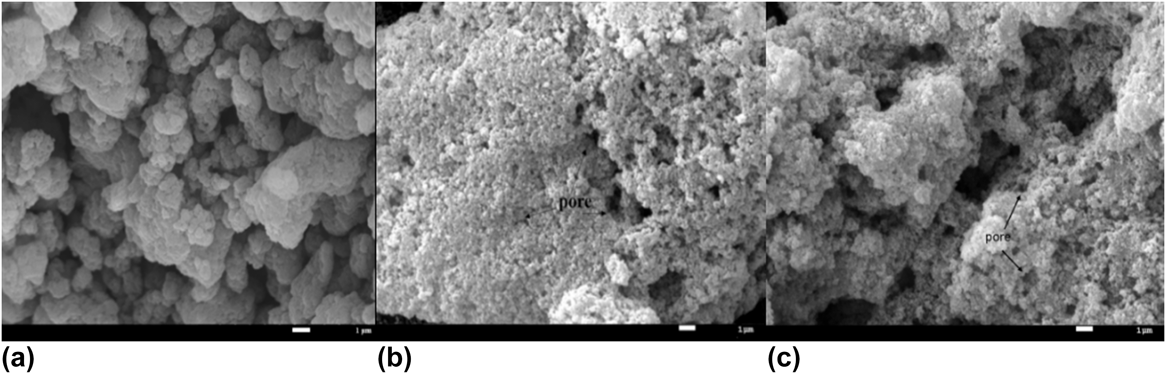
Field emission scanning electron microscopy (FESEM) has been utilized to visually study micromorphology and pores of SnO2 aerogels, as shown in Fig. 3. SnO2 aerogels are consisted of numerous granular aggregates, and smaller granular aggregates are spontaneously united into bigger ones. In the process of agglomeration of small granules, a great deal of mesopores and even micropores can form. Explicitly, macropores are also assembled among lumping granular aggregates. The low volume density of SnO2 aerogels can be attributed to the cellular structure made up of multitudinous pores. From Figs. 3(a) and 3(b), the agglomeration of Sn-AH2 is distinctly severer than that of Sn-PO12. It denotes that the pore structure of aerogels can be effectively regulated by AH.
SEM micrograph of SnO2 aerogel: Sn-PO12 (a); FESEM micrographs of Sn-AH2 (b); Sn-AH2-600 (c).

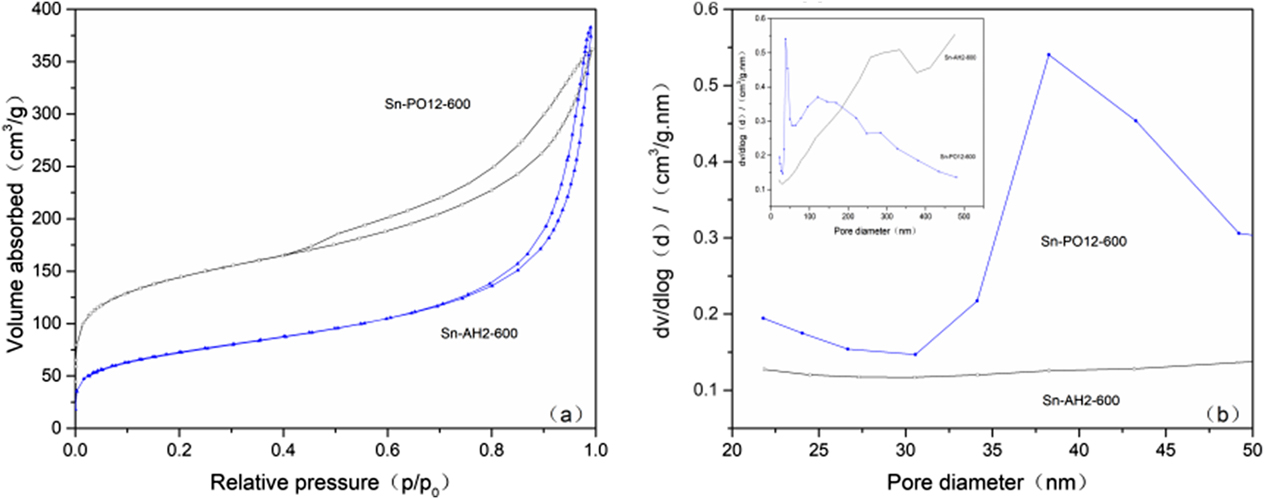
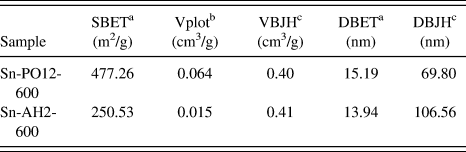
Figure 4 shows the adsorption–desorption of isotherms and pore size distribution of Sn-PO12-600 and Sn-AH2-600. Different contact angles before and after adsorption can cause the difference of adsorption–desorption isotherm. The isotherms are all typical type IV with H4 hysteresis loop according to IUPACF classification, denoting the tapered pore structure of Sn-PO12-600 and Sn-AH2-600. As can be seen in Table II, it can ascribe the different characteristics of SnO2 aerogels to the addition of AH. AH has an obvious impact on the structure of gel by forming hydrogen bond with other ingredients. Furthermore, AH can form hydrogen bond with the hydroxyl on the surface of gel, so the force of hydrogen bond can block the agglomeration of SnO2 during aging and drying. From Table II, the pore volume of Sn-PO12-600 and Sn-AH2-600 calculated by the BJH method is close to each other. However, in Fig. 4(b), the pore diameter of Sn-AH2-600 is distinctly bigger than that of Sn-PO12-600. In other words, AH allows SnO2 aerogels to shape more macropores which can be observed in sub-micron level from Fig. 3(c), corresponding to the analysis of the BJH method of SnO2 aerogels.
(a) Adsorption–desorption isotherm of N2; (b) pore size distribution of Sn-PO12-600 and Sn-AH2-600 by the BJH method.

The pore characteristics of Sn-PO12-600 and Sn-AH2-600.

a BET method.
b Micropore volume by the plot method.
c BJH method between 20 nm and 500 nm.
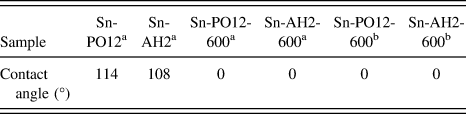
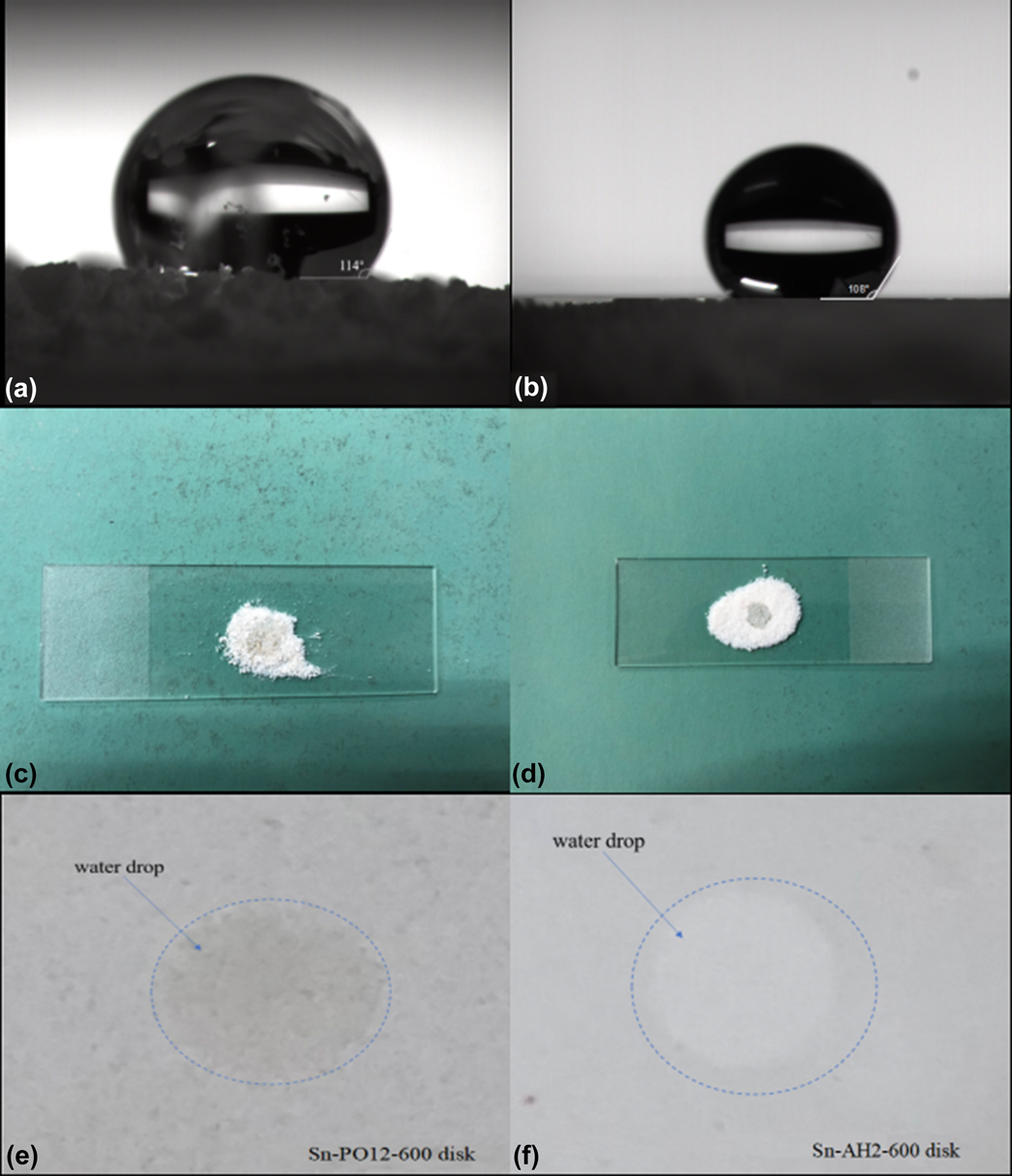
It can be seen from Table III and Fig. 5 that both Sn-PO12 and Sn-AH2 are hydrophobic, indicating that they are successfully modified by TEOS. But after calcination at 600 °C, Sn-PO12-600 and Sn-AH2-600 are revealed with strong hydrophicity. The water drops, whether on the powdered or flaky Sn-PO12-600 and Sn-AH2-600, spread out directly, revealing the contact angle tending to zero. This super-hydrophicity is related not only to the hydroxyl group on the surface but also to the variation of surface roughness due to the three-dimensional porous structure of aerogels.Reference Hosono, Matsuda and Honma22,Reference Cebeci, Wu and Zhai23 The results conform to that of FTIR, demonstrating SnO2 aerogel changes from hydrophicity to hydrophobicity to hydrophicity as a consequence of surface modification and oxidation at 600 °C, respectively.
The contact angle of SnO2 aerogels.

a After a few drops of water on the SnO2 aerogels powder.
b After a drop of water on the SnO2 aerogels disk.
Contact angle: Sn-PO12 powder (a) and Sn-AH2 powder (b); photographs after a few drops of water: Sn-PO12-600 powder (c) and Sn-AH2-600 powder (d); photographs after a drop of water: Sn-PO12-600 disk (e) and Sn-AH2-600 disk (f).

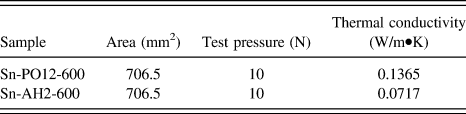
From the data in Table IV, the thermal conductivity of Sn-PO12-600 and Sn-AH2-600 is considered to be 0.1365 W/(m•K) and 0.0717 W/(m•K) independently at 150 °C. Compared with Sn-PO12-600, Sn-AH2-600 is thought to own lower volume density, smaller specific surface area, and larger pore size. In the aspect of heat transfer, the thermal conductivity of SnO2 aerogel skeleton belongs to phonon heat conduction but thermal convection still exists in the pores of SnO2 aerogels. In the condition of a standard atmospheric pressure, the average free path of air is in the 10−8 m order of magnitude at 150 °C.Reference Tsuge, Kim and Sone24 Therefore, in the range of mesopores, Sn-AH2-600 is theoretically better than Sn-PO12-600 in limiting thermal convection to some extent. Nevertheless, the characteristics of Sn-PO12-600, such as micropore volume and specific surface area, are better for reducing the thermal conductivity. And more importantly, as for as volume density, Sn-PO12-600 is bigger than Sn-AH2-600. In other words, at the same temperature, more phonons in Sn-PO12-600 are involved in the process of heat conduction compared with Sn-AH2-600. In conclusion, the thermal conductivity of SnO2 aerogels has a complicated and interactional relationship with volume density, specific surface area, and pore characteristics.
The thermal conductivity of Sn-PO12-600 and Sn-AH2-600 at 150 °C.

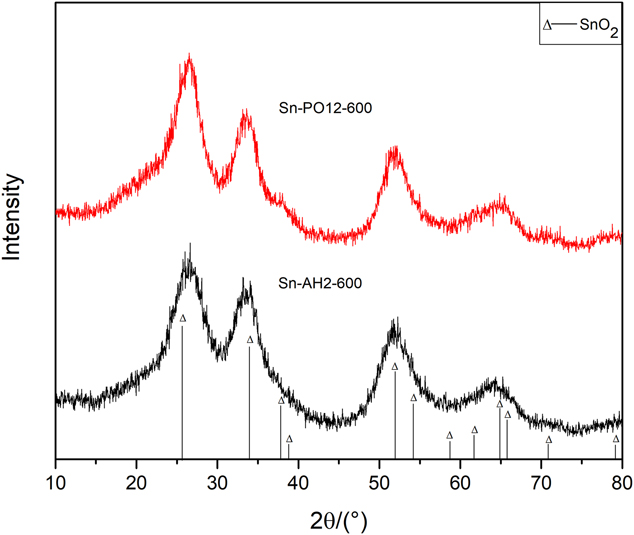
Figure 6 indicates the results of XRD of Sn-PO12-600 and Sn-AH2-600. It can be observed that both of them are in a situation of semicrystalline, and the main peaks at 26.61°, 33.89°, and 51.78° agree with the main peaks of SnO2 (JCPDS no.71-0652), which further proves the successful synthesis of SnO2 aerogels. Simultaneously, the grains, in the semicrystalline, are not completely arranged in order, and the existence of a large number of grain boundaries has a certain effect on the reduction of thermal conductivity. Crucially, the consequences of XRD are matched well with those of FTIR, testifying the rationalization of SnO2 aerogels rather than other aerogels (Fig. 6).
XRD of Sn-PO12-600 and Sn-AH2-600.

IV. CONCLUSION
SnO2 aerogels with a low thermal conductivity of 0.0717 W/(m•K) have been successfully synthesized by the combination of the sol–gel method and ambient pressure drying method. Through the analysis of FTIR and contact angle, the transition of SnO2 aerogels from hydrophicity to hydrophobicity to hydrophicity is proved reasonably. The results of FESEM and adsorption–desorption isotherm of N2 show that SnO2 aerogels are still porous materials with relatively complete skeleton structure and have small volume density and large specific surface area after ambient pressure drying. In addition, AH can allow SnO2 aerogels to shape more macropores by the force of hydrogen bond.
Supplementary Material
To view supplementary material for this article, please visit https://doi.org/10.1557/jmr.2018.389.
ACKNOWLEDGMENTS
This work is supported by Sichuan University. The authors thank the Sichuan University for the help of instruments and fund.