




No CrossRef data available.
Undermining a Bulwark of the Monarchy: Civil-Military Relations in Fortress Przemyśl (1871–1914)
Published online by Cambridge University Press: 20 April 2017
Abstract
An abstract is not available for this content. As you have access to this content, full HTML content is provided on this page. A PDF of this content is also available in through the ‘Save PDF’ action button.
Information
- Type
- Article Commentary
- Information
- Copyright
- Copyright © Center for Austrian Studies, University of Minnesota 2017
References
1 “Das Polizeimassacre in Przemyśl,” Arbeiter Zeitung, 24 May 1907, 4; Allgemeines Verwaltungsarchiv [AVA], Inneres, Ministerium des Innern (MdI), Präsidium (Präs) Carton A 2111 Nr. 5992/MI 1907 (19 June 1907).
2 Pollack, Martin, Galizien: Eine Reise durch die verschwundene Welt Ostgaliziens und der Bukowina (Frankfurt, 2001), 23Google Scholar.
3 Przemyśl's main importance prior to the 1870s was as a site of the Ruthenian national awakening. By the 1850s, though, its role had largely been overshadowed by Lviv. See Stępień, Stanisław, “Borderland City: Przemyśl and the Ruthenian National Awakening in Galicia,” in Galicia: A Multicultured Land, ed. Hann, Christopher and Magocsi, Paul Robert (Toronto, 2005), 52–70 Google Scholar. “Ruthenian” is the preferred term until around World War I, when the Ukrainian national movement became dominant.
4 There is a rich historiography on Habsburg Lviv and Krakow. For a start, see Czaplicka, John, ed., Lviv: A City in the Crosscurrents of Culture (Cambridge, 2005)Google Scholar; Prokopovych, Markian, Habsburg Lemberg: Architecture, Public Space, and Politics in the Galician Capital, 1772–1914 (West Lafayette, IN, 2009)Google Scholar; Purchla, Jacek, Cracow in the European Core (Olszanica, 2008)Google Scholar; Purchla, Jacek, Krakau unter österreichischer Herrschaft 1846–1918. Faktoren seiner Entwicklung, trans. Medziński, Michał and Czownic, Jacek (Vienna, 1993)Google Scholar; Wood, Nathanial D., Becoming Metropolitan: Urban Selfhood and the Making of Modern Cracow (DeKalb, IL, 2010)Google Scholar.
5 Kuzmany, Börries, Brody: Eine galizische Grenzstadt im langen 19. Jahrhundert (Vienna, 2011)CrossRefGoogle Scholar; Frank, Alison Fleig, Oil Empire: Visions of Prosperity in Austrian Galicia (Cambridge, 2005)Google Scholar.
6 Charles Ingrao first formulated this framework for Habsburg strategic policy in “Habsburg Strategy and Geopolitics in the Eighteenth Century,” War and Society in East Central Europe 2 (1982): 49–66 Google Scholar.
7 Przemyśl's population in 1870 was 15,185, of which 42% was Roman Catholic (usually Polish), 19% Greek Catholic (usually Ruthenian), and 40% Jewish. By 1910 it was up to 54,078 and 47% Roman Catholic, 22% Greek Catholic, and 30% Jewish. See Walerjan Kramarz, Ludność Przemyśla w Latach 1521–1921 [The population of Przemyśl in the years 1521–1921] (Przemyśl, 1930), 55, 108.
8 For the importance of the Austro-Hungarian army to the social cohesion of the state, see Deák, István, Beyond Nationalism: A Social and Political History of the Habsburg Officer Corps, 1848–1918 (New York, 1990)Google Scholar, ix; Rothenberg, Gunther E., The Army of Francis Joseph (West Lafayette, IN, 1976)Google Scholar; and more recently Cole, Laurence, Military Culture and Popular Patriotism in Late Imperial Austria (Oxford, 2014)CrossRefGoogle Scholar; and Bassett, Richard, For God and Kaiser: The Imperial Austrian Army (New Haven, 2015)CrossRefGoogle Scholar.
9 See Kramarz, Ludność Przemyśla, 50–106, for an exhaustive breakdown of Przemyśl's population, employment, and demographic makeup during the decades of Austrian occupation. In 1880, Przemyśl's garrison was only 1,373 soldiers, or 6% of the population. By 1890, the garrison ballooned to 7,192 soldiers, or 20% of the city. In 1910, it was 8,514, or 18%.
10 See excerpts from Lerski's memoirs in Wiater, Stanislaw, Przemyśl w Oczach Pisarzy: Antologia XX Wieku [Przemyśl in the eyes of authors: A twentieth-century anthology] (London, 1994), 58–66 Google Scholar.
11 Wagner, Walter, “Die k.(u.).k. Armee-Gliederung und Aufgabenstellung,” in Die Habsburgermonarchie 1848–1918, vol. 5: Die Bewaffnete Macht, ed. Wandruszka, Adam and Urbanitsch, Peter (Vienna, 1987), 178–79Google Scholar.
12 The Reichs-Kriegs-Ministerium ordered all major commands to reevaluate fortress layout and survey potential sites as early as 1866. Kriegsarchiv [KA], Zentralstellen, Kriegsmiisterium, Präs 19-9/2 1868. Austria-Hungary's high command debated throughout the late 1860s and early 1870s about how best to defend central Galicia, with defensive schemes ranging from complete fortification of the San River, to fortifying Jarosław, to fortifying Przemyśl, to fortifying both Jaroslaw and Przemyśl. Ultimately, financial restrictions curtailed the more elaborate defensive plans. See Wagner, “Die k.(u.).k. Armee-Gleiderung und Aufgabenstellung,” 400–412. See also Bobusia, Bogusław, Gosztyła, Marek, and Zub, Monika, Plany Twierdzy Przemyśl [Plans of the Fortress Przemysl], vol. 1 (Przemyýl, 2004)Google Scholar.
13 For a study of fortress construction, see Forstner, Franz, Przemyśl: Österreich-Ungarns bedeutendste Festung (Vienna, 1987)Google Scholar. See also Idzikowski, Thomasz, Twierdza Przemyśl: Powstanie, Rozwój, Technologie [Fortress Przemyśl: Origin, development, technology] (Krosno, 2014)Google Scholar. Between 1871 and 1878, construction work focused on roads to planned fortress sites.
14 von Salis-Soglio, Daniel Frieherrn, Mein Leben und was ich davon erzählen will, kann und darf, vol. 2: Von 1867 an (Stuttgart, 1908), 39–66 Google Scholar. Brunner served as Genie-Director in Przemyśl from 1889–93, but he had considerable influence on Austro-Hungarian fortress design and engineering policy for the rest of his life. See KA, Militärische Nachlässe [NL], box 1, folder 20, “Persönliche Daten über Feldmarshalleutant von Brunner”; and KA, NL, box 2, folder 43, “Feldmarschalleutnant Moritz Ritter von Brunner.”
15 Gilewicz, Aleksy, “Twierdza Przemyśl w XIX I XX w.” [Fortress Przemyśl in the 19th and 20th centuries], Rocznik Przemyski [Przemyśl yearbook] 12 (1968): 159Google Scholar.
16 Fort Optyn is not labeled in Figure 1 but is located directly below the village of Pikulice. Reynolds, Francis J., Churchill, Allen L., Miller, Francis Trevelyan, Wood, Leonard, and Knight, Austin Melvin, eds., The Story of the Great War, vol. 5: Neuve Chapelle, Battle of Ypres, Przemysl, Masurian Lakes (New York, 1916–20), 1448Google Scholar.
17 Malczewski, Jan, Przemyśl w latach 1772–1914: Budownictwo, gospodarka komunalna, przemiany przestrzenne [Przemyśl in the years 1772–1914: Architecture, municipal economy, spatial transformation] (Rzeszów, 2009), 170–84Google Scholar.
18 Statistischer Baubericht über den Bau des Gürtel-Hauptwerkes IV “Optyń” (Mit 4 Plänen und 3 Beilagen) Vienna, 1901.
19 Naturally, there were exceptions. The city's one pogrom during this era was partially motivated by low employment. See “Zaburzenia głodowe w Przemyślu” [Disorders of the head in Przemysl], Kuryer Lwowski [Lviv courier], 27 May 1898, 1–2; “Roboty lub chleba” [Work or bread], Echo Przemyski [Przemyśl echo], 29 May 1898, 2.
20 Błoński, Jacek, “Przemyśl: ‘Najzacniejszy plac broni Galicji,” [Przemysl: The most important armed spot in Galicia] Nasz Przemyśl [Our Przemyśl] 54, no. 3 (March 2009): 41Google Scholar. Kramarz, Ludność Przemyśl, 107. In 1880 there were 1,208 freestanding houses, and by 1900 there were 2,103. For apartment units, it was 3,892 and 7,658.
21 Durkacz-Foremska, Anna, “Education and Culture in Przemyśl during the Galician Autonomy,” in Przemyśl i jego mieszkańcy w Królestwie Galicji i Lodomerii [Przemysl and its inhabitants in the Kingdom of Galicia and Lodomeria] (Przemyśl, 2003), 61–63 Google Scholar.
22 Kaps, Klemens, Ungleiche Entwicklung in Zentraleuropa: Galizien zwischen überregionaler Verflechtung und imperialer Politik (1772–1914) (Vienna, 2015), 337–40, 429CrossRefGoogle Scholar.
23 The relative size of Przemyśl's Jewish population declined over these years—from 38.2% of the city population in 1870 to 30.4% in 1900. Numerically, though, the Jewish community almost tripled in size from 5,962 to 14,109. See Kramarz, Ludność Przemyśl, 108. See Curt Dunagan, “The Lost World of Przemyśl: Interethnic Dynamics in a Galician Center, 1868–1921” (Ph.D. diss., Brandeis University, 1999) for a discussion of the cultural and religious life of Przemyśl's Jews.
24 “Galicya w liczbach” [Galicia in numbers], Gazeta Przemyska, 9 April 1891, 1–2. Lviv had a typical rate of 10%.
25 KA Karten- und Plansammlung, Landesbeschreibungen KVII h, 126–32 “Epsilon Gebäudeinventar aller in Verwaltung der k.u.k. Geniedirektion in Przemysl stehenden ärarischen und dauernd gemieten, dann auf Grund der Einquartierungsgesetze beigestellten und der sonstigen in militaärischer Benützung befindlichen Immobilien.” Most of the army's facilities were built before 1900. See also Bobusia, Bogusław, Gosztyła, Marek, and Zub, Monika, Plany Twierdzy Przemyśl, vol. 3 (Przemyśl, 2010)Google Scholar, which lists over ninety Austro-Hungarian military buildings in Przemyśl, and their current condition and use.
26 KA-KM PRÄS 45-3/7 ex 1889, carton 857, Reichs Kriegs Ministerium Res Nro 6.
27 Beata Świętojańska, “Twierdza Przemyśl, i jej wyplyw na rozwój społeczno-gospodarczy miasta, w okresie autonomii Galicyjskiej” [Fortress Przemyśl and its effect on the socioeconomic growth of the city in the era of Galician autonomy] (Ph.D. diss., University of Rzeszów, 2009), 30–32.
28 Graulik, Johann, Das k. und k. Corps-Artillerie-Regiment Luitpold Prinz-regent von Bayern Nr. 10: Chronik der Ereignisse vom Jahre 1854 bis 1894 (Vienna, 1894), 207–37Google Scholar.
29 Kramarz, Ludność Przemyśla, 57 and 79; “Budzet miasta Przemysla na rok 1901” [Przemyśl's city budget for 1901], Echo Przemyskie, 13 January 1901, 2; Broński, Krzystof, “The Role of Mayors in the Development of Medium-sized Galician Towns Using the Examples of Nowy Sącz, Przemyśl and Stanisławów,” in Mayors and City Halls: Local Government and the Cultural Space in the late Habsburg Monarchy: International conference, 30 November–2 December 1995 (Cracow, 1998), 90Google Scholar. See also Dalecki, Maciej, “Gospodarka finansowa samorządowych wladz miejskich Przemyśla w latach 1867–1914” [Financial management of municipal governmental authorities in Przemysl in the years 1867–1914], Rocznik Przemyski 28 (1991–92): 202–4Google Scholar; Archiwum Państwowe w Przemyślu (State Archive in Przemysl, APP) 129.1361.
30 Graulik, Das k. und k. Corps-Artillerie-Regiment, 235–36. See also unit nationality and linguistic makeup (as of 1914) at “Infanterie-Regimenter 1–102 as at July 1914,” Austro-Hungarian Army, accessed 5 November 2016, http://www.austro-hungarian-army.co.uk/nationality.htm. Units like the 9th, 10th, 77th, and 45th infantry regiments were recruited in central Galicia and thus predominately Polish, Ruthenian, and Jewish. Cavalry and artillery units were transferred in from Bohemia and Hungary to help counter the superiority in Russian cavalry.
31 Pollack, Martin, Galizien: Eine Reise durch die verschwundene Welt Ostgaliziens und der Bukowina (Frankfurt, 2001), 20Google Scholar. Felix Mantel discusses the favorite bakeries of officers, lawyers, and workers. See Wiater, Stanislaw Jozef, Przemyśl w Oczach Pisarzy: Antologia XX Wieku [Przemyśl in the eyes of writers: A 20th-century anthology] (London, 1994), 36Google Scholar.
32 For example, “Wielki bal kostyumowy” [Great costume ball], Nowy Głos Przemyski, 27 February 1904, 2.
33 Quoted in Pudłucki, Tomasz, Iskra Światła czy Kopcąca Pochodnia? Inteligencja w Przemyślu w Latach 1867–1939 [A spark of light or a smoky torch? The intelligentsia in Przemyśl from 1867–1939] (Cracow, 2009), 359Google Scholar.
34 “Zniemczone miasto” [A Germanized city], Gazeta Przemyska, 19 February 1909, 1. These are clearly code terms for the Jews. At this time, Gazeta Przemyska was the local organ of Roman Dmowski's increasingly antisemitic and nationalistic Polish National Democrats.
35 For example, the Edison coffeehouse had military music every day, and the Habsburg café every Sunday. See newspaper advertisements from Nowy Głos Przeyski, 20 February 1904, 3–4; “W kawiarni Habsburg” [In the Habsburg café], Nowy Głos Przemyski, 23 January 1904, 3.
36 Durkacz-Foremska, “Education and Culture,” 69. I have been unable to find exact figures on the size of the prostituion industry in Przemyśl during this era.
37 For more information about Dworki's service, see Bogomila, Filarecka, “Alexander Dworski (1822–1908) Burmistrz Miasta Przemyśl” [Alexander Dworski (1822–1908) mayor of Przemysl], Rocznik Przemyski 32 (1996): 67–76 Google Scholar.
38 G. E. R. Gedye, “Sardonic General Mourned in Austria: Wealth of Anecdotes Recalled with the Passing of Von Galgótzy at 93,” The New York Times, 19 November 1929, 10.
39 See, for example, APP 129.1688, 147–150; APP 129.1467.
40 Quoted in Świętojańska, Beata, “Miasto Przemyśl: Garnizonem Armii Austro-Węgierskiej w Okresie Autonomii Galicyjskiej” [The city of Przemysl: An Austro-Hungarian garrison in the era of Galician autonomy], Rocznik Przemyski 40, no. 4 (2004): 29Google Scholar.
41 One of the more egregious examples of censorship was an open letter to Galgótzy. The letter would have criticized his abuse of police powers and leading an unfriendly army of occupation. See “List otwarty do p. Antona Galgotzego, komendata korpusu” [Open letter to Mr. Anton Galgótzy, corps commander], Głos Przemyski, 4 June 1899, 1; and “W jaki sposób konfiskuje sie, ‘Głos Przemyski’” [How the “Voice of Przemyśl” was confiscated], Głos Przemyski, 18 June 1899, 2. For examples of arrests, see “Rozruchy głodowe przed sądem” [Uproar against starvation in court], Głos Przemyski, 28 October 1899, 3; “Arrestowano” [Arrested], San, 13 April 1879, 2.
42 Świętojańska, “Twierdza Przemyśl,” 30, 215; A. Bloch, “Dr. Herman Liebermann,” in Przemyśl Memorial Book, ed. Menczer, Arie (Israel, 1964), 115Google Scholar.
43 Zbigniew Beiersdorf, “Town Halls in Galicia,” in Mayors and City Halls, 129–30. The most important laws granting local autonomy were the District Law of 1882 and the Large Cities Law of 1889.
44 John-Paul Himka's study of Galician Social Democracy generally focuses on voluntary artisan associations, particularly in and around Lviv, Krakow, and Boryslav before 1890. Przemyśl was relatively quiet during these years, though the city's Greek Catholic Bishop denounced “socialist agitation” in 1886. See Himka, , Socialism in Galicia: The Emergence of Polish Social Democracy and Ukrainian Radicalism (1860–1890) (Cambridge, 1983), 136Google Scholar. Przemyśl was the site of the first Polish Social Democratic party (thanks to a split with the Ruthenians) in Galicia. See Martin Pollack, Galizien, 22–23; Roazen, Paul, Helene Deutsch: A Psychoanalyst's Life (New Brunswick, 1992), 31–34 Google Scholar.
45 Arthur Leinwand, Poseł Herman Lieberman [Representative Herman Lieberman] (Cracow, 1983), 28. Himka, Socialism in Galicia. In Przemyśl, fortress construction, and thus employment, usually went on hiatus from December through March.
46 AVA, Inneres, MdI Präs1871–1902 (cartons A 725, A 867, and A 2108).
47 AVA, Inneres, MdI, Präs Zl: 126/pr. “Bericht des k.k. Statthalteri-Rattes in Bezirkshauptmannschaftsleiten im Przemyśl vom 5/7 1898.”
48 Labor (Po'alei) Zionists frequently disrupted Social Democratic meetings after 1904, sometimes violently. Przemyśl's Jewish community had many of the same divisions and conflicts as other Galician cities. In general, Jewish liberals and progressives started the fortress era as pro-Polish integration. They made considerable progress; by 1901, Jewish council meetings were officially held only in Polish. Jewish Socialists remained integrated with the Polish Social Democratic Party (PPSD) until 1905, when the Jewish Social Democratic Party (ŻPSD) split with the PPSD over concerns about the party's increasing nationalism. Lieberman opposed this split. Meanwhile, in spite of a few activists, Zionism had little support in Przemyśl, at least before the appointment of Zionist Gedalia Schmelkes as city rabbi in 1904. Though there was considerable activity among Jewish progressives, socialists, and Zionists, Przemyśl's Jewish leadership was largely Orthodox and rejected modernization. For further information about Przemyśl's Jews, see Dunagan, “The Lost World of Przemyśl,” 133–35, 225–27. For Galician Jews generally, see Shanes, Joshua, Diaspora Nationalism and Jewish Identity in Habsburg Galicia (Cambridge, 2012)CrossRefGoogle Scholar; and McCagg, William O., A History of the Habsburg Jews, 1670–1918 (Bloomington, 1989), 183, 185Google Scholar. Despite opposition to the army in the decades before World War I, during the war, Przemyśl's Jews enthusiastically supported the Habsburg war effort both in and out of the military.
49 See excerpts from Lieberman's memoirs in Wiater, Przemyśl w Oczach Pisarzy, 58.
50 Wiater, Przemyśl w Oczach Pisarzy, 58–66.
51 Dunagan, “The Lost World of Przemyśl,” 231. Lieberman was well-educated, reading Polish, German, French, English, Ruthenian, Russian, Greek, and Latin, but not Yiddish. See Andrzejewski, Zenon, “Przemyski wątki w biografii Hermana Liebermana (cz. 2)” [Threads from Przemyśl in the biography of Herman Lieberman], Rocznik 9–10 (2011): 250Google Scholar.
52 “Autonomiczna niewola” [Independent slavery], “Msza pod bagnetami” [Mass under bayonets], “Krwawa zabawa” [Bloody game], and “Strazny los żołnierski” [The dreadful fate of soldiers], Głos Przemyski, 15 January 1899, 1–3. The dreadful fate of soldiers is apparently military justice. The story was about the harsh punishments that young Mikołaj Stecykiewicz suffered for falling asleep by his drum during field maneuvers. “Strazny los żołnierski” was a somewhat regular feature in Głos Przemyski, appearing every few weeks in 1899.
53 Leinwand, Poseł, 34–36; Bloch, “Dr. Herman Liebermann,” 115–16.
54 “Aresztowanych,” Echo Przemyskie, 11 November 1900, 3; Wiater, Przemyśl w Oczach Pisarzy, 64.
55 AVA MdI Präs, carton A 2109 (Galicia 1903–05) P. Nr. 8984/MI 1903 (26 December 1903). See also Roazen, Helene Deutsch, 28–30; Wiater, Przemyśl w Oczach Pisarzy, 66.
56 In the censored open letter to Galgotzy, Głos Przemyski specifically threatened to bring conditions in Przemyśl “to the sphere of public discussion and stir up public legal appointees” in Vienna. See “List otwarty do p. Antona Galgotzego, komendata korpusu,” Głos Przemyski, 4 June 1899, 1.
57 “Samobojstwa w Armi” [Suicide in the army], Gazeta Przemyska, 4 March 1900, 1. The garrison had ten suicides (two NCOs and eight enlisted soldiers) between November 1899 and February 1900.
58 Sked, Alan, “Social Attitudes and Legal Constraints: Army Life in the Habsburg Monarchy, 1890–1914,” Journal on European History of Law 2 (2012): 28Google Scholar.
59 Karl Kraus, Die Fackel, Nr. 132, Wien, Anfang März 1903 IV. Jahr, 1–4.
60 Laszlo M. Alfoldi “Die Generale magyarischer Nationalitat im k.u.k. Heer von 1890 bis 1914,” (Ph.D. diss., University of Innsbruck, 1970).
61 Frank, Oil Empire, 158–61; AVA MdI Präs, carton A 2109 (Galicia 1903–1905), P. Nr. 6147/MI 1904 (25 August 1904) and P. Nr. 6756/MI 1904 (21 September 1904).
62 AVA MdI Präs, carton A 2110 (Galicia 1906), Zal. 148/g (from Statthalterei Praesidium in Lemberg to the MoI) (7 August 1906), 1–4.
63 Anna Durkacz-Foremska, “Stan gospodarczy Przemyśla w Królestwie Galicji i Lodomerii w latach 1772–1914” [The economic condition of Przemyśl within the Kingdom of Galicia and Lodomeria in the years 1772–1914], in Przemyśl i jego mieszkańcy [Przemyśl and its inhabitants], 59–60. Galicia had 38,000 industrial workers in 1880, 47,000 in 1890, 60,000 in 1900, and 86,000 in 1910; AVA MdI Präs, carton A 2110 (Galicia 1906), Zl. 831/pr.
64 Możdrzeń, Jan, “Radykalizacja ruchu robotniczego w Przemyślu w okresie oddziaływania rewolucji w Rosji w latach 1905–1907” [Radicalization of the worker's movement in Przemyśl during the era of the Russian Revolution 1905–1907], Rocznik Przemyski 19–20 (1978): 251–80Google Scholar.
65 McCagg, History of Habsburg Jews, 185; AVA MdI Präs, carton A 2110 (Galicia 1906), Zl. 861/pr. See Jobst, Kerstin, Zwischen Nationalismus und Internationalismus: Die polnische und ukrainische Sozialdemokratie in Galizien von 1890 bis 1914. Ein Beitrag zur Nationalitaätenfrage in Habsburgerreich (Hamburg, 1996)Google Scholar for an overview of the shifting relationship between socialists and nationalists in Galicia during the fin-de-siècle.
66 Binder, Harald, “Galicia's Parliamentary Elites in the Transition to Mass Politics,” Elites and Politics in Central and Eastern Europe (1848–1918), ed. Paál, Judith and Popovici, Vlad (Frankfurt, 2014), 145–60Google Scholar. Prior to 1907 votes were allocated by curia, social categories roughly divided by tax bracket. Curial voting invariably shifted power toward the elites—the great landowners curia elected one MP for 108 voters, while for the bottom curia one MP represented 19,000. Lieberman was one of only two Jewish parliamentary representatives of the PPSD elected in 1907.
67 “Taktyka socyalistów” [Socialist tactics], Gazeta Przemyska, 16 April 1907, 2.
68 Leinwand, Poseł Herman Lieberman, 61–64; “Wybory w kraju” [Elections in the country], Kuryer Lwowski, 19 May 1907, 4–5. Lieberman was also supported by some, though not all, of the town's lawyers, doctors, and school teachers. His main opponents were the officer corps, Catholic clergy, and town officials.
69 The 1907 election was an important one for other Jewish candidates as well—the Jewish National Party and Independent Nationalists and the Jewish Electoral Organization managed to get a total of seven representatives elected. See Shanes, Diaspora Nationalism, for a discussion of Jewish candidates in 1907.
70 Shakos refer to parade headgear worn as part of a soldier's uniform.
71 “Das Polizeimassacre in Przemyśl,” Arbeiter Zeitung, 24 May 1907, 4; A. Bloch, “Dr. Herman Liebermann,” 115; AVA MoI Präs, carton A 2111 Nr. 5992/MI 1907; Leinwald, Poseł Herman Lieberman, 63.
72 “Das Polizeimassacre in Przemyśl,” Arbeiter Zeitung, 24 May 1907, 4; AVA MoI Präs, carton A 2112 P. Nr. 5080/MI 1908 (MOI Präs, 25–26.)
73 “Czerwony Przemyśl (Obrazek z niedawnej przeszłości)” [Red Przemysl: Pictures from the recent past], Gazeta Przemyska, 14 June 1907, 3. Gazeta Przemyska switched owners in 1907. Nowy Głos Przemyski took over as the main Social Democratic newspaper in town. The term “half-Asian” was popularized in 1876 by Karl Emil Franzos's, Aus Halb-Asien, a collection of stories published in Leipzig. See Wolff, Larry, The Idea of Galicia: History and Fantasy in Habsburg Political Culture (Stanford, 2010), 241–46Google Scholar.
74 “Obrazki Socyalistycznej Przyszłości” [Visions of a socialist future], Gazeta Przemyska, 14 June 1907, 1–2. The 1907 election was a major victory for Austrian Social Democrats, who won eighty-seven Reichsrat seats. By way of contrast, in 1900, they only won ten seats. In the face of this new socialist threat, Polish conservatives remained a large and solid block in support of the government and emperor. See Kann, Robert A., A History of the Habsburg Empire, 1526–1918 (Berkeley, 1974), 431–32Google Scholar.
75 Leinwand, Poseł Herman Lieberman, 83–86; Orłowicz, Mieczysław, Ilustrowany przewodnik po Przemyślu i okolicy z planem miasta, mapką okolicy i 63 ilustracyami w tekście [Illustrated guidebook for Przemyśl and its surroundings with a map of the city and surroundings and 63 illustrations] (Przemyśl, 1917), 94Google Scholar.
76 For Fortress Przemyśl and the sieges of 1914–15, see Tunstall, Graydon, Written in Blood: The Battles for Fortress Przemyśl in World War I (Bloomington, IN, 2016)Google Scholar; See also Fahey, John, “From Imperial to National: Przemyśl, Galicia's Transformation Through World War I,” REGION: Regional Studies of Russia, Eastern Europe, and Central Asia 4, no. 2 (2015), 195–218 CrossRefGoogle Scholar.
77 “Łzy generalów przemskich” [Tears of Przemyśl's generals], Nowy Głos Przemyski, 5 January 1919, 3.
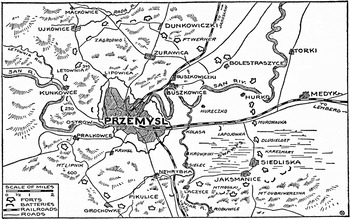
Figure 1: Plan of Fortress Przemyśl.
 You have
Access
- 1
- Cited by
Late on the evening of 17 May 1907, 8,000 Social Democrats and socialists marched to the town hall of Przemyśl, Galicia, to celebrate the election of Dr. Herman Lieberman, a Polish-speaking socialist Jew, to the Austrian imperial Reichsrat. Lieberman had been working for electoral victory for years, despite the formidable opposition of the massive Austro-Hungarian garrison in the city. Przemyśl was one of Austria-Hungary's largest and strongest fortresses, and its 8,500 officers and men did not take kindly to the socialist win. At around eleven o'clock at night, the Social Democratic celebratory march met with a police cordon reinforced by soldiers from the garrison. Workers quickly began throwing cobblestones at the soldiers, who responded with drawn sabers. The resulting brawl killed one worker and injured around twenty policemen and soldiers.Footnote 1
The election and riot in 1907 were the most visible manifestations of a decades-long struggle for social and political control in Przemyśl brought on by the Habsburg army itself. Thanks to an enormous fortress construction project during the 1880s and 1890s, the city elite was dominated by Austrian German officers, pro-Habsburg Polish politicians, and military contractors. However, the fort also brought in thousands of craftsmen, masons, carpenters, and laborers, who organized a branch of the Austrian Social Democratic Party in 1893.Footnote 2 Both the militarized elite and their socialist opponents were created by the fortress, which transformed Przemyśl from a sleepy ecclesiastical town into a critical center of Austria-Hungary's defensive apparatus.Footnote 3 Though the military drove the economy, dominated cultural life, and worked closely with local political elites in Przemyśl, it ultimately was unable to retain its disproportionate influence. The rise of local opposition to the Habsburg army exemplified here is an essential factor in the development of Austrian Social Democracy and civil-military relations across the monarchy. I argue that the Austro-Hungarian army inadvertently created one of the strongest centers of Galician socialism, calling into question the efficacy of the most important pillar of the Habsburg state. Przemyśl's socialists thrived precisely because they were able to act as a counterpoint to the army and its abuse of power.
Przemyśl is an important alternative to typical development in Austrian Galicia. Urban studies in Galicia have typically focused on Krakow and Lviv, large metropolises with clear civilian political, cultural, and economic ties to Vienna.Footnote 4 There has been less study of the small and midsize cities of the province, though work on Brody and the oil-producing regions show the value of this scale.Footnote 5 Przemyśl is distinct from these cities in that it was fortified solely as part of Austria-Hungary's long-term strategic objective of creating and strengthening buffer zones around the core lands of Austria, Bohemia, and Hungary.Footnote 6 There was no demographic or economic justification, though the construction of the fortress and barracks complexes had immense ramifications for the local population and economy.Footnote 7 The Habsburg military is correctly seen as central to the state, pervading the culture, institutions, and mindset of the entire empire.Footnote 8 Przemyśl allows us to study the military apparatus on the local scale and see the effect that an unusually powerful garrison, with a clear start and end and a relatively brief status as a fortress, has on a town.Footnote 9 That much of the reshaped local population eventually rejected the army says a great deal about the popular reception of the Austro-Hungarian army in the last years of the monarchy.
In examining the battle for influence in this imperial fortress, I will follow interwar Polish politician Jerzy Lerski, who explained the growth of the socialists in Przemyśl thus: the Austrians built a huge fortress, which brought in thousands of workers, who were followed by intellectuals who had grown up in the Viennese parliamentarian tradition of Social Democracy. These in turn built a powerful Social Democratic movement that successfully vied with the army for cultural and political influence within the city until the start of World War I.Footnote 10
Building the Forts
Austria-Hungary's strategic planners faced a formidable challenge while preparing for war in Galicia. The province lacked any significant natural barriers, instead stretching north in rolling plains from the Carpathian Mountains toward Russian Poland.Footnote 11 Austria was forced to deeply reevaluate its strategic and military organization after defeats against Italy and Prussia in 1866 and in the face of an increasingly hostile Russia.Footnote 12 As part of these reevaluations, Field Marshal Lieutenant Archduke John surveyed Galicia in 1868, and concluded that due to the topography, Krakow and Przemyśl were really the only feasible places to defend the monarchy's northeastern frontier. He pointed to Przemyśl's hilly terrain, proximity to passes over the Carpathian Mountains, and control of the San River, making it an excellent defensive site. Francis Joseph gave the order to make Przemyśl a Depotplatz (depot) and Bruckenkopf (bridgehead) on 14 July 1871. The city's strategic purpose was to defend the mountain passes and serve as a secure rail and logistical hub. Major fortress construction started in 1878 and continued off and on until 1908.Footnote 13
During this era, the army deeply altered the social and physical makeup of Przemyśl. Austria's fortification committee overlaid its plans on top of the existing city, surrounding it with a mutually supportive series of two fortress rings. The inner ring—the Noyau—was made up of smaller artillery positions and a dirt wall to protect the barracks, train station, warehouses, and armories in and around the city. The Noyau was built first, and then protected by an outer ring—Gürtel—of fifteen large semi-independent artillery fortresses and fifteen additional fighting positions between eight and ten kilometers out from the city center. Daniel Salis-Soglio directed the early construction and helped to refine the design of the fortress complex. After this initial work, he focused on building a road network from the warehouse complex to the planned fortress ring.Footnote 14 The physical transformation of Przemyśl led to social and demographic changes as well. Construction activity required a considerable quantity of civilian laborers in large work gangs, most of whom were from central Galicia, but who began to concentrate in Przemyśl. Citywide, during the heyday of fortress construction, 4,000–5,000 workers were hired by private contractors from Vienna and Budapest.Footnote 15 Most of these worked on the large Gürtel forts, like Fort IV Optyń, which illustrates how the material and labor requirements for the forts were met.
Plan of Fortress Przemyśl.
The large artillery Fort IV Optyń is the southernmost of Przemyśl's forts and required materials shipped in from across the empire.Footnote 16 The fort used at least sixteen different companies to supply just the raw materials—such as brick, stone, sand, and concrete. Refined items like armor plating, furniture, and weaponry were also brought from across the empire, making Przemyśl's train station one of the busiest parts of the city.Footnote 17 The suppliers included Austria-Hungary's main cannon and armor manufacturer Skoda, located in Pelseń, Bohemia, as well as a variety of Hungarian, Viennese, and Galician companies. Optyń kept an average of between 200 and 300 workers daily from 1897 to 1900, though these numbers varied sharply depending on the season and stage of construction.Footnote 18 Most of these workers were unskilled, and used for simple tasks like digging, pouring concrete, or general labor. The fort also employed dozens of skilled masons, metalworkers, and carpenters daily. Optyń was just one of several forts built simultaneously, making the city into a large work camp. In the absence of factories or other industrial infrastructure, construction sites offered many of Przemyśl's workers their first experience with large-scale work. Though major fortress construction was completed by the turn of the century, the forts and surrounding infrastructure occasionally required modifications and the garrison constantly needed renovations, additional buildings, and maintenance, usually keeping the city's builders at least marginally employed.Footnote 19
In addition to heavy construction business, the fortress brought a wide variety of other economic opportunities, including a variety of military support industries. In 1890, there were 56 saddle makers, over 500 gunsmiths, and over 1,700 construction workers. These in turn helped to drive growth in the city population from 22,000 in 1880 to 54,000 in 1910 and resultant civilian construction. From 1880 to 1900, there was an almost twofold increase of both freestanding houses and apartments.Footnote 20 Thanks to the fortress, Przemyśl was a boomtown, with the attendant strain on society and infrastructure.Footnote 21 Part of this growth was a result of Przemyśl's role as a rail hub, but the military drove most of the city's economic activity. The army fed construction contractors, the service sector, and encouraged economic development in the region, though this process prevented diversification of the economy and kept the region dependent on defense spending.Footnote 22 Przemyśl's Jewish community did particularly well in this new market, with traditional Jewish trades like craftsmen, merchants, and distributers in high demand.Footnote 23 While the fin-de-siècle was an era of intense urbanization across Galicia, Przemyśl saw the highest rate of growth by far; for example, in 1891 the Gazeta Przemyska [Przemyśl gazette] reported that Przemyśl had grown 35 percent in the past decade, outpacing its closest rival, Krakow, which grew 20 percent.Footnote 24 These workers would provide the demographic foundation for Przemyśl's labor movement.
Garrison Life
Forts were not the only military structures built during this era, nor were construction engineers the only military personnel. By 1910, Przemyśl featured over sixty-one distinct military facilities, excluding the fortress rings.Footnote 25 Seven major barracks complexes, a military rail yard, artillery parks, magazines, and warehouses filled the city and were mostly constructed during the 1880s and 1890s. These were necessary for a greatly enlarged garrison and the X Corps headquarters, which moved from Brno (Brünn), Moravia, in 1889.Footnote 26 The new military buildings were interspersed within the city, meaning that civilians, soldiers, and officers constantly interacted in the streets, homes, cafés, restaurants, and businesses around town.Footnote 27
Austrian officers and men were not thrilled as units transferred to the fortress throughout the 1880s. Galicia in general was viewed as exile: a dull, boring, and culturally inferior posting. The X Corps Artillery Regiment's attitude is typical. The regiment moved to Krakow in 1883. The unit history complains bitterly about the overabundance of Orthodox Jews, and the lack of any decent lodging, cafes, or restaurants. The regiment was then transferred to Przemyśl in 1889, and recorded that, all things considered, Krakow was not too bad. Krakow was at least a shadow of a modern city. Przemyśl, by contrast, was an “unfinished city” with “no special attraction” that could offer “no exceptional enjoyment.” Even worse for the regiment, its barracks were two kilometers east of even the minimal attractions of the city center. For the early years of the regiment's presence in Przemyśl, officers amused themselves with a portable bowling alley brought by a few of the officers and set up in the shade of a tree in the barracks courtyard.Footnote 28
Although X Corps officers and men were initially displeased with life in Przemyśl, the city developed a robust service economy to cater to the garrison. In 1870, just 531 residents of Przemyśl worked in the hospitality sector, in hotels, bars, restaurants and elsewhere. By contrast, in 1900, there were almost 3,500 hospitality workers—of whom 57 worked in Viennese-style coffeehouses, 845 in restaurants, and 134 in bars. Bars were important enough to Przemyśl that half of the city budget came from alcohol taxation and paid for most of the operating expenses of the police force.Footnote 29
As usual in the Austro-Hungarian army, officers were predominantly Austrian German, with lesser numbers of the monarchy's other nationalities. In contrast, enlisted soldiers were essentially local.Footnote 30 Officers and men put their stamp on Przemyśl by sitting in cafes, walking down streets, and being constantly visible. Simply by frequenting cafes, officers made their favorite establishments, like the Café Steiber, or the Lwowska bakery, semi-official places of business.Footnote 31 Officers were also key participants in elite social life. Balls, including masquerade balls, became extremely popular in Przemyśl and were held regularly from the 1890s on, allowing officers and local women to interact and court.Footnote 32 Maja and Jan Łozińscy wrote of these occasions, that “uniforms added splendor to every party. Soldiers, always fashionable and chivalrous to the women, excellent and focused dancers, were always gladly invited to civilian balls and parties.”Footnote 33 Local Poles were even pleased with the Polish-language abilities of Habsburg officers, and compared them favorably to “Germanized” merchants, industrialists, and intellectuals who threatened Polish culture.Footnote 34 The garrison also spurred an entertainment industry that catered to soldiers—some coffeehouses held regular concerts of military music.Footnote 35 Toward the end of the Austrian period, Przemyśl featured four cinemas and two peep shows.Footnote 36
The new corps command also meant that the army had a local commander with considerable power and influence. From 1891 to 1905 Feldzugmeister (Lieutenant General) Anton Galgótzy commanded the X Corps. His civilian counterpart, Dr. Aleksander Dworski, served as mayor from 1882–1902 and had an impressive record of parliamentary service and city improvement.Footnote 37 Their relationship can be summed up by a story told at Galgótzy's funeral years later. Famously blunt and sparse with words, Galgótzy looked for creative ways to object to conditions in the city. On one occasion, he invited the mayor to lunch, only to take Dworski on a two-hour walk around the dirty streets of Przemyśl. Upon returning to his office, Galgótzy looked at the muddy mayor and said, “that's what we look like when we go for a little stroll in this city.” The next day Dworski hired more street cleaners.Footnote 38
Galgótzy was a close friend of Francis Joseph and enjoyed firm support from the highest echelons of the imperial military. While he was in command of the X Corps, the army dominated the city. The corps Genie director had to approve building projects and zoning within Przemyśl, including religious buildings.Footnote 39 The city government worked closely with the army and is implicated in a complaint by the Social Democratic newspaper Gazeta Przemyska, which described Przemyśl as a “city par excellence for the army” thanks to “regulations … and restrictions,” where “military entrepreneurs can do whatever they please.”Footnote 40 The army also had a close relationship with imperial censors, who restricted local newspapers from reporting negatively about the army. Finally, socialists and other opponents of the army were often subject to arrest and mistreatment.Footnote 41 The army provided the city military police, soldiers funded by the army but used by the city. Thanks in part to these, Przemyśl had a high arrest rate—from 1887 to 1899, there were over 20,000 arrests in Przemyśl, as compared to just under 27,000 in Lviv, a city three times larger. Dr. A. Bloch recalled that civilian authorities “stood at the side” of the military and failed to protect the well-being of civilians “whose economic situation was shaken up by the decrees of the [Corps Commander].”Footnote 42 Conditions in Przemyśl were quite different from those in most towns in Austrian Galicia, which typically had much more autonomy during the fin-de-siècle.Footnote 43
Social Democrats and the Garrison
While the city government, the army, and military contractors usually had a close relationship, this was not always true of other political and social leaders in Przemyśl. Thanks to Przemyśl's robust fortress construction industry and role as a rail hub, the city had a powerful worker's movement by the 1890s. This was somewhat unusual in the under-industrialized province of Galicia.Footnote 44 Przemyśl's working classes were well situated for a socialist movement. The fortress meant that the city featured a large working class, but few permanent industries meant that the workers were mostly unskilled and vulnerable to the vicissitudes of seasonal construction work. This was typical of socialists in Galicia, who tended to focus on artisanal associations rather than actual factory workers.Footnote 45 The army's political and social domination of the city was another major grievance among workers. Austrian authorities were quite concerned about the specter of socialism. Galician police reports frequently mention agitation and subversion by Social Democrats.Footnote 46 Przemyśl's socialists expanded rapidly. In 1898, city officials reported that Przemyśl had nine chapters of Social Democrats alone.Footnote 47 A common criticism of the Social Democrats by Polish nationalists was that they were Jewish. It is true that the city's working-class Jews often supported the Social Democrats, but this represented a split within the Jewish community, many of whom were military contractors or small traders dependent on the garrison. Further complicating the community was Jewish traditional loyalty to the Habsburg monarchy and person of Francis Joseph and competition between Labor Zionism and Social Democracy.Footnote 48
In 1896, lawyer Dr. Herman Lieberman moved from nearby Rzeszów in search of a job, and quickly joined the nascent branch of the Polish Social Democratic Party.Footnote 49 In Przemyśl, Lieberman's main concern was abuses by the Austrian garrison, which he liked to describe as an occupation force. He held special animosity for Feldzugmeister Galgótzy—whom Lieberman derided as an uneducated and simple man who believed that the world began and ended with the army.Footnote 50 As a non-religious, assimilated Jew, Lieberman generally spoke to his supporters in Polish, leaving Yiddish speeches to Josef Siegman.Footnote 51 Lieberman's friend Witold Reger was another local socialist, who edited the Głos Przemyski [Voice of Przemyśl] and frequently reported on army abuses. For example, on 15 January 1899, Głos Przemyski featured an editorial arguing that Mayor Dworski's government was tied by the military authorities, an article on “guards bristling with bayonets” at church, a report on a drunken group of soldiers stabbing a pig to death in the street, and an article on the “dreadful fate of soldiers.”Footnote 52 Most issues of the Głos Przemyski featured at least one article attacking the army for something or other.
The army did not take kindly to this abuse and the paper had to be printed in Lviv rather than locally. Officers were forbidden from visiting coffeehouses that carried it, and army officers went out of their way to intimidate Lieberman, Reger, and other socialist leaders. Their natural response to Social Democratic heckling was to challenge Reger to a duel—which a Major Kreger did in 1899.Footnote 53 Reger refused, so officers of the 58th Infantry Regiment (IR) delivered swords to Reger's house, only for him to throw them away. This affront resulted in additional challenges to other socialists, including Lieberman. Lieberman recounts being surrounded by a malevolent group of officers, only to be rescued by some nearby workers. On another occasion, officers forced their way into Lieberman's house, past his pregnant wife, and proceeded to use their swords to cut up Lieberman's bed. These abuses outraged workers until they attacked and shot an officer from the 58th IR. In response, officials arrested Dr. Lieberman and twenty other Social Democrats.Footnote 54 This arrest did not stop Lieberman from standing for election to the Imperial Parliament in the 1900 elections, though, unable to campaign due to his imprisonment, he lost. Over the next several years, Lieberman served as a defense lawyer in multiple cases involving workers mistreated by feuding with the garrison.Footnote 55
Over the next few years, local newspapers escalated their attacks on the army, promising to bring Przemyśl to the attention of civilian authorities and the capital.Footnote 56 They decided to focus on army abuse of soldiers, as this was more likely to attract Vienna's attention than the abuse of socialists. Starting in March 1900, the Gazeta Przemyska investigated a rash of suicides in the X Corps, eventually publishing multiple articles on the state of the corps and its soldiers.Footnote 57 Through constant pressure by the newspaper and Social Democrats, suicides in the X Corps became a major scandal—so much so that in March 1903, Galgótzy was forced to go to the House of Representatives in Vienna to answer allegations by Social Democratic representative Ignacy Daszyński, who argued that Galgótzy was unsuitable for command and abusive toward his troops. Representatives claimed that in 1901 alone there had been 92 suicides of officers and men, 70 self-mutilations, 44 cases of madness, 400 desertions, and 725 verdicts of heavy labor within the X Corps.Footnote 58 These numbers were exaggerated, angering Galgótzy, who swore at representatives. This confrontation made conditions in the army along the frontier a topic of Viennese newspaper debate for some time. Even satirist Karl Kraus weighed in, theorizing that there were classes of people, including many Jews and Poles, who were “psychologically unfit” for military service, which explained the bad morale on the border.Footnote 59 Despite these accusations, Galgótzy's personal connections made him unassailable, and he went on to command the X Corps until 1905 when he was made Inspector General of the Army.Footnote 60
Workers felt further threatened by the Przemyśl garrison in 1904, as strikes hit the nearby oil-producing region around Borysław. In response to a strike numbering around 8,000 oil workers, seven battalions of soldiers were sent from Przemyśl to contain the strikers, monitor worker activity, and restore order. Partially in response, workers in Przemyśl attacked a concert put on by the hated 58th IR's band for Emperor Francis Joseph's birthday. These anti-imperial protestors marched in under a red banner, carried slogans like “Down with the Government” and “Down with the Emperor,” sang, and threw stones in order to disrupt the army band. Fortunately, the police were able to disperse the demonstration before anyone was hurt, but several protestors ended up in prison.Footnote 61 Social Democratic disruption of the military was not limited to protests. Agitation within the army itself was effective enough that the governor of Galicia wrote to the Ministry of the Interior in 1906 warning that Przemyśl's garrison was being subverted by socialism, a matter that deeply worried the governor.Footnote 62
Riots in Przemyśl took place in the context of a rapidly growing socialist movement within Galicia. The number of factory workers in the province almost doubled in the decades after 1890, reaching 86,100 in 1910. The Congress of the Polish Social Democratic Party (PPSD) for Galicia in 1906 drew over nine thousand attendees—more than double the attendance in 1905.Footnote 63 Riots also took place in the context of the radicalization and fragmentation of the Social Democratic movement in Galicia, due in part to sympathy toward the 1905 Russian Revolution and the increasing nationalist sentiment of virtually all parties in the late Habsburg monarchy.Footnote 64 Thanks to growing numbers of socialists, and increased national tension within the PPSD, a Ruthenian branch of the Social Democrats broke off in 1899, followed by a Jewish branch in 1905 based on the Jewish Bund in Tsarist Russia. Though there were Ruthenian representatives in Przemyśl, the Polish and Jewish branches of Social Democracy dominated the workers’ movement there—Przemyśl was one of four centers for the Jewish Social Democratic Party within Galicia. Within Przemyśl, Ruthenian, Polish, and Jewish Social Democrats remained united later than elsewhere in Galicia, thanks to a common enemy in the army.Footnote 65
Within Przemyśl, the prewar high point of Polish Social Democracy took place during the 1907 election. Lieberman was elected as Przemyśl's representative to the Imperial Parliament despite strong opposition by the Polish National Democrat Hugo Królikowski. As the first Austrian election featuring direct, equal, universal suffrage, the election resulted in a major shakeup within Galician elections and brought a new degree of infighting and political energy.Footnote 66 During the lead-up to the election, much of the National Democratic Party's campaign simply attacked Lieberman and the socialists for being revolutionaries—one article referred to Social Democratic leadership as a “mafia” made up of too many Jews.Footnote 67 Królikowski was supported by conservative elements in Przemyśl—the clergy, officers, Polish conservatives, bureaucrats, Jewish and Polish bourgeois, and the police. Police resorted to harassing and arresting Social Democrats from time to time, and on election day units from the garrison marched around the city to intimidate voters. Despite this opposition, Lieberman won, thanks to strong support among the workers of all of Przemyśl's national groups—Ruthenian, Polish, and Jewish.Footnote 68 Lieberman was one of two Jews elected from Galicia to represent the PPDS.Footnote 69
On 17 May 1907 around 8,000 Social Democrats assembled at eleven o'clock at night, carrying lanterns to celebrate the results of the election to the imperial parliament. Workers assembled on the main city square and marched, singing the “Red Standard” and other socialist songs, with the intent, according to police reports, of “bombarding municipal buildings with stones.” The celebration presented officials with a significant challenge, as workers tore down streetlamps in order to advance on the city hall in darkness. Police and military officials were in no mood to humor boisterous crowds. The thought that an imperial fortress would be represented in the Reichsrat by a Jewish socialist was a galling one. Police inspector Karl Schwarz, supported by sixty police officers and soldiers, attempted to halt the demonstration's progress and called for the workers to extinguish their lanterns and disperse. The workers responded by extinguishing their lamps and throwing large rocks at the police officers, concussing several. The police and soldiers drew their sabers, which only further angered the demonstrators and resulted in hand-to-hand fighting. Some of the policemen allegedly yelled, while stabbing workers, “now you have your Red Przemyśl.” The turning point came when the police were joined by a company of infantry. This show of force by the army effectively ended the demonstration and the workers scattered to surrounding houses. The whole incident was over by one in the morning. In addition to twenty-three concussed soldiers and police officers, “many police soldiers have ripped their uniforms, broken their shackos, and bent their sabers.”Footnote 70 Only four protestors checked into hospitals, though the Arbeiter Zeitung [Workers’ newspaper] in Vienna reported that over two hundred workers were injured. These injured presumably received treatment at home or wanted to avoid association with the protest, and there were rumors that a woman was crushed in the excitement. Remarkably, only one worker was killed in the fighting—but as he lacked any saber wounds, military authorities insisted that he died of overexcitement.Footnote 71
This riot was a subject of considerable interest for the authorities in Przemyśl as well as in Lviv and Vienna. While socialist and nationalist protests were common in Galicia, they typically numbered a few hundred protestors at most. The size and violence of Przemyśl's protest was remarkable for this period. Vienna's Arbeiter Zeitung denounced the police action as a bloody reprisal for the Social Democratic victory and accused the city's Old Polish clique of keeping the police soldiers well supplied with alcohol before action. Galician officials for the remainder of Austrian rule saw Przemyśl as one of the chief centers of socialism within the province and frequently reported on the strength of the socialists to Vienna.Footnote 72 National Democrats and others saw the Social Democratic outburst as a point of embarrassment for the city and for Galicia as a whole. The now National Democratic organ Gazeta Przemyska wrote, chagrined, in June 1907 that if the epithet “half-Asian” had ever applied to Galicia, it was clearly on 17 May when Przemyśl was attacked by a “half-wild horde.”Footnote 73 The National Democrats, discouraged by Social Democratic electoral victories across the monarchy, predicted dark days ahead, and ominously pointed to red banners appearing in Berlin and elsewhere.Footnote 74
A few years later, Social Democrats constructed a massive House of Workers to show their established presence in the city. Finished in 1912, the House of Workers was built largely through small donations from the workers, and was used as a party office, social center, and restaurant. General der Kavallerie (Lieutenant General) Heinrich Kummer, the new X Corps commander, issued an edict forbidding officers and soldiers from setting foot inside the building. Located on the northern bank of the San River, the house stood across from Franz Joseph Street. This was a clear challenge to the army's physical domination of the city.Footnote 75 Thanks to the Social Democrats, the army and Polish conservative's comfortable control of Przemyśl was shaken. Despite active interference by the garrison, the city turned to the Social Democrats and rejected the traditional notion of Austrian militarized popular patriotism.
Conclusion
The army briefly regained its place of prominence in Przemyśl during World War I. In the first weeks of the war, General Hermann Kusmanek's fortress troops forcibly removed Ruthenians from the fortress zone, executed and lynched suspected Russophiles, and instituted martial law. There was little if any socialist opposition to these actions. Unfortunately for the fortress, its fate was tied to that of the Austro-Hungarian army. After Austria's disastrous attempt to invade Russian Poland in August and September 1914, Przemyśl was besieged twice, finally surrendering to the Russians on 23 March 1915. The Austrian army's lack of power and importance was driven home in July, when Bavarian troops recaptured the city as part of the Gorlice-Tarnów offensive. The Austrian army regained command of the city shortly thereafter, but was gradually overwhelmed by increasingly large competing demonstrations of Polish and Ukrainian nationalists as well as socialist strikes.Footnote 76 As the Habsburg empire finally dissolved in 1918, most Polish residents of Przemyśl were delighted. Nowy Głos Przemyski [The new voice of Przemyśl] gleefully described a meeting of Austrian generals in October 1918, as the garrison prepared to leave. “Tears stood constantly in the eyes of the assembled generals. Sincere tears.…” The paper reported that, though the Austrians may have cried, most others were less than moved. It went on to gloat about these “generals—yesterday almost demigods—today ordinary mortals. Maybe less.”Footnote 77
As the army left, Przemyśl devolved into open conflict between Polish and Ukrainian militias, as well as pogroms against the now defenseless Jewish population. Eventually incorporated into the Polish Second Republic, Przemyśl is now on the far edge of the European Union, a few miles away from the Ukrainian border. It is appropriate that a statue of the Good Soldier Švejk still sits on the main market square, contentedly drinking. The city remains in the shadow of the Austro-Hungarian army. The ruined fortress ring is the city's main tourist attraction and former Habsburg barracks now serve the Polish army, border guards, and others. Though the army lost the battle for the heart of Przemyśl, it laid the foundations for the city of today and there is still a place for Habsburg soldiers, even if it is just the harmless and unassuming Švejk.
Acknowledgement
I want to thank Charles Ingrao for his support through what has proven to be a lengthy and travel-intensive research project. When I first mentioned my desire to write on Przemyśl, Dr. Ingrao replied that he didn't really want to go to Galicia, but it was okay if I went. His constant stream of feedback, advice, and encouragement has been invaluable.
Portions of this paper were initially presented at the 2016 American Historical Association and greatly benefited from comments by panel chair Daniel Unowsky, as well as the several-months-long conversation on Austrian civil-military affairs with Jason Engel and Ke-Chin Hsia. I also appreciate the feedback from a workshop organized by Laurence Cole and Elisabeth Berger entitled, “Garnisonsstädte in der Habsburgermonarchie im langen 19. Jahrhundert,” from 25–26 February 2016. Tomasz Idzikowski has been a valuable source of local knowledge and expertise as has Tomasz Pudłucki. Finally, I owe a debt of gratitude to the Purdue History Department, particularly my dissertation committee, Charles Ingrao, Rebekah Klein-Pejšová, and Laurence Sondhaus (of the University of Indianapolis).