1. Introduction
Since the 19th century, northern Morocco (north of the Anti-Atlas) has been famous for its abundant and diversified fossil vertebrate faunas, ranging from Palaeozoic to Pliocene. For the Palaeogene, major fossils of both marine (e.g. Noubhani & Cappetta, Reference Noubhani and Cappetta1997; Cavin et al. Reference Cavin, Bardet, Cappetta, Gheerbrant, Iarochene and Sudre2000; Gheerbrant et al. Reference Gheerbrant, Cappetta, Feist, Jaeger, Sigé, Sudre and Vianey-Liaud1993; Hua & Jouves, Reference Hua and Jouve2004) and terrestrial vertebrates (e.g. Gheerbrant et al. Reference Gheerbrant, Sudre, Cappetta, Iarochene, Amaghzaz and Bouya2002, Reference Gheerbrant, Iarochene, Amaghzaz and Bouya2006; Gheerbrant, Domning & Tassy, Reference Gheerbrant, Domning, Tassy, Rose and Archibald2005; Bourdon, Reference Bourdon2006) have been discovered, including, for example, the oldest evidence of Afrotheria (Gheerbrant, Sudre & Cappetta, Reference Gheerbrant, Sudre and Cappetta1996; Gheerbrant, Reference Gheerbrant2009).
In contrast, and probably due to the difficult access, little attention has been paid to the Cenozoic deposits cropping out along the southwestern Moroccan Sahara (‘Western Sahara’) and observed until the 1950s by Spanish, French and Moroccan geologists, successively. Mainly composed of clastic deposits, geological formations in the south of the Dakhla–Boujdour–Laayoune basin (Fig. 1a) were until now usually mapped as Mio-Pliocene (Saadi, Reference Saadi1988; Rjimati et al. Reference Rjimati, Zemmouri, Benlakhdim, Amzaehou, Essalmani, Mustaphi, Haimouk and Hamidi2008). No evidence of fossil vertebrates older than the Neogene has been reported in previous literature (Joleaud, Reference Joleaud1907; Arambourg in Choubert et al. Reference Choubert, Faure-Muret and Hottinger1966) until the recent discovery of shark teeth and bone remains of archaeocete whales by local people. Thanks to their information, an exploratory field trip in 2009 in the south of the Dakhla peninsula allowed us to locate these fossiliferous levels and to discover many vertebrate fossils, collected in several close localities. Dating interest becomes obvious, considering that all taxa display many characteristics of the Middle–Late Eocene assemblages known from other African fossiliferous localities. The purpose of this paper is to provide the first detailed sedimentary log of the new fossiliferous localities, a preliminary account of the taxa recovered, and to compare this assemblage to other known Eocene assemblages that have been reported elsewhere. In addition, we discuss the stratigraphy and palaeoecological significance of the new assemblages.
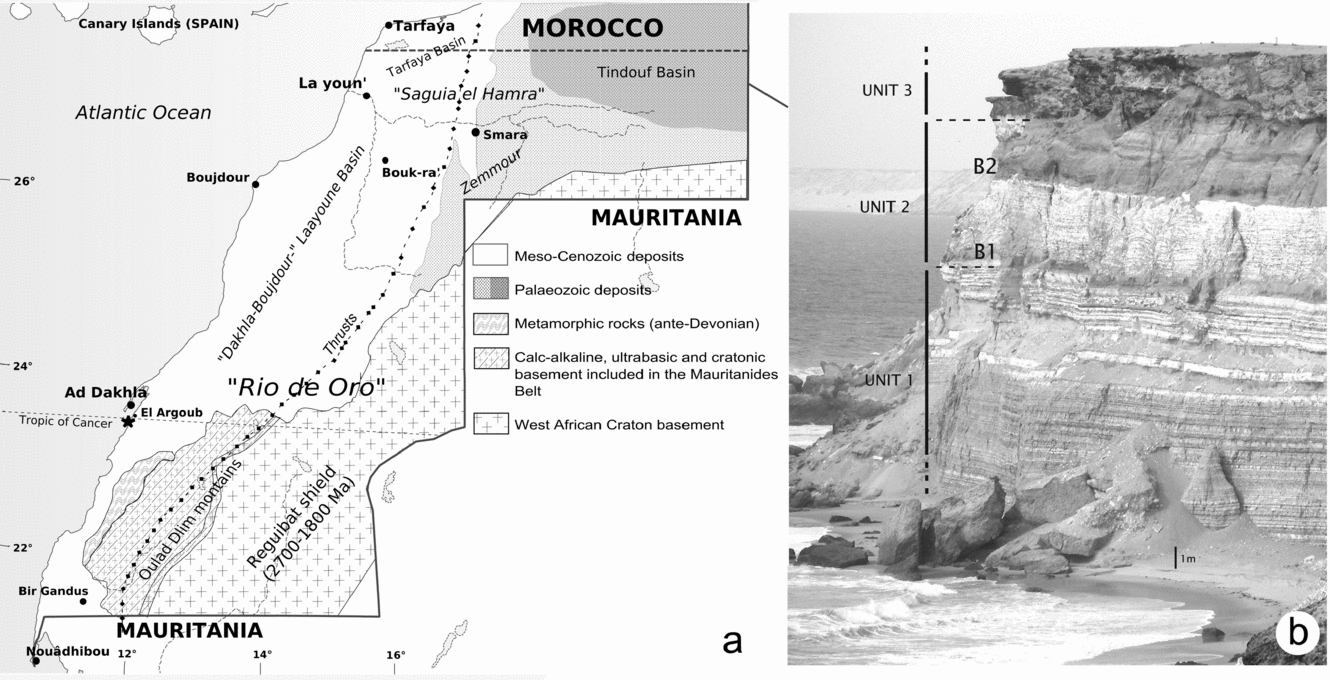
(a) Location of the new fossiliferous deposits (star), south of the city of ad-Dakhla, Moroccan Sahara, Morocco. Principal geological structures simplified from Von Raad & Wissmann (Reference Von Raad, Wissmann and Von Raad1982), Saadi (Reference Saadi1988) and Villeneuve (Reference Villeneuve2005). (b) Outcrop on beach illustrating the stratigraphical sequence as observed south of El Argoub (23°21′17.76″N, 16°01′55.28″W). Lithology is detailed in text.

2. Geological setting
The sub-horizontal stratigraphical sequences visible near Dakhla (Fig. 1b) show a slight syntectonic activity, only marked at the top by some clastic dykes of yellow sandstone intersecting the underlying silt–chert suite. This field observation is in agreement with that of Labails et al. (Reference Labails and Olivet2009), who noticed thick sedimentary deposits offshore of Daklha, as indicated by seismic reflection data. This suggests a slight subsidence process on this passive continental margin as a result of a tectonic inheritance of the great Western African Craton (Fig. 1a, anteclise of Reguibat; see Villeneuve, Reference Villeneuve2005).
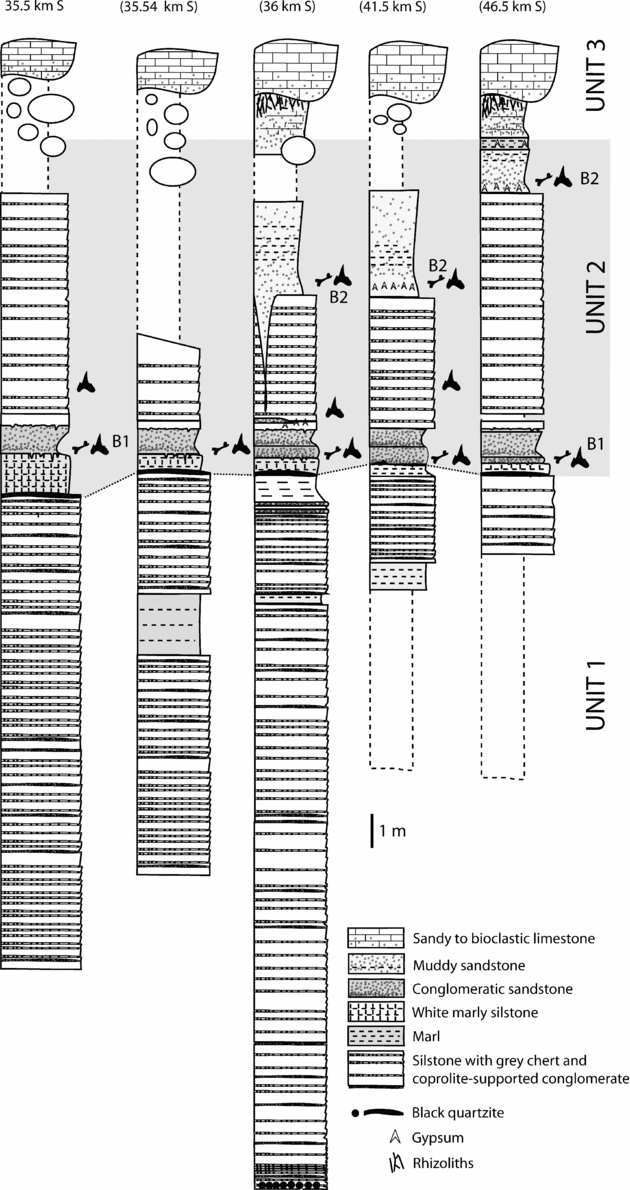
The stratigraphical sequences (Fig. 2) crop out on cliffs along the shoreline in a succession of beaches from south of El Argoub to the commonly named ‘Garitas’ in a restricted military area. The bedrock succession studied here is entirely observable from the beach core (Fig. 1b) and accessible in few track roads used by the local fishermen. Lateral variations of facies are obvious, especially regarding the thickness of sequences (see Fig. 2). We have divided these sequences into three lithological units. Their ages, mainly based on fossil marine vertebrates, will be discussed hereafter.
Stratigraphical section, position of the main fossil vertebrate levels (B1, B2 and intermediate) and unit interpretation of study area. Lithology is detailed in text. Location of section is indicated by distance south from the centre of Dakhla.

The lower part of the sequences (unit 1; see Figs 1b, 2) consists of a thick sequence of marly siltstone, regularly interrupted by grey chert and black coprolite-supported conglomerates. This alternating succession sometimes displays composite marl or yellow sand beds, particularly towards the top of the unit. The boundary between units 1 and 2 is easily detectable and occurs over a distinctive irregular black quartzite (except in the south where it disappears), and below a yellowish-white marly siltstone with micro-remains of fish. Burrows and flaser bedding are sometimes observable inside this layer, mixing the fossiliferous sand coming from the overlying bedrock B1. The thickness of this layer seems to decrease from north to south where it sometimes disappears. Unit 2 begins with the previous bed, followed by the first fossiliferous bed (B1) that in fact consists of two successive layers: a fine compact conglomeratic sandstone at the base (irregularly distributed), with imbedded teeth and larger allochthonous elements which are badly preserved; and a 0.8–1.2 m thick medium sandstone with clay and phosphate grain elements. No calcareous fossil was found in this sandstone, which can range from grey to brown or reddish colour. The contact between B1 and the upper strata is a distinctive irregular erosion surface, emphasized by many burrows and/or interbedded pockets of B1. Over a massive bedrock of 5–10 m of composite white siltstone–chert, the upper fossiliferous bed (B2) consists of a muddy sandstone, sometimes with a gypsum element present. The contact between B2 and the overlying series is badly defined in the sandstone thickness and seems irregular, but B2 always overlies a sandy layer with a high concentration of gypsum. Unit 2 ends with yellow muddy sandstone softly consolidated with irregular pockets of red muddy sandstone. The boundary between units 2 and 3 is not very distinctive and occurs below white calcareous cemented sandstone. The upper part of the sequence (unit 3) consists of a massive sandy to bioclastic limestone, with ripple stratification (particularly in the Dakhla peninsula), partially replaced by dolomite and containing numerous invertebrate fossils or tracks. This perched bedrock, laterally irregular, caps the sedimentary series and constitutes the accessing headland that runs along the coast line. Many rhizoliths occur in the calcareous sandstone, just below the sandy limestone boundary. This unit is thin further south, as observed in ‘Garitas’.
Deposits in the lower part of the sequence (unit 1) are entirely marine, as indicated by the numerous silicate beds, chert and coprolite-supported conglomerates dispersed along the column. Very scarce fossil shells or teeth have been discovered from the visible base of unit 1 to the top of unit 2. A metre-sized bed with large black nodules occurs at the extreme base of the series, when accessible under the beach sand dune.
The upper part of the sequence (unit 3) was mainly formed by marine processes as well, as it consists of a thick sandstone complex in the studied area, with marine fossils (echinids, bivalves and gastropods) from the base to at least 1 m below the massive sandy limestone. The presence of a dense root system and/or burrows in this level may suggest the mangrove soil (vertical pneumatophores) of a tropical area, overlain by a coastal deposit, as indicated by the presence of numerous tracks of marine organisms inside the massive sandy limestone.
3. Systematic palaeontology
The previously described vertebrate fauna from the Dakhla–Boujdour area (‘Rio de Oro’ in Joleaud, Reference Joleaud1907; Arambourg in Choubert et al. Reference Choubert, Faure-Muret and Hottinger1966) probably comes from the massive limestone or lateral equivalents (formerly molasse; Joleaud, Reference Joleaud1907), which sporadically turn into a shelly limestone (pectinid) in the Dakhla peninsula. These authors cited ‘Galeocerdo aduncus, Sphyrna prisca, Odontaspis contortidens, O. cuspidata, Oxyrhina hastalis, Carcharodon megalodon, C. rondeletii, Myliobatis faujasi, Diodon sp. and Chrysophrys sp.’ The accurate Mio-Pliocene age attributed to these fossil vertebrates was in agreement with the contemporaneous geological literature (Font y Sague, Reference Font y Sague1911; Deperet, Reference Deperet1912; Hernandez et al. Reference Hernandez Pachero, Hernandez Pachero, Alia Medina, Vidal Box and Guiinea Lopez1949) and with observations of the invertebrate palaeontologists (Lecointre, Reference Lecointre1962, Reference Lecointre1963a, Reference Lecointreb, Reference Lecointre1966a, Reference Lecointreb; Roman, Reference Roman1963) who considered the massive limestone of ‘Rio de Oro’ (up to 10 km south of Dakhla) as Pliocene (or younger) in age. The age of the underlying deposits (white calcareous sandstone with fossil root mark, unit 3) is currently unknown but we provisionally propose a Miocene age, as suggested by the presence of several Miocene equatorial fossil woods discovered in the Dakhla area (Lecointre & Koeniguer, Reference Lecointre and Koeniguer1965; Koeniguer, Reference Koeniguer1967; updated in Dupéron-Laudoueneix & Dupéron, Reference Dupéron-Laudoueneix and Dupéron1995). The lower part of the sequence (units 1–2) has never been of particular interest to palaeontologists. Only Ortlieb (Reference Ortlieb1975) reported several observations in the ‘Garitas-Amtal’ area, where he collected fossil shark teeth (sent to one of us, HC) and bone fragments in ‘the yellow calcareous or muddy sandstone, located over (northward) or below (southward) some marly sand deposits with gypsum’. While this author pointed out the helpful regularity of the fossiliferous deposit from ‘Garitas’ to ‘Amtal’ towards the south, he only considered one level and could not propose any age for these layers.
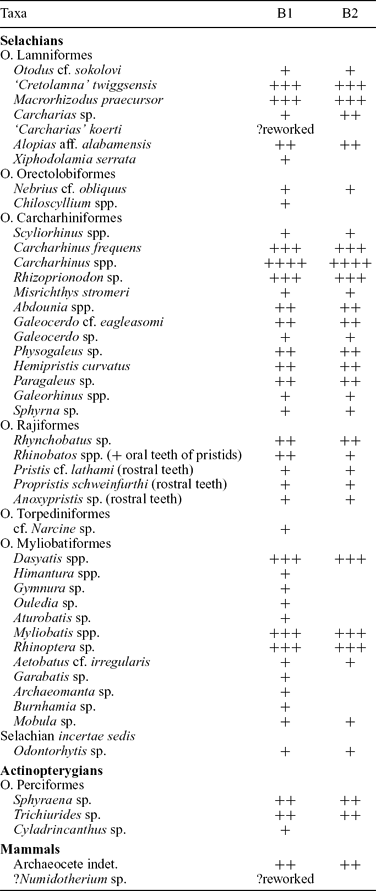
New fossils were collected by surface collecting and screen-washing. A total of seven samples of sediment were taken during a short field trip in 2009. Every sample varied between 2 kg and 20 kg of residue previously concentrated by screen-washing (mesh width down to 0.4 mm). In a further step, the insoluble residue was disaggregated by immersion in diluted acetic acid (6%) or fresh water. The selachians represent the largest part of the fossil vertebrate remains recovered in unit 2, with several thousand specimens collected, equally distributed in samples. The majority of the fossil material consists of isolated teeth (plus partial tooth plates and caudal spines of myliobatid rays, and undetermined vertebrae) representing at least 48 species of sharks and rays. A preliminary list is given in Table 1. Some of them are new and will be described in detail in a forthcoming work devoted to this vertebrate group. Discussions on significant taxa regarding dating and correlation have been favoured in the present study. Isolated teeth, rostral elements and disarticulated bones of bony fish recovered along unit 2 will not be treated here, awaiting supplementary samples of matrix. Two other taxonomic groups of vertebrates were discovered in unit 2 (B1 and B2). These comprise some remains of archaeocete whales and one broken tooth of a terrestrial mammal. The former are often reduced to isolated and badly preserved bones and teeth (DAK.5, Fig. 3j) that clearly belong to Basilosauridae, but some complete skeletons, partially disarticulated, were observed in situ. It is beyond the scope of this paper to report on this promising discovery for cetacean palaeobiogeography and, concerning the mammalian remains, we have only focused on the primitive proboscidean tooth (GTS.1) found in B1.
Preliminary list of fossil vertebrates recovered in study area

Number of ‘+’ symbols indicates the relative abundance in B1 and B2.
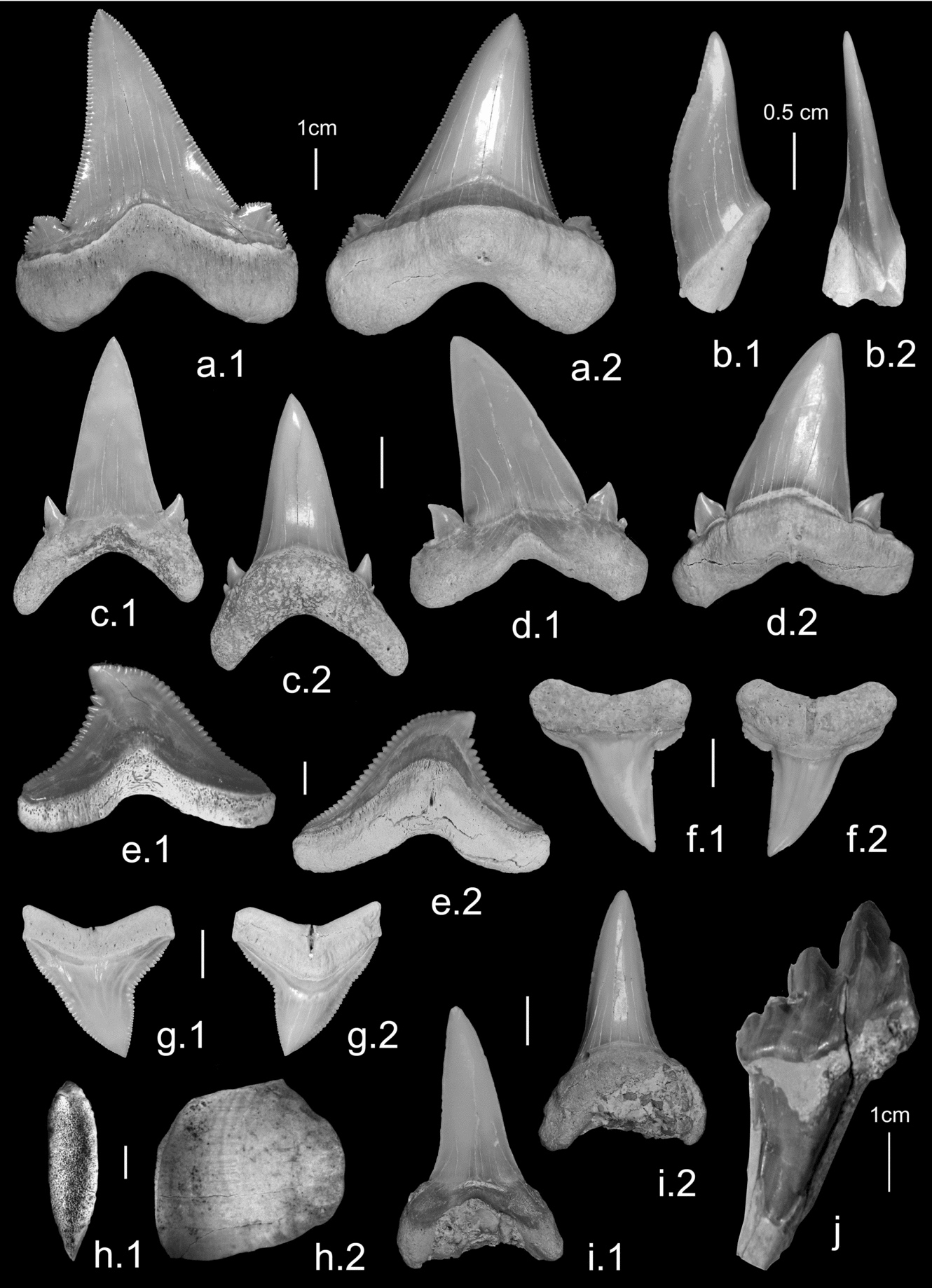
Fossil selachians from Dakhla area. (a) O. cf. sokolowi (DAK.1), 1 – labial view, 2 – lingual view; (b) X. serrata (GTS.2), 1 – profile, 2 – labial view; (c, d) ‘C.’ twiggsensis (DAK.2–3), 1 – labial view, 2 – lingual view; (e) G. cf. eaglesomi (DAK1.1), 1 – labial view, 2 – lingual view; (f) M. stromeri (upper tooth) (DAK2A.1), 1 – labial view, 2 – lingual view; (g) Carcharhinus sp. (upper tooth) (DAK2B.1), 1 – labial view, 2 – lingual view; (h) P. schweinfurthi (rostral tooth) (GTS.3), 1 – basal view, 2 – upper view; (i) ‘C.’ koerti (partially embedded) (DAK.4), 1 – labial view, 2 – lingual view; (j) posterior (lower) tooth of Basilosauridae (DAK.5).

The material is housed in the Laboratory of Paleontology, Institut des Sciences de l'Evolution, Montpellier. Abbreviations: DAK – collection number for material from the Dakhla area, GTS – collection number for material from the Dakhla area, locality of ‘Garitas’.
3.a. Fish fauna
The fish fauna currently consists of 48 fossil species of elasmobranches and 4 fossil species of bony fishes. Forty genera and seven orders are represented, ranking this fossil site in the top ten of the most diversified selachian faunas from the Cenozoic in Africa. Most of these species are new and under study, awaiting careful comparisons with those from the contemporaneous deposits of the Whale Valley (Fayum, Egypt; see Case & Cappetta, Reference Case and Cappetta1990) that are currently undergoing revision (C. Underwood & D. Ward, pers. comm.). Only a limited sample of selachian taxa having an interest for correlation is figured and briefly discussed here.
Locality. Unit 2, B1 and B2 from all sites, ?Samlat Fm., ?Gerran member (Ratschiller, Reference Ratschiller1967).
Class CHONDRICHTHYES
Several modern orders of selachians (sensu Compagno, Reference Compagno and Hamlett2005) are represented in the fossil deposits (see Table 1). However, Hexanchiformes, Squatiniformes, Heterodontiformes and Squaliformes are completely lacking.
Lamniformes: Numerous complete and well-preserved teeth recovered in L1 and L2 (DAK.2–3; Fig. 3c, d) belong to ‘Cretolamna’ twiggsensis (Case, Reference Case1981), the youngest species of the genus which was discussed and adequately illustrated by Case & Cappetta (Reference Case and Cappetta1990, pp. 9–10, pl. 3). This species is easily recognizable by a pair of double flat cusplets on anterior (Fig. 3c) and on lateral teeth (Fig. 3d). The range of this species is restricted to the Middle–Late Eocene interval and its geographical distribution extends to palaeotropical seas between the Caribbean, western Tethys (Case, Reference Case1981; Case & Borodin, Reference Case and Borodin2000) and oriental Tethys (Casier, Reference Casier1971; Case & Cappetta, Reference Case and Cappetta1990; Case & West, Reference Case and West1991; Adnet et al. Reference Adnet, Antoine, Hassan-baqri, Crochet, Marivaux, Welcomme and Metais2007).
Complete teeth of Otodus cf. sokolowi (Jaekel, Reference Jaekel1895) (often called ‘Carcharocles’) are less common in B1 and B2 but relatively well preserved also. The teeth can reach up to 10 cm in height, displaying a large triangular cusp with a well-marked and regular serration on the cutting edges (DAK.1; Fig. 3a), and a pair of lateral cusplets, not very high and often divergent in lateral teeth to less developed in anterior teeth. Case & Cappetta (Reference Case and Cappetta1990, pp. 6–7) have extensively discussed the taxonomic ambiguity within other Eocene species, and particularly in the smaller species Otodus auriculatus (Blainville, Reference Blainville1818), commonly recorded in Eocene deposits worldwide (e.g. Ward & Wiest, Reference Ward and Wiest1990; Dutheil, Reference Dutheil1991; Long, Reference Long1992; Cappetta & Stringer, Reference Cappetta and Stringer2002).
The occurrence of ‘Carcharias’ koerti (Stromer, Reference Stromer1910) (genus status unclear, see Strougo, Cappetta & Elnahas, Reference Strougo, Cappetta and Elnahas2007) is quite surprising because this large pelagic shark is only known from Lutetian deposits widely distributed around Northern and Western Africa (Strougo, Cappetta & Elnahas, Reference Strougo, Cappetta and Elnahas2007; Cappetta, Pfeil & Schmidt-Killer, Reference Cappetta, Pfeil and Schmidt-Kittler2000; Cappetta, Reference Cappetta1987; Cappetta & Traverse, Reference Cappetta and Traverse1988; Noubhani & Cappetta, Reference Noubhani and Cappetta1997; White, Reference White1955; Dartevelle & Casier, Reference Dartevelle and Casier1959). However, all the teeth belonging to ‘C.’ koerti were found in situ inside the hard bone bed (as DAK.4; Fig. 3i) at the base of B1, and their state of preservation is clearly different from all the other taxa, showing a worn patina, blunted cutting edges and sometimes many marks that suggest a reworking from older deposits (Fig. 3i2).
The species Xiphodolamia serrata (GTS.2, Fig. 3b), recently described from Priabonian deposits of Jordan, Iran and Angola (Adnet et al. Reference Adnet, Hosseinzadeh, Antunes, Balbino, Kozlov and Cappetta2009), is probably one of the most important elements for dating of the Dakhla deposits.
Carcharhiniformes: One of the unnamed species of Carcharhinus (DAK2B.1; Fig. 3g) belongs to the ‘bull-shark’ group among Requiem sharks (see Adnet et al. Reference Adnet, Antoine, Hassan-baqri, Crochet, Marivaux, Welcomme and Metais2007) and displays upper teeth with a modern morphology compared to those of species known in the worldwide Eocene seas, including those from the Late Eocene of the southern USA (e.g. C. gilmorei: White, Reference White1956; Müller, Reference Müller1999). If the upper teeth (from B1 and B2) are reminiscent of the Late Eocene and Oligocene specimens from Pakistan (Adnet et al. Reference Adnet, Antoine, Hassan-baqri, Crochet, Marivaux, Welcomme and Metais2007), Egypt (Case & Cappetta, Reference Case and Cappetta1990, figs 164, 165; Murray, Reference Murray2004) or Oman (Thomas et al. Reference Thomas, Roger, Sen, Bourdillon-de-Grissac and Al-Sulmainai1989), there are important differences in crown and root shape (more rectangular) that will require further comparisons. Nevertheless, the presence of such modern Carcharhinus species in the Late Eocene of Western Tethys brings into question the palaeobiogeographical scenarios proposed in Adnet et al. (Reference Adnet, Antoine, Hassan-baqri, Crochet, Marivaux, Welcomme and Metais2007) about the modern rise of large Requiem sharks.
The peculiar carcharhinid Misrichthys stromeri (Case & Cappetta, Reference Case and Cappetta1990) seems to be restricted to the Bartonian and Priabonian of Egypt (Fayum, gebel Mokattam and Western Desert: pers. obs.) and Priabonian of Jordan (Mustafa & Zalmout, Reference Mustafa and Zalmout2002). This is the first occurrence (DAK2A.1, Fig. 3f) outside the Near East. Relatively scarce, teeth of this species have been found in B1 and B2 of unit 2.
Teeth of Galeocerdo cf. eaglesomi (DAK1.1, Fig. 3e) are similar in shape to G. eaglesomi (White, Reference White1955) but are two times larger than the type Lutetian material coming from Ameki, Nigeria (White, Reference White1926, pl. 6 and White, Reference White1955, holotype included), the upper bone bed (BBR) from Togo (Cappetta & Traverse, Reference Cappetta and Traverse1988) and from the Western desert in Egypt (Strougo, Cappetta & Elnahas, Reference Strougo, Cappetta and Elnahas2007). As this material may be considered to be younger in age (both B1 and B2), an increase of size in the ‘lineage’ eaglesomi is thus conceivable and this is the reason we only refer this species to G. eaglesomi.
Two Carcharhiniform taxa are presently recorded for the first time in the Eocene: Paragaleus and Sphyrna. The first is the earliest occurrence for this genus which was unknown before the Miocene, and the second has been confidently known since the Lower Oligocene (Adnet et al. Reference Adnet, Antoine, Hassan-baqri, Crochet, Marivaux, Welcomme and Metais2007).
Rajiformes: Rostral teeth (GTS.3; Fig. 3h) of the sawfish Propristis schweinfurthi (Dames, Reference Dames1883) are unusual and easily distinguishable from other fossil or living Pristidae. This species is known from the Middle–Late Eocene of the Tethyan realm from the Caribbean (Case, Reference Case1981; Case & Borodin, Reference Case and Borodin2000; Cappetta & Stringer, Reference Cappetta and Stringer2002) to Egypt (Case & Cappetta, Reference Case and Cappetta1990) and in the north (D. Kemp, unpub. Ph.D. thesis, Univ. Portsmouth, 1994) and south Atlantic coasts (White, Reference White1926; Dartevelle & Casier, Reference Dartevelle and Casier1959; Cappetta & Traverse, Reference Cappetta and Traverse1988).
All the fossil batoids recovered here display an occurrence compatible with a Bartonian–Priabonian age, except two fossil Myliobatiformes that were previously unknown after the middle Eocene: Aturobatis (Ypresian of USA, Lutetian of southwestern France) and Garabatis (Thanetian–Lutetian of Morocco).
Selachian incertae sedis: Occurrence of the enigmatic genus Odontorhytis (see Cappetta, Reference Cappetta1987) is not surprising because it is relatively common in the Eocene coastal deposits of the Tethyan Realm, from North Morocco (Cappetta, Reference Cappetta1981) to Egypt (Case & Cappetta, Reference Case and Cappetta1990; Strougo, Cappetta & Elnahas, Reference Strougo, Cappetta and Elnahas2007; T. Cook & A. Murray, pers. comm.) and Pakistan (Case & West, Reference Case and West1991). Recorded in B1 and B2, these teeth seem different, however, from those of the Bartonian–Priabonian Egyptian species O. pappenheimi Böhm, Reference Böhm and Kaiser1926 in having a more slender cusp and less massive root.
Class ACTINOPTERYGII
Currently restricted to isolated teeth and broken bones, fossil material of marine bony fishes (Perciformes) has been identified as Sphyraena sp. (Sphyraenidae), Trichiurides sp. (Trichiuridae incertae sedis) and Cylindracanthus sp. (Xiphiidae) with very similar morphologies to those published by Case & Borodin (Reference Case and Borodin2000), who reported Sphyraena sp., Trichiurides sagittidens (Winkler) and Cylindracanthus cf. rectus (Dixon) from the Late Eocene of the Irwinton Sand Member, Georgia.
3.b. Class MAMMALIA
The unique tooth comes from the base of B1 and belongs to a terrestrial mammal. Due to its rarity and importance, it is here described in detail.
Mirorder TETHYTHERIA McKenna, Reference McKenna, Luckett and Szalay1975
Order PROBOSCIDEA Illiger, Reference Illiger1811
Genus Numidotherium Mahboubi et al. Reference Mahboubi, Ameur, Crochet and Jaeger1986
?Numidotherium sp.
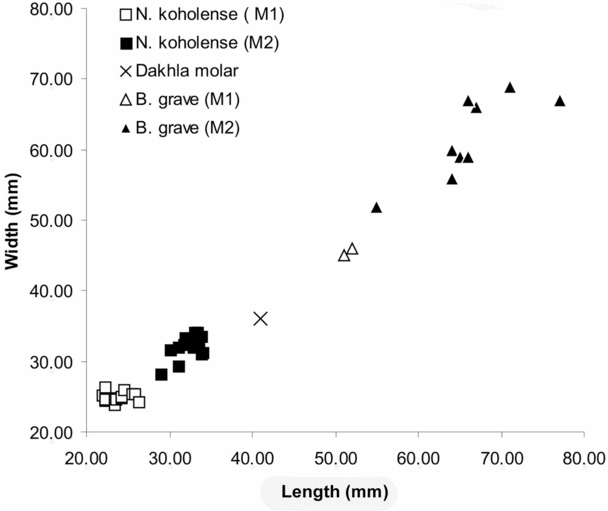
Referred specimen. GTS.1; left M1or2 (Fig. 4) (length = 41 mm; width = 36 mm)
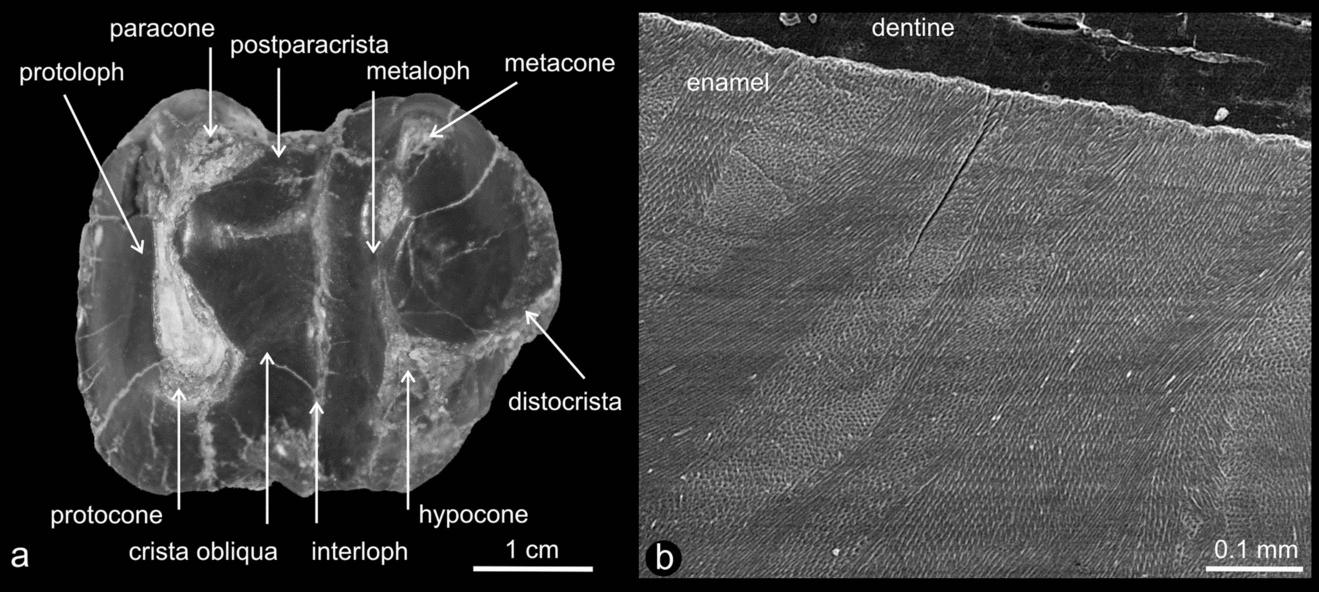
Dakhla proboscidean, left M1or2 (GTS.1) in occlusal view (a); vertical section of the enamel under the paracone (b).

Locality. Unit 2, brown hard ground of the B1 north of ‘Garitas’. ?Samlat Formation, ?Gerran member (Ratschiller, Reference Ratschiller1967).
Description. The crown is brachyodont and rectangular in occlusal view; its morphology is characterized by a bilophodont pattern and a typical true lophodonty without any trace of conules (Fig. 4a). Protoloph and metaloph are slightly anteriorly convex. The metaloph does not reach the top of the acute metacone. Wear affects the mesial wall of both lophs. The hypocone and the protocone are labially situated on the crown and their lingual walls are sloping toward the base of the tooth; the paracone and metacone are smaller than the lingual cusps. Despite the poor preservation of the specimen in its external margins, a mesial cingulum and a small style at the lingual side of the interloph are visible. The preservation does not allow the observation of the potential occurrence of both the parastyle and postentoconule; the number and morphology of the roots are also unknown. The distocrista reaches the hypocone to the distal cingulum; there is no postmetacrista or metastyle. The postparacrista and the crista obliqua are tenuous. The enamel microstructure, studied according to the method described by Tabuce, Delmer & Gheerbrant (Reference Tabuce, Delmer and Gheerbrant2007), is characterized by a schmelzmuster composed of 3-D enamel (thick bundles of prisms decussate in all directions) (Fig. 4). In large areas the vertical component of the decussation is attenuated, evoking Hunter-Schreger bands (Fig. 4b).
Comments. The true lophodont molar morphology and the bilophodonty of this specimen suggest affinities with some deinotheriines or ‘barytherioid’ prosboscideans. The deinotheriines Prodeinotherium and Deinotherium share with the Dakhla proboscidean a one-layered schmelzmuster composed of 3-D enamel (Tabuce, Delmer & Gheerbrant, Reference Tabuce, Delmer and Gheerbrant2007), in addition to their bilophodont M2 (their M1 is trilophodont). These deinotheriines differ, however, in having a complete distocrista linking the hypocone to the top of the metacone. The earliest putative deinotheriid, Chilgatherium from the Late Oligocene of Ethiopia (Sanders, Kappelman & Rasmussen, Reference Sanders, Kappelman and Rasmussen2004), differs in the bunolophodont morphology of its cheek teeth. The ‘barytherioids’, which include one of the oldest representatives of the proboscideans, are possibly paraphyletic taxa (see Gheerbrant et al. Reference Gheerbrant, Sudre, Tassy, Amaghzaz, Bouya and Iarochene2005); they are composed of Numidotherium koholense (Mahboubi et al. Reference Mahboubi, Ameur, Crochet and Jaeger1986; Noubhani et al. Reference Noubhani, Hautier, Jaeger, Mahboubi and Tabuce2008) and Daouitherium rebouli (Gheerbrant et al. Reference Gheerbrant, Sudre, Cappetta, Iarochene, Amaghzaz and Bouya2002) from the Early Eocene of Algeria and Morocco, respectively, plus Barytherium grave from the Late Eocene to Early Oligocene of Fayum (Egypt) and Dor El Talha (Libya) (see Shoshani et al. Reference Shoshani, West, Court, Savage, Harris, Shoshani and Tassy1996; C. Delmer, unpub. Ph.D. thesis, MNHN Paris, 2005), and possibly Phosphatherium escuilliei from the Early Eocene of Morocco (Gheerbrant, Sudre & Cappetta, Reference Gheerbrant, Sudre and Cappetta1996; Gheerbrant et al. Reference Gheerbrant, Sudre, Tassy, Amaghzaz, Bouya and Iarochene2005). Within ‘barytherioids’, GTS.1 is intermediate in size between Barytherium grave and N. koholense or Daouitherium (Fig. 5). Other comparisons with Daouitherium, unknown by its upper molars, are impossible. Daouitherium, as Phosphatherium, differs from the Dakhla proboscidean, however, in having a distinct schmelzmuster composed of true Hunter-Schreger bands (Tabuce, Delmer & Gheerbrant, Reference Tabuce, Delmer and Gheerbrant2007). Phosphatherium differs in addition in having a much smaller size (nearly four times), a mesostyle and a premetacrista. Numidotherium koholense and Barytherium grave are more like the specimen studied here, with their larger size, a more advanced lophodonty, and by the schmelzmuster composed of 3-D enamel. The occurrence of incipient Hunter-Schreger band-like structures in the enamel microstructure of N. koholense is peculiarly similar to the morphology observed in the Dakhla specimen. Moreover, the latter and N. koholense share lophs that are less convex relative to Barytherium grave. N. koholense also differs from Barytherium in the occurrence of a parastyle and postentoconule; unfortunately, these characters cannot be checked on GTS.1 due to the preservation of the specimen. According to C. Delmer (unpub. Ph.D. thesis, MNHN Paris, 2005), N. koholense and Barytherium share the occurrence of a postparacrista II. This structure is lacking in GTS.1, but we consider that this trait is too variable and tenuous, at least on N. koholense, to reject the attribution of GTS.1 to ?Numidotherium. Comparisons are also necessary with Arcanotherium savagei, another bilophodont species from the Late Eocene to Early Oligocene of Dor El Talha (Court, Reference Court1995). Initially related to N. koholense, notably based on its bilophodonty, Arcanotherium savagei was recently excluded from the ‘barytherioid’ proboscideans by Delmer (Reference Delmer2009). This author considers that this taxon is in fact more related to the bunolophodont proboscideans such as Moeritherium and Elephantiformes. It differs from the specimen studied here in having crenulated enamel, a paraconule, a postprotocrista, and an incipient convolute that pre-dates the third loph observed on the upper molars of the elephantiforms Phiomia and Palaeomastodon. The three-layered schmelzmuster of Arcanotherium savagei is also reminiscent of these genera (Tabuce, Delmer & Gheerbrant, Reference Tabuce, Delmer and Gheerbrant2007) and clearly differs from that observed on GTS.1. To conclude, the molar morphology of GTS.1, notably its slightly convex lophs compared to Barytherium and its enamel microstructure, suggests more affinities with Numidotherium than with the other proboscideans. Some critical characters that define N. koholense (parastyle and postentoconule) need to be checked on more preserved material. If these characters were absent, GTS.1 could represent a new taxon. Its size (intermediate between N. koholense and Barytherium) and its Middle/Upper Eocene age (compared to the Ypresian age of N. koholense) could support this hypothesis.
Measurements of the M1or2 of the Dakhla proboscidean compared with Numidotherium koholense and Barytherium grave.

4. Dating and palaeoenvironment
No mention of outcropping Palaeogene deposits has been noted in the literature concerning the Dakhla area and the Palaeogene is only mentioned in a core sample from the offshore basin (C. Labails, unpub. Ph.D. thesis, Univ. Brest, 2007) or limited to the northeastern part of the Dakhla–Laayoune–Tarfaya basins where Palaeogene deposits (Samlat Formation in Ratschiller, Reference Ratschiller1967) overlie the Cretaceous, and consist of marine siliceous chalk (Davison, Reference Davison2005). Within this unit, the Eocene Guerran Member (Ratschiller, Reference Ratschiller1967) is mainly characterized by clastic sediments with calcareous and marl intercalations, probably belonging to the clastic event of the Priabonian suggested by Swezey (Reference Swezey2009) for Western North Africa (clastic dominance between marine mudstone and gypsum or gypsiferous mudstone). The stratigraphical age of this member must be pondered, but it seems to be capped by a regional unconformity, which is labelled ‘end-Eocene’ in Swezey (Reference Swezey2009) and ‘Base Oligocene Unconformity’ in Guiraud et al. (Reference Guiraud, Bosworth, Thierry and Delplanque2005). Overlying this unconformity, the Oligocene Morcba member (in the Samlat Formation: Ratschiller, Reference Ratschiller1967) reaches up to 300 m in thickness and consists mainly of continental sandstone and conglomerate in the Aaiun area. This member is possibly missing in the Dakhla area. The Neogene is generally thin (<100 m) and is only exposed onshore in the western part of the basin. Sandy limestone and oyster beds are the main lithologies reported, as observed in the Dakhla area.
No foraminifera or nannoplankton assemblages were detected in the sampled clastic sediments along the observed series, excluding more precise biostratigraphical correlations. However, there is no doubt that units 1 and 2 are Palaeogene in age because unit 2 is currently dated from the late Middle Eocene (Bartonian) or Late Eocene (Priabonian) according to its palaeontological content and evidence as exposed below. Units 1–2 are probably the southwestern equivalent in age of the Itgui–Gerran members of the Samlat Formation (‘Boujdour-Aaiun’ area in Ratschiller, Reference Ratschiller1967). It is noteworthly that this author mentioned a similar fossil association with fossil shark teeth, coprolites, fish remains and invertebrates in clastic deposits of the Gerran Member (dated to Eocene) near Samlat Amgrash. The majority of taxa recovered in B1 and B2 are known elsewhere in Bartonian and Priabonian deposits, such as the Basilosauridae which worldwide are recovered exclusively in these stages (Uhen, Reference Uhen, Perrin, Würsig and Thewissen2008). Only one taxon, Xiphodolamia serrata Adnet et al. Reference Adnet, Hosseinzadeh, Antunes, Balbino, Kozlov and Cappetta2009 (GTS.2, Fig. 3b) is currently restricted to the Late Eocene period only (Adnet et al. Reference Adnet, Hosseinzadeh, Antunes, Balbino, Kozlov and Cappetta2009). The other part of the fauna either (1) shows a stratigraphical range spanning more Palaeogene stages or (2) has not yet been recorded in the fossil state until now. Besides this strong clue, the modern occurrence of some taxa (e.g. presence of Mobulidae, modern Carcharias and Carcharhinus, very large ‘C.’ twiggsensis and G. aff. eaglesomi, many Hemipristis curvatus), as well as the faunal association type (abundance of Carcharhiniformes, especially Carcharhinus, few Orectolobiforms) rather support a Priabonian age, even if we cannot definitively exclude a late Middle Eocene age for unit 2 also.
The age of the base of unit 2, displaying the brown hard bone bed (with evidence of reworked early Middle Eocene sharks and one terrestrial mammal), remains unclear even if we suspect a Priabonian age as well, remixing a few older elements coming from areas nearby (e.g. ‘C.’ koerti). This peculiar deposit is not laterally continuous and no evidence of unconformity was detected. The local presence of early Middle Eocene fossiliferous sediment is only suspected, because of the very large number of remixed elements that we found in situ. Further detailed sedimentological analysis and palaeontological elements must confirm this assumption. The difference in age between B1 and B2 is not at all obvious, as they display the same fossil species assemblages (see Table 1). Only future, precise analyses of fossil samples can resolve this point. Scarce fossil vertebrates have been discovered in unit 1 and none in unit 3 of the study area but the age of the top of the series (unit 3) was largely discussed in the description of the geological setting (Section 2). This probably corresponds to the Graret Fartet member, mapped southwest of El Argoub by Rjimati et al. (Reference Rjimati, Zemmouri, Benlakhdim, Amzaehou, Essalmani, Mustaphi, Haimouk and Hamidi2008) and probably equivalent to the Aaiun Formation (Ratschiller, Reference Ratschiller1967).
The selachian association shows great similarity with those previously published from the Qasr el-Sagha Formation and Birket-el-Qurun, Egypt (Stromer, Reference Stromer1905; Case & Cappetta, Reference Case and Cappetta1990; C. Underwood & D. Ward, pers. comm.), Qa'Faydat ad Dahikiya in the Wadi Esh-Shallala Formation, Jordan (Mustafa & Zalmout, Reference Mustafa and Zalmout2002; HC, pers. observ.), or the Dash-I-Goran Formation, Pakistan (Adnet et al. Reference Adnet, Antoine, Hassan-baqri, Crochet, Marivaux, Welcomme and Metais2007). It clearly indicates marine deposits (B1 to B2) with elements of tropical environment (e.g. numerous Carcharhinidae, Pristidae, Mobulidae and other Myliobatiforms), an assumption consistent with its past geographical position, considering that the African plate moved northwards and anticlockwise to reach a position during the Late Eocene of approximately 6–8° latitude south of its current position (Swezey, Reference Swezey2009), namely at latitude 15–18°N.
The slight differences in faunal composition and preservation observed laterally or between B1 and B2 are probably related to local change of tidal environment, as observed in Wadi Al-Hitan, Egypt (Peters et al. Reference Peters, Antar, Zalmout and Gingerich2009). In this last work, most of the marine vertebrate remains occur in condensed stratigraphical intervals and the taxonomic composition changes despite their proximity. The proximity of an emerged land (that probably occurred in the Reguibat shield to the east) with terrestrial fauna is now confirmed by the occurrence of ?Numidotherium sp., even if it is premature to correlate the terrestrial taxa with the marine sandstone that yielded the main fish fauna.
5. Conclusions
Middle to Late Eocene marine deposits of the Near East (northern Egypt, eastern Jordan) have yielded numerous fossil vertebrates, mixing marine mammals and selachians (e.g. Case & Cappetta, Reference Case and Cappetta1990; Gingerich, Reference Gingerich1992; Zalmout, Mustafa & Gingerich, Reference Zalmout, Mustafa and Gingerich2000; Mustafa & Zalmout, Reference Mustafa and Zalmout2002). Wadi Al-Hitan (‘the Whale Valley’, northern Egypt) has been classified as a World Heritage site since 2005 (UNESCO), partly in recognition of its palaeontological importance for the knowledge of cetacean evolution (see Gingerich, Reference Gingerich, Fleagle and Gilbert2007). Extensions of a similar depositional environment and faunal associations of the same age towards the Atlantic coast are obviously linked to the high sea-level sequences (e.g. Miller et al. Reference Miller, Kominz, Browning, Wright, Mountain, Katz, Sugarman, Cramer, Christie-Blick and Pekar2005) and a lack of barrier during this period (Meulenkamp & Sissingh, Reference Meulenkamp and Sissingh2003; Guiraud et al. Reference Guiraud, Bosworth, Thierry and Delplanque2005). However, the remarkable similarity of tropical and demersal taxa (e.g. Pristidae, Carcharhinidae, Myliobatiformes) is noteworthy and implies a large longitudinal marine faunal exchange along the south coast of the Tethys and towards the Eastern Atlantic at the end of the Eocene. Concerning the selachians, there is no doubt that forthcoming taxonomical study will strengthen the affinities presently observed with the Fayum and will present a considerable potential for broad-scale stratigraphical correlation between Western North Africa and well-dated sites in the Middle East. This preliminary report clearly confirms the palaeontological interest of the Dakhla deposits which greatly justifies further effort.
Acknowledgements
The authors are indebted to Gérard Barbe and the local people who helped us during the field trips, as well as B. Marandat and A. Ramdarshan for their thorough review of the final manuscript. An anonymous referee is thanked for his/her helpful suggestions to greatly improve the quality of this paper. Contribution ISE-M no. 2010-007.