INTRODUCTION
Incidental catch has been reported around the world and is probably the major factor responsible for non-natural mortality of cetaceans. It is estimated that incidental catches kill roughly 653,365 marine mammals globally and approximately 307,753 of these are cetaceans (Read et al., Reference Read, Drinker and Northridge2006). In some cases, the by-catch is very high relative to abundance leading to population decline (e.g. Phocoena sinus, Gulf of Mexico, D'Agrosa et al., Reference D'Agrosa, Lennert-Cody and Vidal2000; Hector's dolphin, Cephalorhynchus hectori, New Zealand, Burkhart & Slooten, Reference Burkhart and Slooten2003). Although incidental captures may occur in other types of gear (purse seine, Hall, Reference Hall1998; trawl, Dans et al., Reference Dans, Koen Alonso, Pedraza and Crespo2003; longline, Dalla Rosa & Secchi, Reference Dalla Rosa and Secchi2007), gillnets are probably the most harmful fishing gear to cetaceans (Read et al., Reference Read, Drinker and Northridge2006).
In Brazil, several cetacean species have been incidentally killed in gillnets, especially in coastal areas (e.g. Secchi et al., Reference Secchi, Ott, Danilewicz, Gales, Hindell and Kirkwood2003) but also offshore (e.g. Zerbini & Kotas, Reference Zerbini and Kotas1998) and fluvial waters (da Silva & Best, Reference da Silva and Best1996). In Rio Grande do Sul State, southern Brazil, franciscana (Pontoporia blainvillei) (Gervais & d'Orbigny, 1844) and common bottlenose dolphinsFootnote 1 (Tursiops truncatus) (Montagu, 1821) are the species most frequently found washed ashore (Pinedo, Reference Pinedo1986). In the case of the franciscana, most of the stranded animals are likely to come from by-catch in the coastal gillnet fishery (e.g. Pinedo & Polacheck, Reference Pinedo and Polacheck1999). However, until recently, coastal fisheries were thought not to harm bottlenose dolphins. Pinedo (Reference Pinedo1986), after seven years of beach surveys along the Rio Grande do Sul coast, suggested that mortality of bottlenose dolphins is predominantly of natural causes, with sporadic incidental catches in fishing gear. Therefore, special attention has been given only to the franciscana by-catch issue and no detailed study to investigate incidental mortality of bottlenose dolphins in the area has been conducted.
A population of bottlenose dolphins inhabits the Patos Lagoon Estuary and adjacent coastal areas (32°06′S/052°02′W) (Figure 1). Dolphins use these areas to perform all vital activities, moving inside and outside the Lagoon in a minute/hour/daily basis (LTMM, unpublished data). Although efforts to collect photo-identification data from this population began in 1976 (Castello & Pinedo, Reference Castello and Pinedo1977), little is known about its ecology. Only recently the population size was estimated through mark–recapture models applied to data collected in intensive photo-identification surveys in the Patos Lagoon Estuary carried out during winter, spring and summer of 1998. The estimated population size was 83 dolphins (95% CI: 78–88) and was identical throughout the three seasons with a re-sighting rate of marked animals ranging from 93% to 97.6% between seasons, indicating that this population can be considered resident and demographically closed (Dalla Rosa, Reference Dalla Rosa1999). Most of the early information about T. truncatus in this region came from strandings (e.g. Pinedo, Reference Pinedo1986; Barreto, Reference Barreto2000). The Patos Lagoon Estuary is characterized by an extensive maritime traffic, domestic and industrial outflows, and extensive effort of gillnets fisheries. Artisanal and commercial fishing occur year-round inside the estuary and along adjacent coastal areas (Reis & D'Incao, Reference Reis and D'Incao2000), overlapping with the distribution of the bottlenose dolphins (Di Tullio, Reference Di Tullio2009) and other protected species such as elasmobranchs (Vooren et al., Reference Vooren, Lessa, Klippel, Vooren and Klippel2005), turtles and other marine mammals (Secchi et al., Reference Secchi, Ott, Danilewicz, Gales, Hindell and Kirkwood2003). The high number of bottlenose dolphins washed ashore showing evidence of interactions with fisheries in the last few years, raises concerns about population trends and status, given the small population size (Dalla Rosa, Reference Dalla Rosa1999) and low reproductive rates of the species (Wells & Scott, Reference Wells and Scott1990).
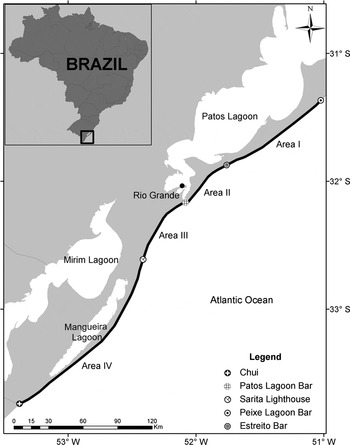
Study area. Area 1= 90 km; Area 2= 45 km; Area 3= 65 km; Area 4= 159 km.

The objectives of this work were to: (1) describe the temporal (seasonal and annual) and spatial trends in strandings of bottlenose dolphins in the southern portion of Rio Grande do Sul coast; (2) to determine the sex and reproductive stage of stranded dolphins; and (3) to assess the levels and sustainability of incidental catches of the population inhabiting the Patos Lagoon Estuary.
MATERIALS AND METHODS
Study area and data collection
The coast of Rio Grande do Sul comprises a 618 km long stretch of sandy beach that is interrupted by the Tramandaí River mouth, on the north coast, and by the Patos Lagoon Estuary mouth, on the south coast. Beach surveys were conducted to record and collect cetaceans and pinnipeds carcasses along the southern and central portions of the coast (~S29°19–S31°16) between 1976 and 2006. For this study, the surveyed area was divided into four sections (Figure 1).
Area I (90 km long): represents the most northerly area from the estuary mouth, located between the Peixe Lagoon (S31°21′30/W51°02′28) and the Estreito bar (S31°51′08/W51°42′38); Area II (45 km long): located between the Estreito bar (S31°51′08/W51°42′38) and the Patos Lagoon Estuary mouth (S32°08′33/W52°04′38); Area III (65 km long): located between the Patos Lagoon Estuary mouth (S32°09′39/W52°05′58) and the Sarita lighthouse (S32°39′42/W52°25′56); and Area IV (159 km long): represents the southernmost area from the estuary mouth, between the Sarita lighthouse (S32°39′42/W52°25′56) and Chuí (S33°44′22/W53°2′209), at the border with Uruguay.
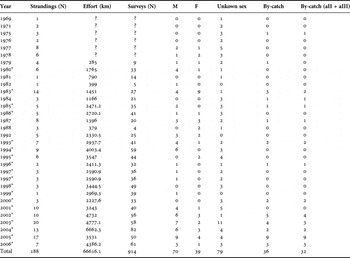
This division was based on survey effort per area and its location in relation to the estuary mouth (south or north). For example, Areas II and III were monitored more intensively in all years between 1979 and 1988. After 1993, survey effort was similar among all areas (Table 1).
Detailed information about survey effort and strandings of bottlenose dolphins, Tursiops truncatus, in the southern portion of Rio Grande do Sul State coast.

*, years systematically surveyed in Areas II and III (surveys were carried out within a maximum two-month interval); M, males; F, females; by-catch, number of carcasses found along all the study area surveyed and with evidence of being caught in gillnets; by-catch aII + aIII, number of carcasses found only in coastal areas near the mouth of Patos Lagoon Estuary (Areas II and III).
During the study period, surveys were carried out by three different research groups: from 1969 to 1987 and 1992 to 2006 by the Laboratório de Tartarugas e Mamíferos Marinhos (Universidade Federal de Rio Grande—LTMM/FURG); during the 1990s by the Museu Oceanográfico ‘Prof. Eliézer de C. Rios’ (Universidade Federal de Rio Grande—MO-FURG); and from 1993 to 2001 by the Núcleo de Educação e Monitoramento Ambiental (NEMA). All groups have experienced researchers on marine mammals. A gap of information exists between 1988 and 1991, except for two surveys conducted by LTMM during the summer of 1988. The standard data collection protocol of stranded dolphins included: date, sex, standard length, the distance from the estuary mouth and geographical location. The state of decomposition of each carcass was determined according to Geraci & Lounsbury (Reference Geraci and Lounsbury2005), as follows: Code 1: alive; Code 2: freshly dead; Code 3: moderately decomposed; Code 4: severely decomposed; and Code 5: mummified or skeletal remains. The sex was determined based on external characteristics. All carcasses found were examined for evidence of interactions with fishing operations. Due to overlapping surveys between research groups in the 1990s and 2000s, information for each carcass was compared to prevent double counting. Although the collection of basic information has been standardized, the characteristics of the surveys conducted by each group varied in terms of area coverage and sampling procedure. Surveys conducted by LTMM/FURG were non-systematic between 1969 and August 1979. From September 1979 to December 1987 surveys were carried out systematically once a month for most of the year and twice a month between October and December (austral spring), when the number of carcasses increased (Pinedo, Reference Pinedo1986). During this period, occasional surveys were also performed along a short stretch (4 km) of beach in the inner part of the estuary. From August 1992 to December 2001, surveys were carried out systematically twice a month for most of the year. From January 2002 to December 2006, depending on logistics and weather conditions, alternating surveys covering all areas took place once a week. Survey effort was restricted to Areas II and III between 1969 and 1984, with occasional surveys beyond these limits. Since 1985 beach surveys covering all areas have become more frequent. Surveys carried out by NEMA were systematic from January 1993 to December 2001. Alternated surveys covering a stretch of 135 km to the north (Areas I and II) and 220 km to the south (Areas III and IV) of the Patos Lagoon Estuary took place once a fortnight. Shorter trips to the north took place more often because of logistic and weather constraints. This research group neither removed carcasses from the beach nor collected biological samples. Beach surveys by MO-FURG were occasional during the 1990s. Some carcasses found were collected.
Maturity-class definition
The carcasses were classified according to three classes: Class I—calves one year old or less; Class II—juveniles/sub-adults (sexually immatures); and Class III—adults (sexually matures). Due to the absence of detailed information about growth and age at attainment of sexual maturity of bottlenose dolphins in this region, some criteria were applied to define maturity-classes of the carcasses found. All individuals aged 0 and also those with no age estimation but presenting characteristics of newborn (e.g. teeth not yet erupted or foetal folds) were included in Class I. The maximum size found in this sample was determined as the upper limit of the total length in Class I (regardless of sex). Female marine mammals are sexually mature when they reach approximately 85% of their asymptotic length (Laws, Reference Laws1956; Chivers, Reference Chivers, Perrin, Würsig and Thewissen2002). However, no information on the asymptotic length of bottlenose dolphins from southern Brazil is available. On the east and north-east coast of Florida, United States, male and female bottlenose dolphins reach maximum lengths of 285 cm and 275 cm, respectively (data extracted from Sergeant et al., Reference Sergeant, Caldwell and Caldwell1973). Sergeant et al. (Reference Sergeant, Caldwell and Caldwell1973) estimated that males and females larger than 245 cm and 225 cm, respectively, are already sexually mature. This means that males and females reaching 82.4% and 81.8% of their maximum lengths registered are sexually mature. We applied these proportions to obtain the approximate length of sexual maturation for male and female bottlenose dolphins in our study area. All dolphins that have reached these lengths were classified as Class III individuals. Dolphins with intermediate body size were allocated to Class II. For specimens of unknown sex we calculated the midpoint between the lengths estimated to define the sexual maturity of males and females and assumed as adult every individual with the total length above this value (>298 cm). Based on the above considerations, the classes were defined as follows: Class I: individuals up to 170 cm; Class II: males between 171 and 317 cm and females between 171 and 277 cm length. Individuals with unknown sex measuring between 171 and 297 cm were allocated in this class; Class III: males and females greater than 318 cm and 278 cm, respectively. Individuals of unknown sex greater than 298 cm were included in this class. A Chi-square goodness-of-fit test was used to determine if there was any difference in the proportion of male and female bottlenose dolphin strandings. Difference in the mean length between males and females was verified through the Student's t-test.
Data selection
We used the information available from all carcasses registered along the whole area and period surveyed to perform a general analysis of the biological characteristics of the bottlenose dolphins stranded (e.g. maximum total length, differences by sex and maturity-classes). To minimize biases due to the unbalanced survey effort across the whole study period and to reduce effect of the potential presence of individuals from adjacent populations in the sample, the following analyses were restricted to data collected only in Areas II and III. These areas were more frequently surveyed and since the sighting (Di Tullio, Reference Di Tullio2009) and stranding rates of bottlenose dolphins decrease significantly as the distance from the estuary mouth increases, individuals found there are more likely to belong to the Patos Lagoon population. Furthermore, two assumptions were made based on field observations and researchers' experience: (i) all carcasses had been detected if surveys were carried out within a maximum of two-month interval; and (ii) the intensification of survey effort (i.e. more than one survey per month) did not affect the number of carcasses registered. Both assumptions are considered reasonable and very probably met because it has already been verified, based on re-sightings of spray-painted carcasses, that even the franciscana (Pontoporia blainvillei) with a body mass up to 10 times smaller than the bottlenose dolphins, may remain on the beach for more than two months after stranding (LTMM, unpublished data). To avoid double-countings, when carcasses were not entirely collected for other studies, the information on position, length and spray marks were carefully checked. Taking these assumptions into account, only years when surveys were carried out within a two-month interval in Areas II and III were included in the following analyses (see Table 1).
DATA ANALYSIS
Seasonal trend in mortality
Seasons were defined as follows: spring (October–December), summer (January–March), autumn (April–June) and winter (July–September). Only specimens with known date of collection and classified in a state of decomposition less than or equal to three were used to investigate the seasonality. These criteria aimed to reduce the chances of erroneously allocating individuals to periods that did not correspond to the month/seasons of their death. Since sex determination by external examination is difficult in carcasses in advanced state of decomposition (i.e. above 3), we assumed that all specimens without recorded state of decomposition, but with known sex, were in decomposition state 3 or less and thus were included in the analysis. A goodness-of-fit G-test (Zar, Reference Zar1999) was used to test the null hypothesis that the number of strandings did not differ between seasons.
Annual trend in mortality
A generalized additive model (GAM) with Poisson error distribution was fitted in R using the mgcv package (Wood, Reference Wood2001) to assess the annual trend in the stranding frequencies. This analysis was restricted to the period 1993–2006, as it represented the largest continuous data series from systematic surveys in the areas closest to the estuary mouth (i.e. Areas II and III).
Spatial distribution of strandings
Correlation between the number of stranding events and the distance from the Patos Lagoon Estuary mouth was evaluated with the Spearman coefficient. A goodness-of-fit G-test (Zar, Reference Zar1999) was used to test the null hypothesis that the number of strandings did not differ between areas (north versus south). A 0.05 significance level was considered for all tests.
Fishery interactions
Carcasses of dolphins killed due to interactions with fishing activities often show external evidence (Cox et al., Reference Cox, Read, Barco, Evans, Gannon, Koopman, Mclellan, Murray, Nicolas, Pabst, Potter, Swingle, Thayer, Touhey and Westgate1998). Pieces of nets attached to the body, lacerated and/or amputated fin or flipper obviously cut by a knife (it is a common practice of fishermen to cut some appendage to remove dolphins from their nets) and net marks on the skin are all common signs of this interaction. Carcasses presenting at least one of these characteristics were recorded as by-catch, though all dolphins with fin or flippers amputated also presented net marks.
Calculating the potential biological removal (PBR) for the Patos Lagoon population
Only data collected between 2002 and 2006 were used to evaluate the potential impact of fisheries on the Patos Lagoon population (during this period high levels of by-catch were registered in coastal areas near to the estuary). As the two closest known adjacent populations of bottlenose dolphins are about 250 km to the south (in Uruguay; Laporta, Reference Laporta2009) and 315 km to the north of the Patos Lagoon estuary (in Tramandaí, RS, Brazil; Simões-Lopes et al., Reference Simões-Lopes, Fábian and Menegheti1998) and no offshore populations of bottlenose dolphins have been observed in the inner continental shelf of Rio Grande do Sul State coast from aerial surveys (Secchi et al., Reference Secchi, Ott, Crespo, Kinas, Pedraza and Bordino2001) we assumed that all dolphins found along the coast adjacent to the estuary (i.e. Areas II and III) belonged to the Patos Lagoon population.
The PBR is defined as the maximum number of animals, not including natural mortalities, which may be removed from a marine mammal stock while allowing that stock to reach or maintain its optimum sustainable population (Wade, Reference Wade1998). The sustainability of the annual number of carcasses presenting clear evidence of interactions with fisheries was assessed through the PBR calculated for the Patos Lagoon population, as follows:
 $$\hbox{PBR} = N_{min} \,. \,(R_{max}/2)\, . \,R_f$$
where:
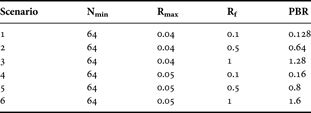
Nmin is the 20th percentile of a log-normal distribution based on an absolute estimate of the number of animals, N.; Rmax is the maximum net productivity level; Rf is a recovery factor. The recommended Rf values ranged from 0.1 for populations considered endangered by the IUCN (IUCN, 2000), or poorly studied, up to 1.0 for populations considered of low risk and well studied (see NMFS, 2000). The Rmax values used in the PBR analysis (i.e. 4% and 5%) were based on recent estimates for a population of bottlenose dolphins inhabiting the Indian River Lagoon system in Florida (Stolen & Barlow, Reference Stolen and Barlow2003). Rmax up to 4% is considered reasonable for small cetaceans impacted by fisheries. Since there was no evidence that this population had been impacted by fisheries prior to the 2000s, this Rmax value is considered conservative. The PBR was calculated for six different scenarios considering a fixed Nmin, given the high precision of the abundance estimates for the Patos Lagoon population (see Dalla Rosa, Reference Dalla Rosa1999). Rmax values were fixed at 0.04 and 0.05 in scenarios 1–3 and 4–6, respectively. These scenarios were run with Rf values of 0.1, 0.5 and 1 to simulate uncertainties and possible unknown estimation errors, as recommended by Wade & Angliss (Reference Wade and Angliss1997).
RESULTS
Differences in mortality by sex and maturity-classes
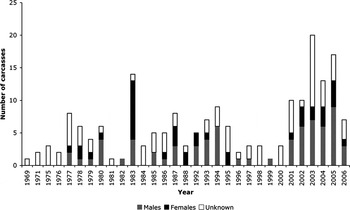
A minimum of 914 beach surveys was conducted between 1969 and 2006 as for some years no survey effort information is available (Table 1). Of these, 406 covered the north (Areas I and II) and 508 covered the southern (Areas III and IV) portion of the coast, totalling 66,617 km of beach surveyed. A total of 188 bottlenose dolphins were found washed ashore. Of these, the sex could not be determined for 79 individuals, 70 were males (64.2%) and 39 were females (35.8%), indicating a 1.8M:1F sex-ratio of those animals sexed (Table 1). This difference was statistically significant (G = 7.53, P = 0.006). The number of males stranded annually was higher than females in most years (Figure 2).
Absolute number of males, females and unknown sex of bottlenose dolphins washed ashore on the southern coast of Rio Grande do Sul State.

The total length of 147 individuals measured ranged from 124.5 cm to 384.0 cm (X = 274.7 cm, SD = 56.3). The total number of stranded individuals with known length and sex was 100, 65 of which were males and 35 were females. The mean total length of males (X = 276.7 cm; SD = 62.6) was smaller than for females (X = 286.9 cm; SD = 39.6), though this difference was not statistically significant (t = –1.02, P= 0.31). The maximum total length for males and females was 384 cm and 340 cm, respectively.
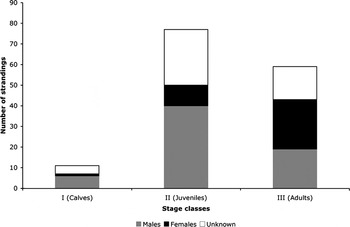
The mortality was not equal across maturity-classes (Figure 3). It was low in calves (N = 11, Class I), high in juveniles and sub-adults (N = 77, Class II) and slightly lower in adults (N = 59, Class III). The mortality of immature dolphins (i.e. Classes I and II pooled) represented 59.9% of the samples. Males (N = 65) were more frequent within the first two classes (71.8%) and only 29.2% were supposedly mature. On the other hand, mature females represented 68.6% of all measured females (N = 35). The number of females in Class III was significantly higher than in Class II (G = 3.98, P = 0.045).
Number of bottlenose dolphins stranded along the southern coast of Rio Grande do Sul State between 1969 and 2006 by maturity-classes and sex.

Temporal trends in mortality
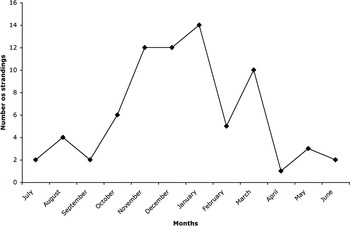
Analysing the mortality data set selected only from years systematically surveyed (i.e. years that met assumptions i and ii—see ‘data selection’ section in Materials and Methods for further information) (N = 17; Table 1), a total of 95 carcasses were recorded in Areas II and III with an average of 5.3 bottlenose dolphins (SD = 4.2) stranded annually. Considering only carcasses in decomposition states 1 to 3 (N = 73), strandings were recorded across all months; however, the frequencies varied significantly among seasons (G = 15.1841, P = 0.0017) showing a strong seasonal pattern (Figure 4). A very high frequency occurred during spring/summer months (80.8%), with the highest value recorded in January (N = 14). A small percentage of carcasses (19.2%) were recorded during autumn/winter with only 1 carcass found in April.
Number of bottlenose dolphins monthly stranded along the southern coast of Rio Grande do Sul State, based on carcasses found only in adjacent areas to the Patos Lagoon Estuary mouth during years systematically surveyed.

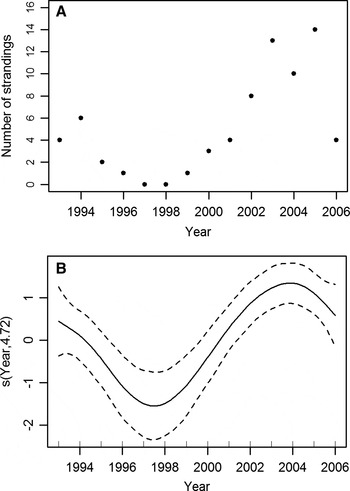
The number of stranded bottlenose dolphins in Areas II and III ranged between zero and 14 per year for the period 1993–2006 (Figure 5A). The fitted GAM (0.784 adjusted r 2, 86.7% explained deviance and approximate P < 0.001 for the smoothed function) indicates relatively low levels of mortality between 1995 and 2000 and a marked increase after 2001, followed by an apparent drop in 2006 (Figure 5B).
Temporal trend in the mortality of bottlenose dolphins along adjacent coastal areas of Patos Lagoon Estuary between 1993 and 2006. (A) Number of stranded dolphins in Areas II and III by year; (B) estimated smooth function (solid line) with 95% confidence interval (dashed lines) for the fitted generalized additive model. Y-axis = fitted function with estimated degrees of freedom in parentheses; x-axis = period.

Spatial distribution of strandings
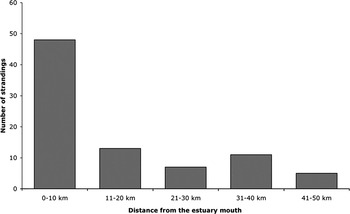
Fifty-eight carcasses (60.4%) were found to the north (Area II) and 38 (39.6%) to the south (Area III) of the Patos Lagoon Estuary mouth. Although the difference in strandings between areas was non-significant (G = 2.99, P = 0.1), the number of strandings decreased significantly as the distance from the estuary mouth increased (rs = –0.955, P = 0.001) (Figure 6). Sixty-one individuals (67%) were found at distances less than or equal to 20 km from the estuary mouth.
Number of carcasses of bottlenose dolphins found along the southern coast of Rio Grande do Sul State according to distance of the Patos Lagoon Estuary mouth.

Fishing-related mortality
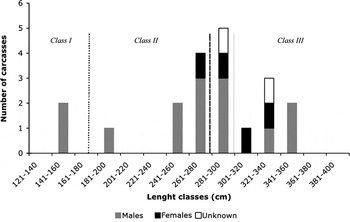
During beach surveys conducted in the Areas II and III between 2002 and 2006, 49 bottlenose dolphins were washed ashore, of which 43% (N = 21) showed evidence of being incidentally caught in fishing nets, 33% (N = 16) showed no evidence and 26% (N = 13) could not be evaluated due to the advanced state of decomposition of the carcasses. Evidence of interactions with fisheries included amputation or deep knife cuts on caudal peduncle (N = 8), net marks on flippers and rostrum (N = 5) and carcass entangled in nets (N = 6). The number of dolphins incidentally caught per year ranged from two to nine (X = 3.4; SD = 1.6) (Table 1). The by-catch was higher during summer (76.2%) (N = 16) and autumn (14.4%) (N = 3) and lower in winter (4.7%) (N = 1) and spring (4.7%) (N = 1). From the 21 animals incidentally caught, 14 (66.7%) were males, 4 (19%) were females and for three (14.3%) individuals sex was not determined (Figure 7). Total length was registered for 20 individuals. Adults accounted for the majority (55%) of incidental catches. Among females, three (75%) were supposedly sexually mature (Class III) while eight (57.1%) males were immature (Classes I and II) (Figure 7). Most carcasses classified as by-catch (N = 17) (80.9%) were found in areas closer than 20 km from the estuary mouth.
Length-class distribution of by-caught bottlenose dolphins registered along adjacent coastal areas of Patos Lagoon Estuary between 2002 and 2006. Lines indicate the division between maturity-classes. Dotted line: Class I (regardless of sex); dashed line: females; continuum line: males; Class I: calves one year old or less (up to 170 cm); Class II: juvenile/sub-adults (males between 171 and 317 cm and females between 171 and 277 cm length, respectively); Class III: adults (males and females greater than 318 cm and 278 cm, respectively).

Potential biological removal for bottlenose dolphins inhabiting the Patos Lagoon Estuary
According to the PBR estimates, summarized in Table 2, even when the most optimistic scenario was considered (i.e. scenario 6, which assumes a maximum net recruitment rate of 5% and a recovery factor, Rf = 1), the PBR was very low. The by-catch exceeded the PBR estimates in magnitude between 2002 and 2006, suggesting that the mean annual by-catch rate is not sustainable. Considering the least optimistic scenario for 2005, when by-catch was highest, the number of dolphins killed by fishery operations is nearly five times above the PBR.
Estimates of the potential biological removal (PBR) for the resident population of bottlenose dolphin, Tursiops truncatus, from the Patos Lagoon Estuary under different scenarios of Rmax and Rf.
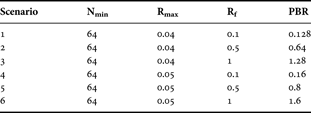
Nmin, is the 20th percentile of a log-normal distribution based on an absolute estimate of the number of animals; Rmax, is the maximum net productivity level; Rf, is a recovery factor.
DISCUSSION
Differences in mortality by sex and maturity-classes
Our results showed differences in mortality by sex and maturity-classes. The mortality of bottlenose dolphins was high in juveniles and adults and low in calves, unlike the expected U shape curve of natural mortality pattern observed in mammals (Caughley, Reference Caughley1966). Since our sample represents a mixture of animals killed from both natural causes and by-catch, the high observed frequency of dead juveniles is probably due to their higher vulnerability to incidental catches (see below).
The stranding frequency of calves in this study (8.75%) was similar to the values observed in the Gulf of Mexico (7%) (Mattson et al., Reference Mattson, Mullin, Ingram and Hoggard2006); however, it was low when compared to other studies focused on bottlenose dolphin mortality (40.5%, South Carolina (McFee & Hopkins-Murphy, Reference McFee and Hopkins-Murphy2002); 25.8%, Indian River Lagoon, Florida (Stolen et al., Reference Stolen, Durden and Odell2007); 18.9%, Sarasota Bay (Wells & Scott, Reference Wells and Scott1990)). Although the small size and accelerated decomposition process of carcasses decrease the likelihood of detecting calves washed ashore (e.g. Stolen & Barlow, Reference Stolen and Barlow2003), our surveys were conducted routinely, thus reducing the chances of missing such carcasses. The greater vulnerability of calves to predation is yet another factor that can lead to an under-estimation of their mortality. But although predation pressure by sharks seems to be important in various locations throughout around the world (e.g. Wells et al., Reference Wells, Scott, Irvine and Genoways1987; Cockcroft et al., Reference Cockcroft, Cliff and Ross1989; Mann & Barnett, Reference Mann and Barnett1999), no evidence of shark predation on bottlenose dolphins exists for southern Brazil. Thus, we believe that it represents a minor source of mortality for this population, if any at all. The low observed stranding frequency of calves might suggest a high calf survival rate for this population, though further investigation is necessary.
Behaviour and social structure probably explain the higher mortality of juveniles/sub-adults. Mother and calf separation usually occurs between 2 and 5 years of age, depending on the sex of the calf and the mother's reproductive condition (Wells, Reference Wells, Duffield and Robeck2000). The post-separation represents the most vulnerable period to the survival of the inexperienced young dolphin, at greater risk of boat strikes and incidental catches (e.g. Wells & Scott, Reference Wells and Scott1997; Stolen & Barlow, Reference Stolen and Barlow2003). In fact, most of the dolphins presenting evidence of by-catch were juveniles and sub-adults, which may explain the high mortality detected in Class II.
Our results showed that the number of stranded males was significantly higher than that of females. The maturity-classes were also affected differently according to sex. Mortality of females was higher in mature animals (Class III), while most of the dead males were immature (Class II). However, considering that sex was not determined for 44% of the dolphins washed ashore, the easier identification of males from the extroverted penis still visible in many fairly decomposed carcasses probably biased the sex-ratio towards males.
Although a mortality sex-ratio of approximately 1:1 is common for Tursiops truncatus (e.g. Sergeant et al., Reference Sergeant, Caldwell and Caldwell1973; Tyack, Reference Tyack1986; Hersh et al., Reference Hersh, Odell, Asper, Leatherwood and Reeves1990), some studies observed a higher mortality of males (e.g. Wells et al., Reference Wells, Scott, Irvine and Genoways1987; Mattson et al., Reference Mattson, Mullin, Ingram and Hoggard2006; Stolen et al., Reference Stolen, Durden and Odell2007), which might again be explained by behaviour and social structure. For example, in the Sarasota Bay population, there seems to be a greater maternal investment in female calves, which tend to be larger and heavier than male calves at the time of separation (Wells, Reference Wells, Duffield and Robeck2000). Although there is strong evidence for natal philopatry in male and female bottlenose dolphins, sex-related variation on movements and ranging patterns exist. The larger core area and movements of male bottlenose dolphins on a daily basis (Wells et al., Reference Wells, Scott, Irvine and Genoways1987) can also make them more susceptible to interactions with human activities, specially gillnets which are extensively used in our study area.
Temporal trends in mortality
The number of strandings increased markedly after 2001 (Figure 5A, B), and between 2002 and 2006, 43% of carcasses showed evidence of interactions with fishing activities. Still, the mortality during this period was probably underestimated, as the beach surveys carried out since 2001 were restricted to the sea coast and did not include estuarine beaches, where carcasses of bottlenose dolphins had been recorded in previous years (see Pinedo, Reference Pinedo1986). Assuming a constant natural survival rate, we would not expect a significant increase in the number of strandings in the absence of fishing-related mortality or catastrophic events. The high number of strandings in 1983 was caused by an isolated event when five dolphins were killed, supposedly, in a net set for sharks (Pinedo, Reference Pinedo1986). In fact, mortality due to interaction with fishing activities was not a cause for concern and was believed to play a minor role in bottlenose dolphin mortality until recently (e.g. Barreto, Reference Barreto2000). The marked increase in mortality detected in this study is probably related to changes in the fisheries dynamics. Production of the artisanal fisheries in the Patos Lagoon Estuary suffered a collapse in the 1980s (Reis, Reference Reis1992). Fish catches in estuarine areas reached 40,000 t. in 1966, but declined to less than 15,000 t in the 1980s due mainly to excessive fishing effort, environmental pollution and the use of non-selective nets (Reis, Reference Reis1992). In 1999, the total annual catch was reduced to about 5000 t (CEPERG/IBAMA, 1999). As a consequence, the fishing activities have been intensified in the adjacent coastal areas (Haimovici et al., Reference Haimovici, Castello, Vooren, Seeliger, Odebrecht and Castello1998), overlapping with the distribution of bottlenose dolphins (Di Tullio, Reference Di Tullio2009).
Seasonality in bottlenose dolphin natural mortality (e.g. South Carolina: McFee & Hopkins-Murphy, Reference McFee and Hopkins-Murphy2002; Florida: Hersh et al., Reference Hersh, Odell, Asper, Leatherwood and Reeves1990; Stolen et al., Reference Stolen, Durden and Odell2007) has been attributed to seasonal increases in abundance, coinciding with the months of highest records of deaths (McFee & Hopkins-Murphy, Reference McFee and Hopkins-Murphy2002), and to extreme temperatures during summer months, causing thermoregulatory stress (Wells et al., Reference Wells, Rhinehart, Hanse, Sweeney, Townsend, Stone, Casper, Scott, Hohn and Rowles2004). Mean summer sea surface temperature in the Patos Lagoon Estuary and adjacent coastal areas is 24.5°C (DP = 1.2) (Di Tullio, Reference Di Tullio2009), which is unlikely to cause any thermoregulatory stress. Furthermore, a systematic photo-identification study showed no seasonal variation in the abundance of the Patos Lagoon population (Dalla Rosa, Reference Dalla Rosa1999). Therefore, the above hypotheses are unlikely for our study area.
The fisheries in the Patos Lagoon estuary and coastal areas follow the seasonal variation in resource availability (e.g. Klippel et al., Reference Klippel, Peres, Vooren, Lamónaca, Vooren and Klippel2005). The artisanal fisheries operate across all seasons, but fishing effort is more intense between October and March (throughout spring and summer). Between April and September, the fishing effort potentially overlapping with bottlenose dolphin distribution is very low (Di Tullio, Reference Di Tullio2009), possibly as a response to time-closure regulations for some fisheries, including gillnets within the estuary during winter months. Therefore, the seasonal overlap with increased fishing effort during summer strongly suggests that by-catch in fisheries is mostly responsible for the seasonal increase in bottlenose dolphin strandings. Assuming that all individuals with recorded sex were of a suitable decomposition state to be included in the analysis for detecting seasonality in mortality could have introduced a bias. However, similar results were obtained when repeating this analysis with only individuals of known sex and decomposition state, suggesting that this assumption did not affect our findings.
The potential causes for interannual variability in the by-catch are not clear, but are probably associated with changes in artisanal fishing effort in the Patos Lagoon Estuary and surrounding areas. The pink shrimp (Farfantepenaus paulensis), uses the estuary as a nursery ground and constitutes the most important resource for the artisanal fisheries in the region (D'Incao, Reference D'Incao1991). During summer, night fishing for juvenile pink shrimp with light-baited stow nets is the main fishing activity in the Patos Lagoon (Almeida & D'Incao, Reference Almeida and D'Incao1999). However, shrimp biomass strongly depends on intrusions of high salinity water in the estuary, which is controlled by river flow and wind conditions. Following periods of low salinity, shrimp biomass and catch are low (Möller et al., Reference Möller, Castello and Vaz2009), and many estuarine-dependent or estuarine-resident species are involuntarily transported or forced to move out of the estuary increasing the biomass of fish and crustaceans in the adjacent coastal zone (Garcia et al., Reference Garcia, Vieira and Winemiller2003; Dumont & D'Incao, in press). This leads artisanal fishermen to target alternative species such as white croaker (Micropogonias furnieri), squirrel hake (Urophycis brasiliensis) and, more recently, the blue crab (Callinectes sapidus) (F. Dumont, personal communication) by setting gillnets in coastal areas near the estuary where bottlenose dolphins concentrate (Di Tullio, Reference Di Tullio2009). Indeed, with the exception of 2005, the observed high bottlenose dolphin mortality occurred during years of low catches of pink shrimp (2002, 2003 and 2004) (Möller et al., Reference Möller, Castello and Vaz2009), suggesting that the temporal variation in the by-catch of bottlenose dolphins is associated with changes in the artisanal gillnet fisheries. If this pattern is confirmed after further investigation, then a management approach combining artisanal gillnet and shrimp fisheries would be recommended to define the most appropriate conservation strategy for the bottlenose dolphin population from the Patos Lagoon Estuary.
The chance that some stranded dolphins found dead near the Patos Lagoon came from adjacent populations should not be discarded. During recent boat surveys along adjacent coastal areas, we registered few individuals that had never been photographed in the estuary and, therefore, were not taken into account in the abundance estimate used in our PBR analysis. Inclusion of such individuals had they washed ashore in Areas II and III would lead to an overestimation of by-catch mortality. On the other hand, it is important to remember that when considering only the carcasses found near the estuary, there is also the possibility of ignoring the mortality of individuals from the population of the estuary that died outside of our study area. While further investigation is needed to evaluate these possibilities, the concentration of carcasses near the estuary mouth (66.7% were found at a maximum distance of 20 km from the estuary—see Figure 6) strengthens the assumption that the bottlenose dolphins stranded in Areas II and III belong to the Patos Lagoon population. Besides being resident throughout the year (e.g. Castello & Pinedo, Reference Castello and Pinedo1977; Dalla Rosa, Reference Dalla Rosa1999) and with no seasonal variation in size (Dalla Rosa, Reference Dalla Rosa1999), this population is characterized by a high usage of the estuary mouth (e.g. Mattos et al., Reference Mattos, Dalla Rosa and Fruet2007; Di Tullio, Reference Di Tullio2009) and reduced individual encounter rates in oceanic coastal areas with increasing distance from the mouth (Di Tullio, Reference Di Tullio2009).
By-catch and potential biological removal
Based on the by-catch analysis restricted to the 2002–2006 period and fresh carcasses, our results suggest that males are more vulnerable to entanglements than females, as by-catch sex-ratio was 3.5 males for every female and the number of individuals caught in nets with unknown sex was low (N = 2; 14.2%). Although these results cannot be conclusive because they are based on a small sample, they corroborate with other studies, which reported sex-related and age-related differences in the by-catch. In many cases, immature males are the most vulnerable (e.g. Pontoporia blainvillei (Secchi et al., Reference Secchi, Ott, Danilewicz, Gales, Hindell and Kirkwood2003), T. truncatus (Hersh et al., Reference Hersh, Odell, Asper, Leatherwood and Reeves1990) and Cephalorhynchus hectori (Slooten, Reference Slooten1991)).
The reproductive value of mature females is higher than any other component of the population; therefore, their mortality has stronger negative effect on the long-term viability of the population (e.g. Caughley, Reference Caughley1977). Moreover, in small populations such as the Patos Lagoon population, the annual removal of a few mature females by non-natural causes will have a strong impact on the population growth rate, which may lead to population decline in only a few years. In this context, it is important to consider that even in the most optimistic scenario, the minimum number of bottlenose dolphins killed each year in fishing nets is above the PBR. When considering the scenarios from one to five, the mean annual by-catch exceeds at least three times the PBR estimated for the Patos Lagoon population. This method, although ad hoc, was adopted by some countries for several years to regulate and limit the by-catch of marine mammals (United States, e.g. Read & Wade, Reference Read and Wade2000; New Zealand, e.g. Manly & Walshe, Reference Manly, Walshe, Garner, Amstrup, Laake, Manly, McDonald and Robertson1999), and simulation studies indicate that it is the most robust and conservative index of sustainability currently used by conservationists (Milner-Gulland & Akçakaya, Reference Milner-Gulland and Akçakaya2001). In Brazil, no measurable criteria have been defined to regulate the maximum allowable number of incidental catches of individuals in wild populations affected by fisheries. The adoption of the PBR-based framework would represent a first and important step to measure the sustainability of marine mammal populations in Brazilian waters.
Our data showed that fishery activities are probably responsible for the increase in the mortality of bottlenose dolphins in southern Brazil and suggest the current levels of by-catch are unsustainable for the Patos Lagoon population. Long-term monitoring of this population is needed to better understand the trend in mortality suggested by our data. Possible effects on the population dynamics of the bottlenose dolphins from the Patos Lagoon Estuary caused by unbalanced stage-classes and sex by-catch rates should be investigated further, as well as the degree of overlap with other populations to the north (Tramandaí) or south (Uruguay). We strongly recommend the development of a specific study to investigate the spatial distribution of gillnets and bottlenose dolphins in the Patos Lagoon Estuary and adjacent coastal waters as a means to elaborate specific by-catch mitigation plans for this population.
ACKNOWLEDGEMENTS
We would like to acknowledge the logistical support provided by the Museu Oceanográfico ‘Prof. Eliézer C. Rios’, Núcleo de Educação e Monitoramento Ambiental (NEMA) and Laboratório de Tartarugas e Mamíferos Marinhos/Universidade Federal do Rio Grande (LTMM/FURG). We are indebted to Maria Cristina Pinedo, who was in charge of the LTMM from the late 1970s to early 2000 period when part of the information used here was collected. Mônica Muelbert, André Barreto, graduate and undergraduate students and many volunteers of the three institutions participated in beach surveys and helped with dissecting carcasses and collecting data during the three decades. Carolus Maria Vooren and Arthur Andriolo provided valuable comments on the early drafts of the manuscript. This is a contribution of the Research Group ‘Ecologia e Conservação da Megafauna Marinha-EcoMega/CNPq’. This study was made possible thanks to the financial support from Yaqu Pacha, Cetacean Society International, Fundação O Boticário de Proteção à Natureza, and Whale and Dolphin Conservation Society. The ‘Conselho Nacional de Desenvolvimento Científico e Tecnológico—CNPq’ provided scholarships to E.R. Secchi (PQ 305219/2008-1), J.C. Di Tullio, and the ‘Coordenação de Aperfeiçoamento de Pessoal de Nível Superior—CAPES’ provided scholarships to P.F. Fruet, L. Dalla Rosa and D.S. Monteiro.