Introduction
Species interactions are crucial determinants for the establishment and spread of alien species (Lockwood et al., Reference Lockwood, Hoopes and Marchetti2007). Interference competition between closely related species is a common interspecific interaction that influences biological invasions (Reitz & Trumble, Reference Reitz and Trumble2002). Reproductive interference, i.e. any kind of interspecific competitive interaction during the process of mate acquisition, often caused by incomplete species recognition, can have adverse effects on the fitness of at least one of the partner species (Gröning & Hochkirch, Reference Gröning and Hochkirch2008). Because reproductive interference is characterized by positive frequency dependence, it is far more likely to cause species exclusion than the density dependence of resource competition (Gröning & Hochkirch, Reference Gröning and Hochkirch2008; Kishi et al., Reference Kishi, Nishida and Tsubaki2009) and is thus receiving increasing attention in research on biological invasions (Liu et al., Reference Liu, De Barro, Xu, Luan, Zang, Ruan and Wan2007; Crowder et al., Reference Crowder, Horowitz, De Berro, Liu, Showalter, Kontsedalov, Khasdan, Shargal, Liu and Carrière2010a).
The whitefly Bemisia tabaci (Gennadius) is a species complex containing at least 28 morphologically indistinguishable species (Dinsdale et al., Reference Dinsdale, Cook, Riginos, Buckley and De Barro2010; De Barro et al., Reference De Barro, Liu, Boykin and Dinsdale2011; Hu et al., Reference Hu, De Barro, Zhao, Wang, Nardi and Liu2011; Liu et al., Reference Liu, Colvin and De Barro2012). Reciprocal crossing experiments conducted among 14 of the 28 putative species have revealed a pattern of reproductive isolation among them (Xu et al., Reference Xu, De Barro and Liu2010; Elbaze et al., Reference Elbaz, Lahav and Morin2010; Wang et al., Reference Wang, Ruan and Liu2010, Reference Wang, Sun, Qiu and Liu2011; Sun et al., Reference Sun, Xu, Luan and Liu2011; Liu et al., Reference Liu, Colvin and De Barro2012). Behavioural observations indicate that the isolation is generally due to pre-mating barriers, although post-mating barriers may be involved in some cases (Liu et al., Reference Liu, De Barro, Xu, Luan, Zang, Ruan and Wan2007, Reference Liu, Colvin and De Barro2012; Wang et al., Reference Wang, Ruan and Liu2010; Sun et al., Reference Sun, Xu, Luan and Liu2011). Despite these barriers, species in the complex often attempt to mate with each other, resulting in strong reproductive interference which can significantly influence the outcome of interspecific interactions between alien and native whitefly species (Liu et al., Reference Liu, De Barro, Xu, Luan, Zang, Ruan and Wan2007; Crowder et al., Reference Crowder, Horowitz, De Berro, Liu, Showalter, Kontsedalov, Khasdan, Shargal, Liu and Carrière2010a; Luan et al., Reference Luan, Xu, Lin, Zalucki and Liu2012; Luan & Liu, Reference Luan and Liuin press).
In the B. tabaci species complex, two invasive species, Middle East-Asia Minor 1 (herein MEAM1, formally referred to as the ‘B biotype’) and Mediterranean (herein MED, formally referred to as the ‘Q biotype’), have made a great impact on world agriculture, causing considerable damage to ornamental, vegetable, grain legume and cotton production (Perring et al., Reference Perring, Copper, Rodriguez, Farrar and Bellows1993; Perring, Reference Perring, Gerling and Mayer1996; Oliveira et al., Reference Oliveira, Henneberry and Anderson2001; Wan et al., Reference Wan, Zhang, Liu, Chen, Chu, Zhang, Zang, Jiu, Lu, Cui, Zhang, Zhang, Zhang, Liu, Liang, Lei and Zhang2009; De Barro et al., Reference De Barro, Liu, Boykin and Dinsdale2011). The spread of MEAM1 has also resulted in the displacement of some relatively innocuous, indigenous B. tabaci in some invaded regions (Perring et al., Reference Perring, Copper, Rodriguez, Farrar and Bellows1993; McKenzie et al., Reference McKenzie, Anderson and Villarreal2004; De Barro et al., Reference De Barro, Bourne, Khan and Brancatini2006; Liu et al., Reference Liu, De Barro, Xu, Luan, Zang, Ruan and Wan2007; Crowder et al., Reference Crowder, Horowitz, De Berro, Liu, Showalter, Kontsedalov, Khasdan, Shargal, Liu and Carrière2010a,Reference Crowder, Sitvarin and Carrièreb). Liu et al. (Reference Liu, De Barro, Xu, Luan, Zang, Ruan and Wan2007) revealed that asymmetric mating interactions between MEAM1 and indigenous whiteflies contributed to the widespread invasion and displacement of indigenous species by this whitefly in China and Australia. Similarly, Crowder et al. (Reference Crowder, Horowitz, De Berro, Liu, Showalter, Kontsedalov, Khasdan, Shargal, Liu and Carrière2010a) used stochastic simulation modelling to analyse data of caged population experiments with various whitefly species conducted in China, Australia, the United States and Israel, and found that between-species variation in mating behaviour was a more significant factor affecting species exclusion than variation in development time or insecticide resistance.
Recently, the widespread invasion of MEAM1 has been increasingly matched by the global spread of a second member of the complex, the MED cryptic species, which has been invading from its presumed origin in the Mediterranean region to other parts of the world (Horowitz et al., Reference Horowitz, Denholm, Gorman, Cenis, Kontsedalov and Ishaaya2003; Martinez-Carrillo & Brown, Reference Martinez-Carrillo and Brown2007; Ueda & Brown, Reference Ueda and Brown2006; McKenzie et al., Reference McKenzie, Hodges, Osborne, Byrne and Shatters2009; Chu et al., Reference Chu, Wan, Zhang and Brown2010). In China, the results of the latest field surveys indicated that MED first appeared in 2003 and by 2009 had become the dominant species in the Yangtze River Valley and eastern coastal areas, and that in many regions indigenous species of the B. tabaci complex are being displaced by the alien MEAM1 and/or MED (Hu et al., Reference Hu, De Barro, Zhao, Wang, Nardi and Liu2011; Rao et al., Reference Rao, Luo, Zhang, Guo and Devine2011; Guo et al., Reference Guo, Rao, Luo, Zhang and Gao2012).
The Asia II 1 (herein AII1, formally referred to as ZHJ2 biotype) is a widely distributed, indigenous cryptic species of the B. tabaci complex in Asia, and field surveys indicate that AII1 is being displaced by MEAM1 and/or MED in many regions in China (Hu et al., Reference Hu, De Barro, Zhao, Wang, Nardi and Liu2011; Rao et al., Reference Rao, Luo, Zhang, Guo and Devine2011; Guo et al., Reference Guo, Rao, Luo, Zhang and Gao2012). Crossing experiments and behavioural observations showed complete reproductive isolation between AII1 and seven other cryptic species of the B. tabaci complex, including the alien MEAM1 and MED (Wang et al., Reference Wang, Ruan and Liu2010, Reference Wang, Sun, Qiu and Liu2011; Liu et al., Reference Liu, Colvin and De Barro2012). In this study, we conducted species exclusion experiments and behavioural observations to investigate the displacement between MED and AII1, as well as the behavioural mechanisms underlying displacement. We also conducted simulation modelling to examine the roles of mating behaviour and life-history traits in the displacement between the two whitefly species.
Materials and methods
Whiteflies and plants
Populations of the alien MED (mtCO1 GenBank accession no. GQ371165) and the indigenous AII1 (mtCO1 GenBank accession no. DQ309077) used in this study were collected from Zhejiang, China. The full details of methods for maintaining the populations were described in Luan et al. (Reference Luan, Ruan, Zang and Liu2008). Briefly, the populations were maintained in separate climatic cubicles on cotton, Gossypium hirsutum (Malvaceae) cv. Zhe-Mian 1793, a host plant suitable to both MED and AII1. The purity of each of the two populations was monitored every 3–5 generations using the random amplified polymorphic DNA-polymerase chain reaction (RAPD-PCR) technique with the primer H16 (5′-TCTCAGCTGG-3′) (De Barro & Driver, Reference De Barro and Driver1997). Newly emerged whitefly adults from each population were used in the species exclusion experiments and behavioural observations (see Luan et al., Reference Luan, Ruan, Zang and Liu2008).
Cotton plants (cv. Zhe-Mian 1793) used in the experiments were cultivated singly in potting mix (a mixture of peat moss, vermiculite, organic fertilizer, perlite in a 10:10:10:1 ratio by volume) in 1.5-l pots in whitefly-proof glasshouses where temperature and humidity were controlled at 24–30°C and 50–70% RH, and natural lighting was supplemented with 14 h artificial lights during the daytime. All experiments used plants at the 5–7 fully expanded true leaf stage and were conducted at 27±1°C, L14:D10 (light 06:00–20:00 h) and 70±10% RH.
Species exclusion experiments
We conducted population cage experiments to observe changes in relative abundance as well as sex ratios in mixed populations of MED and AII1. These experiments involved three treatments: (i) MED+AII1 in mixed population, five replicates; (ii) MED alone in single population, two replicates; and (ii) AII1 alone in single population, two replicates. The experiment was conducted using steel-framed insect rearing cages (55 cm×55 cm×55 cm). The two treatments of MED and AII1 single populations were used as controls. To initiate each replicate of a treatment, newly emerged adults were introduced to a cage containing two cotton plants. In treatment ‘MED+AII1’, the two plants in each replicate (cage) were inoculated with three females and three males of MED and 20 females and 20 males of AII1; in ‘MED alone’, the two plants in each replicate were inoculated with 23 females and 23 males of MED; and, in ‘AII1 alone’, the two plants in each replicate were inoculated with 23 females and 23 males of AII1. The plants were watered as necessary.
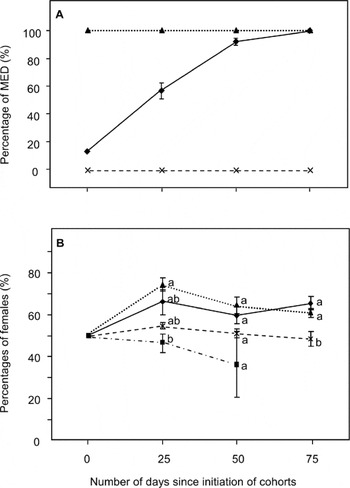
For both MED and AII1, the development time from egg to adult emergence takes, on average, 24–25 days under the test host plant and temperature conditions (Wang P. unpublished data; Xu et al., Reference Xu, Lin and Liu2011). Thus, every 25 days over a 75-day period, in the MED+AII1 treatment, 100 whitefly adults were sampled randomly from each replicate and identified to species; and, in each replicate of the two control treatments, 30 adults were examined by RAPD-PCR for their species identity and 100 individuals were sexed. To avoid overcrowding and maintain the population in each replicate, after each sampling of the adults, the older plant of the two in each cage was cut and taken out with all the eggs and nymphs on it, and a new clean plant was added. Sampling was ended when AII1 was found to be completely displaced by MED in the MED+AII1 treatment, 75 days after initiation of the mixed population (fig. 1).
Changes of relative proportions and sex ratios of MED and AII1 in a mixed population of the two cryptic species on cotton in the laboratory. (A) mean percentages of MED individuals in cohorts of mixed population of ‘MED+AII1’, cohorts of MED alone, cohorts of AII1 alone, respectively ( , MED alone;
 , MED+AII 1;
 , AII 1 alone); (B) mean percentages of females of MED in the cohorts of mixed population of ‘MED+AII1’, mean percentages of females of AII1 in the cohorts of mixed population of ‘MED+AII1’, mean percentage of females in the cohorts of MED alone, and mean percentages of females of the AII1 in the cohorts of AII1 alone, respectively. Error bars indicate standard errors. In (B), different letters to the right of the four mean values on the same day indicate significant differences (P<0.05) (, MED in (MED+AII1);
 , AII1 in (MED+AII1); , MED alone; , AII1 alone).

Behavioural observations
We used the video recording system of Ruan et al. (Reference Ruan, Luan, Zang and Liu2007) to observe the mating behaviour and copulation events of adults caged on plant leaves. One female and one male adults of MED or AII1 were supplemented with one or three males of the same or the other species. Five treatments were conducted for each of the two species (fig. 2A, B). Newly emerged adults of various intra- and inter-species treatments were caged on the lower surface of plant leaves, and their movement and behaviour were observed and recorded continuously for 72 h. The events of courtship and copulation, as well as behaviour of interactions and interference between individuals of the same or different species, were determined by viewing the tapes on a television set or a computer screen.
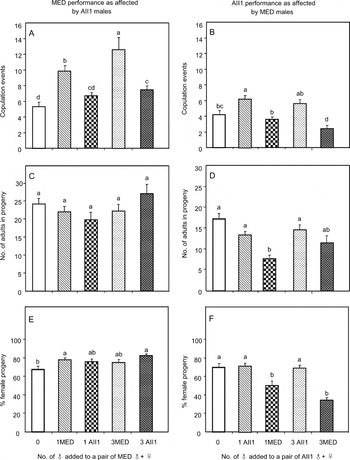
Changes in the mean number of copulation events during the first 72 h after emergence and production of progeny for the first five days after emergence when a pair of MED ♂+♀ was supplemented with one or three ♂ of the MED and AII1 (A, C and E), or when a pair of AII1 ♂+♀ was supplemented with one or three ♂ of the AII1 or MED (B, D and F). Twenty to 40 replicates were conducted for each of the ten treatments, and error bars indicate standard errors. In each of the six diagrams different letters above bars indicate significant differences (P<0.05).

The courtship and mating behaviour of B. tabaci has been described in detail (Perring & Symmes, Reference Perring and Symmes2006; Zang & Liu, Reference Zang and Liu2007). In replay of the tapes, we determined the following behavioural events: (i) copulation: a successful copulation event between a male and female; (ii) courtship: a male and a female positioned parallel to each other with their bodies in contact; (iii) interference: an intruding male interfered with the courtship or copulation of a male and a female; (iv) successful interference without displacement: an event of interference that resulted in immediate, early ending of courtship or copulation, but the intruding male did not replace the earlier male; and (v) successful interference leading to displacement: an event of interference that resulted in replacement of the first male in courting by the intruding male. With the recording of these behavioural elements, we were able to calculate the number of uninterrupted events of courtship, i.e. events of courtship that ended naturally without experiencing any interference. Uninterrupted events of courtship could lead to copulation or could end without copulation.
For treatments where each replicate had only female and males of the same species, we did not need to distinguish individual males, and thus we viewed tapes on a television set. For treatments where each replicate had one female with males from both MED and AII1, we need to identify each male to species at each behavioural event, and thus we viewed the tapes on a computer installed with the Motic Images Advanced 3.2 system (Motic China Group Co. Ltd, Xiamen, China). The techniques for distinguishing individual males with the aid of the Motic Images Advanced 3.2 system on a computer screen are reported in detail in Luan & Liu (Reference Luan and Liuin press). Briefly, the actual lengths of the two males in each replicate were measured and recorded before they were released for the observation, and they were then identified by the difference in their relative body length, i.e. one was longer than the other.
Effect of mating interactions on fecundity and progeny sex ratio
In parallel with behavioural observations, we also examined the progeny production by MED or AII1 using the ten intra- and inter-species treatments (fig. 2C–F). Newly emerged adults of the ten treatments were caged on the lower surface of plant leaves, and left to mate and oviposit for five days before being discarded. All eggs on the plants were reared for 30 days to develop to adults, and all progeny adults were then collected and sexed.
Modelling species exclusion
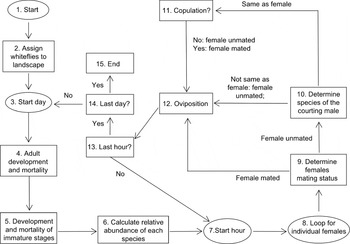
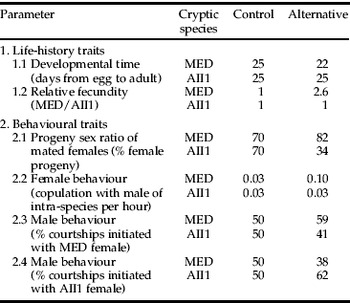
The stochastic simulation model created by Crowder et al. (Reference Crowder, Horowitz, De Berro, Liu, Showalter, Kontsedalov, Khasdan, Shargal, Liu and Carrière2010a, Reference Crowder, Sitvarin and Carrièreb) was used to simulate the roles of life history traits and mating interactions on the outcome of species exclusion experiments between MED and AII1. The full model has been described previously (Crowder et al., Reference Crowder, Horowitz, De Berro, Liu, Showalter, Kontsedalov, Khasdan, Shargal, Liu and Carrière2010a, Reference Crowder, Sitvarin and Carrièreb). Briefly, fig. 3 illustrates the steps of simulation. The model had an hourly time-step, as previous behavioural observations indicate that whitefly females are courted approximately once per hour (Crowder et al., Reference Crowder, Horowitz, De Berro, Liu, Showalter, Kontsedalov, Khasdan, Shargal, Liu and Carrière2010a, Reference Crowder, Sitvarin and Carrièreb). Each female was courted once per time step (1 h) until she was mated. The probability of a courtship ending in copulation P success=P intra×P cop, where P intra is the probability of an intra-species courtship, and P cop is the probability of copulation in intra-species courtships. Values of P intra and P cop were based on the behavioural observations (tables 1–3). In the process of simulation, for each courtship, a random number was drawn from a uniform distribution between 0 and 1 and compared with the observed probability values for P intra and P cop. If either random number was greater than the observed probability, the courtship ended before mating; otherwise, the courtship ended in copulation. Both mated and unmated females laid eggs, with female fecundity peaking at age two and three days and declining thereafter (Crowder et al., Reference Crowder, Horowitz, De Berro, Liu, Showalter, Kontsedalov, Khasdan, Shargal, Liu and Carrière2010a, Reference Crowder, Sitvarin and Carrièreb). Unmated females laid only male progeny, while the progeny sex ratio of mated females depended on the presence (or lack thereof) of the alternate species (table 3). Each day in the model, adults and immature whiteflies developed, with adult survival declining with age (Crowder et al., Reference Crowder, Horowitz, De Berro, Liu, Showalter, Kontsedalov, Khasdan, Shargal, Liu and Carrière2010a, Reference Crowder, Sitvarin and Carrièreb). The model was written in Visual Basic (Microsoft, 2002).
Flowchart of the model. Steps 1–2 set up the parameters and number of generations for the simulation. Steps 3–14 form the loop of simulation for one generation and the number of days in each generation as well as the number of generations to be run depend on the values set up in step 2. Within the larger loop of steps 3–14, steps 7–13 form the loop of simulation for one day.

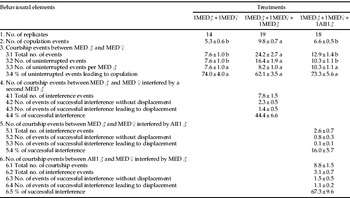
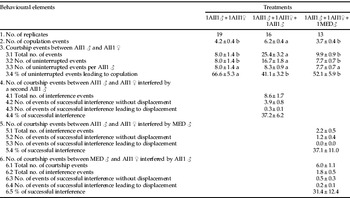
Courtship events and interactions: behavioural elements that caused changes in events of copulation in the MED when a pair of MED ♂+♀ was supplemented with one ♂ of the MED or AII1 during the first three days after emergence.

The data in the table are mean±SEM, and means on the same line followed by different letters indicate significant differences.
Courtship events and interactions: behavioural elements that caused changes in events of copulation in the AII1 when a pair of AII1 ♂+♀ was supplemented with one ♂ of the AII1 or MED during the first three days after emergence.

The data in the table are mean±SEM, and means on the same line followed by different letters indicate significant differences.
Parameter values for modelling species exclusion between MED and AII1: life-history or behavioural traits were assumed to be the same for the two species in the control simulations, while alternative parameter values were assumed based on experimental observations on the performance of the two species.

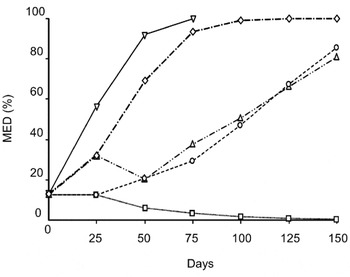
In this study, we conducted simulation with four models to evaluate whether variation in life history traits and mating behaviour between MED and AII1 could predict the patterns of species exclusion observed in the experiments (fig. 1). Respectively, the four models are (i) behaviour model – simulations with variation in mating behaviour only; (ii) life history model – simulations with variation in life history traits only; (iii) combined model – simulations with variation in both mating behaviour and life history traits; and (iv) control model – parameter values for mating behaviour and life history were the same for both species. We ran simulations for six generations with each of the four models (fig. 4) and conducted five stochastic simulations with each model to match the experiments.
Observed and simulated data (with four models) of MED (%) in the mixed population of MED and AII1 during a cage population experiment. Abscissa represents the days of mixed cohort experiment; ordinate represents the proportion of MED cryptic species of Bemisia tabaci in the mixed cohorts ( , Observed;
 , Combined model;
 , Behaviour model;
 , Life-history model;
 , Control model).

Parameter values of life history and behavioural traits were calculated from data of observation on the performance and mating behaviour of MED and AII1 on cotton (fig. 2, tables 1 and 2: Xu et al., Reference Xu, Lin and Liu2011) and are listed in table 3. Thus, in the control model, we presumed that parameter values for life history and mating behaviour were the same for both MED and AII1. In the life history model, we considered variation in development time and relative fecundity, as these traits differed between MED and AII1. In the behaviour model, the behaviour traits differed between MED and AII1, including probability of copulation, probability of initiating intra-species courtships and offspring sex ratio of mated females. In the combined model, the simulations were run with variation in both life history traits and mating behaviour.
Data analysis
For species exclusion experiments, the percentage of females in the same generation with different treatments was analyzed using one-way analysis of variance (ANOVA); and, when a significant effect was detected at the P<0.05 level, the means were compared using a least significant differences (LSD) test.
For behavioural observations, the numbers of copulation events in MED (fig. 2A) or AII1 (fig. 2B) were each analyzed using one-way ANOVA followed by the LSD test. Because in the four treatments of 1MED♂+1MED♀+3MED♂, 1MED♂+1MED♀+3AII1♂, 1AII1♂+1AII1♀+3AII1♂ and 1AII1♂+1AII1♀+3 MED♂, there were too many events of behavioural interactions between the female and males, as well as among the males in each of the replicates, it was difficult to record each of the events accurately for analysis. Thus, detailed recording and analyses on events of behavioural interactions were conducted only for the remaining six treatments. For either MED (table 1) or AII1 (table 2), each of four parameters of courtships, i.e. total number of events, number of uninterrupted events, number of uninterrupted events per male and % of uninterrupted events leading to copulation, was analyzed using one-way ANOVA followed by the LSD test.
For the data of fecundity and progeny sex ratio as affected by mating interactions, the numbers of adults in progeny and % of females in progeny for the five treatments in MED (fig. 2C, E) or in AII1 (fig. 2D, F) were analyzed using one-way ANOVA followed by the LSD test.
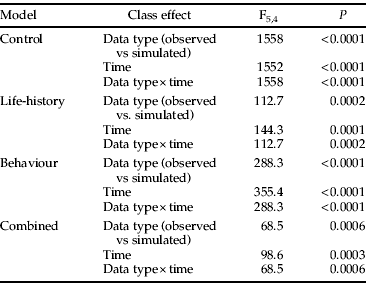
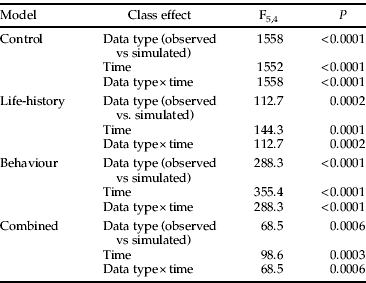
For modelling species exclusion experiments between MED and AII1, we used repeated measures analysis of variance. Congruence between model results and observed data (with proportion of MED as the response) was assessed separately for each model (control, life-history, behaviour, combined), with data type (model or observed), time and their interaction as class effects in the model. Additionally, we used one-way ANOVA and a LSD test to compare the average deviation (absolute values) between observed and simulated data with each model across all generations.
All proportion data were transformed by arcsine square root before the analysis. All statistical analyses were done using the statistical software, STATISTICA (version 6.1) (StatSoft Inc., 2003).
Results
Species exclusion experiments
In the MED+AII1 treatment, the relative abundance of MED increased rapidly in the first three generations, from 13% to 100% by the third generation, i.e. AII1 was completely displaced by MED (fig. 1A). No contamination occurred in the two control treatments of MED and AII1 (fig. 1A). In the meantime, the percentages of females of the two species in the four treatments also experienced some changes. All cohorts of each of the two species used in the start of the treatments had 50% females. In the first generation, percentages of females of MED in both the MED alone and MED+AII1 treatments increased while that of AII1 in the MED+AII1 treatment decreased (fig. 1B; F3, 13=4.01, P<0.05). In the second generation, percentages of females in AII1 in the MED+AII1 treatment declined further although the differences between the four mean values were not significant (fig. 1B; F3, 13=1.11, P=0.39). In the third generation, the percentages of females in MED in both the MED alone and MED+AII1 treatments were significantly higher than that of AII1 in the AII1 alone treatment (F2, 11=8.89, P<0.05).
Behavioural observations
The mean number of copulation events between MED♂ and MED♀ increased significantly when a pair of MED adults were supplemented with males of either MED or AII1, although the increase was more substantial when males of the same species were added than when males of AII1 were added (fig. 2A; F4, 74=12.12, P<0.05). Table 1 shows the behaviour data for the three treatments 1MED♀+1MED♂, 1MED♀+1MED♂+1MED♂ and 1MED♀+1MED♂+1AII1♂. The mean numbers of courtship events between MED♂ and MED♀ increased significantly when a MED male was added (F2, 48=17.72, P<0.05); the mean numbers of uninterrupted courtship events between MED♂ and MED♀ also increased significantly when a MED male was added (F2, 48=8.89, P<0.05). However, the mean numbers of uninterrupted courtship between MED♂ and MED♀ per MED♂ did not differ significantly between the three treatments (F2, 48=1.75, P=0.18); likewise, the mean percentages of events of uninterrupted courtship leading to copulation between MED♂ and MED♀ did not differ significantly (F2, 48=2.21, P=0.12).
The mean numbers of copulation events between AII1♂ and AII1♀ increased when AII1 males were added but decreased when MED males were added (fig. 2B; F4, 64=12.50, P<0.05). Table 2 shows the behaviour data for the three treatments 1AII1♀+1AII1♂, 1AII1♀+1AII1♂+1AII1♂ and 1AII1♀+1AII1♂+1MED♂. The mean number of courtships between AII1♂ and AII1♀ increased significantly when a AII1 male was added (F2, 45=20.64, P<0.05); the mean numbers of uninterrupted courtship events between AII1♂ and AII1♀ also increased when a AII1 male was added (F2, 45=11.93, P<0.05). The mean numbers of uninterrupted courtship between AII1♂ and AII1♀ per AII1♂ did not differ significantly among the three treatments (F2, 45=0.0, P=0.93); however, the mean percentages of uninterrupted courtship events leading to copulation between AII1♂ and AII1♀ declined significantly when either a MED male or a AII1 male was added (F2, 45=6.44, P<0.05).
Comparison of other events in mating interactions between the two species indicates some apparent differences. In particular, the percentage of successful interference of courtships between MED♂ and MED♀ by an AII1 ♂ (16.0) was lower than that (37.1) of successful interference of courtships between AII1♂ and AII1♀ by a MED ♂ (tables 1 and 2). In addition, the percentage of successful interference of courtships between AII1♂ and MED♀ by a MED ♂ (67.3) was higher than that (31.4) of successful interference of courtships between MED♂ and AII1♀ by an AII1 ♂ (tables 1 and 2). These results indicate that MED has a stronger capacity to interfere with courtships of the other species than does AII1.
Effect of mating interactions on fecundity and progeny sex ratio
When a pair of MED ♀+♂ were supplemented with males of either MED or AII1, the mean numbers of adults in the progeny did not change significantly (fig. 2C; F4, 92=1.71, P=0.15), but percentages of females in the progeny increased (fig. 2E; F4, 92=2.46, P<0.05). In contrast, when a pair of AII1 ♀+♂ were supplemented with males of MED, the mean numbers of adults in the progeny, as well as percentages of females in the progeny, decreased significantly (fig. 2D, F4, 116=15.12, P<0.05; fig. 2F, F4, 116=6.61, P<0.05) although the changes were not as clear-cut as for the copulation events, while addition of more males of the same species did not change fecundity or progeny sex ratio.
Modelling species exclusion
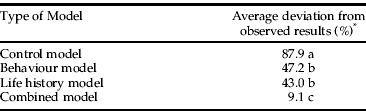
Exclusion of AII1 by MED occurred more rapidly in the population cages than in any of the model simulations (fig. 4, table 4). In simulations with the combined model, the increase of relative abundance of MED followed the trend of the observed data and reached close to 100% in the 4th generation but did not reach 100% until the 6th generation (fig. 4). However, neither the behavioural model nor the life history model simulated the rapid and early increase in the frequency of MED, while the control model predicted exclusion of MED by AII1 (fig. 4). In turn, the average deviation between model results and observed data was significantly lower for the combined model than with the other three models (table 5). Thus, both life-history and behavioural traits appeared to contribute to the rapid exclusion of AII1 by MED.
Results of repeated measures analysis of variance comparing observed with simulated data from four models on the proportion of MED in the mixed population of MED and AII1 during the cage experiments.
Comparison of model predictions with observed results (across all generations) for experiments with MED and AII1.
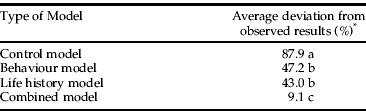
* Percentages followed by different letters differ significantly (ANOVA, F3, 20=18.2, P<0.001).
Discussion
The population cage experiments we conducted demonstrate that MED has the capacity to displace AII1 in a few generations (fig. 1). The behavioural observations show that intensive mating interactions occur between MED and AII1, leading to reduced fecundity and progeny female ratio in AII1, as well as an increase in progeny female ratio in MED (tables 1 and 2, fig. 2). Reduction or increase in female ratio will reduce or increase production of offspring and thus are likely to have population consequences accordingly (Liu et al., Reference Liu, De Barro, Xu, Luan, Zang, Ruan and Wan2007). The modelling of species exclusion indicates that both the asymmetric mating interactions and differences in life history traits between the two species contribute substantially to the process (fig. 4, table 5).
Experiments to investigate competitive interactions between whitefly species on a host plant equally suitable to both species have been conducted for a number species in the B. tabaci complex. Starting with the same (13%) relative abundance as that in the experiment of MED and AII1 here (fig. 1), MEAM1 completely displaced AII1 in six generations (Luan et al., Reference Luan, Xu, Lin, Zalucki and Liu2012) and displaced Asia II 3 (AII3, formally referred to as ‘ZHJ1 biotype’) in nine generations (Liu et al., Reference Liu, De Barro, Xu, Luan, Zang, Ruan and Wan2007). Compared to these case studies, the speed of displacement of AII1 by MED was more rapid. Factors affecting the speed of displacement may be many and warrant future investigations, although behavioural and life-history advantages seen here clearly play a role.
Behavioural observations show that MED exhibits more intensive sexual activities than AII1, in that MED females are more receptive to male courtships and MED males more frequently and efficiently courted females of its own species. In addition, MED males interfere more intensely and successfully with courtships initiated by rival males of the other species than do AII1 males (tables 1 and 2). Similar asymmetric interactions in mating behaviour have been observed between MEAM1 and AII1, between MEAM1 and AII3, between MEAM1 and AN, and between MEAM1 and MED, although details differ among the species pairs (Liu et al., Reference Liu, De Barro, Xu, Luan, Zang, Ruan and Wan2007; Crowder et al., Reference Crowder, Sitvarin and Carrière2010b,Reference Crowder, Sitvarin and Carrièrec; Luan & Liu, Reference Luan and Liuin press). It is interesting to note that while MED is the superior partner in the interactions with AII1 (tables 1 and 2, fig. 4), it is the inferior partner in the interactions with MEAM1 (Crowder et al., Reference Crowder, Horowitz, De Berro, Liu, Showalter, Kontsedalov, Khasdan, Shargal, Liu and Carrière2010a,Reference Crowder, Sitvarin and Carrièreb). Experiments show that this type of asymmetric mating interactions often results in shifts in copulation events and progeny female ratio in opposite directions between the two interacting species (fig. 2: Liu et al., Reference Liu, De Barro, Xu, Luan, Zang, Ruan and Wan2007; Luan & Liu, Reference Luan and Liuin press). Such a consequence may be expected as whiteflies, including all species in the B. tabaci complex, are haplodiploid, so that fertilized eggs give rise to diploid females and unfertilized eggs develop to haploid males (Byrne & Bellows, Reference Byrne and Bellows1991; Ruan et al., Reference Ruan, Luan, Zang and Liu2007). Results of simulation modelling further confirm that such asymmetric mating interactions have consequences at the population level in favouring one of the species in the interactions, although the strength of the effects may vary with species pairs (fig. 4: Crowder et al., Reference Crowder, Horowitz, De Berro, Liu, Showalter, Kontsedalov, Khasdan, Shargal, Liu and Carrière2010a).
The results of simulation modelling indicate that variation in both mating behaviour and life history traits are important determinants in the competitive interactions between MED and AII1 (fig. 4). However, even when both of these factors were considered in the simulation, the rate of increase in relative abundance of MED was still significantly lower than that observed, indicating that some other factors contributed substantially to the interactions (fig. 4). One possible factor may be plant-mediation of the physiological/nutritional interactions between the two species which offered benefits to MED. For example, host plant-mediated interactions between MEAM1 and aphids were shown to have negative or variable effects on the latter species (Nombela et al., Reference Nombela, Garzo, Duque and Muñiz2009; Xue et al., Reference Xue, Wang, Bi, Li and Liu2010). Another factor may be the distributions of two species on different parts of the plant. In the modelling simulations, we assumed that each species has an equal distribution on different leaves of the entire plant. The probability of encounter within and between species could be affected if there were differences in distributions on the plant between the two species (De Barro et al., Reference De Barro and Bourne2010).
Life-history traits would be expected to have an influence on the competition between any two species when the differences are substantial, because these traits contribute directly to reproduction. Reproduction of a given species may vary with host plants. Consequently, when two species co-occur on a plant showing differential levels of suitability to the interacting species, the results of the competition may be altered. For example, experimental studies on the competitive interactions between MEAM1 and AII3 and between MEAM1 and AII1 have been conducted with different host plants, and the results show that the speed of displacement would vary with differential levels of host suitability to the species (Zang et al., Reference Zang, Liu, Liu, Ruan and Wan2005; Luan et al., Reference Luan, Xu, Lin, Zalucki and Liu2012). Of course, as discussed above, the relative levels of suitability to the interacting species may be further complicated by the plant-mediated physiological/nutritional interactions between the species. In the field, the differences in preference towards different host plants by the species would also contribute to the consequences of competitive interactions (De Barro & Bounce, Reference De Barro and Bourne2010).
In summary, by integrating population experiments, behavioural observations and simulation modelling, we found that under laboratory conditions MED had the capacity to displace the indigenous AII1 in a short period of time, and both asymmetric mating interactions and differences in life-history traits between the two species are important determinants in the process of displacement. We were also able to speculate that factors other than those tested here, such as plant-mediated physiological/nutritional interactions between the insect species, may contribute substantially to the interactions. These findings would help our understanding and future investigation on the displacement of AII1, and possibly other indigenous whitefly species by MED in the field.
Acknowledgements
Financial support for this study was provided by the National Basic Research Program of China (2009CB119203), the National Natural Science Foundation of China (31021003, 30730061) and the China Agriculture Research System (CARS-25-B-08).