Introduction
To what extent will an alien invasive aphid primary parasitoid be attacked by native hyperparasitoids when spreading to a new area? Most case studies of aphid parasitoids in new geographical areas have been based on experiences from classical biological control programmes. Poor establishment of primary aphid parasitoids in classical biological control may be due to competition from native parasitoids (Schellhorn et al., Reference Schellhorn, Kuhman, Olson and Ives2002), intraguild predation of aphids and mummies (Ragsdale et al., Reference Ragsdale, Landis, Brodeur, Heimpel and Desneux2011) or hyperparasitism. The effect of hyperparasitoids on the biological control of aphids has been much debated (Brodeur and Rosenheim, Reference Brodeur and Rosenheim2000; Schooler et al., Reference Schooler, De Barro and Ives2011). Most researchers have followed careful quarantine procedures to exclude facultative hyperparasitoids in biological control programmes, while indigenous hyperparasitoids are usually present in the ecosystem and can interfere with the control of aphids by exotic primary parasitoids (Sullivan and Völkl, Reference Sullivan and Völkl1999). However, many field studies of such programmes have shown that primary parasitoids are able to regulate aphid population in spite of high levels of native hyperparasitoids (Farrell and Stufkens, Reference Farrell and Stufkens1990; Hougardy and Mills, Reference Hougardy and Mills2009).
With very few exceptions, Lysiphlebus testaceipes (Cresson) (Hymenoptera: Braconidae: Aphidiinae) is the only primary parasitoid on aphids in vegetable agroecosystems across Benin, with Aphis gossypii Glover (Hemiptera: Aphididae) as a common host (Sæthre et al., Reference Sæthre, Godonou, Hofsvang, Tepa-Yotto and James2011). The parasitoid is native to North America, and is an invasive species that can spread rapidly and expand its host range as has been shown for the Iberian Peninsula (Starý et al., Reference Starý, Lumbierres and Pons2004). The species has spread to many regions of the world either as a result of accident or because it was introduced as a biocontrol agent (Tepa-Yotto, Reference Tepa-Yotto2013). The time and origin for its introduction to Benin is unknown. In Benin, five species of hyperparasitoids have been reported to be reared from aphid mummies (Sæthre et al., Reference Sæthre, Godonou, Hofsvang, Tepa-Yotto and James2011). In the present study, we investigated the aphid–primary parasitoid–hyperparasitoid community on vegetables and weeds at one location in Benin over nearly 2 years, in order to monitor the species of native hyperparasitoids and to what extent they have really adapted to parasitize the invasive primary parasitoid L. testaceipes.
Materials and methods
Aphid mummies were collected from January 2010 to November 2011 in the humid forest zone at Tori, Hla Avamé, South Benin, in the farmers' fields of cucumber (Cucumis sativus L.) (Cucurbitaceae), sweet pepper (Capsicum annuum L.), hot pepper (Capsicum frutescens) and African eggplant (Solanum melongena L.) (Solanaceae) crops, as well as from weeds (Commelina benghalensis L.) (Commelinaceae) growing in the fields. One collection was done from leaves of a tree (Gliricidia sepium (Jacq.) Kunth (Fabales)) (Fabaceae) growing on the field margin as there were no crops or weeds with aphids or mummies present in the field at the time of sampling. At each sampling date, two to three persons collected leaves with aphid mummies for approximately 1 h.
Leaves with mummies were brought to the laboratory and cut into small pieces, in most cases with one mummy on each piece. Mummies already hatched in the field were sorted out. All adult parasitoids emerging from mummies were stored in 70% alcohol. Identification was done by comparing the specimens with a collection of parasitoids recently sampled in vegetable systems across Benin (Sæthre et al., Reference Sæthre, Godonou, Hofsvang, Tepa-Yotto and James2011) and identified at the Natural History Museum of London.
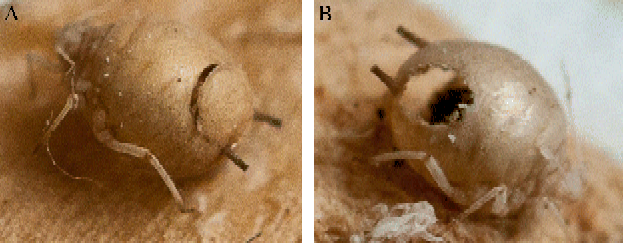
All empty mummies hatched in the field or later in the laboratory were studied under a stereomicroscope. The shape of the exit hole of primary parasitoids is always different from that of the exit hole made by hyperparasitoids, so empty mummies collected in the field were sorted into these two categories. Primary parasitoids (Braconidae: Aphidiinae) always make a circular exit hole with smooth edges, and in most cases, the lid was still present (Fig. 1A). Hyperparasitoids made a saw-edged exit hole with the lid missing (Fig. 1B). Species in the other family of primary parasitoids of aphids, Aphelinidae, also make an irregular exit hole in mummies; however, the mummies of Aphelinidae are black (Starý, Reference Starý, Minks and Harrewijn1988), while the mummies collected in this study were always brown.
(colour online) Empty mummy with an exit hole of (A) the primary parasitoid Lysiphlebus testaceipes and (B) hyperparasitoid (Syrphophagus africanus)
Results
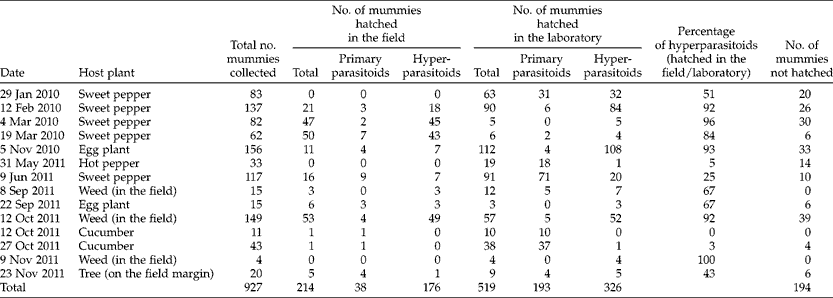
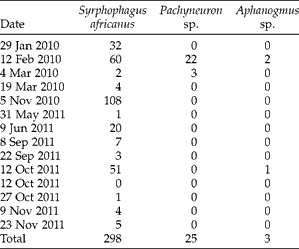
The only aphid species present at Hla Avamé was A. gossypii. The only primary parasitoid species reared from 519 A. gossypii mummies that hatched in the laboratory was L. testaceipes (Table 1). The species of aphid hyperparasitoids that hatched belonged to three species: Syrphophagus africanus (Gahan) (Hymenoptera: Encyrtidae), Pachyneuron sp. (Hymenoptera: Pteromalidae) and Aphanogmus sp. (Hymenoptera: Ceraphronidae) (Tables 1 and 2). Adding the number of mummies hatching in the field had little impact on the percentage of hyperparasitism (Table 1).
Hyperparasitism of mummies collected at Tori, Hla Avamè+

+ Aphid host: Aphis gossypii. All primary parasitoids hatched: Lysiphlebus testaceipes. Identification of primary parasitoids or hyperparasitoids hatched in the field is based on the shape of the exit hole on empty mummies.
Number of species of aphid hyperparasitoids hatched in the laboratory from mummies collected at Tori, Hla Avamè+
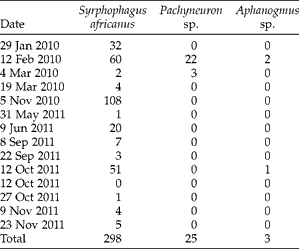
+ Aphid host: Aphis gossypii. Primary parasitoid: Lysiphlebus testaceipes.
Discussion
To our knowledge, with the exception of Sæthre et al. (Reference Sæthre, Godonou, Hofsvang, Tepa-Yotto and James2011), no earlier publications exist on L. testaceipes with reference to hyperparasitoids influencing this parasitoid as an invasive species. Hyperparasitoids on aphids are known in nine different genera in four families of Hymenoptera (Sullivan and Völkl, Reference Sullivan and Völkl1999): Asaphes, Coruna, Euneura and Pachyneuron (Chalcidoidea: Pteromalidae); Dendrocerus (Ceraphronoidea: Megaspilidae); Syrphophagus (Chalcidoidea: Encyrtidae) and Alloxysta, Lytoxysta and Phaenoglyphis (Cynipoidea: Figitidae: Charipinae), respectively. The three genera of Charipinae are endophagous koinobionts that attack live aphids, while the rest are ectophagous idiobionts that oviposit in aphid mummies, except for some species of Syrphophagus that show a dual oviposition behaviour. Koinobiont aphid hyperparasitoids are more specialized with a restricted host range, while idiobionts are generalists with a broader host spectrum (Brodeur, Reference Brodeur, Hochberg and Ives2000; Sanders and van Veen, Reference Sanders and van Veen2010).
Of the 83 species listed in the genus Syrphophagus worldwide (Noyes, Reference Noyes2011), only six species are known to be hyperparasitoids on aphids with Aphidiinae as parasitoid hosts. Of these six, only Syrphophagus aphidivorus (Mayr) in addition to S. africanus has been reported from Africa. Syrphophagus aphidivorus has been found in Egypt, Kenya and Sudan (Noyes, Reference Noyes2011).
The only species of aphid hyperparasitoids in the genus Syrphophagus previously reported from Benin is S. africanus, with distribution from the humid forest zone along the coast to the Sudan Savannah in the north (Sæthre et al., Reference Sæthre, Godonou, Hofsvang, Tepa-Yotto and James2011). According to Noyes (Reference Noyes2011), S. africanus is recorded from Egypt, Kenya, South Africa and Madagascar. It has also been reported on St Helena (John Noyes, personal communication). Little is known about its biology; however, Ganyo et al. (Reference Ganyo, Tounou, Agboton, Dannon, Pittendrigh and Tamò2012) observed that S. africanus could parasitize both living aphids (Aphis craccivora Koch) and aphid mummies (A. craccivora/L. testaceipes), preferring newly formed mummies. This is in accordance with the biology of other Syrphophagus species such as S. aphidivorus (Kanuck and Sullivan, Reference Kanuck and Sullivan1992) and Syrphophagus mamitus (Walker) (Sanders and van Veen, Reference Sanders and van Veen2010).
Sæthre et al. (Reference Sæthre, Godonou, Hofsvang, Tepa-Yotto and James2011) previously recorded an undescribed species, Pachyneuron sp. near muscarum (Linnaeus), from Hla Avamé. The Universal Chalcidoidea Database (Noyes, Reference Noyes2011) includes 26 species of the genus Pachyneuron worldwide. Four species are known to be hyperparasitoids on aphids, and only one of these, Pachyneuron aphidis (Bouché), has been reported from Africa (Libya). Little information exists on the biology of Pachyneuron species (Sullivan and Völkl, Reference Sullivan and Völkl1999).
The third species of aphid hyperparasitoids from Tori, Hla Avamé is probably an undescribed species, Aphanogmus sp. near trasides Polaszek (Table 2), which was previously reported from the same location (Sæthre et al., Reference Sæthre, Godonou, Hofsvang, Tepa-Yotto and James2011). The members of Aphanogmus, in particular of the subgroup to which the species reported from Benin belongs, are commonly hyperparasitoids, attacking braconids or other primary parasitoids (John Noyes, personal communication). To our knowledge, the present study and Sæthre et al. (Reference Sæthre, Godonou, Hofsvang, Tepa-Yotto and James2011) are the first to report on Aphanogmus emerging as a hyperparasitoid of aphids.
Brodeur (Reference Brodeur, Hochberg and Ives2000) compared some published studies on aphid hyperparasitoids, and concluded that Alloxystini (Charipinae) are well represented within native aphid–parasitoid–hyperparasitoid complexes, but almost absent from new, introduced complexes. Our collections of aphid mummies in Benin during 2007–2011 (Sæthre et al., Reference Sæthre, Godonou, Hofsvang, Tepa-Yotto and James2011; this study) show that idiobiont hyperparasitoids were frequent, while the more specific and monophagous hyperparasitoids in Charipinae were not found, suggesting that native koinobiont hyperparasitoids have not yet adapted to this aphid community, probably due to a recent introduction of the primary parasitoid L. testaceipes. Even if L. testaceipes seems to be exposed to a high degree of hyperparasitism during parts of the growing seasons, mostly by the indigenous S. africanus, its dominating presence will be of importance in an integrated pest management strategy in vegetable agroecosystems in Benin.
Acknowledgements
The authors are grateful to the technicians François Onikpo and Franck Mensah for their excellent assistance. The authors also thank the vegetable producer at Hla Avamé who allowed them to work in his fields. This study was funded by the Norwegian Research Council (NRC) through the FRIMUF programme and CGIAR stipend.