Introduction
Frailty is a common and important syndrome that is increasingly prevalent with advancing age. Whilst there is no internationally agreed definition of frailty, there is a consensus that frailty develops as a consequence of a decline in multiple physiological systems, particularly the neuromuscular, neuroendocrine and immunological systems.Reference Walston, Hadley, Ferrucci, Guralnik, Newman, Studenski, Ershler, Harris and Fried1 This decline results in a vulnerability to a sudden change in health status that can be triggered by relatively minor stressor events.Reference Strandberg and Pitkala2 The resulting frailty phenotype includes: weight loss, exhaustion, low energy expenditure, slow gait speed and loss of muscle mass and strength (sarcopenia).Reference Fried, Tangen, Walston, Newman, Hirsch, Gottdiener, Seeman, Tracy, Kop, Burke and McBurnie3 The Fried investigators recorded a frailty prevalence rate of 6.9% in a cohort of 5201 men and women aged 65 years or more, rising to 25.7% in those aged 85 years and over.Reference Fried, Tangen, Walston, Newman, Hirsch, Gottdiener, Seeman, Tracy, Kop, Burke and McBurnie3
Frailty is self-perpetuating; its development results in a spiral of decline that leads to worsening frailty and increased risk of adverse consequences that have substantial health and socioeconomic cost including disability, admission to hospital or long-term care, and death.Reference Fried, Tangen, Walston, Newman, Hirsch, Gottdiener, Seeman, Tracy, Kop, Burke and McBurnie3, Reference Rockwood, Song, MacKnight, Bergman, Hogan, McDowell and Mitnitski4 Any attenuation of the prevalence or severity of frailty is therefore likely to improve the health and well-being of the individual, their families and society.
Sarcopenia, one of the key components of frailty, is a potential target for frailty prevention interventions that incorporate exercise to increase muscle mass and strength. Falls prevention and pulmonary rehabilitation interventions, which include exercise components, have previously been demonstrated to be effective at improving important outcomes and are part of routine care.Reference Gillespie, Robertson, Gillespie, Lamb, Gates, Cumming and Rowe5, Reference Lacasse, Goldstein, Lasserson and Martin6 A proportion of older people who receive these interventions are likely to be frail, but improved outcomes related specifically to frailty are unclear.
A recent systematic review concluded that exercise interventions, particularly those involving strength and balance training, can be successful at improving muscle strength and functional abilities in long-term care residents: a group of older people who are very likely to be frail.Reference Forster, Lambley and Young7 However, the large majority of older people in the UK live at home.8 Exercise interventions for older people living at home can be delivered either individually in their homes, or elsewhere as a group activity. A 2005 Cochrane review concluded that both home-based and group-based exercise interventions are associated with improved outcomes for patients receiving cardiac rehabilitation, but that home-based interventions may be associated with improved adherence.Reference Ashworth, Chad, Harrison, Reeder and Marshall9 In order to explore the available evidence for frail older people, a systematic review was undertaken on the effectiveness of home-based exercise interventions.
Methods
A copy of the full review protocol and search strategy is available on request from the corresponding author. In summary, we searched systematically for all randomized controlled trials (RCTs) and cluster RCTs that evaluated home-based exercise interventions for frail older people. A search strategy was developed for Medline, with appropriate amendments for AMED, CINAHL, Cochrane Library, EMBASE, PSYCHINFO and PedRO, with literature searching to February 2010.
Eligibility criteria
The initial search criteria were deliberately broad and all studies that recruited a cohort of older people (defined for this review as an average age in the study cohort of age 70 years or older) were initially considered for inclusion. The individual study description, selection criteria and reported cohort baseline characteristics were then carefully examined by two independent assessors with expertise in both the assessment of frail older people and frailty indices to determine whether the study populations were frail. Studies were considered as frail only if they selected participants or stratified results using an operationalized definition of frailty or if one or more of the five frailty criteria (weight loss, exhaustion, low energy expenditure, slow gait speed or muscle weakness) were identified.
Studies in which the target population were selected on the basis of the presence of a specific medical condition (e.g. chronic obstructive pulmonary disease, heart failure, cognitive impairment, etc.), and studies conducted in care home facilities, were excluded.
Types of outcomes
Our primary outcome measures for this review were measures of mobility (e.g. the Timed Up and Go TestReference Podsiadlo and Richardson10), health-related quality of life indices (e.g. EuroQol Group 5-Dimension Self-Report Questionnaire (EQ5D)11) and measures of activities of daily living (ADL, e.g. Barthel indexReference Collin, Wade and Davies12). Secondary outcomes measures were muscle strength, balance, depression, bone strength and adverse outcomes including falls and admission to hospital or long-term care.
Types of interventions
For this review, exercise is defined as an activity requiring physical effort that is intended to improve or maintain fitness. Studies in which the intervention included a mix of home-based and group-based exercise were only included if the home-based component formed the greater proportion of the intervention. Entirely group-based exercise interventions were not considered for this review.
The evidence base for falls prevention interventions is already well established and a recent systematic review concluded that the Otago Exercise Programme (OEP), a home-based falls prevention intervention, was effective at reducing falls and mortality.Reference Gillespie, Robertson, Gillespie, Lamb, Gates, Cumming and Rowe5, Reference Thomas, Mackintosh and Halbert13 However, the evidence base from the falls prevention literature is not necessarily generalizable to frail older people. Falls prevention interventions are usually targeted at older people who are living independently or with few restrictions in ADL. Strengthening exercises in falls prevention interventions are often of moderate-to-high intensity and are usually performed standing with weights or thera-bands to provide resistance. Balance exercises incorporate dynamic movement and may be of greater risk for frail older people. Additionally, the majority of falls prevention interventions include a substantial aerobic component that usually comprises moderate intensity walking/cycling/aerobics for 20–30 minutes, 2–3 days a week. Furthermore, the duration of falls prevention exercise sessions are frequently for between 30 and 90 minutes, and this is not necessarily appropriate for frail older people considering the low energy expenditure and fatiguability that characterize frailty. For these reasons, trials in which the intervention had been delivered as the main component of a falls prevention package were also excluded from this systematic review.
Study selection
All titles and abstracts were screened for eligibility by two independent reviewers and any disagreements settled by a third reviewer. Full texts of eligible studies were obtained and reference lists were reviewed for further eligible studies. Two reviewers extracted data using Revman 5.0 software. One reviewer evaluated each study for risk of methodological bias, as outlined in the Cochrane Handbook for Systematic Reviews of Interventions.Reference Higgins, Altman, Higgins and Green14 Studies were assessed for allocation sequence generation, allocation concealment, blinding, completeness of outcome data, selective outcome reporting and other potential sources of bias. For each of these domains a judgement of adequate, partially adequate or inadequate was recorded in order to determine the risk of methodological bias for individual studies. The assessment of bias risk was to inform a sensitivity analysis whereby greatest emphasis was given to the studies that were at lowest risk of methodological bias. Only studies considered to be at low risk of methodological bias would be considered for meta-analysis. If data available precluded meta-analysis then a narrative synthesis was planned.
Results
The review process is summarized in Figure 1 using the PRISMA guidelines.Reference Moher, Liberati, Tetzlaff and Altman15
PRISMA flow diagram

Study characteristics
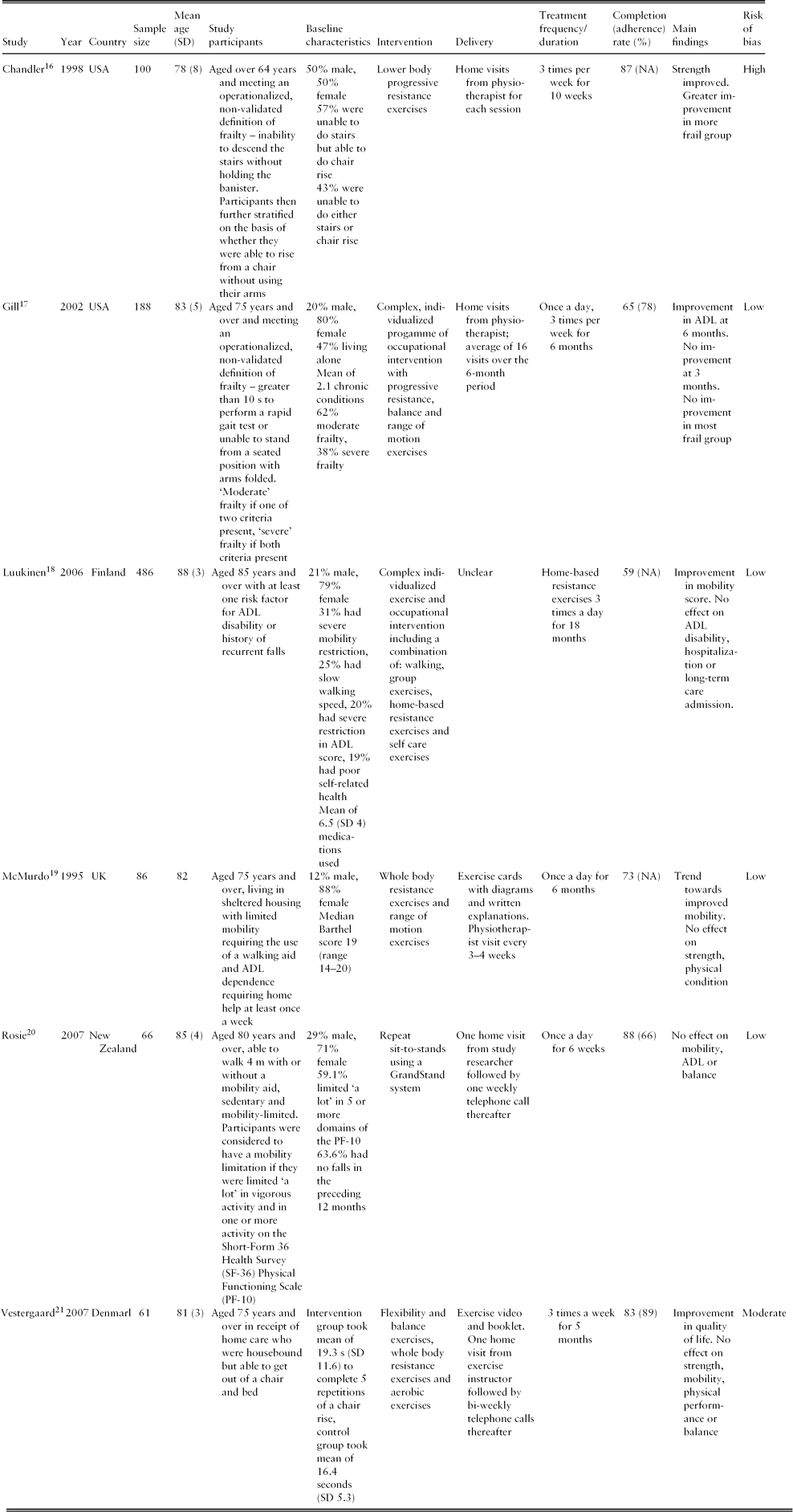
Six RCTs involving 987 participants met the review inclusion criteriaReference Chandler, Duncan, Kochersberger and Studenski16–Reference Vestergaard, Kronborg and Puggaard21 and are summarized in Table 1. The median age was 83 years (range 78–88) and the majority of participants were female (median 79% female, range 50–88%). Three trials were conducted in Western Europe,Reference Luukinen, Lehtola, Jokelainen, Väänänen-Sainio, Lotvonen and Koistinen18, Reference McMurdo and Johnstone19, Reference Vestergaard, Kronborg and Puggaard21 two in the USA,Reference Chandler, Duncan, Kochersberger and Studenski16, Reference Gill, Baker, Gottschalk, Peduzzi, Allore and Byers17 and one in New Zealand.Reference Rosie and Taylor20 A median of 71% (range 8–88%) of older people living at home were eligible for trial inclusion and, of those who were eligible, a median of 75% (range 17–87%) were recruited. The wide range of values reflects the use of different eligibility criteria and different methods of recruitment in the studies.
Summary table of study characteristics, intervention details, main findings and risk of methodological bias
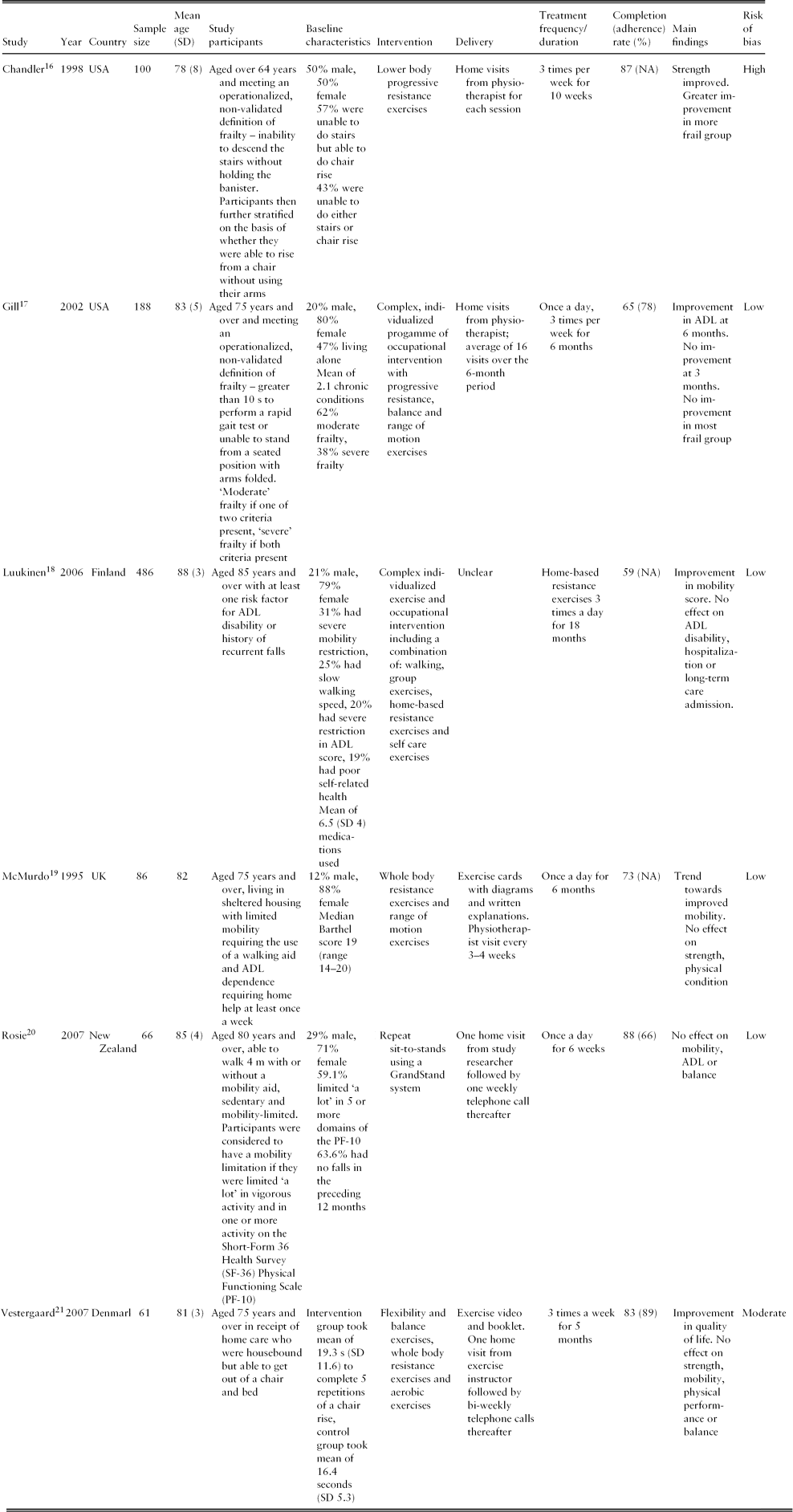
SD, standard deviation; ADL, activities of daily living; NA, not available.
Two trials used an operationalized, non-validated frailty model to select and stratify participants.Reference Chandler, Duncan, Kochersberger and Studenski16, Reference Gill, Baker, Gottschalk, Peduzzi, Allore and Byers17 Four trials did not use an operationalized frailty model to select participants but reported inclusion criteria or baseline characteristics that identified slow walking speedReference Luukinen, Lehtola, Jokelainen, Väänänen-Sainio, Lotvonen and Koistinen18, Reference McMurdo and Johnstone19, Reference Vestergaard, Kronborg and Puggaard21 or physical exhaustionReference Rosie and Taylor20 and were therefore considered by consensus to be frail. All trials assessed participants at the end of the intervention. Median duration of follow-up was 6 months (range 6 weeks to 18 months). Two studies included follow-up of 12 months or more.Reference Gill, Baker, Gottschalk, Peduzzi, Allore and Byers17, Reference Luukinen, Lehtola, Jokelainen, Väänänen-Sainio, Lotvonen and Koistinen18
Methodological quality and study power
Four trials were assessed as low risk of methodological bias,Reference Gill, Baker, Gottschalk, Peduzzi, Allore and Byers17–Reference Rosie and Taylor20 one at moderate riskReference Vestergaard, Kronborg and Puggaard21 and one at high risk of bias.Reference Chandler, Duncan, Kochersberger and Studenski16 Although the majority of trials were single (assessor) blind, one was unblinded.Reference Vestergaard, Kronborg and Puggaard21 Methods of randomization were generally well described but an adequate description of the method of allocation concealment was provided in only two studies.Reference McMurdo and Johnstone19, Reference Rosie and Taylor20 Only three trials performed an a priori power calculation.Reference Luukinen, Lehtola, Jokelainen, Väänänen-Sainio, Lotvonen and Koistinen18–Reference Rosie and Taylor20 Three of the trails recruited less than 100 subjects; only two recruited more than 200 subjects.
Exercise interventions, completion and adherence
One intervention included a single component of progressive resistance exercise.Reference Chandler, Duncan, Kochersberger and Studenski16 Two combined progressive resistance exercises with one or more additional components of balance, walking or range of motion exercises.Reference McMurdo and Johnstone19, Reference Vestergaard, Kronborg and Puggaard21 Two interventions were complex interventions combining multiple exercise components with an occupational intervention.Reference Gill, Baker, Gottschalk, Peduzzi, Allore and Byers17, Reference Luukinen, Lehtola, Jokelainen, Väänänen-Sainio, Lotvonen and Koistinen18 One study used an electronic device that counted the number of sit-to-stands (GrandStand™ system).Reference Rosie and Taylor20
Modal treatment frequency was three times per week (range 3–21 sessions per week). Modal treatment duration was 6 months (mean 28 weeks, range 6 weeks to 18 months).
Information regarding the percentage of participants who completed the exercise intervention through to follow-up was available in all six studies. Completion rates were generally high (median 83%, range 65–88%); interventions of shorter duration generally recorded higher completion rates. Rates of adherence to the exercise intervention, measured as the number of individual exercise sessions undertaken as a proportion of the total possible, were recorded in three studies.Reference Gill, Baker, Gottschalk, Peduzzi, Allore and Byers17, Reference Rosie and Taylor20, Reference Vestergaard, Kronborg and Puggaard21 Various methods were used to define acceptable adherence and rates were generally high (median 78%, range 66–89%).
Analysis of primary outcome data
Meta-analysis of primary outcome data from the studies at low risk of methodological bias was precluded by the absence of consistent reporting of data required for calculation and pooling of standardized mean differences (SMDs) for these continuous outcomes. Therefore, a narrative synthesis of the available evidence from all studies is provided that describes the direction and size of effect, its consistency across studies and the overall strength of the evidence. A narrative description of the evidence from the studies at low risk of methodological bias is also provided.
Effects on mobility
Four trials reported an outcome measure relating to mobility, using various measures of gait speed.Reference Luukinen, Lehtola, Jokelainen, Väänänen-Sainio, Lotvonen and Koistinen18–Reference Vestergaard, Kronborg and Puggaard21 Improved gait speed was reported in one trial,Reference Luukinen, Lehtola, Jokelainen, Väänänen-Sainio, Lotvonen and Koistinen18 a trend towards improved gait speed was reported in one further trial,Reference McMurdo and Johnstone19 and gait speed did not improve in two.Reference Rosie and Taylor20, Reference Vestergaard, Kronborg and Puggaard21
Effects of health-related quality of life
One trial reported an improvement in quality of life, measured using the EQ5D.Reference Vestergaard, Kronborg and Puggaard21 The other trials did not record quality of life measurements.
Effects on activities of daily living
Measures of activities of daily living (ADL) were reported in four trials.Reference Gill, Baker, Gottschalk, Peduzzi, Allore and Byers17–Reference Rosie and Taylor20 Improvements in ADL were reported in one trial;Reference Gill, Baker, Gottschalk, Peduzzi, Allore and Byers17 no improvements in ADL were reported in the other three trials.Reference Luukinen, Lehtola, Jokelainen, Väänänen-Sainio, Lotvonen and Koistinen18–Reference Rosie and Taylor20
Analysis of secondary outcome data
Meta-analysis of long-term care admission data was possible, using dichotomous data from two trials at low risk of methodological bias.Reference Gill, Baker, Gottschalk, Peduzzi, Allore and Byers17, Reference Luukinen, Lehtola, Jokelainen, Väänänen-Sainio, Lotvonen and Koistinen18 These data were pooled for meta-analysis using random effects Mantel-Haenszel modelling (Revman 5.0 software) and are presented as risk ratios in a forest plot (Figure 2). A non-significant trend towards reduced long-term care admission is observed (pooled risk ratio, 0.89; 95% confidence interval, 0.55–1.45).
Forest plot presenting individual and pooled risk of long-term care admission from two trials at low risk of methodological bias

It was not possible to pool continuous outcome data for the other secondary outcomes due to the data limitations described above and a narrative synthesis is presented. Three trials measured muscle strength using upper and lower body strengthReference Chandler, Duncan, Kochersberger and Studenski16, Reference Vestergaard, Kronborg and Puggaard21 or grip strength.Reference McMurdo and Johnstone19 One trial reported improved lower body strength.Reference Chandler, Duncan, Kochersberger and Studenski16 There was no improvement in either upper or lower body strength in one trial.Reference Vestergaard, Kronborg and Puggaard21 No improvement in grip strength was recorded in the study that measured this outcome.Reference McMurdo and Johnstone19 No improvement in general physical performance was reported in one trial.Reference Vestergaard, Kronborg and Puggaard21 Improved balance was reported in one trialReference Luukinen, Lehtola, Jokelainen, Väänänen-Sainio, Lotvonen and Koistinen18 but there was no effect on balance in three trials.Reference McMurdo and Johnstone19–Reference Vestergaard, Kronborg and Puggaard21 There was no effect on depression,Reference Luukinen, Lehtola, Jokelainen, Väänänen-Sainio, Lotvonen and Koistinen18 bone density or flexibility.Reference McMurdo and Johnstone19 Hospitalization rates were not reported in any trials.
Adverse outcomes
Between-group differences in adverse outcomes were reported in only two trials.Reference Gill, Baker, Gottschalk, Peduzzi, Allore and Byers17, Reference Luukinen, Lehtola, Jokelainen, Väänänen-Sainio, Lotvonen and Koistinen18 Increased angina diagnoses were recorded in one trialReference Gill, Baker, Gottschalk, Peduzzi, Allore and Byers17 but no differences in fractures, musculoskeletal pain or death were reported.Reference Gill, Baker, Gottschalk, Peduzzi, Allore and Byers17, Reference Luukinen, Lehtola, Jokelainen, Väänänen-Sainio, Lotvonen and Koistinen18
Trials at low risk of methodological bias
There were four high-quality trials at low risk of methodological bias.Reference Gill, Baker, Gottschalk, Peduzzi, Allore and Byers17–Reference Rosie and Taylor20 One trial selected and stratified participants using an operationalized, but non-validated, measure of frailty.Reference Gill, Baker, Gottschalk, Peduzzi, Allore and Byers17 Participants were considered for inclusion and defined as being frail if they took >10 s to walk 3 m, or if they were unable to stand from seated with both arms folded. Participants with one of the two criteria were defined as being moderately frail; participants with both criteria were defined as severely frail. This relatively large trial (n = 188) investigated the effects of a 6-month complex individualized exercise and occupational intervention and reported an improvement in disability score at 7 months for people with moderate frailty.Reference Gill, Baker, Gottschalk, Peduzzi, Allore and Byers17 This improvement was maintained at 12 months follow-up. There was no effect for people with severe frailty.
Although the other three trials at low risk of methodological bias recruited frail older people they did not use an operationalized measure of frailty to stratify results. One large trial (n = 486) that investigated a complex individualized exercise intervention reported improved mobility and balance but no effect on ADL.Reference Luukinen, Lehtola, Jokelainen, Väänänen-Sainio, Lotvonen and Koistinen18 One smaller trial (n = 86) of a 6-month intervention in a cohort living in sheltered housing reported a trend towards improved mobility but no effect on ADL, grip strength or balance.Reference McMurdo and Johnstone19 One small trial (n = 66) of a 6-week intervention reported no effects on mobility, ADL, grip strength or balance.Reference Rosie and Taylor20
None of the four high-quality trials reported overall effects on the quality of life of participants.
Discussion
This systematic review summarizes the evidence from research trials that recruited 987 participants. Strengths of the review include a robust search strategy and rigorous review procedures that included a detailed assessment of risk of methodological bias using well-recognized methods. A potential weakness of the review is that, although a consensus decision was reached regarding whether individual trials included frail older people on the basis of the frailty phenotype, only one high-quality trial both selected participants and stratified results using an operationalized measure of frailty.
Included trials were generally of high methodological quality. However, individual sample sizes were frequently small and a priori power calculations were not routinely completed, giving rise to the possibility of Type II statistical error due to small sample size. Limitations of data analysis and reporting precluded meta-analysis of primary outcome data, which could otherwise have pooled statistical power. Guidelines for developing RCTs aimed at preventing functional decline and disability in frail older people are availableReference Ferrucci, Guralnik, Studenski, Fried, Cutler and Walston22 and reference to these guidelines will help in the development of future RCTs. Standardization of outcome measures and reporting will further aid the future synthesis of evidence for meta-analysis.
One high-quality trial used an operationalized, non-validated measure of frailty to both select and stratify participants. This trial reported an improved disability score in people with moderate frailty and this was maintained at 12 months. No improvement was reported for people with severe frailty. Other higher quality trials reported inconsistent effects on mobility and disability. None of the four high-quality trials reported effects on quality of life.
Meta-analysis of data from two trials at low risk of methodological bias demonstrated a non-significant trend towards reduced long-term care admission. The relatively low rates of long-term care admission in these two trials and wide confidence intervals identify a requirement for future long-term trials that are adequately powered to detect a significant difference in this important outcome.
Generally high rates of completion and exercise adherence suggest that home-based exercise interventions are acceptable and feasible for frail older people. This supports the similar finding from the earlier systematic review of exercise interventions for older people living in care homes which also identified high rates of intervention completion and adherence.Reference Forster, Lambley and Young7
Conclusion
There is preliminary evidence from one high-quality trial that selected and stratified participants using an operationalized measure of frailty to suggest that home-based exercise interventions may be effective at improving disability in community-dwelling older people with moderate, but not severe, frailty. Operationalized measures of frailty were not used to stratify participants in the other high-quality trials and inconsistent effects of exercise interventions on outcomes including mobility and disability were reported. There is significant uncertainty regarding the effects of home-based exercise interventions on important outcomes including quality of life and long-term care admission for the frail elderly.
Home-based exercises are a potentially simple, safe and widely applicable intervention to prevent dependency decline for frail older people. Adequately powered RCTs that use validated measures to select and stratify frail older people, and that incorporate long-term follow-up of important outcome measures including mobility, disability, quality of life and long-term care admission, will help address the uncertainties that we have identified in this review.
Contributors
All authors were involved in development of the search strategy and systematic review protocol. A.C. and S.B. independently selected studies for inclusion and A.F. resolved any disagreements. A.C. and J.Y. identified trials that included frail older people. A.C. and S.B. extracted data from the included trials and A.C. assessed trials for methodological bias. All authors wrote the article and all authors have approved the final version. A.C. is guarantor for the article.
Funding
There were no external sources of funding for this review.
Conflicts of interest
A.C. is principal investigator (PI) for the Home-based Older People's Exercise (HOPE) trial, a pilot randomized controlled trial to investigate the effects of an exercise intervention for frail older people, funded by the Dunhill Medical Trust; J.Y. is head of the Academic Unit of Elderly Care and Rehabilitation, University of Leeds, which is the host institution for the HOPE trial. S.B., A.F. and S.I. declare that they have no conflicts of interest.
The lead author is supported by a Dunhill Medical Trust Research Fellowship, which is gratefully acknowledged. We would also like to thank Rosemary Campbell-Blair from the University of Leeds library for her help in developing the search strategy.