In the summer of 2014, Teju Cole left his home in New York and travelled to Switzerland, the recipient of a residential fellowship from Literaturhaus Zürich. His residency came with a stipend, an apartment facing the distant mountains in a quiet part of the city, and the requirement that he reside in Switzerland for the better part of six months – though not necessarily in Zurich. Cole anticipated an opportunity for sustained absorption in his manuscript-in-progress, a nonfictional work about Lagos, where he grew up: “where better to write about chaotic, relentless, overpopulated Lagos than in modest, quietly industrious Zürich?”Footnote 1 But what followed was a period less of writing than of mesmerized wandering and photography, through a country Cole evokes as “more different than others,” travelling by every available mode of public transport from the funicular to the ferry, with an old Yashica camera in his hands.Footnote 2
It was the first of many visits to Switzerland in the ensuing years, the cumulative result of which is Fernweh, a visual travelogue that takes the form of a lush photobook shaped like old ski advertisements, whose red silkscreened covering and striking white spaces collectively evoke the Swiss flag. “Fernweh,” Cole has explained, is a German word that describes “a longing to be away from home, a desire to be in faraway places”; its antonym is “Heimweh,” or homesickness.Footnote 3 Both words connote an intensity of feeling tinged with melancholy; “Fernweh” is related to but different from “Wanderlust.” For Cole, Switzerland evokes this particular kind of “awayness,” a feeling he refers to in a 2015 New York Times article as “the estrangement that one could count on.”Footnote 4Fernweh, a meticulously curated sequence of photographs of Switzerland interspersed with fragments of text adapted from Baedeker's Switzerland: Handbook for Travelers (Coblenz, 1872), is a meditation on the idea of longed-for estrangement and the contingent desire to be in an indeterminate faraway place. Reflecting on the photographs in a short afterword to the book, Cole recalls a quotation sometimes attributed to Paul Eluard (sometimes to Rilke, sometimes to Yeats): “There is another world, but it is in this one.” Switzerland, for Cole, is at once a “familiar world of politics and history and human confusion, a world that contains well-hidden poverty and less well-hidden racism. But it is also a magical world, a world within a world … a long poem in an endangered language.”Footnote 5 Cole's Switzerland both is and isn't the portable Switzerland of Baedeker, John Ruskin, William England, Vittorio Sella, or the millions of picture postcards that since the nineteenth century have brought Alpine scenery and turquoise mountain lakes into a global consciousness. The sweeping valleys “encircled by granite, hornblende, and serpentine” are certainly present in Fernweh; so are the distant peaks, the glaciers, the glassy lakes, and the billowing cloud obscuring ethereal crags. “To photograph Switzerland is to rephotograph it,” Cole writes. But something has shifted:
in remaking the photographic image from a contemporary territory … the image has been corrupted by knowledge. Its eyes are open. It knows about photography and postcards and maps and posters. This knowledge is not antic or self-conscious. It manifests, instead, as an unsettling mixture of serenity and melancholy.Footnote 6
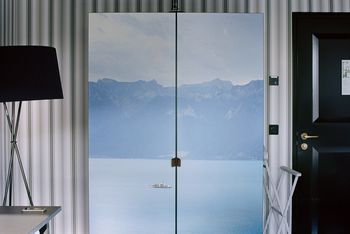
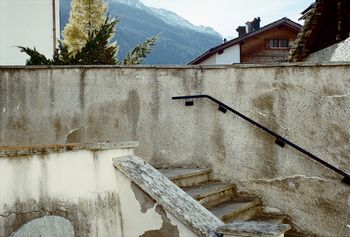
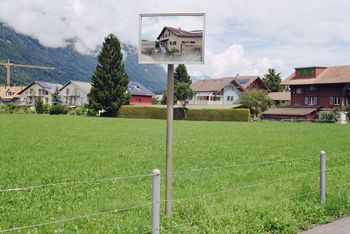
Fernweh seems interested in Swiss terrain primarily insofar as it interacts with what Cole calls “the visual melody of infrastructure.”Footnote 7 Far more prominent than majestic topography in Fernweh are photographs (usually captured in bright summer light and sometimes only featuring stunning landscapes as so much background scenery) that speak to the serene, melancholic loveliness of modernity and human mundanity – albeit, with rare exceptions, strikingly devoid of people. A bend in a road, someone's garden, a map, assorted staircases, assorted empty seats and benches, a tram embellished with an advertisement for Swiss chocolates, fence posts against a green field, a woman on a ferry, the image of an Alpine scene adorning a wardrobe in a hotel bedroom, girls playing lacrosse, a basketball hoop, a wig shop, some unremarkable graffiti on a town wall, a group of discarded cardboard boxes, a parking garage, a string of fairy lights, laundry drying on a line on a windy day. “I let go of the self-imposed pressure to create spectacular images,” Cole told Sunil Shah in a recent interview.Footnote 8 Beyond the mountains, he realized, “lay smaller quarry, ordinary land, cityscapes, interiors … The Alps were the door, but what lay beyond, or below?”Footnote 9 The images he offers are quiet, insisting that modernity is not synonymous with noise. They are enigmatic but tender; “monumental on a tiny scale,” to borrow from John Ashbery, they evoke Eluard's world within a world just as they recall Joseph Cornell's magical hexahedrons.Footnote 10
In the connections Cole draws between Switzerland as previously photographed and his own quietly idiosyncratic images, the country exists both in and out of time. As Cole puts it, “Switzerland is in-between but not average, a periphery in a central location, in this world but not of it.”Footnote 11 Switzerland as we think we know it is there, in Fernweh, but also not there; or, at least, it has been repositioned, reoriented. “Switzerland is mountains,” Cole acknowledges, but he notes that “a lot of travel photography relies on an easy essentialism,” and it is this that Fernweh resists in favour of looking again and again at “the less-obvious differences of texture: the signs, the markings, the assemblages, the things hiding in plain sight in each cityscape or landscape.”Footnote 12 The effect feels quietly radical. In paying attention to what he calls “the necessarily shifting and politically-charged nature of what the ‘ordinary’ is”Footnote 13 – in seeing, and asking others to see, the ordinary in the context of the monomythic spectacular – Cole reconfigures the myth of Switzerland, estranging it from its past, to paraphrase James Baldwin, reimagining its image as he finds new ways to think about and reveal a country that has been visited and photographed for two centuries. Switzerland, in Fernweh, feels like a stranger in its own country.
An early press release about Fernweh made reference to Baldwin's 1953 essay “Stranger in the Village,” published first in Harper's Magazine, and two years later in his seminal collection of essays, Notes of a Native Son. In the essay, Baldwin contemplates white supremacy and American racism, taking as his point of departure his experiences visiting, on several occasions during the early 1950s, the Swiss mountain village of Leukerbad, beginning with a disquieting depiction of his encounters with people in a village where “from all available evidence no black man had ever set foot.”Footnote 14 The villagers fixate on Baldwin's physical characteristics with astonishment and fear, touching his hair and skin as if he “were nothing less than miraculous-or-infernal”: “in all of this,” Baldwin writes, “in which it must be conceded there was the charm of genuine wonder and in which there were certainly no elements of intentional unkindness, there was yet no suggestion that I was human: I was simply a living wonder.”Footnote 15 Baldwin compares his experiences with those of “white men arriving for the first time in an African village, strangers there,” as he was a stranger in Leukerbad, but notes that “the white man takes the astonishment as tribute … whereas I … find myself among a people whose culture controls me … who yet do not even know of my existence.”Footnote 16 He laments his disesteem among the villagers; his status as a stranger in their village is emblematic of the anger he expresses in the essay at what he feels is the ineluctable alienation of black people in the context of European culture. Unlike himself, Baldwin argues, the villagers “cannot be, from the point of view of power, strangers anywhere in the world; they have made the modern world, in effect, even if they do not know it.”Footnote 17
Cole visited Leukerbad in August 2014, during his Literaturhaus fellowship, on what would have been Baldwin's ninetieth birthday, taking his camera and tripod with him, and writing his own meditation on Baldwin, white supremacy, and American racism for the New Yorker.Footnote 18 In its articulation of an imprecise desire to be far away; in its quiet refusal to convey astonishment at the Alps; in Cole's refusal to identify as an interloper, expressed via the steady assurance of his multivalent gaze, Fernweh can be read in subtle dialogue with “Stranger in the Village.” Baldwin notes in the essay that “the root function of language is to control the universe by describing it.”Footnote 19 Cole's language, in Fernweh, is photography, a schematic visual approximation of the microscopic exactitude with which Baedeker's Switzerland accounts for the country. In fragmenting the text of the nineteenth-century guidebook and placing lines from it at uneven intervals in among the photographs throughout the book, Cole forces it to relinquish control over the world it describes so meticulously. By rendering its fragments in the form of erasure poetry, in lines that both are and aren't captions, he reintegrates the opaque and sometimes eccentric scenes his photographs convey into an uneasy framework of meaning: a green metal pole wrapped in a white tarpaulin set against a blue sky and two iron-grey peaks is refigured by its seeming description: “to the memory of a man killed by lighting”; a chain of fairy lights and two trees against a darkening sky evoke “the horrors of seasickness.” Each image is a part of a sequence, but sometimes the part it plays in the sequence is to disrupt it, just as the quasi-captions lacing the book simultaneously illuminate and obscure the images they do and do not describe.
Teju Cole, image from Fernweh. Courtesy of the artist and MACK.

Fernweh is invested in this kind of storytelling: storytelling that rejects the monolithic; storytelling in which other worlds are possible, as well as likely or unlikely connections between worlds (Lagos, New York, Zurich); storytelling in which the limits and limitations of language and imagery are never in question. In remaking modern Switzerland through his photographic and collaged “description” of the country, Cole brings under control the universe that Baldwin railed at with such eloquence and insight. “People who shut their eyes to reality simply invite their own destruction,” Baldwin writes in “Stranger in the Village.”Footnote 20 Departing from Baldwin's self-abnegation and fury, Cole's photobook demystifies mythical Switzerland, serenely revealing the “reality” behind it to be mundane, neither ugly nor beautiful, and somehow universal, essentialist after all. In a recent blog post entitled “In Praise of the Photobook,” Cole muses on the particular experience that time spent with a photobook affords, and Fernweh is no exception: “sitting with it, you have to sit with yourself.”Footnote 21
Teju Cole, image from Fernweh. Courtesy of the artist and MACK.

Partly, this is because almost no one else is present. Hiking on the Gemmipass near Leukerbad (where a fatal plunge narrowly averted by the outstretched hand of his lover led Baldwin to the title of his first novel, Go Tell It on the Mountain), Cole reflects wryly on Baldwin's essay, writing, “not only am I the only black man on the pass just now, I am the only human being of any kind.”Footnote 22Fernweh is characterized by its pervasive absence of people, their presence in Cole's Switzerland suggested rather by their vestiges, their remnants – the result is that everyone is a stranger, and no one. The effect is at once unsettling and tranquil, reminiscent of a moment in Emily St. John Mandel's post-apocalyptic novel Station Eleven:
The beauty of this world where almost everyone was gone. If hell is other people, what is a world with almost no people in it? Perhaps soon humanity would simply flicker out, but Kirsten found this thought more peaceful than sad.Footnote 23
Teju Cole, image from Fernweh. Courtesy of the artist and MACK.

Echoing this “Fernweh” for the end of humanity, Cole quotes his friend M in his afterword, who writes to him having looked at some of the photographs he has sent her in the process of compiling the book: “I keep thinking about the world made by us and without us … I can't help but feel the intimation of – not ruin – but a kind of disappearance. Not tragic, just so.”Footnote 24