I. The Culture of Dō (〔 道 〕 ‘Way’)
In Japan, there are many kinds of dōs. The term has diverse and profound meanings, making it a challenge to define. Simply speaking, dō is a way for people to train the spirit by following specific practices, with the purpose of mastering life. Prominent examples of dōs include chadō / sadō Footnote 2 (〔 茶 道 〕 so-called “tea ceremony”), kadō (〔 華 道 〕 so-called “flower arrangement”), shodō (calligraphy), and bushidō (the ethical code of the samurai). There are also sport practices such as jūdō (judo), kendō (kendo) and aikidō (aikido), all of which are also connected with the culture of dō.
The Japanese art of kōdō (〔 香 道 〕 literally ‘incense dō’, or ‘the way of incense’)Footnote 3 focuses on the sense of smell. It means the ritual appreciation of fragrances that is practised together by following specific performance schemes. Kōdō was created in the latter part of the Muromachi period (1336–1573), along with chadō, which concentrated on taste, and kadō, which focused on sight. The materials and methods as such of appreciating these, concerning both kōdō and chadō, were not native to Japan, but were instead imported or adopted from abroad. In order to become kōdō, these practices of appreciating aromatic materials were refined in Japan from the Heian period (794–1185) on along with the local poetic arts, and as part of aristocratic life. This paper focuses on the interrelations of kōdō with Japanese literature including its spiritual and game character by tracing the history from its precursors up to current practices of appreciating incense in modern ritual settings.
II. Historical Development of Kōdō
1. The age of konkō ([混 香] potpourri of chopped dried aromatics)
Kō (〔 香 〕 general term for ‘ [the various kinds of mixed and/or individual] incense [material(s)] ’ as well as ‘fragrance [i.e. the olfactory phenomenon] ’) most probably arrived in Japan via the Korean peninsula in the middle of the sixth century.Footnote 4 The incense meant a special mixture product, konkō. It consisted of materials such as jinkō (〔 沈 香 〕 agarwood),Footnote 5 sandalwood, cloves, turmeric, and musk. Jinkō was especially important, meaning the resin-impregnated wood of Aquilaria trees. Interestingly, non-resinous wood of Aquilaria trees is lighter than water, and it has almost no aromatic quality. In contrast, highly resin-impregnated jinkō is heavier than water. Hence the latter was given the name jin sui kō (〔 沈 水 香 〕 ‘sinking in water incense’), usually simply abbreviated as jinkō 〔 沈 香 〕.
At that time the aromatics were used in the form of funkō (〔 焚 香 〕 ‘incense to be put on glowing charcoal’), meaning that the aromatic wood was actually burned. The purpose of funkō was to dedicate the scent to Buddha and the various Buddhist and Shintoist deities.
It is believed that at the same time as funkō arrived in Japan, another kind of perfume product called zukō (〔 塗 香 〕 ‘perfume to be painted’ on a surface) was also imported. The materials of zukō and funkō were similar. However, zukō was prepared as a fine powder, while the materials used for funkō were only chopped. Even more important were their different uses. While funkō presented a kind of incense, the powdery zukō was simply strewn over the hands and the body.Footnote 6
Sankō (〔 撒 香 〕 ‘perfume to distribute fragrance’ in the surrounding air) was employed at the same time as funkō. In contrast to the latter however, that was used in incense offerings on the altar in dedication for Buddha and the deities, sankō was placed in a censer with a handle so that it could be taken around and the air could be well-perfumed. Such a handle censer of that time is kept in the Shōsōin (〔 正 倉 院 〕 the National Treasure House in Nara). Exemplary usages are portrayed in the Nihon shoki 〔日 本 書 紀 〕. The Minister Soga no Emishi 〔 蘇 我 大 臣 蝦 夷 〕 used the handle censer in the Buddhist ceremony in the year 642, when he offered Buddha the aromatic good.Footnote 7 This report confirms that a non-clerical used the censer in order to create fragrance.
Another example of an emerging use of aromatics beyond a mere religious context can be found in the case of Prince Ōtomo 〔大友皇子〕. For introducing his new reign in the year 671, he gathered five elder statesmen. The prince took the handle censer and his vow of obedience to Buddha and the deities before the five statesmen took over the censer and pledged loyalty to Prince Ōtomo. The fragrance was intended to unify the collective spirit and mind of all participants and thus to strengthen the new rule.Footnote 8
2. Renkō (〔煉香〕 kneaded incense blends) and the culture of takimono (〔薫物〕 the products and culture of performing their fragrance for purposes of delight)
The production of renkō Footnote 9 (kneaded incense blends, also known as ‘balls of blended incense’)Footnote 10 dates back to the Tang dynasty of seventh to eighth century China.Footnote 11 A powder made of jinkō, cloves, shell opercula, sandalwood, musk, turmeric, and other aromatics, was solidified with amazura (〔甘葛〕, an ancient Japanese sweetener), honey and other ingredients.Footnote 12 It is widely acknowledged that the famous monk Ganjin 〔鑑真〕 (688–763) introduced renkō in Japan.Footnote 13
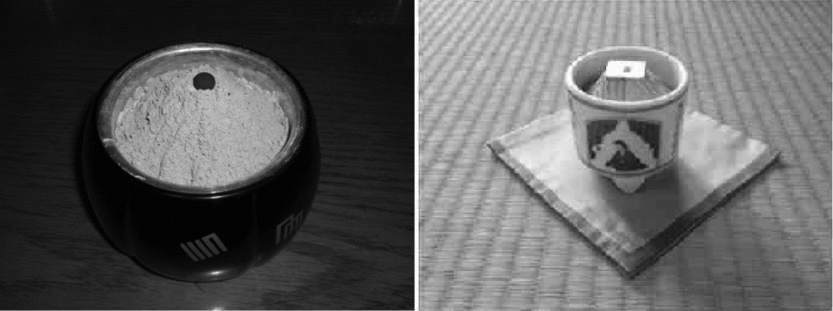
With the development of renkō, Japanese perfumery changed. Concerning the kind of products, the carved aromatic objects of earlier times had led – via the step of refined powdery perfumes – to the more difficult to be produced solid perfumery goods. Moreover, the method of creating fragrances had changed by that time. The incense was not put directly on the glowing charcoal in the kōro (〔香炉〕 a standing censer) anymore. Instead it was often protected from the fire by an ash layer in between, so that it was only warmed without being actually burned (Fig. 1). In this way it became possible to make primarily the essential oils included in the aromatic materials evaporate, and consequently to create a fragrance with only few undesirable incidental notes otherwise caused by the material's incineration.
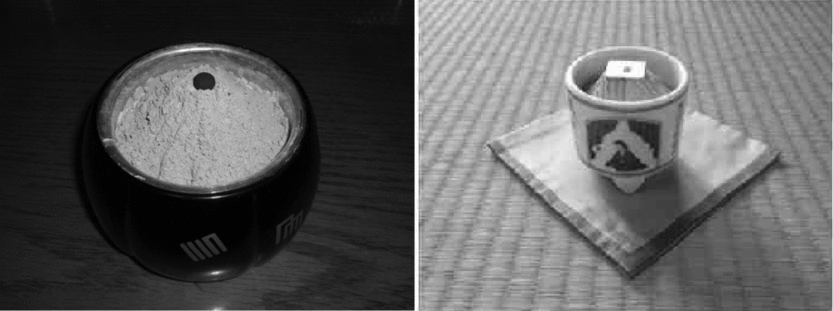
Prepared censers for appreciating fragrances.
Fig. 1 Hitorigōro 〔火取香炉〕 including a kōro (〔香炉〕 censer), with an ash (〔灰〕 hai) layer between the glowing charcoal and the incense on top).
The hitorigōro was originally used for the incensation of renkō products. Nowadays it serves to keep burning charcoal.
Fig. 2. Kikigōro (〔聞香炉〕, also pronounced monkōro) including a kōro, hai, ginyō (〔銀葉〕 silver plate), and a piece of jinkō.
The monkōro is nowadays used for monkō.
In addition, the purpose of making use of perfumes took on a new character. Perfumes that had before been used as a dedication to Buddha and the deities, or to purify the persons who served those, were used increasingly by aristocrats for pleasure. In other words, perfumes started to be used for more generic purposes.Footnote 14 Aristocrats in the Heian period gradually called renkō (the kneaded incense blends) takimono (〔薫物〕 ‘to perform fragrance’), and used it to perfume rooms or the air (a practice called soradakimono 〔空薫物〕) or else wafted it over their clothes (called oikaze 〔追風〕, literally ‘tailwind’). Following these practices, the term “takimono” no longer only referred to the perfume material as such, but became connected with these usages.
The more takimono established itself in Japan, the more the people acquired perfumery expertise, since they had to learn about the qualities and properties of aromatic materials in order to produce the necessary goods. The selection and the mixing ratio of ingredients were varied in producing renkō, and so the products could become more diverse; people were able to create goods of new olfactory character.Footnote 15
In addition to the technical improvements, perfumery became increasingly connected with poetics. Names such as “梅花 (baika, Japanese plum blossoms)”, “荷葉 (kayō, lotus leaf)”, “落葉 (rakuyō, fall foliage)”, “侍従 (jijū, chamberlain), “菊花 (kikka, chrysanthemum flower)”, and “黒方 (kurobō, ancient method of blending perfumes)” were attributed to the different products.Footnote 16
3. The popularisation of ichibokudaki (〔一木炷〕 the exclusive use of one kind of wood in incensation)
3.1. The historical development of ichibokudaki
By the twelfth century the use of blended incense mixtures was no longer universally employed in Chinese perfume and incense making. Rather, one kind of wood instead of aromatic blends was actively pursued in incense preparation – a practice called ichibokudaki.Footnote 17 Moreover, China invented a plate called ginyō (〔銀葉〕 silver plate) which would be placed on top of the heated ash in the kōro. Footnote 18 The wood piece would then be placed over the ginyō. Using the ginyō meant that the wood piece could be better protected from the fire than ever before, in the case of jinkō allowing for an exceptionally mild and pure aroma, by making only the essential oil of the resin vaporise (Fig. 2).
Although aristocrats in Japan continued to practice takimono, the incense culture gradually moved away from kneaded incense blends towards the exclusive use of jinkō during the Kamakura period (1192–1333); ichibokudaki spread to Japan by the fourteenth century at the latest.Footnote 19
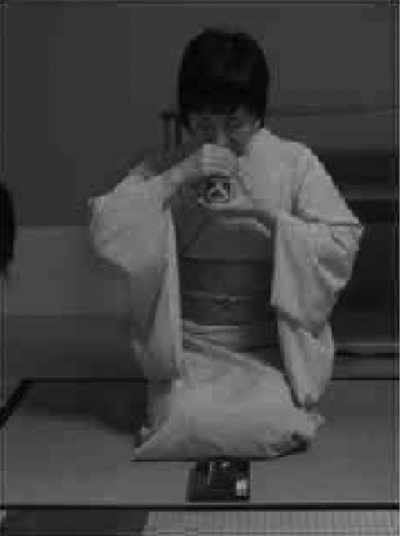
Monkō ( ‘listening to fragrance’).
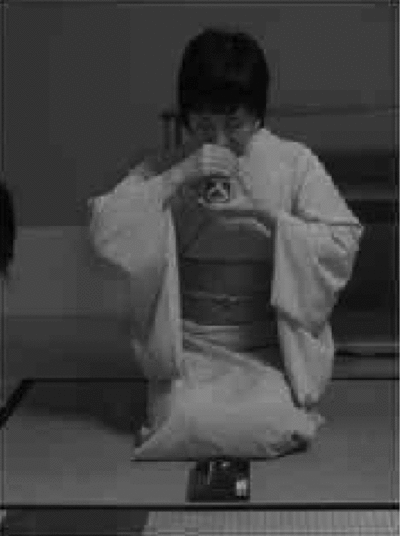
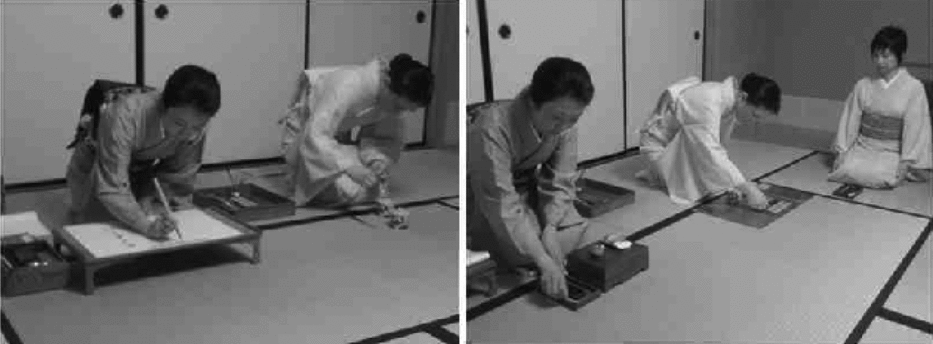
Kōseki (session of ceremonial incense appreciation)
Left: hissha (〔筆者〕 keeper of the kōseki minutes; also called shippitsu 〔執筆〕).
Centre: kōmoto (〔香元〕 the person who tenders the kōro).
Right: kyaku (〔客〕 ‘guest’, participant of the ceremony).

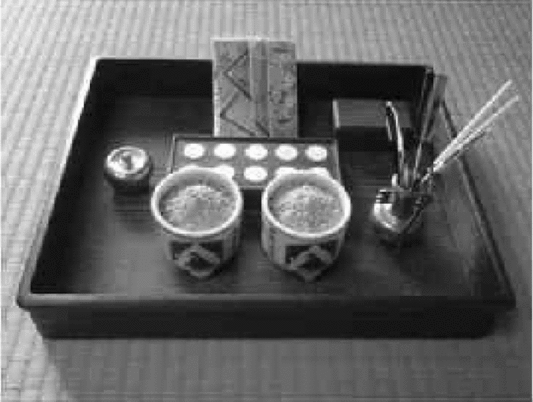
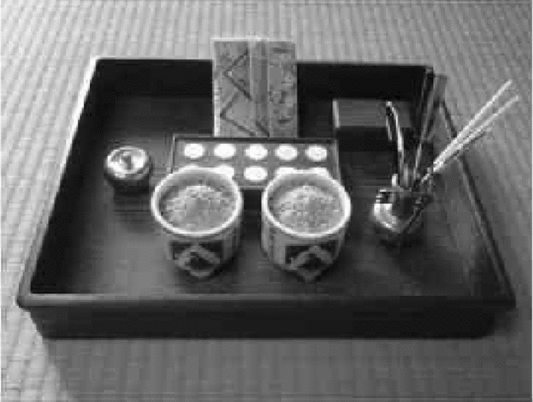
Tools for kumikō (〔組香〕).
Actually, the knowledge and awareness of the different kinds of jinkō was not new. Their different fragrance qualities had been judged since the Heian period. While producing renkō, aristocrats at that time discovered and learned to distinguish the various qualities of jinkō.Footnote 20 However, appreciating solely jinkō in its pure form became a regular pastime in Japan only during the Kamakura period, by using the ginyō method. People called this new method of appreciating fragrances monkō (〔聞香〕, from Chinese wen xiang, ‘to listen to incense’ or ‘to smell incense’).
As people became more sensitive to the various qualities of fragrances, they realised that there was a kind of jinkō whose fragrance was more splendid and delicate than that of other kinds of jinkō. This type was called kyara 〔伽羅〕. The Chinese had already acknowledged its existence since the middle of the twelfth century,Footnote 21 before it began to be appreciated in Japan after the middle of the fourteenth century.Footnote 22 It gave birth to a unique culture, one which would make it necessary to distinguish the superior quality jinkō from other more common jinkō types. Accordingly, the tradition of giving names to selected pieces of jinkō of exclusive quality started. Many superior pieces of jinkō have been named since then, using elegant words from waka (〔和歌〕 Japanese poems), monogatari (〔物語〕 Japanese prose narrative tales), and kanshi (〔漢詩〕 Chinese and Chinese-style poems). Pieces of jinkō have names such as “菖蒲 (Shōbu, ‘Iris’)”, “立田 (Tatsuta, a place in the Nara Prefecture which is famous for autumn colours)”, “雲居 (Kumoi, ‘Cloudy Sky’)”, “八橋 (Yatsuhashi, a place mentioned in The Tales of Ise, i.e. a collection of poems and associated narratives dating from the first half of the Heian period or before)”, “花散里 (Hanachirusato, the name of a character in, and also of a chapter of The Tale of Genji, i.e. a literary work whose sources stem from the years around 1008)” and “楊貴妃 (Yōkihi, Yang Gui-fei, a historical person and character of Chinese poetry)”. The eminent General Sasaki Dōyo 〔佐々木道誉〕 (1296–1373) is said to have named many pieces of jinkō for which he gained a special reputation in the context of kōdō.Footnote 23
3.2. Early forms of incense appreciation games – jisshukō (〔十種香〕 ‘ten kinds of incense’)
More and more, the appreciation of jinkō took on a social frame and character. Historically, the earliest appreciations in game form were called jisshukō (‘ten kinds of incense’) or jitchūkō (〔十炷香〕 ‘ten incense’). The game of enjoying the diversity of different types of jinkō gradually assumed a competitive character, in which the winner would receive a prize. Such competitions, called tōkō (〔闘香〕 incense recognition competitions), became popular at the same time with tōcha (〔闘茶〕 tea recognition competitions). The emphasis on competition however, turned the incense culture into a somewhat uncouth form of recreation.Footnote 24
3.3. The age of takigumikō (〔たき組香〕 ‘linked kō ceremony’)
Towards the end of the fifteenth century, takigumikō Footnote 25 emerged from among several other fine art forms, and cultural practices arising from them, that are referred to as “dō” (as mentioned above). Different ones were established under General Ashikaga Yoshimasa (1436–1490), such as the sophisticated appreciation of tea, flowers, perfumes, and renga (〔連歌〕 ‘linked verse poetry’). These arts were related to each other. Specifically takigumikō was invented by combining earlier practices of appreciating fragrances with the methods of creating and enjoying renga poetry.
Renga counts as one traditional style of Japanese poetry that developed in the Kamakura period (1185–1333) and reached the height of its popularity during the Sengoku period (1467–1568).Footnote 26 As is usually the case in Japanese poetry, its poems are made of 31 syllables that are allocated over two parts. The first consists of three phrases of 5, 7 and 5 syllables, while the second is made of two phrases of 7 syllables each. In comparison with most Japanese poems, however, ‘linked verse poetry’ is special, as several poets contribute to the poetic creation. For example, Poet A writes a 5–7–5 verse, to which Poet B responds with a 7–7 verse. Then, Poet C will compose a 5–7–5 verse that will link to what Poet B has written. The style continues with contributions from different poets, creating ‘linked verse’, or a ‘linked poem’. The following example may illustrate the collaborative process and the poetic linkages in thematic regards that are established by the poets:Footnote 27
A (Sōgi): yuki nagara / yamamoto kasumu / yūbe kana (5–7–5)
B (Shōhaku): yuku mizu tōku / ume niou sato (7–7)
B (Shōhaku): yuku mizu tōku / ume niou sato (7–7)
C (Sōchō): kawa kaze ni / hito mura yanagi / haru miete (5–7–5)
C (Sōchō): kawa kaze ni / hito mura yanagi / haru miete (5–7–5)
D (Sōgi): fune sasu oto mo / shiruki akegata (7–7)
A:
雪ながら山本霞む夕べかな
yuki nagara / yamamoto kasumu / yūbe kana
It has become evening [in spring] when layers of haze settle despite the snow at the foot of the mountain.
by Sōgi 〔宗祇〕 (1421–1502)
B:
yuku mizu tōku / ume niou sato
行く水遠く梅匂ふ里
The river flows far, and the air is redolent [in spring] of the plum blossoms’ scent in the countryside.
by Shōhaku 〔肖柏〕 (1443–1527)
C:
川風に一群柳春見えて
kawa kaze ni / hito mura yanagi / haru miete
The willow branches bending with the breeze towards the river make me feel the beginning of spring.
by Sōchō 〔宗長〕 (1448–1532)
D:
船さす音もしるき明け方
fune sasu oto mo / shiruki akegata
The sound of a ship makes me realize that morning has broken.
by Sōgi 〔宗祇〕
Similarly to the procedure of creating and enjoying linked renga poems, pieces of incense become linked to each other during a takigumikō session, by valuing the jinkōs’ poetic names and relating these to each other. More specifically, the participants bring with them their personal collections of superior (named) jinkō pieces, and a noble person among the group will offer to give one of the precious pieces as the first piece for this occasion. This first jinkō of the day could be any. For example, it might be one which is known as “雲居 (Kumoi, ‘Cloudy Sky’)”. The choice of the following jinkōs is no longer arbitrary. Instead, it is expected that each ensuing piece always relates to the directly foregoing one. Thus, for the next round of appreciating incense, a piece could be chosen that is known as “月 (Tsuki, ‘Moon’)”. Like the name of the jinkō piece before, the name of this ensuing jinkō stems from gago (〔雅語〕 elegant words used in Japanese poems) about the weather and the landscape of the sky. The next participant may then choose a jinkō piece called “秋風 (Akikaze, ‘Autumn Wind’)”. This name connects with “Tsuki” (‘Moon’) – the jinkō piece from before – in seasonal regards, as autumn presents the season of the annual moon feast. Like in renga poetry, a chiming line would so be established, in the case of takigumikō along the poesy of the jinkō pieces’ names.
Other gago that lend their names to jinkō pieces refer to such topics as love, celebration, and the scenery of a particular place.
3.4. Kōawase (〔香合せ〕 incense evaluation ceremony)
Parallel to the development of takigumikō, kōawase (〔香合せ〕 incense evaluation ceremony) established at the beginning of the Sengoku period (1467–1568). The goal was to evaluate the fragrances of jinkō pieces; the ceremonial practice presented a type of awase mono (〔合わせ物〕 literally ‘bringing together’, i.e. all guests bring with them samples of a specific kind of material or intangible product in order to enjoy the comparison between those).Footnote 28 These had started after the Heian period with the ceremonial consideration of Japanese poems. Two teams submitted a poem, these were then considered in terms of their relative aesthetic superiority or inferiority. Ceremonial appraisals of pieces of jinkō in the Sengoku period followed the same pattern, with the fragrances of the named jinkō pieces being evaluated as aesthetically superior or inferior in comparison.Footnote 29 It is thought that the invention of kōawase was an attempt to relate the contemporary incense culture of that time to the valued culture of the earlier Heian period, and thereby to dignify the appreciation of perfumes.
A well-known ceremony was the Higashiyamadono rokuban kōawase 〔東山殿六番香合〕, which took place in 1479 with Shogun Ashikaga Yoshimasa 〔足利義政〕 (1436–1490).Footnote 30 The most famous kōawase however, was the Shino Sōshinke meikō awase 〔志野宗信家名香合〕, with the participation of Shino Sōshin (1443–1523), in 1501.Footnote 31
3.5. The origin of kōdō and kumikō (〔組香〕 incense appreciation games based on various defined rules)
There are various theories as to who the initiator of kōdō was. People such as Sasaki Dōyo (1296–1373), Ashikaga Yoshimasa (1436–1490), Sanjōnishi Sanetaka (1455–1537) and Shino Sōshin (1443–1523) are among those named. However, Shino Sōshin is widely considered to have introduced this new form of incense appreciation.
Notably, the ritual performance and character of appreciating incense changed with the development of kōdō. The technique to appreciate the pure fragrance of jinkō, introduced above as monkō (‘listening to fragrance’), together with the traditions of takigumikō and kōawase, paved the way for the development of kumikōs 〔組香〕, meaning defined games of incense appreciation. Their first basis was gradually created over three generations of sōshōs (〔宗匠〕 master). Shino Sōshin's son Sōon 〔宗温〕 and grandson Shino Shōha/ Syōha 〔省巴〕 straightened the form and the content of the loose games. Their base became completed by Hachiya Sōgo 〔宗悟〕 (d. 1584/1588), after he had taken over the kōdō tradition from the Shino family.Footnote 32 Rules were defined that one had to observe in order to play these games, and which were written down over the course of the following decades. These rules determined in which way and procedure pieces of different jinkō kinds are passed around during the ceremonial session. The task for the participants was to recognise the pieces by their fragrances.
3.6. Kumikō in the Edo period
During the Edo period (1600–1868), the kumikōs became more refined. Playing kumikō became a method by which participants cultivated their knowledge and improved their spirits. In other words, kumikō is not just a game for appreciating scents. Rather, the olfactory experience is combined with the poetic experience of the four seasons, as these play an important part in the theme of many kumikōs. More generally, a large number of kumikōs that were created between the end of the Muromachi period and up to the Edo period, take up motifs of classical literature from the Heian and the Kamakura periods, meaning of waka (classical Japanese poetry),Footnote 33 monogatari (Japanese prose narrative tales),Footnote 34 and kanshi (Chinese and Chinese-like poetry).Footnote 35
The literary component makes kōdō special in comparison with all other dōs. Following the connection of kumikōs with literary models, this pursuit took on an exceptional artistic character. The participants were able to appreciate classical literature at the same time and aesthetically intertwined with the appreciation of the jinkō fragrance.
III. Contemporary kōseki (kōseki 〔香席〕 ritualised incense appreciation session)
Nowadays, people also meet with the purpose of appreciating fragrances ceremonially. Kōseki is one such kind of such gathering. Seki means ‘seat’ or ‘place’, – thus kōseki literally denotes the session as such. Two types are popular.
One of them is the meikōseki (〔名香席〕, session for appreciating famous incense pieces, also called 〔名香聞〕 meikōgiki). Meikō are those exclusive jinkō pieces that have been given a name.Footnote 36 The meikōseki is practiced with the purpose of appreciating the fragrance of these exclusive jinkō pieces and thereby commemorating their specific history, like their origin and the eponym of their name and the historical personalities who chose the name. While doing so, the participants are able to sense the typical experience of deliberate incense appreciation. They feel emotional healing and the lifting of their spirit.
The other kind of kōseki is based on kumikō and presents the incense appreciation session that is most often held nowadays. At the so-called kumikōseki (〔組香席〕 session of playing kumikō), the participants try to distinguish the different fragrances of several jinkō types. Though the participants somehow compete with each other concerning the recognition of the scents, the emphasis is on enjoying harmony with all kōseki fellows while appreciating the fragrance. The challenge of whether or not one is able to determine the different scents makes the sensory appreciation somewhat more interesting.
It is worth noting that the sensory task is not that easy. The fragrance of jinkō, which presents the incense that is mainly used in the various kō ceremonies of today, varies considerably. The botanical origin influences its olfactory character among other natural factors. Also the condition of one's nose as well as the combination of fragrances can affect whether or not one can distinguish the fragrances.Footnote 37
IV. Komadomekō (〔駒止香〕 ‘Kō of Stopping the Horse’) – an exemplary kumikō
There are more than two hundred types of kumikō games that have been handed down from past generations.Footnote 38 One among them is called “駒止香 (Komadomekō, ‘Kō of Stopping the Horse’)”, which will be exemplarily explained in further detail.Footnote 39
Three kinds of jinkō are used for playing this game, which are named “Ide no Tamagawa”, “Sano no watari”, and “Uji yori wataru”, in reference to the so-titled Japanese poems cited in the following. These poems stem from the twelfth and thirteenth centuries and were composed by three generations of poets – Fujiwara no Shunzei, his eldest son Fujiwara no Teika, and his eldest grandson Fujiwara no Tameie. While each of the poems is distinguished by its unique character, the structure and topics of each nonetheless relate to each other. All three wakas poetise on the identical expression “駒とめて (koma tomete, stopping my horse)”. In the same manner, the fragrances of the chosen three jinkō pieces offer similar notes, yet they are unique, so that they contribute to the poem on one topic – the “Stopping of the Horse”. The olfactory nuances are intended to echo the nuances of the poems.
井出の玉川 – Ide no tamagawa (“The Tama River at Ide”)
駒とめてなお水かはむ山吹の花の露そふ井手の玉川
koma tomete / nao mizu kahan / yamabuki no / hana no tsuyu sou / Ide no Tamagawa
I stop my horse and give it water, admiring the dewdrops on the Yamabuki rose petals at Ide's Tama River.Footnote 40
by Fujiwara no Shunzei 〔藤原俊成〕 (1114–1204)Footnote 41
佐野の渡 – Sano no watari (“The Sano Ferry Crossing”)
駒とめて袖うちはらふかげもなし佐野のわたりの雪の夕暮れ
koma tomete / sode uchiharau / kagemo nashi / Sano no watari no / yuki no yūgure
There is no shelter to give my horse a rest, and to brush off the snow from my sleeves, aside the Sano crossing, in this snowy evening.Footnote 42
Fujiwara no Teika 〔藤原定家〕 (1162–1241)Footnote 43
宇治より渡る – Uji yori wataru (“Crossing the River at Uji”)
駒とめて宇治より渡る木幡川思いならずと浮名ながすな
koma tomete / Uji yori wataru / kohatagawa / omoi narazuto / ukina nagasuna Footnote 44
I stop my horse at Uji to cross the Kohata river on foot, as possibly she will not return my feelings, and my pursuit should not get around.Footnote 45
Fujiwara no Tameie 〔藤原為家〕 (1198–1275)Footnote 46
The exercise for all participants of the kumikō is to identify the fine differences and affinities between the fragrances in relation with the poetic references. In order to initiate the play, two pieces of each of the three types of jinkō are necessary. The first piece is generally called shikō (〔試香〕 the piece that is used to introduce the olfactory quality of this type of jinkō before the judging starts; also called kokoromikō and tameshikō), while the other one is known as honkō (〔本香〕 the piece used in the conundrum part of the game; it is taken from the same wood as the shikō, so that their fragrance is identical).
First, the kōmoto (〔香元〕 the person who prepares and serves the kōros) prepares three kōros for the incensation of the three shikō pieces, and tenders them to the Komadomekō participants in a decided order, while reciting the three poems. The poetic association serves to distinguish the character and memorise the different fragrances.
Having introduced the three kinds of jinkō to the participants, the three honkō pieces are then placed by the kōmoto over the glow in another three kōros, and tendered in random order, with the aim of starting with the conundrum part of the kumikō. The participants attempt to recognise the three different fragrances, by assigning them to the shikō samples that were passed around before. They then write the name of the poem for each jinkō sample – “Ide no tamagawa”, “Sano no watari, or “Uji yori wataru” – on the kigami (〔記紙〕 answer sheet, also known as nanorigami 〔名乗り紙〕). The shippitsu (〔執筆〕 record keeper, also hissha 〔筆者〕) notes down all answers of each participant, and will finally announce the correct answer to the conundrum and report on which of the participants could recognise the fragrances.
In any case, the scoring is of minor significance. Instead, the intertwined experience and appreciation of the scents and the poems is of primary importance. Matching the poetic subtleties given in each poem's individual composition and each jinkō's individual fragrance make up the exercise and the aesthetic delicacy of the kumikō. Playing kumikōs thus provides a possibility to express and experience the multifaceted characters and atmospheres of fragrances and poetry.
V. Conclusion
The culture of appreciating fragrances has a long history in Japan. It is characterised by an aesthetic development, not only in regard to the types of aromatic materials used, but also in regard to how the fragrances were appreciated. This paper placed a special focus on the unique relationship between sensory experience and the enjoyment of literary arts, which developed in Japan some time after the material incense had been introduced.
It is not unusual for fragrances to be mentioned in written work in various literary cultures. In Japanese culture, fragrances frequently appear in poetry or prose, as well; meaning is thus attributed to the poem or the story. However, the relationship between the literary and the perfumery arts that is typical of kōdō, which is discussed here, is of another kind. The participant of a kō ceremony simultaneously appreciates the literary poesy and the poesy of the scents. In other words, the olfactory experience is not only imagined, but paves the way towards the literary experience. Through the poetic names of perfumes and the allusion to poetic works as in the cases of meikōiki, takigumikō and kōawase, or via the recitation of poems in a large number of kumikōs, the association with these literary expressions strengthens the various associations of fragrances with sceneries and seasons and with the emotions of their authors. Thus, in practicing kōdō, the literary and the olfactory experiences complement each other and merge in harmony.