A growing body of research over the past decades has revealed associations between early language difficulties and later emotional problems. Results show that there is an association, but less is known about the nature of this association: the timing, what types of language difficulties and internalizing problems are associated, and possible gender differences (Yew & O'Kearney, Reference Yew and O'Kearney2013). This knowledge is important for preventive interventions in childcare and school, especially as internalizing problems and language difficulties may be difficult to detect in a classroom setting (Stowe, Arnold, & Ortiz, Reference Stowe, Arnold and Ortiz1999).
The use of language is essential to social interaction. Problems with understanding and producing spoken language may interfere with the navigation of social life at home, with friends, and academically in school, which may result in withdrawal or anxiousness (Yew & O'Kearney, Reference Yew and O'Kearney2013). Language difficulties may also cause problems with learning emotion regulation strategies and the use of internal speech as regulation (Fujiki, Brinton, & Clarke, Reference Fujiki, Brinton and Clarke2002), which in turn may increase the risk of developing emotional problems. In contrast, social avoidance or withdrawal may also prevent a child from participating in language learning situations, or the emotional arousal of sadness and anxiousness may interfere with a child's capacity and strategies for learning language (Moilanen, Shaw, & Maxwell, Reference Moilanen, Shaw and Maxwell2010).
In the present study, we investigate how problems in one area predict change in another area over time, by controlling for continuity and stability of the constructs between each measure point. This is in line with the theoretical concept of developmental cascades, how function in one domain influences function in another domain over time (Masten & Cicchetti, Reference Masten and Cicchetti2010; Masten et al., Reference Masten, Roisman, Long, Burt, Obradović, Riley and Tellegen2005). There is a growing body of research in this area, especially on associations between externalizing and internalizing problems, social competence, peer rejection, and academic achievement (Bornstein, Hahn, & Haynes, Reference Bornstein, Hahn and Haynes2010; Moilanen et al., Reference Moilanen, Shaw and Maxwell2010; Obradović, Burt, & Masten, Reference Obradović, Burt and Masten2009; Vaillancourt, Brittain, McDougall, & Duku, Reference Vaillancourt, Brittain, McDougall and Duku2013; van Lier & Koot, Reference van Lier and Koot2010). There is still a lack of research on the role of internalizing problems in such developmental cascades (Masten et al., Reference Masten, Roisman, Long, Burt, Obradović, Riley and Tellegen2005), and especially on the association between internalizing problems and language (Bornstein, Hahn, & Suwalsky, Reference Bornstein, Hahn and Suwalsky2013; Conti-Ramsden & Botting, Reference Conti-Ramsden and Botting2008). In the present study, we investigate longitudinal bidirectional associations between parent-rated language difficulties, called language difficulties and internalizing problems from 18 months to 5 years, and between semantic language difficulties and internalizing problems from 5 to 8 years. A final set of analyses is included to investigate how expressive and receptive language difficulties at age 5 predict change in internalizing problems from 5 to 8 years.
Language Difficulties and Internalizing Problems
Co-occurring language difficulties and internalizing problems have been reported in numerous studies. A literature review has showed that 71% of children with diagnosed emotional or behavioral disorders also have co-occurring language deficits, and 57% of children with diagnosed language deficits have co-occurring emotional or behavioral problems (Benner, Nelson, & Epstein, Reference Benner, Nelson and Epstein2002). There are some studies suggesting how internalizing behaviors such as shyness affect language development (Coplan & Armer, Reference Coplan and Armer2005), but the majority of research in this area concerns early language difficulties and later internalizing problems. In a meta-analysis on longitudinal studies, it was concluded that children with early specific language impairment (SLI) were almost twice as likely as typical peers to show clinical levels of emotional problems at follow-up and also more likely to show subclinical levels (Yew & O'Kearney, Reference Yew and O'Kearney2013). These findings do, however, vary according to the age of the children, gender, and type of language difficulty.
Research on this association earlier than 5 years commonly refers to late language emergence or language delay, rather than language impairment. Associations have been noted in cross-sectional studies (Rescorla, Ross, & McClure, Reference Rescorla, Ross and McClure2007; Zubrick, Taylor, Rice, & Slegers, Reference Zubrick, Taylor, Rice and Slegers2007). Some prospective cohort studies have shown a weak to moderate association, especially for boys (Henrichs et al., Reference Henrichs, Rescorla, Donkersloot, Schenk, Raat, Jaddoe and Tiemeier2013), and even when controlling for baseline internalizing problems (Morgan, Farkas, Hillemeier, Hammer, & Maczuga, Reference Morgan, Farkas, Hillemeier, Hammer and Maczuga2015). Clegg, Law, Rush, Peters, and Roulstone (Reference Clegg, Law, Rush, Peters and Roulstone2015) found in a large population-based cohort study that parent report of expressive vocabulary at 2 and receptive vocabulary at 4 had a modest contribution to emotional functioning at 6 years. Other studies have noted no associations. Whitehouse, Robinson, and Zubrick (Reference Whitehouse, Robinson and Zubrick2011) noted no association between expressive vocabulary delays at 2 years and internalizing problems at 5, 8, 10, 14, and 17 years in a population-based cohort study, after adjusting for covariates.
During the years of transition to school, 5 to 8 years, there are also mixed results on the association between language difficulties and internalizing problems. In one population-based study, Beitchman and colleagues (Beitchman, Brownlie, & Bao, Reference Beitchman, Brownlie and Bao2014; Beitchman et al., Reference Beitchman, Brownlie, Inglis, Wild, Ferguson, Schachter and Mathews1996, Reference Beitchman, Wilson, Johnson, Atkinson, Young, Adlaf and Douglas2001; Brownlie, Bao, & Beitchman, Reference Brownlie, Bao and Beitchman2016) found that language impairment at 5 years was associated with continued internalizing problems at 5, 12, and 19 years, but not at 31, except a tendency for elevated social anxiety symptoms in the language disordered group. Some longitudinal studies using clinical samples have similar results (Conti-Ramsden & Botting, Reference Conti-Ramsden and Botting2008; Tallal, Dukette, & Curtiss, Reference Tallal, Dukette and Curtiss1989; Wadman, Botting, Durkin, & Conti-Ramsden, Reference Wadman, Botting, Durkin and Conti-Ramsden2011). Other longitudinal studies using clinical samples have noted a decrease in the association from 5 to 7 years (Benasich, Curtiss, & Tallal, Reference Benasich, Curtiss and Tallal1993; Redmond & Rice, Reference Redmond and Rice2002), from 7 to 11 years (Benasich et al., Reference Benasich, Curtiss and Tallal1993) and up to 16 years (Snowling, Bishop, Stothard, Chipchase, & Kaplan, Reference Snowling, Bishop, Stothard, Chipchase and Kaplan2006; St. Clair, Pickles, Durkin, & Conti-Ramsden, Reference St. Clair, Pickles, Durkin and Conti-Ramsden2011).
Research may suggest that the association between language difficulties and internalizing problems is weak to modest for toddlers, when language is still not developed and parents may have less strict expectations of emotional adjustment (Henrichs et al., Reference Henrichs, Rescorla, Donkersloot, Schenk, Raat, Jaddoe and Tiemeier2013). The association may then peak in the preschool years, when social and emotional skills are rapidly developing. As children grow older, the association may decrease again, as their language improves and new emotion regulation and compensatory skills develop (Beitchman et al., Reference Beitchman, Brownlie and Bao2014). In one line of research, it has been suggested that the association between language difficulties and internalizing problems is not direct and may be mediated through social functioning, emotion regulation, or executive functions (Aro, Eklund, Nurmi, & Poikkeus, Reference Aro, Eklund, Nurmi and Poikkeus2012; Cuperus, Vugs, Scheper, & Hendriks, Reference Cuperus, Vugs, Scheper and Hendriks2014; Fujiki et al., Reference Fujiki, Brinton and Clarke2002).
One limitation in studies on early language difficulties and later internalizing problems is that they do not take into account changes in each construct over time. Recent longitudinal studies have shown that developmental trajectories of children with language difficulties are fluid, and children may move in and out of these categories. Studies have also shown that internalizing problems also may fluctuate over time (Sterba, Prinstein, & Cox, Reference Sterba, Prinstein and Cox2007). Yew and O'Kearney (Reference Yew and O'Kearney2015) acknowledged this and studied the growth of emotional problems in 5-year-olds with SLI. They found that the initial language impairment predicted the level of emotional problems at 5 years, but did not predict the growth of emotional problems up to 11 years.
Another limitation in previous research is that few longitudinal studies take into account the child's initial internalizing problems, which makes it difficult to detect the unique contribution of problems in one area on the development of problems in the other and to study reciprocal influences between the two areas. One exception to this is Bornstein et al. (Reference Bornstein, Hahn and Suwalsky2013), who investigated cross-lagged associations between language skills and internalizing problems from 4 to 14 years. They found that early language skills predicted change in internalizing problems, but found no effects in the opposite direction. We extend on the Bornstein study by studying a larger sample over an earlier time span, including different types of language difficulties and perform all analyses separately for boys and girls.
Types of Language Difficulties
Language is a complex system consisting of multiple dimensions. Language difficulties are commonly understood as problems in one or more of the dimensions of language abilities (Justice et al., Reference Justice, Lomax, O'Connell, Pentimonti, Petrill, Piasta and Catts2015). In the present study, we adopt the view presented by Tomblin and Zhang (Reference Tomblin and Zhang2006), whose work suggested that language ability is initially unidimensional and becomes gradually multidimensional as children enter school. They found that by kindergarten grammar, vocabulary, and discourse formed a single dimension. In first and second grades, the results showed two dimensions: grammar and vocabulary on one side, and discourse on the other. By 8 years, all three dimensions were differentiated. As children's language becomes more advanced, several areas may be impaired, such as phonology, syntax, morphology, semantics, and pragmatics. In typical early language development, there is also a clear distinction between how many words a child understands and is able to produce (Justice et al., Reference Justice, Lomax, O'Connell, Pentimonti, Petrill, Piasta and Catts2015), which is commonly understood as a distinction between receptive and expressive language. As language abilities become more complex, the receptive and expressive division may be understood across the dimensions. In the present study, we measure language difficulties as unidimensional from 18 months to 3 years and as multidimensional from 5 to 8 years.
Associations between different types of language difficulties and internalizing problems have been reported. Beitchman et al. (Reference Beitchman, Brownlie, Inglis, Wild, Ferguson, Schachter and Mathews1996) found increased risk of internalizing problems for children with receptive or mixed receptive and expressive language problems, while Ripley and Yuill (Reference Ripley and Yuill2005) found that expressive language was associated with high levels of emotional symptoms in a group of boys excluded from school. Conti-Ramsden and Botting (Reference Conti-Ramsden and Botting2008) found associations between concurrent receptive language difficulties and emotional problems in a group of 16-year-olds previously diagnosed with SLI. In another study, van Daal, Verhoeven, and van Balkom (Reference van Daal, Verhoeven and van Balkom2007) found that phonological problems were more related to problem behavior, whereas semantic language difficulties were especially related to internalizing problems in a group of 5-year-olds with language impairment. As semantic language may be easier to separate from internalizing behavior (Ottem, Reference Ottem2009), the association between semantic language difficulties and internalizing problems will be a focus in the present study.
Gender Differences
Language difficulties are commonly reported as more prevalent for boys than for girls (Zubrick et al., Reference Zubrick, Taylor, Rice and Slegers2007). Some suggest that rather than language difficulties being more common in boys, there may be a difference in the speed of development. Bornstein, Hahn, and Haynes (Reference Bornstein, Hahn and Haynes2004) found language development to be stable for both boys and girls in the preschool years from 2 to 6 years, with girls consistently scoring higher on multiple language measures. Girls develop faster than boys biologically and neurologically in these years, and they may experience different social expectations, stereotypic interests, and interactions than boys. Thus, the girls with the poorest language functioning will perform better than boys, but still poorer than other girls at the same age, which may for many be their social reference group. Gender differences in the use of language have also been reported. Previous research has suggested that girls are more likely to use language to form and maintain social relationships whereas boys more often use assertive language or use language to achieve goals (Leaper & Smith, Reference Leaper and Smith2004). Studies on gender differences in the development of internalizing problems have traditionally showed similar levels of internalizing problems for boys and girls throughout childhood, and increasing difference during adolescence with girls having higher levels of internalizing problems (Keenan & Shaw, Reference Keenan and Shaw1997). Sterba et al. (Reference Sterba, Prinstein and Cox2007) found that girls were more likely to show a stable elevated level of internalizing problems, whereas boys were more likely to show decreasing or increasing internalizing problems from 2 to 11 years.
One of the first to report a gender difference in the association between language impairment and internalizing problems was Beitchmann, Hood, and Inglis (Reference Beitchman, Hood and Inglis1990). They reported that children with speech and language impairment had a higher risk of developing psychiatric problems, compared to children with typical language development, with girls being at greater risk than boys. They suggested the explanation that when a disorder shows uneven gender ratios, those with the lower prevalence rate tend to be more severely affected. In a more recent study, Conti-Ramsden and Botting (Reference Conti-Ramsden and Botting2008) did not find any gender difference in emotional health symptoms in a group of 15-years-olds previously diagnosed with SLI. In their sample, the language-impaired group had a similar gender distribution as the group with typical language development.
There are few studies investigating gender differences in the association between language difficulties and internalizing problems. The existing evidence so far seems to indicate that boys and girls with language difficulties have equal risk of developing emotional problems (Yew & O'Kearney, Reference Yew and O'Kearney2013). A problem in many of these studies is, however, that there are more boys than girls included in the sample, which reduces the power to identify gender differences (Conti-Ramsden, Reference Conti-Ramsden2013). If we assume that girls develop faster than boys and use similar cutoff for boys and girls, we are likely to include boys who are only delayed, but not impaired (false positives), and not capture girls who are impaired (false negatives). In the present study, we attempt to meet this shortcoming by using gender-specific cutoffs to include a larger proportion of girls in the language difficulty group, and also to avoid including false-positive boys (Richter & Janson, Reference Richter and Janson2007).
Covariates
There are other variables that may affect a child's language development, internalizing problems, and potentially the relationship between the two areas. Socioeconomic factors and family environment have commonly been reported to affect both internalizing problems (Ashford, Smit, Van Lier, Cuijpers, & Koot, Reference Ashford, Smit, Van Lier, Cuijpers and Koot2008) and language development (Schjølberg, Eadie, Zachrisson, Øyen, & Prior, Reference Schjølberg, Eadie, Zachrisson, Øyen and Prior2011). Some studies have also found that the associations between language delay and internalizing problems have disappeared when results are adjusted for covariates (Whitehouse et al., Reference Whitehouse, Robinson and Zubrick2011). We therefore perform all analyses in the present study both unadjusted and then adjusted for mother's education, age at birth (socioeconomic factors), mother's mental health, parent native language, and if the child has any siblings (family environment).
The Present Study
The main aim of this study is to investigate bidirectional longitudinal associations between parent-rated language difficulties and internalizing problems from 18 months to 8 years in a population-based sample. As language is a skill that develops over time, possible language difficulties will also have different manifestations depending on the age of the child. Therefore, we use a general language measure when we analyze the association between language difficulties and internalizing problems from 18 months to 3 years, and focus on semantic language difficulties from 5 to 8 years. In a second set of analyses, which includes children aged 5 to 8, the critical age of transition to school, we investigate how expressive, receptive, and semantic language difficulties predict change in internalizing problems. Most studies use early language difficulties to predict later internalizing problems. In the present study, we use a cross-lagged model to study the bidirectional associations. We hypothesize that early internalizing problems also may predict later language difficulties, and that the association is bidirectional during child development. A secondary aim of the study is to investigate possible gender differences in the association between language difficulties and internalizing problems.
Method
Participants
The results were based on questionnaire data from the Norwegian Mother and Child cohort study (MoBa; http://www.fhi.no/moba). MoBa is a prospective population-based pregnancy cohort study conducted by the Norwegian Institute of Public Health. The cohort now includes 114,000 children, 95,000 mothers, and 75,200 fathers. Participants were recruited from all over Norway from 1999 to 2008, and 41% of invited women consented to participate (Magnus et al., Reference Magnus, Irgens, Haug, Nystad, Skjærven, Stoltenberg and Group2006, Reference Magnus, Birke, Vejrup, Haugan, Alsaker, Daltveit and Knudsen2016). Questionnaire data were gathered at gestational week 15 from both parents, and from mothers at gestational week 30, and when the child was 6 and 18 months, and 3, 5, and 8 years.
The current study is based on Version 8 of quality-assured data. A total of 8,366 participants from the original sample were excluded based on report from Medical Birth Registry of Norway of serious malformations, cerebral palsy, hearing problems, or other syndromes, all of which are thought to affect a child's language development. The final sample consisted of 76,432 children at 18 months (49.2% girls), 58,844 at 3 years, 32,841 at 5 years, and 19,946 at 8 years. The lower number of participants at 5 and 8 years compared to earlier ages was partly due to dropout and partly due to the continuous nature of the data collection process.
Informed consent was obtained from each MoBa participant upon recruitment. The establishment and data collection in MoBa has obtained a license from the Norwegian Data Inspectorate and approval from the Regional Committee for Medical Research Ethics.
Measures
Language difficulties
The Ages and Stages Questionnaire (ASQ; Bricker et al., Reference Bricker, Squires, Mounts, Potter, Nickel, Twombly and Farrell1999) was used to measure language difficulties at 18 months (three items, α = 0.59) and 3 years (six items, α = 0.56). The ASQ items in the MoBa have been use in several studies (Wang, Lekhal, Aaro, Holte, & Schjolberg, Reference Wang, Lekhal, Aaro, Holte and Schjolberg2014; Zambrana, Pons, Eadie, & Ystrom, Reference Zambrana, Pons, Eadie and Ystrom2014). Mothers rated how true statements were for their child as yes, sometimes, or not yet. An example of an expressive language statement is “Can the child tell you at least two things about a familiar object? If you, for example, say, ‘Tell me about the ball,’ can the child answer something like ‘It is round and I can throw it and it is big?’” An example of receptive language statement is “Without giving your child help by pointing or repeating directions, does your child follow three directions that are unrelated to one another? Give all three directions before the child starts. For example, you may ask your child to ‘Clap your hands, walk to the door and sit down’ or ‘Give me the pen, open the book and stand up.’” The ASQ has shown good test–retest reliability (94%), interrater reliability (94%), and concurrent validity when compared to standardized tests (76%–88%; Janson & Squires, Reference Janson and Squires2004). The Norwegian ASQ has shown good construct validity (Richter & Janson, Reference Richter and Janson2007).
Language difficulties at 5 and 8 years were also measured by a 20-item checklist (Language20Q) developed by Ottem (Reference Ottem2009) to identify children with risk of language difficulties. The Language20Q scale includes three subscales: expressive, receptive, and semantic language impairment. Expressive impairment involves having problems with being understood by others. Receptive impairment refers to problems with understanding others and storing information. Semantic impairment involves problems with the meaning of words, which may be impaired with regard to both understanding and producing language. Mothers are asked to rate statements from 1= does not fit the child/absolutely wrong to 5 = fits well with the child, absolutely right. At 5 years we used the full scale (22 items, α = 0.92) with three subscales: semantic (e.g., “Forgets words she/he knows the meaning of”; 8 items, α = 0.85), receptive (e.g., “Is quickly getting tired in tasks demanding attention to language”; 6 items, α = 0.85) and expressive language (e.g., “Is difficult to understand”; 6 items, α = 0.82). At 8 years, we used the semantic subscale (e.g., “Mixes up words with similar meaning”; 8 items, α = 0.84). A confirmatory factor analysis including all 20 items at 5 years and a three-factor model with one second-order factor showed acceptable fit (root mean square error of approximation = 0.049, comparative fit index = 0.962, and Tucker–Lewis index = 0.957). The Language20Q is validated in a Norwegian sample, in a study of 250 children with typical language development and 48 language-impaired children against Language6-16, an established Norwegian scale (χ2 = 83.62, df = 16, p < .001; Ottem, Reference Ottem2009).
Mean scores for ASQ and Language20Q at each age were computed when at least half of the items were answered, and then dichotomized. The cutoff closest to 5% was used, which reflects a careful estimate of the approximate prevalence of language impairment in the Norwegian population (7.5%; Hollung-Møllerhaug, Reference Hollung-Møllerhaug2010). This estimate is similar to Tomblin et al. (Reference Tomblin, Records, Buckwalter, Zhang, Smith and O'Brien1997), who estimated that around 7% of all preschool children have a language impairment. As the gender distribution is varied in this group, dichotomized variables were created separately for girls and boys. The development of gender-specific norms for the Norwegian ASQ has been recommended (Richter & Janson, Reference Richter and Janson2007; see Plomin, Price, Eley, Dale, & Stevenson, Reference Plomin, Price, Eley, Dale and Stevenson2002, for example of gender-specific cutoffs). Children with language scores in the highest 5% (low functioning) of their age and gender group were considered to have language difficulties. The exact cutoff values and number of children in each group are presented later.
The dichotomized ASQ and Language20Q language measures were validated against maternal report at 5 years of whether the child had been assessed by a professional for a language disorder. A larger proportion of boys with language difficulties according to ASQ (38%) or Language20Q (43%) were referred to professional assessment than boys without ASQ defined (10%) or Language20Q defined (9%) language difficulties. A somewhat lower percentage of the girls with ASQ-defined (20%) or Langauge20Q-defined (24%) language difficulties were referred for assessment of language disorder, while 4% of the girls with no language difficulties according to ASQ or Language20Q were assessed. The children who had been assessed and concluded to have combined receptive/expressive language difficulties were considered to be true cases. Children who had not been assessed or had been assessed and concluded by a professional to have problems with pronunciation, stuttering, other problems with language, expressive difficulties only, or no language difficulties were considered to be true noncases. Boys with ASQ-defined language difficulties were about 36 times as likely to have received a combined receptive and expressive language difficulties diagnosis by a professional, compared to boys who were not defined as having language impairment according to the ASQ. For girls, the relative risk was 51. Boys with Language20Q-defined language difficulties had a relative risk of 64 of also having a diagnosis of combined receptive and expressive language difficulties, and girls had a relative risk of 99.
Internalizing problems
The Child Behavior Checklist (CBCL; Achenbach & Rescorla, Reference Achenbach and Rescorla2000) was used to measure internalizing problems at 18 months, and 3 and 5 years. We used four items at 18 months (α = 0.41), five items at 3 years (α = 0.53), and eight items at 5 years of age (α = 0.68). The internalizing items in the MoBa have been used in several studies (Moylan et al., Reference Moylan, Gustavson, Øverland, Karevold, Jacka, Pasco and Berk2015; Sivertsen et al., Reference Sivertsen, Harvey, Reichborn-Kjennerud, Torgersen, Ystrom and Hysing2015). Mothers were asked to rate statements about their child's functioning as not true, somewhat or sometimes true, or very true or often true. Examples of statements are “Clings to adults or too dependent” and “Disturbed by any change in routine.” We performed a separate validation analysis in a subsample of the MoBa participants (n = 1,127) who received the full CBCL at 6 years. The correlations between the full internalizing scale and the MoBa short scales used at 18 months, 3 years, and 5 years were .71, .79, and .87, respectively. The MoBa internalizing short scales used at 18 months and 3 years correlated at .90, 18 months and 5 years correlated at .85, and 3 and 5 years correlated at .86.
Internalizing problems at 8 years were measured by a composite score of the Short Mood and Feelings Questionnaire (SMFQ) and Screen for Child Anxiety Related Disorders (SCARED). The SMFQ is a measure based on the DSM-III-R criteria of depression (Angold & Costello, Reference Angold and Costello1987). A 13-item subscale is used in the MoBa study (α = 0.79). Mothers are asked to rate how true items are for their child during the last 2 weeks as not true, sometimes true, or true. Examples of items are “Felt miserable or unhappy” and “Felt so tired that s/he just sat around and did nothing.” The SCARED is designed to measure DSM-defined anxiety symptoms (Birmaher et al., Reference Birmaher, Khetarpal, Brent, Cully, Balach, Kaufman and Neer1997). A 5-item short scale developed by Birmaher et al. (Reference Birmaher, Brent, Chiappetta, Bridge, Monga and Baugher1999) is used in the MoBa study (α = 0.44). Mothers are asked to rate statements about their child's functioning as not true, somewhat or sometimes true, or very true or often true. Examples of statements are “My child gets really frightened for no reason at all” and “My child is afraid to be alone in the house.” At 8 years, we combined 13 items from the SMFQ and 5 items from the SCARED into an internalizing scale. The reliability of the composite score was good (α = 0.75). Mean scores were created and dichotomized for each age group, with a cutoff at 10% aiming at reflecting approximate prevalence of internalizing problems, including subclinical problems, in the population (Wichstrøm et al., Reference Wichstrøm, Berg-Nielsen, Angold, Egger, Solheim and Sveen2012).
Covariates
In the final analyses, we adjusted for family factors that may influence the association between a child's language and socioemotional development: mother's education, mental health, and age at birth; parent native language; and if the child has any older siblings. Information on parity and mother's age at birth was gathered from the Medical Birth Registry of Norway. Information on mother's education and parent native language was gathered from mother's report at pregnancy. Information on maternal mental health was reported at 18 months, assessed using a 5-item short version of the Hopkins Symptom Checklist. The short version used has been shown to have good construct validity (Strand, Dalgard, Tambs, & Rognerud, Reference Strand, Dalgard, Tambs and Rognerud2003). All analyses were also adjusted for the age of the children in weeks when the mothers completed the questionnaire.
Missing data
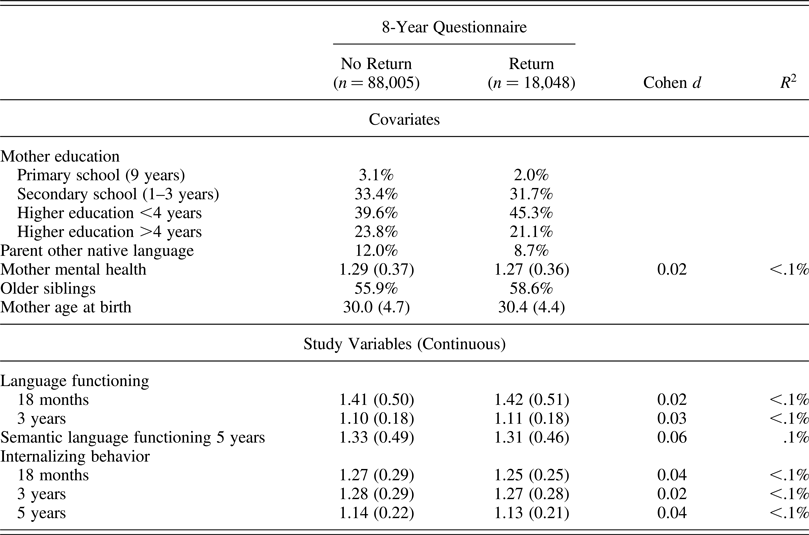
To address the effect of attrition in the present study, we compared the scores of the mothers who had returned the 8-year questionnaire and those who had not. Table 1 shows that although there is some differences in the family variables between the two groups, there were minimal differences in the scoring of the child's language functioning and internalizing behavior at the different ages. The differences between the two groups on the child functioning scores (Cohen d) were all less than 0.1, which is considered a weak effect. Whether mother has answered the 8-year questionnaire or not explained 0.1% or less of the variance in child functioning scores.
Attrition analysis: Differences in scoring between participants with and without return of 8-year questionnaire

Note: The values are the differences between scores from participants who have returned versus those who have not returned the 8-year questionnaire. Mean (standard deviation) are reported for continuous variables. Language functioning measured by Ages and Stages Questionnaire at 18 months, 3 years, and Language20Q at 5 years. Internalizing behavior measures were determined by the Child Behavior Checklist at all ages. All study variables are continuous. The Cohen d values (group difference effect size) were calculated by independent t test, and R 2 (variable variance explained by 8 year return vs. no return) values were calculated by regression analysis in SPSS.
Statistical analyses
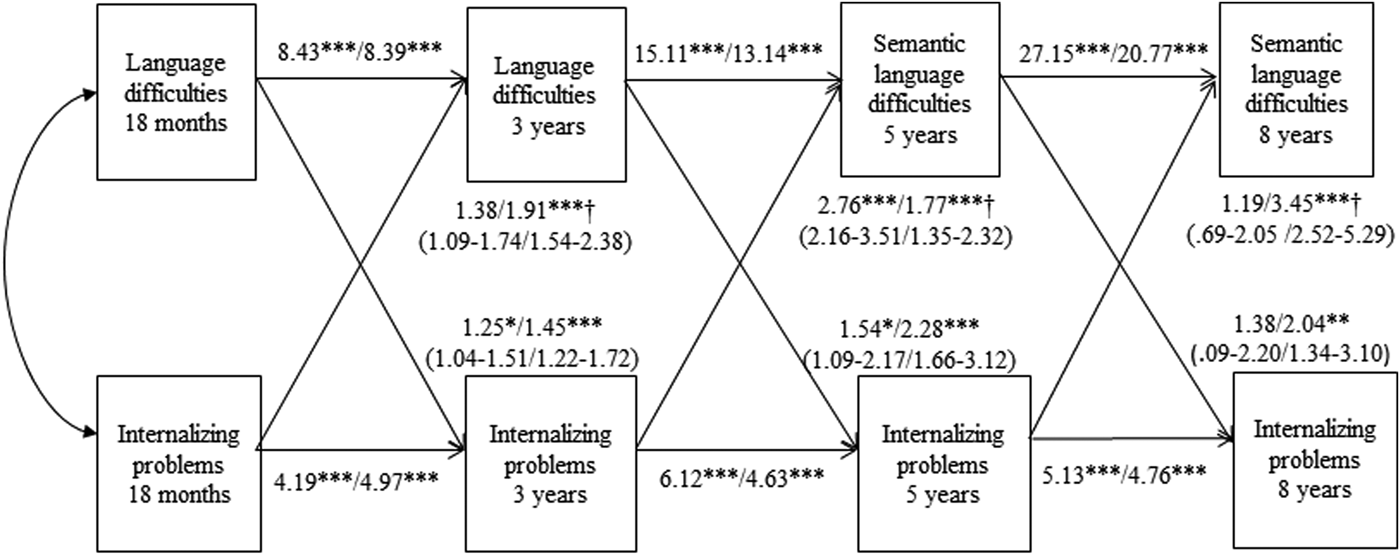
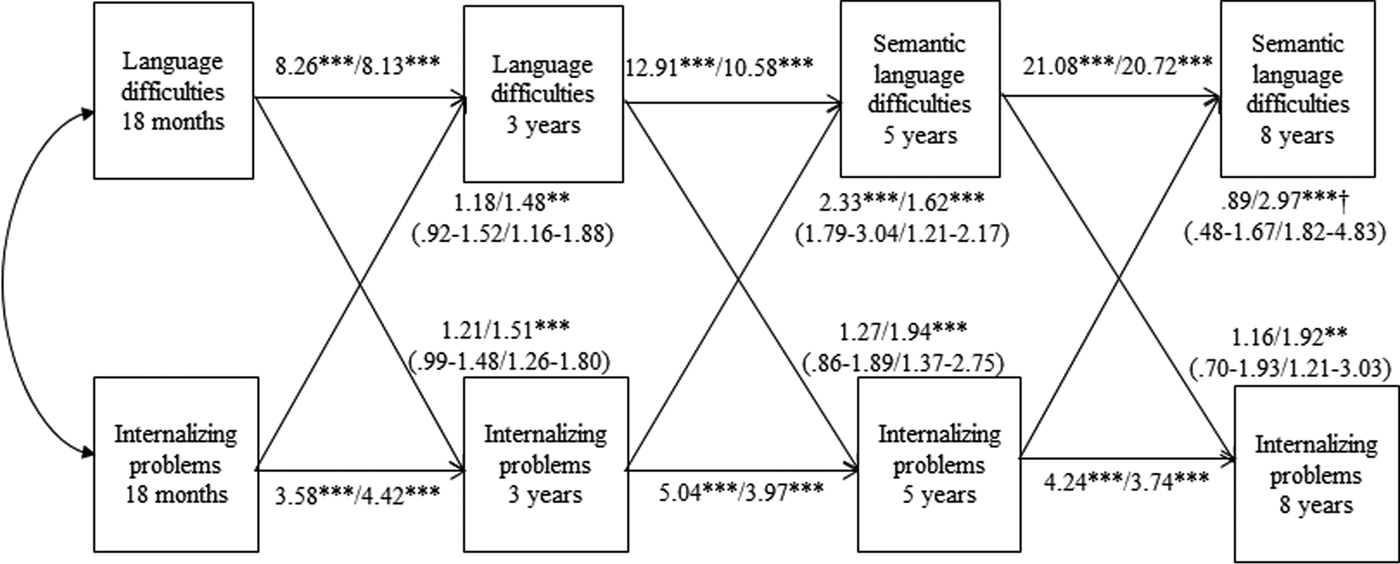
Logistic regression analyses were used to investigate longitudinal associations between language difficulties and internalizing problems. A cross-lagged model was developed to investigate the reciprocal associations between these two constructs. The cross-lagged model included autoregressive and cross-lagged paths. Autoregressive paths account for the stability of each measure across two consecutive time points, for example, how language difficulties at 18 months predict language impairment at 3 years. The cross-lagged paths describe the associations between the two measures, for example, how internalizing problems at 18 months predict language difficulties at 3 years. Adjusting for stability within each construct in the cross-lagged path minimizes the effect of initial correlation between two study variables, allowing the investigation of change in both variables over time. First, we analyzed the unadjusted associations between language difficulties and internalizing problems in the cross-lagged model from 18 months to 8 years (Figure 1). Second, we analyzed the same pathways adjusted for covariates (Figure 2). Third, we included an in-depth analysis of the cross-lagged association between language difficulties at 5 years and internalizing problems at 8 with three different types of language difficulties, also unadjusted and adjusted for covariates. All analyses in Figure 1 and Figure 2 were first performed for girls and boys separately, and then repeated in the full sample to investigate gender differences. To investigate gender differences in effects, we constructed an interaction term based on gender, taking the gender specific cutoffs into account, and the predictor variable, and entered this in a logistic regression for the full sample. Because of the large sample size and multiple testing, we have only included results significant at a .001 level in the discussion. All analyses were performed using SPSS Version 23.
Results from logistic regression analyses for boys/girls (confidence intervals). All analyses are adjusted for child age at return of questionnaire and outcome variable at previous time point. Language difficulties for 18 months/3 years is measured with the Ages and Stages Questionnaire; semantic language difficulties for 5 or 8 years is measured with the Language20Q semantic subscale; internalizing problems for 18 months/3 or 5 years is measured with the Child Behavior Checklist; and internalizing problems at 8 years is measured with the Short Mood and Feelings Questionnaire and the Screen for Child Anxiety Related Disorders. †Significant gender interaction, analyzed in the full sample. *p < .05, **p < .01, ***p < .001.

Results from logistic regression analyses for boys/girls (confidence intervals). All analyses are adjusted for child age at return of questionnaire, outcome variable at previous time point, and covariates. Language difficulties for 18 months/3 years is measured with the Ages and Stages Questionnaire; semantic language difficulties for 5 or 8 years is measured with the Language20Q semantic subscale; internalizing problems for 18 months/3 or 5 years is measured with Child Behavior Checklist; and internalizing problems at 8 years is measured with the Short Mood and Feelings Questionnaire and the Screen for Child Anxiety Related Disorders. †Significant gender interaction, analyzed in the full sample. *p < .05, **p < .01, ***p < .001.

Results
Descriptive results
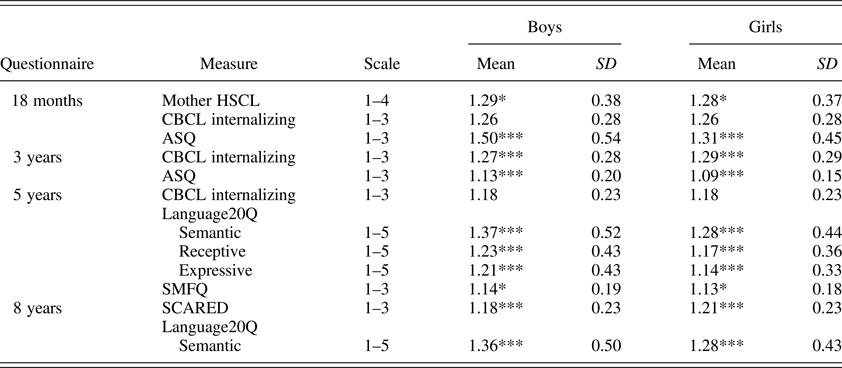
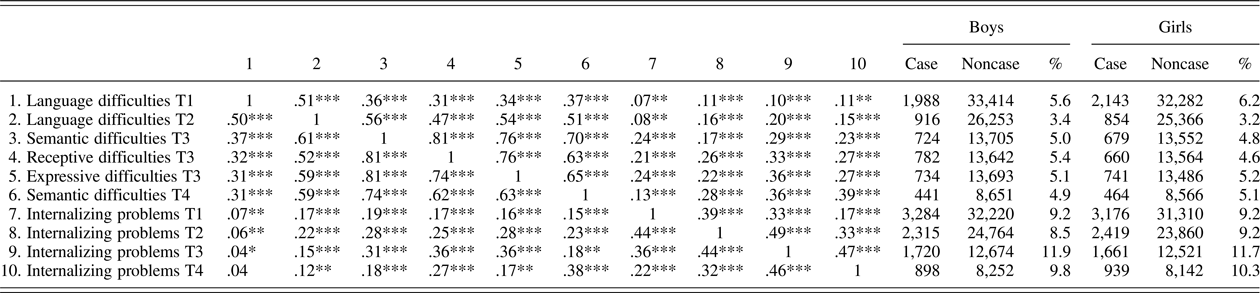
The mean age of the mothers at birth was 30.1 years (SD = 4.6). A total of 56.3% of the children were reported to have older siblings when they were born. During pregnancy, 62.1% of the mothers had completed higher education and 11.4% of the mothers reported that at least one of the child's parents had another first language than Norwegian. Table 2 provides the descriptive statistics for the study variables, and Table 3 shows the correlations between all variables used in the analyses.
Descriptive statistics for all study variables
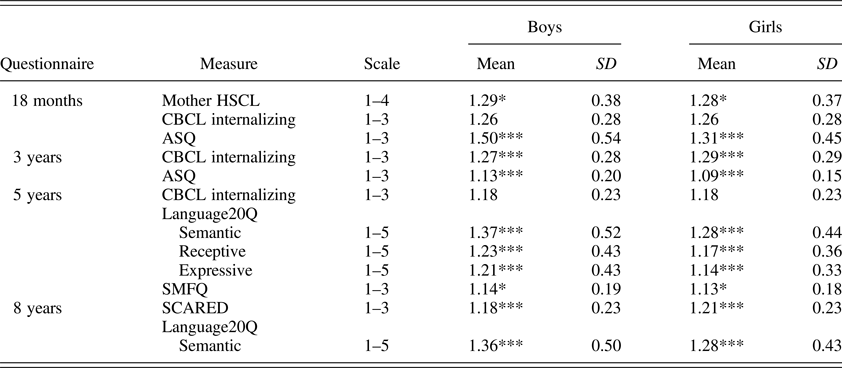
Note: HSCL, Hopkins Symptom Checklist; CBCL. Child Behavior Checklist; ASQ, Ages and Stages Questionnaire; Language20Q, checklist of 20 statements about language related difficulties (semantic, receptive, and expressive subscales); SMFQ, Short Mood and Feelings Questionnaire; SCARED, Screen for Child Anxiety Related Disorders. Significant gender differences.
*p < .05. **p < .01. ***p < .001.
Polychoric correlations between dichotomized measures of language difficulties and internalizing problems from 18 months to 8 years and details on cutoff for dichotomized variables

Note: The results for girls are above the diagonal and for boys are below diagonal. Time 1 (T1) = 18 months; Time 2 (T2) = 3 years; Time 3 (T3) = 5 years; Time 4 (T4) = 8 years. Language difficulties for T1–T2 were measured by the Ages and Stages Questionnaire, language difficulties for T3–T4 were measured by the Language20Q, internalizing problems for T1–T3 were measured by the Child Behavior Checklist, and internalizing problems for T4 were measured by the Short Mood and Feelings Questionnaire/Screen for Child Anxiety Related Disorders. All data were analyzed in STATA.
*p < .05. **p < .01. ***p < .001.
Correlations between dichotomized measures of language difficulties at different time points were all positive and significant. Correlations between measures of internalizing problems were also all positive and significant. As expected, correlations between measures of the two constructs were lower than the correlation within the constructs. ASQ at 18 months correlated significantly with internalizing problems only at 3 years for boys, and for girls, ASQ correlated with internalizing problems at all time points except 18 months. All other correlations were significant. There was an increase in the correlation between the measures, as the children grew older.
Cross-lagged associations
Unadjusted analyses
Figure 1 shows the cross-lagged model illustrating the longitudinal development of language difficulties and internalizing problems from 18 months to 8 years, with bidirectional associations between the two areas. All paths are separate logistic regression analyses. The autoregressive paths show the stability of language difficulties and internalizing problems separately, and the cross-lagged paths show the association between the two areas over time. The cross-lagged paths are adjusted for the stability from previous time point for each construct. For example, internalizing problems at 3 years predicted language difficulties at 5 years, controlled for language difficulties at 3 years, representing the association between internalizing problems at 3 years and the change of language difficulties from 3 to 5 years.
The unadjusted results showed that internalizing problems at 18 months significantly predicted an increase in language difficulties for both girls and boys between the ages of 18 months and 3 years. Girls with internalizing problems at 18 months were almost twice as likely to develop language difficulties from 18 months to 3 years than girls without internalizing problems. The effect for girls was significantly stronger than for boys (odds ratio [OR] = 1.39, p = .045). Internalizing problems at 3 years significantly predicted an increase in language difficulties between 3 and 5 years for boys and girls, with significantly higher effect sizes for boys (OR = 0.64, p = .016). This means that children who are withdrawn and anxious at an early age are at an increased risk of developing language difficulties over the next few years, compared to children who are not as withdrawn and anxious. When looking at the same association in the years of transition to school, we found that girls with internalizing problems at 5 years were more than three times as likely to develop semantic language difficulties from 5 to 8 years, compared to girls who did not have internalizing problems at 5 years. For boys, there was no increased risk of developing semantic language difficulties from 5 to 8 years if they had internalizing problems at 5 years. This gender difference was statistically significant (OR = 2.87, p = .003).
In the opposite direction, we found that language difficulties at 18 months predicted change in internalizing problems between 18 months and 3 years, and language difficulties at 3 years significantly predicted an increase in internalizing problems between 3 and 5 years, for boys and girls. Girls with language difficulties at 3 years are more than twice as likely to develop internalizing problems between 3 and 5 years as girls with typical language development. We also found that girls who had language difficulties at 5 years were more likely to develop internalizing problems between 5 and 8 years, than children who did not have language difficulties at 5 years. For boys, there was no significant association between having semantic language difficulties at 5 years and change in internalizing problems in the years of transition to school. The stability of language difficulties was higher as the children grew older, and in general higher for language difficulties than for internalizing problems. There were no significant gender differences for how language difficulties predicted change in internalizing problems in the unadjusted analyses.
Adjusted analyses
In the adjusted analyses showed in Figure 2, we controlled for older siblings, mother's education, mental health and age at birth, and parent native language. The results followed a similar pattern, but the effects were slightly weaker in the adjusted analyses. At 18 months, internalizing problems still significantly predicted change in language difficulties from 18 months to 3 years for girls, but not for boys. At 18 months language difficulties significantly predicted change in internalizing problems between 18 months and 3 years for boys and girls, slightly higher effects for girls than in the unadjusted analyses. The cross-lagged associations between internalizing problems at 3 years and change in language difficulties from 3 to 5 years were significant for both boys and girls. The effects in the opposite direction were significant for girls only in the adjusted analyses, where language difficulties at 3 years predicted change in internalizing problems from 3 to 5 years. In the years of transition to school, the adjusted analyses showed that internalizing problems at 5 years significantly predicted change in semantic language difficulties from 5 to 8 years for girls, but not for boys. This gender difference was statistically significant (OR = 3.15, p = .003). We also found that semantic language difficulties at 5 predicted a change in internalizing problems from 5 to 8 years for girls, but not for boys. This gender difference was not significant.
Types of language difficulties
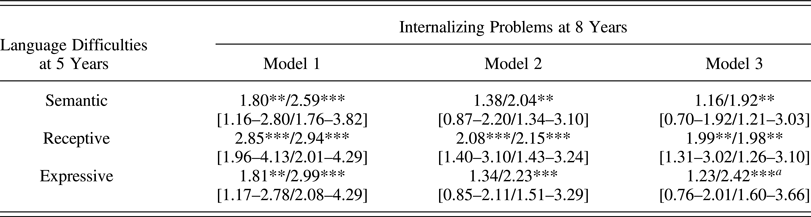
A final set of logistic regression analyses was included to further explore the importance of different types of language difficulties in the development of internalizing problems. We investigated what types of language difficulties at 5 years were associated with internalizing problems at 8 years. At 5 years, we used semantic, receptive, and expressive language difficulties as predictors. We analyzed how each type of language difficulties predicted internalizing problems at 8 years, without taking into account previous internalizing problems (Model 1). Then we adjusted for internalizing at 5 years (Model 2), and finally we controlled for family factors (Model 3).
The unadjusted results in Table 4 show how different types of language difficulties at 5 years predicted internalizing problems at 8 years, without taking into account the child's history of internalizing problems. We see here that all types of language difficulties predict later internalizing problems, for both boys and girls. Children with semantic, receptive, or expressive language difficulties at 5 years are from twice to more than three times as likely to have later internalizing problems. For both boys and girls, receptive language difficulties is a strong predictor. When we take into account a child's history of internalizing problems at 5 years, there is still an increased risk for boys with receptive language difficulties and girls with all three types of language difficulties, to develop internalizing problems between 5 and 8 years. This pattern was similar when we controlled for family factors. The only significant gender interaction in Table 4 was that expressive language difficulties predicted change in internalizing problems from 5 to 8 years when we adjusted for internalizing problems at 5 years and family factors (OR = 1.89, p = .048).
Logistic regression analysis of associations between types of language difficulties at 5 years and internalizing problems at 8 years (boys/girls)

Note: Confidence intervals are in brackets. Model 1 is adjusted for child age at return of the questionnaire; Model 2 is also adjusted for internalizing problems at 5 years; and Model 3 is also adjusted for older siblings, mother's education, mental health, and age at birth and parent native language. Language difficulties were measured by the Language20Q, and internalizing problems were measured by the Short Mood and Feelings Questionnaire/Screen for Child Anxiety Related Disorders.
aSignificant gender interaction, analyzed in full sample.
**p < .01. ***p < .001.
Discussion
Few studies have investigated the longitudinal bidirectional association between language difficulties and internalizing problems in a population-based sample. The present study builds on the sparse existing knowledge by investigating this association from an early age, by including different types of language difficulties and by investigating gender differences in this association. The results from the present study showed that the associations between language difficulties and internalizing problems are bidirectional from an early age. For girls from 18 months to 5 years, we found that language difficulties significantly predicted change in internalizing problems and internalizing problems significantly predicted change in language difficulties between each measure point. For boys, the only significant effect was that internalizing problems at 3 years predicted change in language difficulties from 3 to 5 years. Although the effects were modest at an early age, the results indicate that the longitudinal associations between language difficulties and internalizing problems are reciprocal. This is in line with previous research noting that early language difficulties, as assessed by a professional, is associated with later internalizing problems (Clegg et al., Reference Clegg, Law, Rush, Peters and Roulstone2015) and with a stable higher level of emotional problems over time (Yew & O'Kearney, Reference Yew and O'Kearney2015). It is also in line with previous research on developmental cascades noting that difficulties in one area of development affects the development of difficulties in another area (Masten & Cicchetti, Reference Masten and Cicchetti2010). Our results differ from what exists of previous research on how early internalizing problems predicted change in language skills, where no association has been found (Bornstein et al., Reference Bornstein, Hahn and Suwalsky2013). This may be due to the use of different samples and sample sizes, different measures of language and internalizing problems, or the use of dichotomous measures in our study versus continuous measures in the Bornstein study.
Gender differences
The second aim of the study was to investigate possible gender differences in the longitudinal associations between language difficulties and internalizing problems. All associations between language difficulties and internalizing problems from 18 months to 5 years were significant for girls, whereas internalizing problems at 3 years predicting change in language difficulties from 3 to 5 years significantly for both boys and girls. The latter effect could suggest a peak for boys in a vulnerability for developing co-occurring language and internalizing problems in late preschool years, as suggested by earlier literature (Henrichs et al., Reference Henrichs, Rescorla, Donkersloot, Schenk, Raat, Jaddoe and Tiemeier2013). The association was also stronger for girls from 5 to 8 years. Here we found a strong association between internalizing problems at 5 years and change in semantic language difficulties for girls only. This association was significantly different from boys, even when adjusting for family factors. A possible reason for earlier research to notice weaker effects for older children (Beitchman et al., Reference Beitchman, Brownlie and Bao2014) may be the predominance of boys in the language difficulty group in these studies. The timing of this association is, however, important as it occurs during the years of transition to school.
When looking at the association between different types of language difficulties and internalizing problems between 5 and 8 years, we found that receptive language difficulties were related to change in internalizing problems, for both boys and girls. This is in line with previous research, where samples have consisted of a larger proportion of boys, suggesting that receptive or mixed receptive and expressive language difficulties involves a higher risk of co-occurring emotional problems (Yew & O'Kearney, Reference Yew and O'Kearney2013). In addition, we found that, for girls only, semantic language difficulties were associated with change in internalizing problems. These findings are also in line with previous research, where internalizing problems have been found to be associated with phonology and semantics (van Daal et al., Reference van Daal, Verhoeven and van Balkom2007). The association between expressive language difficulties and internalizing problems was significantly stronger for girls than for boys in our study. To our knowledge, this gender difference has not been noted in previous studies.
The results in the present study differ from previous studies where no gender differences have been found (Conti-Ramsden & Botting, Reference Conti-Ramsden and Botting2008; Yew & O'Kearney, Reference Yew and O'Kearney2013). One reason for this could be the use of mother report of language difficulties in the present study versus clinical assessment in previous studies. Another reason may be the use of different cutoffs to define language difficulties for boys and girls in the present study. Previous studies using clinical samples include more boys than girls; thus, the results may reflect patterns for boys mainly. This could be seen as a double gender bias (Brownlie et al., Reference Brownlie, Beitchman, Escobar, Young, Atkinson, Johnson and Douglas2004). First, boys outnumber girls in clinical studies, either because language difficulties are more prevalent in boys or because boys lag behind in language development and are more commonly defined as cases compared to age-matched girls. Second, clinical samples include more boys because language difficulties are more commonly detected by teachers when paired with behavior problems (Stowe et al., Reference Stowe, Arnold and Ortiz1999), which is more common in boys (Wichstrøm et al., Reference Wichstrøm, Berg-Nielsen, Angold, Egger, Solheim and Sveen2012). Therefore, boys are more likely to be referred, and their language difficulties are detected. Future studies should include a larger number of girls, to ensure sufficient power to detect gender-specific patterns of development.
Mechanisms
It is possible that the association between language difficulties and internalizing problems is due to a third factor. There may be factors, either in the child or in the environment, affecting both child language and internalizing problems. In the present study, results adjusted for family factors showed similar patterns as the unadjusted results with slightly weaker effects, which indicate that the measured shared risk factors played a minimal role for the association between the two areas. There may, however, be other variables affecting the association between language difficulties and internalizing problems that we have not included in the present study. Although twin studies have suggested a common genetic link to both language difficulties and internalizing problems (Beaver, Boutwell, Barnes, Schwartz, & Connolly, Reference Beaver, Boutwell, Barnes, Schwartz and Connolly2014), this does not necessarily explain why problems in one of these areas is associated with development of problems in the other area.
Looking at the longitudinal associations between language difficulties and internalizing problems, we found that the effects were especially strong between 5 and 8 years, during the years of transition to school. This could be due to the use of more specific measurement of semantic language difficulties and that it is easier to reliably measure these constructs in older children. Another explanation may be that children start school in this period, and increased academic and social demands may make children with problems in one area more vulnerable to developing problems in other areas (Moilanen et al., Reference Moilanen, Shaw and Maxwell2010). The significant gender difference between 5 and 8 years suggests that girls with either internalizing problems or language difficulties may be especially vulnerable to developing co-occurring problems during transition to school. Girls with gender-specific language difficulties may differ from gender stereotypes and what is socially expected for girls. Although the girls defined as having language difficulties in the present study had better language functioning as a group than age-matched boys, they may be seen as more deviant compared to a social gender norm, and hence develop avoidant strategies.
The mechanism behind the association between language difficulties and internalizing problems remains, however, largely unclear. In one line of explanations, social interaction is seen as a mediator in the relationship between language difficulties and internalizing problems. Other possible mediators, such as “inner speech” and emotion regulation, have also been suggested (Fujiki et al., Reference Fujiki, Brinton and Clarke2002). In another line of explanation, internalizing problems such as withdrawal may prevent a child from participating in language learning situations. In the present study, we found support for associations between language difficulties and internalizing problems in both directions. To entangle the mechanisms behind this association should be a goal for future research.
Strengths and limitations
The results from the present study must be interpreted in the light of the following strengths and limitations. First, the results may be affected by attrition and selection bias in the MoBa study (Magnus et al., Reference Magnus, Irgens, Haug, Nystad, Skjærven, Stoltenberg and Group2006, Reference Magnus, Birke, Vejrup, Haugan, Alsaker, Daltveit and Knudsen2016). Although the MoBa participants have higher education and in general a healthier lifestyle, it has been shown that the associations in the MoBa are robust regarding potential sample bias (Nilsen et al., Reference Nilsen, Vollset, Gjessing, Skjærven, Melve, Schreuder and Magnus2009). Computer simulations have also indicated that estimates of associations between variables can be very robust against selective nonresponse even in situations where prevalences are heavily biased (Gustavson & Borren, Reference Gustavson and Borren2014). The additional attrition analysis performed in the present study supported that attrition had a minimal effect on the results. Second, we rely on mother report only, and do not have clinical assessment of either language difficulties or internalizing problems. Studies have found that parent report may be used as a valid measure of neurocognitive development in children (Johnson et al., Reference Johnson, Marlow, Wolke, Davidson, Marston, O'Hare and Schulte2004). Nevertheless, as an attempt to meet this possible shortcoming in the present study, we have validated the dichotomized language scales against mother report of clinical assessment. This validation does, however, not account for parental concern, which may affect if a child is referred to professional assessment or not. Children with language difficulties who are not referred would wrongly be included as noncases in this validation. However, the large size of the control group suggests that some misclassified cases as noncases would have minimal impact on the results. Based on this validation, we assumed that the dichotomized ASQ and Language20Q are valid measures of a group of children with a combined receptive and expressive language difficulties, which has commonly been found in the literature to be associated with other developmental problems (Beitchman et al., Reference Beitchman, Brownlie, Inglis, Wild, Ferguson, Schachter and Mathews1996; Conti-Ramsden, Reference Conti-Ramsden2013). Third, the measures of the constructs are not the same for each time point. To measure internalizing problems from 18 months to 5 years, we used items from the CBCL, and at 8 years, we used a composite score of items from the SMFQ and SCARED. Still, we find a relatively high stability for these measures between each measure point, indicating that they capture the same construct. Fourth, another limitation is the stability of language difficulties. It is possible that the lack of significant findings regarding associations for boys is due to the high stability of language difficulties over time. When we control for language difficulties at previous time points, there is little variance left to be explained by a predictor, because of this stability (Cole, Reference Cole2006). The stability is similar for boys and girls between 5 and 8 years, and we did find strong effects for girls in how internalizing problems at 5 years predicted change in semantic language difficulties. Fifth, the final limitation is that some measures that would strengthen the present study were not available in the MoBa data. For example, we were not able to investigate how internalizing problems at 5 years were associated with change in language difficulties from 5 to 8 years, other than for semantic language. Furthermore, other possible mediating and moderating variables, like academic achievement or cognitive skills, were not considered. The main strengths of the current study is the large population-based sample, the use of a model that accounts for within-time correlations and stability within constructs over time, as well as measures available from an early age.
Clinical implications
The present study focused on combined language difficulties and internalizing problems, both types of problems difficult to detect (Cohen & Horodezky, Reference Cohen and Horodezky1998). There are many negative consequences of language difficulties and internalizing problems that may be exaggerated when both problems are present, for example, social or academic problems. The results from the present study show that the reciprocal associations between these areas are present from the early preschool years. As studies have found associations between early language difficulties and later anxiety even in adults (Brownlie et al., Reference Brownlie, Bao and Beitchman2016), early detection of language difficulties is important, to avoid cascading effects.
The present results also showed that for girls, there was as strong association between parent-rated semantic language difficulties and internalizing problems during the years of transition to school. The prevalence of depressive disorders is higher in females than in males, beginning at adolescence and persisting through adult life (Piccinelli & Wilkinson, Reference Piccinelli and Wilkinson2000). Adolescent school failure has also been found to predict later depression in girls (McCarty et al., Reference McCarty, Mason, Kosterman, Hawkins, Lengua and McCauley2008). It is important to understand the precursors to this development in females.
The study of language development has been part of educational research and practice historically, as language is an elementary skill necessary for learning in school. Results on the link between language and mental health, as the present study provides, emphasize the importance of increasing the awareness of the effects of emotional problems on learning in school, as well as incorporating a focus on language in the field of mental health practice. It is important both to include the assessment of language skills when assessing mental health and to be aware of possible language difficulties in the treatment of mental health problems, which is commonly based on verbal communication.