Implications
According to present acts and regulations, farmed foxes shall have a gnawing or other enrichment object in their cages. Despite the legal status of gnawing objects, research on the welfare effects of these objects has been scarce. This study, together with the behavioral results from the same experiment, shows that gnawing bones have some value for farmed blue foxes, and thus may be used to enhance the animals’ welfare. The results leading to this conclusion suggest that foxes housed with bones have better oral health and show fewer stereotypies than foxes housed without any bones. However, the present results also show that problems may arise in pair-housed foxes because of the competition for bones. Accordingly, bones are good enrichment for farmed foxes especially if each fox can monopolize its own bone.
Introduction
Raised concern about animal welfare has increased the interest in enriching the living environments of all production animals, including farmed foxes, that is, blue fox (Vulpes lagopus, earlier Alopex lagopus) and silver fox (Vulpes vulpes). According to present acts and regulations (Europe: European Convention, 1999, see also e.g. for Finland: Ministry of Agriculture and Forestry, 1999), ‘The environment (of farmed foxes) shall be enriched with objects that provide suitable stimuli to gnaw and any other occupational material’. Concerning the gnawing objects, wooden blocks are considered as suitable material for farmed foxes (Ministry of Agriculture and Forestry, 1999).
Despite the legal status of gnawing objects, research on the welfare effects of gnawing objects has been scarce. The experiments on gnawing objects have in accordance with the Ministry of Agriculture and Forestry’s (1999) regulations been carried out mainly on wooden blocks (Korhonen and Niemelä, Reference Korhonen and Niemelä2000; Korhonen et al., Reference Korhonen, Jauhiainen, Niemelä and Sauna-aho2002). Other materials that have been studied as enrichment for foxes are straw (Korhonen et al., Reference Korhonen, Jauhiainen, Niemelä and Sauna-aho2002) and dog toys (Pedersen, Reference Pedersen2004). The experiments with wooden blocks have shown that wooden objects may indeed have some positive effects on the welfare and health of farmed blue foxes. To begin with, blue foxes interact with wooden blocks quite frequently if they are given the opportunity for this, that is, the animals indicate some enrichment value for wooden blocks (Korhonen and Niemelä, Reference Korhonen and Niemelä2000). Furthermore, wooden blocks seem to stimulate play behavior and prevent the development of stereotypic behavior (Korhonen et al., Reference Korhonen, Jauhiainen, Niemelä and Sauna-aho2002). Blue foxes that have an opportunity to interact with wooden blocks have better teeth and oral health (Korhonen et al., Reference Korhonen, Jauhiainen, Niemelä and Sauna-aho2002) as well as a tendency for better reproductive success than the foxes housed without the block (Korhonen and Niemelä, Reference Korhonen and Niemelä2000). However, no significant differences in the physiological (welfare) variables, that is in blood composition and urinary cortisol-creatinine (C-C) ratio, between the foxes housed with or without the block have emerged (Korhonen et al., Reference Korhonen, Jauhiainen, Niemelä and Sauna-aho2002). Furthermore, wooden blocks have markedly increased the incidence of hyperemia in the mucous membrane of stomach and intestine, possibly because of the swallowed splinters of wood (Korhonen et al., Reference Korhonen, Jauhiainen, Niemelä and Sauna-aho2002). In summary, in spite of some positive effects on blue foxes’ welfare, the wooden blocks may also jeopardize the welfare of these animals.
Possible negative welfare effects of any enrichment should be given the greatest attention during evaluation studies (see Newberry, Reference Newberry1995). Therefore, the fundamental aim in this study was to use gnawing objects that would not inflict gastric hyperemia in such a degree as wooden blocks have been observed to inflict (see Korhonen et al., Reference Korhonen, Jauhiainen, Niemelä and Sauna-aho2002). Our hypothesis was that a more natural material, bone, could be a solution for this specific problem. Along with this hypothesis, we assumed that if foxes valued gnawing objects in general, and if the negative effects of gnawing objects (i.e. hyperemia) could be eliminated, then the possible positive effects of gnawing objects would be observed also in other physiological welfare variables as well. Accordingly, we assessed in this study physiology and health, that is weight development, urinary C-C ratio, serum cortisol level after adrenocorticotropin hormone (ACTH) administration, internal organ masses and incidence of gastric hyperemia and bite marks on the leather side of the foxes’ pelts as well as dental and overall oral health, in male-female pairs of blue foxes that were housed either with or without a possibility to interact with a bone (cattle femur) during their growing season (July to December).
Material and methods
The experiment was approved by the Institutional Animal Care and Use Committee of the University of Kuopio, and carried out at the Research Station of the University of Kuopio in Juankoski (Finland).
Animals and housing
There were 16 male-female sibling pairs of blue foxes, born in May to June, in this study. For the first 4 weeks of their lives, the pairs lived in an outdoor fur shed with their mother and other siblings in traditional fox cages (115 × 105 × 70 cm, L × W × H) furnished with a resting platform and a nest box. At the age of 4 weeks, the families and their nest box were transferred to the experimental cage systems and allocated into two experimental groups: bone group and control group. Each experimental cage system consisted of two traditional cages, each furnished with a platform (105 × 30 cm, L × W, 28 cm from the ceiling of the cage) made of plastic-coated wire mesh. Cages were connected together with openings (23 × 28 cm, L × W). When the cubs were small and could not climb onto the platform, the openings between the two cages were situated on both the floor level and the platform level. In the eight double cage systems for the families of the bone group, one frozen and then defrosted cattle femurbone was given for the animals into one of the available cages. No bones were given for the eight families of the control group.
The natal nest boxes were removed when the cubs were 7 to 8 weeks old. Furthermore, the openings on the floor level between the two cages were closed at the cubs’ age of 7 to 8 weeks. At the age of 8 weeks (July), the vixen and the extra cubs were removed from the families, and only the male-female sibling pair was left in each of the double cage systems. Each bone that had been given for each family in the bone group was replaced with two new frozen and then defrosted cattle femurs (average bone weight was 2760 g at the beginning of the experiment). These two bones were put into one of the two cages available for each male-female pair in bone group. The foxes in bone group could not move the bones from one cage to another because the opening between the cages was at that time only at the level of the platform, that is approximately 40 cm above the cage floor. The male-female pairs in control group had no bones in their double cage systems. However, to measure how the weight of the bone changes without any manipulation, eight bones (control group bones, i.e. no animal could gnaw them) were placed in empty fox cages situating in the same outdoor fur shed.
Accordingly, the juvenile pairs in bone group had one bone when they were 4 to 8 weeks old and two bones from the age of 8 weeks until their pelting, in December. There were two exceptions in this schedule though. As this experiment also aimed at studying how the foxes value bones and how the bones affect the behavior of foxes, the experiment included two 10-day deprivations of the bones, carried out in the late-August (at the cubs’ age of 11 to 14 weeks) and at the beginning of October (at the foxes’ age of 18 to 21 weeks) (see Koistinen et al., Reference Koistinen, Turunen, Kiviniemi, Ahola and Mononen2009). During these deprivations, the foxes in bone group had no bones in their cages.
Foxes were fed according to the recommendations given by the Finnish Fur Breeders’ Association with fresh fur animal feed twice a day until the end of November, thereafter once a day. Daily feed portion per animal was the same for each group and was delivered equally to the both available cages. Water was available ad libitum, except in sub-zero temperatures (November to December) when fresh water was provided twice a day.
During the whole experiment, only one female (from the bone group) was excluded from the experiment. This female had epileptic-like fits at the beginning of December and was, therefore, euthanized without delay.
Measured variables
To measure how much the foxes gnawed the bones and how the weight of the bones changed without any manipulation, all bones, that is the bones that were given for the juveniles in bone group and control group bones placed in empty fox cages, were weighed seven times during the experiment: in early and late June, in mid-August and mid-September, at the beginning of October and November and after the pelting in mid-December.
Animals were weighed at weaning (June to July, at the age of 8 weeks), in mid-September and at pelting. To assess the hypothalamic-pituitary-adrenal axis activity, urinary cortisol as a non-invasive method to measure cortisol levels and serum cortisol after ACTH administration as a measure of maximal cortisol production capacity (see Broom and Johnson, Reference Broom and Johnson1993) were determined. By measuring cortisol levels during the two deprivation periods, that is before, during and after the foxes were deprived of the bones (see Koistinen et al., Reference Koistinen, Turunen, Kiviniemi, Ahola and Mononen2009), it is possible to get information about the effects of deprivations per se (samples collected during and after the deprivations) as well as long-term effects of access v. no access to the gnawing bones (samples before the deprivations). The 24 h urine sample of foxes was collected on three occasions associated with each of two deprivation periods (see Koistinen et al., Reference Koistinen, Turunen, Kiviniemi, Ahola and Mononen2009), that is in mid-August (at the cubs’ age of 11 to 14 weeks) and at the beginning of October (at the cubs’ age of 18 to 21 weeks). Urine samples were collected from trays placed under each double cage system just before the 10-day deprivation periods, on the 6th deprivation day and on the 8th day after the deprivation periods. Each urine sample represented a pooled sample from the male and the female of a cage system. Urinary cortisol was analyzed by a competitive immunoassay technique (Coat-A-Count Cortisol Assay by Diagnostic Products Corporation, Los Angeles, CA, USA). The concentration of creatinine was analyzed in the University Hospital of Kuopio (Finland) by kinetic Jaffe’s reaction. Owing to the variation in the dilution of urine, the content of cortisol in the urine was expressed as the C-C ratio (Novak and Drewsen, Reference Novak and Drewsen1989; Lasley and Kirkpatric, Reference Lasley and Kirkpatric1991).
To measure the long-term stress, the foxes were intramuscularly injected with synthetic ACTH (0.25 mg tetracosactide, Synacthen 0.25 mg/ml, Novartis Finland Oy, Espoo, Finland) at pelting in mid-December. Two hours after the injection, the foxes were euthanized by electrocution according to the methods recommended by the Standing Committee of the European Convention for the Protection of Animals Kept for Farming Purposes (European Convention, 1999). Blood samples were immediately drawn with cardiac puncture. The serum cortisol level, as a maximum response to ACTH administration (see Broom and Johnson, Reference Broom and Johnson1993), was analyzed by a competitive immunoassay technique (Coat-A-Count Cortisol Assay).
After the euthanasia of the animals, a veterinarian monitored from the foxes’ teeth the incidence and severity of dental calculus on a subjective four-point scale (0 to 3; 0 – no dental calculus, 1 – mild dental calculus (calculus in some spots of some teeth), 2 – moderate dental calculus and 3 – severe dental calculus (several teeth covered more or less with calculus). The veterinarian also examined the oral cavity of the foxes for other possible oral diseases.
After pelting, brain, heart, liver, spleen and the left and right adrenal were removed from the carcasses, cleaned and weighed, the masses being used as stress-related variables (e.g. Ferchmin et al., Reference Ferchmin, Bennett and Rosenzweig1975; Malheiros et al., Reference Malheiros, Moraes, Collin, Decuypere and Buyse2003; Mormede et al., Reference Mormede, Andanson, Auperin, Beerda, Guemene, Malmkvist, Manteca, Manteuffel, Prunet, van Reenen, Richard and Veissier2007). Adrenal data were lost from one bone group male and one control group male because of the failures in dissection of adrenals in these cases. An experienced person checked out the foxes’ stomach for possible hyperemia.
The pelts were fleshed and cleaned. Thereafter, the incidence and severity of bite marks, as a possible sign of aggressions, was evaluated from the leather side of the pelts. The severity of bite marks was evaluated with a subjective six-point scale (0 to 5, 0 – no marks, 1 – one to three single small marks, 2 – more than three single marks, 3 – as 2, but in addition small areas of incalculable number of marks, 4 – large areas of incalculable number of marks and 5 – almost the whole skin covered with marks).
Statistical analyses
As the two bones in each double cage systems in bone group were not identifiable one-to-one, the average mass of each two bones was used in statistical analysis. Differences in the bone masses between the bones that were given for the foxes in bone group and control group bones placed in empty fox cages were analyzed with General Linear Model (GLM) for repeated measures.
As the two siblings in each cage system were dependent on each other, Linear Mixed Model was used in the analyses of body masses (fixed factors: sex, group and month; random factors: litter (i.e. cage mate) and animal), as well as serum cortisol level after ACTH administration and internal organ masses (fixed factors: sex and group; random factor: litter (i.e. cage mate).
Urinary C-C ratios, representing pooled ratios from the male and the female of each cage system, were analyzed with GLM for repeated measures.
The incidences of bite marks and dental calculus were analyzed with χ 2 test after re-grouping the variables into dichotomous groups (0 – no bite marks/no calculus and 1 – bite marks/calculus). The severity of bite marks and calculus between the sexes and between the groups were analyzed with Wilcoxon signed rank test and Mann–Whitney test, respectively. The severities of bite marks and dental calculus were analyzed further between the experimental groups separately for the males and females with Mann–Whitney test and between the sexes separately for bone and control group foxes with Wilcoxon signed rank test. The results of incidence of gastric hyperemia and oral health (other than calculus) of the foxes are presented only descriptively.
P-values smaller than 0.05 are considered as statistically significant, 0.1 < P < 0.05 as tendencies and P > 0.1 as not significant (ns). Results are presented as mean ± s.e.
Results
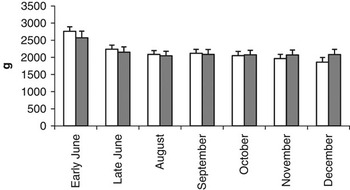
The mass of all bones, that is the bones that were given for the foxes in bone group and control group bones placed in empty fox cages, decreased with advancing time, although this decrease in the mass was more pronounced in the bones that the foxes could gnaw than in the bones that were placed in empty fox cages (Figure 1).
Average mass (g, mean + s.e.) of two bones within each cage system in bone group (open bars) and in empty cages (solid bars) in early and late June, in the mid-August and mid-September, at the beginning of October and November and 1 day after the pelting in the mid-December. Significances (General Linear Model for repeated measures): group F 1,14 = 0.000, ns; month F 3,38 = 172.39, P = 0.000; month × group F 3,38 = 13.58, P = 0.000.

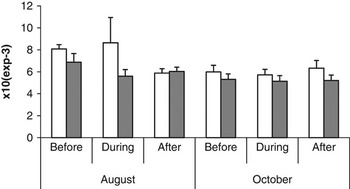
No significant differences were observed in the urinary C-C ratios between the pairs of foxes in bone and control group (Figure 2). The average urinary C-C ratios were higher during the first deprivation period (August) than during the second deprivation period (October). There were no significant differences in the urinary C-C ratios between the different phases (before, during or after the deprivations). The serum cortisol level after ACTH administration at pelting (December) did not differ between the bone and control group foxes, or between the males and females (bone group: 333 ± 8 and 345 ± 33 nmol/l, control group: 333 ± 17 and 363 ± 25 nmol/l in males and females, respectively; significance: sex F 1,26 = 0.83 (ns), group F 1,26 = 0.16 (ns) and sex × group F 1,26 = 0.14 (ns).
Urinary cortisol-creatinine (C-C) ratio (×10−3, mean + s.e.) of juvenile blue foxes in bone group (open bars) and control group (solid bars) before, on the 6th deprivation day of and on the 8th day after the deprivation periods in late-August and at the beginning of October. Group: bone v. control group; period: August v. October; phase: before v. during v. after the deprivation period. Significances (General Linear Model for repeated measures): group F 1,14 = 2.56, ns; period F 1,14 = 7.62, P = 0.015; period × group F 1,14 = 0.41, ns; phase F 1,18 = 0.76, ns; phase × group F 1,18 = 0.69, ns; phase × period F 1,18 = 1.63, ns; phase × period × group F 1,18 = 1.73, ns.

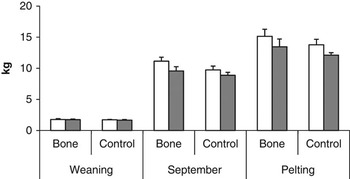
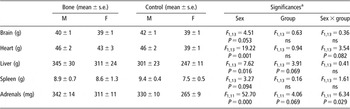
There was no significant difference in the body masses between the bone and control group foxes (Figure 3). In general, the males grew faster and were heavier than the females. There were no significant differences in the masses of brain, heart and spleen at pelting between the two groups (Table 1). All these masses, as well as the masses of liver and adrenals, were higher or at least tended to be higher in the males than in the females. The mass of liver tended to be higher in bone group foxes than in control group foxes. Also the mass of adrenals tended to be higher in bone group foxes than in control group foxes. The difference in the mass of adrenals between the males and females was greater in control group than in bone group.
Body mass (kg, mean + s.e.) of juvenile male (open bars) and female (solid bars) blue foxes in bone and control group at the cubs’ age of 8 weeks (weaning in July to August), in mid-September and at pelting (11 December). Significances (Linear Mixed Model): group F 1,14 = 1.90, ns; sex F 1,13 = 8.07, P = 0.014; month F 2,54 = 664.82, P = 0.000; month × group F 2,54 = 2.25, ns; month × sex F 2,54 = 3.39, P = 0.041; group × sex F 1,13 = 0.14, ns; month × group × sex F 2,54 = 0.17, ns.

Masses of brain, heart, liver, spleen (g) and adrenals (mg) in the juvenile blue foxes in the bone and control group. Group: bone group v. control group

M = male; F = female; ns = not significant.
aLinear Mixed Model.
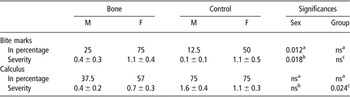
There was no difference in the incidence of bite marks between the bone and control group foxes (Table 2). Fewer males than females had bite marks on their skins. Also the severity of bite marks was less in males than in females. In bone group, females tended to have more bite marks than males (P = 0.084, Wilcoxon signed rank test), whereas no such difference or tendency was evident in the control group (ns, Wilcoxon signed rank test). There was no difference in the severity of bite marks between the experimental groups either in males or in females (for both: ns, Mann–Whitney test).
Percentage of animals with bite marks on the leather side of their skin, severity of bite scars on a subjective scale where 0 denotes ‘no bite marks’ and 5 ‘almost the whole skin covered with marks’ (mean ± s.e.), percentage of animals with dental calculus in December and severity of dental calculus on a subjective scale where 0 denotes ‘no dental calculus’ and 3 ‘severe dental calculus’ (mean ± s.e.) in the juvenile blue foxes in the bone and control group

M = male; F = female; ns = not significant.
aχ 2 test.
bWilcoxon signed rank test.
cMann–Whitney test.
No significant differences emerged in the incidence of dental calculus between the bone and control group foxes or between the males and females (Table 2). The severity of dental calculus was less in bone than in control group foxes, whereas there was no sex difference in this variable. The males in the bone group had less dental calculus than the males in the control group (P = 0.038, Mann–Whitney test), whereas no such difference emerged in females (ns, Mann–Whitney test). There was no significant difference in the severity of dental calculus between the sexes in either the bone or control group (for both: ns, Wilcoxon signed rank test). In the bone group, no fox had any gingivitis or ulcers in oral cavity. In the control group, one fox had a mild gingivitis and three foxes had small ulcers in their oral cavity.
All individuals, regardless of the experimental group, had some hyperemia in their stomach.
Discussion
In this study, we assessed physiological and health effects of gnawing bones in farmed blue foxes. We did not analyze the behavior of the animals in this study but the detailed behavioral data were published elsewhere (Koistinen et al., Reference Koistinen, Turunen, Kiviniemi, Ahola and Mononen2009). The present results are, however, discussed in the light of the behavioral results.
The decrease of the mass of bones that were in the bone group foxes’ cages was greater than that of the bones kept in empty cages (approximately 900 and 500 g per bone, respectively), suggesting that the foxes gnawed the bones at least occasionally. This finding is supported by the behavioral observations, which show that the foxes in the bone group interacted with the bones in 4 ± 1% of observations in August and September and 3 ± 1% of observations in November (Koistinen et al., Reference Koistinen, Turunen, Kiviniemi, Ahola and Mononen2009). Of all observations with interaction with the bones, 55 ± 4% included gnawing the bone. These results show that gnawing bones have some enrichment value for farmed foxes. Furthermore, the present results show that bones are long-lasting, feasible gnawing objects for farmed foxes. This suggests that farmers might approve gnawing bones as an enrichment object for their animals as bones are cheap and the farmers do not have to replace the object every day/every week.
We hypothesized that bone as a natural gnawing material for foxes might ease the problem of gastric hyperemia observed in foxes with a possibility to interact with wooden blocks (Korhonen et al., Reference Korhonen, Jauhiainen, Niemelä and Sauna-aho2002). However, our results revealed that all foxes in our experiment, regardless whether they had or did not have gnawing bones, had some kind of inflammation in their stomach. Accordingly, our results cannot reveal true pros and cons of bones as regards gastric health of farmed foxes. However, our results show that gastric hyperemia is a common phenomenon in farmed blue foxes, and more research is needed for assessing the possible reasons for this.
The body mass of the animals and the masses of several organs were assessed in this study since previous studies have suggested that experienced stress (or increased level of glucocorticoids) may retard growth (e.g. Buyse et al., Reference Buyse, Decuypere, Sharp, Huybrechts, Kuhn and Whitehead1987; Post et al., Reference Post, Rebel and ter Huurne2003; Lin et al., Reference Lin, Sui, Jiao, Buyse and Decuypere2006), inflict involution of spleen (Malheiros et al., Reference Malheiros, Moraes, Collin, Decuypere and Buyse2003; Post et al., Reference Post, Rebel and ter Huurne2003), and increase the mass of adrenals (Selye, Reference Selye1950; see Mormede et al., Reference Mormede, Andanson, Auperin, Beerda, Guemene, Malmkvist, Manteca, Manteuffel, Prunet, van Reenen, Richard and Veissier2007) and liver (Buyse et al., Reference Buyse, Decuypere, Sharp, Huybrechts, Kuhn and Whitehead1987; Malheiros et al., Reference Malheiros, Moraes, Collin, Decuypere and Buyse2003; Lin et al., Reference Lin, Sui, Jiao, Buyse and Decuypere2006). The mass of heart, for its part, can be used as an indicator of exercise (Duncan et al., Reference Duncan, Williams and Lunch1998; Diffee et al., Reference Diffee, Seversen and Titus2001), whereas the mass of brain has been observed to increase in enriched living conditions for example in mice and rats (Henderson, Reference Henderson1970; Ferchmin et al., Reference Ferchmin, Bennett and Rosenzweig1975; Rosenzweig and Bennett, Reference Rosenzweig and Bennett1996; Iso et al., Reference Iso, Simoda and Matsuyama2007). Of these variables, only the masses of liver and adrenals suggested that gnawing bones might have some effects on the welfare of these animals: both the mass of liver and mass of adrenals tended to be higher in bone than in control group foxes. This finding suggests that the foxes in bone group were the ones that had been experiencing more stress, not the un-enriched control group foxes. However, there were no significant differences between the experimental groups in the urinary C-C ratios at any measured time point and in the serum cortisol level after ACTH administration in December. Furthermore, the behavioral results by Koistinen et al. (Reference Koistinen, Turunen, Kiviniemi, Ahola and Mononen2009) show that the bones are valued by the foxes. Unfortunately, in a study by Koistinen et al. (Reference Koistinen, Turunen, Kiviniemi, Ahola and Mononen2009) the male and female within each cage system could not be identified individually. Accordingly, the results cannot tell us whether only one of the foxes within a cage system used the bones and what would be the accurate correlation between the bone use and, for example, stereotypic behavior. Despite this objection, the behavioral results show that there was a rebound-effect in the interaction with the bones after the deprivation periods (Koistinen et al., Reference Koistinen, Turunen, Kiviniemi, Ahola and Mononen2009). Furthermore, the foxes that had bones showed less oral stereotypic behavior and more play behavior, especially more solitary play behavior with the bones, than the foxes that did not have bones. Therefore, it might be speculated that the signs of reduced welfare in bone group foxes, the increased liver and adrenal masses, arose because of the competition for the bones.
Competition for limited resources has been observed in farmed fur animals with other enrichment objects, too (Pedersen et al., Reference Pedersen, Jeppesen and Jeppesen2004). The effects of competition are often observed in subordinate individuals, for example in the females of male-female pairs of farmed blue foxes (see Wakely and Mallory, Reference Wakely and Mallory1988). The present result on the adrenal mass suggests that if there was competition for the bones, this competition was especially taxing for females in the bone group. The results on the bite marks supported this possibility. In bone group, the females tended to have more bite marks than the males whereas no such difference was evident in control group.
The beneficial effects of gnawing bones came out in the dental health of the foxes: the dental calculus observed in bone group foxes was not as severe as it was in control group foxes. This was the case even though the bone group foxes interacted with the bones not more than in 3% to 4% of observations (Koistinen et al., Reference Koistinen, Turunen, Kiviniemi, Ahola and Mononen2009). The result of the beneficial effects of gnawing objects on dental health is in accordance with the results observed in Korhonen et al. (Reference Korhonen, Jauhiainen, Niemelä and Sauna-aho2002). It is, however, worthwhile to note that alleviated calculus was observed especially in bone group males. Accordingly, it seems that the possibly subordinate females could not enjoy of the bones in such a degree as the males. This result supports the earlier mentioned hypothesis of competition for the bones between the male and female housed in pair.
Conclusions
The physiological effects of the possibility to interact with bones were either non-significant or suggested that competition for bones may jeopardize the welfare of subordinate individuals. Owing to the possible competition for bones in the pair-housed foxes, the bones should be given to the animals so that neither of the animals can have monopoly over them but both individuals can enjoy of them. The results, further, show that gnawing bones are beneficial for the dental health of farmed foxes.
Acknowledgements
The authors would like to thank Dr Vet. Med. Heli Lindeberg for her help in assessing the oral and gastric health of the foxes, and Mrs Maija Miskala for examining the foxes’ stomach for gastric hyperemia. The study was supported by the Fur Animal Welfare Research Council and the Finnish Fur Breeders’ Association.