Infections are a major cause of morbidity and mortality worldwide. 1 Common infectious diseases are still among the top 10 leading causes of death,Reference Willmott, Nicholson, Busse, MacArthur, Brookes and Campbell 2 , Reference Liu, Johnson and Cousens 3 and healthcare-associated infections (HAIs) are recognized as a major cause of preventable death in healthcare settings. Furthermore, HAIs are increasingly associated with antimicrobial resistance.Reference Pittet, Hugonnet and Harbarth 4 – 10
Hands are frequently implicated in episodes of cross-transmission of pathogens, contributing as vehicles to the spread of infections both in the community and in hospitals.Reference Pittet, Hugonnet and Harbarth 4 – Reference Willmott, Nicholson, Busse, MacArthur, Brookes and Campbell 11 The central role of hand hygiene in preventing infections has long been recognized,Reference Bifulco, Capunzo, Marasco and Pisanti 12 , Reference Stewardson and Pittet 13 and today, hand hygiene is considered the most important measure to prevent HAI.Reference Pittet, Hugonnet and Harbarth 4 – 10 In 2006, our group proposed a model with 5 essential steps for cross-transmission of pathogens via the hands of healthcare workers (HCWs).Reference Pittet, Allegranzi and Sax 14 This model was used to identify the key moments in which a hand-hygiene action could stop cross-transmission during clinical care, summarized in the widely used WHO “My 5 Moments for Hand Hygiene.”Reference Sax, Allegranzi, Uçkay, Larson, Boyce and Pittet 15 The final step in cross-transmission of bacteria through HCW hands occurs when the caregiver’s contaminated hands come into direct contact with a patient.Reference Pittet, Allegranzi and Sax 14 , Reference Loftus, Koff and Burchman 16 – Reference Morgan, Liang and Smith 23 Interestingly, the correlation between the burden of contamination on HCW hands and the likelihood of transmission to the patient has not been established. This information is essential for the development, regulation, and comparison of products applied for hand hygiene, ie, plain or antimicrobial soaps and alcohol-based hand rubs (ABHRs).Reference Rotter, Sattar, Dharan, Allegranzi, Mathai and Pittet 24 To date, the most widely used tests to validate the microbiological efficacy of hand-hygiene products are the European Norm 1500 (EN 1500) and the American Society for Testing and Materials recommendation E2755-10 (ASTM E2755-10). 25 , 26 However, the end points proposed by these norms are arbitrary rather than evidence based. Furthermore, several studies have addressed the dynamics of bacteria and virus transmission in the community, yet none are supported by evidence-based data to adjust for the probability of cross-transmission according to the burden of hand contamination.Reference Real and Biek 27 , Reference Chowell, Nishiura and Viboud 28
Our objective was to evaluate the likelihood of Escherichia coli cross-transmission from one artificially contaminated hand to another person’s hand, as a function of the burden of contamination. In addition, we aimed to define a threshold in the level of hand contamination below which cross-transmission is not expected in hand-to-hand contact.
METHODS
Study Setting, Participants, and Eligibility Criteria
We conducted a laboratory-based experimental study at the microbiology laboratory of the Infection Control Program, University of Geneva Hospitals (HUG) and Faculty of Medicine, Geneva, Switzerland. Participants were HCWs with several years of training in infection control, with particular expertise in hand hygiene. All participants had short fingernails according to international recommendations.Reference Boyce and Pittet 5 , 6 Exclusion criteria included any skin disorder, current use of systemic or topical antimicrobial agents, use of immunosuppressive treatment, or presence of artificial fingernails.
The study was approved by the institutional review board of HUG and all participants signed written informed consent prior to the experiment.
Experimental Design
All experiments were based on the European Norm (EN) 1500 standard. 25 Escherichia coli was chosen because it is the bacteria used in the EN 1500; it is also frequently associated with HAI.
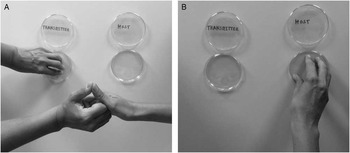
To quantify hand contamination with E. coli associated with hand-to-hand transmission, an experiment that consisted of 4 trials was designed with a pair of HCWs. In each trial, one HCW (transmitter) had both hands contaminated with E. coli before holding with his right hand another HCW’s right hand (host) for 1 minute (transmission procedure; Figure 1A). At the same time, the transmitter’s left hand was sampled (Figure 1A). After 1 minute, the host’s hand that was being held was sampled to assess the degree of cross-transmission (Figure 1B). This trial was performed 4 times in each experiment with increasing concentrations of bacteria in the contamination suspensions. Subsequently, on the same experimental day, HCW roles (transmitter vs host) were swapped, and the experiment was repeated. In total, 6 HCWs participated in the study. All pairwise combinations of HCWs were performed, for a total of 30 experiments and 120 unique trials. Among the 6 participants, 3 were female.
Experimental study design. A. Hand position during the 1-minute transmission procedure: while the right hand of the transmitter holds the right hand of the host; the left hand is being sampled according to the fingertips method. B. After the 1-minute transmission procedure, the hand of the host that had been in contact with the hand of the transmitter is also sampled according to the fingertips method.

Contamination, Transmission, and Sampling Procedures
The reference strain E. coli ATCC 10536 was grown according to EN 1500 to obtain 4 homogeneous suspensions containing increasing concentrations of bacteria: 103 cfu/mL, 104 cfu/mL, 105 cfu/mL, and 106 cfu/mL.
In brief, prior to each experiment and between each individual trial, participants were asked to wash their hands with 5 mL of a plain liquid soap for 1 minute and to handrub with 3 mL of 2-propanol 60%. 25 All procedures were performed according to the 6 specific steps recommended by WHO. 6 , 7 Participants were also instructed to avoid any accidental contamination during the entire study procedure.
The hands of the HCW acting as the transmitter were artificially contaminated by being immersed into the bacterial suspension up to the mid-carpals for 5 seconds. They were then held up to dry for 3 minutes, after which they were considered ready for a transmission episode.
The position to simulate a transmission episode was as follows: the dorsal side of the fingers of one participant (transmitter) are placed in the palm of the other participant (host) with fingers interlocked for 1 minute (Figure 1A). During the 1-minute transmission trial, the left hand of the transmitter was sampled according to the procedure described in EN 1500 (ie, the fingertips method). 25 After the transmission trial, the hand of the host that had been in contact with the transmitter was sampled in the same way.
The fingertips method of microbiological sampling consists in having all 5 fingertips rubbed in a petri dish of 90-mm diameter containing 10 mL of tryptic soy broth (TSB) for 1 minute. 25
Dilution and Plating of Samples
Each sample was studied in 4 different dilutions to accurately estimate bacterial counts. While dilutions for the transmitter samples ranged from 10-4 to 10-7, they ranged from 10-1 to 10-5 for the host samples. To maximize bacterial detection at lower levels of transmission, host samples were also filtered with EZ-Pak Membrane Filters (Merck Milipore, France). The dilution and filtration figures derived from preliminary tests were used in the study design.
After dilution, 1-mL samples were distributed in tryptic soy agar plates within 30 minutes of recovery and incubated at 36±1°C for 24–48 h. After filtration, the filters were also incubated in tryptic soy agar plates at 36±1°C for 24–48 h.
Hand Size Calculation
Hand surface area of each participant was calculated and categorized as small (≤375 cm2), medium (376–424 cm2), or large (≥425 cm2), as described elsewhere.Reference Hsu and Yu 29 , Reference Bellissimo-Rodrigues, Soule, Gayet-Ageron, Martin and Pittet 30 The median hand surface area was 434 cm2 (standard deviation [SD], 97 cm2). According to hand-size categorization, 2 participants had small hands, 2 had medium-sized hands, and 2 had large hands.Reference Hsu and Yu 29 , Reference Bellissimo-Rodrigues, Soule, Gayet-Ageron, Martin and Pittet 30
Study Outcomes and Statistical Analysis
Bacterial colony-forming units (cfu) were counted by visual inspection of each plate, adjusted for the correspondent dilution factor, and converted to log10. For each trial, we evaluated bacterial transmission qualitatively and quantitatively. The bacterial counts detected on the hand of the host were transformed into a dichotomous variable for qualitative assessment of transmission. Transmission was defined if at least 1 cfu was detected on the hand of the host; otherwise it was considered no-transmission. The bacterial counts were evaluated as a continuous variable (colony-forming unit counts on the host hands) for quantitative evaluation.
The primary study outcome was the probability of transmission of at least 1 cfu to the host’s hand as a function of the bacterial counts on the transmitter’s left hand. The secondary study outcome was the burden of bacteria transmitted to the host’s hand as a function of bacterial counts on the transmitter’s left hand.
We used a mixed logistic regression model with a random effect on the subject to assess the association between the transmission and the bacterial count on the hands of the transmitter. We adjusted the model for the hand-size categories of the transmitter and gender. We also estimated the probability of cross-transmission predicted by the model and presented it as a function of the bacterial count on the hands of the transmitter. Statistical analyses were performed using Stata version 14 (StataCorp, College Station, TX). Statistical significance was defined as P<.05 (2-sided).
RESULTS
The mean bacterial counts measured on the left hands of the transmitters after immersion in E. coli suspensions of 103 cfu/mL, 104 cfu/mL, 105 cfu/mL, and 106 cfu/mL were 1.3 log10 (SD, 0.57), 2 log10 (SD, 0.63), 3.1 log10 (SD, 0.76), and 4 log10 (SD, 0.49), respectively. From the 120 transmission trials performed 8 (6.5%) were noninterpretable due to overgrowth of coagulase-negative staphylococci from the participants’ own microbiota. Thus, the study findings are based on 112 trials.
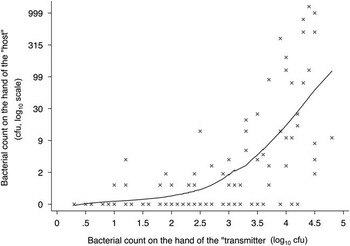
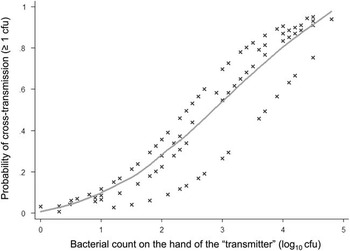
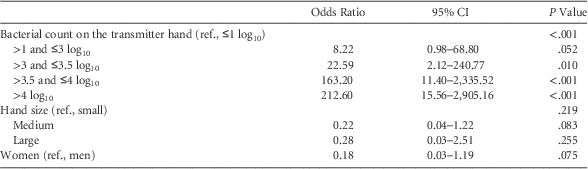
The numbers of bacteria retrieved from host hands as a function of the total count of bacteria retrieved from the transmitter hand are shown in Figure 2. The probabilities of cross-transmission obtained from the model as a function of the bacterial count on the hands of the transmitter are shown in Figure 3. By multivariate analysis, the transmission to host hands was significantly associated with the bacterial count on the transmitters hand after adjustment for gender and transmitter hand size (P<.001) (Table 1).
Cross-transmission of Escherichia coli from transmitter to host. Bacterial count transmitted to the hand of the host, according to the original level of contamination on the left hand of the transmitter; N=112 paired results. The logarithm of zero is not mathematically defined, but we consider it important to show in the graph when the transmission experiment resulted in zero bacteria on the hands of the host. Thus, we have added the value of 1 to all results of the y variable and corrected for this artefact in the shown y-axis labels. cfu, colony-forming units; log, logarithmic.

Probability of cross-transmission of Escherichia coli from transmitter to host. Likelihood of E. coli cross-transmission (at least 1 cfu) to the hand of the host, according to the original level of contamination on the left hand of the transmitter; N=112 paired results. The probability of cross-transmission predicted by the model is presented as a function of the bacterial count on the left hand of the transmitter. cfu, colony-forming units; log, logarithmic.

Likelihood of Escherichia coli Cross-TransmissionFootnote a for Bacterial Burden on the Transmitter Hand After Adjustment for Gender and Transmitter Hand Size According to Multivariate AnalysisFootnote b

NOTE. cfu, colony-forming units; CI, confidence interval; log, logarithmic; ref., reference.
a Bacterial transmission is considered if at least 1 cfu of E. coli is found on the host hand.
b From a mixed logistic regression model with a random effect on the intercept (SD ±1.41e-10 around the intercept).
DISCUSSION
Healthcare worker hands are implicated in at least 50% of all episodes of HAI. 6 , Reference Pittet, Allegranzi and Sax 14 Despite this, the minimum bacterial load on hands necessary to establish bacterial cross-transmission remains unknown,Reference Pittet, Allegranzi and Sax 14 – Reference Rotter, Sattar, Dharan, Allegranzi, Mathai and Pittet 24 as does the necessary degree of “decontamination” produced by hand-hygiene action to prevent transmission events in health care.Reference Boyce and Pittet 5 , 6
In the present study, we developed an experimental model to determine how the bacterial load on one hand affects the risk of cross-transmission to another following a single 1-minute hand-to-hand contact. We have demonstrated the direct relationship between the bacterial load on HCW hands and the likelihood of cross-transmission. We also observed that, under the described experimental conditions, at least 1 log10 cfu of E. coli must be present on HCW hands to be potentially transmitted to another individual. However, this conclusion is limited by the low number of experiments performed at the lowest concentration range, which explains the large confidence interval (95% CI, 0.98–68.8) observed when transmission with a ≤1 log10 contamination in the transmitter hand was compared with transmission resulting from a contamination ranging from >1 to ≤3 log10. Our findings need to be further explored and confirmed by studies specifically addressing low concentration ranges, as well as other potential pathogens such as Staphylococcus aureus, Pseudomonas aeruginosa, Enterococcus spp., fungi or viruses. Should future studies show equivalent results to those presented here, 1 log10 cfu could be considered as a microbiological endpoint for the development and regulation of products intended to be used for hand hygiene in healthcare. This hypothetical situation would call for a revision of the microbiological end points established by both the European and the American norms (EN 1500 25 and ASTM E2755-10, 26 respectively) for evaluating the antimicrobial efficacy of hand-hygiene products.
Our model could also be used to increase the understanding of the transmission dynamics of other pathogens outside the healthcare setting. Hand-to-hand contact is considered to play a relevant role on influenza virus transmission, leading WHO and the United States Centers for Disease Control and Prevention (CDC) to recommend preventive measures such as hand hygiene and cough etiquette by any person to stop the spread of the virus during flu seasons.Reference Brankston, Gitterman, Hirji, Lemieux and Gardam 31 – 34
Our study has several limitations. First, we worked at the limit of bacterial detection by culture. Thus, it is possible that very small quantities of bacteria may have been transmitted to the host hand even when cultures yielded negative results. However, we question whether this has any clinical implication because E. coli is certainly more likely to grow in culture media than on human skin. Thus, this small quantity of bacteria eventually transmitted to a real patient would probably not be sufficient to establish colonization and infection. Second, our results are based on the premise that both transmitter hands were contaminated with the same inoculum during the experimental procedure. This reasoning has been used in prior studies.Reference Bellissimo-Rodrigues, Soule, Gayet-Ageron, Martin and Pittet 30 , Reference Dharan, Hugonnet, Sax and Pittet 35 We expect the magnitude of the contamination to be very similar between both participants’ hands, contaminated at the same time, within the same broth, and under the same controlled experimental conditions. In addition, we conducted a series of experiments comparing right- and left-hand contamination with E. coli (108 cfu/mL) and found no significant differences (unpublished data). Third, as discussed, our results cannot be generalized to bacteria other than E. coli and should stimulate further research. It is important to recall, however, that testing and validation of the antimicrobial efficacy of hand-hygiene products mostly rely on E. coli and Serratia marcescens. 25 , 26 Fourth, we chose a hand-to-hand contact time of 1 minute, even though it is known that the average hand-to-skin contact in clinical practice is much shorter (ie, on the order of only a few seconds). However, in the study design, we aimed to account for the repeated hand-to-skin brief contacts between an HCW and a patient following a hand hygiene action without necessarily having a hand hygiene opportunity between those brief hand-to-skin contacts. For example, after performing hand hygiene before patient contact, the HCW may check the patient’s radial pulse, arrange the bed sheets, help adjust the patient’s bed position, etc. 6 , 7 , Reference Sax, Allegranzi, Uçkay, Larson, Boyce and Pittet 15 Using a 1-minute contact, we aimed to maximize the possibility of transmission and, therefore, to obtain a conservative estimate. Finally, we did not control for other variables known to influence transmission of pathogens, such as contact pressure and humidity.
In conclusion, there is a direct relationship between the bacterial load present on hands and the risk of cross-transmission following a single hand-to-hand contact. Under the described experimental conditions, at least 1 log10 cfu of E. coli must be present on hands to be potentially transmitted to another person. This threshold may be useful for the development of an evidence-based “safe hands” microbiological concept that can be applied in the healthcare setting as well as in the community to prevent the spread of infections and antimicrobial resistance.
ACKNOWLEDGMENTS
We acknowledge all HCWs who participated as volunteers in the present study. We would also like to thank Marlike de Kraker for the advice provided and Mohamed Abbas for the substantial editing contribution to the manuscript.
Financial support: This work was supported by the Infection Control Programme, University of Geneva Hospitals and Faculty of Medicine, Geneva, Switzerland. Daniela Pires is supported by the Swiss National Science Foundation (grant no. 32003B_163262) for hand hygiene research activities and by the Fundação para a Ciência e a Tecnologia (grant no. SFRH/SINT/95317/2013).
Potential conflicts of interest: All listed authors declare no financial support, grants, financial interests or consultancy that could lead to conflicts of interest.