Introduction
In recent years, scholarship has become increasingly sensitive to the way that policy positions public service users in particular roles (Deacon and Mann, Reference Deacon and Mann1999; Greener, Reference Greener2002; Hoggett, Reference Hoggett2001). Le Grand (Reference Le Grand1997, Reference Le Grand2003), for example, suggests users in public services are often treated as ‘pawns’, with little ability to express choice over service provision, when instead they ought to be sovereign ‘queens’. In this view, welfare policy creates incentives that shape the relationships between those that deliver services and those that receive them.
One of the central means that policy has attempted to make service users sovereign is through the extension of the choices available to them (Minister of State for Department of Health et al., 2005; Newman and Vidler, Reference Newman and Vidler2006; Clarke et al., Reference Clarke, Newman, Smith, Vidler and Westmarland2007; Jordan, Reference Jordan2005; McAteer, Reference McAteer2005). Extending choice in public services appears a simple, common-sense solution, an approach to public reform that can be applied to different services. However, despite a great deal of theoretical literature on the extension of choice and consumerism in society more generally, there is a lack of empirical work examining the development of public service choice, or explorations of what choice-based reforms are meant to achieve. Does the use of choice mechanisms create a single approach to public reform, or are the types of choices given to service users very different, attempting to achieve different goals in different services?
6, in his examination of choice policy in the UK (6, 2003), presents the most complete analysis of these questions so far, suggesting choice is used for different goals in different public services (see especially pp. 250–1). The Labour government, however, appears to use the term ‘choice’ more or less generically, as a single approach to reform that can be transferred between public services (Minister of State for Department of Health et al., 2005). This also has a great deal in common with Le Grand's recent work that argues for a further extension of choice policies, particularly through devolved budgets (Le Grand, Reference Le Grand2007).
This article presents an analysis of the post-war development of policies to extend choice in healthcare, education and housing. It asks, where increased user choice was offered, how were the reforms meant to work, and what were their expressed goals? Were these policies attempting to create ‘queens’ by making service users sovereign, as Le Grand advocates or, as 6 suggests, do the goals of choice-based reforms vary according to the service examined? If the intention is to position users as ‘queens’, what problems might such reforms encounter?
The method chosen here is a distinctive one. A corpus of policy documents from three UK service areas was assembled: housing, education and healthcare. Housing was chosen because of the presence of a dominant private market in that sector, and the use of extending choice policies from the Right to Buy since the 1980s. In education, school choice has been emphasised over a similar time period, but choices offered are between predominantly public providers. In healthcare, there is also overwhelming public provision, but choice policies since the 1980s have often meant an increased use of private funds to purchase private care. As such, the three areas cover the spectrum from private to public provision, with policies in place that attempt to extend choice for at least two decades.
The assembled policy documents totalled three-quarters of a million words, and were supplemented by secondary readings of policy texts from each of the service areas, along with visits to the national archives to provide additional background, and a witness seminar was organised to examine findings from the papers. The witness seminar covered policy in the Thatcher and Major eras, and was organised with the help of the Institute of Historical Research in London, inviting policy-makers, civil servants and academics active in that period to discuss their memories of policy-making at that time.
Policy is treated here as the deliberate articulation of a government's aims, recognising fully that there are substantial differences between policy planning and policy implementation (Paige, Reference Paige2007). However, it contends that examining how the meaning of ‘choice’ varies both over time and between services through an analysis of published policy offers a means of looking for both similarities and differences, as well as providing an outline of its historical development.
The article proceeds by an analysis of each decade from the 1940s, exploring the similarities and differences to user choice across the three services. A greater emphasis is placed on later policy as more examples of choice appear there. The article concludes by answering the questions raised above.
The 1940s
At the founding of the modern welfare state, choice policies varied considerably from service to service. In housing (Ministry for Reconstruction, 1945), user choice was not considered at all, confirming to some extent the conventional wisdom that choice was not a driver of policy until much later. After wartime, rebuilding was the main concern instead. In education (Ministry for Reconstruction, 1943), however, choice is present. There were concerns that for choices between schools to be ‘real’, ‘conditions in the different types of secondary schools must be broadly equivalent’ (s.28).Footnote 1 Choices were therefore between types of school (grammar, modern and technical), but with the eleven-plus exam restricting entry opportunities. It was also unclear on what basis parents were meant to make school choices on behalf of their children because of the lack of publicly available information comparing them. This was also the case in healthcare, where patients were expected to choose their GPs with nothing other than a list of practitioners in their local area (Ministry of Health, 1944). Patients were given a choice of GP, and were meant to make this choice on the basis of forming a long-term ‘association’ relationship with their family doctor rather than being able to move practice if things did not work out.
Policy in the 1950s
The first post-war Conservative government was elected in 1951. What difference did this make to the choices available to users? In the 1950s, housing policy emphasised local authorities getting landlords to treat their tenants as customers and attempting to create a private rental marketplace, but with no notion that social housing users should receive the same treatment (Ministry of Housing and Local Government, 1953). The government recognised that houses were in short supply, and encouraged private enterprise to become involved to replenish the housing stock, beginning a new policy theme: the need to have a vibrant private housing market in order for real choice to be in place.
In education (Ministry of Education, 1958), the government emphasised the importance of choosing the correct school, with parents encouraged to take advice to that end. It was an ‘important objective of Government policy to ensure that young people and their parents know what the education service has to offer them’ (s.36). Public officials were there to advise parents rather than provide them information to choose for themselves, so it was an expert-led model. The government was also concerned that local authorities were undermining parental choice by closing grammar schools and replacing them with comprehensives:
But it is quite another matter when a local authority proposes to bring to an end an existing grammar school . . . in order that a new comprehensive school may enjoy a monopoly of the abler children within its area. It cannot be right that good existing schools should be forcibly brought to an end, or that parents' freedom of choice should be so completely abolished. (s.16)
Only in healthcare does choice appear to become relatively unimportant. Proposals for increasing choice for patients did not appear to be a priority at this time; instead, the priority was the need to keep the service within its budget (Webster, Reference Webster, Oakley and Williams1994).
The 1960s
In the 1960s, choices in public services were typically made by planners and experts rather than service users. If service users wanted choice, they had to find a way of accessing the private sector. In 1963, the outgoing Conservative government spelt out this view on housing choice: ‘In a free country the householder must be prepared to meet the cost of his house where he is able to do so. Otherwise he will have little freedom of choice’ (Ministry of Housing and Local Government, 1963: s.75). The following Labour government, in contrast, was silent on choice: their 1965 document was instead concerned about applying a corporatist solution to house-building by coordinating the activities of building societies and builders. There was little mention of the housing users (Ministry of Housing and Local Government, 1965).
The most significant education policy document of the 1960s was circular 10/65 (Department for Education and Skills, 1965) which extended comprehensive education (Chitty, Reference Chitty2004). However, it is rather atypical and so was not included in the analysis here. The result – the rapid extension of comprehensive education – led to a reduction of school choice, the implications of which were to be felt in the next decade.
In healthcare, policy documents were, as with the 1965 housing document, concerned with the application of planning techniques (see, for example, Minister of Health, 1962). Choices, where they were discussed, were made by planners or experts, with user choices only available through private purchase of welfare services. This appeared to reflect the technocratic ‘Keynesian-plus’ policy (Pemberton, Reference Pemberton2000) of the time in which the voice of the user was largely ignored in favour of the expert instead.
Housing policy therefore summed up the government's approach to choice in the 1960s: if users wanted choices, they had to find the resources to access private providers. In education, the state had deliberately set about removing choice, believing its new comprehensive schools could provide most appropriately for the needs of children.
Policy in the 1970s
In housing in the 1970s there was a choice between rental and purchase but, despite the presence of a significant private housing market, there was no evidence of a more consumerist discourse in housing as compared to other services. In 1971 the aim of policy was to provide ‘a decent home for every family at a price within their means’ which was to be achieved by offering ‘a fairer choice between owning a home and renting one’ (Department of the Environment, 1971: s. 5). The extension of ownership was to be achieved through schemes such as cooperative housing, which blurred the boundaries between social and private housing, and was described in the witness seminar by former Chief Charity Commissioner John Stoker as being a central part of the development of housing policy before the Thatcher era (Witness Seminar, 2006: 58).
The extension of home ownership was explicitly opposed by the Labour government of 1974–79 because of concerns it might involve people taking on too much responsibility; ‘it would be no kindness to tempt into the financial responsibilities of home ownership those who simply would not manage the mortgage payments’ (Department of the Environment, 1977: 7.09). Labour policy also rejected the Right to Buy council homes because ‘it would be anomalous for the Government to direct its policies and priorities to the assistance of areas of housing stress and at the same time to accept a substantial depletion of the kind of stock they are encouraging authorities to provide’ (11.38). To modern eyes, this appears rather patronising, but was written at a time when social housing was more widespread and consumer aspirations lower.
In education, greater choice over curriculum was initially to be given to secondary school students: ‘The wider the span of student motivation, the greater the need to match it with a wide and flexible choice of course’ (Secretary of State for Education and Science, 1972: s.108). However, as with housing, the following Labour government had concerns about allowing students greater choice. Labour expressed concerns about students making poor choices, with particular concerns over girls (Department for Education and Skills, 1977): ‘care must be taken to see that girls do not by their choices limit the range of educational and career opportunities open to them’ (2.17).
In healthcare choice occurred as a means of crossing boundaries between the previously unmentioned private sector and public healthcare as the ‘right for people to have an opportunity to exercise a personal choice to seek treatment privately’ (Secretary of State for Health and Social Services, 1972: s.23), breaking a long-held taboo of not mentioning the private sector in health policy documents. In the public sector, the user was to receive ‘services best suited to his needs, his convenience and, as far as practicable, his choice’ (s.48), but with no clear mechanisms being put in place to achieve this goal.
In Conservative policy documents, the 1970s represent the beginning of a consumerist discourse in terms of choice grounded in terms of offering private provision for those able to pay, and an aspiration for better service for those that could not. Labour, however, appeared to believe that choice could be debilitating as well as enabling, and presented public organisational solutions based on the greater application of planning instead.
The 1980s
By the 1980s, the Thatcher government was in power, and a new emphasis on choice appeared across the public services (Clarke and Newman, Reference Clarke and Newman1997). Former Principal Private Secretary Nigel Forman described Thatcher's reforms as being introduced in the name of ‘people, citizens or subjects being less beholden to the state and its work’ (Witness Seminar, 2006: 5). The housing document of 1987 summarises Conservative policy during their first two terms (Department of the Environment, 1987). The Right to Buy introduced in 1980 had ‘proved to be one of the most successful reforms undertaken by the present Government’ (2.10) because ‘Clearly the majority of people wish to own their own homes’ (1.7). Home ownership was justified as giving people ‘independence; it gives them a sense of greater personal responsibility; and it helps to spread the Nation's wealth more widely’ (1.7). In the witness seminar, John Stoker suggested the ‘right-to-buy and consumer interest is obvious, it being linked with the political idea of the time of a property-owning democracy’ (Witness Seminar, 2006: 12).
Public housing provision was criticised: ‘Local authority housing allocation methods can all too easily result in inefficiencies and bureaucracy, producing queuing and lack of choice for the tenant’ (1.11). The means to overcome bureaucracy was through ‘offering a variety of forms of ownership and management; this will help to break down the monolithic nature of large estates’ (1.4) and ‘ensuring greater private sector involvement in housing investment; providing wider choice for the consumer and the tenant’ (7.8).
In housing, private sector providers were the key partners for extending choices for tenants, and the Right to Buy the means of becoming a fully fledged consumer. Labour's reservations of the 1970s had been entirely left behind.
In education, many of the debates of the previous decade were reassessed. Parental choice was to be extended through the Assisted Places scheme, which was put in place because of the ‘abolition of the Direct Grant Grammar Schools’ (Department for Education and Skills, 1985: s.195) and through the use of the independent school sector which made ‘a significant contribution’ through the ‘additional choices it offers parents’ (s.288).
The central feature of secondary education policy of the 1980s was the National Curriculum. The 1985 document stated: ‘There should be an element of choice in the curriculum for the 4th and 5th years but the choice of options should not allow pupils to undertake a programme that is insufficiently broad or balanced’ (s.66). The curriculum was to be designed so that ‘it is likely that 80–85 per cent of each pupil's time needs to be devoted to subjects which are compulsory or liable to constrained choices’ (s.69). At the same time as choice was limited to schools, however, it was extended at sixth form level. AS levels were introduced to widen ‘the choice of subject combinations available to A level students’ (s.111).
Parents were encouraged in the 1980s to choose their child's school from between public and private providers as the latter made ‘a significant contribution through the additional choices it offers parents’ (s.288). Parents became proxy ‘choosers’ of schools on behalf of their children, but former education correspondent Peter Wilby suggested that ‘the differences between schools that they might base that choice on would disappear because everyone would have to teach the same national curriculum’ (Witness Seminar, 2006: 16). With curriculum differences removed, school type (independent or public) appeared to be the basis upon which parents were meant to make their choice.
In healthcare the NHS Management Inquiry reported in 1983 (Department of Health and Social Security, 1983), but choice was not an important concept. The Chair of the Committee, supermarket Chief Executive Roy Griffiths, wanted managers to be accountable to patients locally, and for doctors to provide a better service to patients while understanding their decisions carried resource implications. By 1988, Thatcher had come to see the NHS as a ‘bottomless financial pit’ (Thatcher, Reference Thatcher1993), and had come to believe that significant reform was required. ‘Working for Patients’ (Secretary of State for Health, 1989) introduced a ‘quasi-market’ into healthcare, and introduced patient choice in a number of contexts. Patients should exercise a ‘real choice between GPs’ (7.4): an emphasis not on making a choice of GP for the long term as in 1944, but instead on changing doctor ‘without any hindrance at all’ (7.7), a more short-term, transactional notion of GP selection.
The Conservative government again emphasised the role of the private sector in offering choices to patients. The choice of private medicine was one that was good for the NHS: ‘People who choose to buy health care outside the Health Service benefit the community by taking pressure off the Service and add to the diversity of provision and choice’ (1.18). The private sector was both source of extra capacity and competition to the NHS as ‘introducing more choice into the provision of services will greatly increase the opportunities for managers to buy in services from the private sector where this will improve the services to patients’ (9.12).
Patients were also to be offered additional choices in other aspects of healthcare, with choices over ‘time or place of treatment’ (1.12), to a ‘wider choice of meals’ (1.13), but without the mechanisms through which this was to occur being made explicit.
In healthcare, patients were encouraged to be more selective of their GP, who then made choices about secondary care on their behalf (a principal-agent model of care). The greater use of the private sector for secondary treatment was meant to introduce both competition and extra capacity there. Patients were also encouraged to expect a better standard of food and a say over where and when they would be treated, although it is not clear they ever received much say in any of these areas (Le Grand et al., Reference Le Grand, Mays and Mulligan1998). These reforms were put in place to address what Sir Graham Hart, then Deputy Secretary at the Department of Health, described as the ‘perceived inability of the NHS to manage within the resources that were being made available to it . . . the Department of Health did not see patients as consumers in any sense we would now recognise’ (Witness Seminar, 2006: 29)
Policy in the 1980s presented very different choices in the three services examined here. In housing, the private sector became central to offering tenants more choices, and the Right to Buy the means to become a fully fledged housing consumer. In education, student choice was substantially reduced with the introduction of the national curriculum, but parent choice emphasised in terms of choosing between public and private providers, with far less scope for choice available to parents unable to afford independent school fees or whose children did not receive assisted places. In healthcare patients had a choice of GPs, and increasingly had the opportunity to experience private provision through its entry as both competitor and provider of extra capacity to the NHS. Choice was beginning to appear between public providers (in healthcare), but was still more commonly used in reference to the choices the more affluent could afford between public and private provision (in housing and education).
Policy in the 1990s
The 1992 Conservative government introduced new themes in policy, including perhaps most memorably the use of Charters. In housing, the Right to Buy continued to be celebrated as a ‘revolution’ because ‘Home ownership must remain at the heart of our policies. It is after all what most people want’ (‘introduction’) (Department of the Environment, 1995). The policy was extended to leasehold and higher-value houses on the grounds of its previous success. The Council Tenants' Charter introduced a range of rights including the Right to Manage, which entailed tenants taking over their estates as they ‘can start off by taking responsibility for a limited range of functions, and then broaden it as their confidence and experience grows’ (‘tenant involvement in CCT’). The general approach to policy was that it ‘acknowledges that public provision cannot and should not be all pervading and that we need to empower people to make their own decisions and to accept individual responsibility for the choices they make’ (‘introduction’). Home ownership was still perceived to be the gold standard of housing policy, as responsibility there lay ‘where it belongs – with borrowers, lenders and the insurance industry’ (‘income support’). Individuals accepting greater responsibility for their own housing was a repeated theme throughout the document.
The Conservatives wanted to introduce greater private provision into housing where at all possible. The private sector was to be used to break ‘down old barriers and concepts of who should do what, and opening up new areas of activity to choice and competition’ (‘introduction’). Rental deregulation was necessary because present systems ‘discouraged investment and reduced choice for tenants’ (‘private tenants – key facts’).
In education, documents in both 1992 and 1996 were based on an extension of parental choice (Department for Education and Employment, 1996; Department for Education, 1992). In 1992, choice was extended through the creation of grant-maintained schools that opened ‘the way to greater variety in education’ (‘introduction’). New schools gave parents an additional choice with ‘the right of parents to choose, in a secret ballot, whether their child's school should apply to transfer out of the control of the LEA and become grant-maintained’ (7.1).
The government claimed its approach to reform was to achieve ‘Diversity, choice and excellence . . . with each child having an opportunity to realise his or her full potential, liberating and developing his or her talents’ (15.7). It was necessary to create as much parental choice as possible because ‘In many cases parental wishes expressed through choice of school will drive improvements. We shall make sure parents have comprehensive and timely information so that they can play their part to the full’ (1.66). Diversity offered the opportunity for schools to specialise on the grounds again that it ‘means increased choice for parents and pupils’ (10.2). School choice had changed from being based on a decision (resources permitting) between independent and public schools, to one between new kinds of public schools and the independent sector.
The 1996 education document continued to emphasise choice, giving schools greater powers to select their pupils, ‘extending choice and diversity by encouraging new grammar schools, giving schools more power to select pupils, and developing the specialist schools programme’ (‘introduction’).
By 1997, Labour had returned to power under the Blair promise that the top three priorities for government would be ‘education, education, education’. Choice was far less apparent (Department for Education and Employment, 1997). There was the possibility of greater choice over school meals provided they met ‘minimum nutritional standards’ (s.48). Schools could still opt out of local authority control, but required ‘a ballot of parents which would provide a mechanism for testing whether parents agreed with that choice’. Finally, choice was linked to information: ‘Parents must have the information they need to see what different schools can offer and to assess their choices realistically’ (‘consultation’). Labour's approach to choice appeared to lack the enthusiasm of their predecessors.
The last health White Paper of the Conservative era (Secretary of State for Health, 1996) made a link between choice and the greater availability of information for patients, not in order to choose treatment but instead to support an improved lifestyle. It was now the role of the NHS ‘to provide information to patients and the public so they can make informed choices about their own lives, know what action to take to help themselves, know when and how to seek help, and so they can take part in decisions and choices about care and treatment’ (‘information’). Outside of this new context, choice was barely apparent – suggesting a ‘becalming’ of policy of the 1990s after the introduction of the contentious internal market (Wainwright, Reference Wainwright1998).
In 1997, Labour produced a health White Paper (Secretary of State for Health, 1997). In common with education policy, there was little mention of choice. There was a move back toward producer-led choices, with discussions about new Primary Care Groups and how new budgeting arrangements will ‘give GPs the maximum choice about the treatment option that suits individual patients’ (s.9.8). Choices were being made on behalf of patients rather than by them.
In housing policy in the 1990s, the Conservatives continued to celebrate home ownership, particularly through the Right to Buy, because of the responsibility it gave to individuals. This was in marked contrast with the Labour documents of the 1970s, which took exactly the opposite view. There also appeared to be a growing consensus of the need to extend choice and competition into public housing through the use of private finance. In education the Conservatives presented a model where school choice was central, and to be achieved by attaining diversity of provision, allowing schools to specialise, and by parents choosing between these different types of public providers to drive up standards. In healthcare choices were discussed more in terms of lifestyle than choices between competing healthcare providers. Service choices appeared to be mostly in the hands of providers again.
Labour did not appear to regard choice as being particularly important upon returning to office in 1997. Their approach was more conciliatory to public professionals and appeared to place greater trust in them than had their Conservative predecessors (Greener, Reference Greener2004). Both the Conservatives and Labour placed a greater emphasis upon the role of presenting users with information: through league tables and OFSTED reports in schools; and with public health information in healthcare.
The 2000s
In the 2000 Labour housing policy document (Department of the Environment, Transport and the Regions, 2000), the government claimed its approach to housing was ‘regulatory’ (5.35), and that it was passing responsibility to ‘individuals to provide for their own homes where they can, providing help for those who cannot’ (1.5). The leasehold reforms of the 1990s were extended by allowing tenants to take over the running of their ‘block’ even where they did not purchase it. Labour acknowledged that the Right to Buy had been a success but that the policy had problems that result in a need for ‘further options to help people on low incomes to meet the costs of maintaining their homes’ (4.35). Labour extended the Right to Buy to ‘non-heterosexual couples’ and gave the same tenancy rights to same-sex partners.
Greater social housing choice was to be achieved through ‘customer choice-based letting’ with the provision of information central to ‘bring information about the entire social housing market in an area . . . much closer to potential occupiers’ (9.27). Choice in social housing was also justified because ‘as we enter this new millennium it is right that our policies should work towards giving people the choice they expect in other avenues of life’ (‘Foreword’) – a consumerist justification for reform.
The use of ‘social landlords’ was justified by the need for increased investment, which was the result of ‘Years of under investment in social housing’ that have ‘left a £19 billion repair backlog’ (‘Foreword’). This was further extended through the use of stock options (Stock Options Appraisal Executive Group, 2004) which transformed the ownership of social housing in order to attempt to meet decent homes standards by 2010. Labour appeared to be attempting to extend and modify Conservative policies to make them more inclusionary, but going very much with their grain.
The 2001 education document (Department for Education and Skills, 2001) quoted a speech from the Prime Minister suggesting a goal of public reform was ‘greater choice of the consumer’ (1.8). However, the document itself is rather muted in terms of its use of choice, only using it to offer ‘greater choice between worthwhile options at 14’ (2.35) in an attempt to build bridges between academic and vocational qualifications. This choice was to be made through the provision of information and guidance through Learning Mentors and the Connexions service.
By 2005, driven by the Prime Minister demanding irreversible and structural reforms in welfare (Barber, Reference Barber2007), a strong emphasis on extending choice appeared again (Department for Education and Skills, 2005). Local authorities had to ‘work with the newly-created Schools Commissioner to ensure more choice, greater diversity and better access for disadvantaged groups to good schools in every area’ (‘Executive summary’). There was to be provision of ‘dedicated choice advisers to help the least well-off parents to exercise their choices’ (‘Executive summary’), and, to extend choice to the disadvantaged, the use of ‘customised yellow buses’ was considered to allow children to move easily from their homes to good schools. Technology allowed parents to make ‘more informed choices about schools in their area and make representations to the local authority about provision’ (s.188), so parents could not only choose between schools, but also challenge local authorities where they believed provision was not up to standard.
School diversity came from proposals for schools to be given increased choices to ‘have the freedom to shape their own destiny in the interests of parents and children’ (2.2), primarily through applying to become ‘Trust schools’ which will ‘harness the external support and a success culture, bringing innovative and stronger leadership’ (2.5) and which will, if necessary, lead to taking over the running of local failing schools. The overall approach to reform in 2005 was perhaps best summarised by the phrase ‘to expand choice, create real diversity of provision, and to ensure that the benefits of choice are available to all’ (s.1.29). There was a clear continuity with Conservative policy, with choice being linked to diversity and then back to choice again, something of a circular argument with no clear notion of how improvements were meant to occur in practice.
In healthcare, 2000 saw the publication of the NHS Plan (Secretary of State for Health, 2000). The document reminded patients that they had ‘the right to choose a GP’ (10.5) and that ‘to make an informed choice of GP, a wider range of information about GP practices will be published’ (10.5). As in 1989, this was a principal-agent approach in which patients chose GPs and GPs chose care on behalf of their patients.
Patients were given new choices about the way they accessed health services: they were ‘to have choice emailing or phoning their practice for advice and booking appointments online’ (1.11) and the right to ‘treatment at a time and hospital of the patient's choice’ (10.20) if their scheduled operation was cancelled.
The idea of responding to the ‘individual’ patient was ubiquitous in the NHS Plan: ‘today successful services thrive on their ability to respond to the individual needs of their customers’ (2.12). There was a drive to improve the complaints procedures in which ‘the government will act to reform the complaints procedure to make it more independent and responsive to patients’ (10.21), giving patients not only the right to be heard in their interactions with health professionals, but a reassertion of the right to complain if they were not.
By 2006 (Department of Health, 2006), choice mechanisms were extended further – it was not GPs but patients that made decisions about where they should be treated: ‘In the NHS, patients now have more choice of the hospital that they go to, with resources following their preferences . . . driving down maximum waiting times’ (s.3). As in education, choice was to be supported where necessary: ‘Individuals, their families and other carers need to understand the services that are available in order to make good choices, and they need to receive maximum support in obtaining their chosen service – wherever it is provided’ (8.42).
GPs found themselves in new roles as patient choice was extended. Practices were to ‘redesign care pathways to match patients' needs and wishes’ (6.8) with the relationship between GPs presented as a competitive one: ‘To ensure that there are real choices for people, we will introduce incentives to GP practices to offer opening times and convenient appointments which respond to the needs of patients in their area’ (1.9). Finally, healthier choices in lifestyle and food continued to be emphasised for individuals: ‘We will introduce a new NHS ‘Life Check’ for people to assess their lifestyle risks and to take the right steps to make healthier choices. This will be a personalised service in two parts’ (s.14).
Across the three policy areas, there were strong continuities between Labour and Conservative policy, with Labour's most distinctive difference being their concern to address inequalities, such as extending the Right to Buy to same-sex couples. Choice was to be supported where individuals were unable to decide for themselves, and the private sector used to secure funding for public providers (in housing, education and healthcare) or to create competition (in healthcare). After 2000, Labour's policy became noticeably more radical than their Conservative predecessors': allowing private organisations to oversee social housing, creating Trust Schools with additional freedoms to work outside of local authority control and attempting to put choice in the hands of patients rather than doctors.
Conclusion
The three services examined here have different histories in terms of their use of choice in policy. In housing, choice was something available only to private house purchasers at the end of the war, with subsequent policy attempting to get local authorities to develop a private rental market to offer tenants choices. The 1960s appear to see a removal of user choice, and a focus on planning instead, with the Right to Buy explicitly rejected by the Labour government of the late 1970s, but becoming one of the Thatcher government's most celebrated reforms of the 1980s, remaining firmly in place since. Social housing tenants have been given additional choices in terms of the way their estates are managed, and the private sector has been increasingly used as a means of repairing infrastructure and building new homes. Governments of the 1980s, 1990s and 2000s advocate choice in either private or public housing because of the increased personal responsibility it is thought to bring.
In education, parental choice has been present in policy throughout the post-war period. Initially it was choice between modern, grammar and technical schools, but the choice between public and private provision in education has been emphasised since the 1980s. In that decade, curriculum choices were restricted because of concerns that career-limiting choices were being made by students. In the 2000s, parents are encouraged to be active participants and drive choice agendas where local authorities are perceived to be slow in acting on them. Choice has been linked strongly to diversity since the 1990s, with a greater diversity of school providers allowing increased parent choice, but choice also driving greater diversity of provision. It is unclear from policy documents how a greater diversity of providers is meant to drive up school standards, but the link between choice and diversity (rather than the more obvious one of choice and school improvement or responsiveness) is made repeatedly.
In healthcare, there has been a movement from associational choice to transactional choice of GP: a change from patients making a choice of the family doctor they wish to treat them for the foreseeable future, to a situation where patients are encouraged to change GP practice if they find services not up to the standards they demand. Choices of secondary care were to be made by GPs in the 1980s, but have increasingly been moved into patients' hands since then. As such, healthcare is the area that comes closest to treating users as sovereign ‘queens’, in Le Grand's terms. However, patients are often unaware of available information sources regarding care choices (Greener, Reference Greener, Dawson and Sausmann2005), and the first patient information booklets offered little more than the availability of transport links and the trust's overall healthcare commission rating (Easington Primary Care Trust, 2006). Indeed, it is still contested whether patients actually want healthcare choices at all (Fotaki et al., Reference Fotaki, Boyd, Smith, McDonald, Roland, Sheaff, Edwards and Elwyn2005).
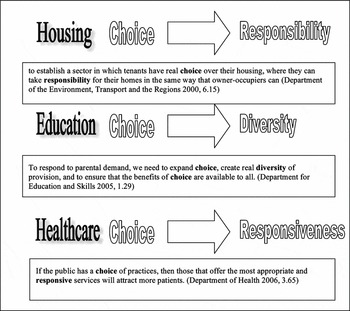
There appear to be three separate goals linked to choice reforms in the services examined here. In housing, choice is linked to the public taking greater responsibility; in education, it is linked to a diversity of provision; and in healthcare, it is linked to the goal of improved responsiveness. These differences are shown in Figure 1.
Choice goals in housing, education and health

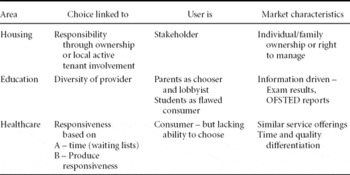
In housing, most recent policy attempts to give social housing users the same responsibilities as private owners. This is a stakeholder-type model of choice in which individuals improve their communities through taking pride in their homes. Homes are the primary assets of families, passed down through generations and forming the bedrock of support and wealth available to them. Policy attempts to extend these ideas to social housing and to private tenants by trying to get the public to engage in the Right to Manage or the Right to Buy, while at the same time outright ownership is still preferred. In housing, choice is linked to responsibility, and to the public becoming stakeholders in their local communities.
In education, choice is meant to lead to education providers becoming more diverse, which in turn is meant to lead to greater choice. This argument appears circular, with choice creating diversity, and diversity creating choice, with the rather counter-intuitive suggestion that parents choose schools on the basis of their type rather than on the basis of their exam results or OFSTED reports. Choice is linked to diversity in an attempt to proliferate the range and type of school providers available for parents. The focus on diversity is often presented as an end in itself, with only a tenuous link to either improved standards or increased responsiveness, and then it unclear as to whether an increase in responsiveness would be geared towards students, parents or to the needs of the economy. That diversity is seen as an end to itself and can be contrasted to the situation in Scotland where parents do not often even request a particular school for their children to attend. In the words of one commentator
south of the border has grown much more diverse over the past 20 years. England has a dizzying variety of secondary schools in addition to community comprehensives and faith schools. These include: foundation schools, CTCs, academies, specialist schools, grammar schools and, shortly, trust schools. Scotland has none of this variety. (Baker, Reference Baker2007)
The question of how a diversity of providers is meant to improve standards is left open, and persists despite government claims that education represents the paradigm example of where extending user choice has worked (Minister of State for Department of Health et al., 2005).
Students have been presented as unable to make the right educational choices for themselves, and the National Curriculum was introduced to try to make sure that they study the right subjects. Students are viewed as flawed consumers, unable to make choices about their courses because of the fear that they might jeopardise their future as a result. Parents are positioned as choosers of schools, but also lobbyists for improvements in local provision.
In healthcare choice is directly linked to improving responsiveness for local healthcare providers, challenging professionals to treat patients more as consumers, and expecting patients to choose the best providers of care. Resources are meant to follow patient choices, with the best providers thriving when chosen. Choice is linked to greater provider responsiveness, with competition between providers who differentiate themselves on the grounds of quality of care offered rather than the nature of standardised service offered. The evidence-based medicine movement attempts to standardise treatment so that it conforms as much as possible to what the ‘gold standard’ of randomised-controlled trials suggests is best for the patients' treatment on average (Muir Gray, Reference Muir Gray1996). There is potential for treatment to become more diverse with the introduction of complementary and alternative therapies, as suggested in recent public health documents (for example, Department of Health, 2006), but in healthcare choice appears to be about attempting to increase the responsiveness of providers of predominantly standardised services.
Responsiveness in healthcare is important in two ways. First, responsive services are those that treat patients in a timely fashion. This is clearly important where patients are enduring real suffering and have to wait for care. The most visible targets within the NHS for a number of years have been waiting lists. The second type of responsiveness is in terms of the care offered by NHS providers, with the government's agenda to challenge clinicians to become more user-centric. This suggests a model of patients as consumers, with patients active choosers of their care and driving reform through their choices.
The healthcare market is in many respects the opposite of the one found in education, with providers offering effectively standardised services, whereas in education diversity of provision is meant to be the driver of choice in the marketplace. Equally, whereas in healthcare patients are generally unaware of the availability of information that might assist their choices, in education standardised information about school performance is relatively easy to obtain (Greener, Reference Greener2003). Healthcare, of the three cases examined here, most closely resembles the economy theory of the market, being based on organising providers into competitive relationships with one another, and attracting patients by offering responsive care.
However, many patients do not know how to access available information or have the expertise to be able to choose rationally between providers. In the words of one of the Witness Seminar participants (who worked in both New Labour and Conservative governments):
One could not, as others have said, trust the patients or the public. They did not have the knowledge. They did not have the information to make direct choices themselves. (Witness Seminar, 2006: 40)
Parents, in contrast, seem able to choose between schools on the basis of information about exam results and OFSTED reports, but in policy documents choice is linked not to results but to school diversity. In healthcare, choice is flawed by patients lacking the expertise to make choices between care providers who offer a standardised treatment, whereas in education parents may have the expertise to make choices between schools, but schools are meant to be achieving improvement not through improved responsiveness but through diversity of provision instead.
Table 1 summarises these three emergent models of choice arising from the analysis above.
Emergent models of choice in housing, education and health

The positioning of users in these services is far more subtle than Le Grand's typology, of public service users being either pawns or queens, and suggests that an analysis of user positions in public policy must make use of a wider range of the possible roles they are required to occupy. It also seems that policy-makers often do not appear to realise that choice policies in areas of welfare reform are very different from one another, both in terms of the mechanisms they utilise, and the goals they are trying to achieve. At worst, this creates the possibility of thoughtless attempts at transfer between policy areas: the extension of choice in healthcare, for example, is often suggested because of its perceived success in education. There is also the second danger that choice policies are presented as being uniform in nature and in goals (Minister of State for Department of Health et al., 2005), when they appear, on more careful analysis, to be very different.
Acknowledgements
Thanks to the anonymous reviewers for their suggestions on how this paper might be improved, and to the ESRC for funding the empirical work within it under a grant funded through the ‘Cultures of Consumption’ programme.