“His life was gentle; and the elements, So mixed in him, that nature might stand up
And say to all the world ‘This was a man’” (Act 5, Scene 5, Line 74)
Julius Caesar, William Shakespeare
The Evolution of Mixed States
To fully appreciate the difficulty of defining mixed states, it is important to first review the evolution of mixed presentations and understand how, over time, the thinking underpinning the terminology used to describe them has developed and gained sophistication.
Kraeplinian nosology
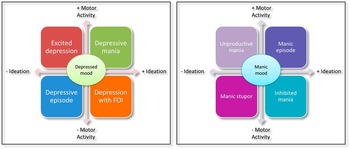
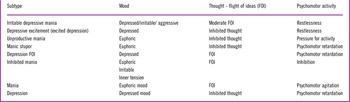
Emil Kraepelin and his student, Wilhelm Weygandt, were among the first to define mixed states as “various combinations of the symptoms characteristic of both the manic and depressive phases” (Kraepelin 1904, p. 381)Reference Kraepelin 1 and incorporated into their description of “manic depressive insanity” the recurrence of symptoms associated with mania, depression, and mixed phases. Kraepelin and Weygandt viewed mixed states as occurring at the intersection between depression and mania, and Kraepelin used this model to substantiate his idea that depression and mania are situated on a continuum. Specifically, he suggested that fluctuations occurring within 3 central psychic domains, namely mood, thought, and psychomotor activity, give rise to 6 subtypes of mixed states: excited depression, depressive mania, depression with flight of ideas (FOI), unproductive mania, inhibited mania, and manic stupor (see Table 1 and Figure 1).Reference Diefendorf 2 Expanding this model further, Kraepelin adopted a dimensional approach, which allowed various combinations of manic and depressive symptoms to occur in an individual.Reference Maina, Bertetto, Boccolini, Di Salvo, Rosso and Bogetto 3 Importantly, these domains distinguished between patients transitioning between manic and depressive states (mixed phase) and those who experience lasting symptoms from both manic and depressive phases concurrently,Reference Diefendorf 2 – Reference Trede, Salvatore, Baethge, Gerhard, Maggini and Baldessarini 4 manifesting as a chronic illness (mixed state).Reference Maina, Bertetto, Boccolini, Di Salvo, Rosso and Bogetto 3 Thus, Kraepelin’s view of mixed presentations is perhaps best conceptualized on an axis orthogonal to that of mania and depression, intersecting at the point at which mania and depression overlap and sometimes transition.
Kraepelin suggests that the variation of symptoms across 3 central domains [mood (predominantly either manic or depressed), thought (+/– ideation), and psychomotor activity (+/– motor activity)] leads to 6 characteristically different subtypes of mixed states: excited depression, depressive mania, depression with flight of ideas (FOI), unproductive mania, inhibited mania, and manic stupor.

Kraepelin and Weygandt’s proposed subtypes of mixed states across dimensions of disordered mood, thought, and psychomotor activity

Leonhard
Despite Kraepelin’s attention to mixed states, there was a relative lack of interest in mixed states from approximately 1920 to 1980. During this period, Kraepelin’s work was widely criticized, in particular by Carl Wernicke, Karl Kleist, and Karl Leonhard.Reference Marneros 5 For example, in 1957, Leonhard distinguished between “partial states” and mixed states. In partial states, the symptoms of depression and mania, though present and observable, remained incomplete, whereas in mixed states, the psychopathology was fully formed and complete, but these states were much less common. Notably, Leonhard was the first to distinguish between unipolar and bipolar mood within manic-depressive illness, while also emphasizing the recurrent nature of both forms.Reference Marneros 5
DSM Classification
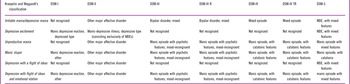
The 1980s witnessed a resurgence of interest in the diagnosis of mixed states, and a bipolar disorder mixed category was included in the Diagnostic and Statistical Manual of Mental Disorders, Third Edition (DSM-III) 6 and Third Edition, Revised (DSM-III-R). 7 However, the DSM definitions of mixed states moved away from Kraepelin’s theory that these presentations do not simply reflect polarities of mood, but rather a complex fluctuation of increased and intensified or inhibited mood, as well as arousal, cognition, behavior, and speech. Table 2 displays Kraepelinian definitions of mixed state subtypes against subtype definitions provided in the DSM overtime. DSM-III required that full criteria for both manic and major depressive episodes must be met, either concurrently, or alternating every few days in order to meet diagnostic criteria. Reifying this further, the Diagnostic and Statistical Manual of Mental Disorders, Fourth Edition (DSM-IV) 8 and Fourth Edition, Text Revision (DSM-IV-TR) 9 introduced the term mixed episodes, a separate category that again stipulated that the full criteria for both manic and depressive episodes had to be satisfied concurrently, each day, and for at least 1 week. In addition, impairment or psychosis had to be evident, and the symptoms could not be attributed to a medical condition or substanceReference Faedda, Marangoni and Reginaldi 10 .
Recognition of Kraepelin and Weygandt’s subtypes of mixed states in DSM

Adapted from Faedda et al.Reference Faedda, Marangoni and Reginaldi 10
However, clinically, the DSM definitions were clearly limited because some symptoms, such as elation and depression, simply cannot co-occur. Consequently, the DSM-IV requirements for a “mixed episode” soon became widely regarded as too stringent and were criticized for not allowing distinction of the primary mood state, ie, predominant manic episode with mixed depressive features or the converse.
Modern day definitions of mixed states
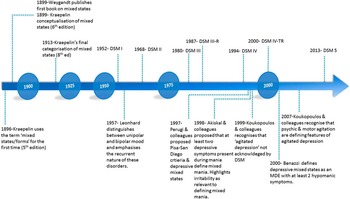
The lack of sensitivity of the DSM-IV–defined mixed episodes prompted many research groups to adapt the criteria for diagnosing mixed presentations (see Figure 2). One influential proposal by Akiskal et al Reference Akiskal, Hantouche and Bourgeois 11 in 1998 suggested that the presence of at least 2 depressive symptoms in the context of a manic episode more suitably defines mixed manic states. Contemporaneously, Perugi et al Reference Perugi, Akiskal and Micheli 12 developed the Pisa–San Diego criteria for defining mixed states, which adopted a more dimensional approach to mixed states. Their criteria required the presence of manic and depressive symptoms, occurring concurrently, in at least 2 psychic domains (“mood: anxious/sad or euphoric/irritable, thought flow: slowing or racing, thought content: depressive or expansive, perceptual disturbance: depressive or expansive, and motility: retardation or acceleration”; p. 172) for a minimum duration of 2 weeks in conjunction with any 2 of the following additional symptoms: emotional lability, lower threshold for anger, changes in libido, sleep disturbances, and variations between opposite mood states/poles in at least 1 previously listed domain. Finally, they also specified that during symptom-free periods, patients should return to appropriate expression of interpersonal and emotional responses.
Timeline depicting key steps in the evolution of mixed states definitions: Kraepelin to DSM-5.

BenazziReference Benazzi 13 proposed that a depressive mixed state occurs in bipolar II depression when at least 2 hypomanic symptoms manifest in the context of a major depressive episode. This definition is subtle, yet critical, because the DSM-IV definition of mixed states automatically identifies mixed mood episodes with mania as part of bipolar I disorder. In other words, depressed individuals featuring hypo/manic symptoms were not recognized and captured as distinct from mania, but rather were designated as being in a mixed manic state.Reference Faedda, Marangoni and Reginaldi 10 In particular, patients experiencing depression with ‘flight of ideas’ or ‘excited depression’ (depression with increased motor activity), as described by Kraepelin, were not acknowledged as distinct.Reference Koukopoulos and Koukopoulos 14
Consequently, Koukopoulos et al Reference Koukopoulos, Sani and Ghaemi 15 propose that mixed states do not necessarily mean that manic and depressive symptoms (as defined by the DSM) have to occur concurrently. For example, “psychomotor agitation, inner anguish, and irritability” (p 4) occurring within the context of a depressive episode is also a mixed state (mixed depression).Reference Koukopoulos, Sani and Ghaemi 15 Instead, they propose that depressive episodes with psychomotor agitation (‘agitated depression’) should require at least 2 of the following psychomotor symptoms, which should be present for several days during a depressive episode: “pacing; handwringing; being unable to sit still; pulling or rubbing on hair, skin, clothing, or other objects; outbursts of complaining or shouting; and over-talkativeness” (p 5).Reference Koukopoulos and Sani 16 TheyReference Koukopoulos and Sani 16 , Reference Koukopoulos, Sani, Koukopoulos, Manfredi, Pacchiarotti and Girardi 17 also suggest that mixed depressive episodes without psychomotor agitation (“mixed depression”) require at least 3 of the following symptoms: “inner tension/agitation, racing or crowded thoughts, irritability or unprovoked feelings of rage, absence of signs of retardation, talkativeness, dramatic description of suffering or frequent spells of weeping, mood lability, and marked emotional reactivity, and early insomnia” (p 6).Reference Koukopoulos and Sani 16 These and other attempts at defining mixed states have brought further sophistication to their classification, but this added complexity also means they are difficult to apply clinically.
The introduction of the mixed features specifier in DSM-5 reflects a shift from the categorical approach of DSM-IV to a more dimensional approach, but one that is still anchored to a categorical framework. Remarkably, reclassification by DSM-5 has eliminated the category of mixed episodes as a codable diagnosis. This has been replaced by a “mixed features specifier” (MxFS) that can be applied to hypo/manic and depressive episodes in the context of bipolar disorder (BD) I and II and major depressive disorder (MDD). Furthermore, the clinical impossibility of a patient presenting with coterminous depressed mood and euphoria has not been completely resolved because depressed and elated mood are still listed as eligible contrapolar symptoms. However, by introducing a MxFS, the current definition has addressed the issue of nominating the primary mood state and reducing the number of additional contrapolar symptoms required to meet diagnostic criteria, for which DSM-IV was justifiably criticized. Using DSM-5 criteria, the post hoc analysis of a large naturalistic sample suggests that 26–34% of individuals who present with a major depressive episode (MDE) in the context of MDD, BD-I, or BD-II, meet criteria for mixed featuresReference McIntyre, Soczynska and Cha 18 ; however, the decision to eliminate overlapping symptoms of distractibility, irritability, and psychomotor agitation (referred to collectively as DIP) has created new problems for diagnosing mixed states.
Initial definitions of bipolar disorder, such as those by Leonhard and others, which were based on traditional manic-depressive illness, emphasized recurrence as their central feature, whereas successive versions of DSM have placed greater emphasis on polarity rather than recurrence. The limitation of a ‘bi’-polar model is that by conceptualizing depression and mania as diametrically opposite does not allow for a meaningful intersection of these mood states, and this makes it difficult to fully accommodate the concept of mixed states. More recently, the concept of characterizing mood episodes as discrete entities has been questioned, with some researchers suggesting that greater focus should be assigned to mood instability and that research should instead focus on subsyndromal symptoms that occur between discrete states.Reference Harrison, Cipriani and Harmer 19
Given the ongoing challenge of accurately characterizing mixed states, and the range of proposed definitions reported in the literature, the prevalence rates continue to vary considerably. For example, for mixed mania, prevalence rates range from 6.7% to 19% using the more stringent criteria set out by the DSM-III/IV and International Classification of Diseases, Tenth Revision (ICD-10), respectively, whereas using broader definitions the range shifts and widens from 27.4% to 66%.Reference Cassidy, Yatham, Berk and Grof 20 With respect to mixed depression, prevalence rates range from 7.5%, using DSM-5 criteria, to 29.1%, with more broadly defined criteria (Research Based Diagnostic Criteria; RBDC) that include the overlapping symptoms of DIP.Reference Perugi, Angst and Azorin 21
The Exclusion of Overlapping Symptoms
Distractibility, irritability, and psychomotor agitation and other neurovegetative symptoms (ie, weight loss/gain+insomnia/hypersomnia) have been excluded from the MxFS in DSM-5 because they are overlapping symptoms that are common to both mania and depression, as well as other disorders (eg, anxiety), and as such the DSM-5 mood disorders workgroup assumed that these symptoms could not be used to distinguish manic and depressive states reliably. Furthermore, because of their dual origins, they were thought to lack any specificity for mixed states per se.
This decision has since been criticized for 2 reasons. First, excluding DIP is not reflective of research evidence or clinical experience.Reference Koukopoulos and Sani 16 For example, studies (such as Judd et al Reference Judd, Schettler and Akiskal 22 and Pae et al Reference Pae, Vohringer and Holtzman 23 ) that have examined patients with at least 1 (or 2/3 concurrent) manic symptom(s) have indicated higher prevalence rates of DIP symptoms compared with other manic symptoms in both MDD and BD patients. More recently, Targum et al Reference Targum, Suppes and Pendergrass 24 adopted slightly less stringent DSM-5 criteria for MDD with mixed features (2 or 3 symptoms present from the opposite mood state rather than 3 as outlined by DSM-5), and showed that in a sample of 211 patients presenting with mixed depression, the most common symptoms were flight of ideas and increased talkativeness (reported by approximately 65% of patients), followed by irritability and distractibility (60% of patients), decreased need for sleep (40% of patients), and psychomotor agitation (36.5% of patients). Similarly, other studies have demonstrated that DIP symptoms are among the most frequently reported symptoms by individuals with mixed depression,Reference Perugi, Angst and Azorin 21 , Reference Miller, Suppes and Mintz 25 which suggests that these are part of the core features of mixed states.
Second, emerging evidence indicates that within the context of mixed states, overlapping symptoms may serve to distinguish between mixed manic and mixed depressive states. For instance, the observed rate of psychomotor agitation in mixed depression is relatively low (36.5%Reference Targum, Suppes and Pendergrass 24 ; 16.1%Reference Perugi, Angst and Azorin 21 ), reflecting perhaps that these patients have MDD with mixed features. In contrast, rates of psychomotor agitation in mixed mania are as high as 91%,Reference Malhi, Fritz and Allwang 26 which suggests that it is a more characteristic feature of mixed mania. Thus, DIP symptoms should not have been excluded from the DSM-5 mixed features specifier.
Anxiety and DIP
It is well established that anxiety symptoms commonly occur during mixed states, particularly mixed manic states. For example, Cassidy et al Reference Cassidy, Ahearn and Carroll 27 report that psychic (93%) and somatic anxiety (52%) frequently feature in patients with mixed mania (using less restrictive diagnostic criteria than DSM-IV). The DSM-5 workgroup, however, argued that anxiety symptoms are common across many disorders, and that they too lack specificity in relation to characterizing mixed episodes; hence they were excluded. Conversely, others have argued that including anxiety would be beneficial because its presence distinguishes pure mania from mixed mania because it features to a greater extent in the latter.Reference Cassidy, Ahearn and Carroll 27 , Reference Cassidy 28 Similarly, anxiety is known to correlate with depression in manic patients and with mania in depressed patients, and much less so in pure mania.Reference Swann, Steinberg, Lijffijt and Moeller 29 This is explained to some extent by findings from factor analytic studies that have examined mania in large samples. These studies have shown that anxiety uniquely contributes to specific depressive factors.Reference Sato, Bottlender, Kleindienst and Möller 30 Hence, we suggest that anxiety is an important symptom and one that—alongside DIP symptoms—is likely to assist in further fractionating mixed presentations.Reference Sato, Bottlender, Kleindienst and Möller 30 Thus more recently, researchers have begun to explore whether underlying anxiety symptoms could potentially give rise to different patterns of DIP symptoms (along with other core features) occurring within mixed presentationsReference Malhi, Fritz and Allwang 31 ; it may be that certain patterns of symptoms, including DIP, typify particular subtypes of mixed states.
Manifestations of Mixed States
A more granular conceptualization of mixed states is akin to Kraepelin’s taxonomy, which was similarly based on an amalgam of thought disorder, mood, and psychomotor activity. Kraepelin also distinguished between 2 types of mixed presentations, which could be interpreted as a mixed phase and a mixed state. Clinically this distinction is key, because it separates bipolar patients into those who are transitioning from one phase of an illness to another, and in doing so have vestigial symptoms that remain as the opposite mood state emerges, and those who present in an enduring mixed state. Complicating matters further, a transitory mixed phase may on occasion be the result of a treatment-emergent affective switch (TEAS), wherein manic symptoms impress upon a depressive state spurred by treatment (eg, antidepressants)Reference Malhi, Masson and Bellivier 32 producing an admixture, which can be misconstrued as a true mixed presentation. It is in separating these heterogeneous origins that patterns of anxiety and DIP symptoms may distinguish mixed states and mixed phases.
Research that has examined subtypes of mixed presentations, of which DIP and anxiety symptoms are prominent features,Reference Perugi, Medda, Reis, Rizzato, Giorgi Mariani and Mauri 33 , Reference Perugi, Medda, Swann, Reis, Rizzato and Mauri 34 has found that psychomotor agitation and distractibility are likely core features of mixed mania,Reference Targum, Suppes and Pendergrass 24 , Reference Malhi, Fritz and Allwang 31 while irritability lends itself more to nonmelancholic depression (admixture of depressive and anxiety symptoms).Reference Malhi, Fritz and Allwang 31 In a similar vein, Perugi et al Reference Perugi, Medda, Swann, Reis, Rizzato and Mauri 34 suggest that mixed states can be characterised by different combinations of 6 distinct dimensional factors: “psychotic-positive symptoms (suspiciousness, hallucinations, unusual thought content, bizarre behavior, conceptual disorganization), mania (hostility, elated mood, grandiosity, uncooperativeness, excitement, motor hyperactivity), disorientation/unusual motor behavior (neglect, disorientation, motor retardation, uncooperativeness, and mannerisms and posturing), depression (anxiety, depression, suicidality, guilt, tension, without elated mood), negative symptoms (blunted affect, emotional withdrawal, and motor retardation), and anxiety (anxiety, somatic concern, and motor retardation).” (p. 801). Koukopolous et al Reference Koukopoulos, Sani and Ghaemi 15 , Reference Koukopoulos, Sani, Koukopoulos, Manfredi, Pacchiarotti and Girardi 17 advocate for distinction between subtypes of depressive episodes with mixed features; they propose partitioning of these into “agitated depression” and “mixed depression.” Although these findings are preliminary and require replication in larger, more diverse samples, collectively they support the notion that DIP features along with anxiety play a key role in mixed states, especially given that these subtypes differ not only in terms of clinical phenomenology, but also illness course, comorbidity, and treatment response.Reference Perugi, Medda, Reis, Rizzato, Giorgi Mariani and Mauri 33
Implications for Treatment and Research
Research implications
Given the lack of consensus regarding the definition of mixed states and the differing perspectives of various research groups, it is not surprising that there is a paucity of research examining treatment outcomes for patients with mixed depression. Earlier studies using DSM-IV mixed episodes criteria rarely examined depression with mixed features and mania with mixed features separately and typically have included these patients alongside those with acute mania. Therefore, most of the studies investigating treatment effectiveness of mixed states have thus far examined separately samples with bipolar depression or mania with mixed features.Reference Fornaro, Stubbs and De Berardis 35 – Reference Tohen, McIntyre, Kanba, Fujikoshi and Katagiri 38 Additionally, though the use of treatments as long-term prophylaxis is widely recommended (eg, lithium), research has yet to examine whether the occurrence of mixed states or mixed features can be reduced with prophylactic treatment. Some study findings indicate that antipsychotics, such as lurasidone or olanzapine, are effective in treating bipolar depressed mixed states compared to placebo.Reference McIntyre, Cucchiaro, Pikalov, Kroger and Loebel 36 , Reference Tohen, McIntyre, Kanba, Fujikoshi and Katagiri 38 A recent exploratory meta-analysis suggests that the administration of second generation antipsychotics results in significant improvement in depressive symptoms for bipolar depressed patients with mixed featuresReference Fornaro, Stubbs and De Berardis 35 ; however, the specificity of this remains unknown. Furthermore, mixed features of depression in this study were assessed post hocReference McIntyre, Cucchiaro, Pikalov, Kroger and Loebel 36 , Reference Tohen, McIntyre, Kanba, Fujikoshi and Katagiri 38 and using a cross-sectional design.Reference McIntyre, Cucchiaro, Pikalov, Kroger and Loebel 36
Clinical implications
As a result of the lack of research on effective treatments for depression with mixed features, some treatment guidelines recommend the same treatment options outlined for mania with close monitoring of any emerging depressive symptoms, 39 while others conclude that there is insufficient research investigating specific treatments relevant to the DSM-5 definition of mixed features to make definitive treatment recommendations as yet.Reference Ostacher, Tandon and Suppes 40 Recent clinical guidelinesReference Malhi, Bassett and Boyce 41 recommend the cessation of any substances that may have a mood elevating effect, such as antidepressants or stimulants, and recommendations with the Australian National Health and Medical Research Council (NHMRC) Level II evidence (randomized controlled trial level of evidence) support include the use of olanzapine,Reference Tohen, McIntyre, Kanba, Fujikoshi and Katagiri 38 quetiapine, valproate monotherapy or combination therapy with an antidepressant, or olanzapine in conjunction with an antidepressant such as fluoxetine.Reference Benazzi, Berk, Frye, Wang, Barraco and Tohen 42
Antidepressant treatment for manic patients with depressive features should be considered with caution as this has the potential to worsen mixed state symptoms or even induce rapid cycling of mood.Reference Fountoulakis, Kontis, Gonda, Siamouli and Yatham 43 Finally, treatment with second-generation antipsychotic monotherapy (compared to placebo) or in combination with a mood stabilizer (compared to placebo and mood stabilizer monotherapy) is effective in treating predominantly mixed manic presentations; however, the effectiveness of these treatments for mixed symptoms within the context of a depressive episode is unknown.Reference Malhi, Masson and Bellivier 32 , Reference Muralidharan, Ali and Silveira 44
From a clinical standpoint, it is difficult to distinguish between patients presenting with a “mixed phase” or a “mixed state,” especially if DIP symptoms are excluded from consideration. For example, in one study, approximately 90% of 211 patients with mixed depression received antidepressant treatment,Reference Pae, Vohringer and Holtzman 23 which suggests that in the majority, a mixed state diathesis was yet to be formulated. The challenge of accurately diagnosing patients with a mixed state affects clinical samples recruited for treatment trials. With the introduction of the DSM-5 mixed features specifier and the exclusion of DIP symptoms, it is likely that the types of patients that will be recruited into research studies will be even more heterogeneous than before. Treatments and strategies for treatment regarding mixed states remain in the early stages of development, and the absence of a clear definition of mixed states and the consequent difficulties that arise, in terms of lack of specificity when assessing and treating these patients, will dramatically limit the development of effective and prophylactic treatment options.
Future Directions
In order to overcome the current issues with defining and treating mixed states, a dimensional approach is needed. Therefore clinical presentations can perhaps be best characterized along a number of domains, with trials of different cut-offs for each domain to assess whether a mixed states syndrome emerges. The definitions proposed by earlier researchers are useful starting points for such endeavors; however, alongside mood, it will be important to develop a detailed understanding of the critical roles that cognition and energy play in mixed presentations. For research purposes, these domains could be examined in greater depth along more specific axes, for example, attention, memory, motivation, drive, and behavioral activity. Mood could also be assessed more granularly, investigating specific symptoms rather than symptom clusters or diagnostic syndromes and over differing epochs of time. In practice, differentiation needs to be drawn between mixed states that are spontaneous and those caused by treatment; those that are transient and those that are sustained; and those that occur with comorbidity and those that stand alone and arise independently. By adopting a systematic and rigorous approach and according mixed states importance, we are likely to develop a richer understanding of mood states as a whole and finally begin to obtain a complete picture of the mood disorder spectrum.
Conclusion
It is clear that much remains unknown and unresolved regarding the description of mixed states. Presentations of mixed mood symptoms are heterogeneous in terms of origin and reflect the end stage of a number of pathways. The simplest is the coloring of mood symptoms by comorbid anxiety. Some presentations reflect the natural transition from mania to depression and vice versa. However, of particular interest are the sustained states of mood in which an admixture of symptoms persist. These are of variable composition and intensity, but likely reflect true mixed states, the pathogenetic mechanisms of which are probably distinct from those of depression and mania.
Disclosures
Gin Malhi reports grants from NHMRC, personal fees from AstraZeneca, personal fees from Lundbeck, personal fees from Janssen-Cilag, personal fees from Servier, other from Melbourne University, personal fees from Elsevier, grants from Ramsay Research and Teaching Fund, and grants from American Foundation for Suicide Prevention, outside the submitted work. Yulisha Byrow, Tim Outhred, and Kristina Fritz have nothing to disclose.