Identifying the pathways through which early adversity (i.e., life stress occurring in childhood or adolescence; Heim, Reference Heim2013) increases risk for depression has emerged as a topic of considerable priority for researchers seeking to understand its developmental origins. Though the potential underlying mediators reflect an array of domains, including for example, alterations in stress physiology, ER difficulties, and impaired social relationships and interpersonal functioning (e.g., Hankin, Reference Hankin2005; Heleniak et al., Reference Heleniak, Jenness, Van der Stoep, McCauley and McLaughlin2016; Stroud et al., Reference Stroud, Chen, Doane and Granger2019), one is perhaps the most parsimonious: Those who experience early adversity continue to experience higher levels of acute stress (i.e., stressful life events; characterized by acute onset and brief duration) across the life course (e.g., Korkeila et al., Reference Korkeila, Vahtera, Nabi, Kivimäki, Korkeila, Sumanen and Koskenvuo2010). Indeed, an emerging body of research indicates that early adversity prospectively predicts later depression via its association with recent (i.e., proximal; e.g., past year) acute life stress (e.g., Hazel et al., Reference Hazel, Hammen, Brennan and Najman2008; Korkeila et al., Reference Korkeila, Vahtera, Nabi, Kivimäki, Korkeila, Sumanen and Koskenvuo2010). Yet, significant gaps remain in our understanding of the developmental pathway linking early adversity to later depression via recent life stress. First, it is unresolved whether early adversity predicts increases in recent acute stress over time (herein called growth in acute stress) or whether it is instead associated with stable levels of high acute stress (herein called acute stress continuity). Second, it is unclear whether all – or only certain types – of recent life events, particularly interpersonal events, mediate the prospective relationship between early adversity and depression. Finally, it is unknown whether early adversity places individuals at greater risk for depression via greater exposure to independent (i.e., fateful) interpersonal events or via greater generation of dependent (i.e., caused in part by the person’s actions or behaviors) interpersonal events or both. In the present study, we addressed these questions in a 3-wave longitudinal study of early adolescent girls.
Pursuing such research during early adolescence, and specifically among early adolescent girls, is particularly informative for elucidating the early trajectory to depression and for informing prevention efforts. Among U.S. adolescents, early adversity is prevalent and potent, contributing to approximately 30% of distress disorder first onsets, including MD (McLaughlin et al., Reference McLaughlin, Green, Gruber, Sampson, Zaslavsky and Kessler2012). Importantly, epidemiological data indicate that early adversity has important implications for first onsets of disorders (e.g., Green et al., Reference Green, McLaughlin, Berglund, Gruber, Sampson, Zaslavsky and Kessler2010), suggesting that focusing on a developmental period characterized by high risk for disorder first onsets may be most informative. Mid-adolescence marks the first developmental period in which first clinically significant major depressive episodes emerge at high rates, particularly for girls (e.g., Rohde et al., Reference Rohde, Beevers, Stice and O’Neil2009). Moreover, during adolescence, subclinical symptoms robustly predict the development of first onsets (e.g., Klein et al., Reference Klein, Glenn, Kosty, Seeley, Rohde and Lewinsohn2013). Thus, investigating whether early adversity predicts future depressive symptoms via growth in recent acute stress among early adolescent girls with no history of MD may be particularly informative for prevention efforts.
Early adversity and depression
Existing research recognizes the critical role of early adversity in increasing risk for depression, including among children and adolescents of varied races, ethnicities, and nationalities (for reviews, see LeMoult et al., Reference LeMoult, Humphreys, Tracy, Hoffmeister, Ip and Gotlib2020; Vrshek-Schallhorn, Ditcheva, & Corneau, Reference Vrshek-Schallhorn, Ditcheva, Corneau, Harkness and Hayden2020). In this work, early adversity has included a wide array of experiences that would be considered stressful, including both single events as well as chronically stressful conditions, and stressors that range in severity, including for example, abuse, neglect, separation and loss, poverty, family discord, and parent psychopathology, and which occur during early life (defined by a particular developmental period [e.g., puberty] or an upper-age limit [typically 12–18]; Heim, Reference Heim2013; LeMoult et al., Reference LeMoult, Humphreys, Tracy, Hoffmeister, Ip and Gotlib2020; Vrshek-Schallhorn et al., Reference Vrshek-Schallhorn, Ditcheva, Corneau, Harkness and Hayden2020). Using this definition of early adversity (Heim, Reference Heim2013), a recent meta-analysis indicated that youth who experience early adversity are 2.5 times more likely to develop childhood- and adolescent-onset MD (i.e., prior to age 18; OR = 2.50, 95% CI [2.08, 3.00], as compared to those who do not experience early adversity (LeMoult et al., Reference LeMoult, Humphreys, Tracy, Hoffmeister, Ip and Gotlib2020). For example, in a prospective study of early adolescents, St. Clair and colleagues (Reference St Clair, Croudace, Dunn, Jones, Herbert and Goodyer2015) demonstrated that experiencing early adversity in the family environment (e.g., family loss, family discord) prior to age 11 predicted subsequent depressive symptoms. Importantly, research indicates that adolescents tend to experience more than one type of early adversity, and that exposure to early adversity (e.g., loss, maltreatment, parental maladjustment) has a cumulative nonadditive effect on disorder onsets (including depression), such that the odds of disorder onset increase with each exposure, but at a decreasing rate (McLaughlin et al., Reference McLaughlin, Green, Gruber, Sampson, Zaslavsky and Kessler2012). Taken together, these findings suggest that early adversity is a potent predictor of adolescent depression, and that studies focusing on the cumulative impact of multiple types of early adverse experiences may be particularly informative in understanding the pathways through which it confers risk.
Despite this considerable evidence, however, mixed findings as well as knowledge gaps highlight the need for additional research. First, there is evidence suggesting that, in some samples, early adversity does not predict adolescent depression (e.g., Hammen et al., Reference Hammen, Hazel, Brennan and Najman2012; Phillips et al., Reference Phillips, Hammen, Brennan, Najman and Bor2005). For example, Phillips and colleagues (Reference Phillips, Hammen, Brennan, Najman and Bor2005) reported that early adversity prior to age 5 (e.g., maternal stress, income) did not significantly predict current or past depressive diagnoses at age 15. Second, some evidence suggests that the impact of early adversity wanes over time (e.g., Green et al., Reference Green, McLaughlin, Berglund, Gruber, Sampson, Zaslavsky and Kessler2010; Oldehinkel et al., Reference Oldehinkel, Ormel, Verhulst and Nederhof2014) – a pattern supporting the stress-recency model, which proposes that stressors will be most potent immediately following their occurrence (Shanahan et al., Reference Shanahan, Copeland, Costello and Angold2011); thus, the effect of early adversity may be time-limited. Third, most prior work supporting early adversity as a risk factor for later depression has not addressed whether early adversity predicts depression while also accounting for the effects of recent stress (i.e., proximal acute [stressful life events] or chronic [ongoing conditions] stress occurring in the past months to the past year) (Vrshek-Schallhorn et al., Reference Vrshek-Schallhorn, Ditcheva, Corneau, Harkness and Hayden2020). Notably, most forms of stress are highly intercorrelated (Vrshek-Schallhorn et al., Reference Vrshek-Schallhorn, Stroud, Mineka, Hammen, Zinbarg, Wolitzky-Taylor and Craske2015), with those who experience early adversity facing higher levels of stress throughout their lives (e.g., Hazel et al., Reference Hazel, Hammen, Brennan and Najman2008). Therefore, when early adversity and recent acute stress are not simultaneously examined as predictors of depression, the effect of early adversity on depression risk may be due to that of recent stress (Vrshek-Schallhorn et al., Reference Vrshek-Schallhorn, Ditcheva, Corneau, Harkness and Hayden2020). Supporting this, in a sample of late adolescents, early adversity prior to age 16 (e.g., abuse, loss) predicted risk for subsequent first onsets of depression when examined alone, but did not uniquely predict risk over and above the effects of recent stress (Vrshek-Schallhorn et al., Reference Vrshek-Schallhorn, Stroud, Mineka, Hammen, Zinbarg, Wolitzky-Taylor and Craske2015). Thus, additional research is needed to clarify the nature of the prospective association between early adversity and adolescent depression.
Early adversity and depressive symptoms: the mediating role of recent acute stress
Considerable research indicates that early adversity contributes to the development of depression in part through its association with recent acute life stress, with most work focusing on childhood maltreatment (i.e., severe abuse and neglect). This work has shown that a higher severity and frequency of early adversity is associated with higher levels of recent acute stress, which in turn is associated with depressive symptoms and disorder onsets among adolescents and adults (e.g., Korkeila et al., Reference Korkeila, Vahtera, Nabi, Kivimäki, Korkeila, Sumanen and Koskenvuo2010; Raposa et al., Reference Raposa, Hammen, Brennan, O’Callaghan and Najman2014). For example, using a composite reflecting past year acute and chronic stress assessed via contextual stress interviews at age 15, Hazel and colleagues (Reference Hazel, Hammen, Brennan and Najman2008) showed that the effect of early adversity (prior to age 6; e.g., discord, maternal stress) on diagnosable depression between ages 15–20 was mediated by recent stress. Similarly, in a study unique in its focus on early adolescent girls, greater early adversity in the family environment (e.g., discord, parenting style) prior to age 6 predicted higher recent self-reported life events between 13 and 14, which in turn predicted higher self-reported depressive symptoms at age 14 (St Clair et al., Reference St Clair, Croudace, Dunn, Jones, Herbert and Goodyer2015). Thus, existing data suggest that some of the distal effects of early adversity on depression may be through recent acute stress.
Despite substantial support for the role of recent acute stress in the early adversity-depression pathway, methodological features of prior work have left considerable knowledge gaps. First, few studies have accounted for prior acute stress. Thus, it remains unresolved whether early adversity predicts growth in acute stress or whether early adversity is associated with acute stress continuity, but not growth in such stress. Individuals who experience early adversity tend to face higher levels of acute stress across in adulthood (e.g., Hammen et al., Reference Hammen, Hazel, Brennan and Najman2012; Korkeila et al., Reference Korkeila, Vahtera, Nabi, Kivimäki, Korkeila, Sumanen and Koskenvuo2010), and acute stress exhibits considerable continuity across follow-ups, including in adolescent samples when contextual stress interviews are used (Uliaszek et al., Reference Uliaszek, Zinbarg, Mineka, Craske, Griffith, Sutton and Hammen2012). Thus, if prior acute stress is not covaried, the mediating role of recent stress may be solely due to acute stress continuity, as opposed to recent stress mediating the early adversity-depression pathway (for a similar argument in the context of stress generation, see Uliaszek et al., Reference Uliaszek, Zinbarg, Mineka, Craske, Griffith, Sutton and Hammen2012). Indeed, others have cautioned that the influence of predictors correlated with baseline stress levels (e.g., early adversity) on longitudinal outcomes could be artificially enhanced when not accounting for the effects of stress continuity (Hazel & Hankin, Reference Hazel and Hankin2014).
Second, to assess recent acute stress, most prior studies have relied on life event checklists, rather than gold-standard contextual stress interviews with blinded severity coding, the latter of which demonstrate superior construct validity and reliability (e.g., Harkness & Monroe, Reference Harkness and Monroe2016) and help to disentangle the environmental stress exposure from the psychological stress response. Indeed, research suggests that individuals who have experienced early adversity tend to perceive recent events as more subjectively stressful than those who have not (e.g., Korkeila et al., Reference Korkeila, Vahtera, Nabi, Kivimäki, Korkeila, Sumanen and Koskenvuo2010), raising the possibility that when checklists are used to assess recent stress exposure, links between early adversity and depression via acute stress may be artificially inflated (Harkness & Monroe, Reference Harkness and Monroe2016). Moreover, use of contextual stress interviews for both early adversity and recent stress ensures temporal precedence of early adversity to events, and events to depression, thereby reducing the potential for reverse causation and increasing the possibility of testing a developmental pathway (Vrshek-Schallhorn et al., Reference Vrshek-Schallhorn, Ditcheva, Corneau, Harkness and Hayden2020).
Third, most prior research has not accounted for lifetime history of depression or prior current self-reported symptoms at one earlier time point. However, findings documenting the mediating role of prior depression in associations between early adversity and current depression (e.g., Kessler & Magee, Reference Kessler and Magee1993) as well as those supporting stress generation (wherein those with prior depression generate higher levels of stress) suggest that prior depression may act as a third variable in the early adversity-recent stress-depression pathway (e.g., Hankin, Reference Hankin2005). Further, depression in adolescents may actually elicit harsher treatment – for example, more angry negative affect, more conflict, and less support – from their parents (e.g., Bodner et al., Reference Bodner, Kuppens, Allen, Sheeber and Ceulemans2017), raising the possibility of reverse causality wherein depression predicts increased exposure to early adversity. In addition, stress (e.g., Uliaszek et al., Reference Uliaszek, Zinbarg, Mineka, Craske, Griffith, Sutton and Hammen2012) and depression (e.g., Conway, Rutter, & Brown, Reference Conway, Rutter and Brown2016) each exhibit considerable continuity over time; thus, to robustly test the early adversity-stress-depression pathway, it is critical to evaluate whether acute stress predicts depressive symptoms accounting for prior acute stress and depression. And perhaps most importantly, those with a prior depressive episode may be more sensitive to subsequent recent stress (i.e., stress sensitization; for a review, see Stroud, Reference Stroud, Harkness and Hayden2020), or may be less sensitive (e.g., stress inoculation or steeling effect models; Rudolph & Flynn, Reference Rudolph and Flynn2007; Seery, Holman, & Silver, Reference Seery, Holman and Silver2010), programed to be resilient in the face of high levels of stress (Del Giudice, Ellis, & Shirtcliff, Reference Del Giudice, Ellis and Shirtcliff2011), resulting in a different pattern of interplay between early adversity, recent stress, and depression for those who develop early onset depression (i.e., prior to mid-adolescence) versus those who do not (Oldehinkel et al., Reference Oldehinkel, Ormel, Verhulst and Nederhof2014).
Finally, most prior studies have focused on late adolescents or adults despite evidence that: a) early adversity accounts for more onsets of child and adolescent disorders, including depression (versus adult onsets; e.g., Green et al., Reference Green, McLaughlin, Berglund, Gruber, Sampson, Zaslavsky and Kessler2010); b) early adversity predicts disorder first onsets during adolescence (McLaughlin et al., Reference McLaughlin, Green, Gruber, Sampson, Zaslavsky and Kessler2012); and c) as discussed above, prior depression may influence the early adversity-stress-depression pathway (e.g., Kessler & Magee, Reference Kessler and Magee1993). Such findings suggest that it may be particularly informative for prevention efforts to investigate the early adversity-stress-depression pathway during early adolescence, prior to mid-adolescence – a period of high risk for the development of first onsets (e.g., Rohde et al., Reference Rohde, Beevers, Stice and O’Neil2009). Moreover, because subclinical symptoms of depression during adolescence robustly predict the development of subsequent MD and are associated with significant impairment (e.g., Klein et al., Reference Klein, Glenn, Kosty, Seeley, Rohde and Lewinsohn2013), it is critical to understand the development of depressive symptoms during this developmental period, rather than diagnosable disorders, to inform prevention, rather than intervention efforts.
Early adversity and depressive symptoms: role of recent interpersonal events
Questions also remain about whether increases in all types of events – or only in certain types of events – mediate the relationship between early adversity and depressive symptoms. Acute life stress varies on several dimensions (e.g., interpersonal nature, independence) some of which influence its association with early adversity (Rudolph & Flynn, Reference Rudolph and Flynn2007) and its etiological significance for depression (e.g., Vrshek-Schallhorn et al., Reference Vrshek-Schallhorn, Stroud, Mineka, Hammen, Zinbarg, Wolitzky-Taylor and Craske2015). However, most existing research has examined all types of recent acute stress or used a total stress composite score (including all types of acute and chronic stress), thereby obscuring whether only certain types of stress play a mediating role.
Importantly, there is reason to predict that recent acute interpersonal, but not non-interpersonal, stress will mediate the early adversity-depression association. First, findings from two studies of late adolescents suggest that interpersonal, but not non-interpersonal, stress may play a mediating role. One study demonstrated that recent chronic interpersonal, but not non-interpersonal, stress mediated the prospective link between pre-adolescent/adolescent (ages 9–16) early adversity (e.g., loss, abuse, violence) and first onsets of depression, though whether the magnitude of the indirect effects was significantly different was not tested (Vrshek-Schallhorn et al., Reference Vrshek-Schallhorn, Stroud, Mineka, Hammen, Zinbarg, Wolitzky-Taylor and Craske2015). A second study, which used composites comprising recent acute and chronic stress, showed that greater early adversity prior to age 6 (e.g., separation, maternal depression, marital discord) predicted higher levels of interpersonal and non-interpersonal stress, but only interpersonal stress predicted later depression (Raposa et al., Reference Raposa, Hammen, Brennan, O’Callaghan and Najman2014), though the significance of this indirect effect was not directly tested. Thus, though there are hints that acute interpersonal, but not non-interpersonal, stress plays a mediating role, it remains to be evaluated directly and whether the magnitude of their mediating effects is significantly different has not yet been tested. Second, theory and research suggest that early adversity interferes with the development of adaptive social and relationship skills, and leads to the development of insecure attachment, maladaptive behaviors (e.g., hostility, conflict), and SIP biases that set the stage for relationship and social functioning difficulties across the life course (e.g., for reviews, see Doyle & Cicchetti, Reference Doyle and Cicchetti2017; Repetti, Taylor, & Seeman, Reference Repetti, Taylor and Seeman2002). Third, interpersonal theories of depression (e.g., Hammen, Reference Hammen1991) and research suggest that acute interpersonal stress has particular etiological significance for depression. For example, acute interpersonal stress is more potent in predicting MDD onsets, as compared to non-interpersonal stress (Stroud et al., Reference Stroud, Davila, Hammen and Vrshek-Schallhorn2011), and uniquely contributes to risk for MDD onsets over and above other forms of stress (Vrshek-Schallhorn et al., Reference Vrshek-Schallhorn, Stroud, Mineka, Hammen, Zinbarg, Wolitzky-Taylor and Craske2015). Moreover, research suggests that early adversity may sensitize individuals to acute interpersonal stress in particular (Rudolph & Flynn, Reference Rudolph and Flynn2007). Thus, early adversity is associated with both greater exposure and sensitivity to recent acute interpersonal, but not non-interpersonal, stress, supporting the possibility that it plays a unique role in the early adversity-depression pathway.
Interpersonal stress exposure and interpersonal stress generation as underlying pathways linking early adversity and depressive symptoms
This study also sought to address a final gap in our understanding of the mediating role of recent stress in the early adversity-depression association: It is unknown whether early adversity places adolescents at greater risk for depression via growth in interpersonal stress exposure (i.e., exposure to independent [i.e., fateful] events) or in acute interpersonal stress generation (i.e., the tendency of vulnerable individuals to behave in ways that lead to the generation of interpersonal events [i.e., dependent interpersonal events caused at least in part by their behavior]; Hammen, Reference Hammen1991) or both. Regarding stress exposure, it has been theorized that one reason that recent stress mediates the link between early adversity and depression is that early adversity and recent interpersonal stress both originate from the same social structures/contexts (e.g., the family; Hammen et al., Reference Hammen, Hazel, Brennan and Najman2012; Pearlin, Reference Pearlin1989), particularly among adolescents living at home (Hazel et al., Reference Hazel, Hammen, Brennan and Najman2008). For example, adolescents who have faced higher levels of early adversity may continue to be exposed to interpersonal events outside of their control (i.e., acute independent interpersonal stress), such as parental job loss and conflicts between parents, many of which are in part caused by their parents’ behavior (Harkness et al., 2006). Regarding stress generation, it has been posited that early adversity leads to the vulnerabilities (e.g., insecure attachment, ER difficulties; Doyle & Cicchetti, Reference Doyle and Cicchetti2017; Repetti et al., Reference Repetti, Taylor and Seeman2002) that confer risk for maladaptive behaviors that contribute to the occurrence of acute dependent interpersonal stress (i.e., interpersonal stressful life events caused in part by the person’s actions or behaviors; for example, conflicts), thereby increasing risk for depression (e.g., Raposa et al., Reference Raposa, Hammen, Brennan, O’Callaghan and Najman2014). In the only study to test whether early adversity confers risk for stress generation (i.e., by separately examining dependent and independent events), childhood emotional abuse prospectively predicted stress generation among adults with a history of depression (Liu et al., Reference Liu, Choi, Boland, Mastin and Alloy2013).
Thus, theory and research suggest that early adversity may place adolescents at risk for both exposure to and generation of interpersonal acute stress, but these two potential pathways have not been tested directly nor has the difference in their mediating roles been statistically compared. Elucidating whether interpersonal stress exposure, interpersonal stress generation, or both mediate the early adversity-depression pathway is critical for informing intervention targets designed to interrupt stress continuity among those with a history of early adversity.
The present study
The present study examined whether the accumulation of early adversity within the family environment prospectively predicted later depressive symptoms in a 3-wave longitudinal study of early adolescent girls with no prior history of diagnosable depression. Based upon prior work showing that early adversity confers risk for adolescent depression (e.g., McLaughlin et al., Reference McLaughlin, Green, Gruber, Sampson, Zaslavsky and Kessler2012; St Clair et al., Reference St Clair, Croudace, Dunn, Jones, Herbert and Goodyer2015), we predicted that greater early adversity would predict subsequent depressive symptoms accounting for lifetime and current history of depressive symptoms. We also examined whether growth in recent acute interpersonal, but not non-interpersonal, stress mediates the prospective association between early adversity and later increases in depressive symptoms. Based upon interpersonal theories of depression (e.g., Hammen, Reference Hammen1991) and prior work (e.g., Vrshek-Schallhorn et al., Reference Vrshek-Schallhorn, Stroud, Mineka, Hammen, Zinbarg, Wolitzky-Taylor and Craske2015), we expected that recent acute interpersonal, but not non-interpersonal, stress would mediate the early adversity-depressive symptoms association accounting for lifetime and current depressive symptoms, and prior levels of acute interpersonal stress. Moreover, we expected that the indirect effect via acute interpersonal stress would be significantly greater in magnitude than the indirect effect via acute non-interpersonal stress. We also examined whether the indirect effect linking early adversity and later depressive symptoms via acute interpersonal stress differed for independent (i.e., fateful) versus dependent (i.e., at least partially caused by the participant’s behavior) forms of acute interpersonal stress – testing interpersonal stress exposure versus interpersonal stress generation as alternative pathways through which early adversity predicts increases in depression over time. Because both pathways have been proposed (e.g., Hazel et al., Reference Hazel, Hammen, Brennan and Najman2008; Raposa et al., Reference Raposa, Hammen, Brennan, O’Callaghan and Najman2014), but not directly tested, and because there is conflicting evidence regarding the etiological significance of dependent versus independent forms of acute interpersonal stress for depression (e.g., Stroud et al., Reference Stroud, Davila, Hammen and Vrshek-Schallhorn2011; Vrshek-Schallhorn et al., Reference Vrshek-Schallhorn, Stroud, Mineka, Hammen, Zinbarg, Wolitzky-Taylor and Craske2015), this analysis was exploratory.
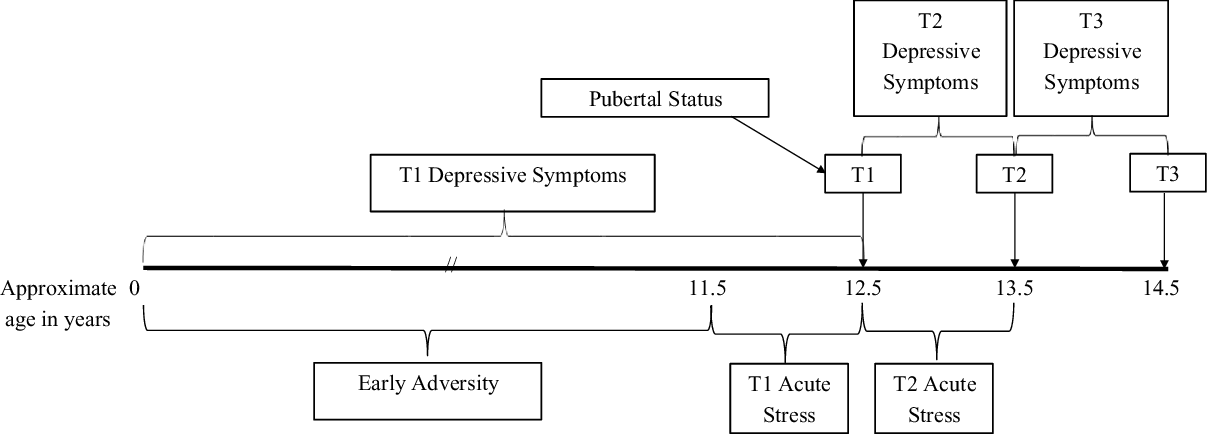
Given that prior work indicates that the effect of early adversity on risk for psychopathology is cumulative (e.g., McLaughlin, Reference McLaughlin2016), we focused on the accumulation of early adverse experiences during approximately the first 11.5 years of girls’ lives (see Figure 1). Consistent with other studies testing the early adversity-recent stress-depression pathway using contextual stress interviews with independent raters to assess early adversity (Hankin, Reference Hankin2005 [study 2]; Vrshek-Schallhorn et al., Reference Vrshek-Schallhorn, Stroud, Mineka, Hammen, Zinbarg, Wolitzky-Taylor and Craske2015), we focused on the cumulative severity of early adversity (total objective severity rating considering all adversities experienced) in our primary analyses. However, other work suggests that the frequency (total number; e.g., McLaughlin et al., Reference McLaughlin, Green, Gruber, Sampson, Zaslavsky and Kessler2012) or the breadth (number of different types; e.g., Turner & Lloyd, Reference Turner and Lloyd2004) of adversities may be critical for understanding youth outcomes, including depression risk. Thus, in follow-up tests, we also examined whether the findings held when we used 2 alternative methods of quantifying the accumulation of early adversity: frequency (the number of experiences, regardless of severity or type) and variety (the number of different types of experiences, regardless of severity or type). Given prior findings, we expected our findings to be robust across different methods of quantifying the accumulation of early adversity.
Study timeline.
Notes. Timeline is not to scale for ease of presentation. Age is approximate based on age at T1. At T1, participants completed a self-report measure to assess pubertal status (Petersen et al., 1998); an objective contextual stress interview to assess acute stress (occurring during the year prior to T1; adapted from Rudolph & Hammen, Reference Rudolph and Hammen1999; Rudolph et al., Reference Rudolph, Hammen, Burge, Lindberg, Herzberg and Daley2000); an objective contextual stress interview to assess early adversity (occurring from birth to one year prior to T1; Rudolph & Flynn, Reference Rudolph and Flynn2007); and a diagnostic interview to assess current and lifetime history of depressive symptoms (Kaufman et al., Reference Kaufman, Birmaher, Brent, Rau, Flynn, Moreci and Ryan1997). At T2, participants completed an objective contextual stress interview to assess acute stress (occurring between T1 and T2; adapted from Rudolph & Hammen, Reference Rudolph and Hammen1999; Rudolph et al., Reference Rudolph, Hammen, Burge, Lindberg, Herzberg and Daley2000), and adolescents completed a diagnostic interview (Kaufman et al., Reference Kaufman, Birmaher, Brent, Rau, Flynn, Moreci and Ryan1997) to assess depressive symptoms since T1. At T3, adolescents completed a diagnostic interview (Kaufman et al., Reference Kaufman, Birmaher, Brent, Rau, Flynn, Moreci and Ryan1997) to assess depressive symptoms since T2.

Method
Participants and procedures
Participants were early adolescent girls who participated in a larger study designed to examine biopsychosocial predictors of psychopathology (N = 132). Participants and their primary female caregivers (herein called “mother”) were recruited from two New England counties through advertisements or flyers, word-of-mouth, and local schools. See Figure 1 for a study timeline. At Time 1 (T1), during a laboratory visit, mothers and daughters each completed separate diagnostic interviews, as well as contextual life stress interviews assessing early adversity and recent acute stress. Adolescents also completed a packet of questionnaires, including a pubertal status measure. Of the 132 participants, 6 had a history of diagnosable depression and 1 had current diagnosable depression. Because prior and current diagnosable depression can influence may act as a third variable in the early adversity-recent acute stress pathway (e.g., Hankin, Reference Hankin2005), and prior depression mediates links between early adversity and subsequent depression (e.g., Kessler & Magee, Reference Kessler and Magee1993), we excluded those 7 participants from analyses (Analytic N = 125).Footnote 1
Approximately one year later (T2), 84.80% (n = 106) participated in the first follow-up that included the same contextual life stress interviews to assess recent acute stress, and diagnostic interviews. Approximately two years after T1, 77.60% (n = 97) participated in the second follow-up (two year: T3) that included the same diagnostic interview.
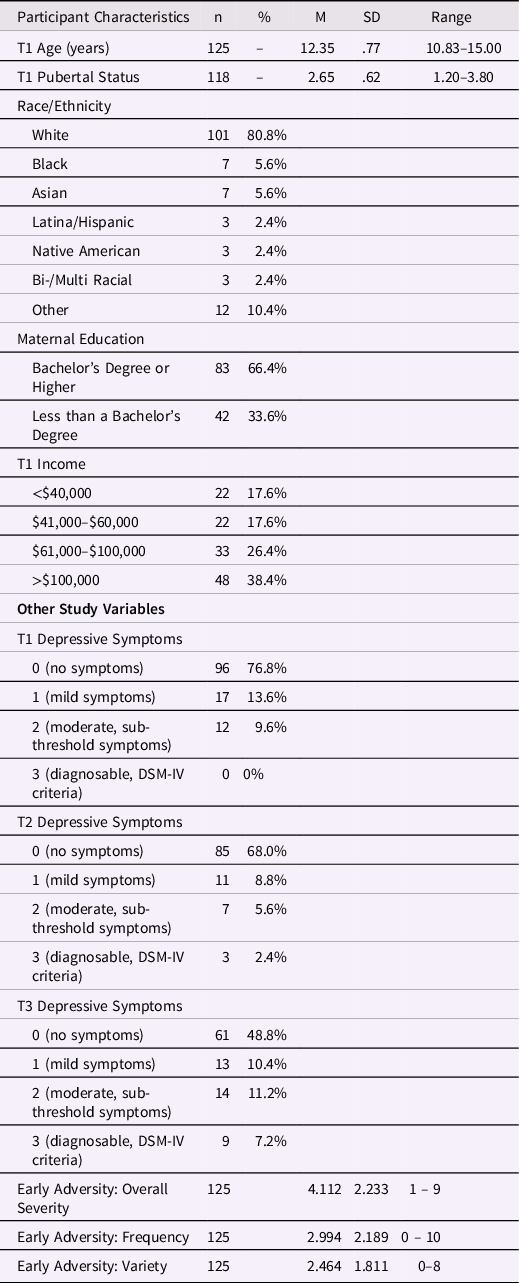
Participant characteristics are presented in Table 1. The racial/ethnic distribution of the sample (80.8% White) is consistent with the two counties from which the sample was drawn, Berkshire County, Massachusetts and Bennington County, Vermont, which are 94% and 97% white, respectively. There were no significant differences between those who did and did not participate in the follow-ups on any of the T1 variables, except: a) those who did not participate in T2 reported more advanced pubertal status (versus those who did participate; t[116] = −2.15, p = .03); and b) those who did not participate in T3 had a greater variety of early adversity (versus those who did participate; t[123] = 2.13, p = .04). Participants were included in analyses regardless of whether they participated in the follow-ups (see below).
Characteristics of adolescent participants and descriptive statistics

Notes. Ns vary due to missing data and attrition at T2 and T3. For race/ethnicity, participants could select more than one category; thus, the percentages total greater than 100%. T1 = Time 1. T2 = Time 2. Time 3 = Time 3. See Table 3 for descriptive statistics for acute stress.
Measures
Early adversity
Girls’ exposure to negative family events and circumstances during their lifetime (up until the year prior to the interview, which was the focus of assessment for recent events to ensure temporal precedence, consistent with prior work [Rudolph & Flynn, Reference Rudolph and Flynn2007]; see Figure 1) was assessed with the lifetime adversity section of the Youth Life Stress Interview (Rudolph & Flynn, Reference Rudolph and Flynn2007). Mothers and daughters completed separate interviews with the same interviewer, and interviewers were blind to all other data (Stroud et al., Reference Stroud, Chen, Doane and Granger2016a). The interview began with a general probe assessing exposure to particularly stressful events and circumstances. Next, a series of probes were used to assess specific types of adversity (death of a close family member or friend, long separation from parents [or primary caregivers], parental separation or divorce, exposure to serious marital conflict, chronic physical or mental illness of a close family member or friend, multiple family transitions [e.g., frequent moves between different caregivers], chaotic family living circumstances [e.g., neglect], legal problems of family members, and financial difficulties). A final probe assessed exposure to any other very difficult experience. See Stroud et al. (Reference Stroud, Chen, Doane and Granger2016a) for detailed descriptive statistics.
Participants provided information about the context (i.e., circumstances) and the consequences for each adversity endorsed. Using audio-recordings of the interviews, a research assistant prepared narrative accounts for each adversity endorsed (excluding participants’ subjective reactions). Information provided by mothers and daughters was combined into a single narrative, consistent with prior work (e.g., Rudolph & Flynn, Reference Rudolph and Flynn2007).Footnote 2 If mothers and daughters endorsed the same adversity, the narratives reflected both of their reports. If only the mother or only the daughter endorsed the adversity, the narrative was based upon only one person’s report. The research assistant then presented the narratives to an independent rating team of two to four coders; coders were blind to participants’ subjective reactions and all other data. The team coded objective impact (i.e., severity) using the narratives on a scale from 1 (no adversity) to 9 (extremely severe negative impact), considering the likely impact of the adversity (or total adversities) for a typical adolescent given the circumstances. The team rated each adversity endorsed and provided an overall severity rating. A second team, blind to the original ratings, rerated a set of participants (n = 60; inter-rater reliability: intra-class correlation [ICC] = 0.99).
In the primary analyses, we used the overall severity rating (based on the overall adversity rating provided by the rating team) to quantify early adversity. In robustness tests, we repeated analyses using two alternative indices of early adversity: a) frequency (total frequency of adversities experienced; e.g., If a participant experienced 2 deaths, 1 marital separation and 2 chronic illnesses of family members or close friends); and b) variety (sum of the number of different types of adversities experienced, regardless of severity; e.g., In example above, variety would be rated 3). See Table 1 for descriptive statistics.
Recent acute life stress
A modified version of the UCLA Life Stress Interview (LSI; adapted from Rudolph & Hammen, Reference Rudolph and Hammen1999; Rudolph et al., Reference Rudolph, Hammen, Burge, Lindberg, Herzberg and Daley2000) assessed adolescents’ past year acute life stress (i.e., events with a brief onset and relatively short duration). Consistent with prior work (Rudolph & Flynn, Reference Rudolph and Flynn2007), this time frame was selected to ensure that there was not overlap with the time period assessed by early adversity, but also that no time was omitted; further, the one-year time period aligns with the definition of recent stress (e.g., Vrshek-Schallhorn et al., Reference Vrshek-Schallhorn, Ditcheva, Corneau, Harkness and Hayden2020) as well as prior work (e.g., St Clair et al., Reference St Clair, Croudace, Dunn, Jones, Herbert and Goodyer2015). At T1, the interview assessed the prior year; at T2, the interview assessed the time since T1. Mothers and daughters completed separate interviews with the same interviewer, and interviewers were blind to other data. For each event reported, participants provided information about its surrounding context (e.g., circumstances and resources to cope with it, predictability, and prior experience with similar events), duration, and consequences to obtain the degree of impact for a typical adolescent given the context (i.e., objective impact). Interviewers prepared narrative accounts of each event (detailing the context, but excluding participants’ subjective reactions) that were presented to an independent rating team, comprising trained and reliable interviewers who were blind to all other data. Consistent with prior work (e.g., Rudolph et al., Reference Rudolph, Hammen, Burge, Lindberg, Herzberg and Daley2000), when mothers and daughters reported the same event, information from mothers and adolescents was combined into a single narrative. If only one reported the event, the narrative reflected only her report.
Consistent with prior work (e.g., Rudolph et al., Reference Rudolph, Hammen, Burge, Lindberg, Herzberg and Daley2000), for each event, the team rated: a) objective impact (1 [no negative impact] to 5 [extremely severe negative impact]; half-points permitted); b) interpersonal status (coded 1/0; rated interpersonal when the primary context involved relations with others or affected the participants’ relations); and c) independence (degree to which the event resulted from the participant’s behavior; 1 [fully independent of the person’s behavior] to 5 [fully dependent on the person’s behavior]; half-points permitted). Events rated as 3 or higher were dependent, and those 2.5 or lower were independent (e.g., Stroud et al., Reference Stroud, Chen, Doane and Granger2016b). A second team, blind to the original ratings, rerated a set of events (n = 132) on objective impact (ICC = .92), interpersonal status (ICC = .98), and independence (ICC = .99).
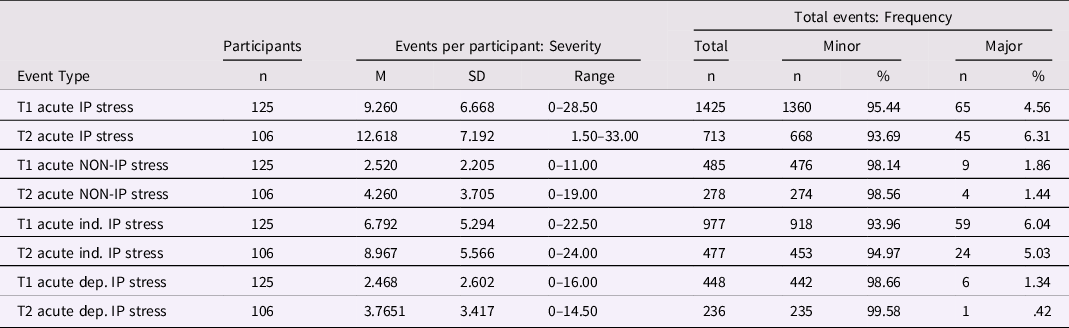
Consistent with prior work (e.g., Rudolph & Hammen, Reference Rudolph and Hammen1999; Stroud et al., Reference Stroud, Chen, Doane and Granger2016b), for each time point, four acute stress composites were created formed by summing the objective impact ratings of for each type of event for each interview period: 1) acute interpersonal stress (interpersonal events; e.g., break-up, conflict); 2) acute non-interpersonal stress (non-interpersonal events; e.g., academic failure; extracurricular disappointment); 3) acute independent interpersonal stress (independent interpersonal events; e.g., parental job loss, death); and 4) acute dependent interpersonal stress (dependent interpersonal events; e.g., conflict, end of friendship). See Table 2 for descriptive statistics.
Descriptive statistics for life events
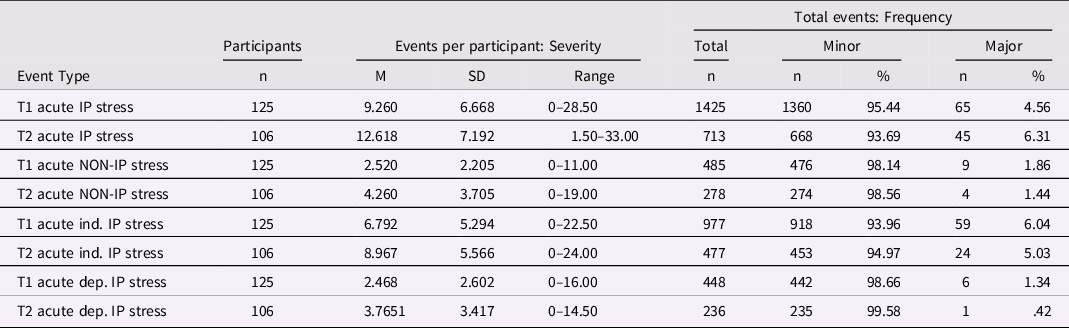
Notes. Participant N varies due to attrition at T2. For severity of events per participant, data refer to the sum of the severity ratings of each event type. For the frequency of total events, total n refers to the total number of events in the study for each event type; the n for minor (i.e., non-severe; objective severity rating of 2.5 or below; Stroud et al., Reference Stroud, Davila, Hammen and Vrshek-Schallhorn2011) refers to the total number of minor events for each event type and the % refers to the percentage of events within each event type that were coded as minor; and the n for major (i.e., severe; objective severity rating of 3.0 or above; Stroud et al., Reference Stroud, Davila, Hammen and Vrshek-Schallhorn2011) refers to the total number of major events for each event type and the % refers to the percentage of events within each event type that were coded as major. Event composites were formed by summing the severity ratings for each event type (regardless of event severity). The frequency of events, minor events, and major events are only presented for descriptive purposes, and were not used in analyses. T1 = Time 1. T2 = Time 2. IP = interpersonal. NON-IP = interpersonal. ind. = independent. dep. = dependent.
Depressive symptoms
At T1 – T3, adolescents were interviewed with the Schedule for Affective Disorders and Schizophrenia for School-Aged Children-Present and Lifetime version (Kaufman et al., Reference Kaufman, Birmaher, Brent, Rau, Flynn, Moreci and Ryan1997), a widely-used semi-structured diagnostic interview with well-established validity (Kaufman et al., Reference Kaufman, Birmaher, Brent, Rau, Flynn, Moreci and Ryan1997). Symptom levels for each disorder were separately rated: 0 = no symptoms; 1 = mild symptoms; 2 = moderate, sub-threshold symptoms; 3 = DSM-IV criteria. T1 ratings reflect lifetime history and current symptoms; T2 and T3 ratings reflect symptoms since the prior interview. At each time point, a rating was made for current and past symptom level (worst since the last follow-up) (e.g., Stroud, Chen, et al., Reference Stroud, Chen, Doane and Granger2019). For each time point, the maximum of the past and current depressive symptom ratings was computed to form a composite (e.g., Stroud, Vrshek-Shallhorn, Norkett, & Doane, Reference Stroud, Vrshek-Shallhorn, Norkett and Doane2019; see Table 1). Thus, the T1 depressive symptoms composite reflects worst lifetime symptom level, and the T2 and T3 depressive symptom composites each reflect the worst symptom level since the prior interview. Inter-rater reliability was assessed by rerating approximately 20% of interviews (blind to original ratings) using audio-recordings (ICCs ranged from .97 to 1.00).
Pubertal status
Because of evidence that associations between early adversity, recent stress, and depression vary as a function of pubertal status among girls (Rudolph & Flynn, Reference Rudolph and Flynn2007), pubertal status was examined as a potential covariate. At T1, adolescents completed the Pubertal Development Scale (Petersen et al., Reference Petersen, Crockett, Richards and Boxer1988) to assess pubertal development. The five items, which assess growth spurt in height, skin and body hair changes, breast development, and age at menarche, are rated on a 4-point scale, from no development (1) to development seems completed (4), except for menarche, which is rated dichotomously. The mean was used (α = .70) to index pubertal status.
Analytic strategy
Primary analyses were conducted in Mplus 8.4 (Muthen & Muthen, Reference Muthen and Muthen1998–2019). Path analyses were conducted with ML estimation and full information maximum likelihood (FIML) was used to handle missing data (Savalei & Rhemtulla, Reference Savalei and Rhemtulla2012). Model fit was assessed with the chi-square test (a p-value >.05 indicates good fit), the CFI(>.90 indicates good fit), and the RMSEA (<.05 indicates good fit; <.08 indicates adequate fit; Browne & Cudeck, Reference Browne, Cudeck, Bollen and Long1993; Hu & Bentler, Reference Hu and Bentler1998).
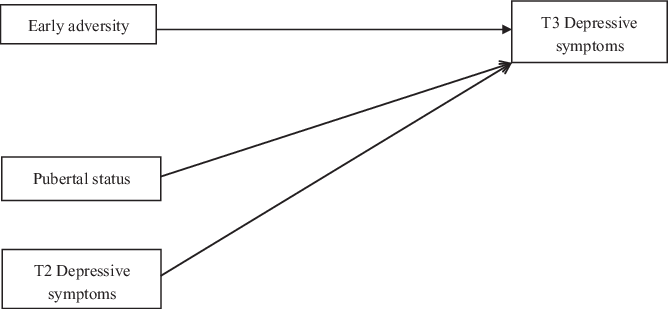
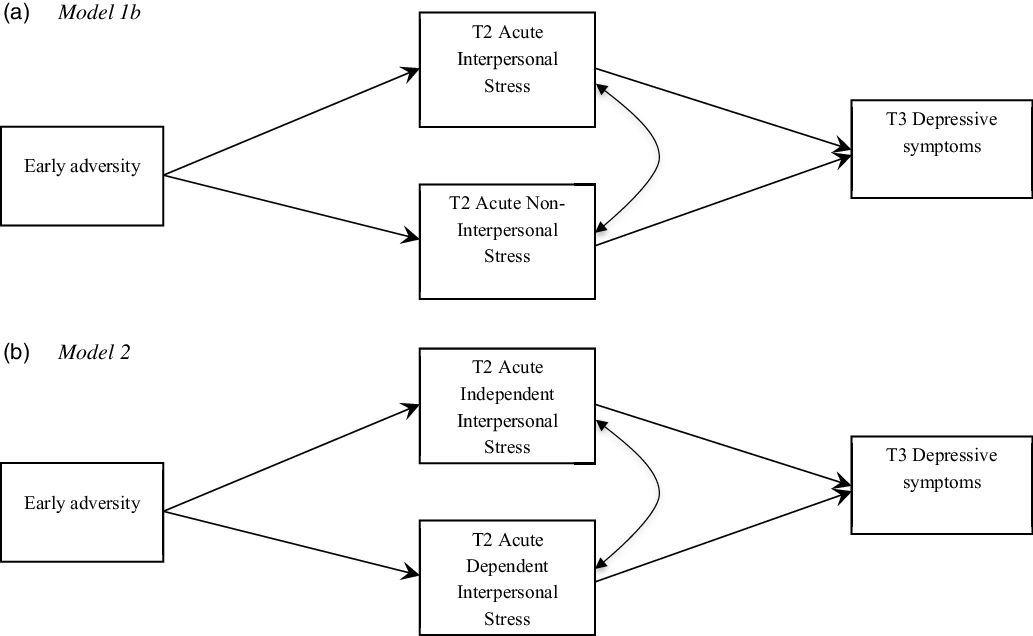
First, we examined the total effect of early adversity on T3 depressive symptoms. Thus, we specified a model that included a path from early adversity to T3 depressive symptoms (Model 1a; Figure 2). Second, to examine whether T2 acute interpersonal and non-interpersonal stress each mediated the prospective association between early adversity and T3 depressive symptoms, we added T2 acute interpersonal and non-interpersonal stress to Model 1a, and included indirect paths from early adversity to T3 depressive symptoms through each form of stress (Model 1b; Figure 3a). Next, in Model 2, we further stratified acute interpersonal stress by independence. This model was identical to Model 1b except that T2 acute independent interpersonal stress and T2 acute dependent interpersonal stress were evaluated as mediators (Figure 3b). Predictor variables were standardized. In Models 1b and 2, a covariance was included between the two forms of T2 acute stress. Because the total effect does not need to be significant to evaluate mediation (e.g., inconsistent mediation models in which the direct and indirect effects may have opposite signs; MacKinnon, Krull, & Lockwood, Reference MacKinnon, Krull and Lockwood2000), we conducted Models 1b and 2 regardless of the significance of the total effect in Model 1a.
Model 1a: Total effect of early adversity on T3 depressive symptoms adjusting for the effects of Pubertal status, T1 depressive symptoms, and T2 depressive symptoms.

Direct and indirect effects of early adversity on T3 depressive symptoms.
Notes. In Model 1b, covariates were pubertal status, maternal education, T1 depressive symptoms, T2 depressive symptoms, and T1 acute interpersonal stress. In Model 2, covariates were pubertal status, maternal education, T1 depressive symptoms, T2 depressive symptoms, T1 acute independent interpersonal stress, and T1 acute dependent interpersonal stress.

Consistent with recommendations (MacKinnon, Reference MacKinnon2008), significance of direct and indirect effects was evaluated using bias-corrected bootstrapping (n = 5000). In all models, significant effects are those not including zero in the 95% asymmetric CIs. A Wald Test of Parameter Constraints tested whether the magnitude of 2 indirect effects included in each model were significantly different. To evaluate the robustness of our findings, we repeated the primary models using two other methods of quantifying the accumulation of early adversity: frequency and variety. These models were identical to the primary models except for replacing the early adversity variable.
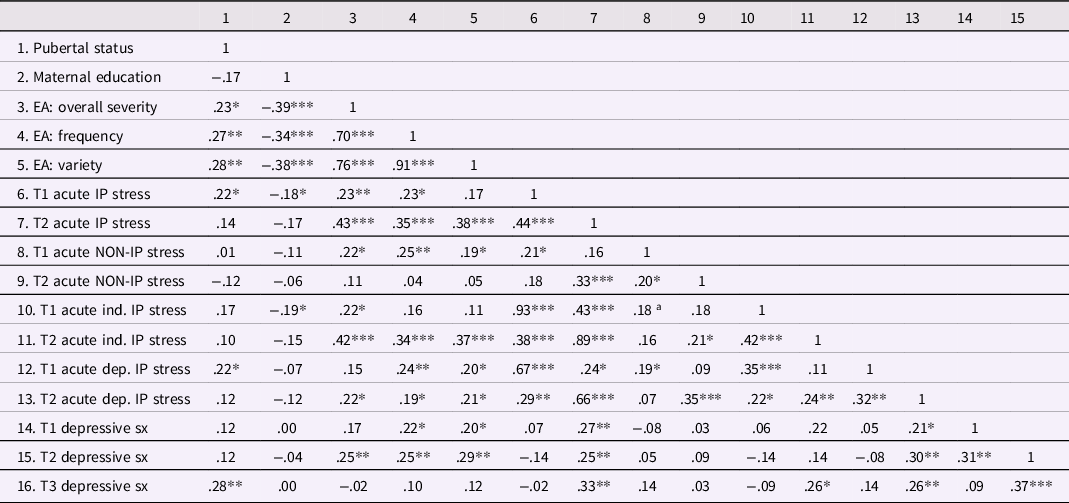
Prior to conducting the primary analyses, we examined descriptive statistics and bivariate correlations, including whether potential covariates (i.e., pubertal status, maternal education) were significantly correlated (p < .05) with early adversity or T3 depressive symptoms. Maternal education and pubertal status were each significantly correlated with early adversity (ps < .05) and pubertal status was significantly correlated with T3 depressive symptoms (p < .05; see Table 3). Thus, pubertal status was included in Model 1a, and maternal education and pubertal status were each included in Models 1b and 2. So that we could evaluate whether early adversity predicted growth in each form of T2 acute stress, we also added the T1 forms of stress that were tested as mediators in Models 1b (i.e., T1 acute interpersonal stress, T1 acute non-interpersonal stress) and 2 (T1 acute independent interpersonal stress, T1 acute dependent interpersonal stress), and then trimmed non-significant paths. Similarly, for all models, we added T1 and T2 depressive symptoms as covariates because we were interested in examining whether early adversity predicted developmental changes in depressive symptoms (via different forms of T2 acute stress), and then trimmed non-significant paths. The models ensure temporal precedence of early adversity to the T2 stress variables, and of the T2 stress variables to T3 depressive symptoms, which is critical in mediation models (e.g., MacKinnon, Reference MacKinnon2008).Footnote 3
Bivariate correlations
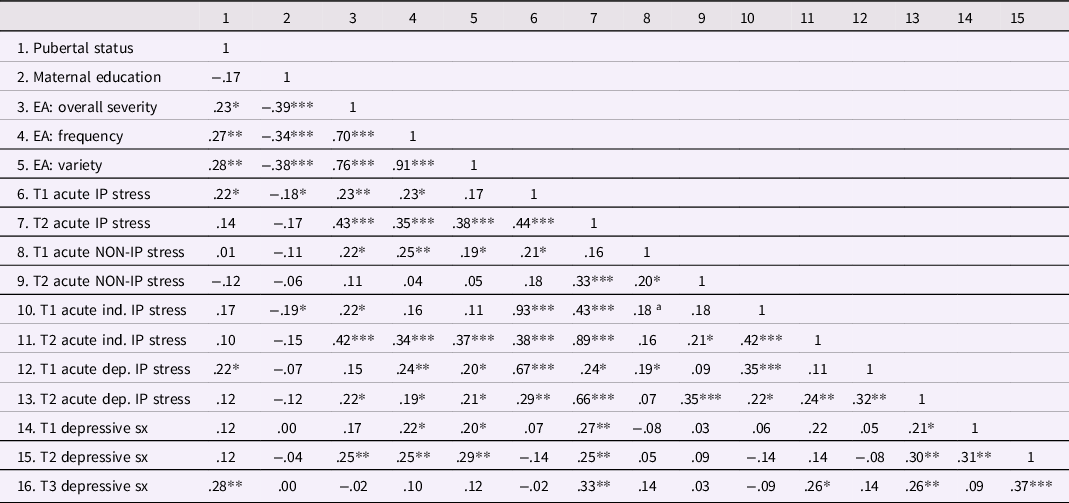
Notes. ***p < .001; **p < .01, *p < .05.
a p = . 05.
Ns varied due to missing data and attrition (see Table 1). T1 = Time 1. T2 = Time 2. T3 = Time 3. EA = early adversity. IP = interpersonal. NON-IP = interpersonal. ind. = independent. dep. = dependent.
Results
Preliminary analyses
Each index of adversity was significantly associated with T1 and T2 depressive symptoms, except for total severity and T1 depressive symptoms which were similar in magnitude to others but not significant (r = .17, p = .07); see Table 3. Unexpectedly, however, the early adversity indices were not significantly associated with T3 depressive symptoms. Consistent with stress continuity (e.g., Uliaszek et al., Reference Uliaszek, Zinbarg, Mineka, Craske, Griffith, Sutton and Hammen2012), the T1 and T2 composites of each form of acute stress were moderately and significantly correlated (e.g., T1 and T2 acute interpersonal stress). T1 acute interpersonal stress was not significantly correlated with T3 depressive symptoms, but the T2 forms of acute interpersonal stress (T2 acute interpersonal stress, T2 acute independent and dependent interpersonal stress) were each significantly correlated with T3 depressive symptoms, a pattern consistent with the time-limited effects of life events (e.g., Brown & Harris, Reference Brown and Harris1978). In contrast, the T1 and T2 acute non-interpersonal stress composites were not significantly correlated with T3 depressive symptoms.
Does early adversity predict increases in T3 depressive symptoms?
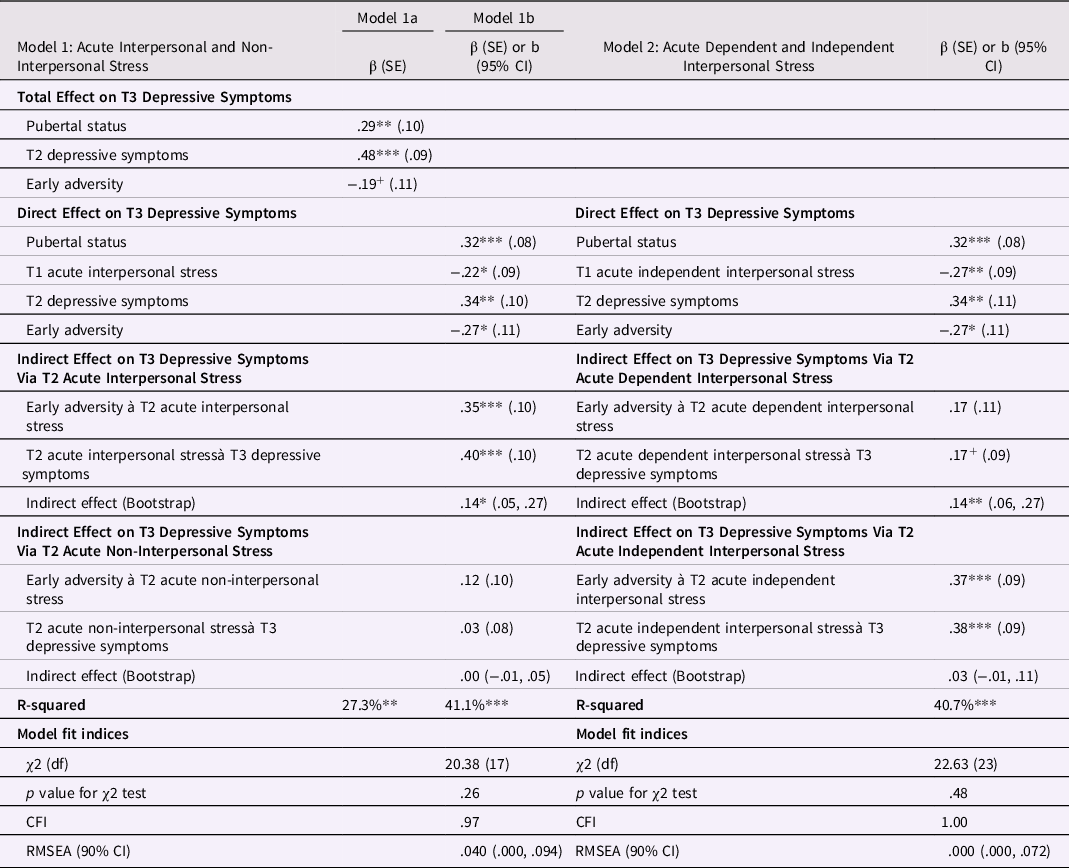
Model 1a examined whether early adversity predicted increases in depressive symptoms between T2 and T3. No model fit indices were available because these models were just-identified models (i.e., a saturated model in which the number known values is equal to the number of free parameters, yielding zero df). Contrary to hypotheses, early adversity was not significantly associated with T3 depressive symptoms. As shown in Table 4, the total effect was small (Standardized Coefficient [β] = −.19, p = .080). The model explained 27.3% of the variance in T3 depressive symptoms.
Examining whether proximal acute stress mediates the association between early adversity and T3 depressive symptoms
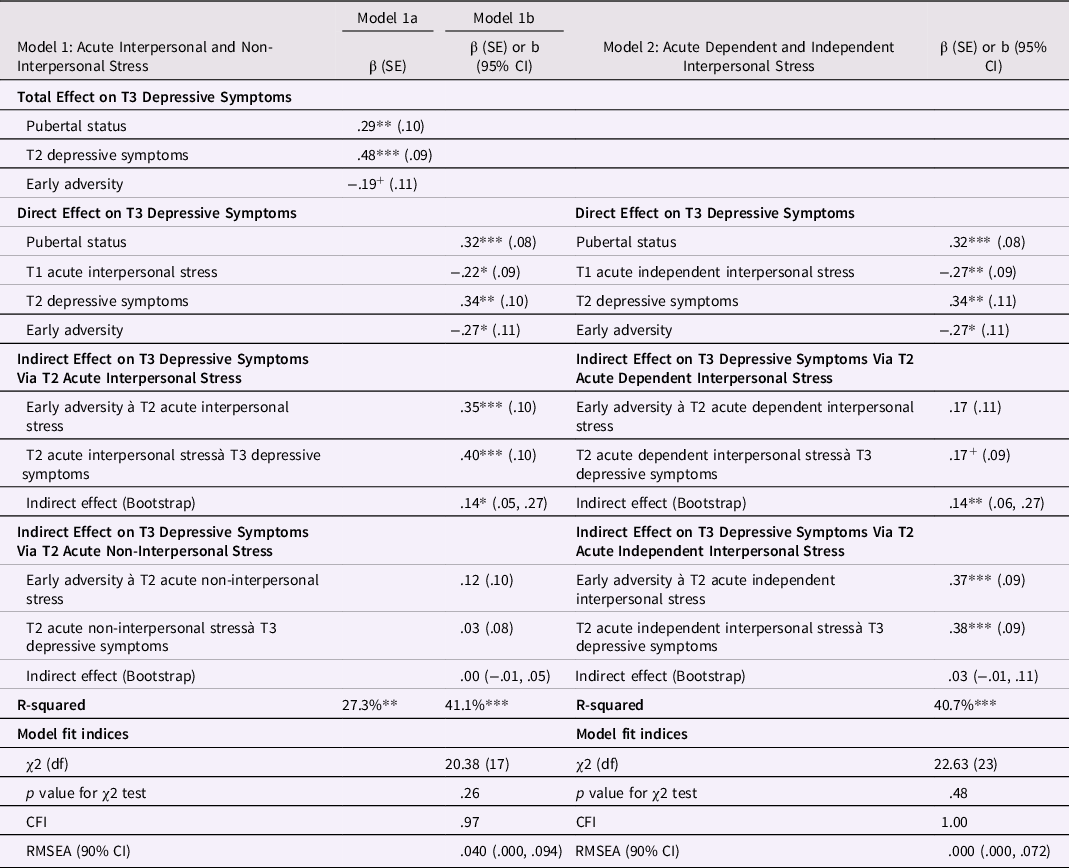
Note. Only total, direct, and indirect effects are included in this table, and thus, not all paths are shown. Model 1a is a base model. Models 1b and 2 are mediation models. B = standardized coefficient.. T1 = Time 1. T2 = Time 2. T3 = Time 3.
***p < .001; **p < .01, *p < .05, + p < .10, n = 125.
Non-significant paths between covariates and main variables were trimmed, and thus, not all covariates included in the models are shown. Note that because non-significant covariate paths were trimmed, Model 1a does not include T1 depressive symptoms and Model 1b does not include T1 acute non-interpersonal stress. In Model 1b, included covariates were pubertal status, maternal education, T1 depressive symptoms, T2 depressive symptoms, and T1 acute interpersonal stress. In Model 2, included covariates were pubertal status, maternal education, T1 depressive symptoms, T2 depressive symptoms, T1 acute independent interpersonal stress, and T1 acute dependent interpersonal stress. Total R2 = total variance in T3 depressive symptoms explained by the model.
Do acute interpersonal and non-interpersonal stress each mediate the prospective association between early adversity and T3 depressive symptoms?
Model fit indices and standardized coefficients for the direct and indirect effects are presented in Table 4 (Models 1b). Model fit indices were adequate. Consistent with predictions, greater early adversity indirectly predicted greater T3 depressive symptoms through growth in T2 acute interpersonal, but not non-interpersonal, stress. Based upon the bias-corrected bootstrap CIs, the indirect effect via T2 acute interpersonal stress was significant (b = .14, p = .013) and the indirect effect via T2 acute non-interpersonal stress was not (b = .00. p = .792). The magnitude of the indirect effect via T2 acute interpersonal stress was significantly greater than that via T2 acute non-interpersonal stress (χ2 [1] = 5.920, p = .015). Unexpectedly, the direct effect of early adversity on T3 depressive symptoms emerged as significant and negative (β = −.27, p = .014). The model explained 41.1% of the variance in T3 depressive symptoms (Table 4).
Do acute independent and dependent interpersonal stress each mediate the prospective association between early adversity and T3 depressive symptoms?
Model fit indices and standardized coefficients for the direct and indirect effects are presented in Table 4 (Model 2). Model fit indices were adequate. Greater early adversity indirectly predicted greater T3 depressive symptoms through growth in T2 acute independent, but not dependent, interpersonal stress. Based upon the bias-corrected bootstrap CIs, the indirect effect via T2 acute independent interpersonal stress was significant (b = .14) and that via T2 acute dependent interpersonal stress was not (b = .03). The magnitude of the indirect effect via T2 acute independent interpersonal stress was also significantly greater than that via T2 acute dependent interpersonal stress (χ2 [1] = 4.702, p = .030). Consistent with Model 1b, the direct effect of early adversity on T3 depressive symptoms emerged as significant and negative (β = −.27, p = .011). The model explained 40.7% of the variance in T3 depressive symptoms (Table 4).
Follow-up robustness tests
To evaluate the robustness of the findings, we conducted follow-up models to examine whether the results were consistent when early adversity was conceptualized as frequency and variety (separate models for each type of conceptualization). First, we evaluated the total effects of early adversity on T3 depressive symptoms. Consistent with Model 1a, the total effect was not significant when early adversity was conceptualized as frequency (β = −.07, p = .587) nor variety (β = −.06, p = .492). Second, we evaluated the indirect and direct effects. Model fit indices were adequate, and the results were similar to that of the primary models. Consistent with Model 1b, the indirect effects via T2 acute interpersonal stress were significant (frequency: b = .09 95% CI [.02, .19], p = .043; variety: b = .11 95% CI [.04, .22], p = .013) and those via T2 acute non-interpersonal stress were not (frequency: b = .00 95% CI [−.01, .04] p = .890; variety: b = .00 95% CI [−.01, .03], p = .880). Their magnitudes were significantly different (frequency: χ2 [1] = 4.115, p = .040, and variety: χ2 [1] = 5.943, p = .015). In contrast to Model 1b, however, the direct effects of early adversity on T3 depressive symptoms were not significant (frequency: β = −.11, p = .24; variety: β = −.13, p = .21). The models explained 38.4% (frequency) and 38.6% (variety) of the variance in T3 depressive symptoms.
Consistent with Model 2, the indirect effects via T2 acute independent interpersonal stress were significant (frequency: b = .09 95% CI [.03, .18], p = .017; variety: b = .11 95% CI [.04, .21], p = .006) and those via T2 acute dependent interpersonal stress were not (frequency: b = .02 95% CI [−.01, .09], p = .302; variety: b = .02 95% CI [−.01, .09] p = .287). In contrast to Model 2, however, the difference in their magnitude was only not significant (frequency: χ2 [1] = 2.944, p = .086, and variety: χ2 [1] = 3.831, p = .050). In addition, the direct effects of early adversity on T3 depressive symptoms were not significant (frequency: β = −.12, p = .20; variety: β = −.14, p = .17). The models explained 38.2% (frequency) and 39.1% (variety) of the variance in T3 depressive symptoms. Full results of all follow-up models available upon request.
Discussion
This 3-wave longitudinal study of early adolescent girls with no prior history of diagnosable depression examined whether early adversity confers risk for the development of later depressive symptoms via growth in recent acute stress. Consistent with predictions, we provided novel evidence that growth in acute interpersonal, but not non-interpersonal, stress mediates the prospective link between early adversity and depressive symptoms. Moreover, we provided the first evidence that early adversity predicts subsequent depressive symptoms via growth in acute independent, but not dependent, interpersonal stress, suggesting that increases in exposure to, rather than in the generation of, acute interpersonal stress, acts as a mediator of the early adversity-depression association. Finally, findings suggested that early adversity may not be associated with later depressive symptoms when examined alone and may reduce risk when accounting for recent acute stress, though the latter effect varied based upon the quantification of early adversity. Each of these findings was bolstered by using gold-standard contextual stress interviews with adolescents and their mothers to assess each early adversity and recent acute stress, by using diagnostic interviews to assess current and lifetime history of depressive symptoms, and by adjusting for prior levels of both depressive symptoms and recent stress, as well as pubertal status and maternal education level.
Early adversity and depressive symptoms: the role of acute interpersonal stress
The present findings suggest that the accumulation of early adversity within the family environment predicts later depressive symptoms via its association with growth in acute interpersonal, but not non-interpersonal, stress. Notably, when accounting for past-year recent acute stress, findings indicate that early adversity predicts growth in acute interpersonal stress over time, strengthening support for the possibility that recent acute interpersonal stress plays a mediating role in the early adversity-depression pathway. In other words, it reduces the possibility that mediation resulted from acute stress continuity (e.g., Hammen et al., Reference Hammen, Hazel, Brennan and Najman2012), which is particularly important during this developmental period as adolescents tend to live in the family structures that may shape their exposure to both early adversity and recent acute stress (Hazel et al., Reference Hazel, Hammen, Brennan and Najman2008; Pearlin, Reference Pearlin1989).
Moreover, extending prior work, models accounted for current and lifetime history of depression, those with lifetime diagnosable depression at baseline were excluded, and the temporal ordering of each link in the early adversity-recent acute stress-depression pathway was ensured. These methodological features reduce the possibility that findings are attributable to several alternative explanations: prior depression acting as a third variable (e.g., Kessler & Magee, Reference Kessler and Magee1993), the continuity of depression over time (Conway et al., Reference Conway, Rutter and Brown2016), or reverse causality wherein depression predicts increases in each acute interpersonal stress (Hammen, Reference Hammen1991) and early adversity (e.g., Bodner et al., Reference Bodner, Kuppens, Allen, Sheeber and Ceulemans2017). Further, in replicating findings across three different indices of the accumulation of early adversity, the present findings expand upon prior work in demonstrating that severity, frequency, and variety are each indicators of adolescents’ level of cumulative early adversity exposure that predict risk for depressive symptoms via recent acute interpersonal stress.
That growth in acute interpersonal, but not non-interpersonal, stress emerged as a mediator adds to prior work suggesting that interpersonal forms of recent stress may play a unique role in the early adversity-depression pathway (e.g., Raposa et al., Reference Raposa, Hammen, Brennan, O’Callaghan and Najman2014; Vrshek-Schallhorn et al., Reference Vrshek-Schallhorn, Stroud, Mineka, Hammen, Zinbarg, Wolitzky-Taylor and Craske2015), and provides the first evidence that the magnitude of the mediating role of acute interpersonal stress is significantly greater than that of acute non-interpersonal stress. Such findings align with research and theory highlighting the etiological significance of interpersonal stress for depression risk (e.g., Hammen, Reference Hammen1991; Vrshek-Schallhorn et al., Reference Vrshek-Schallhorn, Stroud, Mineka, Hammen, Zinbarg, Wolitzky-Taylor and Craske2015), particularly among early adolescent girls (Rudolph & Hammen, Reference Rudolph and Hammen1999), as well as with research suggesting that the sensitizing effect of early adversity may be limited to acute interpersonal stress (Rudolph & Flynn, Reference Rudolph and Flynn2007). Moreover, the prospective link between early adversity and recent acute interpersonal stress is consistent with prior work and theory supporting links between early adversity and interpersonal difficulties across the life course (e.g., Doyle & Cicchetti, Reference Doyle and Cicchetti2017; Repetti et al., Reference Repetti, Taylor and Seeman2002). Adding to this body of work which has focused on severe forms of adversity (e.g., childhood maltreatment, high-risk families), the present findings suggest that the accumulation of relatively less severe experiences in the family environment (e.g., parents’ marital conflict, death of a grandparent) portends growth in interpersonal events across adolescence (e.g., friend moving away, parental job loss). Interestingly, most of the T2 interpersonal events experienced by participants were rated as minor (i.e., non-severe), suggesting that an increase in the accumulation of even minor interpersonal (e.g., brief and resolved conflicts) events mediates the link between early adversity and depressive symptoms.
Independent nature of mediating interpersonal stress
Further clarifying the mediating role of acute interpersonal stress, the present findings suggest that early adversity confers risk for depressive symptoms because adolescents are exposed to increasing levels of fateful interpersonal events, not because adolescents generate increasing levels of interpersonal events. Though prior work has not directly compared interpersonal stress exposure and stress generation as pathways linking early adversity and depressive symptoms, findings are consistent with research demonstrating that adolescents who have experienced early adversity may be selectively sensitized to acute interpersonal (but not non-interpersonal; e.g., Rudolph & Flynn, Reference Rudolph and Flynn2007) and independent (but not dependent; e.g., La Rocque, Harkness, & Bagby, Reference La Rocque, Harkness and Bagby2014) stress. Taken together with the present findings, this suggests that adolescents with a history of early adversity may get caught in a vicious cycle of increasing levels of acute independent interpersonal stress, coupled with increased sensitivity to depression in the face of such stress – a stress perpetuation-sensitization loop.
Future research is needed to evaluate why the mediating role of recent interpersonal events was limited to independent ones, and whether the findings are specific to adolescents. One possibility is the link between early adversity and independent interpersonal events emerged as a consequence of their relatively enduring shared context(s), such as family conflict, family instability, or socioeconomic disadvantage (Hammen et al., Reference Hammen, Hazel, Brennan and Najman2012; Pearlin, Reference Pearlin1989). As in prior adolescent samples, many of the independent interpersonal events adolescents experienced (e.g., parental job loss, parental illness) were caused by their parents (e.g., La Rocque et al., Reference La Rocque, Harkness and Bagby2014). Though speculative, this raises the possibility that parental interpersonal stress generation (i.e., at-risk parents generate interpersonal stressors in adolescents’ lives) may act as one mechanism underlying the association between early adversity and growth in recent acute interpersonal stress exposure during this developmental period. Though focused on the intergenerational transmission of depression, Hammen and colleagues’ (Reference Hammen, Hazel, Brennan and Najman2012) model proposes that parental risk (e.g., parental depression) predicts offspring depression via the intergenerational transmission of stress exposure and generation, a cascade that begins with early adversity and continues through adulthood (Hammen et al, Reference Hammen, Hazel, Brennan and Najman2012). Therefore, it may be that parental interpersonal stress generation acts as a pathway linking early adversity and depressive symptoms in the developmental period observed in the present study whereas adolescent interpersonal stress generation acts as a pathway during older developmental periods. Supporting this, others have hypothesized that stress generation processes emerge with age, beginning in early adolescence when adolescents have increasing agency in creating their environments (Hammen et al., Reference Hammen, Hazel, Brennan and Najman2012; Liu & Alloy, Reference Liu and Alloy2010). Further, existing research documenting links between early adversity and stress generation has focused on adults (Liu et al., Reference Liu, Choi, Boland, Mastin and Alloy2013). Thus, research examining interpersonal stress exposure, as well as adolescent and parental interpersonal stress generation, as pathways through which early adversity predicts depression across multiple developmental periods is needed.
Early adversity may not confer risk for future depressive symptoms among early adolescent girls
The present findings suggest that early adversity may not directly confer risk for later adolescent depression (i.e., when examined in the absence of the indirect effect via recent acute stress). Though contradicting evidence that early adversity places individuals at long-term risk for depression (e.g., Green et al., Reference Green, McLaughlin, Berglund, Gruber, Sampson, Zaslavsky and Kessler2010; Kessler & Magee, Reference Kessler and Magee1993), such findings do align with several (but not all; e.g., St Clair et al., Reference St Clair, Croudace, Dunn, Jones, Herbert and Goodyer2015) studies examining depression during adolescence. For example, in terms of the accumulation of early adversity, one study showed that the total number of early adversities experienced prior to age 5 (i.e., frequency in 5 domains; e.g., economic hardship, mother’s relationship with partner, maternal stressful events) did not predict depressive disorders at age 15 (Phillips et al., Reference Phillips, Hammen, Brennan, Najman and Bor2005). Similarly, in terms of experiencing single types of adversity, one study demonstrated that several types of adversity (each examined alone) predicted childhood or young adult, but not adolescent, depression (e.g., parental psychopathology, loss and violence events; Shanahan et al., Reference Shanahan, Copeland, Costello and Angold2011). Thus, the focus on adolescent depression as well as a specific type of early adversity (i.e., within the family environment) may have shaped the present findings. Moreover, the developmental timing of the early adversity may have also played a role. For example, in one investigation when the developmental timing of maltreatment was not considered, experiencing any maltreatment was associated with increased risk for depression during adolescence (ages 14–16; versus those with no maltreatment history; Thornberry, Ireland, & Smith, Reference Thornberry, Ireland and Smith2001). However, when stratified by timing, adolescent (age 12 and above), but not childhood (0–11), maltreatment was associated with increased risk of adolescent depression.
Recency stress models
Early adversity also did not place adolescents at risk for subsequent depression when accounting for the mediating role of acute stress: early adversity only indirectly conferred risk through increases in recent acute interpersonal (independent) stress. This pattern of findings aligns with recency stress models which posit that stressors are most potent just after occurrence, posing a time-limited risk, which decays over time (Shanahan et al., Reference Shanahan, Copeland, Costello and Angold2011). Consistent with this, prior work has shown that adversities occurring during adolescence, but not childhood, predict the development of adolescent depression (Shanahan et al., Reference Shanahan, Copeland, Costello and Angold2011; Vrshek-Schallhorn et al., Reference Vrshek-Schallhorn, Wolitzky-Taylor, Doane, Epstein, Sumner, Mineka and Adam2014). For example, Shanahan and colleagues (Reference Shanahan, Copeland, Costello and Angold2011) demonstrated that family dysfunction (i.e., parent-adolescent conflict, interparental conflict, scapegoating) occurring during adolescence, but not childhood, predicted adolescent-onset depression. Thus, if the potency of stress on depression decays over time (e.g., Brown & Harris, Reference Brown and Harris1978), early adversity’s impact on depression may have lessened over the 2–3 year gap between the time period tapped by the early adversity measure and the onset of symptoms (see Figure 1) (e.g., Oldehinkel et al., Reference Oldehinkel, Ormel, Verhulst and Nederhof2014), thereby creating space for recent acute independent interpersonal stress to predict depression.
Promotive effects of distal stress in the absence of recent stress
Interestingly, when accounting for the mediating role of recent stress, greater severity of early adversity predicted subsequent decreases in T3 depressive symptoms, suggesting that when adolescents are not exposed to growing levels of acute independent interpersonal stress, experiencing a greater severity of early adversity may surprisingly be promotive. In a similar pattern, in these models, T1 acute impersonal and T1 acute independent interpersonal stress were each negatively associated with T3 depressive symptoms, highlighting that the statistically unique effect of more distal forms of these types of stress (i.e., after accounting for these forms of recent [i.e., T2]) stress) may be promotive. Though perhaps counterintuitive, these promotive effects are not unprecedented, and appear consistent with stress inoculation or steeling effects (e.g., Rudolph & Flynn, Reference Rudolph and Flynn2007; Seery et al., Reference Seery, Holman and Silver2010). In a similar pattern, a greater number of lifetime pre-onset traumas predicted greater risk for MDD onsets via greater recent chronic and acute stress exposure, but decreased risk when recent stress levels were held constant (Turner & Lloyd, Reference Turner and Lloyd1995). Moreover, the notion that exposure to early adversity – at least for certain levels of adversity (e.g., moderate) and in certain contexts (e.g., high levels of recent stress) – may be advantageous later in development is also supported by other theoretical models (e.g., Del Giudice et al., Reference Del Giudice, Ellis and Shirtcliff2011; Seery et al., Reference Seery, Holman and Silver2010). The present results, however, do not fit perfectly with these frameworks as each suggests that those with at least some early adversity may be more resilient in later high stress environments. Thus, replication will be important, particularly given that few adolescents in the present study were facing more severe forms of early adversity (e.g., neglect, childhood maltreatment) and most were experiencing recent events that were rated as minor. Moreover, the promotive effect of early adversity only emerged when it was quantified by total severity, and not when quantified by frequency or variety. Nonetheless, that adolescents with a history of early adversity may not be at risk (or may be at reduced risk) for depression when they are not exposed to growing levels of recent acute independent interpersonal events underscores the need for prevention efforts to reduce exposure to such events among adolescents with a history of early adversity.
Future directions
The present findings suggest several directions for future research. First, research is needed to understand the role of stress-sensitive systems in the pathway linking early adversity to depressive symptoms via acute independent interpersonal stress. Many of the stress-sensitive systems that may be altered by early adversity (e.g., Cicchetti & Rogosch, Reference Cicchetti and Rogosch2012) and serve as underlying mechanisms linking early adversity to psychopathology, such as the hypothalamic–pituitary–adrenal (HPA) axis (e.g., Stroud, Chen, et al., Reference Stroud, Chen, Doane and Granger2019), may be particularly sensitive to interpersonal and independent forms of acute stress (e.g., Dickerson & Kemeny, Reference Dickerson and Kemeny2004; Stroud et al., Reference Stroud, Chen, Doane and Granger2016b). Thus, future work should examine whether alterations in HPA axis functioning may be a mechanism through which adolescents with a history of early adversity develop depressive symptoms in the face of acute independent interpersonal stress.
Second, research should aim to delineate factors that moderate the pathway between early adversity and depression via acute independent interpersonal stress. It may be particularly fruitful to focus on factors shown to be protective in the context of early adversity, and that have implications for sensitivity to specific types of recent life events. For example, reward system functioning (as indexed by neural responses to reward and loss) has been shown to moderate the link between each early adversity (Dennison et al., Reference Dennison, Sheridan, Busso, Jenness, Peverill, Rosen and McLaughlin2016) and recent life events (Luking et al., Reference Luking, Nelson, Infantolino, Sauder and Hajcak2018) with adolescent depressive symptoms. Importantly, in a sample of adolescent girls, one study demonstrated that minimal deactivation of the ventral striatum in response to loss reduces risk for depression in the face of negative independent, but not dependent, events (Luking et al., Reference Luking, Nelson, Infantolino, Sauder and Hajcak2018). Other promising candidates include HPA axis alterations (e.g., Stroud, Vrshek-Shallhorn, et al., Reference Stroud, Vrshek-Shallhorn, Norkett and Doane2019) and genetic variation in the serotonin system (e.g., Starr, Vrshek-Schallhorn, & Stroud, Reference Starr, Vrshek-Schallhorn and Stroud2019), both of which have been implicated in sensitivity to depression in the face of acute interpersonal, but not non-interpersonal, stress.
Third, future research is needed to explore whether the early adversity-acute independent interpersonal stress-depression pathway varies according to the type and timing of early adversity. The early adversity index used in the present study captured interpersonal stress in the family environment, and though the early adversities were not coded for independence, it is likely that they were outside of the adolescents’ control (e.g., marital conflict, death of a family member). Given that early adversity may selectively sensitize individuals to similar types of proximal stressors (e.g., early parental loss and proximal losses; Slavich, Monroe, & Gotlib, Reference Slavich, Monroe and Gotlib2011), it may be the case that acute independent interpersonal stress emerged as a mediator because of our focus on early interpersonal (and likely uncontrollable) stressors. Furthermore, prior research has identified links between emotional (but not physical or sexual) abuse and acute stress generation (Liu et al., Reference Liu, Choi, Boland, Mastin and Alloy2013), raising the possibility that more severe forms of adversity than those investigated here, or perhaps certain types of adversity, may predict depressive symptoms via acute interpersonal stress generation. Finally, given evidence that adversities occurring during sensitive periods characterized by heightened plasticity may have a greater influence on sensitivity to subsequent stress (e.g., Heim & Binder, Reference Heim and Binder2012), investigating whether the mediating role of acute independent interpersonal stress varies according to the developmental timing of the adversity is also imperative. Future research that prospectively measures multiple types of early adversities, recent acute stress, and depressive symptoms on multiple occasions and across multiple developmental periods will help to elucidate not only the risk pathways, but will also refine prevention efforts designed to interrupt growth in stress exposure according to type and developmental timing of adversities, as well as type of recent acute stress.
Limitations
Several limitations merit note. First, the sample was small, self-selected, and included early adolescent girls who were mostly White. Thus, replication in more diverse samples will be critical. For example, research indicates that early adolescent girls may be more likely to develop depression in the face of interpersonal stress (versus early adolescent boys; Rudolph & Hammen, Reference Rudolph and Hammen1999), and that there may be gender differences in links between early adversity and adolescent depression (e.g., St Clair et al., Reference St Clair, Croudace, Dunn, Jones, Herbert and Goodyer2015). Thus, future work is needed to evaluate whether findings extend to boys. Moreover, research is needed to evaluate whether the findings extend beyond White adolescents. Though meta-analytic evidence suggests that race/ethnicity does not moderate the association between early adversity and depression (LeMoult et al., Reference LeMoult, Humphreys, Tracy, Hoffmeister, Ip and Gotlib2020), there is evidence of racial/ethnic disparities in exposure to early adversity, with adolescents of color experiencing a greater frequency of early adversities (e.g., López et al., Reference López, Andrews, Chisolm, de Arellano, Saunders and Kilpatrick2017) as well as a higher prevalence of depressive symptoms (e.g., Schilling, Aseltine, & Gore, Reference Schilling, Aseltine and Gore2007) relative to White adolescents. Further, one large epidemiological study of Non-Hispanic White, Non-Hispanic Black, and Hispanic adolescents demonstrated that cumulative lifetime exposure to early adversity accounted for the higher rates of depressive symptoms observed in Hispanic versus Non-Hispanic White youth – though race/ethnicity did not emerge as a moderator of the link between early adversity and depressive symptoms nor MD diagnosis (López et al., Reference López, Andrews, Chisolm, de Arellano, Saunders and Kilpatrick2017). In addition, race/ethnicity may only moderate the link between certain types of early adversity and adolescent depression (e.g., witnessing severe injury or murder; Schilling et al., Reference Schilling, Aseltine and Gore2007). Thus, exploring whether the findings generalize to adolescents of color is a critical next step.
Second, given that most adolescents were experiencing depressive symptoms, rather than diagnosable disorders, the present findings may not generalize to onsets of diagnosable depression; however, prior work demonstrates importance of understanding symptom emergence (e.g., Klein et al., Reference Klein, Glenn, Kosty, Seeley, Rohde and Lewinsohn2013). Further, given patterns of early adversity, recent acute stress, and adolescent depression may differ for those with versus without an early onset (Oldehinkel et al., Reference Oldehinkel, Ormel, Verhulst and Nederhof2014), and those who developed diagnosable depression prior to Time 1 (approximately age 12.35 years of age) were excluded from analyses, the findings may not apply to those with early onset depression. Third, replication in a high-risk sample of adolescents facing higher levels of early adversity and recent stress is needed. Fourth, although a number of steps were taken to reduce the impact of potential third variables, including ensuring temporal precedence for each link in the early adversity-depression pathway, adjusting for pubertal status, maternal education, and prior levels of recent stress and depressive symptoms, and excluding those with prior diagnosable depression, other third variables may have driven the results. For example, the likelihood of exposure to life stress and depression are influenced by shared genetic factors (Kendler & Karkowski-Shuman, Reference Kendler and Karkowski-Shuman1997). Finally, the present study only focused on two potential pathways linking early adversity and depression – stress exposure and stress generation. Given the implications of early adversity for intermediate outcomes at multiple levels of analysis (e.g., functioning of stress-sensitive systems, ER, EF; McLaughlin, Reference McLaughlin2016) across development, studies that investigate the role of multiple mechanisms simultaneously, and across multiple developmental periods, will offer the most insight about the pathways through which early adversity predicts risk for depression.
Conclusion
The present findings provide novel evidence that the accumulation of early adversity in the family environment renders early adolescent girls at risk for depression in part because they subsequently face growing levels of recent independent interpersonal events. Moreover, in the absence of such recent events, early adversity does not appear to confer risk for depression. The implications of this pattern of findings are clear: to prevent adolescent depression among those with a history of early adversity, recent stress exposure – specifically to independent interpersonal events – should be targeted through family-based approaches. Secondary to preventing exposure should be targeting adolescents’ response to such events through fostering coping strategies (Vrshek-Schallhorn et al., Reference Vrshek-Schallhorn, Ditcheva, Corneau, Harkness and Hayden2020). In line with this, family-based cognitive behavioral interventions have been shown to reduce adolescents’ depressive symptoms through two mechanisms – changes in the home environment (e.g., parenting) and increases in use of effective coping skills (e.g., secondary control) in the face of family stress (e.g., Compas et al., Reference Compas, Champion, Forehand, Cole, Reeslund, Fear and Roberts2010). By identifying the unique role played by independent interpersonal events, the present findings underscore the importance of developing coping strategies specifically for independent interpersonal events, often focused on adolescents’ parents (e.g., parental job loss). Such family-based interventions teach secondary control strategies such as acceptance, cognitive reappraisal, and distraction (Compas et al., Reference Compas, Champion, Forehand, Cole, Reeslund, Fear and Roberts2010), which are effective in helping adolescents cope with family stress (e.g., Jaser et al., Reference Jaser, Champion, Reeslund, Keller, Merchant, Benson and Compas2007) as well as stressors outside of their control (Weisz, McCabe, & Dennig, Reference Weisz, McCabe and Dennig1994).
In conclusion, the present study provides novel evidence that increases in exposure to recent independent interpersonal stress is one pathway through which early adversity confers risk for adolescent depression.
Acknowledgments
The authors gratefully acknowledge the families who participated in this study and the staff of the Williams College Youth Emotion Center.
Funding statement
This research was supported by institutional funds from Williams College (C.B.S., Principal Investigator). E.E.D. was supported by National Science Foundation Graduate Research Fellowship (Grant No. 1650457).
Conflicts of interest
None.