1. Introduction
The biclausality of complex predicates has been one of the central topics in Japanese generative grammar since its inception (see Kuroda (Reference Kuroda1965), Kuno (Reference Kuno1973) and Shibatani (Reference Shibatani and Masayoshi1976) for early discussions). Certain complex predicates in Japanese (with the causative construction being the representative case) – despite the fact that their surface syntactic structures are clearly monoclausal – behave as if they had biclausal structure (where the projection of one of the predicates is syntactically embedded under the other predicate) with respect to interpretive phenomena such as binding, honorification, adverb scope and quantifier scope.
In derivational frameworks, this apparent mismatch between surface structure and interpretation is accounted for by positing a biclausal syntactic structure at some abstract level of representation that is then derivationally mapped to a monoclausal surface structure. Putting aside possible theory-internal considerations, which are irrelevant to the point under discussion, the most parsimonious account of complex predicates under this derivational perspective is, a priori, one in which the relevant notion of biclausality is defined for a single level of representation. The biclausality effects observed with respect to different empirical phenomena are then uniformly accounted for at this level of representation. From this, it follows that whether a particular construction exhibits biclausality with respect to any of the above set of phenomena should strictly coincide with whether it does so for the other phenomena. In fact, in derivational approaches, it is seldom explicitly questioned whether the whole set of phenomena in question should all be analyzed in terms of a uniform representation (that is, the validity of a uniform analysis for a potentially heterogeneous set of data is simply presupposed).
By contrast, analyses of complex predicates in nonderivational, lexicalist, frameworks do not share this assumption. More specifically, since these frameworks adhere to the general methodological principle that the minimum amount of theoretical machinery should be postulated to account for observed phenomena, the supposition of an abstract biclausal syntactic representation that does not correspond to the surface form is not an available option. The mismatches between syntax and semantics observed with respect to different empirical phenomena, then, are often accounted for in terms of completely different mechanisms. Manning, Sag & Iida's (Reference Manning, Ivan, Masayo, Robert and Georgia1999) analysis of the causative construction is a case that illustrates this point vividly; essentially, it handles each of the apparent obstacles (binding, adverb scope and quantifier scope) to a monostratal approach by bringing in separate techniques independently developed in the literature of HPSG and LFG.Footnote 2
Thus, curiously, at both ends of the opposing views, it seems that the question of which, if any, of the alleged evidence for biclausality should be accounted for uniformly has not been explicitly taken up in the literature as an empirical question worthy of careful consideration.Footnote 3 However, if one seeks out the implicit assumptions made by the previous authors in these different theoretical perspectives and takes their implications seriously, it is clear that the two approaches (albeit covertly) make fundamentally different claims about the nature of complex predicates and the grammar of the language.
In this paper, I examine one specific instance of this question, namely the correlation of adverb scope and quantifier scope, and examine it in detail. I argue that a unified analysis is empirically desirable for these two phenomena even though such a unified analysis has not been given in lexicalist approaches. After reviewing in detail the problems of Manning et al.'s analysis, I propose an alternative that achieves this goal and thereby overcomes the deficiency of Manning et al.'s analysis. That is, the present paper undertakes a detailed case study of a subset of the issue of biclausality in Japanese complex predicates from the perspective of re-examining the empirical foundations of theory construction. Even from a study of this one subset of the entire problem, the inadequacy of a certain type of approach becomes strikingly clear. This showcases the value of explicitly questioning implicit assumptions in light of empirical data in making nontrivial contributions to theory development.
2. Patterns of semantic scope of adjuncts and quantifiers in complex predicates
In this section, we examine the semantic scope properties of different types of complex predicates in Japanese. The generalization that emerges is that the patterns of scope taking for adverbs and quantifiers always coincide. That is, any given type of complex predicate admits scope ambiguity for adverbs if and only if it does so for quantifiers. What is noteworthy is that this generalization holds independently of the particular syntactic relation obtaining between the embedding and embedded predicates. As we will see in detail in section 3 by taking Manning et al.'s analysis as an example, this fact poses a significant challenge to previous lexicalist accounts, where mechanisms dealing with adverb scope and quantifier scope are separate from one another. Specifically, in such approaches, a mutually unrelated set of constraints will need to be duplicated in the syntax and the lexicon to get the facts right. The analysis that I propose in section 4 avoids this problem because it provides a uniform representation in the semantic component in terms of which the relevant scopal properties of different types of complex predicates are characterized, resulting in a system with a minimum of stipulation.
2.1 Lexically-formed complex predicates
In Japanese, there are many derivational bound morphemes that attach to verb stems and serve certain grammatical functions such as voice, modality and negation. In addition to these, there is a class of so-called compound verbs (CVs) in which two verbs appear linearly adjacent to one another, bearing certain semantic relations. In this paper, I collectively refer to both types of constructions as lexically-formed complex predicates;Footnote 4 what is common to them is that the morphologically complex sentence-final predicate behaves syntactically as a single word (this is sometimes referred to as the lexical integrity of complex predicates; for evidence for this and relevant discussion, see Kageyama (Reference Kageyama1993), Matsumoto (Reference Matsumoto1996a) and Manning et al. (Reference Manning, Ivan, Masayo, Robert and Georgia1999) and references cited therein).
Despite uniformly exhibiting lexical integrity, these complex predicates manifest different properties with respect to semantic interpretation: some of them exhibit apparent biclausality effects in the interpretation of scope-taking elements such as adverbs and quantifiers whereas others do not. In what follows, we examine representative cases of each.
2.1.1 Lexically-formed complex predicates exhibiting scope ambiguity
2.1.1.1 The causative construction
In Japanese, the causative construction is formed by adding a derivational morpheme -(s)ase to the verb stem. It is well-known that, despite its lexical integrity, the causative predicate behaves as if it had a biclausal syntactic structure with respect to several interpretive phenomena including adverb scope and quantifier scope.Footnote 5
First, as noticed as early as Shibatani (Reference Shibatani and Masayoshi1976), the causative construction exhibits adverb scope ambiguity as in (1):
(1)


This sentence can be taken as saying either that Taro (matrix subject) was silent or that Hanako (embedded subject) was silent. The former is a reading in which the adverb modifies the whole complex predicate, whereas the latter is a reading in which it modifies the embedded verb stem.
A remark is in order here regarding the interaction of word order and adverb scope. Miyagawa (Reference Miyagawa1980) and Ishikawa (Reference Ishikawa1985) noted that the narrow scope interpretation in which the adverb modifies the verb stem is difficult unless the adverb occurs immediately before the verb stem. Ishikawa (Reference Ishikawa1985: 194) gives the following example to support his claim:
(2)
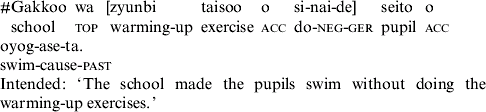
However, as argued by Matsumoto (Reference Matsumoto1996a: 157–159), such a generalization is only apparent. Matsumoto (Reference Matsumoto1996a) gives a minimally modified example of (2) in which the word order is retained but the narrow scope reading is possible (p. 159, (52)). Thus, I assume that adjuncts can in general take both wide and narrow scope for predicates that allow for scope ambiguity regardless of the position in the sentence, and that the difficulty of certain interpretations with certain word orders are due to some processing constraints that are outside the grammar proper.
It has also been noted in the literature (Kitagawa Reference Kitagawa1994, Manning et al. Reference Manning, Ivan, Masayo, Robert and Georgia1999) that a similar scope ambiguity is observed with respect to quantifiers. The following sentence, which contains the quantifier biiru dake ‘only beer’, is ambiguous between two readings, as differentiated by the two English translations:Footnote 6
(3)

2.1.1.2 Biclausal compound verbs
It has often been pointed out in the literature on Japanese complex predicates (e.g. Kageyama Reference Kageyama1993, Matsumoto Reference Matsumoto1996a, Yumoto Reference Yumoto and Takane2002) that not all CVs have uniform syntactic and semantic properties. In particular, there is a class of CVs including V-wasureru ‘forget to V’ and V-naosu ‘re-V’ that do not exhibit scope ambiguity of either adverbs or quantifiers, as opposed to those that do allow for such ambiguity. I will call the former ‘monoclausal CVs’ and the latter ‘biclausal CVs’.Footnote 7 In this section we will look at the scopal properties of biclausal CVs. The monoclausal CVs will be discussed in section 2.1.2.1.
The biclausal CVs exhibit scope ambiguity for both adverbs and quantifiers. The relevant data for adverb scope are as follows:
(4)
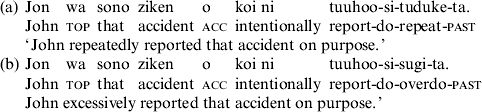
Both (4a) and (4b) are ambiguous between two readings. (4a), for example, can either mean that each of the individual acts of reporting (which were repeated) was intentional (narrow scope reading) or that the repeating (of the act of reporting) was intentional (wide scope reading).
As noted by Yumoto (Reference Yumoto and Takane2002), the quantifier scope data parallel the above adverb scope data.
(5)

(5a), for example, exhibits the narrow/wide scope ambiguity for the quantifier yooguruto dake ‘only yogurt’. In the narrow scope reading, what Naomi continued was the habit of eating only yogurt without eating anything else (perhaps as required by a new diet she was trying). In the wide scope reading, by contrast, the sentence means that yogurt was the only thing that Naomi continued eating. The wide scope reading does not exclude the possibility of Naomi eating something other than yogurt, but the narrow scope reading does. The same type of ambiguity is available for (5b), as explicated by the different English translations.
2.1.2 Lexically-formed complex predicates not exhibiting scope ambiguity
Lexically-formed complex predicates that do not exhibit scope ambiguity include monoclausal CVs and the so-called nominative object construction. In this section, we will look at the relevant data of these constructions.
2.1.2.1 Monoclausal compound verbs
As noted in the literature (Kageyama (Reference Kageyama1993) and Matsumoto (Reference Matsumoto1996a), among others, for adverb scope and Yumoto (Reference Yumoto and Takane2002) for quantifier scope), certain CVs in Japanese including V-wasureru ‘forget to V’ and V-naosu ‘re-V’ do not exhibit scope ambiguity. Adverb scope data are given in (6):
(6)
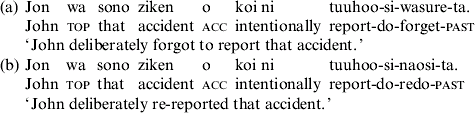
(6a) does not allow for the narrow scope reading for the adverb koi ni ‘intentionally’. The only legitimate interpretation available for this sentence is one in which John's forgetting to do something (and not the act itself whose execution was neglected) was deliberate. In other words, the adverb obligatorily modifies the V2 (the second element of the compound verb). Similarly, (6b) does not allow for a reading where the adverb takes narrow scope.
The crucial point for the present discussion is that, as noted by Yumoto (Reference Yumoto and Takane2002), quantifier scope data parallel the above adverb scope data. Again, the narrow scope interpretation is unavailable for these verbs.
(7)

(7a) unambiguously means that the only thing Naomi forgot to eat was yogurt. A reading in which the quantifier takes scope lower than the V2 is unavailable. Likewise, the only reading available for (7b) is one that can be paraphrased as the English translation given above, where the quantifier takes wide scope.
2.1.2.2 The nominative object construction
The potential -e(ru) and the desiderative -tai complex predicates exhibit two case marking patterns, as illustrated by the following examples:
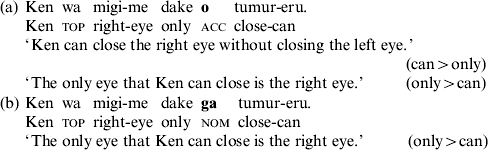
(8)
(9)

As noted by Tada (Reference Tada1992) and Takano (Reference Takano2003), among others, what is interesting about these complex predicates is that the scope interpretation of the object quantifier varies depending on its case marking. That is, if the object is marked in the nominative case (following previous literature, I call this the ‘nominative object construction’, NOC) as in (8b) and (9b), only the wide scope reading is allowed, while no such restriction is found with (8a) and (9a), where the object is marked in the accusative case. I follow Koizumi (Reference Koizumi, Masatoshi and Hiroyuki1994) in assuming that the latter kind of sentences are ambiguous between the wide scope reading and the narrow scope reading, although the wide scope reading seems to be more difficult (in particular, in the case of (9a)).
Adverb scope data in this construction have been much less frequently noted in the literature but are highly relevant to our discussion. Matsumoto (Reference Matsumoto1996a) notes a contrast with respect to adverb scope interpretation, which crucially is parallel to the above quantifier scope data. That is, whereas the NOC does not allow adverbs to take narrow scope, no such restriction is found with the accusative-object counterpart.
(10)
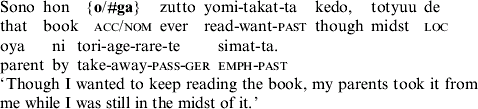
With the nominative object, (10) can only mean that the duration of the period of wanting to read the book was long; it is thus infelicitous in the given context.
2.2 Syntactically-formed complex predicates: VN-governing predicates
2.2.1 Argument transfer and the phenoisyntax of VN-governing predicates
Grimshaw & Mester (Reference Grimshaw and Mester1988) noted that the light verb construction in Japanese, in which the light verb suru takes a so-called verbal noun (VN; typically Sino-Japanese argument-taking nouns with verb-like meanings), exhibits a phenomenon that they dubbed argument transfer: the arguments of the VN, which is categorically a noun, are sometimes allowed to appear verbally case-marked without changing the meaning.Footnote 8 The pair in (11) illustrates the phenomenon.
(11)
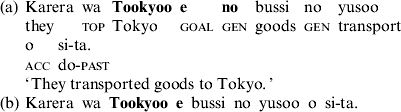
In (11b), the goal argument Tookyoo e ‘to Tokyo’ of the VN yusoo ‘transport’ appears in a verbal case, unlike the expected pattern in (11a) where the same argument appears with the genitive marker no, which indicates its status as an argument of the VN. The verbal case assignment for the goal argument in (11b) is assumed to be mediated by the higher light verb since VNs do not by themselves have the ability to assign verbal cases to their arguments, as noted, for example, by Iida (Reference Iida, Masayo, Stephen and Draga1987: 104, example (23)).
Although Grimshaw & Mester (Reference Grimshaw and Mester1988: 208) conjectured that suru ‘do’ is the only verb that triggers argument transfer in Japanese, it was later discovered by Matsumoto (Reference Matsumoto1996a, Reference Matsumotob) that the range of verbs that trigger argument transfer is in fact much broader.Footnote 9 There are a number of predicates having meanings similar to raising and control verbs that exhibit patterns of case marking in which argument transfer has arguably taken place. Matsumoto (Reference Matsumoto1996a) gives the following example to illustrate this point:
(12)

In (12), the verb hazime ‘begin’ subcategorizes for an accusative-marked VN. What is noteworthy in this sentence is that one of the arguments of this VN, the goal argument Tookyoo e ‘to Tokyo’, appears in a verbal case in much the same way as the goal argument of the VN in the case of the genuine light verb construction (11b). Matsumoto gives further examples of such predicates with the following classification based on their semantic characteristics:
• verbs with aspectual meaning
kurikaesu ‘repeat’, tudukeru ‘continue’, kaisi-suru ‘begin’, etc.
• verbs of thinking and planning
kuwadateru ‘attempt’, wasureru ‘forget’, kangaeru ‘think’, etc.
• verbs and nominal adjectives with possibility meaning
dekiru ‘can’, ari-uru ‘be possible’, etc.
• directive and permissive verbs
meiziru ‘order’, motomeru ‘ask’, mitomeru ‘permit’, etc.
In what follows, I call these predicates VN-governing predicates.
Unlike the lexically-formed complex predicates we saw above, in the VN-governing predicate construction (VNC), the embedded predicate (VN) and the governing verb (GV) do not constitute a morphological word; rather, the GV syntactically subcategorizes for the VN. This can easily be confirmed by the fact that the VNC fails the set of tests used by Manning et al. (Reference Manning, Ivan, Masayo, Robert and Georgia1999) to determine the wordhood of complex predicates. Thus, as (13) illustrates, in reduplication, what is reduplicated is the GV alone and not the sequence of the VN and the GV. Second, it is not possible to make a nominalized form from the sequence of the accusative-marked VN and the GV by -kata suffixation as shown in (14). Finally, (15) demonstrates that in question-answer pairs, the GV alone can serve as a perfectly well-formed answer to a question. All of these data point to the GV's independent status as a word.
(13)
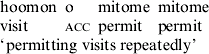
(14)

(15)

2.2.2 Scopal properties of VN-governing predicates
We now examine the scopal properties of the VNC. Just like the monoclausal CVs, the VNC does not exhibit scope ambiguity for either adverbs or quantifiers. To the best of my knowledge, this parallel between adverb scope and quantifier scope has thus far not been noticed in the literature.
As noted by Yokota (Reference Yokota, Miriam and Tracy1999), in sharp contrast to the possibility of argument transfer in the VNC, there is no equivalent phenomenon for adjuncts.Footnote 10 The relevant data are given in (16):
(16)
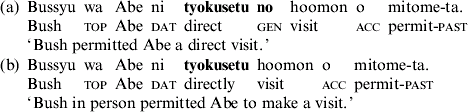
As can be seen from its translation, (16b) does not have a reading in which the adverb tyokusetu ‘directly’ that syntactically appears outside the projection of the VN (we know this from the fact that the genitive marker is lacking on the adjunct in (16b) in contrast to (16a)) is construed as modifying the embedded VN hoomon ‘visit’ (that is, a reading that would be predicted to be possible if adjuncts were able to transfer from the VN to the GV). As Yokota correctly points out, that reading is available only for sentences in which the adjunct of the VN appears within its projection in the form of a genitive-marked nominal modifier as in (16a). Incidentally, sentences like (16a) are also unambiguous in the indicated reading. Thus, unlike the causative construction and the biclausal CVs, the VNC does not allow for scope ambiguity for adverbs.
Matsumoto (Reference Matsumoto1996a) argues that not only arguments but also adjuncts transfer in the VNC. This claim, however, is untenable for the following two reasons: (i) as shown by Yokota (Reference Yokota, Miriam and Tracy1999), the generalization of adjunct nontransfer in cases such as (16) where the adjunct statuses of the relevant dependents are uncontroversial is robust and (ii) in all of Matsumoto's putative adjunct transfer examples, it is not clear whether the adjuncts really semantically modify the embedded predicates (his (17) and (19) on p. 72 and his (28a, b) on p. 78). In all of the examples falling under case (ii), slight modifications of the original examples in the direction of resolving the vagueness in question yield sentences in which the putative adjunct transfer readings clearly and consistently disappear:
(17)

Under Matsumoto's analysis, which allows for adjunct transfer, it is not clear how the semantic infelicity of the examples in (17) is to be accounted for.
The quantifier scope data parallel the adverb scope data in this construction as well. That is, a quantificational argument of the VN that is transferred to the GV obligatorily takes scope over the GV.
(18)

In these examples, we are interested in the syntactic positions of the quantifier wain dake (no) ‘only wine (gen)’ and the available readings for the sentences. (18a), in which the quantifier is within the projection of the VN (which is evident from its genitive marking), only allows the narrow scope reading. By contrast, (18b), in which the same quantifier is transferred to the GV (we know this from the fact that the case marker is missing on the quantifier; such deletion is only possible with nominative and accusative markers), only allows for the wide scope reading. Thus, the VNC does not exhibit quantifier scope ambiguity, in much the same way as it does not allow adverb scope ambiguity.
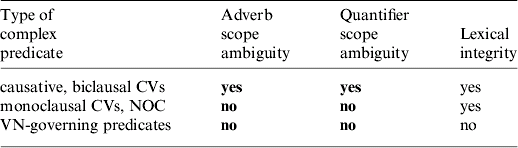
2.3 Summary of the data
The data discussed in this section are summarized in the following table:
Scopal properties and lexical integrity of different kinds of complex predicates
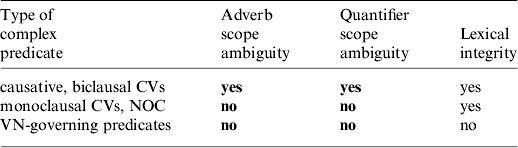
The monoclausal CVs, the NOC and the VN-governing predicates share the property of not allowing scope ambiguity for either adverbs or quantifiers but differ in terms of lexical integrity. As will be discussed in detail in the next section by taking Manning et al.'s (Reference Manning, Ivan, Masayo, Robert and Georgia1999) analysis as an example, the independence of the syntactic properties of different types of complex predicates from their scopal properties poses a significant problem for attempts to extend previous nonuniform treatments of scopal phenomena to these constructions.
3. Manning et al.'s (Reference Manning, Ivan, Masayo, Robert and Georgia1999) analysis of the causative construction
In this section, I review Manning, Sag & Iida's (Reference Manning, Ivan, Masayo, Robert and Georgia1999) (henceforth MSI) lexicalist analysis of the causative construction in Japanese and point out the problems that it faces when one attempts to extend it to other types of complex predicates discussed in the previous section. Since the analysis proposed in the next section builds on MSI's analysis in many respects (in particular, I follow them in taking lexical integrity as a serious methodological principle), I focus on discussing this work in this section. Comparison with another major lexicalist approach by Matsumoto (Reference Matsumoto1996a) in LFG will be deferred to a later section.
3.1 Lexicalist treatments of adverb scope and quantifier scope by Manning et al. (Reference Manning, Ivan, Masayo, Robert and Georgia1999)
MSI propose an analysis of the causative construction in Japanese in which the verb stem and the causative suffix constitute one word. They argue for this analysis based on several pieces of evidence, all of which point to the lexical integrity of the causative complex predicate (in section 2.2.1, I used some of these tests to argue for a different analysis for the VNC, that is, one in which the embedded and embedding predicates do not constitute a single word).
In MSI's analysis of the causative construction, the lexical entry for a complex causative verb is produced by applying a lexical rule to the lexical entry for the base verb (more precisely, their analysis is formulated in the type-based morphology framework (Riehemann Reference Riehemann1998), but this detail does not concern us here). They account for the adverb scope ambiguity in the causative construction by adopting the adjunct-as-argument mechanism originally proposed by van Noord & Bouma (Reference van Noord and Gosse1994) to deal with a similar scope ambiguity of adverbs in Dutch complex predicates in HPSG. Essentially, scope ambiguity arises since there are two possible ways in which adjuncts can be ‘reanalyzed’ as arguments in the causative complex predicate: if an adjunct is ‘reanalyzed’ as an argument of the verb stem, the narrow scope reading obtains and if it is ‘reanalyzed’ as an argument of the derived verb composed of the verb stem and the causative suffix, the wide scope reading obtains. This is technically achieved by allowing for the Causative Formation Lexical Rule (CFLR; the lexical rule for producing a causative complex predicate from the lexical entry for the verb stem) and Adjunct Addition Lexical Rule (AALR; the lexical rule for putting an adjunct on the argument structure list of the lexical entry for a verb) to interact with one another. That is, if the AALR is applied first to the verb stem and then the CFLR is applied, the narrow scope reading is produced, since the AALR fixes the scope of the adverb immediately above the predicate given as input; if the order of application of the two rules is otherwise, the wide scope reading is produced. (Reference Manning, Ivan, Masayo, Robert and Georgia19) informally illustrates the semantic representations for the two lexical entries of the causative compound verb hasir-ase ‘cause to run’:
(19)

Quantifier scope is also determined lexically. Building on Pollard & Yoo (Reference Pollard and Yoo1998), MSI develop a lexicalized version of Cooper storage in HPSG, which is formulated as a constraint on objects of type stem. In this analysis, all quantifier meanings are first collected from the arguments by the lexical head that subcategorizes for them. The quantifiers thus collected are then either retrieved by that lexical head or passed up to a higher head. (The scope of the quantifier is fixed when it is retrieved from the store, as in standard implementations of Cooper storage.) Thus, in a causative sentence, if the object of the verb stem is a quantifier, it is either retrieved by this verb stem or inherited to the causative suffix and retrieved by the latter. In the former case, the narrow scope reading results. What is crucial here is that the relevant constraint targets objects of type stem. The verb stem in the causative construction does not count as an independent word, but it counts as a token of type stem.
(20) schematically represents the lexical entry for the causative verb nom-ase ‘cause to drink’ as used in (3) in MSI's analysis:Footnote 11
(20)
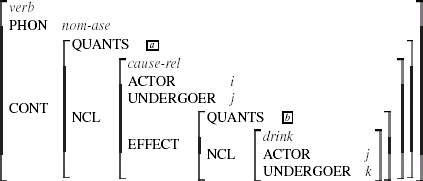
In MSI's analysis, the net effect of putting together all the constraints that interact in governing quantifier retrieval amounts to the requirement that an append of lists  and
 is a singleton list containing the quantifier (i.e. the list 〈only-beer〉, where only-beer is meant to be an abbreviation for a quantifier description in terms of HPSG feature structures in the format of Pollard & Sag (Reference Matsumoto1994)). When this constraint is resolved by instantiating the QUANTS value of the higher causative stem as =〈〉 and that of the lower verb stem as =〈only-beer〉, the representation for the narrow scope reading is obtained.
3.2 Problems with Manning et al.'s (Reference Manning, Ivan, Masayo, Robert and Georgia1999) analysis
MSI's analysis of the causative can successfully account for adverb scope ambiguity and quantifier scope ambiguity while fully maintaining lexical integrity. The machinery they make use of to achieve this goal is (i) the adjunct-as-argument analysis (for adverb scope) and (ii) the lexical quantifier retrieval mechanism (for quantifier scope). However, this approach encounters a significant problem when one tries to extend it to other types of complex predicates that are not discussed in MSI's original paper. Because of the dissociation of the mechanisms accounting for the two scopal phenomena, it fails to capture the generalization that adverbs and quantifiers behave in a similar way with respect to the availability of scope ambiguity for different types of complex predicates.
3.2.1 Lexically-formed complex predicates
As we saw in section 2.1.2, monoclausal CVs and the NOC do not allow for scope ambiguity. The existence of such complex predicates is somewhat troublesome for MSI's analysis. Assuming that these complex predicates are derived by lexical rules (which is supported by the fact that they are fully productive and exhibit all the properties of lexical integrity just like the causative), other things being equal, their analysis would predict that these constructions should also exhibit scope ambiguity. What is worse, since MSI's analysis involves separate mechanisms for adverb scope and quantifier scope, it turns out that separate stipulations are needed to block unwanted narrow scope readings for each. More specifically, the following two distinct stipulations need to be introduced to the relevant lexical rules: (i) the input verb stem has not undergone the AALR and (ii) no quantifier has been retrieved by the input verb stem.
That (i) serves the intended purpose should be clear given that the application of the AALR before complex predicate formation is what produces the narrow scope readings for adverbs. Under MSI's analysis, since verb stems that have undergone the AALR belong to a distinct type adverb-type-raised-stem, this can be achieved by encoding an appropriate constraint on the input specification of relevant lexical rules. Similarly, given that the retrieval by a stem that does not count as a word is the source for the narrow scope readings for quantifiers, (ii) suffices to block the relevant overgeneration regarding quantifier scope, and it is technically possible to introduce such a constraint in MSI's system as follows:
(21)

The feature structure on the left-hand side of the arrow designates the input entry for the lexical rule. Thus, (21) says that the input of the lexical rule for monoclausal CV (and NOC) formation has to satisfy the requirement that it passes up all the quantifiers inherited from its arguments to the higher verb via the QS(TORE) feature (in other words, no quantifier can be retrieved by the verb stem itself).
These technical solutions, however, fail to capture the empirical generalization that adverb scope possibilities and quantifier scope possibilities always coincide for a given type of complex predicate. Under this perspective, it would be just an accident that we do not find any type of complex predicate that exhibits adverb scope ambiguity but not quantifier scope ambiguity or vice versa.
3.2.2 VN-governing predicates
The problem of overgeneration of narrow scope readings is not limited to the class of lexically-formed complex predicates seen above. Essentially the same problem arises with the VNC, a case of syntactically-formed complex predicate. In this section, I first introduce an analysis of this construction in HPSG in terms of argument composition (Hinrichs & Nakazawa Reference Hinrichs, Tsuneko and Nerbonne1994). Then, I illustrate how this analysis, when combined with MSI's assumptions about adverb and quantifier scope, overgenerates, calling for yet another set of separate stipulations to rule out unwanted readings.
In HPSG, the standard way of analyzing constructions in which arguments of an embedded predicate are realized as arguments of a higher one is to employ the mechanism of argument composition (Hinrichs & Nakazawa Reference Hinrichs, Tsuneko and Nerbonne1994). Following previous analyses of Korean light verbs by Ryu (1993) among others, I assume a version of the argument composition mechanism for the VNC where the arguments of the VN are optionally inherited to the GV, given the optionality of argument transfer (Grimshaw & Mester Reference Grimshaw and Mester1988, Matsumoto Reference Matsumoto1996a). (22) illustrates an analysis of (12), which involves transfer of one argument from the VN to the GV:
(22)

Here, the goal argument PP Tookyoo e ‘to Tokyo’, tagged as  , originally ‘starts out’ as an argument of the embedded VN yusoo ‘transport’ and then is inherited to the higher GV and discharged in the projection of the latter. (The procedural metaphor adopted here and elsewhere is purely for expository purposes; in HPSG, the grammar consists entirely of declarative constraints on linguistic signs.)
Now a problem arises when one combines this fairly uncontroversial approach to the VNC with MSI's analysis of complex predicates. Specifically, the analysis wrongly predicts that the narrow scope reading for adverbs is possible in this construction. (23) illustrates how this happens for sentence (16b):
(23)
Here, the AALR has applied to the VN (hoomon ‘visit’) and has inserted an adjunct to its COMPS list, at the same time fixing the scope of the adjunct immediately above the VN (as shown in the shaded part of (23)). This adjunct (tagged as ) is then inherited by the GV (mitome-ta ‘permit’) and syntactically discharged by it, thereby surfacing as an adverb rather than as an adjective. Thus, (23) represents a situation where an adjunct appearing at a syntactically higher node semantically takes narrow scope.
The quantifier scope mechanism assumed by MSI is also problematic in that it overgenerates with respect to the VNC in an analogous fashion. Recall from the discussion in section 3.2 that MSI's quantifier scope mechanism involves a constraint on objects of type stem. In MSI's type system, what counts as a word trivially counts as a stem. Given this, both the GV and the VN are possible loci for quantifier retrieval when that quantifier is originally an argument of the VN that is inherited to the GV, just as both the verb stem and the causative suffix are possible loci for quantifier retrieval in the causative construction. Thus, the unwanted narrow scope reading is predicted to be possible for sentences like (18b).
In order to rule out these unwanted readings, separate stipulations are needed just as in the case of monoclausal CVs and the NOC. In this case, the lexical entries for GVs need to be elaborated as follows:
(i) Elements that can be inherited from the VN to the GV are limited to true arguments (to rule out adverb narrow scope).
(ii) If an argument that is inherited from the VN to the GV is a quantifier, its quantificational force must not already have been retrieved by the embedded VN (to rule out quantifier narrow scope).
A particularly disturbing aspect of such an approach is that not only are the stipulations taking care of adverb scope and quantifier scope independent of one another, but that such separate stipulations are duplicated: one pair for the lexical rules for forming certain types of CVs as outlined in section 3.2.1 and one pair for the lexical entries for VN-governing predicates as noted above. From this observation, it should be clear that what is needed in order to overcome this situation is a system in which a single representation serves as a controlling factor for the availability of scope ambiguity of different kinds of scope-taking elements (i.e. adverbs and quantifiers) uniformly across different kinds of complex predicates. In the next section, I develop and defend such a system by building on recent work by Cipollone (Reference Cipollone, Michael, David, Anna and Vanessa2001), which makes crucial use of structured semantic representations in accounting for adverb scope ambiguity in complex predicates.
4. Proposal: a theory of semantic complexity of complex predicates
In the previous sections, we have observed a certain parallel between the patterns of scope taking of adverbs and quantifiers with respect to different kinds of complex predicates and examined the challenges that these data pose to a previous lexicalist analysis by MSI. In short, the problem of MSI's analysis is that there is no straightforward way of capturing the empirical pattern due to the fact that these two phenomena are treated by completely separate mechanisms.
In this section, I develop a more coherent analysis for the observed pattern. Given the strong parallel between the two phenomena, it is more plausible to construct a theory of syntax and semantics of complex predicates in which this empirical pattern follows from a single factor, rather than being taken care of separately. Intuitively, what is needed is a system in which adverb scope and quantifier scope are determined in reference to information represented in one and the same component.
In what follows, I develop such a system by building on an analysis of the Japanese causative construction (and some other complex predicates) by Cipollone (Reference Cipollone, Michael, David, Anna and Vanessa2001). In this work, Cipollone proposes a novel approach to adverb scope ambiguity in the causative construction by making the semantic representation of complex predicates partially transparent. Syntactically, an adverb combines with the whole complex predicate but it is allowed to ‘look inside’, as it were, of the internal structure of such predicates to take narrow scope. I propose an extension of this approach in which quantifier scope is also determined with reference to this partially transparent semantic representation and defend that analysis in terms of its empirical predictions. This unification of the scope-taking mechanisms for adverbs and quantifiers is both the heart of the present proposal and what has been lacking in previous lexical analyses of complex predicates, as was already shown for MSI's HPSG approachFootnote 12 and as will be revealed to be the case for Matsumoto's (Reference Matsumoto1996a) LFG analysis as well (see section 5).
This section is organized as follows: in 4.1, I outline the basic idea of the proposed analysis in informal terms. Then, in 4.2, I introduce the full-fledged formal analysis in HPSG including detailed specifications of relevant lexical entries and lexical rules as well as rigorous formulations of scope interpretation mechanisms for adverbs and quantifiers. Readers who are satisfied with only an intuitive understanding of the main proposal of the paper can safely skip section 4.2.
4.1 Controlling scope ambiguity by lexical properties of complex predicates
In this section, I outline the basic idea of the proposed analysis. The novel aspect of the present proposal is the extension of Cipollone's (Reference Cipollone, Michael, David, Anna and Vanessa2001) analytic technique to the problem of quantifier scope and the extension of empirical coverage to complex predicates that do not allow for scope ambiguity. As will become clear below, these two extensions work hand in hand to constitute a system that is empirically more adequate than previous proposals.
4.1.1 Predicates that allow for scope ambiguity
Cipollone (Reference Cipollone, Michael, David, Anna and Vanessa2001) accounts for word-internal adverb scope in the causative construction by introducing a slightly noncompositional semantics.Footnote 13 Within theories of semantics that strictly maintain compositionality, information about how the meaning of a given phrase is computed from the meanings of its parts is not available in the semantic representation of that phrase. Thus, speaking in terms of lambda expressions, expressions that are not β-reduced and those that are β-reduced are treated as fully equivalent in terms of their informativeness for further semantic composition. For example, the terms λp[cause′(x, p)](run′(y)) and cause′(x, run′(y)), where the former β-reduces to the latter, are theoretically fully equivalent. By giving up this strictest notion of compositionality, however, one can give a different interpretation to the relation between the two formulas. That is, assuming that they are representations for the Japanese causative verb hasir-ase ‘cause to run’, one can say that the former is more informative than the latter in that it retains the information of how the whole causative meaning is derived from the meanings of the causative suffix and the verb stem; in the former term but not in the latter, the meaning contribution from the causative suffix and that from the verb stem are stored in a way that is still fully distinguishable. This means that, in the former case, the internal structure of the meaning of the causative complex predicate can be made visible and available for further manipulation even after the verb stem and the causative suffix are combined with one another. Cipollone's proposal is to take advantage of the analytic possibilities opened up by adopting this view and define the semantics of adverbial modification in such a way that an adverb that syntactically combines with the whole causative complex predicate can take scope below the meaning of the causative suffix.
(24) illustrates how this analysis works for the sentence Gakkoo de hasir-ase-ta ‘(I) made him run at school’ in its narrow scope reading (the shading in the diagram highlights where the adverb takes scope).
(24)
What is noteworthy in this analysis is that the semantic representation (i.e. the CONT value) of the complex causative verb hasir-ase-ta ‘caused to run’ is list-valued. The first element  of this list corresponds to the meaning of this list corresponds to the meaning of the causative suffix and designates a causative event. The second element
 corresponds to the meaning of the verb stem and designates a running event. The order of the list is relevant here; it encodes the relation between these two meaning components such that the latter is an argument of the former (which is meant to be (a feature structure representation of) a function over propositions).
With this slightly enriched representation of the internal structure of the causative complex predicate, it becomes possible to assign narrow scope readings to the adverb that syntactically combines with the whole complex predicate as in (24). The lexical entry for the adverb and the semantic composition principle that licenses the local tree in (24) guarantee that the meaning of this adverb can scope over any element of the list-valued semantic representation of the verbal projection that it combines with (for further details of how this works, see section 4.2). In the case of (24), the adverb meaning scopes immediately over the meaning of the verb stem (as can be seen in the shaded portion of the picture in (24); run-rel (the ‘running’ relation) is immediately embedded under location-rel (the ‘location’ relation, which identifies the location of the argument event as the value of the LOCATION feature) in the semantic representation of the mother VP node, which represents the meaning of the whole VP including the adverb). Since this whole complex term is specified as an argument of the causative event (the first element of the list), the adverb is interpreted as specifying the location of the embedded event, thus the narrow scope reading. There is another option for the adverb to ‘discharge’ its semantic contribution, namely, to take the first element of the CONT value of the lower VP as argument. This corresponds to the wide scope reading. Thus, by virtue of the enriched semantic representation employed, elements that syntactically attach from outside can manipulate the internal structure of a complex semantic term and the surface structure does not necessarily reflect the actual scoping relations between operators.
The same technique can be employed for dissociating quantifier scope from surface syntactic structure. That is, if the principle governing quantifier scope is formulated in such a way that the scope of a quantifier is determined syntactically but nondeterministically, crucially making reference to the internal structure of the semantic representation of the verbal projection that the quantifier combines with, narrow scope readings for quantifiers in sentences like (3) can be licensed in exactly the same way as narrow scope readings are licensed for adverbs.
(25) illustrates how this works for sentence (3) in the narrow scope reading (the place where the quantifier takes scope in the semantic representation is marked by the shading).
(25)
Here, the quantifier meaning specified as the value of the QSTORE feature of the NP node is inserted into the QUANTS value of the second element of the list-valued semantic representation of the head, which corresponds to the meaning of the verb stem. Consequently, the quantifier takes scope higher than the verb stem but lower than the causative suffix. This will be guaranteed by the Quantifier Scope Principle to be formulated in the next section, which specifies that the quantifier meaning that comes from the argument can be retrieved by any of the elements that constitute the list-valued semantic representation of the verbal predicate. In the case of the causative complex predicate, since there are two elements in this list (i.e. the meaning of the verb stem and the meaning of the causative suffix), two scoping possibilities are available for the quantifier, which correspond to the narrow scope and wide scope readings.
What distinguishes the present approach from previous treatments of scopal phenomena in lexicalist theories is that, in the present approach, the structure of the semantic representation of the head plays a crucial role in determining the possible scope interpretations for both adverbs and quantifiers. Thus, the present analysis straightforwardly captures the parallel between adverb and quantifier scope with respect to different types of complex predicates on the basis of a unitary syntax/semantics mapping interface, as we will see next.
4.1.2 Predicates that do not allow for scope ambiguity
As the above illustration has made clear, the source of scope ambiguity for both adverbs and quantifiers in the present account is the structure of the semantic representation of the predicate. Thus, the semantic structures of complex predicates that do not allow for scope ambiguity are specified in such a way that their internal structures are invisible for further manipulation. Once this is done, the unavailability of scope ambiguity with these predicates in both cases automatically follows. As an illustration, the lexical entry for the monoclausal CV tabe-wasure ‘forget to eat’ is given in (26).
(26)
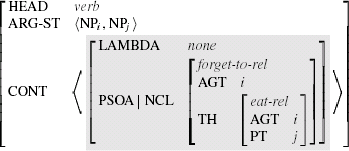
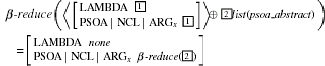
The difference between this entry and the entries for predicates that allow for scope ambiguity is that the semantic representation is specified as a singleton list (as highlighted with shading above) in (26), where the content that comes from the verb stem (the feature structure typed eat-rel) is already embedded inside the whole complex semantic representation. Replacing the semantic representation of the causative complex predicate in (24) and (25) by that of this lexical entry, it should be clear that in the case of the monoclausal CVs such as V-wasureru ‘forget to V’ there is only one way for adverbs and quantifiers to determine their scope, that is, to take scope over the whole complex predicate. Thus, the unavailability of narrow scope is accounted for in a uniform manner as a general lexical property of such predicates. The unavailability of scope ambiguity in the VNC is accounted for along the same lines. The only difference between the monoclausal CVs and the NOC on the one hand and the VNC on the other is that in the latter case, the meanings of the higher predicate and the lower predicate are combined in the syntax rather than in the lexicon. Thus, the lexical specification on the GV becomes slightly complicated, involving an explicit definition of the function ‘β-reduce’, which produces a β-reduced semantic representation from one that is not yet β-reduced. For details, see section 4.2.
4.2 Formalization of the analysis in HPSG
4.2.1 Lexical rules and lexical entries
Cipollone (Reference Cipollone, Michael, David, Anna and Vanessa2001) formalizes his system of structured semantics in HPSG by enriching the semantic representation of the original HPSG theory (Pollard & Sag Reference Pollard and Sag.1994) along the following lines. First, as already seen above, the CONT feature is list-valued. This is meant to represent a list of lambda abstractions over propositions, which are formally encoded by objects of type psoa-abstract with two features LAMBDA and PSOA as follows (var(psoa) is a notation for a variable over objects of type psoa):
(27)
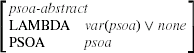
The value of the PSOA feature is declared to be of type psoa, which represents propositional content as in Pollard & Sag (Reference Pollard and Sag.1994). The value of the LAMBDA feature can be thought of as a variable of an appropriate type bound by the lambda operator (since the list specified as the CONT value of a verbal projection represents a chain of multiple embeddings of predicates, variables specified for the LAMBDA feature are ‘higher-order’ ones and are not variables over individual indices). If the value of the LAMBDA feature is specified as none, there is no variable binding. Thus, meanings of simple verbs are typically represented as a singleton list of a psoa-abstract object, where the value of the LAMBDA feature is none, as in the following (simplified) lexical entry for hasir ‘run’:
(28)
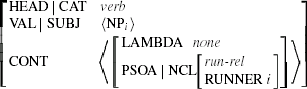
On the other hand, the meaning of a complex predicate (that allows for scope ambiguity) is specified as a list of psoa-abstracts with more than one element. The first element (corresponding to the semantic content of the outermost embedding predicate) of this list is a psoa-abstract whose value for the LAMBDA feature is an index reentrant with the value of an appropriate feature (one that stands for the semantic argument of this verb) inside its PSOA value. Subsequent elements of that list represent semantic contents of the embedded predicates where the precedence relation reflects the semantic embedding, with the last element being the most deeply embedded one. Thus, the value of the CONT feature of the causative verb hasir-ase ‘cause to run’ will look like the following:
(29)
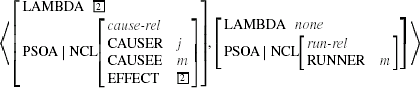
As already briefly noted in the previous section, the order of the elements in this list is crucial. The complete semantic interpretation for a sentence is obtained by applying β-reduction to the semantic representation of the top S node, where, for any given two consecutive elements, the right-hand element is given as an argument to the left-hand element that serves as the functor.
Cipollone assigns partially transparent semantic representations such as (29) as the CONT values of causative complex predicates by minimally revising MSI's Causative Formation Lexical Rule (CFLR):
(30)

What is crucial in this revised CFLR is that the CONT value of the output entry is specified as a list obtained by prefixing the semantic content representing a causative event to the CONT value of the original verb (for other details of this lexical rule, see Cipollone (Reference Cipollone, Michael, David, Anna and Vanessa2001) and Manning et al. (Reference Manning, Ivan, Masayo, Robert and Georgia1999)).
As discussed in section 4.1, under the present approach, the unavailability of scope ambiguity for certain lexically-formed complex predicates, that is, monoclausal CVs and the NOC, can be accounted for by allowing the output of the lexical rules for these types of complex predicates to have semantic representations that are not transparent, unlike the semantic representations for the complex predicates that allow for scope ambiguity. As an illustration, I sketch here the lexical rule for the -tai desiderative NOC (F tai is a function that changes the phonological form of the verb appropriately by suffixing the morpheme -tai):
(31)
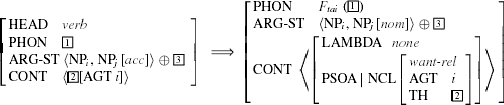
I assume that this lexical rule is a subtype of no-cp-lr (nominative-object-complex-predicate-lexical-rule; the supertype subsuming the lexical rules for producing nominative object-taking predicates) that specifies that the CONT value of the output entry is singleton and that the case assignment of the second NP in ARG-ST is changed from accusative to nominative. Thus, the relevant constraint is stated in a fully general fashion as a property associated with nominative object-assigning predicates. (This is made possible by a recent advance in HPSG, where lexical generalizations are captured in terms of the highly elaborate organization of the lexicon with type inheritance hierarchies along the lines of Sag, Wasow & Bender Reference Sag, Wasow and Bender2003.) The lexical rules for producing monoclausal CVs are similar to (31) but are simpler in that they do not involve this change of case assignment on the object.
In the case of the VNC, since the VN and the GV are combined with one another in the syntax rather than in the lexicon as discussed in section 2.2.1, the semantics of the VN and the GV are put together as specified in the lexical entry for the GV. This, in turn, means that the lexical entry for the GV should be specified in such a way that its semantic representation does not make the part coming from the VN visible to elements syntactically combining with it at higher nodes. Thus, the lexical entry for the verb mitome ‘permit’ will be something like the following:Footnote 14
(32)
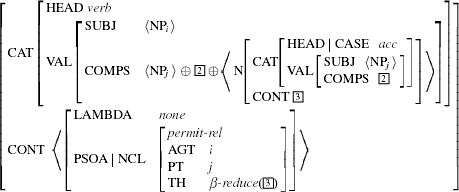
What is crucial in this lexical entry is that the CONT value is specified as a singleton list, which accounts for the unavailability of the narrow scope reading for adverbs and quantifiers appearing outside the projection of the VN.
4.2.2 Scope interpretation principles
4.2.2.1 Adverb scope
Cipollone (Reference Cipollone, Michael, David, Anna and Vanessa2001) formalizes the semantics of adverb modification in his system of structured semantics as follows. By virtue of the partial transparency of a complex predicate's semantics, the narrow scope reading for adverbs can be generated by minimal modifications to the lexical entries for adverbs as standardly assumed in HPSG. More specifically, Cipollone proposes that typical modifiers conform to the following general schema (notations are slightly changed):
(33)
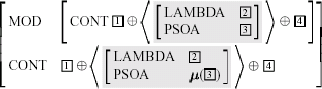
In (33), μ designates a function that takes a feature structure of the sort psoa and gives back as value the result of applying the relevant meaning of the modifier to that psoa. Thus, this schema allows an adverb to freely pick up any one of the elements composing the chain of ‘lambda expressions’ (which correspond to the semantic contributions of each component of the complex predicate) of the modified verb as the target of modification.Footnote 15 Thus, it serves the purpose of nondeterministically resolving adverb scope as described in the previous section. Since Cipollone adopts the Semantic Principle of Pollard & Sag (1994), which states that the meaning of the phrase is inherited from the adjunct daughter rather than the head daughter in a head-adjunct structure, the correct meaning of adverbial modification is passed up to higher nodes by this lexical specification (see for example the coindexation  of the CONT values of the mother and the adjunct daughter in the tree in (24) for an illustration).
4.2.2.2 Quantifier scope
The nondeterministic quantifier scope resolution described in section 4.1 is formally implemented in the present approach by introducing the following Quantifier Scope Principle (the letter H on the first element on the right-hand side of the arrow is an abbreviation for ‘HEAD-DAUGHTER’ and indicates that this feature structure corresponds to that of the head daughter):
(34)

I assume that all local trees where the type of the CONT value of the head daughter is a list of psoa-abstracts (i.e. where the head daughter is a projection of a category with a predicative meaning, including at least verbs, adjectives and VNs but not ordinary referential or quantificational nouns) must conform to this principle. In this analysis, quantifiers are immediately retrieved from the QSTORE at the node where the quantificational NP combines with the head verbal projection.Footnote 16 (At nodes where the head daughter is not a predicative category, I assume that the value of the QSTORE feature is simply inherited from daughters to the mother.)
Essentially, what (34) says is that quantifiers are allowed to freely pick up any portion of the complex semantic representation of the head to scope over, just as adverbs are allowed to. Thus, quantifier scope is determined at the node where the quantifier combines with the head verbal projection, but is not necessarily determined uniquely with respect to its syntactic position since it is allowed to take narrow scope as long as the internal structure of the head is made transparent. In this way, word-internal scope-taking is made possible by means of a simple syntactic principle of quantifier scope, without recourse to the intricate lexical quantifier retrieval mechanism originally formulated by MSI and adopted by Cipollone (Reference Cipollone, Michael, David, Anna and Vanessa2001). Note once again the close resemblance between the quantifier scope mechanism and the adverb scope mechanism in the present analysis. Both crucially make use of the fact that the internal semantic structure of a complex predicate is made visible to phrases attaching from outside for licensing narrow scope readings. As we have seen, under the present proposal, this reformulation of the quantifier scope mechanism vis-á-vis the one adopted by Cipollone is the key to capturing the parallel between quantifier scope and adverb scope in terms of the lexical specifications of different kinds of complex predicates.Footnote 17
5. Comparison with Matsumoto's (Reference Matsumoto1996a) analysis of complex predicates in LFG
In Matsumoto's (Reference Matsumoto1996a) analysis of complex predicates, the mechanism of functional uncertainty (Kaplan & Zaenen Reference Kaplan, Zaenen, Mark and Anthony1989) plays a crucial role in mediating a certain degree of mismatch between syntactic structure and semantic interpretation found in complex predicate constructions. That is, functional uncertainty licenses structures in which dependents (arguments and adjuncts) of a lower predicate appear as sisters to a higher one. For example, it accounts for the adverb scope ambiguity of the causative construction while maintaining lexical integrity. (35) illustrates how the narrow scope reading for the adverb in sentence (1) is licensed in Matsumoto's analysis.
(35)
The c-structure (35a) is licensed by the following phrase structure rule with a functional uncertainty annotation:
(36)

The Kleene star on XCOMP in (36) stands for a string composed of an arbitrary number of XCOMP (including zero). GF (‘grammatical function’) is a variable ranging over grammatical function names such SUBJ and OBJ. Thus, ‘XCOMP*GF’ can be instantiated as strings such as ‘SUBJ’, ‘XCOMP XCOMP OBJ’, etc. This is what triggers the nonlocal mapping of c-structure elements under a chain of multiple XCOMP embeddings in the f-structure.
(35b) shows the f-structure corresponding to the top S node in (35a). In conformity to (36), the adverb damatte ‘silently’ in (35a) is annotated such that its f-structure is mapped to the value of the ADJ attribute of the f-structure of the verb stem that is embedded under the XCOMP of the entire f-structure in (35b) (as marked by the shading in the above picture). Thus, (35b) represents the narrow scope reading for (1). If the annotation on this adverb were instead simply ‘(↑ADJ)=↓’ (which would also satisfy (36)), the f-structure of this adverb would be mapped to the value of the ADJ attribute of the outer f-structure, resulting in the representation for the wide scope reading.
Another place where functional uncertainty is employed in Matsumoto's analysis is the argument transfer phenomenon in the VNC: in (37a) (the structure for (12)), the verbally case-marked goal argument Tookyoo e ‘to Tokyo’ of the VN appears syntactically as if it were an argument of the higher verb hazime ‘begin’.
(37)
The dissociation of the c-structure and the f-structure here is again mediated by the mechanism of functional uncertainty (with the ‘(↑ XCOMP OBLgo)=↓’ annotation on the goal argument Tookyoo e).
While Matsumoto's analysis of complex predicates, as it originally stands, is not equipped with a mechanism that deals with quantifier scope, it is easy to provide it with one along the lines of the proposal by Halvorsen & Kaplan (Reference Halvorsen, Ronald, Mary, Ronald, John and Annie1995). Essentially, one accounts for quantifier scope ambiguity for complex predicates like the causative by representing quantifier scope at the level of (possibly biclausal) semantic structure and stipulating an uncertainty relation on the mapping between the f-structure and the semantic structure. The relevant uncertainty constraint states that the semantic contribution of the quantified NP can be mapped to the value of the QP (Quantifier Phrase) attribute of the semantic structure of either the embedded predicate or the matrix predicate in sentences like (3). Except for this ‘nonlocal’ mode of mapping between the f-structure and the semantic structure, the mapping between the two levels of representation is assumed to be carried out locally, just as the mapping from c-structure nodes to f-structure components is, for the most part, local. For a more complete discussion of how this approach works and the explicit formulation of the relevant constraint between the f-structure and the semantic structure, the reader is referred to Halvorsen & Kaplan (Reference Halvorsen, Ronald, Mary, Ronald, John and Annie1995).
The point here is that this uncertainty relation between the f-structure and the semantic structure allows for two semantic structures, (38a) (for the wide scope reading) and (38b) (for the narrow scope reading), to correspond to the single f-structure (39) for sentence (3) (the shading indicates the position of the quantifier).
(38)
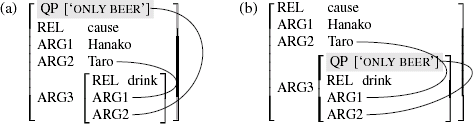
(39)
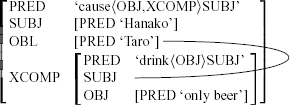
Thus, Matsumoto's analysis of complex predicates, augmented with Halvorsen & Kaplan's quantifier scope mechanism, is roughly equivalent to MSI's analysis in that it successfully deals with the problem of accounting for narrow scope readings of adverbs and quantifiers for those complex predicates that exhibit scope ambiguity, and does so without abandoning lexical integrity.
Matsumoto's analysis covers a wider range of complex predicates in Japanese than does MSI's account. In particular, he discusses complex predicates that do not exhibit scope ambiguity such as monoclausal CVs and the NOC. In Matsumoto's analysis, the unavailability of adverb scope ambiguity for monoclausal CVs and the NOC is accounted for in terms of assigning monoclausal f-structures to these predicates. This treatment bears some resemblance to the present account in that it essentially blocks unwanted narrow scope readings for these predicates by making the internal semantic representations of these predicates invisible.
Nevertheless, there are two major problems with Matsumoto's analysis. The first comes from the VNC. As pointed out by Yokota (Reference Yokota, Miriam and Tracy1999) and as we have seen in section 2.2.2, adjuncts cannot transfer from the VN to the GV in the VNC. Matsumoto's analysis, however, predicts that adjunct transfer should be possible in this construction since functional uncertainty is applicable not only to arguments but also to adjuncts. That is, by means of functional uncertainty, an adjunct that associates with the embedded predicate in the f-structure can appear as a sister to the GV in the c-structure (essentially, just as adverbs can take narrow scope in the causative construction as in (35), there is nothing that precludes the same thing from happening in the VNC). Furthermore, blocking this unwanted reading by limiting the availability of functional uncertainty to arguments (which is in fact the solution proposed by Yokota (Reference Yokota, Miriam and Tracy1999)) is not a viable option. Such a restriction would incorrectly rule out narrow scope readings for adverbs for predicates such as the causative.
One might wonder whether making the f-structure of the GV in the VNC monoclausal (just like the monoclausal CVs and the NOC) would save Matsumoto's analysis from this overgeneration problem. However, this move is implausible given that adjuncts do take narrow scope when they appear inside the projection of the VN, as discussed in section 2.2.2. It is not clear how the narrow scope readings of adjuncts in like (16a) would be accounted for in Matsumoto's analysis if the f-structures of the VN-governing predicates were made monoclausal.
It should be noted here that the present analysis does not suffer from this problem since the VNC is not treated as semantically monoclausal. That is, even though the internal structure of the predicate is made invisible to elements that attach from outside, VN-governing predicates still have fully biclausal semantic structures in the present approach. Thus, as long as the scope-taking element appears syntactically within the projection of the VN, the narrow scope reading is obtained, as illustrated in the following analysis for (16a):
(40)
This elucidates one crucial difference between the present proposal and Matsumoto's approach. That is, while in the present analysis it is possible for a semantically complex predicate to behave as if it were semantically simplex in a certain syntactic environment, such a possibility is not available in Matsumoto's approach. The VNC shows the necessity for allowing such a possibility by exhibiting apparent monoclausality with respect to elements that hold sisterhood relations in the syntax to the higher predicate.
The second problem with Matsumoto's analysis is that it cannot easily capture the parallel between adverb scope and quantifier scope, even with the augmentation of the Halvorsen & Kaplan-style quantifier scope mechanism outlined above. This is essentially because the two phenomena are treated by disjoint mechanisms, just as in MSI's analysis. Thus, in order to rule out the unwanted narrow scope readings for quantifiers with monoclausal CVs, the NOC and the VNC, a stipulation separate from the one ruling out adverb narrow scope would need to be introduced. However, this is undesirable given the close parallel between these phenomena, as already discussed in detail with regard to MSI's analysis.
6. Other biclausality phenomena
In the literature on complex predicates in Japanese, phenomena other than adverb scope and quantifier scope have been used as criteria for the mono-/biclausality of different types of complex predicates (see Kageyama (Reference Kageyama1993) and Matsumoto (Reference Matsumoto1996a) for an overview of relevant data and literature as well as detailed discussion of each of the phenomena). In this section, I briefly consider two such phenomena, honorification and passivization, and discuss whether it is plausible to employ the present approach's technique of structured semantic representation to account for the relevant facts regarding these phenomena.
6.1 Honorification
Subject honorification is one of the phenomena that has been used as a criterion for the biclausality of complex predicates (Shibatani (Reference Shibatani1978) and Kuno (Reference Kuno1983) are among the earliest discussions of the honorification data of complex predicates). In particular, different types of CVs are known to exhibit different distributional patterns with respect to the possibilities of honorification (Kageyama Reference Kageyama1993, Matsumoto Reference Matsumoto1996a, Yumoto Reference Yumoto2005).
The basic generalization is that biclausal CVs only allow honorification of the V1 alone (as shown in (41)) while monoclausal CVs only allow honorification of the whole CV (as shown in (42)):
(41)

(42)

Matsumoto (Reference Matsumoto1996a) accounts for these patterns by means of the mono-/biclausality of the f-structures of these predicates. According to him, the subject honorific marker o-V ni naru cannot attach to elements that correspond to two predications in f-structure. The CV kaki-sugi is assumed to be biclausal in f-structure in Matsumoto's analysis. Thus, the V1 and V2 correspond to inner and outer predications of this biclausal f-structure and hence the CV as a whole violates the condition for honorification marker attachment.
Given the similarity between Matsumoto's approach and the present analysis such that biclausal f-structures in the former roughly correspond to non-β-reduced semantic representations in the latter, an account of honorification in the present approach that states that the honorific marker cannot be attached to predicates having non-β-reduced semantic representations will predict roughly the same pattern as Matsumoto's analysis. However, in my view, this kind of analysis incorrectly predicts that honorification of the whole complex predicate should be impossible in the causative construction, which has a biclausal semantic/f-structure representation. Contrary to this prediction, such sentences are perfectly natural:
(43)

While the honorification data deserves more careful consideration, I tentatively conclude that the structured semantic representation of the present approach is not an optimal mechanism for accounting for the facts in this case. Rather, it seems that in many cases the relevant facts regarding honorification can be accounted for in terms of the lexical semantics of the predicates. For example, Yumoto (Reference Yumoto2005: 213) suggests a semantic explanation for the impossibility of honorification of V1 alone in the reciprocal CV V-au. According to Yumoto, the honorification of V1 alone, that is, forms such as o-maneki-ni nari-au ‘invite hon-recip’ requires the V2 (in this case, the reciprocal verb) to form a compound with the honorific auxiliary naru. However, the form nari-au sounds somewhat awkward due to the fact that naru, when used as a content word (and not as an honorific auxiliary), is a change of state predicate, a kind of predicate that does not combine naturally with the reciprocal verb au. Yumoto concludes that honorification of V1 alone involving the form nari-au has reduced acceptability due to this interference from the non-honorific use of naru. Although Yumoto is not explicit about this point, extending this analysis to monoclausal CVs seems to be a promising direction.
6.2 Passivization
Passivization is another phenomenon that has been used to determine the biclausality of complex predicates (Kageyama Reference Kageyama1993, Matsumoto Reference Matsumoto1996a, Yumoto Reference Yumoto2005). Due to space considerations, I again limit the discussion to CV constructions. As shown by the following data, passivization of the whole CV is possible only for monoclausal CVs.
(44)
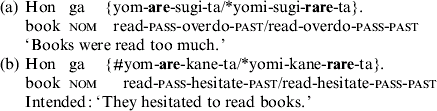
(45)
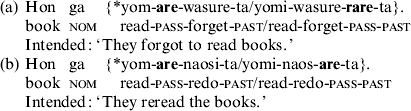
The badness of passivization of the V1 alone for monoclausal CVs, as in (45), can be given a semantic explanation along the lines of Yumoto's (2005:178) account of a certain subset of monoclausal CVs: the V2 requires a verb that takes an agentive subject, but the passivized verb fails to satisfy this requirement. However, the pattern in (44) – in particular, the fact that passivization of the entire CV is impossible for control-type biclausal CVs like (44b) – does not seem to be explicable in semantic terms. Here, I suggest an account in terms of the structure of the semantic representation as given in the present approach. That is, the data can be accounted for by assuming that passivization is impossible for predicates that have non-β-reduced semantic structures. The intuition behind this account is that a predicate can be passivized only when it can be regarded as a single predicate; predicates having non-β-reduced semantic representations do not count as single predicates since they still retain complex internal structures composed of multiple predicates.
This analysis makes the prediction that the GV in the VNC can be passivized since the semantic structures of these predicates are β-reduced. This prediction seems to be borne out by the following data:
(46)

Like honorification, passivization is arguably not a purely syntactic phenomenon that can be accounted for solely in terms of some structural representation (be it syntactic structure or structured semantic representation). However, given that a purely semantic analysis does not seem to be adequate either (in particular, the possibility of passivization of the whole CV for the monoclausal CVs vs. the impossibility of that pattern for the control type biclausal CVs does not seem to be explainable in such accounts), it seems reasonable to employ the mechanism of structured semantic representations to account for a certain aspect of the entire pattern that is not reducible to other factors.
7. Conclusion and outlook for further research
In this paper, I have discussed the scope interpretation of adverbs and quantifiers in different types of complex predicates in Japanese. Based on the generalization that not all complex predicates uniformly exhibit scope ambiguity and that the availability of such ambiguity for a particular type of complex predicate always coincides for adverbs and quantifiers, I proposed an extension of a novel approach to the syntax-semantics interface in HPSG by means of structured semantic representations as proposed by Cipollone (Reference Cipollone, Michael, David, Anna and Vanessa2001) and argued for its empirical advantages over earlier lexicalist analyses (Matsumoto Reference Matsumoto1996a, Manning et al. Reference Manning, Ivan, Masayo, Robert and Georgia1999). That is, the observed generalization can only be captured in an approach in which the relevant principles are stated in reference to a single and uniform data structure used for semantic representation and cannot be attributed to other properties of complex predicates such as lexical vs. syntactic composition.
In order to further evaluate the validity of positing a distinct status for such an enriched semantic representation, the applicability of this technique to other properties of complex predicates (and possibly other empirical problems) needs to be investigated. I briefly considered honorification and passivization data in the previous section, tentatively concluding that an application of the technique to the latter (where a certain subset of the phenomena cannot be treated purely in terms of semantic considerations) seems to be possible. Also, crosslinguistic investigation needs to be conducted to determine whether other languages lend themselves to an approach like the one proposed here.
One might question the explanatory adequacy of the present proposal based on the fact that the distinction of biclausality of semantic structure is treated purely in terms of idiosyncratic properties of individual lexical items. This seems to be inevitable given the lack of any obvious syntactic or semantic property that pertains to the relevant distinction; to the best of my knowledge, no convincing independent explanation has been given for similar notions of different ‘degrees’ of biclausality of complex predicates in the previous literature (Kageyama Reference Kageyama1993, Matsumoto Reference Matsumoto1996a). Thus, at this point, whether or not an explanation can be given beyond mere taxonomic classification is still an open question.
Finally, it should be noted that the approach to the syntax-semantics interface proposed by Cipollone and extended in this paper bears a certain resemblance to the technique of underspecified semantics (such as Minimal Recursion Semantics, cf. Copestake et al. Reference Copestake, Flickinger, Pollard and Sag2005) that originated from computational approaches to semantics and has been more recently applied to theoretical issues (see in particular the papers collected in Richter & Sailer (Reference Richter and Manfred2005)). I adopted Cipollone's system in this paper mainly for convenience; as demonstrated above, it is sufficiently rigorous and explicit to capture the empirical generalizations made in this paper and yet is simple enough, without having all the elaborate features that are found in other more sophisticated formalisms. Given the existence of a body of work that addresses other empirical issues by employing other similar systems, the question of how the theoretical framework adopted in this paper can be integrated with those of other studies needs to be examined in future research.