Entering complex pulmonary arteries stenoses is one of the main challenges for the congenital interventional cardiologist. This difficulty is due to anatomical reasons or secondary to multiple surgery and interventions. Two brilliant techniques have been previously described to address this issue: the telescopic catheter-in-long sheath parallel to a stiff guidewire techniqueReference Butera1 and the use of a microcatheter in a telescopic system.Reference Brown, Boshoff, Eyskens, Martens and Gewilig2 This case report describes the combination of these two techniques that allowed us to cross a previously stented left pulmonary artery to perform progressive ballooning and final stenting-in-stent.
Case
A 22 kg, 5-year-old girl with double outlet right ventricle, sub-aortic ventricular septal defect, sub-valvar and valvar pulmonary stenosis and hypoplastic left pulmonary artery had a complete double outlet right ventricle repair with ventricular septal defect patch closure, commisurotomy of the pulmonary valve, infundibulum enlargement and left pulmonary artery enlargement with autologous pericardial patch at the age of 5 months. Six months later, she underwent a transcatheter recanalisation of the left pulmonary artery with ballooning and implantation of a 5 × 20 mm Cook formula stent (Cook Medical, Bloomington, IN, USA). Although asymptomatic, follow-up transthoracic echocardiogram 5 years later showed significantly compromised flow towards the left pulmonary artery. It was then decided to perform elective percutaneous left pulmonary artery balloon dilatation and stenting.
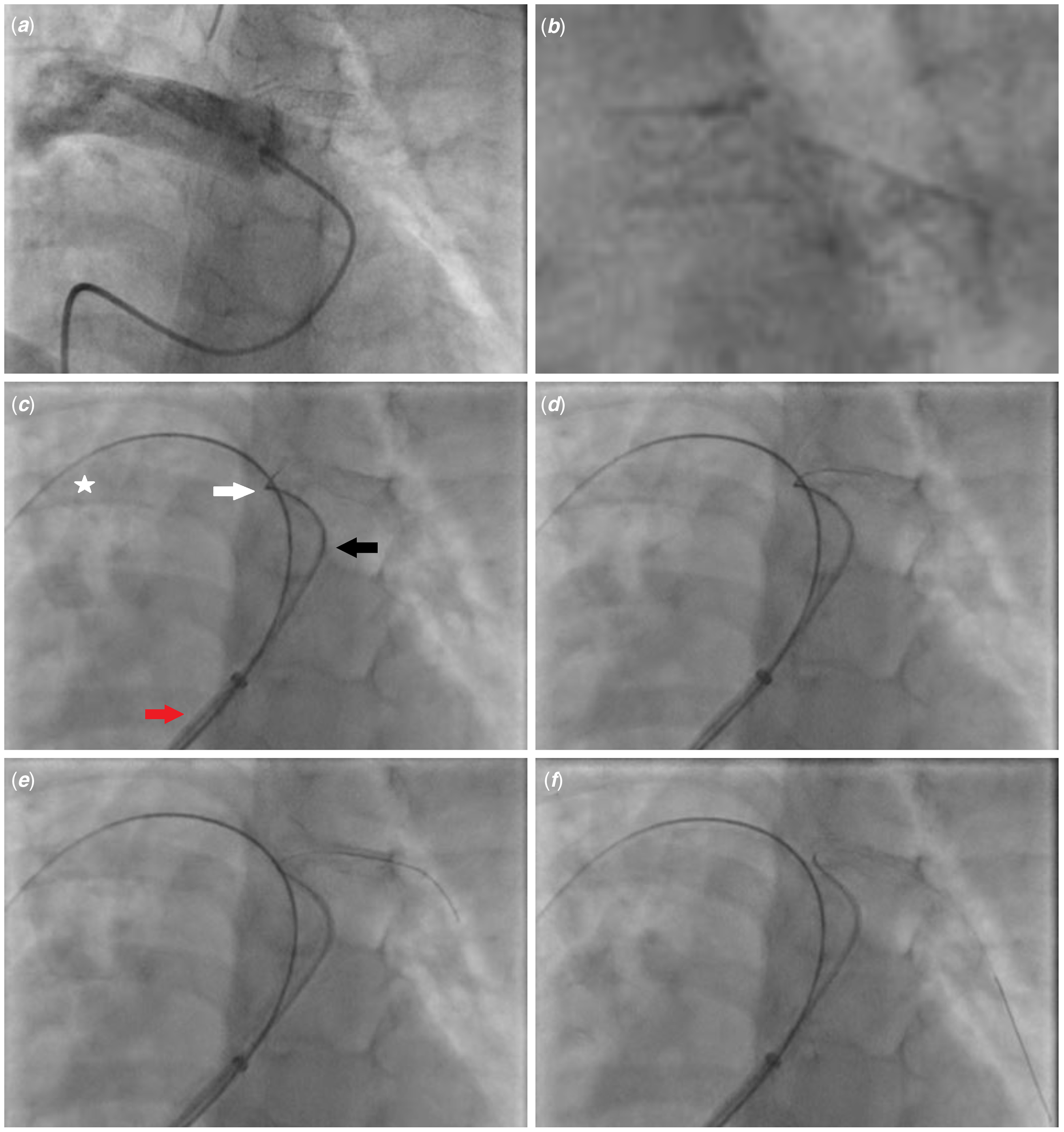
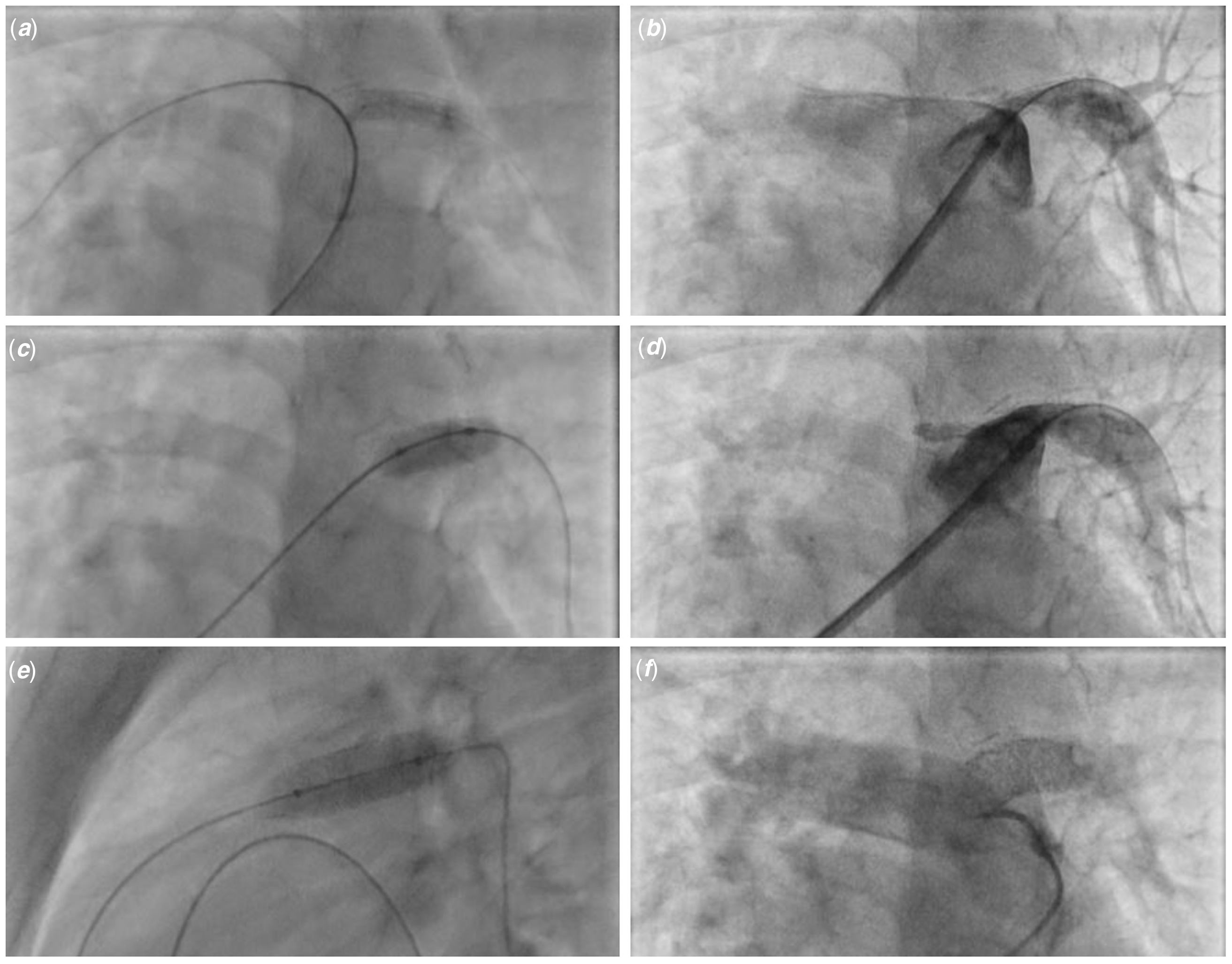
Left femoral vein access was achieved under general anaesthesia. Haemodynamic assessment showed half systemic right ventricle pressure and no significant right ventricle to main pulmonary artery gradient. Main pulmonary artery angiogram demonstrated unobstructed right pulmonary artery with high take off the reconstructed left pulmonary artery and type 3 fracture with subluxation of the stent and almost absent flow to the left lung (Fig 1a, b). Several attempts to cross the left pulmonary artery stent with different angle-shaped catheters and pre-shaped guidewires were unsuccessful. Subsequently, an 8 Fr 55 cm Cook flexor sheath (Cook Medical, Bloomington, IN, USA) was advanced over an Amplatz Super Stiff™ Guidewire (Boston Scientific Corp., Natick, MA) placed in the distal right pulmonary artery. Immediately after, a 4 Fr Judkins right coronary artery catheter was advanced side by side to the Amplatzer Super Stiff wire and orientated towards the LPA stent. Several attempts to enter the left pulmonary artery with hydrophilic 0.035'' Terumo wire (Terumo Corporation, Tokyo, Japan) and various coronary wires were not successful. Finally, a 90° SuperCross™ microcatheter (Teleflex, Morrisville, NC, USA) was assembled co-axial to the 4F Right Judkins and the 8F long sheath (Fig 1c) This telescopic system was stabilised by the Amplatz Super Stiff™ Guidewire placed in the right pulmonary artery and allowed to engage the proximal part of the left pulmonary artery stent and advance a Sion blu coronary wire (ASAHI INTEC, Seto, Japan) into the distal left pulmonary artery (Fig 1d, e, f). Then, the left pulmonary artery stent was dilated with a 4 × 20 mm Maverick balloon (Boston Scientific Corp., Natick, MA) (Fig 2a, b) and a 7 and 10 × 20 mm Powerflex balloons (Cordis, Hamburg, Germany) (Fig 2c, d). Finally, a 10 × 19 mm Omnilink Elite® stent (Abbott Vascular, IL, USA) was implanted stent-in-stent with an excellent final result (Fig 2e, f). The child was discharged the following day on aspirin.
( a ) Main pulmonary artery angiogram showing unobstructed right pulmonary artery and high take off the reconstructed left pulmonary artery with type 3 fracture with subluxation of the stent ( b ) and almost absent flow to the left lung. ( c ) A 90° SuperCross ™ microcatheter (white arrow) was assembled co-axial to the 4F Right Judkins (black arrow) and the 8F long sheath (red arrow). ( d, e, f ) This telescopic system stabilised by the Amplatz Super Stiff Guidewire in the right pulmonary artery (white star) allowed to engage the proximal part of the LPA stent and to advance a Sion blu into the distal LPA.
The left pulmonary artery stent was progressively dilated with a 4 × 20 mm Maverick balloon (a, b) and a 7 × 20 mm and a 10 × 20 mm Powerflex balloons ( c , d ) with only partial relief of the the stenosis on the following angiographies. Finally, a 10 × 19 mm Omnilink Elite stent was implanted into the previous stent with an excellent final result ( e , f ).
Discussion
Pulmonary arteries’ anatomy can be very complex, especially in patients with CHD who underwent multiple surgeries and catheterisation procedures. The challenge to access the pulmonary arteries is often due to high and acute take-off of the vessel, distorted anatomy and tortuosity caused by conduits, surgical plasties, reimplantation, narrowed, and/or fractured stents. Brown et al. described an innovative technique using a microcatheter in a telescopic system to reach complex targets in congenital heart disease.Reference Brown, Boshoff, Eyskens, Martens and Gewilig2 This coaxial method, originally used by interventional radiologists in peripheral vessels,Reference Okazaki, Higashihara, Koganemaru, Ono, Hoashi and Kimura3,Reference Klow, Paulsen, Vatne, Rokstad, Lien and Faulchald4 consisted of a microcatheter with guidewire inserted in a 4 Fr diagnostic catheter deployed via a 6 Fr or larger guiding catheter/sheath. This telescopic approach has been used in coronary angiography from a severely dilated ascending aorta,Reference Geijer and Ka5 closure of paravalvular leaks,Reference Yuksel6 and stenting of a tortuous vertical ductus arteriosus.Reference Haas, Pozza, Fischer, Ulrich, Jakob and Lehner7 Butera et al developed a different approach to deal with difficult pulmonary arteries anatomies, using a stiff guidewire in an easily reachable area to stabilise a 6–8 Fr long sheath in the main pulmonary artery. Coaxially within the long sheath and parallel to the stiff wire, a diagnostic catheter is advanced and can be easily oriented toward the target vessel or area of interest because it is stabilised by the ensemble stiff wire and long sheath.Reference Butera1
This case report describes for the first time a combined approach of these two techniques, after failure of the “Telescopic Catheter-In-Long Sheath and Parallel to a Stiff Guide Wire” from Butera et al.Reference Butera1 Even though the diagnostic catheter in telescopic fashion could be easily turned towards the left pulmonary artery, the fractured 5 mm Cook Formula stent was impossible to cross due to its high take off, and type 3 fracture of the stent with subluxation of the distal part. The use of the 90° Supercross microcatheter proved essential in engaging the proximal part of the left pulmonary artery stent and allowing advancing a coronary wire. We believe that the SuperCross microcatheter contributed to the successful result due to the excellent torque response, flexibility, and 90° angle.
Conclusion
In conclusion, we report a new innovative technique combining the advantages of two previously described advanced techniques, with the additional use of the SuperCross microcatheter. Such strategy can be helpful in some particularly complex congenital interventions in the pulmonary arteries.
Acknowledgement
We thank Karl Evangelista (Royal Brompton hospital cardiac physiologist) for his support during this case.
Authors' contributions
Enrico Piccinelli, Carles Bautista-Rodriguez, and Alain Fraisse contributed in the drafting of the manuscript and final approval of the manuscript submitted.
Financial support
This research received no specific grant from any funding agency, commercial, or not-for-profit sectors.
Conflicts of interest
None.
Ethical standards
The authors assert that all procedures contributing to this work comply with the ethical standards of the relevant national guidelines on human experimentation (please name) and with the Helsinki Declaration of 1975, as revised in 2008, and has been approved by the institutional committee.