




No CrossRef data available.
Article contents
Population structure and recruitment of the ectoparasite Argulus coregoni Thorell (Crustacea: Branchiura) on a fish farm
Published online by Cambridge University Press: 09 October 2003
Abstract
The population structure and recruitment of Argulus coregoni was monitored at a Finnish fish farm during the open water periods of 1999 and 2001 by weekly sampling of attached argulids. In 2001 the numbers of rainbow trout examined increased in the autumn when the A. coregoni population was declining. When the water temperature exceeded 10 °C, at the end of May, A. coregoni egg hatching commenced. A mean number of 98 (S.D.±5·4) juvenile A. coregoni was recorded on each fish, before the start of female egg laying in July 1999. The abundance of lice was lower in 2001. The main recruitment of A. coregoni juveniles occurred in early summer, but the hatching of eggs continued until September. However, no pulses of hatching were recorded later in the summer and the numbers of lice on fish substantially decreased after mid-July in both years. On average, only 0·6 (S.D.±0·72) parasites/fish were found between August and late October 2001 and none in November. We suggest that there is 1 main A. coregoni generation annually in Central Finland. Environmental conditions, especially temperature, affects the population cycle of A. coregoni: we found a more synchronous and intense population cycle during the summer 1999, when the early summer was warmer than in 2001. The overall sex ratio (female[ratio ]male) of A. coregoni was nearly 1[ratio ]1 in June 1999, but was male biased (1[ratio ]1·4) in June 2001. It was also shown that from July onwards, many females detached from the fish host in order to lay their eggs on the bottom of the pond. Large males were often bigger than the largest females between mid-July and early September 2001, when as many as 3·7 (S.D.±1·48) times more males than females were present in the lice samples.
Information
- Type
- Research Article
- Information
- Copyright
- 2003 Cambridge University Press
INTRODUCTION
One of the most important factors affecting the life-history strategy of parasites at northern latitudes is the strong seasonality with cold winters. Two ectoparasitic Argulus species occurring in Finland, Argulus coregoni Thorell and A. foliaceus Linné, have different strategies for coping with the harsh, but predictable, winter period. A. foliaceus usually overwinters as eggs, although adult lice have also been recorded in winter (e.g. Pasternak, Mikheev & Valtonen, 2000). In contrast, current data imply that A. coregoni overwinters only as eggs (Shimura, 1983; Mikheev et al. 2001). Overwintered A. coregoni eggs are known to hatch over an extended period in the laboratory, which may well enhance the likelihood of the larvae locating and infecting a host (Mikheev et al. 2001).
Argulus ectoparasites have caused serious epizootic outbreaks on some Finnish fish farms in recent years. Unlike A. foliaceus (Pasternak et al. 2000), the life-history traits and population dynamics of A. coregoni are poorly studied, particularly at high latitudes and, unfortunately, methods for controlling lice infestations are inadequate. Traditionally, fish lice have been controlled by using a variety of chemical baths, or by environmental methods such as drying-out ponds (Kabata, 1970). With an increasing need to develop ecologically sustainable fish farming and limited use of chemicals, the knowledge of a parasite's ecology is the basis for developing efficient and environmentally friendly biological methods of controlling infestations.
The dynamics of egg hatching, the recruitment pattern, as well as the sex ratio and the number of generations per year, are characteristics of a parasite's life-cycle that determine levels of infestation. The sequence of generations can be estimated by recording the parasite population's size or age structure within a year and the recruitment pattern onto the host population. Shimura (1983) has recorded 2 generations of A. coregoni in a year in Japan. The sex ratio of A. coregoni was found to be close to unity (Shimura, 1983).
The main objective of this study was to estimate the quantitative population biology of A. coregoni on a salmonid fish farm in Central Finland over 2 years. We aimed to follow the population structure: the sex ratio, size frequency distribution and recruitment of lice juveniles and the number of generations in a year. For this purpose we collected weekly samples of lice attached on rainbow trout (Oncorhynchus mykiss).
MATERIALS AND METHODS
Study site
This study was carried out during the open water periods of 1999 and 2001 at a Finnish inland fish farm. The farm is supplied with water from a nearby lake containing several salmonid species, including brown trout (Salmo trutta), whitefish (Coregonus lavaretus) and vendace (C. albula). Lake water enters the farm via two large canals, one of which leads to numerous ponds containing rainbow trout (O. mykiss), brown trout (S. trutta) or salmon (S. salar) of various age groups and also brood fish. Outflow canals carry water from the farm back into the lake.
The second inflow canal is a raceway-type rearing pond that contained rainbow trout aged 2+ in both years. This farming canal, which has a maximum water depth of 2 m, a width of 8 m, a length of 1000 m and a bottom of mud, sand and stones, is divided with metal grating into 9 interconnected sections. A stock of about 20000 fish was held in one section of the canal. In both years the flow rate was approximately 1·050 l/s, oxygen concentration 6–8 mg/l, and pH 6·5–7·0. The water temperatures in the farming canal are presented in Fig. 1. Fish lice were mainly sampled from the 2 last sections of the farming canal, except for the first sample in May 1999, which was collected from a fishpond (surface area of about 500 m2 and a maximum water depth 2·5 m). This fishpond is directly connected to the farming canal. The flow rate in ponds varied within the range of 10–25 l/s and the oxygen concentration from 5 to 6 mg/l in 1999.

Fig. 1. Water temperatures at the Finnish inland fish farm recorded daily during the open water periods in 1999 and 2001.
Sample collection
Weekly samples of about 100 fish lice were collected from 1 randomly chosen rainbow trout for 5 weeks from 27 May 1999. In early summer, the intensity of fish lice on the fish was in excess of 100 per fish, but from the middle of July onwards the lice population was sparse and hence sampling was performed from several fish and less frequently. At that time, the numbers of lice collected were under 100. The last sampling was on 10 November in 1999, when 15 fish were examined.
Samples of about 100 fish lice were always collected from several randomly chosen fish in 2001 (Table 1). We also aimed to accurately determine the parasite population structure in the late open water period; thus the numbers of fish examined increased considerably towards the autumn. Sampling started on 19 June and was performed weekly up to 3 October. Thereafter, sampling was carried out less often but over 1000 fish were examined when necessary to obtain one lice sample. The final 600 fish were examined at the end of November 2001.
Table 1. Sampling to determine the population structure of Argulus coregoni at an inland fish farm in Finland in 2001 (Sampling date, number of hosts examined and the sample size are presented.)

Fish were chosen randomly and collected with a dip net directly from the fishpond and transferred to a water container. Because of the need for large-scale sampling after 6 September (2001) onwards, large groups of fish were caught with a seine net. Capture and transfer of the fish was performed as quickly as possible to limit the number of escaping lice. Captured fish were immediately anaesthetized with MS-222 and all fish lice were detached from the skin, gills and buccal cavity into the water. The sample of about 100 lice was preserved in 70% alcohol for later identification and measurements in the laboratory. Some A. foliaceus specimens were also present in the samples, but were not handled in this study.
A. coregoni were identified and their total length recorded to the nearest 0·1 mm from the end of abdominal telson to the anterior cephalic border with an ocular micrometer and a dissecting microscope. Sex was determined from the shape and size of the gonads (see Shimura, 1981). The 1st-stage larvae, called metanauplii (Rushton-Mellor & Boxshall, 1994), were counted separately from each sample, but their sex was not determined. The sex ratio of A. coregoni was estimated during both seasons. The number of A. coregoni per fish and the corresponding estimated population size of attached A. coregoni was counted during the open water period of 2001.
RESULTS
Overwintered Argulus coregoni eggs started to hatch in the spring; by the end of May 1999, all fish lice were less than 1·2 mm in length (Figs 2 and 3). By June and late July 2001 the size frequency distribution of A. coregoni was skewed to the right with an increasing proportion of larger size classes (Fig. 3), indicating that the main recruitment occurs in spring. A peak of small metanauplii (0·5–0·8 mm in length) was observed only on the 29 June 1999 sample, when large numbers of juveniles had hatched and comprised nearly 60% of sampled lice. However, in subsequent samples, this cohort of small juveniles was not separated in the size frequency distribution. On 5 July 1999 the size frequency distribution of A. coregoni was again skewed to the right as in 2001 and later on no distinct modal size class was found.

Fig. 2. Size–frequency distribution of Argulus coregoni. Samples were collected in 1999 and 2001 from second-summer rainbow trout (Oncorhynchus mykiss) at a fish farm in Finland. The number of fish examined to obtain each parasite sample was 1–15 in 1999 and 6–1401 in 2001.

Fig. 3. Seasonal changes in the size–frequency distribution of Argulus coregoni during the open water periods in 1999 and 2001. Numbers of A. coregoni examined and the sex ratio (female[ratio ]male) are also presented. Significant differences from a ratio of 1[ratio ]1 are marked with asterisks (*P<0·05, **P<0·01, ***P<0·001). The data were analysed using the chi-squared test with Yates' correction of continuity.
In 2001, which was a colder year than 1999, no peaks of metanauplii were found after the first sampling (Figs 2 and 3). The day degree sum of water temperatures above 10 °C was 2444 °C in 1999 and 2114 °C in 2001. The spring and early summer was warmer in 1999 than 2001: in June, day degrees were 578 °C and 439 °C, respectively. Later in the summer, monthly day degrees were almost equal in 1999 and 2001. Fish lice, excluding the newly hatched metanauplii, collected at the end of June were shorter in length in 2001 than in 1999 (Mann–Whitney U test: U=1102·0; P<0·001). On 29 June 1999 the mean length was 7·2 mm (S.D.±2·83) and maximum size class 10–11 mm, while the mean length was 5·5 mm (S.D.±2·01) and maximum size class 7–8 mm in 2001. The first gravid females (length of over 8 mm) were found on 23 June in 1999, but only on 2 July in 2001. Females kept in an aquarium did not lay their eggs until they reached the minimum size of 8·6 mm (Hakalahti, unpublished observations). On 5 July 2001, the first egg clutches appeared on ‘egg traps’ that were placed in the farming canal (Hakalahti, unpublished observations). Females needed approximately 600 and 590 day degrees (counted from temperatures over 10 °C) to attain gravidity in 1999 and 2001, respectively. Gravid females were found up to 3 October 2001 (Fig. 3), when the water temperature at the farm was around 8 °C.
Although recruitment of most of the A. coregoni juveniles occurred in early summer, the hatching of overwintered eggs was extended over the summer during both years. Small specimens, less than 2 mm in length, hatched from the overwintered eggs were found up until 19 July in 1999 and even up to 26 September in 2001 apparently due to the more extensive sampling in 2001. In 2001 we concentrated on describing the population structure of the declining A. coregoni population by considerably increasing the number of fish examined towards the autumn. However, sampling in 1999 provided a better description of the actual decline in the population (see Fig. 2).
The number of A. coregoni per fish, and thus population size of the parasite, seemed to be greater in the early summer of 1999 than 2001. Between 27 May and 12 July 1999, from 85 to over 100 lice were collected from each individual fish (mean 96±7·1 S.D.), whereas in 2001 the maximum estimated mean number of parasites per fish was only 33·5 (Table 1). It corresponds to a population size of 670 thousand attached argulids in each section of the canal. The estimated mean abundance of A. coregoni fell at the end of July 1999 from 61 parasites/fish (19 July) to 1·8 parasites/fish (28 July). This decline was also observed in 2001, when the number of parasites per fish decreased from 32 (19 July) to 4·3 (26 July) (Table 1). Later in the season, parasites were found occasionally in both years. The population size of A. coregoni decreased slowly during the autumn. A few individuals were still found on 18 October 2001, although none were observed in the last sample of 600 fish at the end of November 2001.
The overall sex ratio of pooled fish lice samples was near unity in 1999 (χ2-test: n=683; P>0·05), although females slightly dominated during the summer in 1999, except in the samples taken on 5 and 19 July (Fig. 3), when females were laying eggs. Males dominated in these samples with sex ratios of 1[ratio ]2·1 (n=100) and 1[ratio ]1·2 (n=61), respectively, although the difference was significant only in the former sample (χ2-test: P<0·05). From the end of July 1999 onwards, females dominated, although the sample sizes were small (n=9 in August; n=3 in September) and differences were not significant.
In 2001, when our objective was to determine the population structure during autumn, the pooled sex ratio of all lice samples was male biased 1[ratio ]2 (χ2-test: n=1593; χ2=158·2; D.F.=1; P<0·001). The sex ratio (pooled samples between 19 June and 29 June) of A. coregoni was male biased 1[ratio ]1·4 already in early summer of 2001 (χ2-test: n=311; χ2=6·8; P<0·05). However, the sex ratio was near unity (χ2-test: n=231; χ2=2·1; P=0·15) during the same period in 1999, indicating differences in the sex ratio between study years. Females dominated only in early October 2001 (χ2-test: n=51; P<0·05) and slightly, but not significantly, in late September (Fig. 3). The proportion of males increased noticeably after 6 July 2001, when as many as 3·7 (S.D.±1·48) times more males (χ2-test: P<0·05; see Fig. 3) were collected up to 6 September 2001. An increase in the male-biased sex ratio coincided with a decrease in the relative numbers of gravid females in the population (Fig. 4). The percentage of gravid females and males over 8 mm in length was negatively correlated in the samples (Pearson r=−0·678; P=0·006). The relative number of gravid females decreased after the 6 July 2001 sample, when females detached from the fish hosts and started to lay eggs, while males remained on fish (Fig. 4). By mid-July and early August the relative numbers of mature males on fish also declined. However, the dominance of large males was seen up to the end of August in 2001.

Fig. 4. Relative numbers of gravid females (>8 mm in length) and males (>8 mm) on rainbow trout during the open water period of 2001.
The largest A. coregoni individuals collected from fish were females in 1999. In size classes larger than 11 mm, only 14·3% were males. The largest recorded A. coregoni female in 1999 was 13·7 mm and the largest male 11·4 mm in length. Contrary to 1999, the largest collected individuals in 2001 were males due to more extensive sampling during autumn: 76·5% of the lice over 11 mm in length were males and 68% of large males were collected from 26 July 2001 onwards. At that time sampling was not performed intensively in 1999. The biggest recorded male and female was 14·4 mm and 13·8 mm in length, respectively. Large males were present in the samples from 19 July 2001 onwards, when population size started to decline.
DISCUSSION
Our objective was to estimate the population structure and the seasonal cycle of Argulus coregoni over 2 years. In this respect we followed the sex ratio, size frequency distribution, recruitment of juveniles and the number of generations in a year by collecting weekly Argulus samples attached on rainbow trout.
Water temperature needs to exceed 9–10 °C before the seasonal hatching of A. coregoni eggs starts; overwintered A. coregoni eggs started to hatch only at the end of May 1999. On 27 May the largest recorded juvenile was only 1·1 mm in length. Before the start of our sampling in 1999, 320 fish were examined for different purposes from the same fish farm. No A. coregoni specimens were found (Mikheev et al. 2001). Eggs of A. foliaceus (Stammer, 1959) and A. japonicus are also able to hatch only at water temperatures above 10 °C (Shafir & van As, 1986).
Size frequency distributions distinguished a cohort of firstly-hatched individuals (recruited in May) during both summers until the first females matured and started to lay their eggs in June–July. Although the main recruitment of A. coregoni juveniles occurred in early summer, the hatching period of eggs was extended, so small juveniles that had recently hatched (less than 2 mm in length) were found up to 19 July in 1999 and up to 26 September in 2001. However, in late June 1999 a pronounced peak of metanauplii was observed, when their relative proportion in the sample was nearly 60%. This peak was not seen in 2001. The rapid temperature rise observed in June 1999 could have induced this egg hatching. The day degree sum of water temperatures over 10°C in June was 139 degrees higher in 1999 than in 2001. However, the peak in abundance of small juveniles was not clearly seen in the size distribution of older lice later in the summer 1999. Egg-laying time (Shimura, 1983), illumination (Mikheev et al. 2001) and water temperature have all been recorded to influence the egg-hatching cycle of the fish louse (Shafir & van As, 1986). Clearly, more experiments are needed to clarify and quantify the biotic and abiotic factors affecting to the egg hatching rhythm of argulids.
The synchronous appearance of small lice juveniles is a sign of a new generation (see Shimura, 1983; Pasternak et al. 2000). However, the observed second peak of small juveniles at the end of June 1999 cannot represent a second A. coregoni generation of the year, because egg-laying of females had only just started. The embryonic development and growth of fish lice are known to depend positively on the ambient water temperature (Shafir & van As, 1986). The development of A. coregoni eggs requires about 30 days at 20 °C (Shimura, 1983). The mean water temperature at the farm was 20·9 °C in July 1999 and the eggs laid by the first mature females could therefore have hatched only in early August. Only juveniles that had hatched before late August theoretically had an opportunity to mature and lay eggs, because an A. coregoni female needs around 600 day degrees to mature. All eggs that hatched after August would therefore have died before maturation. The last gravid females were collected on 3 October, when the water temperature at the farm was around 8 °C. However, small juveniles were still found at the end of September in 2001.
No peaks of metanauplii were found in August and the population size of A. coregoni decreased substantially after July during both study years. On average, only 0·6 (S.D.±0·72) parasites per fish were recorded in each sampling time between 2 August and 18 October and none in November 2001, when 600 fish were examined. Mikheev et al. (2001) also found that the overwintered A. coregoni eggs from the same farm hatched during an extended period in the laboratory. Hence it is possible that most of the individuals found from August onwards had also hatched from overwintered eggs, representing the first generation of the year. However, juveniles hatched after August did not have time to mature and lay eggs and thus were dead ends. A. coregoni specimens were not found in winter (November). The size frequency distribution of A. coregoni in the spring and the disappearance of lice in the autumn of both years indicate that A. coregoni overwinters only as eggs, as has previously been suggested (Shimura, 1983; Mikheev et al. 2001), and that A. coregoni has only 1 generation annually in Central Finland. Experimental studies are required to verify this. However, in Japan the first A. coregoni individuals hatched in April–May (Shimura, 1983), about 1 month earlier than in Finland. Shimura (1983) found a pronounced peak of small metanauplii in September and thus suggested the appearance of 2 generations per year. The warm water period is longer in Japan than in Finland, which enables the development of the second generation. Our data indicate that if the global warming continues A. coregoni may have a potential to produce a second generation also in Finland.
A male-biased sex ratio (female[ratio ]male=1[ratio ]2) of pooled A. coregoni samples was observed during the summer of 2001, when sampling was carried out intensively until the end of October. In 1 sample (late August), 5·8 times more males than females were found. Females only dominated at the end of the open water period. In 2001 the marked dominance of males occurred when the A. coregoni population was low and females were laying their eggs. Not surprisingly, fewer males were found in 1999 when lice samples were mainly collected from 1 fish. However, contrary to the 1999 findings the male biased sex ratio was observed already in June 2001, indicating differences in the sex ratio between years. From the beginning of July onwards in both years, females detached from the fish hosts in order to lay their eggs (see also Shafir & van As, 1986; Pasternak et al. 2000), when their relative numbers on fish decreased. Eggs were laid on solid objects on the bottom of the fishponds. Based on our present results it seems that A. coregoni females die soon after depositing their eggs and rarely return to a fish host, which is reflected by the marked dominance of males from mid-July onwards. However, laboratory and field observations on egg-laying behaviour are needed to confirm this hypothesis. By early August relative numbers of males decreased also, when the death rate of large males increased. Poulin & FitzGerald (1988) also found a male-biased sex ratio in A. canadensis and proposed that it was partly due to differences in reproductive behaviour between the two sexes, which we also noticed during egg laying. A. japonicus males also dominated most of the season (Shafir & Oldewage, 1992). Contrary to our results from the summer of 2001, Shimura (1983) recorded a sex ratio of attached A. coregoni of nearly 1[ratio ]1.
In 1999, when the early summer was warmer than in 2001, females slightly dominated in June and late in the season (August). Males significantly dominated only during the egg-laying period of females in 1999. Contrary to previous studies on A. coregoni (Shimura, 1983) and A. foliaceus (Pasternak et al. 2000) we found that A. coregoni males can grow much bigger than females. Large males up to the length of 14·4 mm were observed from 19 July onwards in 2001. Large males were missed in 1999, perhaps due to the small sample sizes in this year. The appearance of large males cannot be due to temperature differences between 1999 and 2001, since monthly day degrees were almost equal in late summer in these years. Instead, it could result from the constant and abundant resources at a fish farm that enable the survival of males. A. coregoni specimens in Finland reached a larger definitive size than Japanese specimens; all specimens were under 11·5 mm in length in Japan (Shimura, 1983).
A life-history strategy like that of A. coregoni, which includes extended recruitment of juveniles, may be an adaptation to unpredictable host availability in nature. It ensures the persistence of the parasite population even when the fish population is sparse. Attempts to control the A. coregoni infection at fish farms using chemical baths are ineffective and expensive, because the recruitment of juveniles continues throughout the summer. We suggest that preventative methods should instead be targeted against the resting eggs. At fish farms this could be done, for instance, by moving the fish to new tanks and then drying out the empty tanks before introducing new fish. A. coregoni showed flexibility in its life-cycle: the sex ratio and the recruitment pattern of the parasite varied between years depending on ambient environmental conditions.
The authors are grateful to H. Häkkinen, M. Herkman, T. Laitinen and A. Halttunen for help with field-work and Y. Lankinen for facilities at the fish farm. A. Pasternak and V. Mikheev from the Russian Academy of Science kindly provided data on Argulus coregoni size–frequency distributions on 27 May and 7 June 1999. We thank P. J. Hudson, A. Pasternak and V. Mikheev for helpful comments on the manuscript. R. Siddall kindly checked the English. This work was financed by the Foundation for Research of Natural Resources in Finland, OLVI Foundation and the Finnish Cultural Foundation.
References
REFERENCES
KABATA, Z.
(1970).
Diseases of Fishes: Book I. Crustacea as Enemies of Fishes.
T.F.H. Publications,
New Jersey.
MIKHEEV, V. N.,
PASTERNAK, A. F.,
VALTONEN, E. T. &
LANKINEN, Y.
(2001).
Spatial distribution and hatching of overwintered eggs in a fish ectoparasite, Argulus coregoni Thorell (Crustacea: Branchiura).
Diseases of Aquatic Organisms 46,
123–128.CrossRefGoogle Scholar
PASTERNAK, A. F.,
MIKHEEV, V. N. &
VALTONEN, E. T.
(2000).
Life history characteristic of Argulus foliaceus L. (Crustacea: Branchiura) populations in Central Finland.
Annales Zoologici Fennici 37,
25–35.Google Scholar
POULIN, R. &
FITZGERALD, G. J.
(1988).
Male-biased sex ratio in Argulus canadensis Wilson, 1916 (Crustacea: Branchiura) ectoparasitic on sticklebacks.
Canadian Journal of Zoology 67, 2078–2080.Google Scholar
RUSHTON-MELLOR, S. K. &
BOXSHALL, G. A.
(1994).
The development sequence of Argulus foliaceus (Crustacea: Branchiura).
Journal of Natural History 28,
763–785.CrossRefGoogle Scholar
SHAFIR, A. &
VAN AS, J. G.
(1986).
Laying, development and hatching of eggs of the fish ectoparasite Argulus japonicus (Crustacea: Branchiura).
Journal of Zoology 210,
401–414.CrossRefGoogle Scholar
SHAFIR, A. &
OLDEWAGE, W. H.
(1992).
Dynamics of a fish ectoparasite population: opportunistic parasitism in Argulus japonicus (Branchiura).
Crustaceana 62,
50–64.CrossRefGoogle Scholar
SHIMURA, S.
(1981).
The larval development of Argulus coregoni Thorell (Crustacea: Branchiura).
Journal of Natural History 15,
331–348.CrossRefGoogle Scholar
SHIMURA, S.
(1983).
Seasonal occurrence, sex ratio and site preference of Argulus coregoni Thorell (Crustacea: Branchiura) parasitic on cultured freshwater salmonids in Japan.
Parasitology 86, 537–552.CrossRefGoogle Scholar
STAMMER, H. J.
(1959).
Beiträge zur Morphologie, Biologie und Bekämpfung der Karpfenläuse.
Zeitschrift für Parasitenkunde 19,
135–208.Google Scholar

Fig. 1. Water temperatures at the Finnish inland fish farm recorded daily during the open water periods in 1999 and 2001.
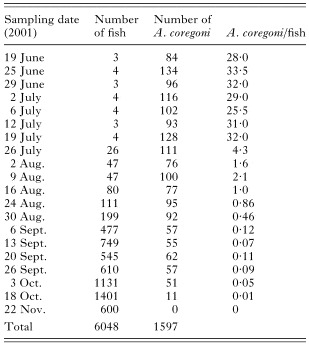
Table 1. Sampling to determine the population structure of Argulus coregoni at an inland fish farm in Finland in 2001
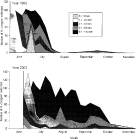
Fig. 2. Size–frequency distribution of Argulus coregoni. Samples were collected in 1999 and 2001 from second-summer rainbow trout (Oncorhynchus mykiss) at a fish farm in Finland. The number of fish examined to obtain each parasite sample was 1–15 in 1999 and 6–1401 in 2001.
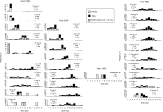
Fig. 3. Seasonal changes in the size–frequency distribution of Argulus coregoni during the open water periods in 1999 and 2001. Numbers of A. coregoni examined and the sex ratio (female[ratio ]male) are also presented. Significant differences from a ratio of 1[ratio ]1 are marked with asterisks (*P<0·05, **P<0·01, ***P<0·001). The data were analysed using the chi-squared test with Yates' correction of continuity.

Fig. 4. Relative numbers of gravid females (>8 mm in length) and males (>8 mm) on rainbow trout during the open water period of 2001.
 You have
Access
- 43
- Cited by