Introduction
The banded fruit weevil (BFW), Phlyctinus callosus (Schönherr) (Coleoptera: Curculionidae), is indigenous to South Africa. It was first reported in New Zealand in 1899, from where it spread to all southern states in Australia (Kuschel, Reference Kuschel1972). In South Africa, the BFW has been recognized as a pest since 1896 (Lounsbury, Reference Lounsbury1896). It is the only curculionid that causes primary damage to deciduous fruit in South African orchards, and is also regarded as one of the most serious pests on grapevines (Myburgh et al., Reference Myburgh, Whitehead and Daiber1973; Annecke & Moran, Reference Annecke and Moran1982). Recently, the BFW has also been found to be a serious pest of blueberries (Bredenhand et al., Reference Bredenhand, Van Hoorn, May, Ferreira and Johnson2010). The adult weevil causes damage to fruit mainly by chewing away the skin, as well as the underlying flesh, resulting in shallow lesions. In the Western Cape, fruit damage tends to occur from December to February (Marais & Barnes, Reference Marais and Barnes2003; Fisher & Learmonth, Reference Fisher and Learmonth2004).
Females of the BFW lay their eggs just below the soil surface, or in loose organic litter. When first-instar larvae hatch, they burrow into the soil and start feeding on the roots. The majority of larvae occur in the top 10 cm of soil, where overwintering takes place (Barnes, Reference Barnes1989a). Most of the BFW larvae pass through 6–8 instars, but some have up to 11 instars. Pupation of larvae lasts approximately 14 days (Barnes, Reference Barnes1989b). Emergence of the adults takes place during the late spring and early summer (Myburgh et al., Reference Myburgh, Whitehead and Daiber1973). The BFW normally has one generation per year, but in irrigated orchards and in the Western Cape province of South Africa, two generations occur per year; the second-generation adults emerge in autumn, when conditions are optimal (Barnes, Reference Barnes1989a; Nel & Addison, Reference Nel and Addison1993).
In many apple and pear orchards, snout beetles have been found to cause more damage than does any other pest insect. Control of BFW is unsatisfactory, as the weevil has developed a high tolerance to many pyrethroids, with indications of cross-tolerance to acephate (Barnes et al., Reference Barnes, Knipe and Calitz1994). As the BFW cannot fly, trunk barriers can be used to prevent weevils from reaching the fruit, although such a control method is very labour intensive (Barnes et al., Reference Barnes, Knipe and Calitz1996). There is a need for alternative control options, particularly those that are aimed at the soil stages of the insect.
Entomopathogenic nematodes (EPNs) are lethal pathogens of insects that occur naturally in the soil all over the world. In combination with their symbiotic bacteria, they have been used successfully against many insect pests (Griffin et al., Reference Griffin, Boemare, Lewis, Greval, Ehlers and Shapiro-Ilan2005; Wright et al., Reference Wright, Peters, Schroer, Fife, Grewal, Ehlers and Shapiro-Ilan2005). Such biological control agents have a wide host range, and can actively search for their host, while remaining harmless to the environment (Gaugler & Boush, Reference Gaugler and Boush1979). The soil stages, larvae and pupae, and emerging adults of the BFW remain in the soil for a long time, with such stages offering a window of opportunity for targeting by nematodes. The advantages of EPN include their ability to counter a wide range of soil-inhabiting pests, their easy application, and the safety of non-target arthropods in their presence (Georgis & Gaugler, Reference Georgis and Gaugler1991; Kaya & Gaugler, Reference Kaya and Gaugler1993).
EPNs have been used successfully to control black vine weevil larvae, in potted plants and with crops grown in glasshouses (Wilson et al., Reference Wilson, Nitzsche and Shearer1999; Fitters et al., Reference Fitters, Dunne and Griffin2001; Lola-Luz et al., Reference Lola-Luz, Downes and Dunne2005). After infesting potted and field strawberries with black vine weevil larvae, Lola-Luz & Downes (Reference Lola-Luz and Downes2007) then applied three soil drenches using nematodes, after which no live weevils were recovered. Successful control of clover root weevils by EPN has been demonstrated in research undertaken by Bell et al. (Reference Bell, Jackson and Nelson2000) in New Zealand, using a Petri dish and pot experiment with two heterorhabditids and one steinernematid. Bell et al. (Reference Bell, Jackson and Nelson2000) have shown that all nematode species were able to kill the larvae of the clover root weevil. The oriental beetle has been controlled by the use of a steinernematid in greenhouse and field trials, with control ranging between 50 and 95% (Polavarapu et al., Reference Polavarapu, Koppenhöfer, Barry, Holdcraft and Fuzy2007).
Laboratory bioassays were undertaken to test the susceptibility of larvae and adults of the BFW to endemic nematode species. The effect of other biological characteristics, such as vertical movement, nematode concentration and temperature, on the mortality of BFW larvae was also investigated. The development of the nematode in sixth-instar BFW larvae was followed to determine whether nematodes would be able to complete their life cycle in the insect.
Materials and methods
Source of nematodes and insects
Nematodes were obtained from local surveys (Malan et al., Reference Malan, Nguyen and Addison2006, Reference Malan, Knoetze and Moore2011), with cultures being maintained at Stellenbosch University by recycling IJs every 3–6 months through Galleria mellonella (L.). The IJ inoculum of the different isolates was reared on G. mellonella, according to the procedures devised by Kaya & Stock (Reference Kaya and Stock1997). Nematodes were stored in 150 ml filtered water at 14°C in 500-ml, horizontally placed, vented culture flasks, and shaken weekly. The nematodes were used as inoculum within 1 month after harvesting.
Adult BFWs were collected from a farm in Elgin by means of a process that involved corrugated cardboard bands tied to the trunks of apple and plum trees. The adults were kept in perspex boxes (15 × 20 cm) and given Caprosma sp. branches on which to feed. Eggs, oviposited by adults between layers of wet cotton wool, were harvested and hatched at room temperature on wet filter paper in Petri dishes. The first-instar larvae were added to the surface of the river sand in 5-litre pots, each containing five fully grown carrots, with the tops kept intact. The carrots were wetted daily and kept in a growth chamber at 25°C for a period of 4 weeks, after which the larvae of the BFW were harvested by means of washing the sand from each pot through a sieve (Ferreira, Reference Ferreira2010).
Galleria mellonella larvae used for the preparing of nematode recycling and inoculum were reared on a diet that contained the following ingredients: five parts brown bread flour, five parts baby cereal, two parts wheat germ, two parts yeast, two parts glycerine and one part honey (Woodring & Kaya, Reference Woodring and Kaya1988).
Twenty-four-well bioassay protocol
A 24-well bioassay tray (flat-bottom, Nunc™, Cat. No. 144530, Thermo Fisher Scientific (Pty) Ltd, Gauteng, Johannesburg, South Africa) was used as the test arena. Every alternate well was lined with a circular piece of 13-mm-diameter filter paper to obtain an even distribution throughout the well. Each of the wells used was inoculated with a concentration of 400 IJs in 50 μl filtered tap water. For each treatment, a control treatment was used to which only water was added. One BFW was added to each well. The wells were closed with the lid, placed in a closed plastic container lined with moistened tissue paper, and placed in a growth chamber at 25 ± 2°C for 4 days. Thereafter, mortality was determined, and the infection of the insect was confirmed by means of dissection with the aid of a stereomicroscope. All bioassays were repeated on different test dates, and with freshly prepared inoculum.
Susceptibility of BFW larvae
Using the 24-well bioassay protocol, two isolates of Heterorhabditis bacteriophora Poinar 1974, SF134 (FJ423603) and SF351 (FJ455843), and one isolate of H. zealandica Poinar, 1990 SF41 (EU699436), were used to test the susceptibility of BFW larvae. The nematode inoculum was pipetted into each of ten alternate wells, with one BFW larva being added to each well (Navon & Ascher, Reference Navon and Ascher2000). One bioassay plate was used for each nematode isolate and the control plates received water only. The procedure was conducted on three different test dates.
Susceptibility of BFW adults
Using the 24-well bioassay protocol, three nematode species, H. zealandica (SF41), H. bacteriophora (SF134) and Steinernema khoisanae Nguyen, Malan & Gozel, 2006 (106-C) (Nguyen et al., Reference Nguyen, Malan and Gozel2006), were used to test the susceptibility of adult BFW. Two bioassay plates, containing ten adults each, were used for each nematode species and the controls, which received water only. The number of IJs penetrating the host was determined for each nematode species. The procedure was repeated three times on different dates.
Sand bioassay
Centrifuge tubes (1.5 cm × 15 cm in diameter) were filled with sieved river sand (frozen overnight) and 1.4 ml water was added to each tube (Yu et al., Reference Yu, Gouge and Baker2006). To simplify retrieval, a BFW larva was placed in an Eppendorf tube (0.2-ml thin-walled polymerase chain reaction (PCR) tube) pierced with 10 holes, using a heated needle (Kehres et al., Reference Kehres, Denon and Mauleon2001). Eppendorf tubes containing a BFW larva were placed, at depths of 0, 5, 10 and 15 cm, in each of ten sand-filled centrifuge tubes. Heterorhabditis zealandica (SF41) was added by pipetting on the surface of the sand of each tube, with the control treatments receiving water only. After 7 days at 25°C, the mortality of BFW caused by infection was confirmed by dissection. This experiment was conducted on three separate dates.
Sand versus sandy loam soil
River sand and sandy loam soil (62.0% fine sand : 20.6% medium sand : 8.0% coarse sand : 6.0% silt : 3.4% clay) was sieved and frozen overnight before use. For both media, Eppendorf tubes, each containing a single BFW larva, were buried at a depth of 10 cm, with ten tubes being used for each treatment. Heterorhabditis zealandica (SF41) was pipetted on the surface of each tube, with the controls receiving water only. The tubes were closed with the lid, and then left at 25°C for 7 days. The experiment was repeated on two separate test dates.
Nematode concentration
To determine the effect of different concentrations of H. zealandica (SF41) on the mortality rate of BFW, the 24-well bioassay protocol was followed. Concentrations of 0, 200, 400 and 800 IJs/insect of H. zealandica (SF41) were inoculated, after which a larva of BFW was added. For each concentration tested, four bioassay plates with ten larvae were used, with the control treatments receiving water only. The mortality caused by the nematodes was confirmed by means of dissection after periods of 2, 4 and 6 days.
Effect of temperature
The effect of three different temperatures (11, 15 and 25°C) on the larvicidal activity of H. zealandica (SF41) was studied using the 24-well bioassay protocol. For each treatment, one bioassay plate with ten larvae each was used. The plates were incubated at the different temperatures specified. The experiment was repeated on two different test dates.
Biology of H. zealandica (SF41) in BFW larva
The 24-well bioassay protocol was followed with ten plates, with six BFW larvae in each plate (n= 60) and using H. zealandica (SF41) as inoculum. On day four, all infected larvae from each plate were rinsed in tap water to remove surface nematodes and placed in six 9-cm-diameter Petri dishes lined with moist filter paper and incubated at 25 ± 2°C in a growth chamber. Six larvae (one Petri dish) were removed every 3 days and dissected using a stereomicroscope, allowing for observations on the development of the nematodes inside the BFW larvae to be noted. The first-generation hermaphrodites were counted to determine the number of IJ that had successfully penetrated the larvae.
Eight Petri dishes (of 3.5-cm-diameter), containing one BFW larva each, were left undisturbed and placed on modified White traps (White, Reference White1927) for 22 days in a closed container at 25 ± 2°C in a growth chamber, to determine the mean number of IJs produced per larva.
Data analysis
The results were analysed using STATISTICA 9.0 (Statsoft Inc., 2009). Data were analysed by using a one-way analysis of variance (ANOVA) with post-hoc comparisons of means. Bonferroni's method, or a bootstrap multiple comparison, was used, in which residuals were not normally distributed (Efron & Tibshirani, Reference Efron and Tibshirani1993). The results from the concentration trial were analysed using a factorial ANOVA probit analysis (Hintze, Reference Hintze2007).
Results
Screening
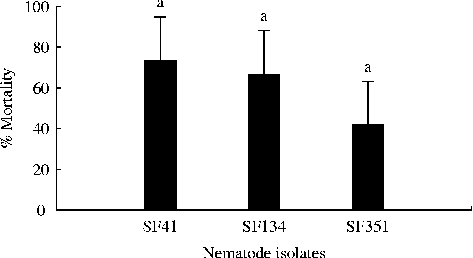
The mean percentage mortality of BFW larvae obtained for H. zealandica (SF41) was 73.3 ± 0.066%, for H. bacteriophora (SF134) 66.6 ± 0.098%, and for H. bacteriophora (SF351) 41.6 ± 0.127% with no mortality for the control treatments. Results from the three different test dates were analysed separately, and no significant differences were found. The results were pooled (fig. 1) and analysed using a one-way ANOVA. No significant difference was found between the three isolates (F (2,15)= 2.741; P= 0.097). The residuals were not normally distributed and, consequently, a non-parametric test, in this case the Kruskal–Wallis test, was done (H (2,18)= 3.628; P= 0.163), confirming the ANOVA results obtained.
The mean percentage mortality (95% confidence interval) of Phlyctinus callosus larvae inoculated with Heterorhabditis zealandica (SF41) and H. bacteriophora (SF134, SF351), at a concentration of 400 IJs/50 μl, after a period of 4 days. Different letters above vertical bars indicate significant differences (one-way ANOVA; F (2,15)= 2.741; P= 0.097).

Adults
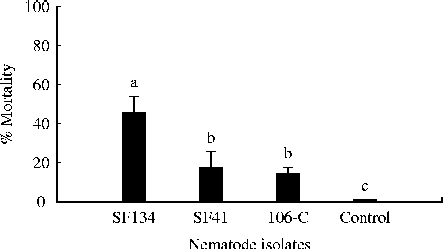
Heterorhabditis bacteriophora caused a mean mortality of 45 ± 0.05% for adult weevils; H. zealandica, 16 ± 0.049%; and S. khoisanae, 13 ± 0.021%. No mortality of adult weevils was found for the controls after 4 days. The interaction effects between the different dates and treatment proved to be insignificant (F (4,9)= 2.36; P= 0.13), and the results were pooled (fig. 2) and analysed using a one-way ANOVA. Heterorhabditis bacteriophora differed significantly from H. zealandica and S. khoisanae (F (3,20)= 26.581; P< 0.0001), with no significant difference being found between H. zealandica and S. khoisanae. The mean number of IJs that were found to have penetrated BFW adults was ten for H. bacteriophora, eight for H. zealandica and six for S. khoisanae.
The mean percentage mortality (95% confidence interval) of adult Phlyctinus callosus inoculated with 400 IJs/insect of Heterorhabditis bacteriophora (SF134), H. zealandica (SF41) and Steinernema khoisanae (106-C), after 4 days. Different letters above vertical bars indicate significant differences (one-way ANOVA: F (3,20)= 26.581; P< 0.0001).

Sand bioassay
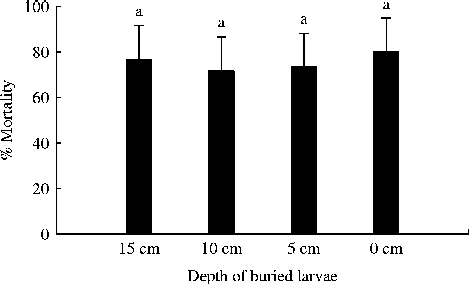
A high percentage mortality rate for BFW larvae was obtained for the different depths ranging between 71 and 80%. A mean mortality of 77 ± 0.076% at 15 cm, 71 ± 0.065% at 10 cm, 73 ± 0.091% at 5 cm and 80 ± 0.044% at 0 cm were obtained, while no mortality was obtained with the control treatments. Results from the three different test dates were analysed separately, and no significant differences were found. Results were thus pooled (fig. 3) and analysed using a one-way ANOVA. No significant difference was found between the different soil depths (F (3,20)= 0.266; P= 0.849). The residuals were not normally distributed and, consequently, a Kruskal–Wallis test was done (H (3,24)= 1.72; P= 0.633), confirming the ANOVA analysis.
The mean percentage mortality (95% confidence interval) obtained for Phlyctinus callosus larvae, buried at four different depths, inoculated with Heterorhabditis zealandica at a concentration of 400 IJs/100 μl, after 7 days. Different letters above vertical bars indicate significant differences (one-way ANOVA; F (3,20)= 0.266; P= 0.849).

Sand versus sandy loam soil
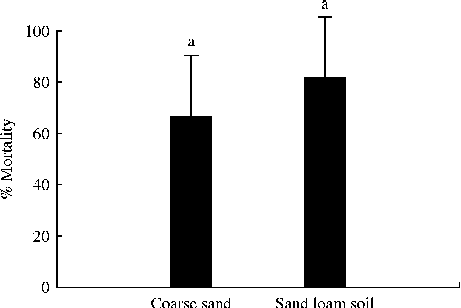
A higher mean (82.2 ± 0.084%) percentage mortality rate was obtained with the sandy loam soil than with the use of sand (67.5 ± 0.12%). Results from the three different test dates were analysed separately, and no significant differences were found. Results were thus pooled and analysed using a one-way ANOVA (fig. 4). No significant difference was found between the coarse sand and the sandy loam soil (F (1,10)= 0.99; P= 0.343). The residuals were not normally distributed and, consequently, a Mann–Whitney test was done (U= 9; P= 0.173) confirming the ANOVA results. No mortality was obtained in the control treatments.
The mean percentage mortality (95% confidence interval) recorded for Phlyctinus callosus larvae buried at 10 cm and inoculated with Heterorhabditis zealandica (SF41) at concentration of 400 IJs/100 μl in sandy loam soil and coarse river sand, after a period of 7 days. Different letters above vertical bars indicate significant differences (one-way ANOVA; F (1,10)= 0.99; P= 0.343).

Nematode concentration
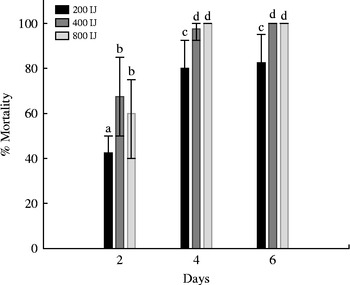
The results analysed using factorial ANOVA showed that there was no significant interaction (F (4,27)= 0.2; P= 0.94) between the main factors, concentration and the amount of time on the different test dates, and the results were pooled. The percentage mortality due to treatments differed significantly (F (2,27)= 9.28; P= 0.0009) and the percentage mortality due to the amount of time also differed significantly (F (2,27)= 33.82; P< 0.001). Heterorhabditis zealandica, inoculated at a concentration of 200 IJs/50 μl, resulted in mortality of 42.5 ± 0.047% after 2 days, with the mortality increasing after 4 and 6 days to 80 ± 0.071% and 83 ± 0.063%, respectively. An increased concentration of 400 IJs/50 μl resulted in mortality of 68 ± 0.11% after 2 days. After 4 and 6 days, the mortality rate was 98 ± 0.025% and 100%, respectively. When 800 IJs/50 μl were used, the results showed 60 ± 0.12% mortality after 2 days, and 100% after both 4 and 6 days. There was a significant difference between 200 IJs/50 μl and 400 IJs/50 μl (P= 0.0093), and also 200 IJs/50 μl and 800 IJs/50 μl (P= 0.0054) after 2 days. Results after 4 days exhibited a significant difference between 200 IJs/50 μl and 400 IJs/50 μl (P= 0.0051), as well as between 200 IJs/50 μl and 800 IJs/50 μl (P= 0.0091). Results found after 6 days were similar to results found after 4 days, whereby a significant difference was found between 200 IJs/50 μl and 400 IJs/50 μl (P= 0.0051), and also between 200 IJs/50 μl and 800 IJs/50 μl (P< 0.0001). A mortality rate ranging from 17.5 ± 0.039% to 30 ± 0.18% was found in the control treatments during the experiment.
The mean percentage mortality (95% confidence interval) rate recorded for Phlyctinus
callosus obtained after exposure to concentrations of 200 (■), 400 ( ) and 800 (
 ) IJ of Heterorhabditis zealandica (SF41) per larva over a period of 2, 4 and 6 days Different letters above vertical bars indicate significant differences (factorial ANOVA; F
(4,27)= 0.2; P= 0.94).

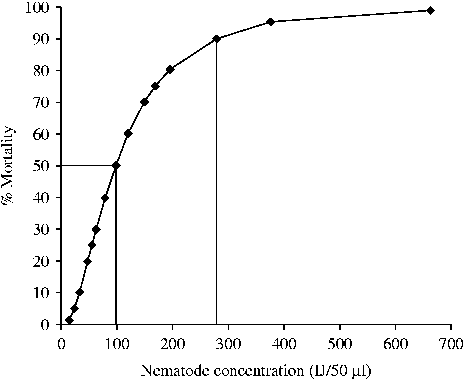
The LD50 and LD90 doses over a period of 2 days were 235 and 12,677 IJs/50 μl, respectively. After a period of 4 days, the LD50 and LD90 doses changed to 96 and 278 IJs/50 μl, respectively (fig. 6). After a period of 6 days, the LD50 and LD90 doses were 88 and 254 IJs/50 μl, respectively.
The LD50 and LD90 doses were 96 IJs and 278 IJs, after exposure of Phlyctinus callosus larvae to Heterorhabditis zealandica (SF41) for a trial period of 4 days, at 25°C, using Probit analysis.

Effect of temperature on mortality
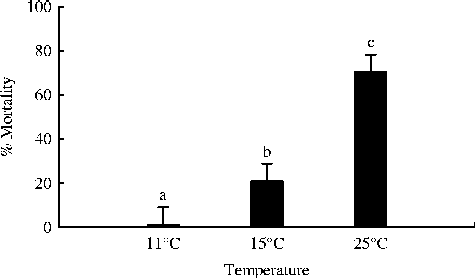
The mean percentage mortality at 25°C was 54 ± 0.044%, and 11 ± 0.045% at 15°C, while no mortality was observed at 11°C. Results from the two different test dates were separately analysed, and no significant differences were found. The results were then pooled (fig. 7) and analysed using a one-way ANOVA (F (2,12)= 97.5; P>0.001). The residuals were not normally distributed, and, consequently, a Kruskal–Wallis test was done (H (2,15)= 13.06; P= 0.0015), confirming the ANOVA results. A Bonferroni multiple comparisons procedure showed that there was a significant difference between 11 and 25°C (P< 0.0001). There was a significant difference between 11 and 15°C (P= 0.0067) and between 15 and 25°C (P< 0.0001). The control mortality rate, using water as inoculum, was 0% at all temperatures tested.
The mean percentage mortality (95% confidence interval) for Phlyctinus callosus larvae after exposure to Heterorhabditis zealandica (SF41) at three different temperatures, after inoculation with a concentration of 400 IJs over a period of 4 days. Different letters above vertical bars indicate significant differences (one-way ANOVA; F (2,12)= 97.5; P>0.001).

Development of nematodes in BFW larvae
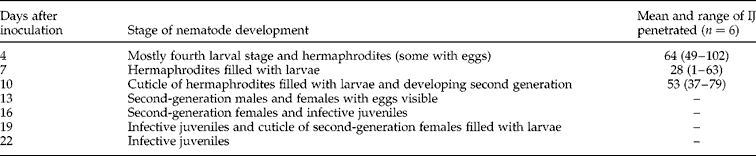
Mortality of 74 ± 0.081% was obtained after 4 days with sixth-instar BFW larvae. The colouring of the host's body was found to have changed from a creamy white colour to brown. The number of hermaphrodites was counted until day 10, with a mean penetration rate of 48 IJs penetrating the larva (table 1). The time recorded from IJ entrance into the body until a new cohort of IJ developed was 16 days. During this period, the nematodes passed through two generations. The first adult hermaphrodites were observed 4 days after the death of the insect. After 7 days, the hermaphrodites were filled with larvae. By day 13, eggs were observed in the females of the second generation. By the sixteenth day, IJ started to develop. On day 19, the presence of females of the second generation and of IJs was still to be observed. On day 22, all the IJs emerged, leaving the cadavers flattened and empty.
The development of Heterorhabditis zealandica in sixth-instar larvae of Phlyctinus callusus exposed to a concentration of 400 IJs/insect for a period of 4 days at 25°C in a growth chamber.

The mean IJ production of nematodes within the BFW larvae was calculated to be 3300 per insect. The average size of the larvae used was 4.92 mm long and 1.45 mm wide. The mean width of the head capsule was found to be 84 μm, indicating them to be the sixth larval stage.
Discussion
No previous research has been conducted in South Africa investigating the use of EPN for the control of BFW. However, some research has been conducted in Australia and New Zealand, where EPNs were used very successfully against BFW (Curran & Patel, Reference Curran and Patel1988; Prestidge & Willoughby, Reference Prestidge and Willoughby1990). Research undertaken by Curran & Patel (Reference Curran and Patel1988) found that H. bacteriophora ( = H. heliothidis), distributed through a trickle irrigation system, reduced weevil survival by 59 and 25%, compared to untreated strawberry plants (Curran & Patel, Reference Curran and Patel1988). Similarly, Prestidge & Willoughby (Reference Prestidge and Willoughby1990) produced excellent results when H. bacteriophora were applied topically and inundatively to the soil against P. callosus larvae and pupae. Total mortality was achieved after 48 h, when 5 × 10⁴ IJs were applied per pot (Prestidge & Willoughby, Reference Prestidge and Willoughby1990).
In a local study, Barnes (Reference Barnes1987) indicated that it was not possible to obtain high numbers of BFW larvae by means of sieving infested orchard soil, and that patchy distribution and seasonal variation make field evaluation for the effective control of BFW extremely problematic. An important first step in future research into the use of EPN for the control of BFW will be to obtain high numbers of good-quality laboratory-reared BFW larvae to be used in laboratory and field trials.
Larvae of the BFW were found to be susceptible to the three nematode isolates tested. The two Heterorhabditis spp. performed better than did the steinernematid with regard to percentage mortality, with H. zealandica causing the highest mortality (73.3%). No significant differences between the three species were found, but, as only a limited amount of larvae were available, it would be beneficial to conduct more replications in future research, when larvae are abundantly available. Good results were obtained regarding larval mortality after 4 days at a concentration of 400 IJs/insect.
Heterorhabditis isolates have been used successfully against the black vine weevil (Simons, Reference Simons1981; Lola-Luz et al., Reference Lola-Luz, Downes and Dunne2005; Lola-Luz & Downes, Reference Lola-Luz and Downes2007), but have been found not always to perform better than do steinernematids against weevils, as can be seen in the research undertaken by Shapiro & McCoy (Reference Shapiro and McCoy2000). The objective of their research was to observe nine nematode species and 17 strains for use against the citrus weevil, which is a severe pest of citrus in Florida, USA. In their study, specific isolates of Steinernema performed better when compared to the performance of Heterorhabditis.
In the current study, EPNs were evaluated against adult weevils, even though the larval stage of the weevil was the main focus of the study. Results illustrated that the same tendency for susceptibility was found to exist with regard to the three species tested, but with H. bacteriophora resulting in the highest mortality (45%), and differing significantly from the other two species. However, the adults were found to be less susceptible than were the larvae, most likely as a result of the insects exhibiting grooming behaviour that was typical of Coleoptera (Gaugler et al., Reference Gaugler, Wang and Campbell1994; Koppenhöfer, Reference Koppenhöfer, Lacey and Kaya2000). Better performance of the heterorhabditids could also be attributed to the possession of a dorsal tooth, which enables the nematode to enter the host insect directly by means of abrasion of the thin parts of the sclerotized cuticle.
Results obtained in the sand bioassay trial illustrated that the IJs were capable of moving down to the lowest depth of 15 cm within 1 week after inoculation, with a mean percentage mortality of 76%, and no significant differences between the different depths. Nguyen & Smart (Reference Nguyen and Smart1990) obtained comparable results in an earlier study of Steinernema scapterisci. The vertical downward (15 cm) movement of the nematodes tested in the current study indicates that BFW larvae can be reached in the soil effortlessly, considering the vertical distribution of the weevil larvae, which has been reported by Barnes (Reference Barnes1989a) to be mostly in the top 10 cm. Unfortunately, no pupae were tested, as a result of the shortage of larvae, but it is recommended that such testing be done in future research.
Superior performance of nematodes was observed in sandy loam soil compared to in coarser sandy soil. The enhanced performance can possibly be attributed to higher moisture retention in sandy loam soil than in coarser sandy soil, making the former a more suitable medium for the mobility and infection of nematodes (Molyneux & Bedding, Reference Molyneux and Bedding1984; Kaya, Reference Kaya, Gaugler and Kaya1990). Moisture is a key factor in nematode survival (Wright et al., Reference Wright, Peters, Schroer, Fife, Grewal, Ehlers and Shapiro-Ilan2005), with heterorhabditids being known to be more susceptible to desiccation than are steinernematids (Surrey & Wharton, Reference Surrey and Wharton1995). Although there was no significant difference between the mortality rates of the larvae in the different soil types, a markedly higher percentage mortality rate was detected for the larvae in the sandy loam soil.
Results from the concentration trial illustrated a positive relationship between the IJ concentrations and the percentage larval mortality after 4 days. The LD90 value was found to be 278 IJs/50 μl after 4 days, giving a good indication of a field concentration with acceptable levels of control. The research undertaken by De Waal (Reference De Waal2008) showed that 275 IJs/ml as an LD90 dose effectively controlled codling moth larvae after 2 days.
Optimum BFW control can be achieved by applying nematodes during winter and early spring, as the larvae that are then present in the soil are most susceptible to EPNs. During winter and early spring, the temperatures are generally low, which might prove to be a challenge (Ferreira & Malan, Reference Ferreira and Malan2010), as cool temperatures tend to affect both host-finding ability and the rate of EPN infection (Lacey & Unruh, Reference Lacey and Unruh1998; Vega et al., Reference Vega, Lacey, Herard, Pilarska, Danova, Tomov and Kaya2000). In the current study, the EPN isolates performed extremely poorly at 11°C, and nematodes only started to become active at temperatures above 15°C. Consequently, application of nematodes in the field should take place when the ambient temperature ranges between 18 and 30°C. As BFW larvae are present in the soil during winter and early spring, nematodes should be applied when the daytime temperature exceeds 15°C.
The development trial of H. zealandica in BFW larvae was successfully concluded with the production of a new cohort of IJs, which demonstrated that BFW larvae can act as a suitable host for future nematode generations, with the possibility of persistence in the soil. The developmental rate of the nematodes in BFW closely resembled that of H. bacteriophora in G. mellonella, but only at a slightly slower pace (Aguera de Doucet et al., Reference Aguera de Doucet, Bertolotti and Cagnolo1996).
The current study showed that BFW larvae are suitable hosts for H. zealandica, which can result in an increased persistence in the soil. The selected isolate has great potential to be used in combination with other management strategies to control BFW. Further research into this pest insect is required; for example, screening more EPN species and using more repetitions. Nematodes have the ability to be used effectively against BFW, as the soil stages can be targeted in order to reduce the population before the adults emerge and cause damage to the fruit. The present study showed BFW larvae not to be as susceptible to nematode infection as are codling moth (De Waal et al., Reference De Waal, Malan and Addison2011) and false codling moth (Malan et al., Reference Malan, Knoetze and Moore2011) larvae, with double the concentration of nematodes and double the time being required to obtain comparable results.
Acknowledgements
This research was funded by the South African Apple and Pear Producer's Association (SAAPPA) and by the Technology and Human Resources for Industry Programmes (THRIP). The authors would like to thank D.G. Nel of the Centre for Statistical Consultation, Stellenbosch University, for assistance with the statistical analyses.