Near the end of his solo piece The Myopia, an epic burlesque of tragic proportion, prominent playwright and performer David Greenspan presents a pair of scenes in which he investigates, from a queer perspective, the question of time in the theatre. In the spirit of The Myopia's own temporally disruptive mechanics, I will describe the second scene first: an Orator and his Doppelganger, who “bears a striking resemblance to the actress Carol Channing,”Footnote 1 have a conversation in which they explain to the audience that the overlong fourth act, in whose stead they appear, has been cut from the play. The Doppelganger, who is particularly concerned with keeping good time (and whose “striking resemblance” to Channing is camped in performance as an uncostumed Greenspan does an uncanny vocal impersonation of the actress), looks impatiently at her wrist—as if at a watch—and says that audiences will put up with “telling” in the theatre, as distinct from “showing,” only if the telling is “not too long. People—who of course apprehend words by either reading or listening—might be willing to sit a long time apprehending words by reading but might not be willing to sit a long time apprehending words by listening. Even if they're simultaneously seeing.”Footnote 2 Here the Doppelganger, like the Orator, speaks in rhythms explicitly modeled on those of Gertrude Stein, whose essay “Plays” is invoked earlier in the scene. Likewise concerned with the pacing of showing and telling and the phenomenology of audience responses to that pacing, Stein complains famously in “Plays” of theatre's “syncopated time,” its inability to produce an identity between “the emotional time of the play” and spectators' “emotional time as audience.”Footnote 3 Stein's own plays do not exactly solve the problem of syncopated time but rather attempt to circumvent the problem altogether by rejecting the theatrical apparatus that, in her view, produces syncopation—that is, “by blurring beyond recognition the distinctions among dialogue, didascalia, and other diegetic language that seems to belong to the province of neither dialogue nor didascalia.”Footnote 4
Greenspan's approach to playwriting differs from Stein's, even as he acknowledges openly his debt to her and traces a genealogy from her work to his. Like Stein, he wants to test the extent to which “telling is the essence of what happens” onstage,Footnote 5 an aim manifested in performance when, for instance, his mimicry of Channing's voice “tells” rather than “shows” audiences the Doppelganger's resemblance to the actress. But unlike Stein, he tells in such a way that characters' dialogue, stage directions, and act and scene divisions remain legible and distinct (though recited by one performer). So how, beyond dragging Channing, does Greenspan make “what happens” queer, where queer is understood, here and throughout, to signify an interrogation of norms, conventions, and coherences of gender and sexuality as well as the pleasure that comes from such an interrogation? And how does Greenspan's queer making, thus defined, affect and inflect time?
The answer may begin to emerge more clearly from the immediately prior scene in The Myopia, an entr'acte to which the Orator's conversation with the Doppelganger is yoked. In direct contrast to the miming of the Doppelganger's watch—which is fittingly absent, since she can't, in fact, keep good time over the course of her highly digressive conversation with the Orator—the entr'acte conjures an image of a conspicuously visible timepiece. The Orator, in his related role as Raconteur, recalls a theatregoing experience in which “perfunctorily costumed” stagehands helped actors change sets “in plain view of the audience”Footnote 6:
But you know, you can always tell the difference between the actors and the stage-hands. I don't know why this is—but I think it is because there is a difference. The actors are always smiling or staying in character while they change the set. But of course you know and I know—and one hopes they know—all they're actually doing is just changing the set. And then the crew lumbers on in that grumpy but purposeful way, and they are not smiling and they are not even remotely in character. They simply are characters. In fact, what they are, are “characters in action”—that action being changing the set. And changing the set is the essence of what they are doing. And it really is, and it really is real, and it really is interesting; because not only are they actually doing something, they are really actually doing something. And you know it, and I know it, and they capture your attention. Or at least they capture mine.
And one particular member of this particular crew did capture my attention in particular; because not only was he actually doing something—really actually doing something—the other thing I found interesting about him was that though he was costumed—perfunctorily at least—as a turn of the century roustabout—he was wearing a digital watch. And that was very interesting, because it made him—if somewhat surreal—nonetheless more real—more than the actors who were more than perfunctorily costumed. And he captured my attention. I didn't watch the actors—not that they were actually doing anything that actually needed to be watched—I watched him.Footnote 7
What excites the Raconteur in the unwitting “scene” thus described is a set of effects that Greenspan seeks in his turn to create deliberately as a playwright: the condensation of more than one temporal order, produced here by the conjunction of the late nineteenth-century costume and the patently contemporary digital watch; the departure from realism and the eruption of metatheatrical reflexivity that this condensation allows; and the possibility that such a metatheatrical departure from realism engenders an experience “more real”—and perhaps more queer, in its arousal of unexpected forms of engaged and desirous attention—than mere realism may accommodate.
This set of antirealistic effects, emphasizing reflexivity and temporal multiplicity, is not only described but also enacted throughout The Myopia. Indeed, the creation of these effects is, I argue, the central defining feature of Greenspan's ongoing theatrical project and its queer ethos. Because this nonnormative ethos emerges from Greenspan's sustained investment in temporal coincidences or transferences, in his metatheatrical commentaries, and in the mutual constitution of the two, I nominate the queer time of his plays more specifically as superposed time. Superposition captures well the dual writerly modes that I have in mind—and the crucial inseparability of these modes as Greenspan negotiates their interpenetration—because the word not only denotes “the action of causing two or more sets of physical conditions or phenomena … to coincide, or co-exist”Footnote 8 but also may, to an ear imaginatively turned, connote the reaches beyond the theatrical pose to which metatheatrical moments, gestures, and postures offer access. In theatrical scenarios governed by this superposed time, Greenspan discloses how the manipulation of such time may, at the least, offer a queer critique of “straight” (linear and sexual) time and how, at its most promising, the navigation of such time may itself be experienced queerly and satisfyingly.
In his most recent work, these queer satisfactions sometimes take the form of same-sex marital fulfillment. Greenspan's qualified and ambivalent embrace of marital possibility, most fully explored in the 2009 play A Horse's Ass, may seem at first blush like a curiously liberal move for a radical playwright—and may seem, moreover, like a move at odds with the desire to articulate daringly queer temporalities. The latter misperception would be especially tempting, given the purchase with which compelling theorists of queer time use their work, almost without exception, to resist the mainstream politics that endorse same-sex marriage. But what makes Greenspan's theorization of queer time, as it unfolds especially in A Horse's Ass, so worthy of attention is its distinctive departure from other such theorizations—a departure that accommodates, among other things, a more nuanced stance on marriage than mere refusal of the institution. At the same time, Greenspan's timely intervention, and the space it preserves for a tentative and complex valuation of marriage, does not constitute a break from but rather is consistent with his earlier plays that use their queer time, almost unilaterally, to disparage marriage. In particular, the negative anatomizations of marriage in The Myopia and Son of an Engineer lay the groundwork, ironically, for the carefully positive view of marriage enunciated in A Horse's Ass. Because A Horse's Ass is a loose adaptation of the sixteenth-century Italian comedy Il marescalco, the play and its analysis may also gesture toward a longer historical view of marriage and its same-sex coordinates than many accounts of queer temporalities offer.
All in the Timing
In A Horse's Ass, as in the play by Pietro Aretino on which it is based, the marescalco (master of his lord's horses), known and derided throughout Mantua for his exclusive sexual relations with young men, is forced by his lord to marry a highly eligible woman—only to discover, in the moment immediately after the wedding, that the supposed woman is actually a knight's page in disguise. Attending to this punch line, arguably the main source of Greenspan's attraction to Aretino's text, we might ask how the same-sex marriage performed onstage in Il marescalco could join and enrich discussions of the history of marriage and its sometime queer coordinates. In an introduction to their recent, fine, and very faithful translation of the play, Laura Giannetti and Guido Ruggiero note that the period when Aretino wrote it was one of major historical transition:
As the now old merchant-banker elites of the earlier Renaissance became more aristocratic—the most notable example being perhaps the Medici family of Florence, who had started out as bankers (and probably pawnbrokers) and during the sixteenth century gradually became nobles and dukes—the ideal of virtù continued to evolve. Especially important in this newer version of virtù were the manners and courtly ways that suited a new, more aristocratic upper class who now, rather than investing in trade and competing to rule their city-states, more and more preferred to invest in land, live off their revenues, and socialize at court—a newer reality that Aretino bitterly satirizes in Il marescalco. Footnote 9
If the prevailing sentiment about the evolution of ideals in the early sixteenth century was that it signified devolution and that subjects were living in “the worst of times, and perhaps even the end of time” (xix), then the bitter satire that Giannetti and Ruggiero attribute to Aretino could be understood as fundamentally backward-looking: the “better time” to which the corrupted court's motions are implicitly compared is the period in the late fifteenth century before the French invasion of Italy “initiated a half-century of … dynastic battles” (xix) and the consequent diminution, ethical and otherwise, of court life in various Italian city-states. Yet even though the marescalco's same-sex marriage is arranged by a lord who typifies, Aretino suggests, this very degradation, it would be a mistake to read the play as thus condemning the marriage as one more instance of the end time's decadence, a public celebration to be laughed at rather than with. Rather, the lord's structuring and conspicuous absence throughout the entirety of the play—including, notably, at the marriage ceremony, ostensibly engineered by him, that constitutes its conclusion—creates a time and space that registers, viscerally and affectively, as one provisionally and playfully free from his command, despite what is disclosed to the audience about the role of his unseen hand in the coordination of some of the play's action. Indeed, it is the very production of this provisional and playful freedom, a topsy-turvy license disarticulated from the lord's rule, that allows “Aretino irreverently [to turn] the traditional burla [a cruel joke on dishonorable behavior] on its head—calling into question the virtù of the courtiers who witness the whole event [of the marriage] and perhaps traditional Renaissance sexual mores as well” (xxii). As Giannetti and Ruggiero propose, not the marescalco in marriage with a boy but the courtiers who would wish to force him to marry a woman are the ultimate butt of the joke that has seemed to be at his expense; the play affirms the same-sex marriage as a kind of reward to the long-suffering marescalco, who pleads earlier, “I want to live as I wish, sleep with whom I like, eat what pleases me, without the scolding of a wife” (149). And, given what I have described as the play's backward-looking ethical tendency, we could extend this line of argumentation to suggest that the marriage thus affirmed is not only not a symptom of the debauched present but also, and weirdly enough, a fantastical return to an idealized past. As Allan A. Tulchin observes, “society tolerated a wide variety of [same-sex] household arrangements” in certain French and Italian contexts “in the later Middle Ages and the [early] Renaissance.”Footnote 10 This tolerance waned when the “quickening of a culture in the West that was urban, bourgeois, and statist”—the culture of Aretino's moment—made the availability of same-sex intimacies “more prominent” but also more “potentially destabilizing.”Footnote 11 In turn, that threat of social destabilization engendered new and fuller forms of sexual policing, represented theatrically by the constant public harassment, for instance, to which the marescalco is subjected. By contrast, if the marriage that figures as the marescalco's vindication is utopian in its impulse, then it is nostalgically so: it takes the sexual ethics of a period just recent enough to be (mis?)remembered and renders those ethics as a break with the present—but a break with the present that also feels apocalyptically forward-looking, potentially ending “end time.”
Shifting registers, then, from the present to the past, we can see how same-sex marriage may have been available, in another time and place, for precisely the kind of double-hinged movement between the “not-yet-here” and the “no-longer-conscious” that José Muñoz has recently championed for its utopian promise.Footnote 12 Of course, when Muñoz champions such utopian promise and the queerly temporal disruptions that enable it, he distinguishes it precisely from the “political nihilism”Footnote 13 that he associates with such agendas as the affirmation of same-sex marriage. And when Greenspan revisits and reimagines Aretino's once-utopian conception of same-sex marriage, he is doing it, as it happens, from Muñoz's precise time and place (New York City, 2009) and thus with much of the same sort of skepticism (if none of the outright rejection) with which his contemporary treats the institution. A Horse's Ass departs considerably from Aretino's characterizations, jokes, pacing, politics, and sociocultural implications, and the departures are rendered chiefly through the two related tactics that constitute Greenspan's superpositional strategy: the layering of early sixteenth-century Mantuan life with early twenty-first-century American life and the interpolation of explicit language about the acts of writing and staging an adaptation. Moreover, it is through these very forms of temporal and self-referential play that Greenspan makes legible his qualified affirmation of contemporary same-sex marriage—one that aligns, theoretically and politically, with the positions of commentators who fall somewhere ambivalently (and productively so) between a flat dismissal of marriage and a full endorsement of it.
One such commentator is Tom Boellstorff, writing in an important special issue of GLQ devoted to queer temporalities (to which Muñoz, meditating on queer utopianism, is also a contributor). Boellstorff asserts, “The question in regard to marriage should not be the binary ‘should people do it or not?’ but ‘in what ways can our acts from within a system of power do more than sustain or not sustain that system?’”Footnote 14 Boellstorff calls here for work “from within a system of power”Footnote 15 that would nevertheless entail transformation of that system. In this framework, it might be tenable for subjects to inhabit marriage queerly—to make of same-sex marriage an institution that not only refused what Eric O. Clarke calls the “dominant heteronormative standard” of moralityFootnote 16 but also, and in so refusing, embodied the “new, better ways of ordering relationships” for which other critics of same-sex marriage, much like Clarke, long.Footnote 17 Importantly, Boellstorff imagines the possibility, albeit with reservation and qualification,Footnote 18 of a queer inhabitation of marriage that would, at the same time, be part of a broader strategy of inhabiting time queerly—of queering the straight time that is “shaped by linked discourses of heteronormativity, capitalism, modernity, and apocalypse.”Footnote 19 Because this yoking of queer marriage and queer temporal horizons is one that similarly animates Greenspan's writing in A Horse's Ass, it is worth spending some time, as it were, with Boellstorff's meditations on queer temporalities, as they pertain relevantly to and can be rethought in light of Greenspan's innovative reworking of theatrical time.
In Boellstorff's formulation, both progressive and conservative critics think of same-sex marriage (indeed, they think, period) within the order of a straight time that is “evolutive, teleological, apocalyptic, paranoid: straight time is nothing less than a millenarian temporality.”Footnote 20 Because straight time, as it governs event and thought alike, constitutes not just linearity but also causality, their shared maintenance of straight time leads critics on opposite sides of the political spectrum to structurally identical, if superficially dissimilar, kinds of argumentation. As Boellstorff explains, “In both [progressive and conservative] cases, the linear structure of straight time is also a causal structure: one thing leads to another along a ‘slippery slope’ trajectory of apocalypse that for conservatives will culminate in polygamy, marrying one's pets, and other imagined horribles, and for progressives will culminate in things like gentrification.”Footnote 21 But that is not to say that progressively oriented queer critics do not wish to warp, disrupt, or otherwise tamper with the mechanics of straight time. Indeed, positing the experience of queer temporality as an oppositional way of inhabiting the world has been the recent project of a number of major queer scholars, including Lee Edelman, Elizabeth Freeman, and Judith Halberstam.Footnote 22 Thus, Boellstorff makes his most crucial intervention in showing how these critics, and others like them, fail, ultimately, to shake off the coils of straight time. In his estimation, their ways of imagining queer time take straight time for granted instead of submitting it to a full and radical interrogation:
The most fundamental and consequential limitation of conceptions (and thus practices) of queer time to date is that they share with dominant, heteronormative temporalities the assumption that time is ultimately linear—indeed, that it is “straight.” Their intervention lies in slowing down, stopping, or reversing that linear trajectory, rather than calling it into question. For instance, Judith Halberstam['s] … counter to “reproductive temporality” is framed in terms of a “stretched-out adolescence”: delay, not abandonment, of the linear trajectory… . Similarly, Lee Edelman speaks of “reproductive futurism” against which the queer subject represents “no future,” and Elizabeth Freeman speaks of “‘temporal drag,’ with all of the associations that the word ‘drag’ has with retrogression, delay, and the pull of the past upon the present.”Footnote 23
In contradistinction to these versions of queer time that leave straight time finally intact, Boellstorff looks to times and places jarringly discontinuous with our own to find examples of temporality that might be redeployed queerly in a twenty-first century, Western context: the “oscillating time” of the ancient Greeks, which he mentions briefly; and “coincidental time,” which he adapts from Javanese and Balinese contexts and which could, unlike straight time, privilege “intersection” and “admixture.” Coincidental “moments recall not realist narratives of progress but a surrealist aesthetic ‘that values fragments, curious collections, [and] unexpected juxtapositions.’”Footnote 24
Ironically, Boellstorff invokes coincidental time, a mode that would constitute a more complete break with straight time than competing versions of queer temporality, in the service of thinking through options for the transformation of marriage from within that institution's current coordinates and predicates. And this irony comes with an attendant disappointment. Far from detailing the explicit ways that a same-sex couple might enjoy married life coincidentally rather than straightly (in all its senses), Boellstorff merely gestures toward “a time in which same-sex marriage could ‘fall’ in”—and thus reconfigure—its “heteronormative context”: a provocative but nevertheless vague suggestion.Footnote 25 Perhaps Boellstorff's reluctance to push through this vagueness stems, as he almost concedes, from the difficulty of imagining abiding material transformation in the face of “capitalism's deeply embedded linear logics of wage labor and production and the reproductive logics of modern governmentality.”Footnote 26 Arguably less difficult to imagine is aesthetic transformation, and thus it is telling that Boellstorff should, in part, frame his distinction between straight time and coincidental time as one between realism and something like surrealism. (Recall, by way of comparison, Greenspan's approving mention in The Myopia of the “somewhat surreal” effect of the stagehand's digital watch, “more real” than realism.) In noting Boellstorff's recourse to aesthetic categories, I wish by no means to imply that such categories and the regimes that they underwrite do not have crucially material stakes and consequences for the subjects who tarry and toil within their bounds (or, at best, their shadows), as has been made clear by so many incisive critics of the exacting tolls of realism.Footnote 27 Nor do I wish to imply that effecting a transformation of the curiously intractable regime of aesthetic realism may not effect further transformations of reality as such (an important proposition to which to return). Indeed, looking to Greenspan as just such an interrogator of realism—and the straight time that undergirds it—may allow us, because of the richness and specificity of Greenspan's theatrical worlds, to see, if not move, beyond the somewhat hazy impasse in which Boellstorff theorizes coincidental time.
For Greenspan is likewise an (implicit) theorist, as I have suggested above, of the similar concept of superposed time, a phenomenon that hits the viewer or reader with full force as soon as the Prologuer begins the long opening speech of A Horse's Ass. In the very first lines that he (re)writes for the Prologuer (a street hawker in Il marescalco), Greenspan establishes a temporal superposition with various dimensions: “Okay, so a few years ago—say 1526—the Duke of Mantua, who is an example of kindness and goodness in this, this most hideous century of ours, had in his service a certain Marescalco (a master of horses) who was as enthusiastic about women as a hemophiliac is about needles.”Footnote 28 When Aretino first published Il marescalco in 1533, 1526 was indeed “a few years ago,” and the central lineament of Greenspan's joke depends upon “preserving” this original writerly context, now obviously and humorously out of joint for a 2009—or later—audience, for which 1526 is rather a long time ago. The superposition of 1533 (or so) and 2009 (or so) is amplified in the repetition, “this, this,” passing itself off nonchalantly as a momentary stutter or pause but also registering as a doubled modifier for “most hideous century of ours,” at once Aretino's sixteenth and Greenspan's twenty-first. At the same time, Greenspan embroiders the conjunction of these two moments with the faint suggestion of a couple of others: “Okay, so” (as in, “Okay, so a rabbi walks into a bar”) invokes the Jewish comedian's shtick, remembered from Greenspan's childhood, that will unfold more prominently over the course of the play (and is already more evident later in this very speech, which is full of such verbal tics as “So, what,” and “audiences these days”). And the “hemophiliac” unenthusiastic “about needles,” who figures in or as a punch line, recalls the American height of AIDS-induced panic in the mid to late 1980s, which was foregrounded in some of Greenspan's earlier plays. The years 1533, 1963, 1989, 2009: these collide with but don't quite dissolve into each other, just as Aretino's compositional choices and Greenspan's revisions of them meet, without merging, in the metatheatrical gambit that comprises most of the rest of the Prologuer's speech:
Now wouldn't it be a mortal sin not to punish with a wife some castrone who was not only not ashamed of being such a beast, but didn't give a second thought about shoving it in your face? Actually no, I think it's the playwright who ought to be punished—for sending an actor out onstage to deliver a prologue that not only tells the audience what's going to be happening in the play—as if you couldn't figure that out on your own, but gives away the end of the play. “But that's how it's done in the original,” he said—in the play our play is based on—”they give away the entire plot.” “So, what, you couldn't change it a little, let the audience be surprised?” I mean this play was commissioned, he was supposed to write something original, not just copy some antique play. Though to be fair, he did imagine writing a conversation between himself and Aretino in which they argued not only about whether to keep the prologue—versus jumping right into the action, not giving away the plot—but also about trimming parts of the play—which we have done because it's long and filled with jokes that only a sixteenth-century Italian audience would get—and besides, audiences these days—I hate to generalize (and I certainly don't want to offend anybody)—but most audiences these days—it seems to me—really have little patience for a long evening in the theatre. Unless it's a musical. Which this is not. (And even then.) I mean that's been my observation… . I just wanted you to know that the playwright did not write the scene between himself and Aretino, he didn't think any of the information about the Italian court and deleting all the in-jokes and trimming the play was necessary, you didn't need to hear anything about it. I'm just trying to help you out! He did write what I just said, because this is after all a play and somebody's got to write the lines. (3)
The superposed time(s) of the play, established in the Prologuer's first sentences, opens a space for playful self-commentary about writing an adaptation for the theatre—and about the conditions of the theatre as such—that becomes quite heady as Greenspan imagines his Prologuer wrestling not only with Aretino's spoilers but also (reflexively) with Greenspan's own reflexivity. Yet a closer consideration of the speech reveals something arguably more complex than headiness: the necessary, and not merely coincidental, imbrication of one kind of superposing (of times) with another kind of “super-posing” (the character's—and actor's—metatheatrical regard of his own pose in the role). The time that condenses multiple times gestures at once toward “all time” and “no time”—and, in so unstably doing, impresses upon us the fact that the only time that can, in turn, seem stable is the enchanted time, the magical “now,” of the theatre itself. What else, then, in such theatrical time, marked as theatrical time, but for the prologue to be about the writing and performing of prologues—and for the deliverer of that speech to be not the more idiosyncratic street hawker of Aretino's play but the “Prologuer,” a kind of Everyman of the preamble?
Yet to emphasize the mutual constitution of these two kinds of superposition is not to underestimate the importance of the more superficial thrust of the speech, the Prologuer's straying from Aretino and from “Greenspan,” for that straying foreshadows in miniature the more fleshed-out chafing against role of the play's two main characters—Sheldon, the marescalco, and Giannicco, his servant—a chafing or resistance that becomes Greenspan's central preoccupation in the play. Indeed, the marescalco's very renaming as Sheldon by his balia (childhood nurse) is not only one point in a multipronged attack on the anti-Semitism that suffuses Aretino's play but also, and more specifically, an almost incantatory identification of him with the intrusive order of time—Greenspan's time—that makes such anti-anti-Semitism thinkable. Moreover, it is an identification that the marescalco, who is otherwise persecuted for his sexuality, feels intuitively and thus assents to blithely and without remark:
BALIA: Sheldon! Sheldon! Come in I want to talk to you.
MARESCALCO: (To GIANNICCO and PEDANT.) Who's Sheldon?
PEDANT: You are.
MARESCALCO: Since when?
PEDANT: I guess just now. It sounds better than her calling, “Marescalco, Marescalco.” That just means “master of the horse.” I'm just called Pedant. I've got no name. We're stock characters.
MARESCALCO: I'm not really a stock character. How many homosexual protagonists you think there are in Renaissance literature?
GIANNICCO: In literature in general?
PEDANT: Some people think there are too many. And even if you have a name in the play, you still fill a stock role: the character lacking a certain virtù—the butt of a joke.
MARESCALCO: I don't agree with you. I think there's something subversive going on here.
GIANNICCO: I think so too. (19–20)
Where is the “here” where “something subversive [is] going on”—Aretino's play, Greenspan's adaptation, or (more likely in this theatre of superposition) both? Recent scholars assent quite readily to the “subversive” notion that the marescalco is not the butt of Aretino's joke. But Greenspan goes further than such scholarship may by weaving this notion into the play itself—and by putting that notion in the marescalco's own mouth in the moment of his renaming, a conjunction that underscores again the profound connection in the play between metatheatricality and the queer manipulation of time(s). As for Giannicco, who is in crucial accord with his master in this moment, he likewise asserts his fundamental—as if unbidden—identification with Greenspan's time (or, rather, with one of Greenspan's times, his childhood time) in a joke accomplished, like Sheldon's renaming, near the beginning of the play, when the marescalco's friend Jacopo congratulates him on his impending marriage:
JACOPO: I came to congratulate you myself. I hear she's not only beautiful, but from a good family. And that she brings you a dowry of four thousand scudi.
GIANNICCO: That's a lot of money! You could buy me a new car.
MARESCALCO: A what?
JACOPO: What's a car?
GIANNICCO: I don't know, it just came out of my mouth. Maybe a '62 Thunderbird Convertible. (6)
Out of context, the lightness of early moments in the play, like this one, may seem rather like slightness, yet they creep into the play so slowly but surely (and multiply) that they open an eventual gulf between Aretino's play and Greenspan's—and that gulf is the space in which Sheldon and Giannicco resist the limits of early modern sexual mores, roles, and routines. In so doing, they simultaneously embrace a model of sexuality forged in the crucible of Greenspan's contemporary American experience.
This embrace begins in fits and starts, as when, for instance, Giannicco wonders, in an aside to the audience, whether the sixteenth-century Italian convention of sex between older and younger men—one supposed to be forgone upon the older man's entry into an opposite-sex marriage—may be constraining or even troubling: “You, in the 21st century. What do you make of my relationship with the Marescalco? I'm 19. He's 33. Never mind how old the actors really are. It's a convention of the time, younger men with older men—it's accepted. Is it something you're comfortable with? I'm just asking” (24). By the end of the play, this wondering and doubt give way to a nearly wholesale repudiation, by both Sheldon and Giannicco, of the conceptions (and regulations) of sexuality, intimacy, and companionship prevalent in their Ur-context. From Aretino's perspective, the perfect reward for the marescalco's suffering is not the continuation of his sexual relationship with Giannicco—who even in Il marescalco emerges as bound, if tenuously, to his master by ties of genuine affection—but marriage to a much more minor character, the knight's page, so much the better a match because he is younger (that is, more age-”appropriate”), newer, and presumably hotter. In turn, Greenspan performs the same marriage between the marescalco and the knight's page, but only so that Sheldon and Giannicco may resist the severance of their relationship that the marriage implies. Indeed, they use performative language to initiate their own, differently inflected marriage, one rooted, as Giannicco says earlier, in sex but also in such ritual, quotidian pleasures as the marescalco “get[ting] up, walk[ing] the dog, [and] pick[ing] up a couple of bialys while I put on the coffee” (31). Not surprisingly in a play styled like this one, their performance of the marriage is full of winks and nods to the audience:
MARESCALCO: Stay with me and be mine. We will grow older. The thirteen, fourteen years between us will seem less I think the older we grow.
GIANNICCO: (Surprised.) But you read the introduction to these plays. You know the world we live in.
MARESCALCO: Live quietly with me. Look at our friends inside, laughing and enjoying a good meal. Let them see us together at the table. I have to believe after this day well spent, that people can change and that it is possible to appeal to what is kind and tolerant. The Duke is magnanimous. He has subverted the status quo. It is just as the Prologuer said. Stay with me. Love me. Do this with me and I will love you with all my heart.
GIANNICCO: (After a pause.) There is the musical with Henry Higgins and Eliza Doolittle. The end of the play it's based on is different. She leaves and doesn't come back. It's only in the musical that she returns.
MARESCALCO: I know, it's preposterous. “There are tears in her eyes. She understands.”
[They are now so close to each other.]
GIANNICCO: I like the play better.
MARESCALCO: So do I. [Any objections? If there are it's too late. They're kissing.] They kiss.(65)
Never before, perhaps, has a stage marriage been swathed in so many layers of metatheatricality, from the invocation of the Prologuer and Aretino's commentators to the quiet preservation of the absent officiant's role in Greenspan's bracketed directions (intoned during staged readings of the play).
But the most prominent of these metatheatrical flourishes—the intertextual lacing of this couple's relationship with the central one of My Fair Lady (and Pygmalion)—is also the most complex and disruptive. The kiss that seals the marriage belies the characters' avowed rejection of (at least other characters') happy endings, but gesture cannot undo language entirely, and the characters' distaste for the musical revision of Shaw calls into question the status of Greenspan's revision of Aretino. With that questioning emerges a productive doubt about the play's ostensible endorsement of this marriage (and same-sex marriage as such), a doubt that is yoked, moreover, to Greenspan's temporal relays. Almost immediately upon the heels of the dialogue above, Sheldon addresses the audience thus: “I have my Giannicco and he has his Sheldon. We don't live in a time when we can be married. But we're going inside to have good supper” (66). The “time” of which Sheldon speaks here is, as we have by now come to expect and accept, the superposed times of (at least) 1533 and 2009. Thus, on the face of it, the ambiguity of Sheldon's line would seem designed to remind us how little has changed vis-à-vis marriage between two cultures in which same-sex instantiations are often outlawed. At the same time, the line seems to offer a tacit championship of Sheldon's hope “that people”—and with them institutions such as marriage—”can change.” But is this championship so easy and unqualified? Perhaps not, if we consider the other telling invocation of time in this scene, Sheldon's mention of “the thirteen, fourteen years between” him and Giannicco. Even as they have morphed into a couple not unlike the Henry and Eliza of musical comedy (or, more accurately, like the same-sex pairs who smile from the wedding pages of the New York Times's Styles section), they remain, simultaneously, the less familiar, age-disparate characters of Aretino's play: two men who, even in Greenspan's sweetened adaptation, express their affection as much through aggressive and violent displays as through gentle and tender ones and whose lewd speech, song, and behavior with other characters call into question their fitness for or interest in monogamy. Superposed time allows Greenspan to preserve deliberately these unsanitized aspects of Aretino's world and thus to render ambivalent his take on the benignity of conventional twenty-first-century marriage, however much his characters (wandering, like the Prologuer, not only from Aretino but also from “him”?) may want it. Indeed, superposed time allows Greenspan to move not past but through what Clarke would call the counterfactual contradiction inherent in the subjunctive mood of bourgeois publicity: the two central characters in A Horse's Ass are licensed to act both as if they were more normative twenty-first-century gay men and as the asynchronously nonnormative queers (cross-generational, nonmonogamous: out of time, out of step) that they otherwise appear to be from “our” perspective—which may no longer seem so advanced.
Is this the best of both worlds—or is it, at least, a concrete example of what could be implied by Boellstorff's celebration of coincidental time and marriage's potential “fall” into that time? And if so, what would it mean for such a concrete “realization” to be effected in the magical time, the all and no time, of the theatre? To be sure, Greenspan offers nothing like a practical blueprint for inhabiting marriage oppositionally in the world beyond the stage's edge, but the “as ifs” of the play encourage us, in our turn, to ask a series of “what ifs,” including, powerfully, “What if both time and marriage were felt, experienced, performed in ways that challenged the encroachment of realism on real life?” Such a question is inspired by the exuberant assault on realism that Greenspan offers in A Horse's Ass. That assault, moreover, is a continuation of an antirealistic project that animates earlier plays by Greenspan, most notably Son of an Engineer and The Myopia. Not (merely) coincidentally, these plays also indict the closeting, violent, or otherwise numbing effects of straight time, and they figure that indictment as part of an extended meditation on how not to do marriage, which has its ironic complement in the cautiously promarital affirmations of A Horse's Ass. Turning “back” now to Son of an Engineer and The Myopia provides a way to assess this complementarity while queerly resisting a teleological trajectory—one that would be implied by a straightforwardly chronological approach to Greenspan's corpus and that would position A Horse's Ass as the evolutive culmination of his thinking about marriage.
Time Will Tell
Son of an Engineer is a 1994 play in which Greenspan's exploration of superposed time is also an explicit negotiation of the relationships among straight time, realism, and marriage. The play begins when The Killian Boy—whose name is evocative of the way post–World War II suburban housewives might hail their neighbors' children—encounters just such an apron-wearing housewife, Phoebe, and her husband, Tom, who is quite literally “a large bear—like you see in the woods—ursidae carnivora.”Footnote 29 The Killian Boy has returned to his childhood home only to discover that his parents have left without explanation and that the stewardship of the house is now in the hands of Phoebe and Tom, who reside there with their sulky, shy, and circumspect daughter, Diane, a teenager marked, like The Killian Boy, as queer. Indeed, The Killian Boy's queerness, established early through his longing, erotically charged phone-booth calls to a friend named Seymour, is contrasted with the heteronormativity of Phoebe and Tom, inhabitants of straight time: where the Beckettian repetitions, nuanced and modulated, of The Killian Boy's phone calls connote the phenomenology of a mind in process, the talk of Phoebe and Tom is presented as repetitions without difference, flat and deadening. The following “realistic” exchange, which initiates their complex relationship with The Killian Boy, is typical:
TOM: Maybe you should come in the house.
Silence. Uh oh.
THE KILLIAN BOY: I think I better be going….
PHOEBE: Tom, please, he's gotta find his family.
Tom, please, he's gotta locate his family.
Got to. Besides, Diane's not feeling well. A boy in the house. I don't know.
TOM: Diane's our daughter.
PHOEBE: Besides, Diane's not feeling well. A boy in the house. I don't know.
TOM: Diane's our daughter.
The Killian Boy: No, I'm gonna hit the road….
TOM: You don't have to come in. Don't feel obligated or under any pressure.
You don't have to come in. Don't feel obligated or under any pressure. I just thought— (19–20)
“Thought” is precisely what does not animate the monotony of this repetitive straight time, which Greenspan elaborates in something like a series of concentric circles. First we see, as here, the numbing effect of dully repeated, rote words; then we're witness to a scene that, as the play implies, occurs again and again, day after day: a minor argument (Tom does not sufficiently support Phoebe's insistence that Diane interrupt her homework to help Phoebe set the table) escalates shockingly quickly into a full-blown violent confrontation, suffused with lines like, “Don't call me an animal!” (Phoebe), “You gonna call me names, I'll slap you” (Tom), and threats by each party to kill the other (31, 33). Moreover, the realistic banality of both repeated stultifying words and repeated hostile scenarios unfolds within a larger conceptual repetition: the domestic time of the 1950s or early 1960s, to which Tom and Phoebe seem starkly to belong, is repeated in and superposed with the early 1990s, the present time in which the play is written and “actually” (or at least otherwise) set. Various cues and clues place Tom and Phoebe, temporally, in the iconic—and hellish—suburbia recalled from Greenspan's childhood (Phoebe says, for instance, “I was just a girl during the War—a teenager” [47]), even as other details contradict this temporal frame and place the action “later”: The Killian Boy, who is thirty-six (68), informs us that his mother was a child in 1936 (74), facts that would, after we do some math, place the play much later than the 1950s or 1960s—say, in the late 1980s or early 1990s. The last detail emerges from a conversation between Tom and The Killian Boy about a photograph of Mrs. Killian as a little girl, on the back of which is written “April, 1936” and of which her son says that he never knew whether April denoted the month of the snapshot or the name of his mother, which she “never told” him (74). Here, time is also a name. And thus Greenspan links a linguistic ambiguity—the dual meanings of April, one of which is temporal and the other nominal—to the doubling of time in the play, for one of those times (the early 1960s or so), also names an era and that era's typifying structure of feeling rather than a specific year. The danger for all of the characters is that even if it's the 1980s or 1990s, they will stay stuck in that structure of feeling, which is precisely the feeling of “stuckness” that comes from inhabiting a series of structuring repetitions.
That Greenspan should figure straight time as repetitive time is specific to Son of an Engineer and would seem, at first blush, opposed to Boellstorff's contention that straight time is teleological, millenarian, and paranoid. But the play proceeds to thematize the very paradox that repetitive time is also, and at once, apocalyptic: straight time cycles from minute to minute (as evinced in language), from day to day (as conjured in domestic fights), and from generation to generation (as suggested by the superposition of the 1960s and the 1990s); but at the same time, straight time careens toward—and through—nightmarish disaster, only to find on the other side of disaster a new series of cycles, more grim and unbearable than the former ones, to repeat. In this case, the disaster takes the form of nuclear holocaust that destroys the earth, but not before Tom, an engineer, can spirit away Phoebe, Diane, and new “son” The Killian Boy in a rocket to Mars, where they seem to be the sole inhabitants. In the act that traces their altered routines (but routines nonetheless), the most vivid is Tom's violent sex with The Killian Boy, whom he forces to fellate him as Phoebe, shattered by her wasted appearance, watches and performs her own daily ritual of desultory food preparation. If straight time is apocalyptic, the play suggests that this kind of fallout represents what happens when straight time is left to continue moving “forward” after the apocalypse. Or, as Tom says, “Establish … a point of light. Now throw … out … a second point of light. Connect those two points of light with a line segment. Feel the energy move between those two points of light. Chow, chow, chow, chow, chow, chow, chow” (82). Literally and graphically, he makes The Killian Boy eat him. Metaphorically, the act and the speech that accompanies it disclose how straight time devours what's in its path.
Or at least what refuses to dodge its path. The Killian Boy, participating in the familial feeling of stuckness, might instead, like Diane, leave Tom and Phoebe's encampment (read: entrapment) and venture into the mysterious Martian mountains. In so departing, Diane makes the queer choice. (For all the same-sex sex, The Killian Boy is, curiously, on the straight path from which he can't—or won't—diverge.) And Diane's queer choice allows her to usurp the place that bearish fathers like Tom otherwise arrogate to themselves. When she returns, “She is robed—like a patriarch—in soft earth colors. Radiant, she appears cleansed. She walks with a long staff” (90). Having lived among the native Martians, she has learned from them how to repair Tom's long-ago crashed ship, and that experiential learning opens up a vista of potentially queer, and certainly multitudinous, options to her: “There are a million worlds. I have the knowledge” (95). This line is addressed to The Killian Boy, whom Diane invites to travel through space with her—pointedly without her oppressive parents. Suggestively, the conversation in which he tries to convince her not to “let them die” is, like so many earlier conversations between Tom and Phoebe, structured by repetitions without difference. “But Diane, your parents are old and feeble. You saw. They couldn't care for themselves,” he, similarly feeble, says twice (95–6). In so repeating himself—and so trying to ensnare Diane—The Killian Boy has become the active agent, rather than the passive and quiescent target, of straight time, to which he finally and fully accedes after Diane, the mountain climber, departs. Unlike her, he decides, “I'm not going to go up into the mountain. I just want to keep this place clean, a bit” (100) and thus seals his fate as the (somewhat) witting victim of heteronormative “engineering.”
Thus far we have seen how the temporal dimension of superposition works in Son of an Engineer: overlaying the cold-war past, the near-millennial present, and the postapocalyptic future, Greenspan establishes the conditions for a queer critique of the straight—and straitened—life that unfolds in such overlaid time(s). At the same time, he uses the figure of Diane to gesture toward an oppositional way of inhabiting time, which is also, in this play, an oppositional way of inhabiting space, as Diane looks again and again for an elsewhere to which to retreat: her suburban bedroom, the Martian mountains, the outer reaches of the galaxy. How the play itself should be realized in space is a crucial and related question, even a problem, and Greenspan's solution to that problem, as director and performer, allowed the cultivation of the play's metatheatrical dimension. In a preface to the published version of Son of an Engineer, Greenspan describes his frustrating experience as the director of the play at H O M E for Contemporary Theater and Art, and he compares his disappointment in that production, which was fully but minimally staged, to the pleasures and successes of earlier and later solo readings, when he “sat in a chair, played all the parts and recited the stage directions”:Footnote 30
[The full production] didn't work. I could not realize the unencumbered flow of events, nor the suddenness and absurdity of each consequent episode. Reciting the stage directions had permitted me opportunity to create[,] in words, worlds and environments and then, in words, to erase them. It was neat. It was like a radio play without radio, a puppet play without puppets. The restricted visualization I employed in production was inadequate compensation for loss of the stage directions. “Flying” the miniature rocket to the accompanying sound effect of nuclear holocaust was never as potent, shocking, or absurd as my simply saying: “The rocket ship blasts off. The Earth is destroyed by missiles.”Footnote 31
The effect of Greenspan reading such a bold stage direction is not just “potent, shocking, or absurd,” as he notes, but reflexive, even defamiliarizing, and this defamiliarizing reflexivity, made possible in solo performance, amplifies the play's queer critique. Just as Diane looks to escape the play's mise-en-scène, so, too, does Greenspan produce, in a kind of incantatory language, a fantastic theatre of the imagination that exceeds the limits of the conventional stage. This theatre of imagination is the place where he can queerly lay waste to an Earth, more like hell, that deserves, in his anarchic and darkly comic vision, to be “destroyed by missiles.”
Escape from the hellish predictability of straight time is clearly desirable, but escape doesn't necessarily signify annihilation of certain concepts and constructs, like family. Indeed, it may be possible to live in something like family (think of Diane “robed—like a patriarch”) and thrive, so long as that family is queer (coded here as Martian). What textures and contours such a queer relationality might have is not fully realized in this play; Greenspan saved such an ambition for later projects like A Horse's Ass (and, in a more modest way, the Obie-winning 2003 play She Stoops to Comedy).Footnote 32 In the meantime, his next play, The Myopia, joined Son of an Engineer as a work that is relentlessly focused on straight time's injuries and that likewise uses superposition to generate a queer critique of that straight time. In terms of staging, The Myopia is built on Son of an Engineer's foundations. The latter play's unfolding as one long, wildly imagined, and polyvocal monologue, only emergent in performance, shaped The Myopia as a piece of writing: after early drafts of the play were performed in staged readings with a limited number of other actors, Greenspan committed to imagining The Myopia explicitly (and only now performs it) as a solo piece in which he sits in a chair, plays all the parts, and recites the stage directions. As he claims of Son of an Engineer, “potent,” “absurd”—and superpositional—effects are achieved in this kind of performance of The Myopia. But if the play's very title suggests the “neat” result of narrowing focus to create something “like a radio play without radio, a puppet play without puppets,” that valence is the only positive one granted to the term myopia, which is otherwise meant in the play to thematize the perils of restricted vision.
The play poses a central metatheatrical question—and challenge: How does a playwright revisit the marital misery, already explored by Greenspan in plays like Son of an Engineer (and already trod by so many playwrights before him, from Strindberg to Albee and beyond), in a way that is not stale, solipsistic, or myopic but fresh, expansive, and even politically meaningful? To begin to answer this question, Greenspan writes into The Myopia a strange character (creature might be a better word to describe him) who is a playwright, a figure for Greenspan himself, and who fails profoundly to supersede the artistic myopia that Greenspan fears and wishes to ward off. He is called Barclay, and he is, strangely, “an illuminated globe of singularly ocular appearance” who speaks thus to “his second self”:Footnote 33
Now do I remember me. I fancied me a drama of me parent's nightmare marriage—a mythologic burlecue of endless discord. Savages were they! This play to be my revenger's comedy. Thus did I return, finger the wreckage. But what manic distraction. I could not spin their conflict into play. They “played” the same scene time and time again. Obsession with the “drama” altered me. Fixed in purpose I hardened. I find myself self-rendered thus. A fragile globe. Unlife-like shell. Encased. Immobile! And stuck in your head. (13)
Like The Killian Boy, Barclay is “stuck,” literally “immobile,” in the straight time of his parents, a couple named Koreen and Febus, whom we see elsewhere in The Myopia act out “the same scene,” not only one that they play “time and time again” but also one that Phoebe and Tom enacted in Son of an Engineer. A fight begins over something small and trivial (in this case, Koreen is angry that Febus won't make time to look with her at condominiums that he believes they can't afford) and rapidly spirals into a series of “savage” recriminations and threats—an escalation whose effects are surreally metaphorized in Koreen's bodily swelling, until “her hand is bigger than Febus” (28). In performance, Greenspan uses the occasion of Koreen's swelling to manifest the idea that The Myopia is, like Son of an Engineer, a kind of “puppet play without puppets”: enacting one of the couple's arguments, he holds his hands before him as if they were themselves puppets rather than the hands that might hold puppet strings. One of them, pointed downward with two fingers wriggling like little legs, stands for (all of) Febus. The other, now the monstrous, “oversized” hand of Koreen, is flattened, tautly straightened, and pointed accusingly at “Febus.” Thus does the notion of bodily-swelling-as-argumentative-escalation exceed its status as metaphor and become an image in action—a notion that we are asked not only to grasp intellectually but also (and unlike the plays' myopic characters) to see.
The long-term effects of Koreen and Febus's “endless discord” are similarly metaphorized in the “unlife-like shell” that Barclay, replaying his parents' conflict with “manic distraction,” inhabits and that his second self, who is reminiscent of Diane, warns him will “go dark. All gone dark” (13). Not his alone, Barclay's darkness resonates powerfully with the myopia of two other characters: his father Febus, who “wears thick bottle glasses” (12) and who tries but fails to write an improbable musical comedy about Warren G. Harding; and Harding himself, whom we encounter in the play's first scene just as light “falling in harsh precision on the longitude of his left eye foments a dropping of his blind—leaving him monoptic, stymied in a painful wink” (6). Indeed, Greenspan avoids the writerly limitations, the myopia, of both Barclay and Febus precisely by tracing such resonances: that is, by not merely juxtaposing but superposing scenes with content as perversely various as Koreen and Febus's courtship and marriage, Harding's (nonmusical) rise to political power, and the shattering of the globe that contains and constrains Barclay—an offstage event related by the Orator in his conversation with the Doppelganger. If the admixtures of this “epic burlesque” sound headily absurd, they are meant, insouciantly, to register as such. But the play aims to do more than revel in this insouciance. Rather, Greenspan's superpositional strategy invites us to think about the macropolitical stakes and purchase of overlaying material that is, for instance, as idiosyncratically personal as one family's dysfunction and as broadly historical as the “Republican Ascendancy” (45) of the twentieth century, rendered (in language) as a hallucinatory pageant, starring Harding, that sweeps across the stage. Thus does the personal become, in a sense, political—but negatively so, for what Barclay, Febus, and Harding have in common is a quiescence that, left unchecked, evolves into or works in the service of political quietude. Just as Harding, “even though he didn't want to be President[,] … became President, suggesting that he didn't not want to be President enough,” so, too, do Febus and Barclay—and so many others of both their generations—“do things we know we shouldn't and don't want to but don't not want to enough” (52). Moreover, Greenspan's superposition of 1920, 1960, and 2000 suggests that such quietude, marked as rightist (or at least as susceptible to rightist ideology) is a culturally specific response to what he calls the “social upheaval” that shaped the United States in the twentieth century (57)—and that this quietude may continue to deform the twenty-first in the absence of vision and vigilance.
This warning, then, about the dangers of quietude configures the “tragic proportion” of the epic burlesque, and it is poignantly symbolized by a concluding tableau in which Koreen, shattered by the devastation of her marriage (or rather by the experience of marriage as devastation), “begins to harden, petrify” (67). In performance, tears stream quietly down Greenspan's face as he describes this process of petrifaction:
Her body loses human form. Her flesh is made gritty, granitic. Her features indiscernible. Thus is she rendered, immobile, a great misshapen crag. A seagull soars above her, “Errh, errh.” The waves pound—their watery insults splash her stony visage—like Niobe now—all salty tears. In time, the vast persisting ocean will make silt this tower of grief. 'Til then she stands with fearsome aspect, fast against the crashing sea. A final blessed curtain as light is extinguished. (67)
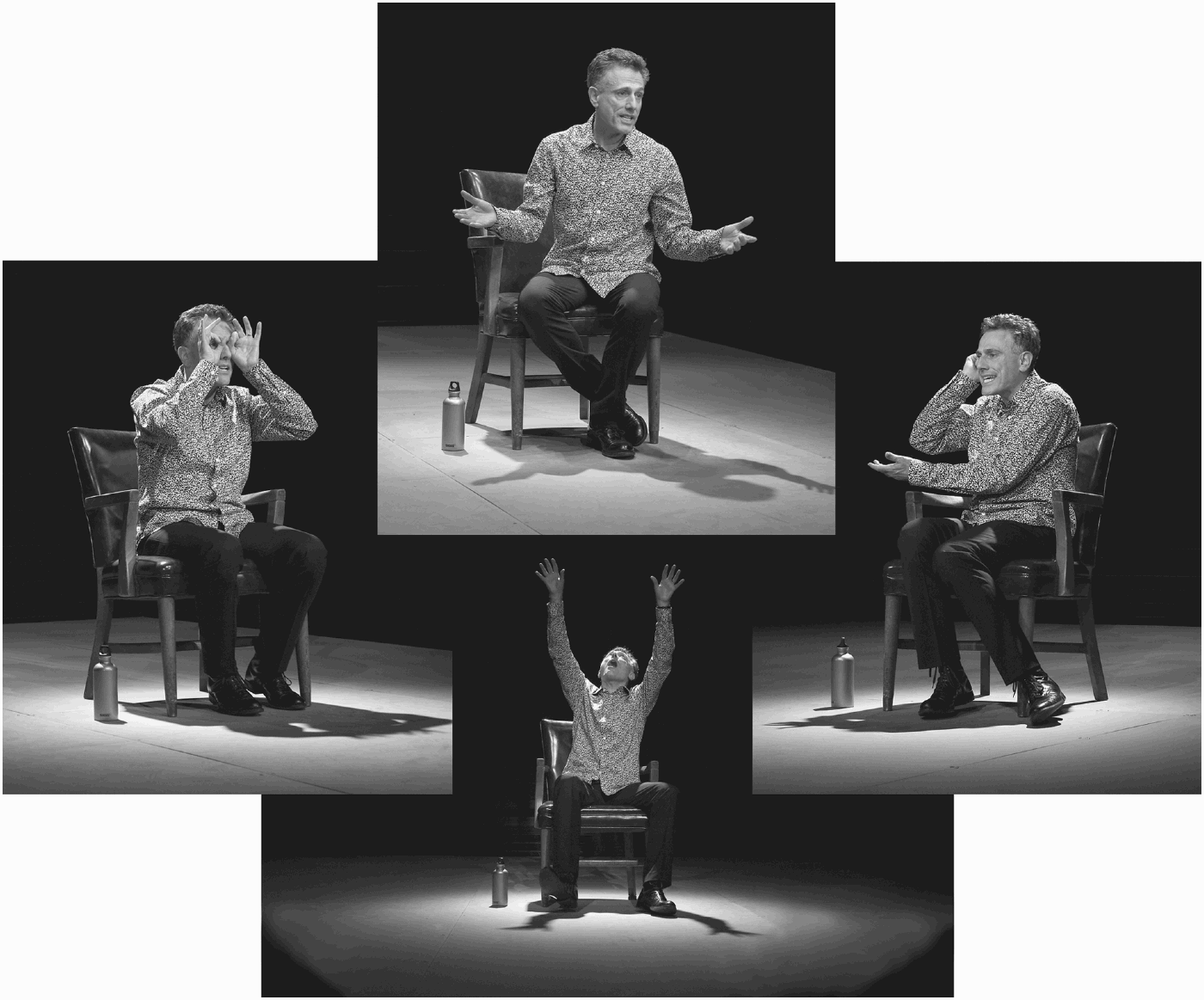
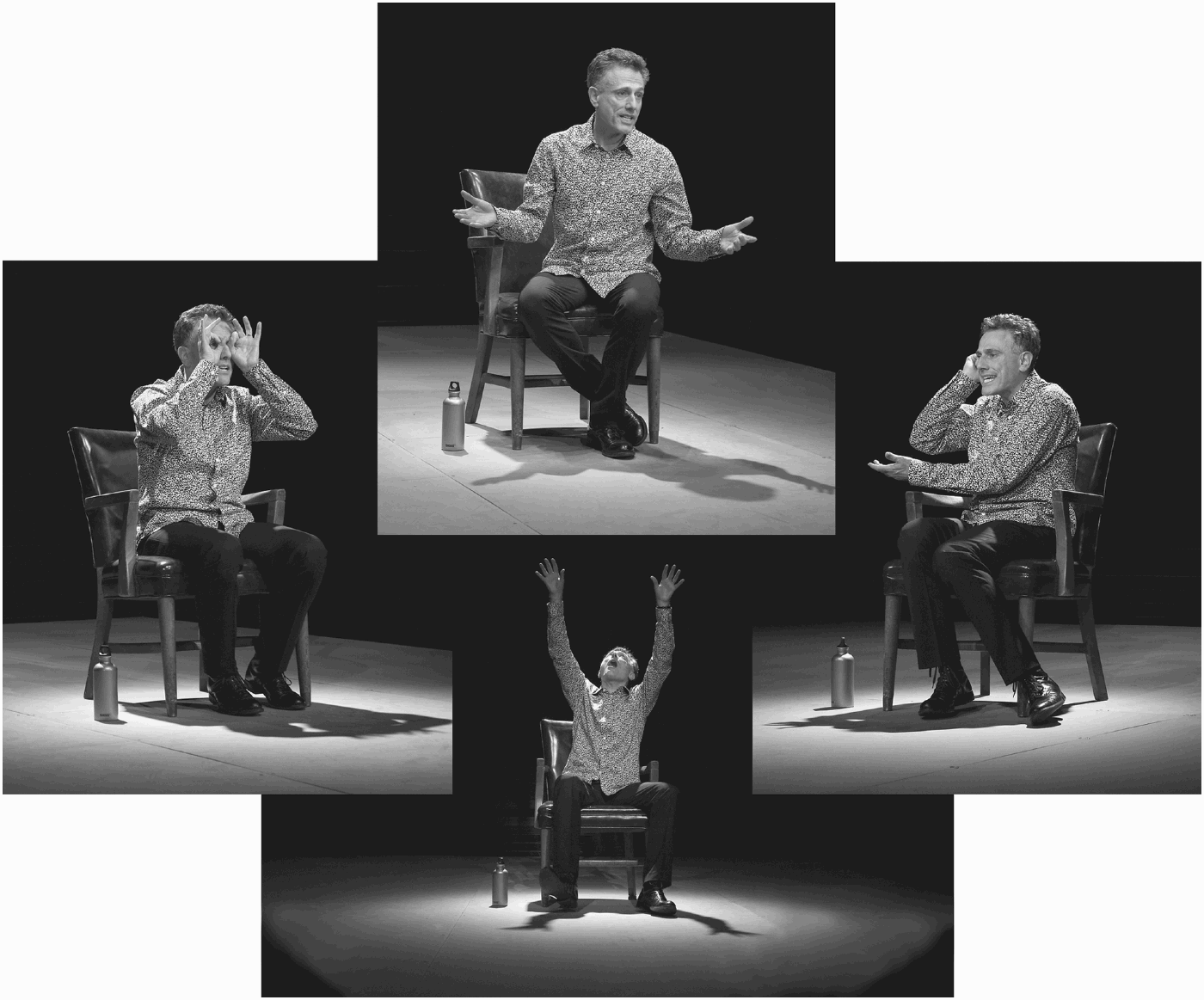
If the final curtain that falls on Koreen is a blessing, then it stands in miniature for the larger blessing constituted by Greenspan's theatrical project: his ongoing resistance to the immobility that the “great misshapen crag” symbolizes and the queer celebration of motion—“evolution, change, and flux”Footnote 34—with which he contrasts it. As A Horse's Ass playfully, but complexly, reveals, such motion may even animate marriage, otherwise so maligned in Greenspan's work, if marriage can be successfully (that is, queerly) disarticulated from the “broken-kitchen-sink realism”Footnote 35 that ultimately breaks characters like Koreen. And whether or not such motion can or will animate marriage, it certainly does enliven the stage—even, miraculously, when what happens onstage is the recitation of an entire play by an actor who never leaves his chair. Far from immobile in that chair, like stony Koreen or globular Barclay, Greenspan is full of vitality (Fig. 1); as Charles Isherwood says of Greenspan's recent performance in The Myopia (which enjoyed a New York revival in January 2010):
Strictly speaking “The Myopia” is a one-man show, the brown paper bag of contemporary New York theater. Yet you emerge from this brilliant and bewildering production … feeling dazzled and disoriented, as if you'd just seen a splashy Disney musical crossed with a Greek tragedy and a kitchen-sink drama, or maybe an evening of Samuel Beckett plays as staged by Florenz Ziegfeld.
With this unique and strangely bewitching work Mr. Greenspan, a quirky downtown actor and an avant-garde playwright, proves himself once again to be a theatrical conjurer of rare gifts. Using just the words he has written and the music of his voice, he fills the imagination of the audience with images of pathos and comedy, of fantasy and absurdity, that … leave a fizzy sense of excitement, the giddy elation that follows a great fireworks display.Footnote 36
Images from The Foundry Theatre's 2010 production of David Greenspan performing The Myopia, an epic burlesque of tragic proportion. Photos courtesy of The Foundry Theatre/Jon Wasserman.
If all this is true (and, having been likewise excited and moved, I would heartily assent to Isherwood's assessment), then imagine what Greenspan may do with some actual fireworks—or at least the handful of actors, costumes, lighting, and set that it would take to stage fully A Horse's Ass, which was not imagined, like The Myopia, as a solo piece. Originally commissioned by the Classic Stage Company, the adaptation has had a few public readings but has yet to be mounted in a full Off-Broadway or regional production. If CSC makes good on a tentative plan to include a production of the play in its 2011–12 season, then Greenspan will have the well-deserved satisfaction, to borrow the play's own cheeky words about queer sex, of realizing A Horse's Ass “out here in public… . What better way than in the open?”Footnote 37