Borderline personality disorder (BPD), a severe personality disorder that causes significant social and functional impairment in youth and adults and which has a lifetime mortality by suicide of almost 10% for those affected (Chanen, Jovev, & Jackson, Reference Chanen, Jovev and Jackson2007; Skodol et al., Reference Skodol, Gunderson, McGlashan, Dyck, Stout and Bender2002), is likely to involve a complex relationship between genetic and environmental factors (Reichborn-Kjennerud, Reference Reichborn-Kjennerud2010). Some aspects of the etiology of BPD are likely to be shared with other personality disorders attributable to common liability factors (Eaton et al., Reference Eaton, Krueger, Keyes, Skodol, Markon and Grant2011). This is especially true for antisocial personality disorder (ASPD), where researchers have reported up to 60% (Zanarini & Gunderson, Reference Zanarini, Gunderson, Stoff, Breiling and Maser1997) comorbidity between BPD and ASPD. Some have argued that ASPD and BPD are manifestations of the same underlying pathology, expressed differentially in males and females (Paris, Reference Paris1997). Although relatively little is known about their specific childhood antecedents (Cohen & Crawford, Reference Cohen, Crawford, Bender, Oldham and Skodol2005), such high comorbidity rates suggest that ASPD and BPD might share one or more common personality dimensions, such as externalizing (Eaton et al., Reference Eaton, Krueger, Keyes, Skodol, Markon and Grant2011). The developmental pathway(s) leading to BPD in adulthood remain unclear (Lenzenweger & Cicchetti, Reference Lenzenweger and Cicchetti2005). Investigating etiological processes early in the life span represents an important step toward better understanding of the development of personality pathology and informing prevention and early intervention strategies (Chanen, Jovev, McCutcheon, Jackson, & McGorry, Reference Chanen, Jovev, McCutcheon, Jackson and McGorry2008).
Personality disorders can be conceptualized as extreme and/or maladaptive variants of general personality structure (De Clercq, De Fruyt, & Widiger, Reference De Clercq, De Fruyt and Widiger2009), and this provides a heuristic framework for identifying and understanding their childhood antecedents. Longitudinal studies support the preservation of individual differences in temperament from early childhood to young adulthood (Caspi, Reference Caspi2000; Clark, Reference Clark2005; Zanarini & Frankenburg, Reference Zanarini and Frankenburg1997), with weak to moderate associations between temperamental characteristics in early childhood and personality differences. Previous research has identified four broad temperamental dimensions (Putnam, Ellis, & Rothbart, Reference Ellis and Rothbart2001) that are related to four of the “Big Five” factors of adult personality (Rothbart, Ahadi, & Evans, Reference Rothbart, Ahadi and Evans2000). These four dimensions are based upon neurobiological theory and show developmental continuity (Rothbart & Bates, Reference Rothbart, Bates, Eisenberg, Damon and Richard2006). Surgency (SUR) refers to a tendency to seek out and enjoy intense experiences, together with a lack of shyness and fear, and is positively associated with the personality factor of extroversion (Putnam et al., Reference Putnam, Ellis, Rothbart, Eliasz and Angleitner2001). Negative affectivity (NA) refers to expressed and felt irritability, sadness, and frustration in response to limitations and is associated with the personality dimension of neuroticism (Rothbart & Ahadi, Reference Rothbart and Ahadi1994). Affiliation (AF) relates to a desire for, and pleasure in, warmth and closeness with others and is aligned with the personality factor of agreeableness. Finally, effortful control (EC) refers to the ability to inhibit a dominant response in order to produce a more socially appropriate and/or goal-directed, nondominant response (Rothbart et al., Reference Rothbart, Ahadi and Evans2000), and it maps reasonably well onto the adult personality dimension of conscientiousness (Putnam et al., Reference Putnam, Ellis, Rothbart, Eliasz and Angleitner2001).
Temperamental extremes are important candidates for developmental antecedents of personality disorders, including BPD and ASPD. Low EC has been associated with externalizing problems, such as aggressive and impulsive behaviors, danger seeking, and substance abuse (Caspi, Moffitt, Newman, & Silva, Reference Caspi, Moffitt, Newman and Silva1996; Rettew, Copeland, Stanger, & Hudziak, Reference Rettew, Copeland, Stanger and Hudziak2004; Swendsen, Conway, Rounsaville, & Merikangas, Reference Swendsen, Conway, Rounsaville and Merikangas2002), most of which are common to both BPD and ASPD. Low AF (or antagonism) has been reported in both BPD and ASPD (Harpur, Hart, & Hare, Reference Harpur, Hart, Hare, Costa and Widiger1993; Joyce et al., Reference Joyce, McKenzie, Luty, Mulder, Carter and Sullivan2003) and reflects lack of capacity for compassion and cooperativeness, particularly toward authority figures, as well as suspiciousness and interpersonal antagonism. Despite these similarities, BPD and ASPD might differ in their levels of NA (i.e., neuroticism). High NA has been reliably associated with BPD (Joyce et al., Reference Joyce, McKenzie, Luty, Mulder, Carter and Sullivan2003; Samuel & Widiger, Reference Samuel and Widiger2008), whereas ASPD individuals are thought to have lower NA due to the inherent callous–unemotional traits and lack of remorse and empathy (Liest & Dadds, Reference Liest and Dadds2009; Samuel & Widiger, Reference Samuel and Widiger2008).
There has also been strong interest in the role of frontolimbic abnormalities in the etiology of personality disorders (PDs), principally BPD. The hippocampus is critically involved in sensitivity to stress and processing of contextual aspects of the environment (i.e., contextual learning), potentially determining individual sensitivity to environmental context (Whittle et al., Reference Whittle, Yap, Sheeber, Dudgeon, Yücel and Pantelis2011). Nunes and colleagues' (Reference Nunes, Wenzel, Borges, Porto, Caminha and de Oliveira2009) meta-analysis of seven studies of hippocampal volumes in patients with BPD reported smaller right and left hippocampal volumes in BPD patients, suggesting that bilateral volume reductions might be biological substrates of BPD symptomatology. Although Whittle et al. (Reference Whittle, Yucel, Fornito, Barrett, Wood and Lubman2008) have reported an association between hippocampal volume and the temperamental dimension of EC in a healthy adolescent sample, two studies of adolescents with BPD (which aim to reduce the influence of confounding “duration of illness” factors upon observed volumes) have not found hippocampal volume reduction at this earlier stage of BPD (Brunner et al., Reference Brunner, Henze, Parzer, Kramer, Feigl and Lutz2010; Chanen, Velakoulis, et al., Reference Chanen, Velakoulis, Carison, Gaunson, Wood and Yücel2008). They instead pointed to abnormalities of the prefrontal inhibitory control system as a potential early vulnerability for BPD. However, such a neurodevelopmental model of prefrontal disinhibition is not specific to BPD and has been applied to several disorders, including ASPD (Yang & Raine, Reference Yang and Raine2009).
Hippocampal asymmetry might have a particular role in impulsive and aggressive behaviors (seen in both ASPD and BPD); it might reflect an underlying neurodevelopmental abnormality that disrupts hippocampal–prefrontal circuitry. Recent research has suggested that hippocampal asymmetry develops in utero and is maintained into adulthood in infants with a normal neurological course (Thompson et al., Reference Thompson, Wood, Doyle, Warfield, Egan and Inder2009). Moreover, the degree of rightward structural asymmetry decreases somewhat with age in normal children (Isaacs et al., Reference Isaacs, Lucas, Chong, Wood, Johnson and Marshall2000; Szabo et al., Reference Szabo, Wyllie, Siavalas, Najm, Ruggieri and Kotagal1999) and greater rightward hippocampal asymmetry might reflect an interruption to this normal developmental process (Thompson et al., Reference Thompson, Wood, Doyle, Warfield, Egan and Inder2009). However, the exact mechanism by which disruption to the prefrontal–hippocampal circuitry might result in impulsive behavior is uncertain.
In humans, asymmetries in hippocampal structure and function have been reported in ASPD and related disorders. For example, through positron emission tomography, a significant asymmetry of hippocampal functioning was observed in violent offenders, with 41 murderers showing reduced left but increased right hippocampal functioning compared with 41 matched control subjects (Raine, Buchsbaum, & LaCasse, Reference Raine, Buchsbaum and LaCasse1997). Similarly, Soderstrom and colleagues (Reference Soderstrom, Hultin, Tullberg, Wikkelso, Ekholm and Forsman2002), using single photon emission computerized tomography, found an association between reduced left (but not right) hippocampal activation and high psychopathy scores in violent offenders. Structural imaging studies have yielded similar results. Chesterman, Taylor, Cox, Hill, and Lumsden (Reference Chesterman, Taylor, Cox, Hill and Lumsden1994) found that twice as many violent forensic patients had unilateral hippocampal atrophy lateralized to the left than to the right. Raine and colleagues (Reference Raine, Ishikawa, Arce, Lencz, Knuth and Bihrle2004) showed that apprehended psychopaths showed an exaggerated structural hippocampal asymmetry (right > left) relative to nonapprehended psychopaths and normal controls. Changes in the hippocampus have been associated with disrupted social learning and inattention to environmental cues that could result in poor insight into emotional states and thus emotional responses that are inappropriate to the social context (Le Doux, Reference Le Doux1996). These findings suggest that atypical (larger) rightward hippocampal asymmetry is associated with impulsive, disinhibited, and unregulated antisocial acts (rather than planned or emotionally detached antisocial behavior), possibly through disruption of circuits involving the hippocampus (Raine et al., Reference Raine, Ishikawa, Arce, Lencz, Knuth and Bihrle2004).
However, no study has tested the hypothesis that the atypical rightward hippocampal asymmetry might also be associated with BPD symptoms. Extant research has focused on separately comparing left and right hippocampal volumes (Nunes et al., Reference Nunes, Wenzel, Borges, Porto, Caminha and de Oliveira2009). Moreover, given the link between atypical rightward hippocampal asymmetry and impulsive, disinhibited, and unregulated behavior, further investigation of atypical rightward hippocampal asymmetry in BPD is warranted, particularly because impulsivity in BPD is associated with dysfunctional behaviors, such as self-mutilation, substance abuse and sexual promiscuity, and impulsivity at an early age is a predisposing vulnerability for both current and future difficulties with emotion regulation (Crowell, Beauchaine, & Linehan, Reference Crowell, Beauchaine and Linehan2009).
The current study sought to evaluate the interaction between a putative biological factor (i.e., atypical rightward hippocampal asymmetry) and an individual difference factor (i.e., temperament) in cross-sectionally predicting BPD symptoms during early adolescence. The association of these factors with symptoms of ASPD was also evaluated to establish the specificity of any relationship observed with BPD. Hippocampal asymmetry and temperament appear to be relatively independent of one another, with neurobiology accounting for a small amount of variance in temperament (Whittle et al., Reference Whittle, Yucel, Fornito, Barrett, Wood and Lubman2008). Nevertheless, neurobiological factors might have a moderating influence on the association between temperament and personality pathology, such that EC, for example, might be associated with BPD symptoms only in the presence of greater hippocampal asymmetry. Thus, temperamental extremes of high NA, low AF and EC, together with greater rightward hippocampal structural asymmetry might provide a biological diathesis for development of the two most severe PDs.
Specifically, the current study examined whether the relationship between early temperament and personality pathology (BPD and ASPD symptoms) is moderated by atypical rightward hippocampal asymmetry in an adolescent community sample. It was hypothesized that atypical rightward hippocampal asymmetry would moderate the relationship between temperament and both BPD and APD symptoms. Atypical rightward hippocampal asymmetry was predicted to interact with low AF and low EC to predict both BPD and ASPD symptoms, whereas the interaction between atypical rightward hippocampal asymmetry and high NA was hypothesized to be a predictor of BPD symptoms only. The effect of gender on the above relationships was also examined.
Method
Participants
Participant screening was conducted in a large sample of 2,479 sixth-grade students from 97 schools in metropolitan Melbourne, Australia. Selection was based on temperament and aimed at maximizing the range of risk and resiliency for later onset of psychopathology in recruited participants. To this end, we aimed to ascertain a sample of adolescents who were representative of the range of scores across each higher order temperament dimension measured by the Early Adolescent Temperament Questionnaire—Revised (EATQ-R; Ellis & Rothbart, Reference Ellis and Rothbart2001). Equal numbers of adolescents were recruited across the following ranges of scores on each of the four higher order factors of the EATQ-R: 0 to 1 SD above and below the mean, 1 to 2 SD above and below the mean, 2 to 2.5 SD above and below the mean, and >2.5 SD above and below the mean. This resulted in selection of 425 (16%) adolescents showing relatively even distribution across each higher order temperament dimension, while maintaining the range of temperament scores evident in the larger sample.
Of the selected adolescents, 245 agreed to participate in one or more intensive phases of research, and of these, 153 agreed to undergo magnetic resonance imaging (MRI). The MRI sample consisted of 71 females and 82 males (mean age = 12.6 years, SD = 0.4, range = 11.4–13.7 years). There were 139 right-handed and 14 left-handed participants (based on the Edinburgh Handedness Inventory; Oldfield, Reference Oldfield1971). No differences between participants who agreed and those who declined MRI assessment were observed on temperament, NA, t (412) = 0.58, p = .56; EC, t (412) = 0.32, p = .75; SUR, t (412) = 0.56, p = .58; AF, t (412) = –0.71, p = .48; or sex χ21 = 0.54, p = .46.
Participants were screened for present and past case level Axis I disorders using the Schedule for Affective Disorder and Schizophrenia for School-Age Children, Epidemiologic Version (Orvaschel & Puig-Antich, Reference Orvaschel and Puig-Antich1994). Overall, 15 participants met criteria for a psychiatric diagnosis (past depressive disorder, n = 1; past separation anxiety disorder, n = 1; current social phobia, past simple phobia, n = 1; current simple phobia, n = 1; past ADHD, n = 2; current ADHD, n = 1; current obsessive–compulsive disorder, n = 2; past and current psychotic disorder with hallucinations, n = 2; current oppositional defiant disorder, n = 2; past oppositional defiant disorder, n = 6; past conduct disorder, n = 1).
During the screening interview, 20.3% (n = 31) participants reported experiencing one or more traumatic events during their lifetime. Out of these participants, 17 (54%) reported being confronted with traumatic news, 7 (22%) witnessed domestic violence, 5 (16%) were involved in car accidents, 4 (13%) witnessed violent crime, 2 (6%) reported being victims of physical abuse, 2 (6%) reported being victims of sexual abuse, 1 (3%) reported being a victim of a violent crime, and 3 (10%) reported witnessing other traumatic events. None of the participants met the criteria for posttraumatic stress disorder.
In accordance with local ethics committee guidelines, informed consent was obtained for all participants (and their parent or guardian) before their inclusion in the study.
Measures
Temperament
Participants completed the EATQ-R (Ellis & Rothbart, Reference Ellis and Rothbart2001). The questionnaire was completed at two time points (in-school screening and diagnostic assessment 6 months to 1 year post screening). Confirmatory factor analysis, performed on item data from the large-school screening sample, provided good fit for a factor structure reflecting 10 temperament subscales, largely consistent with the a priori scales (Ellis & Rothbart, Reference Ellis and Rothbart2001). Items were also used to derive four higher order factors: NA (frustration items), EC (activation control, attention, and inhibitory control items), SUR (fear [reversed-scored], shyness [reversed-scored], and surgency items), and AF (affiliation, pleasure sensitivity, and perceptual sensitivity items). The four factors showed good internal consistencies for both school screening and diagnostic assessment administrations (Whittle et al., Reference Whittle, Yucel, Fornito, Barrett, Wood and Lubman2008). The temperament scores obtained during the diagnostic interview phase were used in all analyses because it was the closest to the MRI assessment.
PD symptoms
The BPD and ASPD subscales of the Children in the Community Self-Report Scale (CIC-SR) were used to dimensionally assess BPD and ASPD symptoms in the sample. The CIC-SR was developed as an age-appropriate measure of PDs for the CIC sample (mean age = 13 years). The CIC study's original assessment of PDs took place in 1983, and the scale has been modified on subsequent occasions to reflect the most recent DSM system revisions. The scale was most recently updated following the introduction of the DSM-IV. The development of the CIC-SR, described in detail by Crawford and colleagues (Reference Crawford, Cohen, Johnson, Kasen, First and Gordon2005), was based on data collected on a sample (N = 816) longitudinally assessed at mean ages of 13, 16, 22 and 33, respectively, thus producing consistent measures of PDs spanning from early adolescence into adulthood (Cohen, Crawford, Johnson, & Kasen, Reference Cohen, Crawford, Johnson and Kasen2005; Johnson, Cohen, et al., Reference Johnson, Cohen, Kasen, Skodol, Hamagami and Brook2000; Johnson, Cohen, Skodol, et al., Reference Johnson, Cohen, Skodol, Oldham, Kasen and Brook1999). These symptom scales have been repeatedly used in longitudinal analyses showing that adolescent PD symptoms predicted long-term impairment and dysfunction independent of Axis I disorders (Bernstein, Cohen, Skodol, Bezirganian, & Brook, Reference Bernstein, Cohen, Skodol, Bezirganian and Brook1996; Bernstein et al., Reference Bernstein, Cohen, Velez, Schwab-Stone, Siever and Shinsato1993; Crawford, Cohen, & Brook, Reference Crawford, Cohen and Brook2001; Johnson, Cohen, Brown, Smailes, & Berstein, Reference Johnson, Cohen, Brown, Smailes and Berstein1999; Johnson, Cohen, Skodol, et al., Reference Johnson, Cohen, Skodol, Oldham, Kasen and Brook1999; Kasen et al., Reference Kasen, Cohen, Skodol, Johnson, Smailes and Brook2001).
The CIC-SR based on the current DSM-IV conceptualization of PDs has 10 subscales corresponding to each of the 10 DSM-IV PD categories. There are 154 items, each rated on a 4-point scale: 1= never, 2 = rarely, 3 = sometime, 4 = often. The BPD scale (26 items) and the ASPD scale (31 items) were used in the present study. Some examples of BPD items include unstable interpersonal relationships, “People I have looked up to have ended up disappointing me”; affective instability, “I feel that I am about to go to pieces or fall apart”; difficulty controlling anger, “I have temper outbursts I cannot control.” Examples of ASPD items include irritability and aggressiveness, “I get into serious physical fights at school or work”; reckless disregard for safety, “I have driven a car when I was drunk or high on drugs”; lack of remorse, “I break the rules at school or work”.
In the present study, the subscales were not used for diagnostic purposes but to dimensionally assess BPD and ASPD symptoms in a sample of early adolescents (mean age = 12.6 years, SD = 0.4, range = 11.4–13.7 years) that have consented to participate in a longitudinal, 5-year follow-up study. The BPD and ASPD scores ranged from 1 to 3.92 (M = 1.72, SD = 0.56) and 1.01 to 2.96 (M = 1.27, SD = 0.27), respectively. This is comparable to the data reported in the CIC study for BPD (M = 1.7, SD = 1.5); however, ASPD data were not collected until 1992 when participants were 22 years of age (Johnson, Smailes, Cohen, Brown, & Bernstein, Reference Johnson, Smailes, Cohen, Brown and Bernstein2000). Both scales had excellent internal consistency (BPD Cronbach α = 0.94; ASPD Cronbach α = 0.86) in the present sample. Cross-sectional associations between scores on the two scales and the Children's Global Assessment Scale (Shaffer et al., Reference Shaffer, Gould, Brasic, Ambrosini, Fisher and Bird1983) and Child Behavior Checklist (Achenbach, Reference Achenbach1991) indicate that BPD symptoms were a significant predictor of poor psychosocial functioning and increased externalizing symptoms (all p < .001) in the sample. Thus, the scales met the benchmarks for internal consistency and convergence with other self-report instruments in the present sample.
Life events
The frequency of discrete stressful life events was measured using the Stressful Life Events Questionnaire—Revised (SLE) adapted from one utilized in the infant development study based at the Oregon Research Institute (Lewinsohn, Rohde, & Gau, Reference Lewinsohn, Rohde and Gau2003). The SLE is a 30-item self-report checklist measuring the occurrence of both normative (e.g. starting at new school) and nonnormative (e.g. death of a family member) experiences representative of the types of events empirically determined to be stress inducing for most young people (Lewinsohn et al., Reference Lewinsohn, Rohde and Gau2003). Although not all events on the scale would necessarily be considered negative or aversive, they are all usually associated with some form of coping behavior because of a significant change in life circumstances on the part of the affected individual or significant others (e.g., parent, sibling, other relative, or close friend). Many researchers examining the measurement of stress associated with life events have emphasized that the requirement for adaptation in the face of life change is the core defining feature of a “stressful life event,” regardless of whether it is positively or negatively valanced (Holmes & Masuda, 1974). This approach to the conceptualization of a stressful event framed the selection of items for the SLE.
Image acquisition
Magnetic resonance imaging scans were performed on a 3-T scanner at the Brain Research Institute, Austin, and Repatriation Medical Centre, Melbourne, Australia, using a gradient echo volumetric acquisition sequence (repetition time = 36 ms, echo time = 9 ms, flip angle = 35 degrees, field of view = 20 cm2, pixel matrix = 410 × 410) to obtain 124 T1-weighted contiguous 1.5 mm thick slices (voxel dimensions = 0.4883 × 0.4883 × 1.5 mm).
Image preprocessing
Images were transferred to an SGI/Linux workstation for morphometric analysis. Image preprocessing was carried out using tools from the Functional Magnetic Resonance Imaging of the Brain software library (http://www.frmib.ox.ac.uk/fsl). Each three-dimensional scan was stripped of all nonbrain tissue (Smith, Reference Smith2002), resampled to 1 mm3, and aligned to the MNI 152 average template (six-parameter rigid body transform with trilinear interpolation) using FLIRT (Jenkinson & Smith, Reference Jenkinson and Smith2001). This registration served to align each image axially along the anterior commissure–posterior commissure plane and sagittally along the interhemispheric fissure without any deformation.
Morphometric analysis
The hippocampus was defined and quantified using the software package ANALYZE (Mayo Clinic, Rochester, NY; http://www.mayo.edu/bir/). The guidelines for tracing the hippocampus were adapted from those described by Velakoulis and colleaues (Reference Velakoulis, Pantelis, McGorry, Dudgeon, Brewer and Cook1999, Reference Velakoulis, Wood, Wong, McGorry, Yung and Phillips2006). Hippocampal tracings included the hippocampus proper, the dendate gyrus, the subiculum, and part of the fimbria and alveus. Boundaries were defined as posterior: section with the greatest length of continuous fornix; lateral: temporal horn; medial: open end of the hippocampal fissure posteriorly and the uncal fissure anteriorly; and superior: fimbria and alveus posteriorly and amygdala anteriorly. Watson et al.'s (Reference Watson, Andermann, Gloor, Jones-Gotman, Peters and Evans1992) protocol was used to assist in the separation of the amygdala from the hippocampus (to maximize reliability for the current dataset). Hippocampal estimates were based on total voxels within the defined region.
Brain tissue was segmented into grey matter, white matter, and cerebrospinal fluid using an automated algorithm, as implemented in FAST (Zhang, Brady, & Smith, Reference Zhang, Brady and Smith2001). An estimate of whole brain volume was obtained by summing grey and white matter pixel counts (i.e., whole brain volume included cerebral grey and white matter, the cerebellum, and brainstem but not the ventricles, cisterns, or cerebrospinal fluid).
Treatment of missing data
As indicating in the preceding descriptions of the baseline and follow-up assessments, 153 completed an MRI assessment. In this sample, 2 participants were missing temperament data and 5 were missing APD data. Missing data imputation was therefore utilized. We chose to treat the missing data as meeting the less restrictive missing at random assumptions (Schafer & Graham, Reference Schafer and Graham2002) and imputed all missing observations using the EM approach in the SPSS missing values procedure. In addition to the variables of interest, the imputation model contained all centered variables and two-way interactions. After imputation of missing data, all continuous independent variables were again mean centered and interaction terms were recalculated.
Statistical analysis
Intra- and interrater reliabilities were calculated for raw left and right hippocampal volumes. Intraclass correlation coefficients (all > 0.90) were deemed acceptable. Hippocampal volumes were corrected for whole brain size using a covariance adjustment method (Jack et al., Reference Jack, Twomey, Zinsmeister, Sharborough, Petersen and Cascino1989). Hippocampal asymmetry was calculated using the formula right–left whole brain corrected hippocampal volume.
Data were analyzed using two separate regression analyses. All continuous independent variables were mean-centered before forming any interaction terms. The dependent variable in each regression model was PD symptom scored; separate analyses were conducted for BPD and ASPD scores. Age and number of life events were entered into the first block. Sex, hippocampal asymmetry, and temperament dimension (EC, NA, SUR, AF) were entered into the second block to examine main effects while controlling for age and number of life events. In Blocks 1 and 2, standard linear regression method was utilized to examine main effects of all variables before adding interaction terms. In Blocks 3 and 4 of the regression analyses, stepwise method was utilized to identify interactions that are the best predictors of BPD and ASPD symptoms. In the third block, all two-way interactions involving second-block predictors were entered using a stepwise method. The three-way interaction was entered into the fourth block, also using a stepwise method. Probability of F ≤ 0.05 to enter a variable into the regression equation was utilized in the stepwise models in third and fourth blocks. Any significant interactions involving sex were followed up with linear regression analyses for males and females separately. Significant interactions between continuous variables were explored using Stata Version 11 (StataCorp., 2009). As a continuous moderator variable, hippocampal asymmetry was calculated and plotted at +1 SD and –1 SD of the adjusted mean for the purpose of illustration when plotting the relationship between variables in significant interactions.
Results
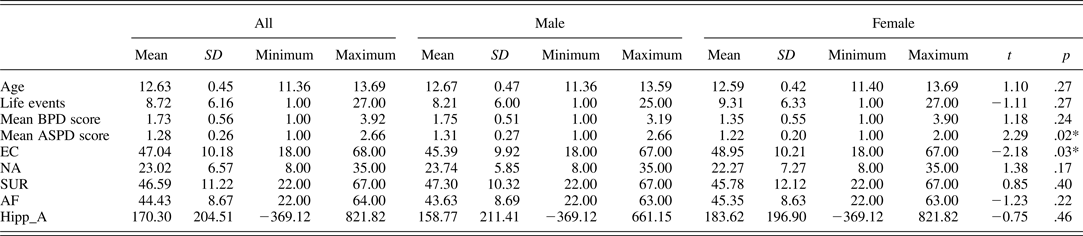
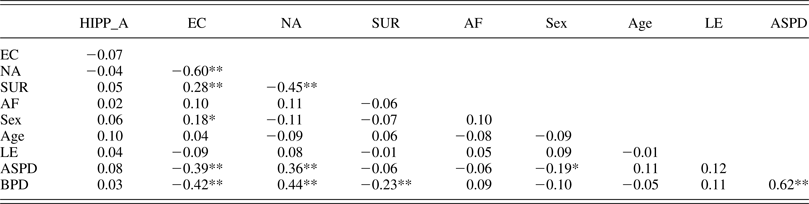
Descriptive statistics for dependent and independent variables used in the regression analyses, including sex differences, are shown in Table 1. These analyses suggest that boys had significantly higher ASPD symptoms and lower EC scores than girls. Significant differences were not observed on any of the other variables of interest. Correlations between variables in the regression analyses are shown in Table 2. Both ASPD and BPD symptoms were moderately associated with low EC and high NA temperament dimensions. Rightward hippocampal asymmetry, life events, and age had low correlations with each other and other variables of interest (all r ≤ .1).
Descriptive statistics for the dependent and independent variables used in the regression analyses

Note: BPD, borderline personality disorder; ASPD, antisocial personality disorder; EC, effortful control; NA, negative affectivity; SUR, surgency; AF, affiliation; Hipp_A, hippocampal asymmetry.
*Significant at α = 0.05.
Correlation analyses for the dependent and independent variables used in the regression analyses
Note: Hipp_A, hippocampal asymmetry; EC, effortful control; NA, negative affectivity; SUR, surgency; AF, affiliation; LE, life events; ASPD, antisocial personality disorder; BPD, borderline personality disorder.
*Significant at α = 0.05.
**Significant at α = 0.01.
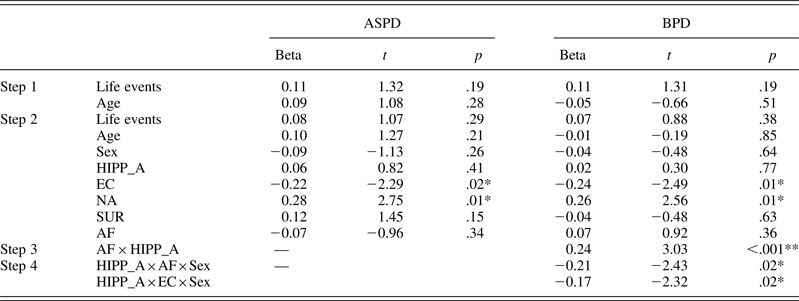
A summary of regression analyses predicting BPD and ASPD symptoms on the basis of hippocampal asymmetry, sex, and the four temperament variables (and their interactions) is shown in Table 3. EC and NA were significant main effects in predicting both APD and BPD scores, such that low EC and high NA were associated with higher BPD and higher ASPD pathology. In the ASPD regression model, none of the two-way or three-way interactions met the variable entry criteria (all F > 0.05) and were excluded from the regression equation.
Summary of stepwise regressions predicting BPD scores and ASPD scores
Note: BPD, borderline personality disorder; ASPD, antisocial personality disorder; Hipp_A, hippocampal asymmetry; EC, effortful control; NA, negative affectivity; SUR, surgency; AF, affiliation.
*Significant at α = 0.05.
**Significant at α = 0.01.
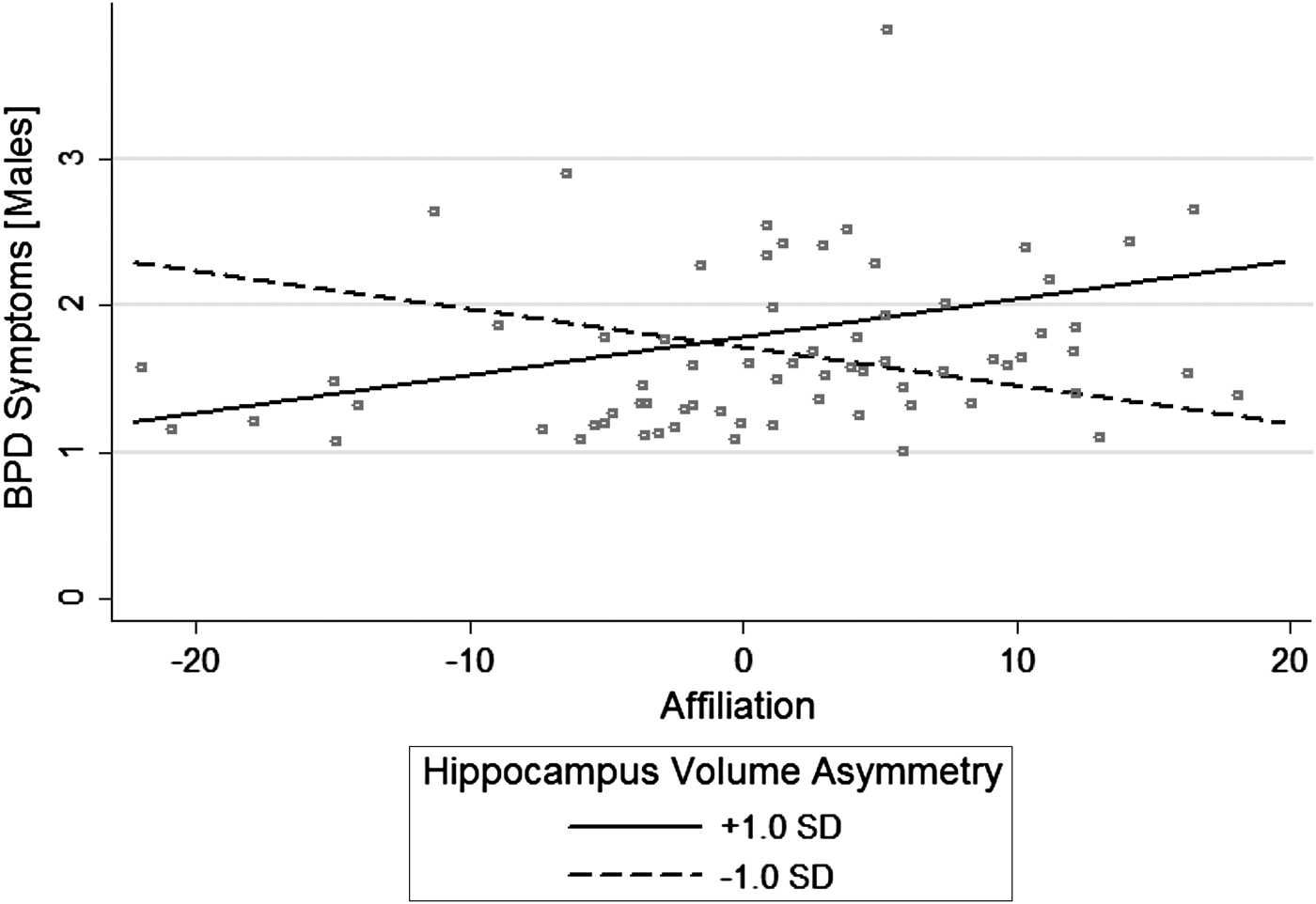
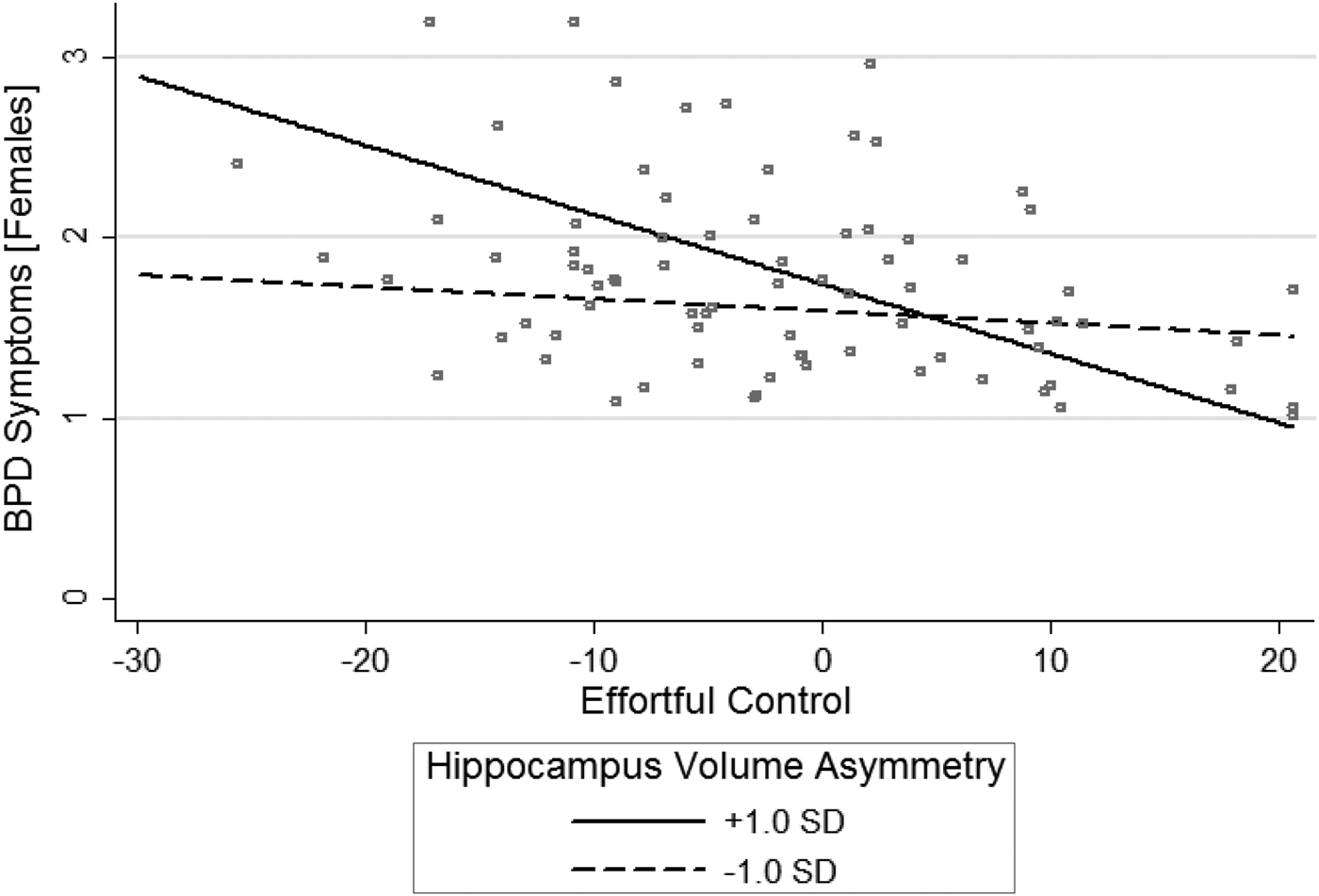
As shown in Table 3, BPD scores were predicted by two significant three-way interactions: (a) there was a significant interaction among rightward hippocampal asymmetry, sex, and AF and (b) among rightward hippocampal asymmetry, sex, and EC. Post hoc analyses revealed that there was significant interaction between AF and hippocampal asymmetry in predicting BPD symptoms only for boys (β = 0.39, t = 3.47, p < .01), which is shown in Figure 1. A significant interaction between EC and hippocampal asymmetry in predicting BPD symptoms was found only for girls (β = –0.22, t = –2.09, p = .04) and is shown in Figure 2.
The results of the post hoc analysis of the significant interaction between affiliation (AF) and hippocampal asymmetry for boys in predicting borderline personality disorder (BPD) symptoms.
The results of the post hoc analysis of the significant interaction between effortful control (EC) and hippocampal asymmetry for girls in predicting borderline personality disorder (BPD) symptoms.
Examination of slope significance for small and large rightward hippocampal asymmetry lines in Figure 1 indicated that small rightward hippocampal asymmetry (β = –2.77, p = .01) and large rightward hippocampal asymmetry (β = 2.69, p = .01) were both significant moderators of the relationship between AF and BPD symptoms. In boys, high BPD symptoms were associated with low AF and small rightward hippocampal asymmetry as well as with high AF and large rightward hippocampal asymmetry. In Figure 2, examination of slope significance indicated that only large rightward hippocampal asymmetry (β = –2.49, p = .01) was a significant moderator of the relationship between low EC and BPD symptoms in girls, such that high BPD symptoms were associated with low EC and large rightward hippocampal asymmetry.
Discussion
This study extends previous research by investigating the interaction between temperament and brain structure, specifically atypical rightward hippocampal asymmetry, in the prediction of BPD and ASPD symptoms in early adolescence. The main finding of the study identifies large rightward hippocampal asymmetry as a moderator of the relationship between BPD symptoms and AF in boys, and between BPD symptoms and EC in girls. Boys were more likely to have elevated BPD symptoms if they were high on AF (i.e., a temperamental desire for closeness with others) and had atypical (larger) rightward hippocampal asymmetry (i.e., a biological predisposition toward impulsive, unregulated, and reward-driven behavior). In boys, low AF (or antagonism) was a significant predictor of BPD symptoms in the presence of more typical (low) rightward hippocampal asymmetry. In girls, low EC (or poor self-regulation) was associated with elevated BPD symptoms in the presence of atypical rightward hippocampal asymmetry. Low EC and high NA (i.e., irritability and frustration in response to limitations) were found to be significant predictors of ASPD symptoms in early adolescence, independent of hippocampal asymmetry and gender, which is consistent with the previous research examining the associations between temperament and ASPD (Basoglu et al., Reference Basoglu, Oner, Ates, Algul, Bez and Ebrinc2011; Fowles & Dindo, Reference Fowles and Dindo2009).
Hippocampal impairments have been associated with disrupted social learning and insensitivity to environmental cues that could result in the expression of emotions that are inappropriate to the social context and poor insight into emotional states (Le Doux, Reference Le Doux1996). In humans, asymmetries in hippocampal structure and function have been reported in ASPD and related disorders (Raine et al., Reference Raine, Buchsbaum and LaCasse1997; Soderstrom et al., Reference Soderstrom, Hultin, Tullberg, Wikkelso, Ekholm and Forsman2002). The present findings might appear contrary to this by suggesting that atypical rightward hippocampal asymmetry was not associated with ASPD symptoms per se; rather, atypical rightward hippocampal asymmetry interacts with temperament dimensions of EC and AF to cross-sectionally predict BPD symptoms, which include impulsive and unregulated behavior. However, direct comparison between our findings and existing research is limited because previous research in this area did not examine BPD symptoms, AF, or self-regulation, and did use criminal samples (specifically violent offenders) to examine atypical rightward hippocampal asymmetry (Raine et al., Reference Raine, Buchsbaum and LaCasse1997; Soderstrom et al., Reference Soderstrom, Hultin, Tullberg, Wikkelso, Ekholm and Forsman2002). It is notable that the present findings implicating atypical rightward hippocampal asymmetry in BPD symptoms do offer support for previous research specifically linking atypical rightward hippocampal asymmetry with impulsive, disinhibited, and unregulated antisocial acts, rather than callous, reward-driven and planned antisocial/psychopathic behavior (Raine et al., Reference Raine, Ishikawa, Arce, Lencz, Knuth and Bihrle2004).
The present findings also highlight the importance of examining the interaction effects of vulnerabilities, because these are often synergistic rather than additive (Crowell, Beauchaine, & Lenzenweger, Reference Crowell, Beauchaine, Lenzenweger, Beauchaine and Hinshaw2008). Interaction effects have been proposed as more meaningful predictors of personality dysfunction than each factor in isolation (Beauchaine, Klein, Crowell, Derbidge, & Gatzke-Kopp, Reference Beauchaine, Klein, Crowell, Derbidge and Gatzke-Kopp2009). Although widely employed in genetic studies, past research has not utilized such interaction models to examine the impact of biological moderators on temperament-disorder associations in the PD literature. The interaction of temperament with gender and atypical rightward hippocampal asymmetry found in this study supports such an approach. It indicates a more complex relationship between temperament and personality dysfunction that also implicates the role of brain development, particularly in development of BPD symptoms.
In the present study, low AF (or antagonism) was a significant predictor of BPD symptoms for boys in the absence of atypical rightward hippocampal asymmetry. Low AF reflects a lack of capacity for compassion and cooperativeness, particularly toward authority figures, as well as suspiciousness and interpersonal antagonism, and has been previously reported in BPD (Joyce et al., Reference Joyce, McKenzie, Luty, Mulder, Carter and Sullivan2003). In the presence of atypical hippocampal development, on the other hand, high desire for interpersonal closeness (high AF) was particularly predictive of BPD symptoms in boys. Although the involvement of high AF could be considered unexpected, high desire for closeness with others can manifest itself as increased rejection sensitivity and intolerance of aloneness, which are important features of BPD (Ayduk et al., Reference Ayduk, Zayas, Downey, Cole, Shoda and Mischel2008; Gunderson, Reference Gunderson1996), as well as dependency and sociotropy, which are well established risk factors for mood disorders (Coyne & Whiffen, Reference Coyne and Whiffen1995). Thus, high AF is associated with an increase in BPD symptoms in boys when occurring alongside disruption in brain circuits controlling impulsivity, emotion regulation and contextual learning.
The present study also highlights EC as an important dimension of temperament in the emergence of BPD symptoms in girls. EC includes the ability to voluntarily manage attention as well as inhibit or activate behavior as needed to adapt. For example, the ability to focus attention when there are distractions, to sit still and not interrupt in classroom, and to complete an unpleasant task are all aspects of EC. These abilities underlie the emergence of self-regulation, a major milestone in children's development that is often implicated in theories of BPD (e.g., Linehan, Reference Linehan1993). Normative research has demonstrated that girls score higher on measures of EC than boys, which reflects a better ability to manage and regulate their attention and inhibit their impulses (for review, see Else-Quest, Hyde, Goldsmith, & Van Hulle, Reference Else-Quest, Hyde, Goldsmith and Van Hulle2006). Our findings indicate that BPD symptoms are associated with disruption to hippocampal circuitry in girls who also have low EC and, perhaps, do not meet the same developmental milestones involving self-regulation as their peers.
However, the exact nature of how the disruption to the hippocampal circuitry results in impulsive or dysregulated behavior is uncertain. In a developmental sense, greater rightward hippocampal asymmetry might reflect an interruption to the normal developmental process that sees the rightward structural asymmetry decrease somewhat with age in normal children (Isaacs et al., Reference Isaacs, Lucas, Chong, Wood, Johnson and Marshall2000; Szabo et al., Reference Szabo, Wyllie, Siavalas, Najm, Ruggieri and Kotagal1999). Moreover, the brain undergoes significant changes during adolescence (Paus, Reference Paus2005; Shaw et al., Reference Shaw, Greenstein, Lerch, Clasen, Lenroot and Gogtay2006), particularly in regions associated with social cognition, emotional experience, emotional regulation, and cognitive control (Nelson, Leibenluft, McClure, & Pine, Reference Nelson, Leibenluft, McClure and Pine2005). It is possible that disruption to normal hippocampal development results in disrupted associations between behavior and social and emotional experience. LeDoux (Reference Le Doux1996) has suggested that disruption in the connections between the hippocampus and other brain regions could result in the expression of emotions that are inappropriate to the social context, along with poor insight into emotional states. This perspective is consistent with clinical features of BPD, such as rejection, intolerance of aloneness, and affective dysregulation, as described in the DSM-IV-TR (American Psychiatric Association, 2000).
It is also noteworthy that the relationship between atypical hippocampal asymmetry and BPD symptoms was moderated by sex in the present sample. Sex differences in the prevalence of BPD and ASPD are well established (Paris, Reference Paris1997). ASPD and BPD have a number of points of overlap: in symptoms, in personality dimensions that underlie their phenomenology, in community prevalence, in risk factors, and in outcome and response to treatment. Some have argued that both disorders have a common base in impulsive personality traits, but the behavioral differences between them are shaped by gender; BPD is more prevalent in females and ASPD in males (Paris, Reference Paris1997). The present findings support this view to an extent. We have found that low EC is a temperament dimension associated with both BPD and ASPD symptoms and that boys have significantly lower EC and higher ASPD scores than girls. However, our findings relating to possible sex differences in developmental pathways for ASPD and BPD symptoms are less clear. The findings suggest that, in the presence of vulnerable temperament (high AF in boys and low EC in girls), a biological predisposition (exaggerated rightward hippocampal symmetry) is needed for presentation of BPD symptoms. The negative findings related to ASPD should be interpreted with caution and replicated in larger samples. Interpretation of the findings is further complicated by sex differences in brain development that occur during adolescence (Giedd, Castellanos, Rajapakse, Vaituzis, & Rapoport, Reference Giedd, Castellanos, Rajapakse, Vaituzis and Rapoport1997; Hier, Reference Hier1979). Other brain systems may also be affected, but this has not been examined in this study.
One of the major strengths of this study is the assessment of BPD and ASPD symptoms early in the course of the disorder (i.e., prior to the contact with mental health service or formal diagnosis). The majority of research to date has focused on adult samples with long-standing PD diagnoses. Such samples are confounded by the effects of chronic mental state problems (e.g., depression, anxiety), recurring negative life events, and treatment (Chanen, Velakoulis, et al., Reference Chanen, Velakoulis, Carison, Gaunson, Wood and Yücel2008). Moreover, a large proportion of the ASPD research has focused on individuals incarcerated for the antisocial acts they have committed. In contrast, the present study has focused on identifying factors representing possible temperamental and biological vulnerability to developing BPD and ASPD symptoms later in life. Other strengths of this study include the use of a relatively large community sample and robust measures of temperament and hippocampal asymmetry.
There are several limitations to this study. First, there is a notable overlap between ASPD and BPD symptoms in our sample (r = .67), which is consistent with high rates of comorbidity noted for these disorders (Zanarini & Gunderson, Reference Zanarini, Gunderson, Stoff, Breiling and Maser1997). Although this might suggest a large degree of overlap between the two constructs, particularly on the externalizing dimension, our findings indicate that developmental pathways leading to the two disorders might be somewhat different. Interpersonal sensitivity (high AF) and poor self-regulation (low EC) coupled with atypical hippocampal asymmetry might be particularly important in development of BPD symptoms in boys and girls, respectively, whereas poor self-regulation (low EC) and high irritability (high NA) might be associated ASPD symptoms independent of gender and hippocampal asymmetry. However, the evidence of differential developmental pathways for BPD and ASPD needs to be interpreted with caution because the present findings are the most relevant at symptom level rather than disorder level. The results need to be replicated in clinical samples of adolescents diagnosed using clinical interview-based measures of BPD and ASPD. Longitudinal research allowing for a path-analytic or structural equation approach is needed to further differentiate developmental pathways for BPD and ASPD. Second, reliance on self-report measures in this study must also be acknowledges as a limitation, and further validation of the current version of the CIC-SR is recommended. Third, the connectivity of the hippocampus to other brain regions (e.g., frontal and prefrontal) might be important to understanding the mechanisms by which this neuroanatomical feature confers risk for PDs. Future work utilizing measures of hippocampal connectivity could be useful in more thoroughly characterizing the role of the hippocampus in a network of regions underlying biological sensitivity to BPD and ASPD and to broaden findings implicating atypical rightward hippocampal asymmetry in the development of BPD symptoms in early adolescence. Fourth, moderation analysis implies that the causal relation between two variables changes as a function of the moderator variable. Because this is a cross-sectional study, the causality of the variables cannot be inferred. Longitudinal research is needed to answer questions regarding causality.
Despite these limitations, this is the first study to examine the relationship between atypical hippocampal asymmetry and BPD symptoms, and it builds on previous work reporting significant associations between atypical hippocampal asymmetry and impulsive, unregulated behavior. Furthermore, it represents an important contribution to the current understanding of the neurobiological and temperamental mechanisms underlying development of PD symptoms, particularly in early adolescence.