Gram-negative psychrotrophs are the most commonly recovered isolates from refrigerated raw milk. Of these, Pseudomonas spp. are the most commonly associated with milk deterioration, owing to their short generation time at refrigeration temperatures (Oliveira et al., Reference Oliveira, Favarin, Luchese and McIntosh2015; Al-Rodhan and Nasear, Reference Al–Rodhan and Nasear2016). Pseudomonas spp. have high genetic diversity and metabolic versatility and are predominantly lipolytic and proteolytic at temperatures below 10 °C, actions that reduce the quality of dairy products (Oliveira et al., Reference Oliveira, Favarin, Luchese and McIntosh2015). Proteases act in a similar way to chymosin by cleaving κ-casein and causing destabilization and denaturation of casein micelles. Defects such as UHT milk gelation, reduction in cheese yield, changes in consistency and texture as well as sensorial defects may be observed. Lipases are glycoproteins that hydrolyze long- and short-chain triglycerides, esters, monoglycerides, and phospholipids, resulting in the release of fatty acids and glycerol molecules to impart rancid and soapy taste and smell to dairy products (Chen et al., Reference Chen, Daniel and Coolbear2003).
Given the impact of the changes caused by the psychrotrophic enzymes on the quality of milk and dairy products, this study aimed to evaluate the proteolytic and lipolytic capacity and potential of Pseudomonas spp. isolated from cold raw milk as well as the influence of milk storage temperature and bacterial population on these activities.
Materials and methods
Determination of psychrotrophic and Pseudomonas spp. counts
Pseudomonas spp. were isolated from 10 samples of refrigerated raw milk that were sent for processing after 48 h of refrigeration in bulk tanks from the dairy farms. The milk was transported in trucks with isothermal tank to the processing industry. Milk temperature was measured using a digital thermometer. Psychrotrophic counts were determined by plate count agar (Himedia, Mumbai, India) at 21 °C/25 h (Oliveria and Parmelle, Reference Oliveria and Parmelle1976). For Pseudomonas spp., CFC-supplemented (cefaloridine, fusidic acid, cetrimide) Pseudomonas agar base (Himedia, Mumbai, India) was used at 30 °C for 48 h. Results were expressed as log CFU/ml of milk and the analyses were performed in duplicate.
Proteolytic and lipolytic capacity and potential of Pseudomonas spp.
An agar plate containing 25 to 250 colonies of Pseudomonas spp. was selected for each sample, and all the isolates were evaluated for proteolytic and lipolytic capacities. Evaluation of proteolysis and lipolysis employed 10% milk agar (21 °C/72 h) and tributyrin agar (21 °C/72 h) respectively (Frank et al., Reference Frank, Christen, Bullerman and Marshall1992). The presence of clear halos revealed proteolytic and lipolytic capacities. The potential of protease and lipase synthesis was also evaluated by measuring the characteristic halos formed after 72 h. Proteolytic isolates with halos ≤2 cm and lipolytic with halos <1.5 cm were classified as low potential. Those isolates with halos >2 cm and ≥1.5 cm were considered high potential proteolytic and lipolytic isolates, respectively.
After proteolytic and lipolytic evaluation, the isolates were confirmed to belong to Pseudomonas spp. by polymerase chain reaction (PCR).
Confirmation of the genus Pseudomonas
Bacterial genomic DNA was extracted using the Wizard Genomic DNA Purification Kit (Promega Corporation, Madison, USA) following the manufacturer´s instructions. The isolated DNA was stored at −80 °C. The extracted genetic material was utilized in PCR reactions using the forward PA-GS F (5′-GACGGGTGAGTAATGCCTA-3′) and reverse PA-GS-R (5′-CACTGGTGTTCCTTCCTATA-3′) (Spilker et al., Reference Spilker, Coenye, Vandamme and LiPuma2004) primers that amplified the 16S rRNA (618 bp) region of the gene (GenBank number AY486387.1).
Ultrapure water was used as the negative control and DNA from the strains P. aeruginosa (ATCC 27853), P. fluorescens (ATCC 13525), and P. putida (ATCC 31483) were used as positive controls.
Statistical analysis
The potential of both lipolytic and proteolytic activities (diameter of halos) were correlated to temperature and bacterial counts using logistic regression (binomial distribution) to determine whether milk temperature and population size of Pseudomonas spp. influenced the lipolytic and proteolytic potential of the isolates. Proteolytic potential was categorized as high (>2 cm) or low (≤2 cm), while lipolytic potential was categorized as high (≥1.5 cm) or low (<1.5 cm). The cut-off values for each category were based on the mean of more than 40 observations for each category. Finally, the temperature and bacterial count of Pseudomonas spp. for each category (high and low potential) were compared using the Mann-Whitney test. For all methods, a P value of ≤0.05 was considered significant. The software used was Statistica Statsoft 13.0.
Results and discussion
The mean population of psychrotrophics in milk samples was 6.7 log CFU/ml (5.65 to 6.97 CFU/ml) and that of Pseudomonas spp., as confirmed by PCR, was 5.73 log CFU/ml (4.95 to 6.16 log CFU/ml). This result is equivalent to a prevalence of 10.7% of Pseudomonas spp. in the total psychrotrophic population isolated from refrigerated raw milk. According to Oliveira et al. (Reference Oliveira, Favarin, Luchese and McIntosh2015), molecular techniques facilitated the identification of other psychrotrophics found in freshly collected milk. This microbiota, along with Pseudomonas spp., plays an important role in the deterioration of refrigerated milk.
Of the 173 isolates confirmed as Pseudomonas spp., 91.38% (159) possessed proteolytic and lipolytic capacities, indicative of their high deterioration abilities. In our study, six (3.47%) isolates had only lipolytic capacity and eight (4.62%) exhibited only proteolytic capacity (Supplementary File Table S1). Some strains of Pseudomonas spp. were able to simultaneously synthesize three types of hydrolytic enzymes (proteinase, lipase, and phospholipase), whereas others could synthesize only proteolytic or lipolytic enzymes (Decimo et al., Reference Decimo, Morandi, Silvetti and Brasca2014). It has been shown previously that the differences in the extracellular enzymatic activity of the strains are associated with genetic characteristics of each group (Ercolini et al., Reference Ercolini, Russo, Ferrocino and Villani2009).
The evaluation of the proteolytic potential of the isolates from the measurement of the diameter of proteolytic halos showed that 64.16% of Pseudomonas spp. isolates had high proteolysis potential (halos > 2.1 cm) (Supplementary File Table S1 and Supplementary File Fig. S1), with the largest halo measuring 2.9 cm. Xin et al. (Reference Xin, Meng, Zhang, Cui, Han and Yi2017) evaluated the proteolytic potential (7 °C/10 d) of Pseudomonas spp. isolated from refrigerated raw milk and observed that 30.7% of halos were larger than 1.4 cm. Bacterial proteases are mostly alkaline metalloproteases encoded by the aprX gene. These enzymes hydrolyze casein, preferably the casein layer, followed by the beta and alpha S1 (Decimo et al., Reference Decimo, Morandi, Silvetti and Brasca2014), thereby promoting changes in the fermentation process such as coagulation and maturation of cheese and sensorial defects such as bitter taste and gelation in UHT milk (Samaržija et al., Reference Samaržija, Zamberlin and Pogačić2012).
Proteolytic potential was associated with milk temperature, (7.5 to 9.7 °C) (P = 0.05) and Pseudomonas spp. counts (4.95 to 6.16 log CFU/ml) (P = 0.02) (Fig. 1 and Supplementary File Fig. S1). Thus, larger halos (>2 cm) are indicators of high proteolytic potential, and occurred more frequently in milk samples with high microbiological counts maintained at lower temperatures (Supplementary File Fig. S1). As seen in Fig. 1, the probability of milk sample contamination with counts above 5.8 log CFU/ml and temperatures lower than 8 °C with Pseudomonas spp. possessing a high proteolytic potential was higher than 80%. Thus, in the present study, milk refrigeration at a minimum temperature of 7.5 °C, used as an isolated practice, will probably fail to avoid sensorial changes in dairy products. Meng et al. (Reference Meng, Zhang, Liu, Zhao, Wang and Zheng2017) concluded that milk storage temperatures below 7 °C fail to prevent the growth and proteolytic activity of Pseudomonas spp., but the proteolytic activity decreased upon reduction of the storage temperature from 10 °C to 2 °C. In our study, the reduction in Pseudomonas spp. population can result in an improvement in milk and consequently dairy products quality, thereby reducing the defects caused by bacterial proteases.
Probability of high proteolytic potential as a function of Pseudomonas spp. population (log CFU/ml) and temperature of raw milk refrigerated in the receiving platform of processing facility.

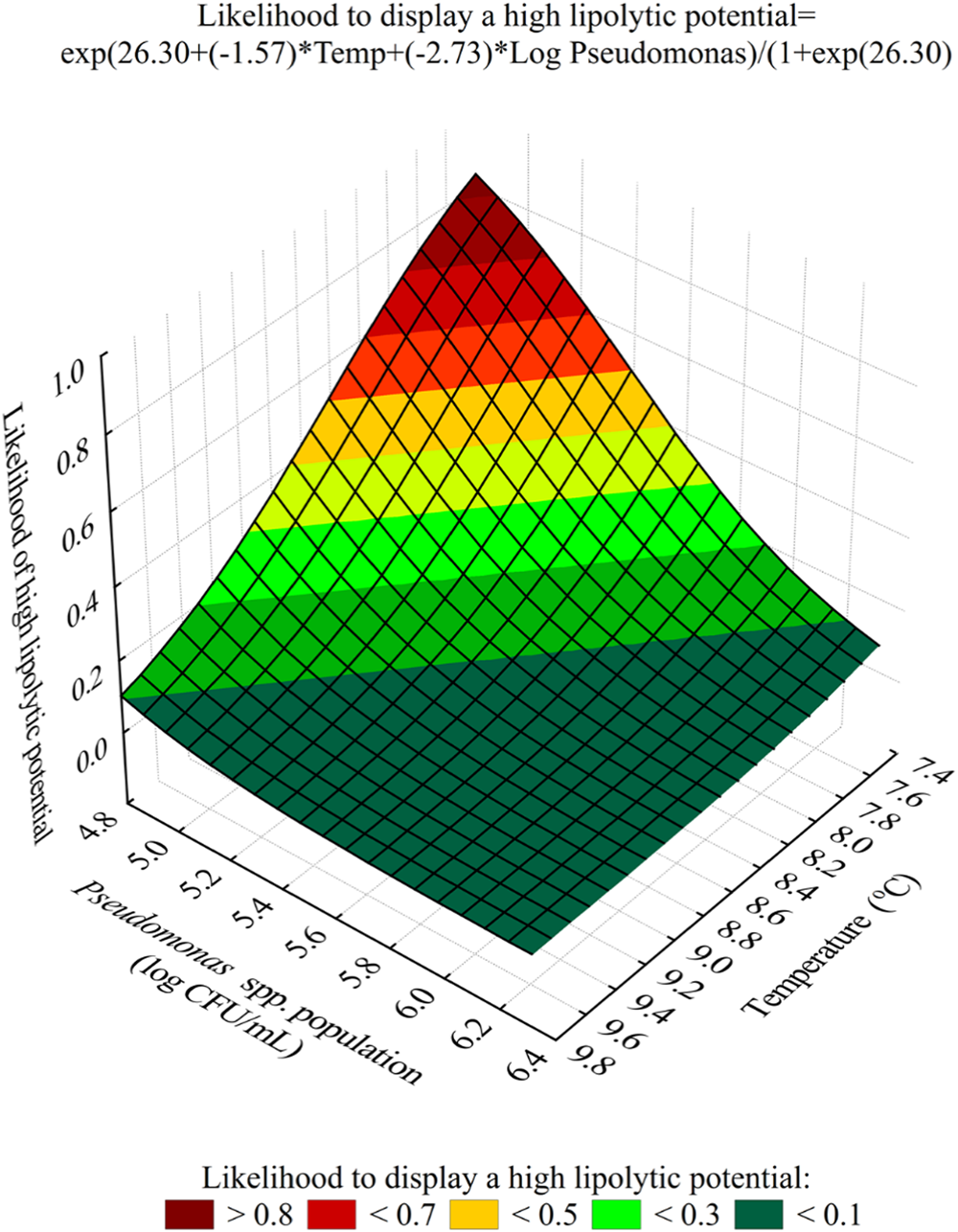
The lipolytic potential of Pseudomonas spp. was lower than the proteolytic potential and 70.52% (Supplementary File Table S1) of the isolates had low lipolysis halos (≤1.5 cm). Although lipolytic degradation of milk is not as high as proteolytic degradation, defects such as rancid and soapy taste and/or burning due to the action of lipases are the first perceptible sensory changes (Deeth and Fitz-Gerald, Reference Deeth, Fitz-Gerald, Fox and MCsweeney2005). Lipolytic potential had a negative association with temperature (P < 0.01) and Pseudomonas spp. counts (P < 0.01). However, larger halos (>1.5 cm) indicative of higher lipolytic potential occurred more frequently in milk samples with lower microbiological counts and stored at lower temperatures (7.5 °C) (Fig. 2 and Supplementary File Fig. S2). Thus, knowing the genetic characteristics of the circulating strains and their origin may be more important to efficiently control the defects caused by the lipases synthesized by Pseudomonas spp. than good cow milking aimed at reducing bacteriological population and milk refrigeration. As seen in Fig. 2, the rate of occurrence of Pseudomonas spp. with high lipolytic potential in milk samples with counts below 5.2 log CFU and temperatures lower than 8 °C was greater than 80%. Lipases encoded by the lipA gene catalyze the hydrolysis of triglycerides, resulting in the release of fatty acid molecules and glycerol. According to Woods et al. (Reference Woods, Burger, Beven and Behringer2001), the regulation of lipase production (low temperature regulation) of Pseudomonas spp. is associated with low storage temperatures, unlike thermoregulation of other pathogens.
Probability of high lipolytic potential as a function of Pseudomonas spp. population (log CFU/ml) and temperature of raw milk refrigerated in the receiving platform of processing facility.

In conclusion, reduction of Pseudomonas spp. population in refrigerated milk is important for controlling the population of psychrotrophic organisms with high lipoprotein degradation capacity. In addition, lower counts are associated with isolates with lower proteolytic potential. In turn, lower refrigeration temperatures were not associated with milk samples containing Pseudomonas spp. with low lipolytic and proteolytic potential. Therefore, in addition to implementation of good cow milking, genetic studies evaluating strains of Pseudomonas spp. present in the milking environment, as well as the origin of these isolates, could be useful to improve the quality and shelf life of dairy products.
Supplementary material
The supplementary material for this article can be found at https://doi.org/10.1017/S0022029919000645
Acknowledgements
This study was financed in part by the Coordenação de Aperfeiçoamento de Pessoal de Nível Superior – Brasil (CAPES) – Finance Code 001