


Introduction
Management of arable weeds without the assistance of modern synthetic herbicides is difficult, but sometimes necessary. For instance, where weeds have evolved resistance to herbicides, periodic interjection of non-chemical methods of weed management may be indispensable for sustaining cropping systems otherwise wholly dependent upon herbicidesReference Powles and Yu 1 . In addition, non-chemical methods are compulsory for organic systems. Moreover, weed control is the major agronomic concern of most organic growersReference Moynihan 2 , Reference Walz 3 .
Organic growers employ a wide range of methods to manage weeds Reference Bond and Grundy 4 , Reference Melander, Rasmussen and Barberi 5 . Among the many methods are two ‘pre-emergence’ weed control tactics that can be used for spring-planted crops: stale (or false) seedbed technique and winter cover crops. Stale seedbeds are a long-established practice that can be used with supplemental herbicides in conventional systemsReference Johnson and Mullinix 6 or without them in organic systemsReference Bond and Grundy 4 . For example, spring weed populations emerging in previously cultivated soil are killed through subsequent cultivations prior to crop sowing. The stale seedbed could be prepared weeks or even months ahead of time (e.g., the previous autumn) to encourage the spring flush of weeds prior to actual crop planting. Weed control typically improves appreciably with later cultivations in spring, but subsequent crop yield tends to decline with these late planting datesReference Coulter, Sheaffer, Haar, Wyse and Orf 7 . Thus, a balance must be reached between low weed populations and high crop yield in terms of successful application of the stale seedbed techniqueReference Forcella, Eradat-Oskoui and Wagner 8 . Additional issues with stale seedbed management are that repeated soil cultivations cause commensurate losses in arbuscular mycorrhizae in soilReference Douds, Nagahashi and Shenk 9 as well as soil organic matter and soil structureReference Reicosky, Kemper, Langdale, Douglas and Rasmussen 10 , and soil particles through water and wind erosion.
Cover crops, specifically winter rye (Secale cereale L.), for weed control in temperate regions have gained considerable popularity recentlyReference Brennan and Boyd 11 , partly due to the advent of roller-crimpers used to terminate their growth effectively in springReference Bernstein, Posner, Stoltenberg and Hedtcke 12 – Reference Smith, Reberg-Horton, Place, Meijer, Arellano and Mueller 17 . A winter rye cover crop has several attributes. First, it is extremely cold-hardy, which allows for reliable over-winter survival in north temperate regions, such as Minnesota, where winter air temperatures of −20 °C commonly occur. Second, seed costs for vigorous and well-adapted varieties are modest, as little as US$50 ha−1. Third, the plant grows lushly in early spring and inhibits weed seed germination and/or weed seedling establishment. Fourth, winter rye can be killed by mechanical means relatively easily at or just after anthesis. If done properly, the kill rate is nearly 100% and, thus, little resprouting or retillering occurs. Fifth, some summer crops, such as soybean, are relatively insensitive to leachates from decomposing winter rye residues, which may be inhibitory to other species, and fix their own nitrogen, which overcomes nitrogen immobilization caused by lushly growing rye. Sixth, winter rye cover crops have positive environmental characteristics, including sequestration of carbon and many labile soil nutrients, as well as inhibition of soil erosion.
Cover crops also have disadvantages. The major drawback of using winter rye as a cover crop is that its growth termination by mechanical methods must be delayed until anthesis. Anthesis usually does not occur until early to mid June in Minnesota, which means that relatively short-season soybean varieties (<1.0 RM, relative maturity) with inherently lower yield potentials, must be planted in rye mulch. Traditional planting dates without cover crops for full-season soybean (⩾1.0 RM) in this region are early to mid May. Moreover, regardless of the late planting date, rolled and crimped rye mulch by itself may impose a yield penalty on soybean, either directly or through reduced stand establishment. At lower latitudes (⩽43°N) such as southern Wisconsin, central Illinois and central Pennsylvania, these penalties range from nil to about 20% of soybean yieldReference Bernstein, Posner, Stoltenberg and Hedtcke 12 , Reference Davis 13 , Reference Nord, Curran, Mortensen, Mirsky and Jones 15 , Reference Mischler, Curran, Duiker and Hyde 18 . In North Carolina, yield penalties across five site-years were 0, 4, 5, 19 and 57%Reference Smith, Reberg-Horton, Place, Meijer, Arellano and Mueller 17 , with the latter value likely due to failure of the rye mulch to control weeds rather than a direct effect of rye mulch on soybean. In contrast, where growing seasons are longer, such as in Alabama, rolled and crimped winter rye mulches may provide yield rewards for soybean compared with conventional plantingsReference Price, Reeves and Patterson 16 . How soybean responds to rolled and crimped rye mulches in the extremely short growing seasons of the northern Great Plains (⩾45°N) is not known.
Objectives of the current project were to compare stale seedbeds with roller-crimper terminated winter rye cover crops with regard to (i) pre- and post-plant weed seedling dynamics and end-of-season weed biomass, (ii) hand-weeding labor requirements, (iii) soybean stands and yields, and (iv) cursory calculations of economic returns for a north temperate region such as west central Minnesota. The null hypothesis is that the aforementioned variables do not differ between stale seedbed and cover crop systems; whereas the alternative hypothesis is that a rye cover crop suppresses weeds so effectively that it may be a superior method compared with the stale seedbed approach.
Materials and Methods
Field site
Two identical experiments were performed at the Swan Lake Research Farm, Stevens County, MN (45°41′N, 95°48′W) in 2010 and 2011. Separate fields, less than 100 m apart, were used each year. Soil type was a Barnes loam (fine-silty, mixed, super-active, frigid Calcic Hapludoll) with a pH of 7.3, and sand, silt, clay and organic matter contents of about 41, 33, 25 and 6%, respectively. Camelina (Camelina sativa [L.] Crantz) was the previous crop in 2009 and soybean (Glycine max [L.] Merr.) in 2010.
Experimental design and winter rye management
Each experiment followed a randomized split plot design 19 with four replications. Main plots comprised stale seedbed versus rye mulch treatments, and split plots involved intense or lax weed control, as detailed below.
For every experiment, a section of a field was partitioned into eight plots arranged in four blocks. Each plot was 6 m wide and 12 m long. One plot in each block was sown to winter rye (‘FS Hi-Rye 500′ on September 2, 2009 and September 20, 2010) at 73 kg ha−1 in rows spaced at 20 cm. These plots constituted the ‘rye mulch’ treatment. The remaining plots were field-cultivated and fallowed over winter. These represented the ‘stale seedbed’ treatment. The entire area was fertilized with 112 kg N ha−1 in the form of ammonium nitrate, which was incorporated with a field cultivator, immediately prior to sowing rye to eliminate N nutrition as a source of variation.
Heights of representative winter rye plants were measured at four random locations in each block at weekly intervals beginning in early May. Winter rye biomass was estimated by clipping all plants at ground level in two randomly placed 0.5 m2 quadrats in each block at the time that growth was terminated (June 9, 2010 and June 14, 2011). Samples were weighed immediately to determine fresh weight and then dried for one week at 50 °C to determine dry weight. At the time of sampling, plants were in the post-anthesis stage, which was about 1 week after they had reached their maximum heights. Anthers extruded from flowers were dry and shriveled, which indicated that pollination was complete, and represented a useful rule-of-thumb for the time to terminate growth of a winter rye cover crop in west-central Minnesota.
Weed emergence patterns before planting soybean were recorded in one randomly placed but permanent quadrat (each 0.5 m2) in each plot of both the rye mulch and stale seedbed treatments. Seedlings were identified, counted, and removed by hand at approximately weekly intervals beginning in early May in both years.
Winter rye growth was terminated with a 3-m wide, water-filled, roller-crimper with chevron-like bladesReference Davis 13 , Reference Mirsky, Curran, Mortensen, Ryan and Shumway 20 . Rolling-crimping occurred in a single direction parallel with the rows. Preliminary rolling-crimping in border plots indicated that winter rye lodging increased with tractor speed; consequently, all winter rye cover blocks were rolled and crimped at a speed of ⩾10 km h−1. Rolling-crimping was highly effective in killing winter rye, with negligible regrowth observed.
Soybean planting and management
Soil in stale seedbed treatments was field-cultivated again and harrowed on the same dates as rolling-crimping. Such late seedbed preparation would have been expected to control large percentages of annual weeds at this site. In this region >90% of potential seedling populations of common annual weeds typically can be controlled by seedbed preparation in early to mid June compared with more traditional seedbed preparation times in late April to early MayReference Forcella, Eradat-Oskoui and Wagner 8 . Within 1 day after roller-crimping or field-cultivation, soybean was sown with a John Deere MaxEmerge no-till planter at 387,000 seeds ha−1 in rows spaced 76 cm apart. (The use of trade names does not imply product endorsement by USDA.) For comparison, target planting dates for conventional soybean (1.0 RM) are early to mid May in this area.
Both short- and nearly full-season varieties were tested each year. The short- and full-season soybeans were planted in contiguous but separate and non-randomized plots, and therefore, they were treated as separate experiments. The short-season variety was Croplan RT0043 (0.04 RM) both years; and the full-season variety was NK S08 M8 (0.8 RM) in 2010 and Croplan 970 (0.9 RM) in 2011. The plots were 12 m long and 6 m wide (8 rows), and within each a 4-row subplot was assigned randomly to either of two weed management treatments: lax (little or no additional weed control) or intense (augmented weed control). For augmented weed control in stale seedbed plots, ethalfluralin was applied at 0.6 kg ai ha−1 and incorporated with a spring tine harrow. In addition, inter-row areas of all stale seedbed plots were cultivated once in mid July. Hand-weeding supplemented the herbicide-treated and cultivated stale seedbed subplots, and it was the sole form of additional weed control in the augmented rye mulch plots. Hand-weeding included both hand-pulling and hoeing with long-handled hoes. Amounts of time spent hand-weeding were recorded. Decisions of whether or not to hand-weed a plot were made by two technicians with about 40 years of combined experience in research on soybean–weed interactions. Decisions were subjective and were meant to mimic those of hand-laborers hired by growers.
In summary, each soybean experiment had the following treatments: (1) stale seedbed (stale seedbed augmented by inter-row cultivation), (2) stale seedbed plus (stale seedbed augmented with ethalfluralin, cultivation, and hand-weeding), (3) rye mulch (winter rye mulch only), and (4) rye mulch plus (winter rye mulch augmented by hand-weeding).
Weed monitoring
Weed emergence patterns after planting were estimated by permanently and randomly positioning two 0.5 m2 quadrats in each augmented subplot of the short-season soybean only, and identifying, counting, and removing all weed seedlings at approximately weekly intervals beginning immediately after soybean planting and continuing through September. Quadrats were lifted and replaced immediately before and after inter-row cultivation events in the stale seedbed plots. Weed biomass was determined on September 22, 2010 and September 28, 2011 by clipping all weeds at ground level within a 0.5 m2 quadrat (0.5 × 1.0 m) that was perpendicular to and spanned the central two soybean rows in each subplot of the short-season soybean.
Soybean yield was determined by harvesting the central two rows of short- and full-season soybean in each subplot with a plot combine on October 6 and 12, 2010 (prior to the first killing frost of autumn) and October 4 and 7, 2011 (after the first killing frost on September 14). Seed yield samples were cleaned of chaff and other debris, seed moisture determined (via a capacitance meter), weighed, sample weights adjusted to 13% seed moisture and unit-area yields calculated. Soybean stand was determined by counting cut stems in two 1-m lengths of row in each subplot immediately after harvest.
Statistical evaluations
Statistical evaluations included preliminary analysis of variance (ANOVA) that considered the soybean establishment method (rye mulch versus stale seedbed) and weed management (intense versus lax) as fixed effects and block (four replications) and year (2010 and 2011) as random effects. Year effects were always highly significant (P < 0.01) and, consequently, yearly data were examined separately using the split plot procedure available in Statistix 9 software 19 , with the establishment method as the main factor and weed management as the sub factor. Tukey's HSD was used to compare treatment means at P = 0.05 or 0.10. Lastly, linear regression was used to explore the relationship between soybean stand density and soybean yield.
Results
Winter rye growth
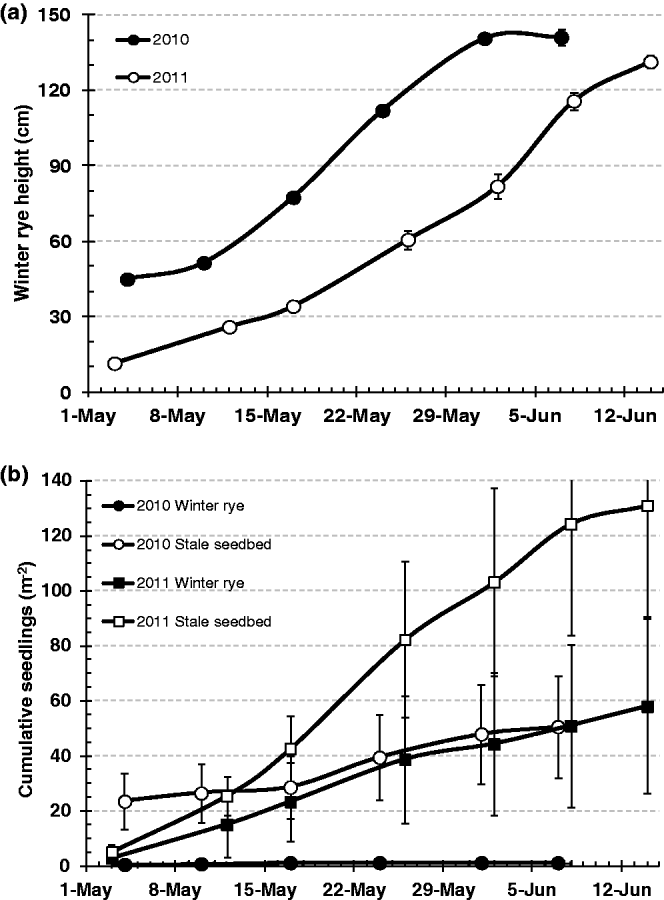
Winter rye growth (Fig. 1a) probably was delayed in spring 2011 compared with 2010 because of the late snow-melt and abnormally low temperatures. Although winter rye grew rapidly during May each year, the cover crop was more vigorous in 2010 than 2011. Height, fresh weight, and dry weight (±SE) of winter rye at termination with a roller-crimper on June 11, 2010 were 141 ± 3.3 cm, 26 ± 3.6 Mg ha−1 and 6.0 ± 1.04 Mg ha−1; and on June 14, 2011 these same variables were 131 ± 2.6 cm, 22± 3.9 Mg ha−1 and 6.0 ± 0.89 Mg ha−1. The rolled and crimped winter rye created mulch on the soil surface that was 5–15 cm thick.
(a) Increase in height of winter rye during May and June 2010 and 2011, with growth terminated by rolling and crimping on June 9, 2010 and June 14, 2011. (b) Cumulative emergence of weed seedlings prior to soybean planting in a winter rye cover crop and a stale seedbed during spring of 2010 and 2011. Vertical bars represent standard errors.
For comparison, dry weights of ‘Hi-Rye’ at the time of rolling-crimping were 6–7 Mg ha−1 (mid May) in central IllinoisReference Davis 13 ; ‘Rymin’ winter rye was nearly 11 Mg ha−1 (early June) in southern WisconsinReference Bernstein, Posner, Stoltenberg and Hedtcke 12 and 4.5–11 Mg ha−1 (May) in North CarolinaReference Smith, Reberg-Horton, Place, Meijer, Arellano and Mueller 17 ; and ‘Aroostock’ winter rye ranged from about 6 to 10 Mg ha−1 (early June) in central PennsylvaniaReference Nord, Curran, Mortensen, Mirsky and Jones 15 .
Weed emergence, biomass and hand-weeding
Pre-plant weed emergence was curtailed appreciably by the presence of growing winter rye (Fig. 1b). In 2010, cumulative total emergence of all weed species combined was 51 ± 18.5 plants m−2 in the stale seedbed system, but only 1 ± 0.3 plants m−2 in rye mulch. Analogous values in 2011 were 131 ± 40.5 plants m−2 in the stale seedbed and 58 ± 31.7 plants m−2 in rye mulch. Thus, winter rye provided 98% pre-plant weed control in 2010 and 56% in 2011 in terms of seedling numbers. Observations indicated that plant sizes also decreased substantially by the presence of rye mulch. The dominant weed species were eastern black nightshade (Solanum ptycanthum Dun.) in 2010 and redroot pigweed (Amaranthus retroflexus L.) in 2011. Nightshade and pigweed represented 60 and 12% of the total pre-plant weed population of the stale seedbed system in 2010 and 4 and 50% in 2011. The presence of rye mulch decreased pre-plant densities of these two species by ⩾82%. Nightshade control is especially critical in organic systems in terms of nightshade berry and seed contamination and pigment staining of soybean seed at harvest.
Post-plant weed emergence patterns were affected by the presence of rye mulch, but in contrasting manners during the 2 years (Fig. 2). In 2010, about 30 ± 7.5 plants m−2 emerged in the stale seedbed system compared with only 1 ± 0.3 plants m−2 in rye mulch. Emergence was complete by mid July. Half of the plants in the stale seedbed system comprised annual weeds common to the research farm: nightshade, pigweed, common lambsquarters (Chenopodium album L.) and foxtails (Setaria spp.). The remaining plants were dandelion (Taraxacum officinale Weber). Pigweed and dandelion evenly represented the few plants that emerged in rye mulch.
Cumulative emergence of all weed seedlings combined after soybean planting in winter rye mulches and stale seedbeds during summers of 2010 and 2011. In 2011, solid lines represent combined annual weeds without the perennial, dandelion, whereas the dotted lines include dandelion (77 and 98% of recorded plants in stale seedbed and rye mulch, respectively). Vertical bars represent standard errors. (For clarity, SE not included for 2011 values with dandelion.)
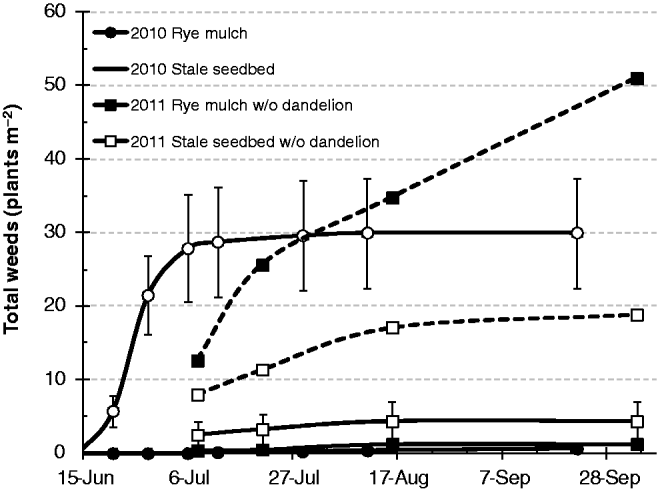
The pattern of emergence in 2011 began later and continued longer than in 2010 and, surprisingly, densities were higher in the rye mulch than in the stale seedbed system (Fig. 2). The stale seedbed system supported 19 ± 8.2 plants m−2 whereas 51 ± 46.4 plants m−2 emerged in the winter rye mulch. About 23% of the plants in the stale seedbed system were pigweed, lambsquarters and foxtail and the rest were dandelion. In contrast, 97% of the plants in the rye mulch were dandelion, the rest being an even mixture of foxtail, lambsquarters, nightshade and pigweed. The early growing season (May through July) of 2011 was moist (315 mm rain) compared with that of 2010 (182 mm rain), which allowed dandelion to reproduce vigorously over spring and summer throughout the general area. The rye mulch probably trapped many wind-blown dandelion seeds, which lack dormancyReference Martinkova, Honek and Lukas 21 , during that time and created an excellent seedbed for them to germinate immediately. Excluding dandelion from the calculations, then post-plant annual weed emergence was 4.4 ± 2.61 and 1.3 ± 0.66 m−2 in the stale seedbed and rye mulch treatments, respectively (Fig. 2), which proportionally reflects the results in 2010.
Weed biomass (dry weight) at the end of the 2010 growing season was influenced substantially by the establishment method (main factor, P = 0.04), weed management (sub factor, P = 0.01) and interactions between these two variables (P = 0.01). Total weed biomasses in stale seedbed, stale seedbed plus, rye mulch and rye mulch plus treatments were 453 ± 131.3, 8 ± 5.6, 1 ± 1.0 and 1 ± 0.5 g m−2, respectively (Tukey's HSD0.05 = 308). In contrast, at the end of the 2011 growing season, weed biomass was not influenced by the establishment method (P = 0.48), weed management (P = 0.94) or interactions (P = 0.72), primarily because of the high levels of dandelion that proliferated in the rye mulch plots during late summer. Nevertheless, weed biomass averaged only 35 ± 8.7 g m−2 across treatments in 2011, which probably was not high enough to have interfered with soybean growth and yield in any treatment.
For comparison, in Illinois total end-of-season weed biomass in soybean was reduced from about 500 g m−2 in stale seedbeds to <100 g m−2 in rye mulchReference Davis 13 . In southern Wisconsin, weed biomass in early July was reduced by 62% in rye mulch compared with stale seedbedsReference Bernstein, Posner, Stoltenberg and Hedtcke 12 . In central Pennsylvania, mid-summer weed biomass reduction in soybean due to rolled and crimped winter rye compared with bare soil across five site-years was 15, 53, 91, 92 and 93%Reference Mischler, Curran, Duiker and Hyde 18 . Lastly, in the absence of herbicides, rolled and crimped rye in Alabama provided 58, 69 and 83% weed control over 3 yearsReference Price, Reeves and Patterson 16 .
Hand-weeding
Four hand-weedings were performed in 2010 (June 29 and July 8, 19 and 29) in the stale seedbed system that was augmented with herbicide. Cumulative times (labor-hours) were equivalent to 66 ± 9.2 h ha−1 in the short-season soybean and a nearly identical duration of 61 ± 8.3 h ha−1 in the full-season soybean. No hand-weeding was needed in the rye mulch system because of the paucity of weeds. Two hand-weeding efforts were conducted in 2011 (July 25 and August 17). Cumulative labor-hours were 15 ± 6.6 and 22 ± 4.9 h ha−1 in the stale seedbed short- and full-season soybeans, which also received herbicide, but only 3 ± 0.2 and 6 ± 1.9 h ha−1 were needed in the rye mulch short- and full-season soybean treatments, which were herbicide-free. Thus, the rye mulch either eliminated or greatly reduced labor requirements for hand-weeding.
For comparison, an average hand-weeding time of 5 h ha−1 was reported for high-value organic soybean (sans cover crop) in IowaReference Delate 22 , but this was only for removing weeds that overtopped the crop later in the growing season. In Ontario, Canada, hand-weeding (at $10 h−1) was the major expense for organic weed management, where costs ranged from $92 to $288 ha−1, which represents about 8–25 h ha−1 of labor 23 . Hand-weeding in high-value vegetable crops may require up to 175 h ha−1 in New York StateReference Evans, Bellinder and Hahn 24 and >200 h ha−1 in CaliforniaReference Gianessi and Reigner 25 . The latter statistic is only for ‘hand-weeding’ literally (i.e., hand pulling), as hand-hoeing is considered a different class of manual labor in California.
Soybean stand
Stand densities differed between years for both short-season (P = 0.07) and full-season (P < 0.01) soybean, and there were year × establishment method interactions for both varieties (P = 0.05, 0.03). Consequently, stands for both varieties were analyzed separately each year. In 2010, short-season soybean stands were influenced by the establishment method (P = 0.05), but not weed management (P = 0.23) nor an establishment method × weed management interaction (P = 0.17). Stands averaged 335,000 ± 16,000 plants ha−1 in the stale seedbed system and 266,000 ± 15,000 plants ha−1 in the rye mulch system (Tukey's HSD0.10 = 53,000). In 2011, no variable or interaction influenced short-season soybean stands (P > 0.68). Stand density averaged 333,000 ± 11,000 plants ha−1 across treatments.
In 2010, full-season soybean stands were not influenced by the establishment method (P = 0.23) nor weed management (P = 0.83), but an interaction did exist (P = 0.06). Densities in stale seedbed, stale seedbed plus, rye-mulch and rye-mulch plus treatments were 291,000 ± 18,000, 263,000 ± 18,000, 214,000 ± 28,000, and 237,000 ± 30,000 plants ha−1, respectively (Tukey's HSD0.10 = 44,000 between establishment methods). In 2011, full-season soybean stands were affected by the establishment method (P = 0.08), but not weed management (P = 0.77) nor an interaction (P = 0.49). In this instance, rye mulch plots had higher densities (340,000 ± 18,000 plants ha−1) than stale seedbed plots (312,000 ± 15,000 plants ha−1).
In summary, treatment effects were inconsistent regarding soybean stands. The year effect probably was due to poor soil-seed contact in 2010, which was caused by incomplete closure of the soil slot created by the planter's double-disk openers. Failure of the packing wheel to close the slot was a result of wet soil conditions at planting, generally, and root-bound soil, specifically, in the rye mulch plots. Root-bound soil on the sidewalls of the slot tended not to crumble and overtop seeds, and dry weather immediately after planting inhibited exposed seeds from germinating. In 2011, the packing wheel was adjusted to facilitate better closure of the seeding slot, and plentiful rainfall after planting assured high germination rates and good stand establishment. For comparison, soybean stands in southern Wisconsin, central Pennsylvania, and North Carolina either were not affected or were influenced inconsistently by rye mulchReference Bernstein, Posner, Stoltenberg and Hedtcke 12 , Reference Nord, Curran, Mortensen, Mirsky and Jones 15 , Reference Smith, Reberg-Horton, Place, Meijer, Arellano and Mueller 17 .
Soybean yield
Yields differed between years for both short-season (P < 0.01) and full-season (P < 0.01) soybean, and there were year × establishment method interactions for both varieties (P = 0.03 and 0.05). Consequently, yields for both varieties were analyzed separately each year. Short-season soybean yields in 2010 were influenced by the establishment method (P = 0.09), but not by weed management (P = 0.61) nor an establishment method × weed management interaction (P = 0.34). Yields averaged 2560 ± 220 kg ha−1 in the stale seedbed system and 1770 ± 120 kg ha−1 in the rye mulch system (Tukey's HSD0.10 = 740). In 2011, no variable or interaction influenced short-season soybean yields (P ⩾ 0.72), which averaged 1360 ± 100 kg ha−1.
Full-season soybean yields in 2010 were affected by the establishment method (P < 0.01), weed management (P = 0.08) and an establishment method × weed management interaction (P < 0.01). In the stale seedbed, stale seedbed plus, rye mulch and rye mulch plus treatments, full-season soybean yields averaged 2640 ± 190, 3260 ± 120, 2080 ± 110 and 1830 ± 110 kg ha−1, respectively (Tukey's HSD0.05 = 420). In 2011, no variable or interaction influenced full-season soybean yields (P ⩾ 0.12), which averaged 1960 ± 120 kg ha−1.
For comparison, in Illinois weed-free soybean (3.0 RM) attained yields of 2200–3200 kg ha−1 in rye mulch compared with 2700–3800 kg ha−1 in bare soil, with locally late planting dates of May 24 to June 2Reference Davis 13 . Similarly, in Wisconsin soybean (1.0 RM) yields were about 2800 kg ha−1 in rye mulch and 3600 kg ha−1 in stale seedbeds planted late (May 18–June 17)Reference Bernstein, Posner, Stoltenberg and Hedtcke 12 . Thus, mulch derived from rolled and crimped winter rye lowered yield potential more in 2010 in Minnesota (31–34%) than in Illinois and Wisconsin (16–22%). This geographical difference probably reflects the shorter growing season and greater aridity of western Minnesota compared with Illinois and Wisconsin. Furthermore, negative effects of rye at these locations on soybean yield would be exacerbated by late soybean planting and soil water use by winter rye.
The linear regression relationship between soybean yield and soybean stand was significant in 2010 for both short-season (F = 10.8, P = 0.01) and full-season varieties (F = 5.5, P = 0.03). However, the intensity of the relationships was modest with low r 2 values (0.43 and 0.27) and slopes of only 7 and 6 kg seed yield 1000−1 plants, respectively. Yield and stand were not related in 2011; corresponding statistics for short- and full-season varieties were F = 0.7, 0.1; P = 0.41, 0.71; r 2 = 0.05, 0.01; and slopes of 2 and 1 kg seed yield 1000−1 plants.
In summary, the generally lower yields in 2011 compared with 2010 probably were caused by 2011's early frost (September 14), which terminated seed maturation of both varieties prematurely. A comparably low temperature in 2010 was not reached until October 15, which was after soybean harvest. As a consequence, soybeans were able to reach their yield potentials in 2010. Similarly, the longer growing season in 2010 allowed expression of effects of the establishment method, specifically the effects of a stale seedbed (dense stands and high yields) compared with rye mulch (poorer stands and lower yields). Rye mulch sufficiently impeded weed emergence and growth that even in the weedy treatment soybean yield losses due to weed competition were not detected. In contrast, stale seedbeds without augmented weed control could have weed populations high enough to make an appreciable impact on soybean yield. Lastly, no management effects were apparent during a year with an abruptly terminated (early frost) growing season, as in 2011.
Conclusions
Both pre-plant and post-plant populations of common annual weeds were lowered appreciably by the use of winter rye mulches compared with stale seedbeds. As a consequence hand-weeding requirements were negligible (0–6 h ha−1) in soybean planted into rye mulch, but ranged from 15 to 66 h ha−1 in stale seedbed systems. Thus, rye mulches can clearly lower hand-weeding efforts, but rye mulches also have the capacity to lower yield potential of both short- and full-season soybean, for instance by 31 and 34%, respectively, in 2010, compared with the use of stale seedbeds. These yield decreases translate into losses of about 800–1000 kg ha−1 of soybean seed with the use of rye mulches. Market values of feed grade soybean seeds were $0.53 kg−1 (conventional) and $1.04 kg−1 (organic) in mid May 2012. Thus, with winter rye as a cover crop, gross returns for soybean could be lowered by about $500 ha−1 for conventional soybean and $1000 ha−1 for organic soybean compared with soybean planted into stale seedbeds without rye mulch.
The use of stale seedbeds, however, potentially entails higher management costs for weed control compared with the use of winter rye cover crops. For example, in 2010 full-season soybean yield was lowered by nearly 900 kg ha−1 because of weeds not controlled by inter-row cultivation in the stale seedbed system. This reduction represents gross return losses of about $450 ha−1 (conventional) to $900 ha−1 (organic), which are comparable with the penalties imposed by the use of winter rye cover crops (see previous paragraph). If 60 h of hand labor were required to remove the offending weeds, as in 2010, and labor was valued at $10 h−1, then this input would be worth $600 ha−1. Thus, hand labor may still be a rational option for organic soybean planted in stale seedbeds (i.e., $900 − $600 = $300 net gain), but less likely so for conventional soybean (i.e., $450 − $600 = $150 net loss). These admittedly coarse calculations also suggest that a conventional grower in Minnesota with herbicide resistance problems would benefit more from adopting winter rye cover crops than the stale seedbed technique to manage resistant annual weeds. In contrast, the stale seedbed technique augmented by hand-weeding compared with winter rye cover crops probably is roughly equally cost-effective for organic growers in Minnesota, assuming labor for hand-weeding is available when needed. In the absence of assured availability of sufficient hand labor, the value of winter rye cover crops increases markedly.
Acknowledgements
This project would not have been possible without the assistance and dedication of Dean Peterson, James Eklund, Charles Hennen and Scott Larson.



