The construct of “internal working models” is central to attachment theory. Although Bowlby (Reference Bowlby1980) wrote of internal working models from conceptual metaphoric (Bretherton, Reference Bretherton1985), cognitive science, and neuroscience perspectives, subsequent research focused on the first of these leads. Here, we assess the automatic attentional strategies of organized versus disorganized mothers using the emotional Stroop task. We assess attention because it underpins the attachment system. We compare organized with disorganized classifications because organization represents the strategic allocation of attention, whereas disorganization reflects the collapse of strategic allocation, under conditions of perceived emotional threat. We use the emotional Stroop task because it instantiates decades of theory and research on attention allocation under normative and threat conditions. This latter benefit affords the ability to (a) validate and augment conceptual metaphoric explanations of the internal working model and (b) define internal working models from cognitive science and neuroscience perspectives. As a whole, the study represents an attempt to synergize multiple levels of analysis so as to better understand the origins of developmental psychopathology (Cicchetti & Posner, Reference Cicchetti and Posner2005).
Internal working models are central to attachment theory: “each attachment is defined by an internal representational model of the attachment figure” (Kirsh & Cassidy, Reference Kirsh and Cassidy1997, p. 1143; or by more than one such model, Main, Reference Main, Cassidy and Shaver1999). Following Craik (Reference Craik1943), who argued, “the organism carries a small-scale model of external reality and its own possible actions within its head” (p. 61), Bowlby (Reference Bowlby1969, Reference Bowlby1973, Reference Bowlby1980) proposed that environmental situations and attachment figure availability are not appraised anew whenever needed. Rather, starting in infancy and based on ever-accruing experience, individuals construct models of the world, significant persons within it, and the self. Founded on repeated interactions, these models become “engrained” or “automatic” (Bowlby, Reference Bowlby1980, p. 55). Conscious or “controlled” processes are relatively slow and require attention, but they are voluntary (Cohen, Dunbar, & McClelland, Reference Cohen, Dunbar and McClelland1990). In comparison, automatic processing is more efficient because it makes fewer demands on attention, but it lacks flexibility (Bargh & Chartrand, Reference Bargh and Chartrand1999; Bowlby, Reference Bowlby1980; Bretherton & Munholland, Reference Bretherton, Munholland, Cassidy and Shaver1999; Cohen et al., Reference Cohen, Dunbar and McClelland1990). Internal working models influence expectations, affect, and behavior in attachment relationships automatically; this automaticity makes them central to attachment theory.
Various methods have been developed to assess working models. The Strange Situation (Ainsworth, Blehar, Waters, & Wall, Reference Ainsworth, Blehar, Waters and Wall1978), Adult Attachment Interview (AAI; Main & Goldwyn, Reference Main and Goldwyn1994), and Working Model of the Child Interview (WMCI; Zeanah, Benoit, Hirshberg, Barton, & Regan, Reference Zeanah, Benoit, Hirshberg, Barton and Regan1994) are particularly relevant here. With respect to the Strange Situation, it is argued that the infant's behavior pattern, and the model underlying it (Bretherton, Reference Bretherton1985; Main, Kaplan, & Cassidy, Reference Main, Kaplan and Cassidy1985), derive from the interaction between the environmentally stable tendency to seek/maintain proximity to selected figures (Bowlby, Reference Bowlby1969) on the one hand and the limited number of response styles on the other hand. Caregivers can respond with consistently sensitive, inconsistently sensitive, or consistently insensitive caregiving. Correspondingly, the infant forms a secure attachment (involving balanced environmental exploration and orientation to the caregiver and direct communication of attachment signals), ambivalent/resistant attachment (extreme orientation to the caregiver at the expense of exploration and hyperactivated attachment signals), or avoidant attachment (extreme orientation to the environment, downgraded orientation to the caregiver and suppressed attachment signaling). All three patterns are organized; they reflect a coherent strategy for maintaining physical and/or psychological proximity with the caregiver. But whether the caregiver is sensitive or insensitive, if he/she is frightened (as in the case of caregivers with unresolved trauma), frightening (as in the case of abusive caregivers; Main & Solomon, Reference Main, Solomon, Brazelton and Yogman1986, Reference Main, Solomon, Greenberg, Cicchetti and Cummings1990) or helpless with respect to caregiving (Lyons-Ruth, Melnick, Bronfman, Sherry, & Llanas, Reference Lyons-Ruth, Melnick, Bronfman, Sherry, Llanas, Atkinson and Goldberg2004), the infant's attachment strategy may collapse and the infant may behave in ways that are not obviously aimed at proximity with the caregiver, despite the infant's need for comfort. In contrast to the organized attachment strategies, disorganization has been described as “the most maladaptive attachment modality” (Stams, Juffer, & van IJzendoorn, Reference Stams, Juffer and van IJzendoorn2002, p. 808) and the one “most clearly related to later psychopathology” (Goldberg, Benoit, Blokland, & Madigan, Reference Goldberg, Benoit, Blokland and Madigan2003, p. 239). Disorganization represents frank maladaptation of the attachment system and the relational modulation of arousal (Lyons-Ruth et al., Reference Lyons-Ruth, Melnick, Bronfman, Sherry, Llanas, Atkinson and Goldberg2004). Again, the aforementioned patterns are assumed to reflect distinct internal working models (Bretherton, Reference Bretherton1985; Main et al., Reference Main, Kaplan and Cassidy1985).
In adulthood, internal working models of attachment to caregivers are assessed with the AAI (Main & Goldwyn, Reference Main and Goldwyn1994). Here, judgments about attachment security are based on the coherence of the narrative as reflected in its quality (truthful and supported by evidence), quantity (succinct and complete), relation (relevant to the topic as presented), and manner (clarity and orderliness). Based on the pattern of coherence, transcripts are classified as autonomous (coherent, emotionally integrated, and straightforward), dismissing (unconvincingly idealized, emotionally constricted, or frankly devaluing), preoccupied (confused and/or emotionally labile), or unresolved (significant losses or traumas are described incoherently). The first three of these classifications represent organized attachment strategies; the latter is disorganized. Again, the narrative is used to infer the existence of internal working models and information processing bias. It is argued that people “[1] are able to access distress-related memories in order to [2] reflect on attachment relationships and [3] maintain cooperative interview discourse” (Kobak, Cole, Ferenz-Gillies & Flemming, 1993, p. 233). Here we must infer from discourse to conscious reflection to information access. Such a chain reveals little about the inferred processes and is vulnerable to misinference at every step.
To examine caregivers' internal working models of their children, Zeanah et al. (Reference Zeanah, Benoit, Hirshberg, Barton and Regan1994) developed the WMCI. The interview seeks to assess the caregiver's internal working model via narrative. Transcripts are coded as balanced (coherent description of the infant and the caregiver–infant relationship), disengaged representations characterized by coolness, distance, or indifference to the infant), or distorted (internal inconsistencies within the representation), all considered organized forms of attachment. In addition, as its name indicates, a high score on the scale “irrational fear of loss of the child” indicates that the caregiver experiences irrational fear of losing the infant. Although fear of loss of the child through death has been associated with the dismissing classification in the AAI (George, Kaplan & Main, Reference George, Kaplan and Main1996), it appears to reflect a confused, dissociated, and irrationally fearful state in the context of the WMCI; in the WMCI, the interviewee responds as caregiver, rather than care receiver.Footnote 1 As with the AAI, narrative is used to infer internal working models and bias in automatic information processing.
As Main (Reference Main, Cassidy and Shaver1999) pointed out, narrative is a “representational product” (p. 877) and “representational products … are not the same as the internal representations themselves, which are of course inaccessible to direct inspection” (Main, Reference Main, Cassidy and Shaver1999, p. 877, original italics). Therefore, inference from behaviour and narrative to internal working models must be validated against more basic measures of information processing. In this study, we assess hypotheses linking the organization/disorganization dimension, as assessed with maternal AAIs, maternal WMCIs, and infant Strange Situations, to performance on a maternal measure of attention, an emotional Stroop task. Below, we review the framework within which this study was conducted.
Information Processing and Attachment
Because the organism has limited ability to attend and process information (Kahneman & Treisman, Reference Kahneman, Treisman, Parasuraman and Davies1984), sensory inflow is appraised out of awareness before a portion reaches consciousness for more complex processing. Experience renders some environmental features more phenomenologically salient than others (Bruner, Reference Bruner1992; Erdelyi, Reference Erdelyi1974). On this basis, Bowlby (Reference Bowlby1980) argued that an individual's attachment history influences what is and what is not processed consciously. Main et al. (Reference Main, Kaplan and Cassidy1985) offered this definition: “The internal working model is a set of rules for obtaining or limiting access to … information” (p. 67).
Supporting his claims in the context of defensive processes, Bowlby (Reference Bowlby1980) surveyed the information processing literature. Defensive exclusion and diversion of attention were central to this scan. Thus, Bowlby (Reference Bowlby1980) discussed dichotic listening experiments at length. In these studies, different messages were transmitted to a subject, one to each ear. The subject was instructed to repeat verbatim one of the messages. At experiment's end, subjects were unaware of the unattended message. There were exceptions, however, as when some personal message was transmitted. Other experiments showed that unattended messages affected response to subsequent tasks and mood. Bowlby also cited analogous tachistoscopic and eye movement findings. He interpreted these data as evidence that (a) sensory inflow can be processed outside of awareness (b) and its meaning determined (c) such that it influences behavior (d) without the individual being aware of this bias.
Contemporary information processing theorists might criticize the details of Bowlby's account. For example, the meaning of dichotic listening tasks is controversial (Holender, Reference Holender1986). More generally, there are limits on the capacity for unconscious processing (Greenwald, Reference Greenwald1992). Nevertheless, researchers agree that nonconscious processing can have profound effects on conscious experience (Greenwald, Reference Greenwald1992). Essentially, Bowlby's argument withstands examination in the light of subsequent information processing research.
This is an important concession; although Bowlby (Reference Bowlby1980) reviewed attention specifically in the context of defensive processes, attention and defensive processes are, in fact, central to attachment theory more broadly. At the most fundamental level, Bowlby initially described the attachment system as being “turned on” or “turned off.” Bretherton (Reference Bretherton, Coelho and Ahmed1980) recognized subsequently that shutting down the system would leave the infant at risk; therefore, the theory was modified to suggest that proximity to the attachment figure is continuously monitored (attended to; see also Maier et al., Reference Maier, Bernier, Pekrun, Zimmermann, Strasser and Grossmann2005).
Furthermore, it is in the context of continual, usually nonconscious, monitoring (attention) that we understand attachment behavior (Main, Reference Main, Cassidy and Shaver1999; Main et al., Reference Main, Kaplan and Cassidy1985). Broadly speaking, attachment categories reflect the capacity to balance attachment and exploratory needs, that is, allocate attention to the caregiver versus environment. For example, avoidance represents an “organized yet relatively inflexible shift of attention” (Main, Reference Main, Cassidy and Shaver1999, p. 858) away from attachment stimuli, whereas ambivalence reflects the converse. By contrast, “[A]ttention is fluid in secure babies … and liable to dysregulation or collapse in disorganized babies” (Main, Reference Main, Goldberg, Muir and Kerr1995, p. 427; see also Hesse & Main, Reference Hesse and Main2006). Main argued further that in the service of maintaining avoidant and ambivalent/resistant behavior strategies, the infant may actively and defensively preserve a particular attentional state, a state that may be sustained into adulthood and reflected in discourse. For example, the AAI provides opportunity for the adult to “flexibly direct … attention toward interview topics” (Dozier & Kobak, Reference Dozier and Kobak1992, p. 1474; see also Kobak et al., Reference Kobak, Cole, Ferenz-Gillies and Fleming1993) or for “deflection of attention from … attachment topics” (Bretherton & Munholland, Reference Bretherton, Munholland, Cassidy and Shaver1999, p. 100).
However, as Goldberg (Reference Goldberg2000) pointed out with respect to attachment and information processing generally, “there is considerably more theory … than evidence” (p. 150). Furthermore, the existing evidence does not always vindicate predictions. Thus, Main et al. (Reference Main, Kaplan and Cassidy1985) and Kirsh and Cassidy (Reference Kirsh and Cassidy1997) coded children's reactions to family photographs or attachment-relevant pictures several years after the children had been observed in the Strange Situation. Children who had been classified as avoidant, and unexpectedly, sometimes children who had been classified ambivalent, tended to look away from the pictures more often than children who had been classified secure. Belsky, Spritz, and Crnic (Reference Belsky, Spritz and Crnic1996) found no differences in distractibility during emotional episodes of a puppet show among 2.5-year-olds who had been classified secure or insecure as infants. However, Fearon and Belsky (Reference Fearon and Belsky2004) showed that attachment classification served as a moderator, rendering secure children less susceptible to the impact of risk factors (gender and social–contextual adversity) on a computerized attentional performance task.
Dozier and Kobak (Reference Dozier and Kobak1992) demonstrated that deactivation or avoidance of issues related to separation, rejection, and threat from parents, as assessed with the AAI, was related to increases in skin conductance, an autonomic phenomenon related to behavioral inhibition. The implication is that dismissing individuals utilize automatic deactivating strategies to divert attention from attachment-related material.
Maier et al. (Reference Maier, Bernier, Pekrun, Zimmermann, Strasser and Grossmann2005) administered the AAI and a perceptual threshold task involving identification of pictures to young adults. Maier et al. (Reference Maier, Bernier, Pekrun, Zimmermann, Strasser and Grossmann2005) found that higher vigilance to social stimuli was related to dismissing and, to a lesser extent, preoccupied attachment tendencies. Maier et al. (Reference Maier, Bernier, Pekrun, Zimmermann, Strasser and Grossmann2005) reconciled these high-vigilance findings with the deactivating findings of Dozier and Kobak (Reference Dozier and Kobak1992) by arguing that vigilant attention is a prerequisite for successful avoidance of negative information. Maier et al. (Reference Maier, Bernier, Pekrun, Zimmermann, Strasser and Grossmann2005) also found that the dismissing dimension was related to vigilance with respect to pictures of animals. The authors interpreted these findings as consistent with the notion that the dismissing individual's fear system is permanently activated because he/she has not internalized a safe haven representation.
Zeijlmans van Emmichoven, van IJzendoorn, De Ruiter, and Brosschot (Reference Zeijlmans van Emmichoven, van IJzendoorn, de Ruiter and Brosschot2003) administered the AAI and the emotional Stroop task to a sample of 28 outpatients with anxiety disorders and compared these to a nonclinical comparison group of 56 individuals. The Stroop included stimuli from three valences, positive, neutral, and threatening (e.g., MURDER, FATAL), presented under subliminal and supraliminal conditions. No effects emerged for the subliminal condition. For the supraliminal condition, the three-way interaction among attachment classification, clinical status, and word valence proved significant. Clinical participants with autonomous attachments evinced the largest interference of threat words compared to the other groups. Zeijlmans van Emmichoven et al. (Reference Zeijlmans van Emmichoven, van IJzendoorn, de Ruiter and Brosschot2003) concluded that the autonomous subjects' longer latencies to respond to threat words reflected willingness to process menacing information. However, from a Stroop perspective, the findings and explanation are nontraditional. This is because latency to label print color is typically associated with loss of controlled processing in favor of automatic processing (i.e., in the Stroop paradigm, controlled processing involves volitionally following instructions to label color; automatic processing involves processing word meaning; MacLeod, Reference MacLeod1991; Williams, Mathews, & MacLeod, Reference Williams, Mathews and MacLeod1996). The findings of Zeijlmans van Emmichoven et al. (Reference Zeijlmans van Emmichoven, van IJzendoorn, de Ruiter and Brosschot2003) indicate that anxious autonomous individuals are prone to loss of controlled processing. One must keep in mind, however, that the findings are part of a complex three-way interaction, the threat stimuli are related to clinical condition (anxiety disorder), not attachment representations, per se, and findings can vary with approach to computing Stroop effects (within-subject vs. between-subject approaches; see Bar-Haim, Lamy, Pergamin, Bakermans-Kranenburg, & van IJzenoorn, 2007).
Overall, results of the above studies yielded inconsistent findings, with some confirming expectations, others failing to confirm, and still other studies yielding countertheoretical results. Unlike aforementioned investigators, who compared secure and insecure attachment patterns, we assess attention across organized and disorganized classifications. The sine qua non of disorganization is “fright without solution” (Main, Reference Main, Goldberg, Muir and Kerr1995). Therefore, the comparison of organized and disorganized classifications represents a contrast between a strategic approach to resolving fear through attachment versus disorientation in the face of fear. With respect to attention specifically, Lyons-Ruth and Jacobvitz (Reference Lyons-Ruth, Jacobvitz, Cassidy and Shaver1999) described disorganization as “a collapse of the infant's … attentional strategies” (p. 523). In adulthood, disorganization manifests as lapses in the monitoring of (attending to) reasoning and discourse when discussing potentially traumatic experiences (Hesse & Main, Reference Hesse and Main2006; Main, Reference Main, Goldberg, Muir and Kerr1995). In this context, disorganization has been linked to dissociative symptoms in posttraumatic stress disorder (PTSD; e.g., Carlson, Reference Carlson1998; Liotti, Reference Liotti1992, Reference Liotti, Solomon and George1999; Ogawa, Sroufe, Weinfeld, Carlson, & Egeland, Reference Ogawa, Sroufe, Weinfield, Carlson and Egeland1997). For example, Carlson (Reference Carlson1998) found that attachment disorganization in infancy was related to dissociation in adolescence. Of further interest, in a meta-analysis of threat-related attentional bias in anxious and nonanxious individuals, Bar-Haim et al. (Reference Bar-Haim, Lamy, Pergamim, Bakermans-Kranenburg and van IJzendoorn2007) found no significant Stroop effects in typical controls, a further rationale for comparing individuals considered most at risk for psychopathology (disorganized) with individuals at less risk (organized).
With these considerations in mind, we administered the emotional Stroop task to a sample of mothers in the context of attachment disorganization. The Stroop task is “a hallmark measure of attention” (MacLeod, Reference MacLeod1991, p. 187) and the emotional Stroop is the most commonly used task designed to show how performance suffers as a result of selective attention to emotionally relevant stimuli where the processing of those stimuli is disruptive (Williams et al., Reference Williams, Mathews and MacLeod1996). This claim has been validated in over 50 studies demonstrating that color naming of emotional words is slowed in comparison to the color naming of neutral words in samples with emotional disturbance but not in control samples; in controls, color naming latencies are more comparable across emotional and neutral words (Williams et al., Reference Williams, Mathews and MacLeod1996). Furthermore, Williams et al. (Reference Williams, Mathews and MacLeod1996) demonstrated that samples with PTSD evince greater interference than any other clinical sample, a relevant observation here given that disorganization may be associated with symptoms of PTSD, as mentioned above. Of importance, both disorganized attachment and emotional Stroop response involve the coordination of strongly conflicting motivations under conditions of emotional arousal; therefore, the emotional Stroop may provide a particularly sensitive means of assessing automatic processing in disorganized attachment.
Use of the Stroop in the context of attachment may be particularly revealing because there has been much theorizing and research on the cognitive processes and neurobiology underlying Stroop performance (MacLeod, Reference MacLeod1991; Williams et al, Reference Williams, Mathews and MacLeod1996). This includes the application of concepts and phenomena such as personal salience, threat tags, parallel distributed processing, and neuromodulatory control. Again, the Stroop may provide insight into these aspects in the context of internal working models, and it is only by understanding such mechanisms that we can move beyond the notion of the internal working model as a catchall explanation (Hinde, Reference Hinde and Rutter1988), an “assumption” (Atkinson, Nichols, et al., Reference Atkinson, Niccols, Paglia, Coolbear, Parker and Poulton2000, p. 806), or a “useful heuristic” (Belsky & Cassidy, Reference Belsky, Cassidy, Rutter and Hay1995, p. 383) to comprehend how internal working models actually work from cognitive science and neuroscience perspectives.
With specific reference to the present study, we assessed a low-risk, community sample of women in their third trimester of pregnancy with the AAI and WMCI. At 6 and 12 months postpartum, we administered emotional Stroop tasks to the mothers. At 12 months, we observed the infants in the Strange Situation. We hypothesized the following:
1. Women classified disorganized on the (a) AAI and (b) WMCI, and (c) women whose babies are so classified in the Strange Situation show longer latency of response to threat words (negative attachment, negative emotion) than to the neutral words. In contrast, organized mothers show more equivalent latency to respond across conditions. We include women whose infants are classified disorganized in this set of hypotheses because the parents of disorganized infants display loss of control of conscious processes, as reflected in dissociative behavior (Hesse & Main, Reference Hesse and Main2006), conflicted behavior toward the baby, including sequential or simultaneous display of contradictory behavior patterns (Main & Hesse, 1998) and communication errors (e.g., contradictory signaling to infant; Bronfman, Parsons, & Lyons-Ruth, Reference Bronfman, Parsons and Lyons-Ruth2004), and actions that indicate “collapse of attentional and behavioral strategy” (Hesse & Main, Reference Hesse and Main2006, p. 325). Grienberger, Kelley, and Slade (Reference Grienberger, Kelley and Slade2005) suggested that the AMBIANCE, a coding system for atypical/disrupted caregiving behavior (Bronfman et al., Reference Bronfman, Parsons and Lyons-Ruth2004) emphasizes “competing strategies” and “contradictory attachment tendencies” (p. 301) that simultaneously amplify and reject infant attachment. Such observations are important in the present context because the Stroop is designed to assess conflict between controlled and automatic processing under conditions of emotional arousal.
2. The dyad's cumulative disorganization (varying from 0 to 3, according to whether the dyad was never classified disorganized or whether it was classified disorganized on one or more of the AAI, WMCI, or Strange Situation) is positively related to the difference between threat and neutral latency response times. This grouping is based on many lines of reasoning. (a) The index reflects varying levels of classification reliability (e.g., one can be more certain of the classification of a dyad classified disorganized across all three measures than of a dyad classified disorganized on one measure). This is important because validity is bounded by the square of reliability; therefore, combining classifications may provide a powerful test of the hypothesis that disorganization is related to Stroop response time. (b) The index pertains to cumulative risk (which has been employed successfully in the attachment-information processing literature, as mentioned above; Fearon & Belsky, Reference Fearon and Belsky2004). Cumulative risk models, as improper linear scales, circumvent some of the error inherent in noncross-validated regression equations (Dawes, Reference Dawes1979). Hence, the cumulative disorganization score analyses serve to crosscheck the regression findings used to validate Hypothesis Set 1. (c) The cumulative disorganization score serves as an omnibus test of the hypothesis that disorganization is related to Stroop reaction time as the score combines all attachment data into a single index. This serves to reduce the probability of Type I error. (d) From a substantive perspective, combined classifications may assess the pervasiveness of disorganization (across mothers' representations of their parents, mothers' representations of their infants, and mothers' behavior toward their infants), a dimension that has not been studied previously. (e) The scale may represent a scale of degree of disorganization. Disorganization is, after all, assessed on scales of 1 to 9, with 5 as cutoff. In the scale used here, we combine three reliable classifications to derive scales of 0 to 3. We do not wish to validate one or the other of these lines of reasoning, but each indicates that combining classifications in a single scale is a reasonable strategy.
3. The match between (a) AAI and Strange Situation classifications and (b) WMCI and Strange Situation classifications is related to the difference between 6-month and 12-month Stroop latencies. For example, we expect that if a mother is classified unresolved on the AAI and her infant is organized in the Strange Situation, the mother's latency to respond to threat words (compared to neutral words) will have improved from 6 to 12 months. We make this prediction because if a caregiver's attentional strategy changes over time (to become more or less conflicted), we might expect her behavior to change also and this will affect the infant's attachment pattern. For example, Atkinson et al. (Reference Atkinson, Scott, Chisholm, Blackwell, Dickens and Tam1995) showed that attentional strategies (in this case, approach and avoidance) influenced maternal sensitivity toward the infant both directly and indirectly.
Method
Sample
The subjects in the present study are a subsample of mother–infant dyads reported on elsewhere (Atkinson et al., Reference Atkinson, Goldberg, Raval, Pederson, Benoit and Moran2005; Raval et al., Reference Raval, Goldberg, Atkinson, Benoit, Myhal and Poulton2001). For the present study, 102 dyads completed all three attachment assessments plus the 12-month Stroop. However, because of timing and technical difficulties, the Stroop was introduced late in the study and only 47 mother–child dyads were administered the attachment assessments plus the 6- and 12-month Stroop tasks. For the purposes of consistency and analytic parsimony, and because the sample of 47 permitted longitudinal analyses and the ability to address all aforementioned hypotheses, we based major analyses on this smaller sample. However, some of the background analyses, specifically analyses addressing the interrelations among attachment assessment classifications, are conducted on the sample of 102 dyads because cell sizes were too small to conduct chi-squared analyses with the smaller sample. In one instance, we supplemented a focal 47-subject analysis with an analysis based on 102 dyads that had all attachment assessments plus the 12-month Stroop; this was to clarify an ambiguous finding, as described below.
The 47-subject sample consisted of 19 female and 28 male infants. The sample was 83% Caucasian, with small percentages of other ethnicities, including Asian, Hispanic, and African Canadian. Mean age of the mothers was 31.89 years (SD = 3.65). Forty-four (93.5%) of the mothers were married. Mothers and fathers had a mean 15.50 (SD = 3.17) and 17.00 (SD = 3.35) years of education, respectively. The sample was largely middle class, with 77% earning a family income exceeding $50,000 Canadian.
Procedure
Mothers were administered the WMCI and AAI in the third trimester of pregnancy. The WMCI was administrated an average of 9 days prior to the AAI. At 6 months postpartum, the mothers watched an edited, 17-min version of a documentary about a 17-month-old boy placed in a residential nursery for 9 days while his mother was in hospital to give birth (Robertson & Robertson, Reference Robertson and Robertson1969/1990). We showed the film to prime mother's attachment system before presenting the Stroop. Activating the meaning of words, either semantically or by manipulating current circumstances, increases the probability of color-naming interference, particularly if the theme of interest (attachment) represents a long-term concern (Williams et al., Reference Williams, Mathews and MacLeod1996). When the babies were 12 months old, we showed the mothers a 13-min, edited documentary about a 2-year-old girl admitted to hospital for 8 days for minor surgery (Robertson & Robertson, Reference Robertson and Robertson1959) and we administered an emotional Stroop task. On the second visit (an average of 2 weeks later), we observed the infant in the Strange Situation. In addition, to control for the effects of psychological disturbance, mothers were administered several inventories, both prenatally and through the first year of the baby's life.
AAI
The AAI (George et al., Reference George, Kaplan and Main1996) is a semistructured interview that queries childhood relationships with attachment figures, attachment relevant experiences from early childhood, and the impact of these experiences on development, current functioning, and parenting. The interview was audio taped, transcribed, and coded using Main and Goldwyn's (1994) guidelines. The coding emphasizes qualitative aspects of the narrative rather than factual information. Based on ratings of experiences with each attachment figure and current state of mind with respect to those experiences, the transcripts were classified as autonomous, dismissing, preoccupied, or unresolved. All identifying information was removed from the transcripts before a highly experienced coder (D.B.), who has consistently passed the standard reliability test and achieved reliability with other laboratories, coded them. She was blind to all other measures.
WMCI
The WMCI (Zeanah et al., Reference Zeanah, Benoit, Hirshberg, Barton and Regan1994) administration and coding procedures are structurally analogous to those of the AAI (George et al., Reference George, Kaplan and Main1996). The parent is asked to describe his/her emotional reactions during pregnancy, the infant's personality and development, features of the relationship with the baby, anticipated difficulties with the infant, and response to infant behaviors and distress. The transcript is coded according to five primary rating scales: richness of perception, openness to change, intensity of involvement, coherence, caregiving sensitivity, acceptance, infant difficulty, and fear for infant safety. Based on these scales, transcripts are classified as balanced, disengaged, distorted, or involving irrational fear for the child's safety. A primary coder (K.B.) classified all cases and a second coder (N.M.) independently coded 20 cases. Agreement across the four classifications was 85%.
Strange Situation
Infant attachment was assessed in the Strange Situation (Ainsworth et al., Reference Ainsworth, Blehar, Waters and Wall1978), a standardized laboratory observation of eight increasingly stressful episodes involving mother, infant, and a female stranger. In Episodes 4, 6, and 7 the infant is separated from mother; in Episodes 5 and 8 the pair is reunited. The procedure is videotaped and the infant's behavior toward mother is classified as secure, avoidant, resistant (Ainsworth et al., Reference Ainsworth, Blehar, Waters and Wall1978) or disorganized (Main & Solomon, Reference Main, Solomon, Greenberg, Cicchetti and Cummings1990). A primary coder (S.G.) classified all cases and a second coder (D.B.) independently coded 30 cases. Agreement across the four classifications was 93%. Both coders had attained reliability with the Carlson and Sroufe (Reference Carlson and Sroufe1993) tapes.
Stroop task
In the conventional Stroop task (Stroop, Reference Stroop1935), a word signifying a color is presented to the subject in colored print (e.g., the word RED is presented in green print). The subject is instructed to label the color of the print (in this case, to say “green”). Successful performance of this task demands that the subject intentionally allocate attention to one aspect of the stimulus (print color) while intentionally inhibiting attention with respect to the other (word meaning). The Stroop effect involves a several millisecond delay when the word meaning and the print color are discrepant, compared to when they are the same. This is because the subject's automatic processing of word meaning disrupts his/her controlled processing of word color (controlled because labeling print color is volitional, in that it represents compliance to experimenter instructions). The extent of this disruption is calculated by subtracting the subject's latency to respond to stimuli matched on color and meaning (e.g., RED presented in red) from stimuli mismatched on color and meaning (e.g., RED presented in green; see MacLeod, Reference MacLeod1991, for a review).
In an adaptation of this procedure, clinical researchers varied the emotional significance of the word meaning so as to magnify its potentially disruptive effect on color naming. Researchers thereby showed, across several clinical disorders, that clinically salient words, which represent threat to the individual concerned (e.g., SNAKE to a snake phobic), interfere with color naming to a greater extent than do neutral words. This is because the subject's automatic processing of word meaning, the salience of which is magnified by its emotional significance, disrupts the subject's controlled processing of word color. The extent of disruption is calculated by subtracting the subject's latency to respond to neutral stimuli from his/her latency to respond to threat stimuli (see Williams et al., Reference Williams, Mathews and MacLeod1996, for review). We designed the current study within this emotional Stroop framework.
The 6-month Stroop task involved a negative attachment condition and a neutral, nonattachment condition (matched, in terms of stimulus length, to within one letter and one syllable; see Appendix A for stimulus list). Typically, neutral and positive words are used as control stimuli (Williams et al., Reference Williams, Mathews and MacLeod1996); we included positive words to ensure that they held no special significance for disorganized or organized mothers, as would be reflected in differential response latencies. Because no significant differences in response time emerged using the positive stimuli, we excluded them and their neutral matches to simplify analyses and reporting.
Prior to each stimulus presentation, a target “+” sign flashed on the screen for 500 ms to orient the subject. Before presentation of experimental stimuli, subjects responded to 20 practice trials of the words “one,” “two,” “three,” “four,” and “five,” presented in random order, with each of the colors (red, green, blue, yellow, purple, and white on a grey background) presented four times. With respect to the Stroop task proper, at 6 months each stimulus was a single word, 4 mm vertical, 18 mm horizontal, presented in upper case letters. We presented 300 trials in random order, with the restriction that the same word or color could not appear twice in succession. Stimuli were presented supraliminally for 500 ms each. The interstimulus interval was 3 s. There was a 60-s break after 150 trials. Subject reaction times were computer recorded with a voice-activated microphone.
For the 12-month Stroop task, we replicated aforementioned stimulus conditions, but supplemented them with two further conditions, negative emotion and positive emotion, and two matched neutral conditions. We added the negative emotion condition for discriminant validity purposes; we wished to determine whether the Stroop effect manifested only across attachment conditions, or whether it was evident across emotion conditions as well. Given the strong interrelatedness of attachment and affect (e.g., Cassidy, Reference Cassidy1994), we expected the effect would apply across negative attachment and negative emotion stimuli. As explained above, although positive emotion stimuli are typically used for control purposes, we added them to ensure they did not elicit differential response latencies from organized and disorganized mothers. Preliminary analyses assured us of the lack of differentiation and we dropped positive stimuli to simplify analyses and presentation (see Appendix A for the stimulus list).
The second change to the 12-month Stroop, compared to the 6-month Stroop, involved the presentation of two-word phrases, rather than single-word stimuli. This modification was designed to facilitate differentiation between attachment- and emotion-relevant words. For example, the word “betray” may be equally applicable in the contexts of attachment and, say, work; the phrase “father betray” attenuates ambiguity. We also reduced the number of stimuli per condition (from six to five), omitting one presentation color (white) because of this. Stimuli were roughly group matched for number of letters (mean stimulus length/condition varied between 11.0 and 13.8) and number of syllables (mean stimulus length/condition varied between 3.6 and 4.2). We attempted to use familiar words. Mean familiarity ratings for our stimuli vary between 552 and 584 across conditions, according to Wilson's (Reference Wilson1987) scale. The range of all words rated by Wilson lay on a scale ranging from 100 to 700, with a mean of 488 and a standard deviation of 99. However, in many instances (e.g., LONELY, ABONDON) familiarity ratings were unavailable. Otherwise, presentation and treatment of the stimuli were as described above. All Stroop sessions were recorded. Before data analysis, tapes were reviewed and false starts (e.g., cough) and incorrect responses were excluded.
Mental health measures
To ensure that attachment–Stroop relations were not confounded by mental health status, we administered the Symptom Checklist 90-R (Derogatis, Reference Derogatis1994) prenatally, the Beck Depression Inventory (Beck, Steer, & Garbin, Reference Beck, Steer and Garbin1988) twice prenatally and at 6 and 12 months, and the Edinburgh Postnatal Depression Scale (EPDS; Cox, Holden, & Sagovsky, Reference Cox, Holden and Sagovsky1987) at 4 weeks, 4 months, and 5 months. All these measures are supported by substantial reliability and validity data.
Results
Preliminary analyses
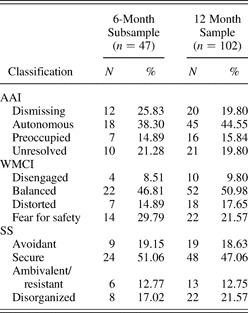
Classification distributions for the AAI, WMCI, and Strange Situation are shown in Table 1 for both the subsample assessed with the Stroop task at 6 months (N = 47) and the full 12-month sample (N = 102). To assess whether the sample of 47 dyads who completed all assessments differed from the larger sample of 102, we compared the samples across demographic, mental health, attachment, and Stroop data. Among 22 tests, one proved significant: the sample of 47 reported greater depression on the 4-month EPDS (z = 1.98, p < .05). Given the ratio of significant to nonsignificant findings, and given that no other depression assessment proved significant, we interpreted this finding as Type I error. We also assessed AAI, WMCI, and Strange Situation classifications, as well as the accumulation of these classifications, against the background demographic and mental health variables (plus combinations of these health variables to maximize reliability) listed above. No background variables were related to attachment status. With respect to the mental health variables, 3 of 80 analyses proved significant, not all in the same direction. These results are consistent with expected Type I error rate. In addition, we assessed the 6- and 12-month Stroop outcomes against background and mental health variables but found no significant differences. These latter findings might be considered surprising, given that the Stroop has been used to show differences between clinical and nonclinical samples, but the present data are based on a community sample, with attendant range of restriction in mental health variables. This is consistent with the meta-analytic findings of Bar-Haim et al. (Reference Bar-Haim, Lamy, Pergamim, Bakermans-Kranenburg and van IJzendoorn2007), who found no significant differences in emotional Stroop reaction time among normal control participants. Overall, these results suggest that relations between attachment classifications and Stroop were not confounded by demographic or mental health variables.
Distribution of AAI, WMCI, and SS classifications for the subsample with 6-month Stroop data and the sample with 12-month Stroop data

Note: AAI, Adult Attachment Interview (Main & Goldwyn, Reference Main and Goldwyn1994); WMCI, Working Model of the Child Interview (Zeanah et al., Reference Zeanah, Benoit, Hirshberg, Barton and Regan1994); SS, Strange Situation (Ainsworth et al., Reference Ainsworth, Blehar, Waters and Wall1978).
Attachment classifications
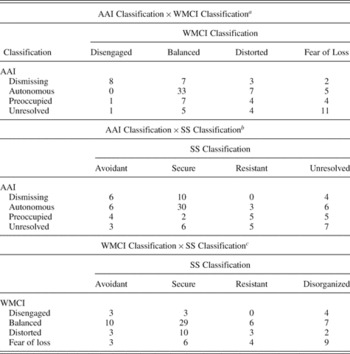
We assessed relations among attachment classifications using the sample of 102 because the sample of 47 did not suffice given the number of cells involved. Chi-squared analyses (attachment measure × four-way classification; see Table 2) showed significant relations between AAI and WMCI, χ2 (9) = 45.94, p < .01, and between AAI and Strange Situation, χ2 (9) = 25.57, p < .01. The association between WMCI and Strange Situation approached significance, χ2 (9) = 14.55, p = .10. Above, we suggested that WMCI irrational fear of loss of the child is related to AAI unresolved attachment and Strange Situation disorganized attachment. Examining this more closely, we found that the WMCI fear of loss/no fear of loss was associated with AAI unresolved/not unresolved, χ2 (1) = 14.84, p < .01, and with Strange Situation disorganized/organized, χ2 (1) = 6.20, p < .05.
Interrelations among AAI, WMCI, and SS classifications

Note: AAI, Adult Attachment Interview (Main & Goldwyn, 1994); WMCI, Working Model of the Child Interview (Zeanah et al., Reference Zeanah, Benoit, Hirshberg, Barton and Regan1994); SS, Strange Situation (Ainsworth et al., 1978).
aχ2(9) = 45.94, p < .01.
bχ2(9) = 25.57, p < .01.
cχ2(9) = 14.55, p = .10.
Attachment classifications and Stroop reaction time
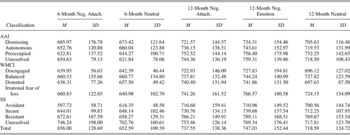
We averaged Stroop response latencies across each condition for the 6- and 12-month assessments by attachment classification (Table 3). We were interested in the query, “How do within-classification response times differ across conditions?” That is, what is the relative difference, within attachment classifications, between response latencies to target conditions (e.g., negative attachment) versus neutral conditions? The question dictates a within-subject design (for contrast of within- and between-subject designs in the context of repeated, multiple observational designs, see Bar-Haim et al., Reference Bar-Haim, Lamy, Pergamim, Bakermans-Kranenburg and van IJzendoorn2007; Bush, Hess, & Wolford, Reference Bush, Hess and Wolford1993). This design is extremely sensitive, in so far as it controls for within-subject measurement error and random fluctuations between subjects. We followed the data analytic recommendations of Bush et al. (Reference Bush, Hess and Wolford1993). These recommendations are based on Monte Carlo investigation and are designed for within-subject, multiple observation designs, as adopted here. Specifically, we standardized scores within each subject and across conditions. We then range corrected the scores by subtracting the subject's lowest score from each of her other responses and dividing the difference by the range. Bush et al. demonstrated that the success of the Z and range-corrected transformations results from scaling the subject's effect size in terms of his/her dispersion. We then eliminated the highest and lowest score for each subject in each condition. Finally, we log transformed the scores to more fully approximate normality of distributions. Ultimately, the transformed scores correlated with the untransformed scores of .88 and .77 at 6 and 12 months, respectively.
Stroop reaction time (ms) across AAI, WMCI, and SS classifications (N = 47)
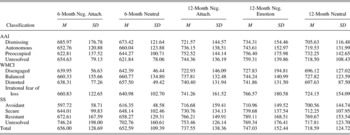
Note: AAI, Adult Attachment Interview (Main & Goldwyn, Reference Main and Goldwyn1994); WMCI, Working Model of the Child Interview (Zeanah et al., Reference Zeanah, Benoit, Hirshberg, Barton and Regan1994); SS, Strange Situation (Ainsworth et al., Reference Ainsworth, Blehar, Waters and Wall1978).
Having transformed the data, we assessed stability of Stroop latency from 6 to 12 months. It proved stable for all conditions, rs between .45 and .47, p < .01 in every case. Before assessing for hypothesized differences, we evaluated the data in search of unpredicted differences. We found no consistent differences with respect to secure and insecure attachment. Nor did we find differences between negative attachment and negative emotion conditions; we therefore combined these conditions. We addressed our hypotheses as follows.
Hypothesis Set 1
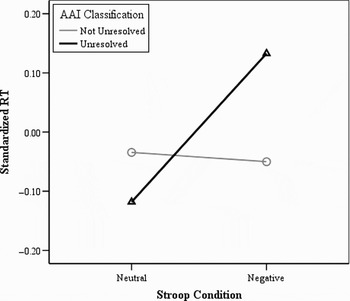
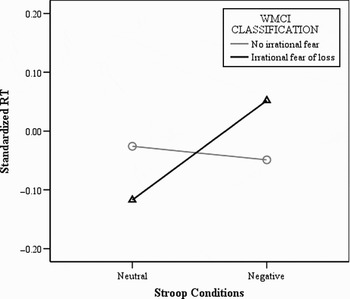
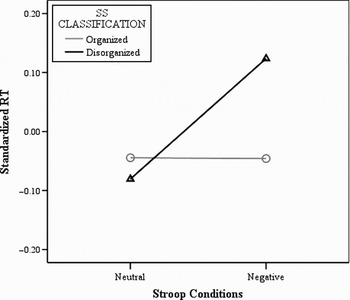
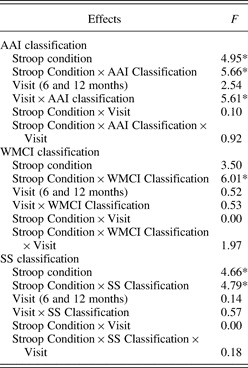
We hypothesized that mothers classified as unresolved on the AAI, evincing irrational fear of loss of the child on the WMCI, or having infants with disorganized attachment in the Strange Situation show greater latency to respond to threat stimuli than to neutral stimuli. Women classified as not unresolved, not having irrational fear of loss of the child, or with children with organized attachment have more comparable response times across threat and neutral conditions. To assess these hypotheses, we conducted two-way repeated measures analyses of variance for the AAI, WMCI, and Strange Situation (N = 47). In each case, attachment classification (“organized,” “disorganized”) and Stroop condition (negative attachment/emotion, neutral) served as independent variables, time (6 and 12 months) served as repeated measure, and Stroop reaction time was dependent variable. In every instance, the Attachment Classification × Stroop Condition interaction was significant (Table 4) interactions are illustrated in Figures 1, 2, and 3. These analyses demonstrate that mothers in the disorganized group show relatively greater latency to respond to threat stimuli than to neutral stimuli, whereas the response times of mothers in the organized group are more comparable across threat and neutral conditions.
The Stroop reaction time (RT) by AAI classification (N = 47).

The Stroop reaction time (RT) by WMCI classification (N = 47).

The Stroop reaction time (RT) by Strange Situation (SS) classification (N = 47).

Stroop reaction time by AAI, WMCI, and SS classifications

Note: AAI, Adult Attachment Interview (Main & Goldwyn, Reference Main and Goldwyn1994); WMCI, Working Model of the Child Interview (Zeanah et al., Reference Zeanah, Benoit, Hirshberg, Barton and Regan1994); SS, Strange Situation (Ainsworth et al., Reference Ainsworth, Blehar, Waters and Wall1978).
* p < .05.
Hypothesis Set 2
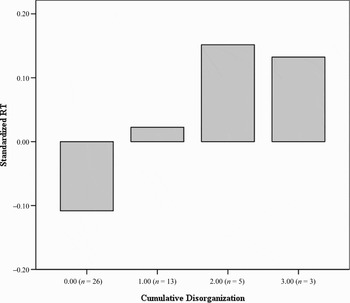
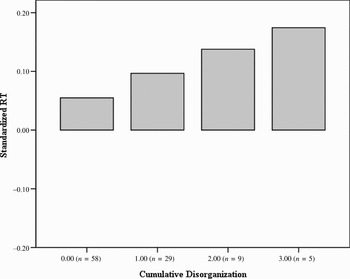
We predicted that the mother–infant dyad's “cumulative disorganization score” (varying from 0 to 3, according to whether the dyad was never classified disorganized or was disorganized on one or more of the AAI, WMCI, or Strange Situation) is positively related to the difference between threat and neutral latency to response times at 6 and 12 months. This hypothesis was confirmed at 6 months (see Figure 4; ρ = .38, p < .01), and there was a trend toward significance at 12 months (ρ = .22, p < .10) using the sample of 47. To resolve ambiguity in the latter case, we repeated the analysis, this time using the sample of 102 subjects with all necessary data. The relation did prove significant, ρ = .22, p < .05 (see Figure 5). At both ages, the greater the number of times a dyad was classified disorganized, the greater the difference in response times to neutral and target stimuli.
The relation between the cumulative disorganization score and the relative Stroop reaction time (RT) at 6 months.

The relation between the cumulative disorganization score and the relative Stroop reaction time (RT) at 12 months.

Hypothesis Set 3
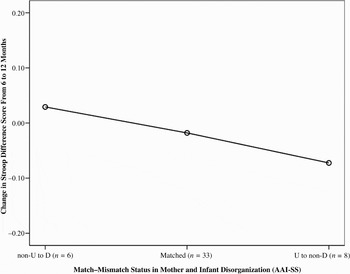
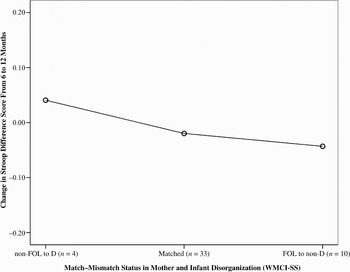
We hypothesized that the match–mismatch state between (a) AAI and Strange Situation classifications and (b) WMCI and Strange Situation classifications is related to the difference between 6-month and 12-month Stroop latencies to threat stimuli. To assess this hypothesis, we coded mother–infant matches (e.g., mother not unresolved, infant organized; mother unresolved, infant disorganized) as 0 (to represent “no difference” or comparability in the mother and infant classifications); we coded mismatches involving maternal organization and infant disorganization as –1 (to represent the “loss” of organization in the dyad) and mismatches involving maternal disorganization and infant organization as +1. We then subtracted Stroop threat stimulus latencies from neutral stimulus latencies for each subject (to represent latency to respond to threat in relation to latency to respond to neutral stimuli). Finally, we subtracted the difference score derived thereby for the 12-month data from the difference score for the 6-month data (this gave us the difference between 6- and 12-month latencies to threat stimuli relative to neutral stimuli). We correlated this score (6-month relative reaction time minus 12-month relative reaction time) with the attachment match-mismatch score (−1, 0, +1). This correlation proved significant for both the AAI, ρ = −.34, p < .05 and the WMCI, ρ = −.32, p < .05 (Figures 6 and 7). The match–mismatch status in mother and infant attachment classifications is related to differences in maternal Stroop response time from 6 to 12 months.
The relation between the change in the Stroop reaction time between 6 and 12 months and match/mismatch status on the AAI and Strange Situation (SS); ρ = −.34, p < .05; U, unresolved; D, disorganized. Mothers classified as resolved on the AAI prenatally but who have organized infants at 12 months show a relative increase in response times to negative Stroop stimuli from 6 to 12 months. Mothers whose attachment classification is consonant with that of their infants show relatively constant response times. Mothers who are unresolved prenatally but who have organized infants show a relative decrease in response times to negative Stroop stimuli from 6 to 12 months.

The relation between the change in the Stroop reaction time between 6 and 12 months and match/mismatch status on the WMCI and Strange Situation (SS); ρ = −.32, p < .05; FOL, fear of loss; D, disorganization. Mothers classified as having no irrational fear of loss on the WMCI prenatally but who have disorganized infants at 12 months show a relative increase in response times to negative Stroop stimuli from 6 to 12 months. Mothers whose attachment classification is consonant with that of their infants show relatively constant response times. Mothers who have an irrational fear of loss prenatally but who have organized infants show a relative decrease in response times to negative Stroop stimuli from 6 to 12 months.

Discussion
We hypothesized that automatic attentional processes are related to organized and disorganized internal working models as assessed by three measures of attachment classification. We assessed mothers' mental representations of their own childhood attachment experiences (AAI) and of their (projected) relationships with their children (WMCI) in the third trimester of pregnancy. We observed these participants' infants in the Strange Situation at 12 months. At 6 and 12 months, we administered emotional Stroop tasks to the mothers, with negative attachment/negative emotion and neutral conditions. Three broad hypotheses were validated. (a) Stroop response latency is related to AAI, WMCI, and Strange Situation classifications. Mothers classified as unresolved, mothers experiencing irrational fear of loss, and mothers with disorganized infants (all of whom we generically refer to as “disorganized”) showed slower response times to threat stimuli, compared to neutral stimuli, than mothers in the corresponding organized groups. (b) The greater the number of times a dyad was classified as disorganized, the slower was the mother's response time to threat stimuli, compared to neutral stimuli. (c) Change in Stroop response latency from 6 to 12 months on threat stimuli, relative to neutral stimuli, was associated with the match status of mother–infant attachment classifications (e.g., mothers classified unresolved prenatally with organized infants at 12 months showed the greatest relative reduction in response latency to target words).
These findings demonstrate associations between representational models of attachment and automatic information processing. This validates a central assumption of attachment theory: Automatic processes are integral to mental representations. The present findings validate Bowlby's (1980) basic model of information processing: (a) sensory inflow can be processed outside awareness (b) and its meaning determined, (c) so that it influences behavior, in this case, latency to respond (and, possibly behavior toward the infant, given that infant disorganization is related to maternal Stroop performance) (d) without the individual being aware of this bias (response differences between neutral and target stimuli were in the order of milliseconds).
More specifically, the findings address the issue of attention allocation and flexibility. As reviewed above, attachment strategies have been conceptualized with reference to flexibility of attention allocation. In the case of disorganized babies, attentional strategies simply collapse under stress. From a behavioral perspective, this collapse manifests in the activation of conflicting response tendencies, which compete for expression, a dynamic reminiscent of that triggered by the Stroop. Similarly, unresolved adults experience lapses in the monitoring of (attention to) reasoning or discourse in discussion of potentially traumatic incidents. The present findings confirm this loss of attentional flexibility under conditions of threat. The conscious intent of all subjects was to label the color of the word stimuli, as instructed. Latency to respond data indicate that disorganized individuals had less control over this conscious intent in the context of negative attachment/negative emotion stimuli.
Bowlby (Reference Bowlby1980) explained this loss of flexibility by means of a multistage theory of perception. He argued that recognition of pattern proceeds from two directions simultaneously. On the one hand, the perception of a stimulus initiates automatic analyses that continue through a series of processing stages. On the other hand and simultaneously, those same stimuli trigger expectations based on memories and knowledge, such that idiosyncratic stimulus meaning conceptually drives information processing. As the two processes merge, they are checked against the stimulus and the task is completed. Although processing in terms of prior experience augments processing speed, it also undermines flexibility. This account is consistent with current cognitive and neurophysiological research, as outlined below.
Clinical cognitive researchers argue that long-term disorders create cognitive “danger schemata” (Mathews & MacLeod, 1985), “fear structures” (Foa, Feske, Murdock, Kozak, & McCarthy, Reference Foa, Feske, Murdock, Kozak and McCarthy1991), or “threat tags” (Williams et al., Reference Williams, Mathews and MacLeod1996), which are activated in times of acute emotional arousal. These information templates are stored in memory and facilitate integration of experiential material. However, when fear structures are activated, they impede access to other structures necessary to integration of information relevant to competing tasks (Foa et al., Reference Foa, Feske, Murdock, Kozak and McCarthy1991). This interpretation, consistent with that of Bowlby (Reference Bowlby1980), suggests that fear structures related to negative attachment/negative emotion among disorganized individuals undermine flexibility of attention allocation. How does this happen?
As mentioned, one advantage of using the Stroop task is that substantial Stroop-related research and theorizing can help in understanding internal working models. Several explanations of the Stoop effect have been proposed, including the connectionist model of Cohen et al. (Reference Cohen, Dunbar and McClelland1990). Simulations of this model replicate most important standard Stroop phenomena (Cohen et al., Reference Cohen, Dunbar and McClelland1990), explain the standard Stroop effect more convincingly than alternate theories (MacLeod, Reference MacLeod1991), and apply to the emotional Stroop task (Williams et al., Reference Williams, Mathews and MacLeod1996). Therefore, we adopt Cohen et al.'s (1990) model to interpret the current data.
Cohen et al.'s (1990) connectionist model utilizes a parallel distributed processing framework to show that processing involves the spread of activation along pathways of interconnected modules (see Cohen et al., Reference Cohen, Dunbar and McClelland1990; Fig. 1). Modules consist of groups of highly interconnected units (see Cohen & Servan-Schreiber, Reference Cohen and Servan-Schreiber1993; Fig. 2) that serve a particular information processing function. The strength of a pathway, defined as those interconnections between units that make up the modules in the pathway, varies. But knowledge, that is, the ability to generate the appropriate response to a particular input, resides in the strength of these module interconnections. The greater the strength of the pathway, the more automatic is the processing of information relevant to it and the greater is the speed and accuracy of response.
In this parallel distributed processing framework, attention is a modulator represented by task demand units (e.g., identify word color) that are functionally analogous to the performance units discussed in the last paragraph. Attentional units are involved in selecting a pathway by altering the strength of connections within it to facilitate processing. Attention modulates the units in the pathway by adjusting their resting levels, sensitizing some (e.g., those involved in color naming) and desensitizing others (e.g., those involved in word meaning) and/or inhibiting some (e.g., those involved in word meaning) and disinhibiting others (e.g., those involved in color naming). However, if two pathways (e.g., color naming and word meaning) operate simultaneously and share individual units, conflicting activation of these units may result, with consequent interference. The greater the strength of the nonselected processing pathway (word meaning), the greater will be the difficulty in desensitizing or inhibiting that connection and the greater its interference with the selected pathway (color naming).
Williams et al. (Reference Williams, Mathews and MacLeod1996) applied this model, derived from the standard Stroop effect, to emotional Stroop findings. Williams et al. (Reference Williams, Mathews and MacLeod1996) argued that emotional Stroop effects evinced in clinical subjects are explained by two factors: current concern/personal salience and stimulus negativity. These considerations are important in the current context because they indicate that negative attachment and negative emotion are issues for the disorganized mother and that they bias attentional processes. Furthermore, the fact that perceived stimulus negativity augments the Stroop effect in both clinical and disorganized samples may provide a clue as to why disorganization represents a risk factor for psychopathology. Specifically, attentional bias is not simply an epiphenomenon of emotional disturbance, but is crucial to its etiologically and maintenance (Posner & Rothbart, Reference Posner and Rothbart2000). Thus, Williams et al. (Reference Williams, Mathews and MacLeod1996) argued that attentional bias contributes to a cycle whereby slight increases in emotional difficulty lead to increased salience of particular stimuli, which in turn, magnifies the emotional aspect of those stimuli. One can imagine, then, how the automatic attentional bias of disorganized individuals toward negative attachment/negative emotion magnifies concern for these issues to the point where they increasingly obviate broader attentional allocation and become psychopathological.
What do the current Stroop data tell us about the mechanics of automatic processing per se? They indicate that the personal salience of negative attachment/emotion stimuli to disorganized mothers augments the resting activation level of input units (units that interpret incoming stimuli) related to attachment and emotion. In effect, what happens is that the experimenter activates the “task demand unit” to name color by so instructing the subject, thereby directing the weight of attentional processes to color naming. This sets off a flow of activation to other units in the network. The direction and degree of this flow are determined by the pattern of connectivity and weights of connections in the network. However, for disorganized mothers, the affective salience of stimuli like “ABANDON,” their greater resting activation level or stronger connections in the word pathway, results in greater activation of intermediate units in the word pathway, despite the fact that the task demand unit involves word color. Although the disorganized mother tries not to attend to word meaning, that meaning serves as a “threat tag,” and activation spreads along the word–meaning pathway, nevertheless. For example, the word “abandon” interferes with the participant's conscious effort to name its color, and it does so without relying on controlled attentional allocation because the bias is “automatic.” As Bowlby (Reference Bowlby1969) argued, “When first received sensory input, derived from an environmental event, is assessed. If judged of no importance, it is blanked off. If judged otherwise, it is amplified” (p. 136). Hesse and Main (Reference Hesse and Main2006) also postulated a parallel distributed processing explanation of information processing in disorganization. Based on the concept of “segregated systems” which are not under central control (Bowlby, Reference Bowlby1980), Hesse and Main (Reference Hesse and Main2006) proposed the parallel functioning of multiple neural nets, such as those described above, each of which compete for prominence in a given thought process.
Moving deeper into the mechanics of automatic processing and the Stroop, target stimuli (in this case, negative attachment/emotion words) may have historical associations with “threat or loss” (Williams et al., Reference Williams, Mathews and MacLeod1996, p. 17) for disorganized mothers. These associations may result in the tagging of input units such that responsivity to these units is subject to neuromodulatory control. Williams et al. (Reference Williams, Mathews and MacLeod1996) mentioned two possible modulating neurotransmitters, norepinephrine (NE) and dopamine (DA). These catecholamines are important in the present context for three reasons: (a) NE and DA augment target neuronal transmission while minimizing less relevant noise (as required for good Stroop performance). (b) NE and DA play a role in nonpsychiatric attentional difficulties (and the current data indicate that disorganized mothers manifest such difficulties). (c) NE and DA are associated with attachment processes broadly. These factors simultaneously implicate NE and DA in attentional processes and attachment disorganization. They are discussed below.
1. NE and DA are involved, ultimately through control of the prefrontal cortex, in suppressing irrelevant responses and selecting newly appropriate behavior (i.e., in selective attention; Robbins, Reference Robbins2005). More specifically, NE and DA likely modulate neuronal activity by simultaneously enhancing the ability of neurons to transmit signals and reducing distortion by noise (Cohen & Servan-Schreiber, Reference Cohen and Servan-Schreiber1993). The functions of NE and DA may be most evident in circumstances involving response choice, where they serve to “tune” and “switch” attention (Oades, Reference Oades1985), particularly where a correct response must compete with a stronger incorrect response (Cohen & Servan-Schreiber, Reference Cohen and Servan-Schreiber1993), as in the case of traditional and emotional Stroop tasks. The functions of NE and DA may be further relevant to the emotional Stroop task because they apply to processes related to both external stimuli (e.g., attention) and internal stimuli (e.g., stress and the consolidation of stimulus traces; Oades, Reference Oades1985). The tuning and switching processes may work, in part, by enhancing working memory (Arnsten, Reference Arnsten1998; Robbins, Reference Robbins2005; in this instance, by enhancing the current task demand to name color) and by inhibiting previously learned contextual rules (Amos, Reference Amos2000; in this case, by inhibiting the anxiety historically associated with target word meaning). We are suggesting that for disorganized mothers, the catecholamine systems may fail to augment the current task demand (name color) and to inhibit the meaning of words historically associated with threat/loss because the latter are “tagged” as threat related. Note how this catecholeminergic explanation provides a neurobiological underpinning for Bowlby's (1980) multistage theory of defense (discussed above), wherein the recognition of pattern proceeds from two directions simultaneously, the stimulus itself and experience-based expectations.
2. The second reason that NE and DA are important in the present context is as follows. The prefrontal cortex is influenced by multiple afferent neurochemical systems from the major monoamine and cholinergic neurotransmitter systems (Robbins, Reference Robbins, Myslobodsky and Weiner2000). All these neurotransmitters are implicated in neuropsychiatric abnormality, many of which involve the failure to adequately regulate behavior in the face of changing environmental demands, leading to impulsive and inflexible response (Robbins, Reference Robbins2005). However, only two of these neurotransmitters in particular, NE and DA, also undermine cognitive and attentional flexibility in more typically developing individuals under conditions of uncontrollable stress (Arnsten, Reference Arnsten1998). This is relevant here because disorganization is a nonpathological condition defined by poorly controlled stress. It is possible that for disorganized individuals, very high levels of catecholamine release during exposure to a stressor, in this instance negative attachment/negative emotion stimuli, disrupt the working memory function of the prefrontal cortex.
3. More generally, NE and DA play an especially important role in attachment. Thus, Kraemer (Reference Kraemer1992), in his psychobiological model of attachment, emphasized that catecholamine levels vary with rearing conditions in nonhuman primates. For example, attachment stress produces alterations in NE (Clarke et al., Reference Clarke, Hedeker, Ebert, Schmidt, McKinney and Kraemer1996) that persist indefinitely (Higley, Suomi, & Linnoila, Reference Higley, Suomi and Linnoila1991) and undermine the coordinated function of NE and DA (Kraemer & Clarke, Reference Kraemer and Clarke1990). Kraemer (Reference Kraemer1992) proposed that NE and DA are central aspects of the “caregiver-icon,” the collective of neuronal structures/environment that represents the self in relation to the caregiver. Schore (Reference Schore, Sanville and Ruderman2003) also described the special role of NE and DA in attachment, noting that these catecholamines enervate the prefrontal orbital cortex (particularly in the right hemisphere). This locus likely consolidates attachment representations and plays an important role in directing attention, in part through its connections with the anterior cingulate (also modulated by DA [Fan, Fossella, Sommer, Wu, & Posner, Reference Fan, Fossella, Sommer, Wu and Posner2003] and NE [Abraham, Delanoy, Dunn, & Zornetzor, Reference Abraham, Delanoy, Dunn and Zornetzer1979]), a structure centrally involved in standard and emotional Stroop response (Compton et al., Reference Compton, Banich, Mohanty, Milham, Herrington and Miller2003; Whalen et al., Reference Whalen, Bush, McNally, Wilhelm, McInerney and Jenike1998)}. Not only are NE and DA involved in attachment generally, but a direct association has been found between DA and disorganized attachment. Based in part on evidence that the DA D4 receptor (DRD4) gene is implicated in attentional, cognitive and emotional processes (which, of course, are particularly relevant in the current context), several investigations (Gervai et al., Reference Gervai, Nemoda, Lakatos, Ronai, Toth and Ney2005; Lakatos et al., Reference Lakatos, Nemoda, Toth, Rosen, Ney and Sasvari-Szekely2002; Lakatos et al., Reference Lakatos, Toth, Nemoda, Ney, Sasvari-Szekely and Gervai2000; van IJzendoorn & Bakermans-Kranenburg, Reference Van IJzendoorn and Bakermans-Kranenburg2006) confirmed DRD4 involvement in attachment disorganization; it appears that maternal unresolved loss or trauma is associated with infant disorganization, but only in the presence of the DRD4 seven-repeat polymorphism (van IJzendoorn & Bakermans-Kranenburg, Reference Van IJzendoorn and Bakermans-Kranenburg2006). This is interesting because the DRD4 gene is associated with difficulty in resolving conflict (Posner & Rothbart, Reference Posner and Rothbart2007), a commonality of both disorganization and Stroop performance. The present findings, indicating that disorganized mothers show greater latency to respond to threatening stimuli than to neutral stimuli on Stroop tasks, provide convergent validity for models implicating NE and DA in attachment processes and suggest ways in which these catecholamines may influence functional attachment behavior, namely, by augmenting an automatic attentional response to negative attachment/emotion stimuli at the expense of controlled and flexible attention to other aspects of the environment.
Considerations such as those above are also useful in updating attachment theory. To explain individuals' ability to selectively attend to some stimuli while excluding others from consciousness, Bowlby (Reference Bowlby1980) followed Horn (Reference Horn, Lehrman, Hinde and Shaw1965, Reference Horn and Desiraju1976). Horn (Reference Horn, Lehrman, Hinde and Shaw1965) noted, “signals elicited by stimuli to which an organism attends are treated differently in the nervous system from those elicited by stimuli to which it does not attend” (p. 205). He argued that the responsivity of some neuronal groups could be temporarily augmented and that temporary reductions in the responsivity of other neuronal groups could be attained by reducing the levels of what Bowlby (Reference Bowlby1980) termed, “a special priming input which these neurons require” (p. 51). Although Horn (Reference Horn, Lehrman, Hinde and Shaw1965) speculated on what this “special priming input” might be, he accepted that “such a notion is in advance of our present physiological knowledge” (Horn, Reference Horn and Desiraju1976, p. 295). The neuromodulatory role of NE and DA was recognized subsequent to Horn's (1976) speculations (Oades, Reference Oades1985), but these catecholamines are almost certainly two of the “special priming inputs” that Bowlby (Reference Bowlby1980) recognized must be facilitating attentional processes.
The present data do not bear on catecholamines directly, of course, and our purpose is not to examine fully the neurobiological mechanisms implicated in emotional Stroop processing (this would involve review, for example, of the anterior cingulate [Egner & Hirsch, Reference Egner and Hirsch2005; MacLeod & McDonald, Reference MacLeod and MacDonald2000] and its relations to the right orbitofrontal cortex (Schore, Reference Schore, Sanville and Ruderman2003), and bilateral occipitotemporal and amygdala areas (Compton et al., Reference Compton, Banich, Mohanty, Milham, Herrington and Miller2003) and other loci and systems (Egner & Hirsh, 2005; for a survey of the neuroanatomy of the emotional Stroop task in the context of attachment and mothering, see Gonzalez, Atkinson, & Fleming, in press). Rather, as mentioned, a great advantage of assessing attention with the Stroop task is that we know much about its cognitive and neurobiological underpinnings. We exploit this fact, offering a basic explanation of processing difficulties using an accepted model of Stroop performance (parallel distributed processing) and its neuromodulation (through DA and NE) in an attempt to “fill out” the construct of “internal working model” and move it beyond its role as “useful heuristic” (Belsky & Cassidy, Reference Belsky, Cassidy, Rutter and Hay1995, p. 383).
The present findings and related inference are relevant in the broader attachment context because selective attention is essential for successful organization of higher order behavior (Arnsten, Reference Arnsten1998). This higher order behavior likely includes maternal behavior toward offspring. It is possibly for this reason that the present data show relations between maternal attention and infant attachment organization, to the point where a mismatch between mother and infant is related to a change in Stroop response time between 6 and 12 months. One can imagine, for example, as a mother's attentional strategies become less conflicted, so does her caregiving behavior and, in response, the conflict evinced in the infant's behavior. What might lead to these changes in attentional strategy is unclear, although researchers have discussed modification of working models in the context of major life transitions, including the birth of a child (Feeney & Noller, Reference Feeney and Noller1996). Collins and Read (Reference Collins, Read, Bartholomew and Perlman1994) argued that significant changes in a person's social environment may disconfirm existing models.
Although the present data do not bear directly on the issue of change, previous research has shown that attentional style, as assessed by maternal self-report, is related to both maternal affect and behavioral responsivity to the infant (Atkinson et al., Reference Atkinson, Scott, Chisholm, Blackwell, Dickens and Tam1995). Furthermore, meta-analytic data show that the prediction of infant attachment security from observations of maternal responsiveness is strongest when the mother is obliged to divide her attention between infant and another task and the observer is provided with detailed, behavior-based instrumentation guiding his/her sensitivity observations (r = .49), weaker when the mother must divide attention but the observer is not provided with a strong attentional prosthesis (r = .34), and weakest when the mother's attention is undivided (e.g., mother feeds child, with no distractions) and the observations are relatively unaided (r = .22; Atkinson, Paglia, et al., Reference Atkinson, Paglia, Coolbear, Niccols, Poulton, Leung, Tarabulsy, Larose, Pederson and Moran2000). Atkinson, Paglia, et al. (Reference Atkinson, Paglia, Coolbear, Niccols, Poulton, Leung, Tarabulsy, Larose, Pederson and Moran2000) concluded, “effective attention allocation … lie[s] at the core of sensitive interaction” (p. 49).
Although it is too early to discuss at length the implications of these findings for intervention, we do note some interesting findings in the cognitive behavior therapy (CBT) literature, by way of example. Specifically, Goldapple et al. (Reference Goldapple, Segal, Garson, Lau, Bieling and Kennedy2004) demonstrated that successful CBT resulted in metabolic changes (as assessed with positron emission tomography) to various regions of the prefrontal cortex, including areas of the dorsal anterior cingulate cortex. Of interest, these areas have specifically been implicated in emotional Stroop processing (Gonzalez et al., in press). Based on their findings, Goldapple et al. (Reference Goldapple, Segal, Garson, Lau, Bieling and Kennedy2004) suggested that CBT-induced changes in these regions may influence directed attention and reduce bias toward the processing of negative information. Furthermore, the anterior cingulate is strongly linked to areas mediating empathy, impulse control, and attitude processes (Lieberman, 2007), all presumably related to sensitivity of parenting. These data provide further evidence for the convergence of cognitive and attachment theories (Maier, Bernier, Atkinson, & Corcoran, in press; McBride & Atkinson, in press) and for the potential role of CBT in the context of attachment (McBride, Atkinson, Quilty, & Bagby, Reference McBride, Atkinson, Quilty and Bagby2007).
Our data indicate that disorganized individuals show a disruption in controlled processing in the face of threat/loss stimuli. We argued that this might impede the organization of higher order attachment behaviors. By way of caveat, however, we note that automatically processing stimuli that are historically associated with threat/loss may be adaptive in some instances. Much has been written about the adaptive nature of “suboptimal” attachment patterns (Belsky, Reference Belsky, Cassidy and Shaver1999). Of relevance in the current context, Arnsten (Reference Arnsten1998) argued that under conditions of acute danger, it might be advantageous to foreclose controlled processing in favor of habituated and environmentally dependent processes that have ensured survival in the past. Indeed, many controlled processes associated with the prefrontal cortex are undermined by stress, whereas automatic processes are improved, especially in instances where the individual has limited control over the stressor. Furthermore, NE and DA are particularly important to this process (Arnsten, Reference Arnsten1998). Thus, uncontrolled attentional allocation to negative attachment/negative emotion stimuli may be (or may have been) adaptive for disorganized mothers, for whom such stimuli may be (or may have been) associated with real threat, either to self or infant.
There are limitations to this study, of course. First and foremost, the sample size is small, a shortcoming that is particularly pronounced when the subjects are divided into cells. Second, most of the attachment and Stroop data were not collected concurrently, so we cannot derive an estimate of contemporaneous functioning. The data are correlational, precluding insight as to whether attachment representations influence attentional capacity or vice versa, whether the relation is transactional, or whether the relations derive from some third underlying variable(s). In contrast, we replicated all findings across a 15-month time span using multiple attachment assessments, repeated and different Stroop tasks, and multiple analyses, all of which underscore the reliability of results. It is true that the present findings need replication, but the fact that they were consistent in this study across time, assessment, and analysis does confer some assurance of their reliability.
The data were consistent not only in showing differences between organized and disorganized dyads but also in failing to demonstrate differences between secure and insecure dyads. Past findings comparing secure and insecure individuals have been inconsistent, with some showing predicted differences, some showing no differences, and some showing unanticipated differences. Generally speaking, the pattern of findings across previous studies and the present one suggest that investigators must match the information processing task to the attachment discrimination attempted. For example, the emotional Stroop task may be particularly sensitive to differentiating between organized and disorganized dyads because it foments conflict between fear and attachment in an effort to disrupt controlled processing, a mark of disorganized attachment. The Stroop may fail to discriminate between organized secure and organized insecure individuals because these classifications are not defined in terms of disorientation under conflict. As another example of successfully matching the information processing task with the attachment discrimination attempted, Dozier and Kobak (Reference Dozier and Kobak1992) found that increased skin conductance was associated with avoidance on the AAI, presumably because increased skin conductance is related to inhibition, a defining feature of dismissing attachment. Lynch and Cicchetti (Reference Lynch and Cicchetti1998) found that compared to insecure children, secure children better recalled positive attributes that they had said did not describe their mothers on an incidental recall task. Given that glucorticoids are released at higher levels in the context of stress, that they are released at higher levels in children with insecure attachment than secure attachment in response to stress, that they damage the hippocampus, and that the hippocampus mediates recall (Lynch & Cicchetti, Reference Lynch and Cicchetti1998), one would expect greater recall flexibility on the part of secure participants, as Lynch and Cicchetti (Reference Lynch and Cicchetti1998) demonstrated. Such findings indicate that the information processing task applied must be carefully aligned with the attachment discrimination attempted.
We summarize with Main et al.'s (1985) definition of an internal working model, quoted earlier: “The internal working model is a set of rules for obtaining or limiting access to … information” (p. 67). Central to this definition is the issue of attentional bias. In this article, we discussed attentional bias in terms of instrumentation (AAI, WMCI, and Strange Situation), which assesses controlled attention (either flexible or inflexible, in the case of organized attachment) or the loss of controlled attention (in the case of disorganized attachment). This same process of loss of controlled attention is reflected in the notion of “threat tags” (as expounded by clinical researchers), the automatic propagation of signals along pathways of interconnected modules (as elucidated by connectionist models), and the biasing of neuronal responsivity (as defines neuromodulation). Only by exploring the internal working model across multiple explanatory levels can we fully validate it and understand its role as a potential risk factor for psychopathology.
Appendix A
6-Month Stroop stimuli

12-Month Stroop stimuli