Antibiotics have revolutionized healthcare by treating and preventing life-threatening infections for patients requiring surgical procedures. However, unintended consequences of antibiotic use, worsened by unnecessary use, are the development of antibiotic resistant bacteria and adverse drug events including Clostridium difficile infections (CDI), which harm children every year.Reference Logan, Braykov and Weinstein1–Reference Herigon, Hersh and Gerber5 The current rate of antibiotic resistant infections is now considered a major worldwide public health crisis by the World Health Organization.6,7
Significant antibiotic overuse occurs among children undergoing surgical procedures. Although the Centers for Disease Control and Prevention (CDC) surgical site infection (SSI) prevention guideline does not recommend postoperative prophylactic antibiotics after incision closure for clean or clean-contaminated surgical cases,Reference Berrios-Torres, Umscheid and Bratzler8 empirical literature shows prolonged postoperative antibiotic courses occur in an estimated 40% of surgical cases.Reference Sandora, Fung and Melvin4,Reference Rangel, Fung and Graham9 Even 1 additional dose of surgical prophylaxis in a child is associated with a 6-fold increased risk for CDI, which may have serious consequences, including mortality.Reference Sandora, Fung and Melvin4
Unnecessary postoperative antibiotic use is an ideal target for antibiotic stewardship programs (ASP) to address. ASPs implement coordinated strategies (e.g., prospective audit with feedback) to optimize antibiotic prescribing, which may subsequently reduce the emergence of antibiotic-resistant bacteria and the occurrence of adverse drug reactions, including CDI. The Infectious Disease Society of Americaʼs antimicrobial stewardship guideline recommends implementing interventions to reduce antibiotic therapy to the shortest effective duration,Reference Barlam, Cosgrove and Abbo10 and studies in pediatrics have demonstrated the ability of ASPs to decrease antibiotic use in hospitalized children.Reference Hurst, Child and Pearce11,Reference Stach, Hedican and Herigon12 Furthermore, data support the importance of ASP collaboration with surgical teams to improve prescription of appropriate antibiotics for the correct duration in clean surgical procedures.Reference Liu, Li and Hao13 However, the best approaches to eliminate or reduce unnecessary prolonged antibiotic courses have not been well established.
Although CDC recommendations incorporate specific contextual factors related to the patient (e.g., severity of illness) and infection (e.g., type of bacteria), these recommendations do not overtly consider other important contextual factors in which reduction strategies are implemented, such as the surgical specialty prescribing the antibiotic.Reference Broom, Broom and Kirby14–Reference Charani, Tarrant and Moorthy17 Theoretical frameworks of ASP intervention delivery suggest that these contextual factors create variability in prescribing practices.Reference Harvey and Kitson18 Therefore, a critical first step to developing effective strategies to eliminate unnecessary postoperative antibiotic prophylaxis is to understand the contextual factors that influence surgeons’ prescribing practices.
Implementation frameworks are useful for conceptualizing the factors that influence the use and integration of evidence in clinical practice, in this case the appropriate use of antibiotics. The integrated framework for Promoting Action on Research Implementation in Health Services (i-PARIHS) is a conceptual framework that has been used successfully in clinical settings. In this framework, successful implementation of evidence into practice is a function of the quality and type of evidence to be implemented, the characteristics of the context where the evidence will be implemented, and the means by which it is integrated or facilitated into practice.Reference Harvey and Kitson18,Reference Hill, Guihan and Hogan19 We used i-PARIHS to explore the factors that contribute to pediatric surgeons’ decisions regarding surgical prophylaxis and thereby inform the development of effective strategies for eliminating excess postoperative antibiotic use in children.
Methods
Sampling, recruitment, and informed consent
We conducted 5 semistructured focus groups with 23 surgeons at a quaternary-care childrenʼs hospital. Pediatric surgical divisions and interventional cardiologists within the pediatric cardiology division were recruited using a purposive sampling approach to represent a variety of specialties and surgical procedures where antibiotic prophylaxis may be warranted. If a division chief agreed to participation, a focus group was scheduled and other members of the division were invited to participate. Consent was obtained from all participants by a research team member prior to the start of the focus group. Participants were not provided any incentive for participation. The Institutional Review Board at Washington University in St Louis approved the protocols.
Data collection and instrument
Each focus group lasted 30–90 minutes and was facilitated by a neutral non-physician to allow for honesty and openness in the conversation. Focus groups were audio recorded and a notetaker was present for each session. An interview guide was created by the research team with guidance from members of the hospital ASP as well as a comprehensive literature review. Open-ended questions were asked about current prescribing practices, views about new guidelines surrounding antibiotic prescribing during surgery, prior education about antibiotic stewardship, and views about the stewardship program at the hospital.
Analysis
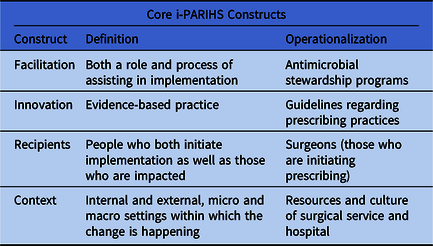
Audio recordings were transcribed verbatim utilizing an online transcription service. The transcripts were de-identified and reviewed for accuracy. The first author developed a code book identifying, defining, and describing codes based on the i-PARIHS framework with feedback from the entire research team. Four primary constructs comprise the i-PARIHS framework: the innovation, recipients, context, and facilitation. Table 1 includes each of the 4 constructs, a definition of each, and how we operationalized it in the context of our study.
Framework Constructs, Definitions, and Operationalization for This WorkReference Harvey and Kitson18

Two broad approaches to qualitative coding were used. The first was categorical coding of i-PARIHS constructs designed to group text on a similar topic together, and the second was thematic coding, which emerged from the text into meaningful, actionable issues that could potentially be addressed through ASP strategies.Reference Saldaña20 The first and second authors coded and analyzed all transcripts separately. The coders then identified any discrepancies in coding or code definition interpretation. The coders discussed discrepancies until 100% consensus was reached.
Results
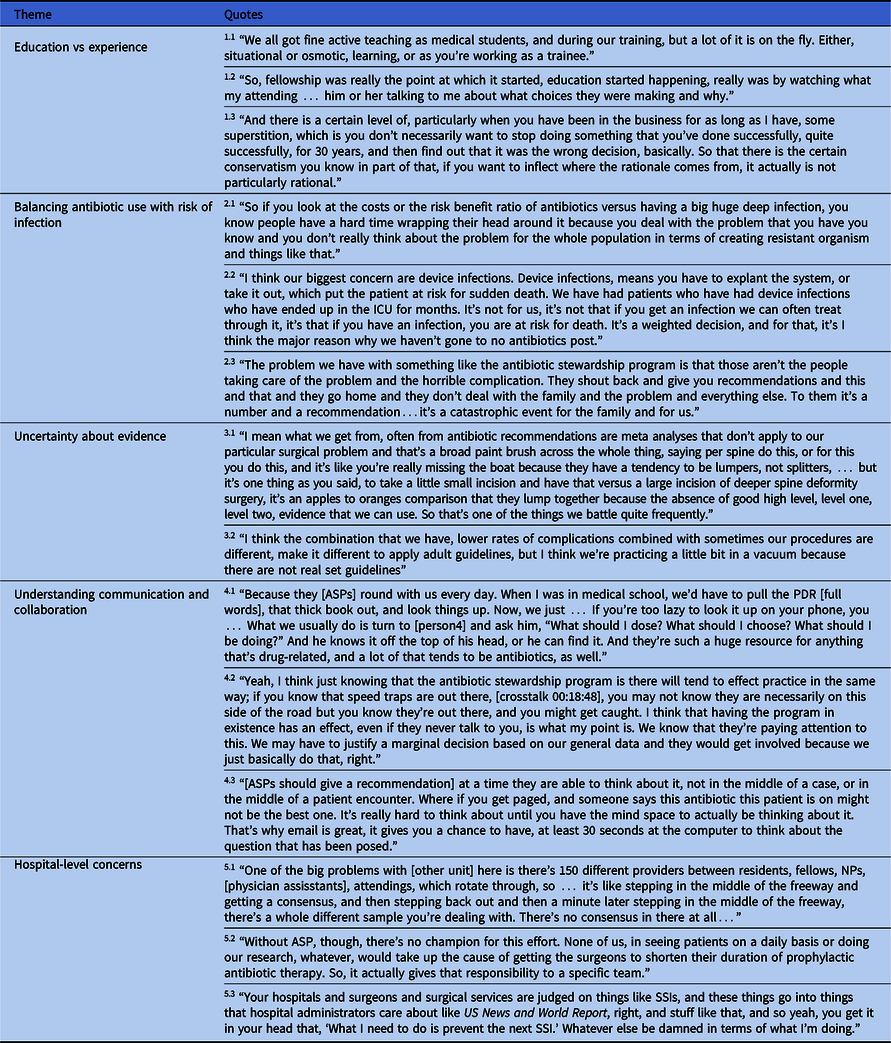
The physicians had a median work experience (post fellowship) of 9 years (range, 0.5–29) and 19 (66%) identified as male. A range of 2–9 surgeons participated in each focus group. The physicians were from the following pediatric specialties: interventional cardiology, cardiothoracic surgery, otolaryngology, general surgery, and orthopedic surgery. Five themes emerged as influencing antibiotic prescribing practices: (1) reliance on previous experience and early education, (2) balancing antibiotic use with risk of infection, (3) uncertainty about the state of the scientific evidence, (4) understanding importance of communication and team collaboration, and (5) hospital-level concerns. Themes and examples of quotes can be found in Table 2.
Examples of Quotes Related to Each Coding Theme

Reliance on early education and experience
Foremost, surgeons described their primary knowledge of prescribing practices as originating from their early education (quote 1.1). Many reported lack of formal training on prescribing, but instead learned while in early practice, including fellowship (quote 1.2). Many senior surgeons reported that they had not changed their practices since their early training (quote 1.3). This example quote also demonstrated anxiety around and resistance to changing practices the surgeon had used successfully for a number of years. Participants also reported that they rarely received continuing education on the appropriate use of antibiotics in the surgical setting and antibiotic resistance as a means to update their knowledge.
Balancing antibiotic use with risk of infection
Surgeons weighed both the risks and benefits for the patient when making decisions about antibiotic prescribing. Surgeons recognized risks of overprescribing including development of antibiotic resistant bacteria, adverse drug reactions, cost, and CDI. However, surgeons often prioritized the primary risk of underprescribing, namely, the development of a SSI requiring further extensive medical intervention (quote 2.1). This concern was more acute among surgeons in specific subspecialties like orthopedics (quote 2.2). Interestingly, when asked if surgeons were concerned about contributing to the development of multidrug-resistant organisms, they felt their contribution was minimal and the issue was of greater concern in other contexts, such as critical care units, outpatient settings, and nursing homes. Furthermore, surgeons reported feeling solely responsible for adverse outcomes in their patients that their stewardship colleagues did not have to address (quote 2.3).
Uncertainty about the scientific evidence
All groups mentioned the lack of pediatric specific data to support guidelines in their practice (quote 3.1). In addition, participants commonly mentioned the uniqueness of each patient and therefore an unwillingness to change their antibiotic practices without first having evidence of high quality and direct relevance to their specific subspecialty and/or a specific procedure (quote 3.2). This comment suggests that even evidence demonstrating no increased risk of SSI with the elimination of postoperative prophylaxis among children would still be insufficient for many subspecialists, who would rely on high-quality evidence within their own respective surgical area to change their prescribing practice.
Understanding communication and collaboration between surgeons and ASPs
Surgeons cited communication and collaboration with infectious disease (ID) specialists and the ASP as a significant influence on their antibiotic use. Surgeons recognized the value of both ID specialists and the ASP in their respective roles and expertise (quote 4.1). However, all indicated that such collaboration was more challenging in the clinical setting (quote 4.1). Surgeons often characterized collaboration with ASPs and ID physicians as a “negotiation” in which each respective party was trying to get as much of their own preference as possible. Surgeons also likened ID collaboration to a “speed trap” (quote 4.2) in which the surgeon tried to evade ASP or ID physicians. The implications in these descriptions were that communication between specialties was often contentious and that surgeons were often not interested in input from these specialists.
Furthermore, surgeons routinely discussed communication preferences and how the communication route impacted their receptivity to input from ID and ASP clinicians (quote 4.3). Although this participant indicated preference for email communication, which allowed time to consider the issue, other participants described disliking automated electronic communications. However, surgeons made several suggestions about how to improve collaboration: routine educational presentations, consistent data collection and reporting, reliable monitoring of SSIs within the hospital, and providing antibiograms to aid in selecting antibiotics for treatment for infections. Finally, surgeons expressed interest in receiving both more feedback on infections and surgical outcomes, and updates on current scientific evidence.
Hospital-level concerns
Several structural issues emerged at the departmental and hospital levels that influenced the use of antibiotics in surgical patients. First, surgeons reported rarely, if ever, reviewing electronic health record standardized order sets within their specialties or having them revised by leaders like department chairs. Among the only specialty that reported reviewing order sets, the most recent revisions had occurred 5 years prior. Second, surgeons expressed frustration in the variability in antibiotic use based upon the patientʼs location, time of day of prescribing, and medical specialty caring for the patient (quote 5.1). These quotes suggest that while the surgeon felt that they prescribed antibiotics appropriately, other departments might have a large influence on the antibiotics being given. To reduce this variability, surgeons expressed interest in broadening the presence of ASP to provide consistent advice on antimicrobial use (quote 5.2). Finally, surgeons expressed pressure from hospital administrators to avoid SSIs due to hospital reporting of metrics (e.g., quote 5.3), which influence national ranking within their specialties and of the hospital. As such, surgeons were further motivated to avoid SSIs through overprescribing rather than considering the adverse events possible with antibiotic use.
Discussion
Few studies have examined the beliefs and perceptions among pediatric surgeons surrounding prescribing practices and other contextual factors influencing antibiotic use. In alignment with the i-PARHIS framework, this study identified a complex set of factors that contribute to surgeonʼs antibiotic prescribing behavior. Furthermore, additional evidence on the safety in eliminating postoperative antibiotics in clean and clean-contaminated cases specific to the context of these surgeons is needed. Finally, these results indicate several strategies that ASPs might leverage to improve antibiotic prescribing for children undergoing surgical procedures.
Factors influencing prescribing behavior
Foremost, surgeons referenced their individual evaluation of risk and benefit with regard to antibiotic use. Although they understood the long-term outcome of antibiotic resistance from unnecessary antibiotic use, our results suggest the negative consequences of an SSI were much more concerning and prominent in the minds of surgeons. The literature suggests that conceptualizing risk and benefit accurately is challenging for physicians, who often underestimate potential harms of their medical treatment.Reference Hoffmann and Del Mar21 Second, surgeons did not report formal or ongoing education regarding antibiotic prescribing. Aside from a few individuals, primarily surgeons early in their career, most surgeons commented that they had not received feedback or further education on current evidence regarding antibiotic prescribing. This lack of ongoing education dedicated to appropriate antibiotic use and potential negative consequences contributed to different mental models surrounding the complexity of prescribing and a lack of practice standardization among surgeons and departments. Finally, physicians were skeptical of the evidence informing the CDC guideline. Although literature and guidelines are the most common dissemination format for current evidence regarding appropriate antibiotic use, physicians often are distrustful of the literature and guidelines and their application to their patient population.Reference Flores, Lee and Bauchner22–Reference Finkelstein, Lozano and Shulruff24
Our findings point to several contextual factors that may also inadvertently contribute to inappropriate antibiotic use: the interaction between the surgeons and other specialties; a lack of consistent prescribing across surgical specialties; and pressure at the hospital-level to reach certain performance measures. Surgeons clearly articulate that team dynamics and structured workflow within the hospital affect the way that antibiotics are prescribed. For example, surgeons perceived their interaction with ASPs as neutral at best and adversarial at worst. Presumably, a poor relationship interferes with the ability of ASPs to make recommendations about the most appropriate practices. In another example at the departmental level, standard order sets or use of a shared advanced practice professional for multiple surgeons can alter prescribing practices. Yet, order sets were rarely updated to reflect current evidence. In addition to these interprofessional challenges, surgeons reported pressure from hospital leaders to ensure low rates of SSIs. In the current healthcare environment, hospital administrators face pressure to demonstrate delivery of high-quality care as reflected by measures such as patient satisfaction scores and hospital rankings in publications such as US News and World Report. To address this pressure and optimize postoperative outcomes, surgeons believed that overprescribing antibiotics was a mechanism to reduce the risk of SSI for the patient and improve hospital performance measures but discounted the potential harm of the antibiotics (i.e. antibiotic resistant bacteria, CDI).
Potential for ASP implementation
These results suggest several potential opportunities for improving antibiotic prescribing practices among surgeons. Providing ongoing educational opportunities for surgeons is an ideal starting point, due to surgeon reliance on experience from initial surgical training and limited continuing education. In alignment with the i-PARHIS framework, we recommend that education should address both the current evidence and the perceived risks associated with implementing new CDC guidelines. Further, teams must focus on surgery or site-specific evidence, such as recent SSI occurrences, to help update surgeons on the current evidence and to mitigate concerns. Surgeons also reported an interest in receiving ongoing education both on the current evidence and research as well as information specific to their hospital.
Although education is often insufficient for achieving behavior change, we also emphasize several additional approaches to create systemic change.Reference Davey, Marwick and Scott25 First, there is potential to improve collaboration between the ASP members and surgeons. If surgeons perceive the ASP personnel negatively, they may not be receptive to implementing ASP recommendations. The role of networks and the relationships that comprise them are important for successful implementation of prevention interventions.Reference Szymczak26 Reviews have suggested that interventions based in multiprofessional teamwork, with better communication and common goals, are more effective in healthcare settings.Reference Cunningham, Ward and De Brun27 Second, ASPs may consider approaching departments to update surgical order sets. Since order sets are established to standardize practice around a particular routine and surgeons rarely deviate from order sets, this may support better prescribing practices while distributing the work burden involved in updating order sets amongst different teams, which would result in a wider systemic impact.
Because the strategies previously mentioned are not comprehensive, we also encourage ASPs to consider improvement strategies suggested by the surgeons. Existing research suggests that community-initiated approaches, in this case surgeons, help generate positive outcomes and support for future efforts.Reference Flynn and Hartfield28,Reference Wick, Hobson and Bennett29 Furthermore, in this study, surgeons did not report interventions that they felt were inappropriate or that they resisted. This finding suggests that ASPs may have more latitude than expected to create practice change and develop strategies to facilitate change.
The evidence behind the guidelines
A more complicated concern is the evidence base informing guideline recommendations, and whether they are appropriate in a specific case. In the context of the current study, the CDC guidelines recommend elimination of postoperative antibiotic prophylaxis in clean and clean-contaminated cases based on evidence from adult studies. Because pediatric surgeons question the generalizability of the evidence to children, the CDC guidelines have diminished impact on practice. In addition, evidence from research is only one type of information that practitioners use in clinical decision making. As demonstrated by our study and others, practitioners integrate research, personal experience, local sources of data (e.g., experiences from peers), and patient preferences.Reference Rycroft-Malone, Seers and Titchen30 Therefore, even if postoperative antibiotic studies were conducted specific to a population (i.e. children) and/or procedure (i.e. spinal fusion), surgeons may still perform the inappropriate prescribing practice. Despite this reality, few studies have assessed how different forms of evidence are valued and used by clinicians. Additional research is needed to better understand the sources of evidence, evidence quality deemed credible from the perspective of the provider to prompt practice change, and relative impact on practice of different types of evidence.
This study has several limitations. It was conducted at a single academic medical center with a limited number of providers from surgical specialties. Thus, the work should be repeated with other medical facilities before generalizability can be ensured. However, this work could inform future data collection efforts as well as provide insight into potential strategies for an ASP interested in strengthening its relationships with a surgical program.
In conclusion, our results highlight the complex decision making in postoperative antibiotic prescribing and highlights strategies ASPs may use when working to improve antibiotic prescribing practices. Surgeons weigh multiple factors when making prescribing decisions including the patient risk of infections and their previous learning and experience. In addition, collaboration with ASPs and hospital-level factors impact surgeon prescribing. Through analysis of this work and feedback from surgeons, unique opportunities exist to effectively and efficiently create a reduction in medical overuse while providing safe patient care for children undergoing surgical procedures.
Acknowledgments
The content is solely the responsibility of the authors and does not necessarily represent the official view of the National Institutes of Health.
Financial support
Research reported in this publication was supported by the Washington University Institute of Clinical and Translational Sciences (grant no. UL1TR002345) from the National Center for Advancing Translational Sciences (NCATS) of the National Institutes of Health (NIH). This work was also supported by the Agency for Healthcare Research and Quality (AHRQ grant no. R01 HS26742-01A1), the Center for Dissemination and Implementation, and the Institute for Public Health at Washington University in St Louis.
Conflicts of interest
None of the authors have conflicts of interest to disclose relevant to this work.