1. Introduction
Intensifying adverbs are devices which scale a quality up, down, or somewhere between the two (Bolinger Reference Bolinger1972: 17). To intensify the adjective cool, speakers of British English have a variety of functionally equivalent intensifiers at their disposal. They can use very, really, so, dead, bloody, right and well, among many others.Footnote 1 A seemingly recent arrival to the British intensifier system is proper, as in that was proper cool.Footnote 2 Believed to have entered English from the Latin proprius via Norman French (OED, proper), proper now has a variety of denotations in Present Day English. As an adjective, it can denote suitability (e.g., wear the proper equipment), etiquette (e.g., it wouldn't be proper to do that) and worthiness/authenticity (e.g., it's proper street food). As an adverb, proper can function as an adverb of manner (e.g., we like to do things proper in our house), and a marker of degree (e.g., he is proper tall); the degree function applying exclusively to British English. Some examples of proper intensifying adjectives from the present dataset are reported in (1).Footnote 3
(1)
(a) . . . he's always been proper thin, hasn't he? [BNC2014S, S0458]
(b) that's a proper romantic story [BNC2014S, S0014]
(c) it's proper cheesy [BNC2014S, S0133]
(d) it's like a proper scary job [BNC2014S, S0084]
While a few studies make reference to the intensifier proper (Barnfield & Buchstaller, Reference Barnfield and Buchstaller2010: 272; Stratton, Reference Stratton2018: 807), to date, only Núñez–Pertejo and Palacios–Martínez (Reference Núñez–Pertejo and Palacios–Martínez2018) have investigated its current use and frequency. As the authors point out (Reference Núñez–Pertejo and Palacios–Martínez2018: 122), ‘there are no monographic studies in the literature on [its] use as [an] intensifier[ . . . ], which may be indicative of the current emergence of new uses and functions in this area of intensification.’ In their study, Núñez–Pertejo and Palacios–Martínez (Reference Núñez–Pertejo and Palacios–Martínez2018) examined the intensifier proper, along with the intensifier bare, in Multicultural London English. They found that proper was used mostly by younger speakers ages 16–19. Given the lack of exploration of this emerging intensifier, the present study contributes to this empirical discussion by examining its use in the spoken parts of the two British National Corpora (henceforth, BNC). Since the question of age is pertinent to the ongoing discourse regarding its usage, the stratified spoken components of the corpora are used, namely the BNC1994DS (British National Corpus 1994, Demographic Spoken Sample) and the Spoken BNC2014S (British National Corpus 2014, Spoken Sample).
The present study addresses four research questions. Firstly, has there been a significant change in the frequency of the adjective intensifier proper from 1994 to 2014? Secondly, does any change in frequency correlate with the decrease in frequency of functionally equivalent intensifiers? Thirdly, is there any discernable difference in its collocational distribution from 1994 to 2014? In other words, does proper come to intensify a wider variety of adjectives as time goes on? Finally, does the intensifying use of proper correlate with social factors such as sex or age?Footnote 4
2. Intensifiers
2.1 What are intensifiers?
While a variety of labels have been used to describe intensifiers such as ‘degree words’ (Bolinger, Reference Bolinger1972), ‘degree intensifiers’ (Allerton, Reference Allerton, Steele and Threadgold1987), ‘degree adverbs’ (Peters, Reference Peters and Kastovysky1994) and ‘degree modifiers’ (Paradis, Reference Paradis1997), following previous work (e.g., Ito & Tagliamonte, Reference Ito and Tagliamonte2003; Tagliamonte, Reference Tagliamonte2008; Stratton, Reference Stratton2018), intensifiers are defined as adverbs which have an intensifying function. While the overarching label used to describe intensifiers is not of immediate importance, the distinction between different types of intensifiers is pertinent to the present study. Quirk et al. (Reference Quirk, Greenbaum, Leech and Svartvik1985: 590) differentiate between two major types of intensifiers: ‘amplifiers’ and ‘downtoners’. For the purpose of this study, amplifiers are defined as intensifiers which scale up the meaning of an adjective (e.g., really, so, very) and downtoners are intensifiers which scale down the meaning of an adjective (e.g., a bit, kind of, a little bit). Both intensify the degree of an adjective but in opposite directions. Amplifiers are further sub-divided into ‘boosters’ and ‘maximizers’ according to the degree of amplification. Boosters are amplifiers which heighten the degree of the adjective (e.g., very, so, really) and maximizers are amplifiers which heighten the degree of the adjective to the end point of the scale (e.g., completely, absolutely, utterly). All intensifiers dealt with in the present study, are amplifiers, more specifically, boosters.
2.2 Why study intensifiers?
The rich literature on intensification in the English language has yielded some important findings about language variation and change (Bolinger, Reference Bolinger1972; Paradis, Reference Paradis1997; Ito & Tagliamonte, Reference Ito and Tagliamonte2003; Tagliamonte & Roberts, Reference Tagliamonte and Roberts2005; Tagliamonte, Reference Tagliamonte2008; Barnfield & Buchstaller, Reference Barnfield and Buchstaller2010; D'Arcy, Reference D'Arcy2015; Stratton, Reference Stratton2018; Stratton, Reference Strattonforthcoming). For instance, many quantitative studies have found that the use of intensifiers or specific types of intensifiers can correlate with the sex of the speaker (Ito & Tagliamonte, Reference Ito and Tagliamonte2003; Tagliamonte & Roberts, Reference Tagliamonte and Roberts2005; Tagliamonte, Reference Tagliamonte2008), the age of the speaker (Tagliamonte, Reference Tagliamonte2008), and the social class of the speaker (Macaulay, Reference Macaulay1995). In other words, specific social groups prefer specific intensifiers. Intensifiers are also thought to function as part of a dynamic multi-dimensional system, which means that an increase in frequency of one intensifier, likely correlates with a decrease in frequency of others (Ito & Tagliamonte, Reference Ito and Tagliamonte2003; Tagliamonte & Roberts, Reference Tagliamonte and Roberts2005; Tagliamonte, Reference Tagliamonte2008; Barnfield & Buchstaller, Reference Barnfield and Buchstaller2010). The established sensitivity of intensifiers to social factors and their known nature to compete longitudinally were the motivating factors for research questions two and four.
3. Methodology
3.1 Corpora
The BNC1994DS and the BNC2014S were used to examine the use of the adjective intensifier proper from 1994 to 2014. Both the BNC1994DS and the BNC2014S are reasonably balanced for sex, age and social class and were designed this way with the goal of facilitating sociolinguistic research (Love, Hawtin & Hardie, Reference Love, Hawtin and Hardie2017b). Their balanced design thus provides an opportunity to investigate the social attributes which may be associated with using the adjective intensifier proper. The BNC1994DS consists of 153 texts containing 5,014,655 words (from 341 speakers) and the Spoken BNC2014S consists of 567 texts containing 4,789,185 words (from 376 speakers). The BNC1994DS contains ‘everyday spontaneous interactions’ (Leech, Rayson & Wilson, Reference Leech, Rayson and Wilson2001: 2) and the BNC2014S was designed in a similar way given that it was designed as its counterpart (Love et al., Reference Love, Dembry, Hardie, Brezina and McEnery2017a: 321).
3.2 Coding and Data Processing
Following previous studies on intensifiers (Ito & Tagliamonte, Reference Ito and Tagliamonte2003; Tagliamonte & Roberts, Reference Tagliamonte and Roberts2005, Tagliamonte, Reference Tagliamonte2008; Stratton, Reference Stratton2018), the present study focused on the intensification of adjectives. A corpus search query was run using the appropriate part-of-speech tagging to gather instances where proper occurred before an adjective.Footnote 5 All examples (i.e., tokens) were subsequently checked manually to determine whether proper was functioning as an intensifier. For instance, the search found the examples proper Indian food, proper special effects and it's a proper American diner, all of which are contain the adjective proper, not the intensifying adverb.Footnote 6
4. Results
4.1 The Frequency of proper
The search queries in the two corpora automatically found 16 tokens in the BNC1994DS and 75 tokens in the BNC2014S. However, after carefully weeding through the data, there were only three unambiguous instances of proper intensifying adjectives in the BNC1994DS and only 31 in the BNC2014S. A simple measure which can be used to examine whether there is a statistically significant difference between the frequency of a given variant across two or more corpora is a Log-Likelihood test. In this case, the Log-Likelihood test indicated that the difference in frequency of proper in the BNC1994DS and the BNC2014S was statistically significant.Footnote 7 However, even though this difference is significant, comparing the absolute frequencies of proper is problematic given that there are more words in the BNC1994DS than in the BNC2014S. One way to deal with the unequal number of words per corpus is to normalize the frequency by a common dominator, such as words per 100,000. Doing so estimates that proper had a normalized frequency of .06% in 1994 but this increases to .7% by 2014. However, frequency normalization is also problematic since it does not account for the total number of times proper could have actually been used, but was not. To account for the number of opportunities each speaker had to employ the intensifier proper, both occurrence and absence of each intensifiable context must be accounted for, which means counting the zero contexts (e.g., that was proper boring VS that was ∅ boring). This methodological approach is known as the Principle of Accountability (Labov, Reference Labov1966: 49, Reference Labov1972: 72). According to my estimates, when accounting for the total number of instances proper could have been used, its frequency was .00004 in 1994 but .0003 in 2014; once again indicating an increase in use over the two decades. While its frequency as an intensifier is significantly lower than many competing intensifiers (such as so, very and really), all statistical estimates indicate a significant increase in frequency over the 20-year period. The rate of increase in 1994 to 2014 is 10.6%.Footnote 8
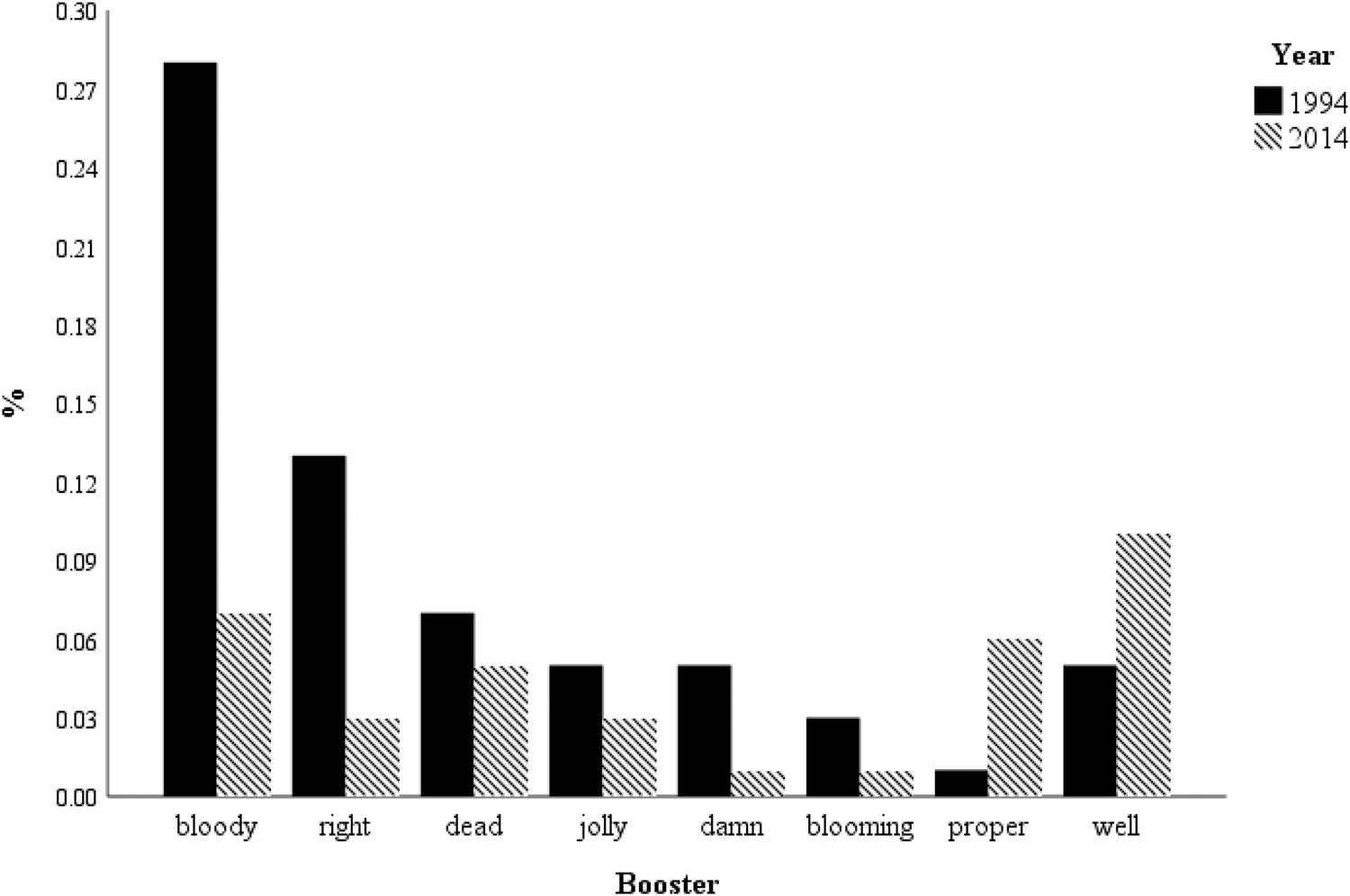
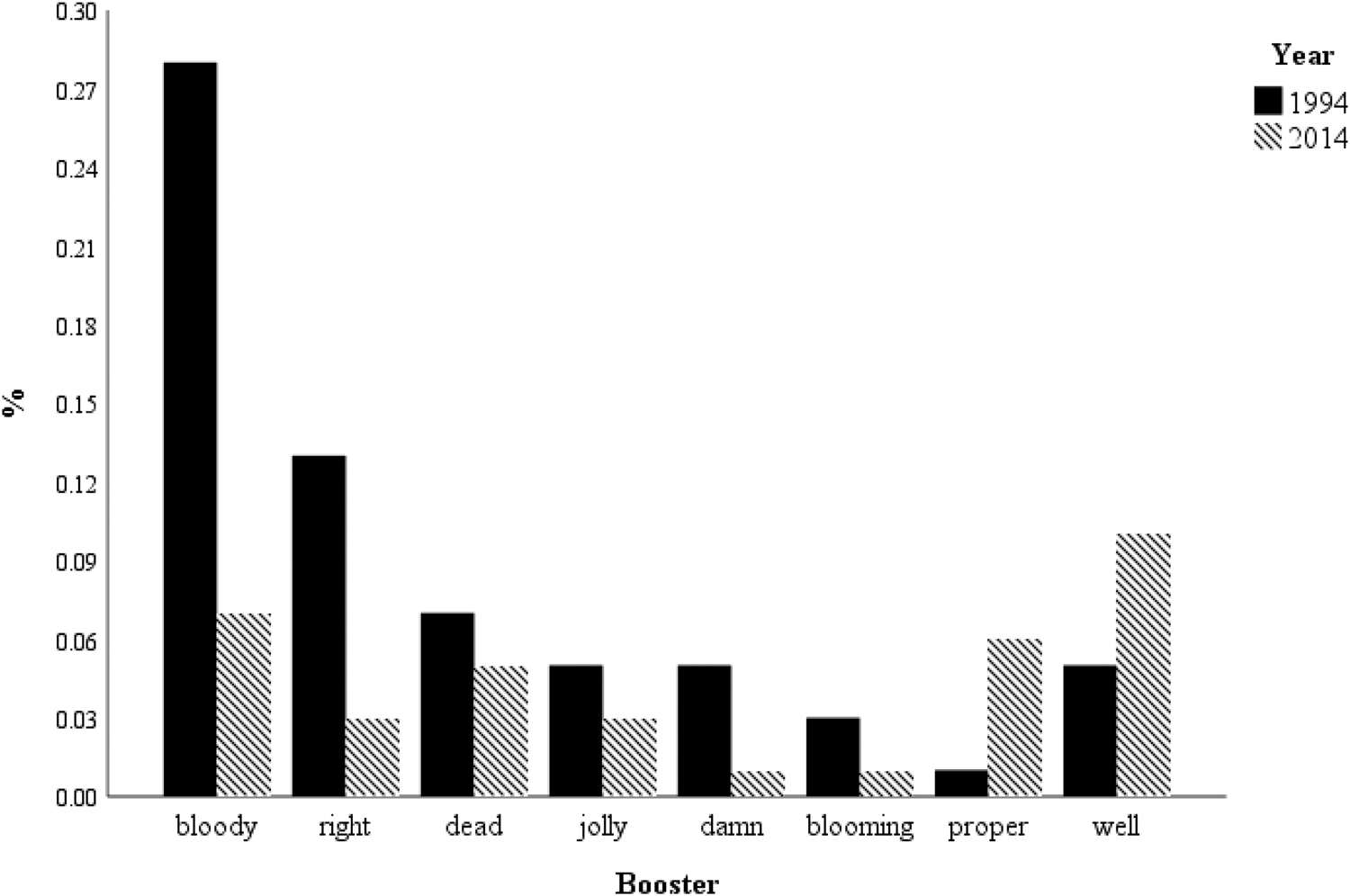
As has been found in previous studies, the top three mostly frequently used boosters were so, really and very (Ito & Tagliamonte, Reference Ito and Tagliamonte2003; Tagliamonte & Roberts, Reference Tagliamonte and Roberts2005; Tagliamonte, Reference Tagliamonte2008). However, when contextualizing the trajectory of the intensifier proper with other competing boosters, its increase correlates with a decrease in frequency of other boosters, as reported in Figure 1. In the BNC1994DS, proper was used less frequently than all other boosters listed. However, by 2014, it was used more frequently than blooming, damn, and jolly. Intensifiers like bloody and right also decrease in frequency by 2014. It has been argued that one of the reasons intensifiers fluctuate in ranking throughout time is that their high frequent use eventually leads to a loss in their intensifying effect (Tagliamonte, Reference Tagliamonte2012: 334). As result, to maintain intensifying power, overused intensifiers are frequently replaced by older or newer intensifiers.
The Intensification Rate of Low Frequency Boosters from 1994 to 2014Footnote 9
4.2 Collocational Distribution
Having determined that the adjective intensifier proper increased in frequency over the two decades, the next question is, has its use changed in any way since 1994? Because there were only three tokens of proper in the BNC1994DS, restricting the collocational analysis to the stratified datasets would not be particularly revealing. Therefore, for the collocational analysis the full corpus datasets were used. In the BNC1994, proper was used 10 times to intensify adjectives, yielding a normalized frequency of .09%. In the BNC2014, proper was used 131 times to intensify adjectives, yielding a normalized frequency of 1.2%.
In the spoken component of the BNC1994, proper intensified seven different adjectives (little, old, decent, pissed off, posh, silly and poorly).Footnote 10 By 2014, the number of unique adjectives intensified by proper increases to 95. On this basis, in addition to increasing in frequency, it is clear that proper comes to intensify a wider range of different adjectives by 2014. Some examples of its use are reported in (2). Of the seven adjectives in the BNC1994, five denote negative semantic prosody. Of the 131 adjectives in the BNC2014, 115 could be categorized into either positive or negative semantic prosody, of which, 61% denote negative semantic prosody (e.g., sick, grumpy, freaky) and the remaining 39% denote positive semantic prosody (e.g., good, nice, beautiful). The remaining were neutral. These findings corroborate the findings of Núñez–Pertejo and Palacios–Martínez (Reference Núñez–Pertejo and Palacios–Martínez2018: 136) who found that ‘the proportion of adjectives expressing negative semantic prosody is far higher than with a positive orientation’. They also note that ‘these adjectives serve to describe a human quality or condition which in most cases is portrayed by the speaker as negative. We can then say that young speakers resort to the use of proper to describe and accentuate a person's negative trait’. This observation also holds true in the present dataset.
The fact that proper intensifies adjectives denoting negative semantic prosody may be indicative of semantic bleaching (cf. Hopper & Traugott, Reference Hopper and Traugott1993), a process whereby the original meaning of a word disappears over time, or more moderately, becomes diluted. Since it is no longer the case that the original meaning of ‘appropriateness’ and ‘correctness’ is conveyed in the use of proper as an intensifier, this dilution of its adjectival meaning can be taken as evidence of semantic bleaching. In other words, proper starts out as denoting something positive (i.e., ‘correct/appropriate’ as opposed to ‘inappropriate/incorrect’), but as an intensifier it comes to intensify adjectives which no longer have to denote positivity, as in (2a), (2d) and (2f). An example of proper in a dialogue exchange is provided in (3).
(2)
(a) he's proper silly (BNC1994, KSS)
(b) it seems extremely hard to work in that high-pressure environment in a big you know proper posh restaurant (BNC2014, S0115)
(c) is the VIP area like proper expensive? (BNC2014, S0080)
(d) they're a proper strange group of girls (BNC2014, SAR5702)
(e) he picked up a ball and it was like proper shiny (BNC2014, SBXK32))
(f) I've got proper hairy toes (BNC2014, S0220)
(3) Spoken BNC2014 – Dialogue [SD3W 362]
S0202: what time are you two setting off?
S0211: erm as soon as I'm ready
S0202: so a few hours then
S0220: what odd shaped feet you have [anonymous name]. Your toenails are rank
S0202: they're not
S0202: they're proper rank
S0211: why?
S0220: [they're] they're all like normal toes and then . . .
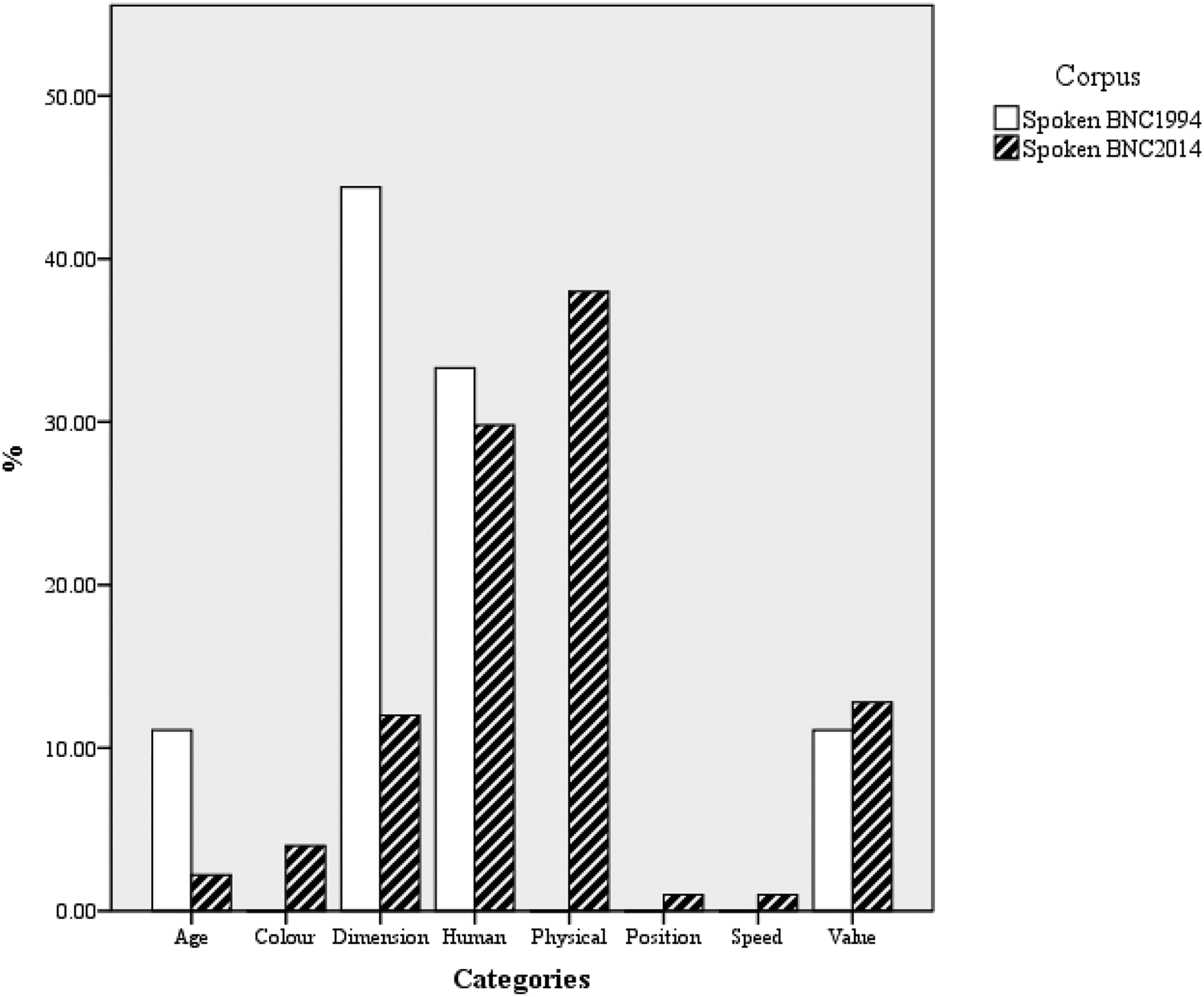
To take the collocational analysis a step further, it can be useful to explore the semantic properties of the adjectives proper intensified. Dixon (Reference Dixon1977: 31) laid out a taxonomy which classifies adjectives into eight semantic categories: dimension (e.g. big, little, long, short), physical property (e.g. hard, soft, hot, cold) color (e.g. black, white), human propensity (e.g. happy, rude, jealous), age (e.g. new, old), value (e.g. good, bad, perfect), speed (e.g. fast, quick), position (e.g. far, near). The adjectives intensified by proper were categorized according to Dixon's taxonomy, as reported in Figure 2. The most striking change was the increase in the number of adjectives denoting physical property. In the BNC1994, there were no instances of proper modifying adjectival heads denoting physical property, whereas in the BNC2014, adjectives of physical property are the most frequent semantic class modified. Some examples are reported in (4).
(4)
(a) well they get proper hot weather [BNC2014, S0483]
(b) we've got one for the plates but it's proper dirty [BNC2014, S0542]
(c) . . . if you take it when you haven't eaten anything it makes you feel proper sick [BNC2014, S0192]
(d) yeah I was like proper ill [BNC2014, S0219]
Adjectives which precede a noun are called attributive adjectives (e.g., the tall man) whereas adjectives which do not precede a noun are called predicative adjectives (e.g., he is tall). In the BNC1994, 66.6% of the adjectives intensified by proper were attributive adjectives and 33.3% were predicative adjectives. By 2014, more predicative adjectives become intensified, with 54% of the adjectives being predicative. The shift from intensifying attributive adjectives to predicative adjectives is thought to be evidence of a progressive intensifier (Ito & Tagliamonte, Reference Ito and Tagliamonte2003; Tagliamonte, Reference Tagliamonte2008). Some examples of this shift are provided in (5) and (6).
(5) BNC1994
Attributive:
(a) you could get a proper posh pencil [JN6]
(b) that little girl of yours is a proper little mother [KC2]
-
Predicative:
(c) I mean he's proper silly [KSS]
(d) . . . he's proper pissed off [KD2]
(6) BNC2014
Attributive:
(a) He used to say proper Yorkshire stuff [S0206]
(b) Like proper old school photos [S0336]
(c) That's a proper romantic story [S0014]
(d) I never fart like proper loud ones [S0228]
Predicative:
(e) It's proper comfy [S0228]
(f) No, one of the girls is proper scared of ghosts [S0447]
(g) Are they having a massive orgy or what? They were proper loud [S0211]
(h) One of the check men got proper grumpy [S0687]
Classification of adjectives Intensified by proper
4.3 Who Uses proper?
Núñez–Pertejo and Palacios–Martínez (Reference Núñez–Pertejo and Palacios–Martínez2018) found that the age group who used the intensifier proper most frequently was 16–19-year-olds. To investigate its distribution in the present dataset, we return to the stratified samples of the BNC since they are reasonably stratified for age. Surprisingly, the age group which used this intensifier most frequently was not 16–19-year-olds, but 19–29-year-olds. 61% of the tokens came from speakers ages 19–29 and 25% came from speakers ages 30–39. A possible explanation for the difference in findings between the present study and Núñez–Pertejo and Palacios–Martínez (Reference Núñez–Pertejo and Palacios–Martínez2018) is the time depth since the data on proper in Núñez–Pertejo and Palacios–Martínez came from 2004–2010. In contrast, data in the BNC2014S represent a few years later. Therefore, although the use of the intensifier proper may have initially been constrained by age (Núñez–Pertejo & Palacios–Martínez, Reference Núñez–Pertejo and Palacios–Martínez2018), by 2014 the adolescent speakers have become adults but continue to use this intensifier in adult life. When speakers refrain from using a given linguistic form or structure that they once used at an earlier stage in life, this process is known as ‘age grading’ (Tagliamonte, Reference Tagliamonte2012: 46–55). The fact that the use of the intensifier proper was not constrained by age suggests that its use is not affected by age grading, and instead can be viewed as an instance of language or generational change given that its use was attested by speakers of all ages. The social class of the speaker also did not constrain its use. In the BNC2014S, it was even used by lecturers, accountants, journalists and teachers. Some examples are reported in (7). There were also no observable differences between its frequency among men and woman.
(7)
(a) that's a proper grumpy romantic story (Female, Journalist, BNC2014S, [S0014])
(b) [Place] is a proper big city (Female, Literary Editor, BNC2014S, [S0329])
(c) [Name] was proper grumpy (Male, Lecturer, BNC2014S, [S0424])
Since the findings from Núñez–Pertejo and Palacios–Martínez (Reference Núñez–Pertejo and Palacios–Martínez2018) speak to Multicultural London English, prior to their study, one might have assumed that this intensifying use was a feature of that dialectal region only. However, the metadata in the BNC corpora reveal that its use is not restricted to London. It was recorded by speakers throughout England (such as Leeds, Manchester, Birmingham, Liverpool, Cambridge, Milton Keynes, Essex, Kent). The fact that there is little information regarding the use of this intensifier in Wales, Scotland and (Northern) Ireland, does not mean that the adjective intensifier proper is not used there, but instead its absence in these regions is simply a reflection of the sampling for geography in the corpus.
5. Discussion and Conclusion
The present study set out to explore the current use of the adjective intensifier proper in British English by building on the work by Núñez–Pertejo and Palacios–Martínez (Reference Núñez–Pertejo and Palacios–Martínez2018). The first research question sought to investigate whether the frequency of proper had changed over a 20-year time span from 1994 to 2014. To address this question, the stratified samples from the two BNC corpora were used. While proper was still used less frequently than many competing intensifiers, there was a significant increase in its frequency by 2014. The second question addressed whether any change in frequency correlated with a rearrangement in the intensifier system. When comparing the trajectory of proper with other intensifiers, its increase in frequency descriptively correlated with a decrease in what were previously more frequently used intensifiers such as jolly and right. The fact that the increase in proper goes hand-in-hand with the decrease in frequency of jolly and right, ties in with the notion that intensifiers are structured as a part of an interwoven system. While the past few decades have seen some fluctuation in the ranking of low frequency variants in British English, such as dead and well (Barnfield & Buchstaller, Reference Barnfield and Buchstaller2010; Stratton, Reference Strattonforthcoming), very, really and so have remained the three most frequently used intensifiers in British English. Broadly speaking, this stability of high frequency intensifier variants might suggest that it takes a great deal of time for highly frequent intensifiers to be replaced by newer ones; even though low frequency variants are found entering the system all the time. For instance, in North American varieties of English which have seen the arrival of variants such as hella, as in that was hella cool, and way, as in that was way boring (Bucholtz et al., Reference Bucholtz, Bermudez, Fung, Edwards and Rosalva2007), very, really, and so still remain as the three most frequently used variants (Tagliamonte & Roberts, Reference Tagliamonte and Roberts2005; Tagliamonte, Reference Tagliamonte2008).
The third research question sought to examine any changes in the way the intensifier proper was used. While proper preferred to intensify adjectives denoting negative semantic prosody (e.g., proper rank), proper already had a predilection for intensifying such adjectives in the 1990s. Nevertheless, these findings were in line with the findings of Núñez–Pertejo and Palacios–Martínez (Reference Núñez–Pertejo and Palacios–Martínez2018). However, as for an observable difference, there was an increase in the number of different adjectives proper intensified over the two decades, which lines up with the fact that it had become a more favored intensifier by 2014.
The most interesting finding was the outcome of the final research question. Núñez–Pertejo and Palacios–Martínez (Reference Núñez–Pertejo and Palacios–Martínez2018) found that proper was used most frequently by 16–19-year-olds. However, according to the present data from 2014, this intensifier was used most frequently by 19–29-year-olds. This suggests that proper is not constrained by age grading and the once 16–19-year-olds have continued to use the intensifier into adult life. Had adolescent speakers stopped using the intensifier after adolescence, the intensifier could have actually decreased in frequency if other generations did not use it. However, the speakers continued to use it and it seemingly spread outward to other age groups and social classes. Its use was found by both male and female speakers, speakers of all social classes and all ages groups in the corpora. Therefore, in short, while proper is by no means as frequent as the intensifiers very, really and so, it has certainly gained some traction in both function and popularity in recent years.
 JAMES M. STRATTON is a Germanic linguist at Purdue University. He specializes in historical linguistics, language variation and change, and applied linguistics. Recently, his work has focused on intensifier variation in English, German, and Norwegian, using a corpus-based variationist framework. He has forthcoming studies in the Journal of Germanic Linguistics and the Canadian Journal of Linguistics, and has published in English Studies and the Interdisciplinary Journal for Germanic Linguistics. Email: jstratt@purdue.edu