Introduction
Pierre Robin sequence is a disorder characterised by glossoptosis, micrognathia and obstruction in the upper airway, with or without a cleft palate.Reference Reddy 1 Even though the tongue of children with Pierre Robin sequence may not be hypertrophic compared to that of children without the disorder, the micrognathia does not allow for the tongue to be in a natural, unobstructing position. In adults with obstructive sleep apnoea (OSA), moving from an upright to a supine position has been shown to decrease the volume of the upper airway by approximately 33 per cent.Reference Camacho, Capasso and Schendel 2 It follows that in children, the upper airway volume would also decrease significantly when moving from the upright to supine position. Tongue–lip adhesion has been described as an effective surgery for keeping the tongue in an anterior position, so that it does not obstruct the upper airway. Tongue repositioning via subperiosteal release of the floor of mouth has also been performed to move the tongue into a more anterior position.Reference Siddique, Haupert and Rozelle 3
A systematic review of studies evaluating the effect of tongue–lip adhesion and tongue repositioning on Pierre Robin sequence patients with OSA, with a meta-analysis, would be useful to quantify the overall effects of these treatments. Hence, this review entailed a search of the international literature for studies (e.g. case reports, case series, cohorts, randomised trials) evaluating the effects of tongue–lip adhesion and/or tongue repositioning on Pierre Robin sequence patients with OSA, and the data were used to perform a meta-analysis.
Materials and methods
Information sources
We searched Google Scholar, Web of Science, Cochrane Collaboration databases, and PubMed/Medline. The Preferred Reporting Items for Systematic Reviews and Meta-Analysis (‘PRISMA’) statementReference Moher, Liberati, Tetzlaff and Altman 4 was downloaded and used as a guide for performing this study.
Search
Medical Subject Headings (MeSH) terms, keywords and phrases were tailored to each specific database that was searched. A sample search, which was used in PubMed/Medline, is as follows: ‘lingual’, ‘tongue’, ‘glossal’, ‘glossectomy’, ‘glossopexy’, ‘tongue-lip adhesion’, ‘tongue lip adhesion’, ‘lip/surgery*’ (MeSH), ‘tissue adhesions’ (MeSH) or ‘tongue/surgery*’ (MeSH), and ‘child’, ‘pediatric’, ‘paediatric’, ‘children’, ‘infant’ or ‘teenager’, and ‘Pierre Robin’ or ‘Pierre-Robin’. Other databases were searched with a similar search strategy, with appropriate modification to meet the requirement for the databases. The database function ‘similar articles’ (or equivalent) and ‘cited by’ (or equivalent) were used to search for further articles.
Study selection
The inclusion criteria for this article, using the ‘PICOS’ acronym (participants, interventions, comparisons, outcomes and study designs), were as follows. The participants were children (aged less than 18 years) diagnosed with Pierre Robin sequence and OSA. The interventions were tongue–lip adhesion and/or tongue repositioning. Comparisons of pre- and post-tongue surgery data were made. Quantitative sleep study data were the outcomes assessed (i.e. apnoea/hypopnoea index, apnoea index, respiratory disturbance index, mean oxygen saturation and lowest oxygen saturation). All study types were included in the search: posters, abstracts, case reports, case series, cohorts and randomised trials. The study exclusion criteria were: studies in which other surgical procedures were performed simultaneously, such as mandibular distraction osteogenesis or tracheostomy, and studies in which there were qualitative data without any quantified data.
Methodological quality
The National Institute for Health and Clinical Excellence (NICE) tool for case series was used to individually assess the quality of each study. 5 This comprised eight items scored in terms of ‘yes’ or ‘no’ responses.
Hypothesis
The null hypothesis for this systematic review and meta-analysis was that tongue–lip adhesion and tongue repositioning did not change the sleep study variables. To test the null hypothesis, the pre-operative data were compared to post-operative data. Means (± standard deviations) were collected from each study, and were subsequently used to calculate mean differences, standardised mean differences and 95 per cent confidence intervals (CIs). The apnoea/hypopnoea index percentage changes were based on the individual studies and on the overall combined studies.
Statistical calculations
Stata 14.1 statistical software (StataCorp, College Station, Texas, USA) and the Cochrane Collaboration's Review Manager Software (RevMan) version 5.3 were used to evaluate the data. 6 To determine statistical significance, we used p < 0.05 as the cut-off. To determine the magnitude of effect for the standardised mean difference, we selected Cohen's guidelines,Reference Cohen 7 and reported effects as small (standardised mean difference of 0.2), medium (standardised mean difference of 0.5) or large (standardised mean difference of 0.8). If additional data or outcomes were needed, we emailed or attempted to contact the corresponding authors of the relevant studies using the contact information provided. For studies in which the mean was reported without the standard deviation, and there was no response from the corresponding authors, we calculated and used the weighted average.
Heterogeneity and bias risk
The I2 statistic was used to evaluate for inconsistency or heterogeneity between studies. The I2 statistical categories are: low inconsistency = 25 per cent, moderate inconsistency = 50 per cent and high inconsistency = 75 per cent.Reference Higgins, Thompson, Deeks and Altman 8 The Cochran Q statistic was additionally used for determining heterogeneity, and, as recommended in previous studies, statistically significant heterogeneity was defined as a Q statistic p-value of ≤ 0.10.Reference Lau, Ioannidis and Schmid 9
Data collection
Two authors (EH and MC) systematically searched the literature for relevant articles from 31 January 2016 through to 8 July 2016, and searched from the inception of each database. Initially, the authors reviewed the titles along with the abstracts. Potentially relevant articles were subsequently downloaded in full-text form.
Results
Studies selected
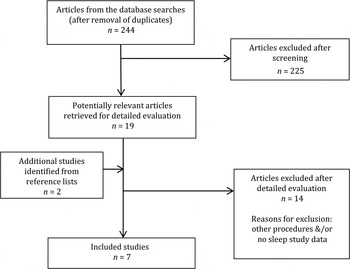
The search identified 244 potentially relevant studies based on the search criteria; 21 of these were potentially relevant after abstract and title review, and were downloaded in their entirety (Figure 1). Seven studies with 90 children met the inclusion criteria. Five studies,Reference Flores, Tholpady, Sati, Fairbanks, Socas and Choi 10 – Reference Resnick, Dentino, Katz, Mulliken and Padwa 14 comprising 59 patients, presented outcomes for tongue–lip adhesion, and 2 studies,Reference Caouette-Laberge, Borsuk and Bortoluzzi 15 , Reference Caouette-Laberge, Plamondon and Larocque 16 comprising 31 patients, presented outcomes for tongue repositioning performed via subperiosteal release of the floor of the mouth.
Study selection flowchart for tongue–lip adhesion and tongue repositioning procedures.

Study characteristics
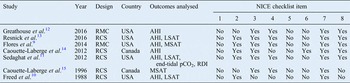
Table I provides the findings based on the NICE quality assessment tool.
General characteristics and nice quality criteria of included studies

National Institute for Health and Clinical Excellence case series checklist items: (1) Case series collected in more than one centre (i.e. multi-centre study)? (2) Is the study hypothesis, aim or objective clearly described? (3) Are the inclusion and exclusion criteria (case definition) clearly reported? (4) Is there a clear definition of the outcomes reported? (5) Were data collected prospectively? (6) Is there an explicit statement that patients were recruited consecutively? (7) Are the main study findings clearly described? (8) Are outcomes stratified (e.g. by abnormal results, disease stage, patient characteristics)? NICE = National Institute for Health and Clinical Excellence; RMC = retrospective matched cohort; AHI = apnoea/hypopnoea index; RCS = retrospective case series; LSAT = lowest oxygen saturation; MSAT = mean oxygen saturation; end-tidal pCO2 = partial pressure of carbon dioxide at the end of expiration during tidal breathing; RDI = respiratory disturbance index
Outcomes
Apnoea/hypopnoea index and tongue–lip adhesion
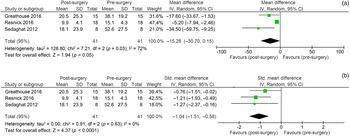
Five studies presented outcomes for tongue–lip adhesion, with mean apnoea/hypopnoea index improvement from 30.8 ± 22.3 to 15.4 ± 18.9 events per hour in 41 patients (50 per cent reduction) (Table II).Reference Flores, Tholpady, Sati, Fairbanks, Socas and Choi 10 – Reference Resnick, Dentino, Katz, Mulliken and Padwa 14 Random effects modelling in 41 patients demonstrated an apnoea/hypopnoea index mean difference of −15.28 events per hour (95 per cent CI = −30.70 to 0.15; overall effect z = 1.94, p = 0.05). The Q statistic was p = 0.03 (significant heterogeneity) and I2 = 72 per cent (moderate to high inconsistency). Random effects modelling for apnoea/hypopnoea index standardised mean difference was −1.04 (large magnitude of effect using Cohen's guidelines) (95 per cent CI = −1.51 to −0.58; overall effect z = 4.37, p < 0.0001). The Q statistic was p = 0.63 (no statistically significant heterogeneity) and I2 = 0 (no inconsistency) (Figure 2).
Pre- and post-tongue–lip adhesion outcomes in terms of: apnoea/hypopnoea index mean difference (a) and standardised mean difference (b). SD = standard deviation; IV = interval variable; CI = confidence interval; Std. = standardised

Demographic and sleep study data pre- and post-tongue lip adhesion and tongue repositioning surgery*

Data represent average values ± standard deviations, with values in parentheses indicating ranges. *In Pierre Robin sequence children with obstructive sleep apnoea.
†Mean oxygen saturation. AHI = apnoea/hypopnoea index; LSAT = lowest oxygen saturation; pre-op = pre-operative; post-op = post-operative; – = not reported
Apnoea/hypopnoea index and tongue repositioning
Two studies (31 patients) presented outcomes for tongue repositioning via subperiosteal release of the floor of the mouth; the apnoea/hypopnoea index improved from 46.5 to 17.4 events per hour in 25 patients (62.6 per cent reduction) (Table II).Reference Caouette-Laberge, Borsuk and Bortoluzzi 15 , Reference Caouette-Laberge, Plamondon and Larocque 16
Lowest oxygen saturation and tongue–lip adhesion
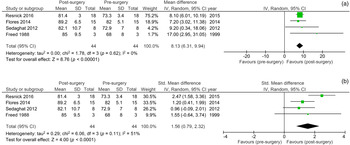
Four studies presented outcomes for tongue–lip adhesion, with a mean lowest oxygen saturation improvement from 75.8 ± 6.8 to 84.4 ± 7.3 per cent in 44 patients (an improvement of 8.6 per cent) (Table II).Reference Flores, Tholpady, Sati, Fairbanks, Socas and Choi 10 – Reference Sedaghat, Anderson, McGinley, Rossberg, Redett and Ishman 12 , Reference Resnick, Dentino, Katz, Mulliken and Padwa 14 Random effects modelling in 44 patients demonstrated a lowest oxygen saturation mean difference of 8.13 (95 per cent CI = 6.31 to 9.94; overall effect z = 8.76, p < 0.00001). The Q statistic was p = 0.62 (no statistically significant heterogeneity) and I2 = 0 per cent (no inconsistency). Random effects modelling for lowest oxygen saturation standardised mean difference was 1.56 (large magnitude of effect using Cohen's guidelines) (95 per cent CI = 0.79 to 2.32; overall effect z = 4.00, p < 0.0001). The Q statistic p-value was 0.11 (no statistically significant heterogeneity) and I2 = 51 per cent (moderate inconsistency) (Figure 3).
Pre- and post-tongue–lip adhesion outcomes in terms of: lowest oxygen saturation mean difference (a) and standardised mean difference (b). SD = standard deviation; IV = interval variable; CI = confidence interval; Std. = standardised

Mean oxygen saturation and tongue repositioning
Caouette-Laberge et al. reported that mean oxygen saturation improved from 90.8 ± 1.2 to 95.0 ± 0.5 per cent in six children (Table II).Reference Caouette-Laberge, Plamondon and Larocque 16
Discussion
There are three main findings from this systematic review with meta-analysis. First, tongue–lip adhesion improved the apnoea/hypopnoea index by approximately 50 per cent, from 30.8 ± 22.3 to 15.4 ± 18.9 events per hour. The small mandible of children with Pierre Robin sequence predisposes them to obstruction at the level of the base of the tongue. Tongue–lip adhesion and anterior displacement of the tongue allows for an improved retrolingual airway, resulting in a significant improvement in the apnoea/hypopnoea index. Given that the traditional alternatives are tracheostomy, which would bypass the upper airway, or mandibular distraction, which would allow for a skeletal improvement in the mandible, the overall decision will involve a long discussion with the patient and their family. Pierre Robin sequence children who have undergone tongue repositioning surgery and a sleep study are fewer in number, indicating that tongue repositioning is not performed as often.
Second, oxygen saturation improves with both tongue–lip adhesion and tongue repositioning procedures. The lowest oxygen saturation in children who underwent tongue–lip adhesion improved by 8.6 per cent. For tongue repositioning, mean oxygen saturation improved from 90.8 to 95.0 per cent (improvement of 4.2 per cent). It is assumed that anterior displacement of the tongue during sleep leads to an improvement in airflow, with fewer obstructions. Additionally, when there are obstructions, the airway is less likely to be obstructed for as long a duration, which improves the overall mean saturation and the overall lowest oxygen saturation. In order to fully determine the effect of tongue–lip adhesion and tongue repositioning procedures on oxygen saturation, we recommend that authors report the following four variables: mean oxygen saturation, lowest oxygen saturation, oxygen desaturation index and the percentage of sleep time spent under 90 per cent oxygen saturation.
Third, additional research is recommended. Tongue–lip adhesion seems to be more easily performed than tongue repositioning via subperiosteal release of the floor of the mouth. This might explain why there are more publications on tongue–lip adhesion. Although tongue repositioning in children with Pierre Robin sequence has demonstrated a large improvement in the apnoea/hypopnoea index (62.6 per cent reduction), the procedure is not as commonly performed. It is possible that tongue repositioning could serve as an alternative to tongue–lip adhesion in children with Pierre Robin sequence; however, thus far, only Caouette-Laberge and colleagues have reported outcomes for apnoea/hypopnoea index and oxygen saturation. It is unclear whether other surgical procedures, such as base of tongue reduction, would also benefit Pierre Robin sequence patients. Given that not all institutions have surgeons who are comfortable performing mandibular distraction, there may be circumstances where surgeons may consider other tongue surgical procedures or even tracheostomy given the nuances of individual patient circumstances.
Limitations
It is possible that, despite our best efforts, we could have missed a relevant study in the literature. However, we searched for several months in an independent fashion. Additionally, we limited our investigation to publications with sleep study data in order to quantify the improvement in sleep apnoea outcomes, specifically apnoea/hypopnoea index and oxygen saturation.
Conclusions and relevance
The international literature demonstrates that tongue–lip adhesion and tongue repositioning can improve apnoea/hypopnoea index and oxygenation parameters when used as isolated treatments for OSA in children with Pierre Robin sequence.